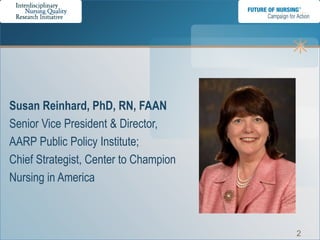

Susan Reinhard, PhD, RN, FAAN
Senior Vice President & Director,
AARP Public Policy Institute;
Chief Strategist, Center to Champion
Nursing in America


                                       2
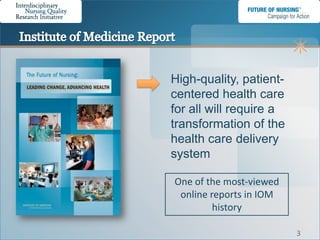
High-quality, patient-
centered health care
for all will require a
transformation of the
health care delivery
system

One of the most-viewed
 online reports in IOM
         history

                         3
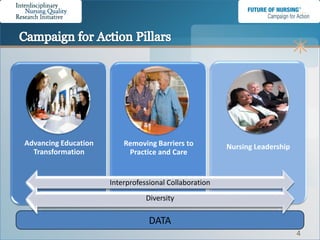
Advancing Education       Removing Barriers to          Nursing Leadership
  Transformation           Practice and Care


                      Interprofessional Collaboration
                                 Diversity

                                  DATA
                                                                             4
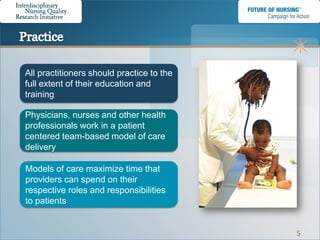
All practitioners should practice to the
full extent of their education and
training

Physicians, nurses and other health
professionals work in a patient
centered team-based model of care
delivery

Models of care maximize time that
providers can spend on their
respective roles and responsibilities
to patients


                                           5
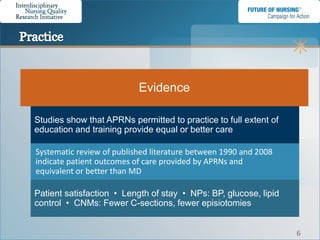
Evidence

Studies show that APRNs permitted to practice to full extent of
education and training provide equal or better care

Systematic review of published literature between 1990 and 2008
indicate patient outcomes of care provided by APRNs and
equivalent or better than MD

Patient satisfaction • Length of stay • NPs: BP, glucose, lipid
control • CNMs: Fewer C-sections, fewer episiotomies


                                                                  6
7
Barbara Safriet, JD, LLM
Visiting Professor of Health Law at Lewis &
Clark Law School, Portland, Oregon;
Former Associate Dean for Academic Affairs
and Lecturer in Law at Yale Law School
The Future of Nursing: Leading Change,
Advancing Health - Appendix H:
“Federal Options for Maximizing the Value of Advanced
Practice Nurses in Providing Quality, Cost-Effective Health Care”

                                                                    8
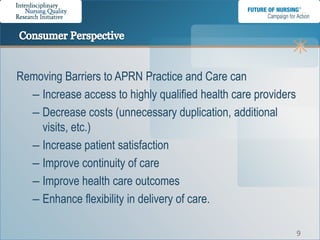
Removing Barriers to APRN Practice and Care can
  – Increase access to highly qualified health care providers
  – Decrease costs (unnecessary duplication, additional
    visits, etc.)
  – Increase patient satisfaction
  – Improve continuity of care
  – Improve health care outcomes
  – Enhance flexibility in delivery of care.

                                                                9
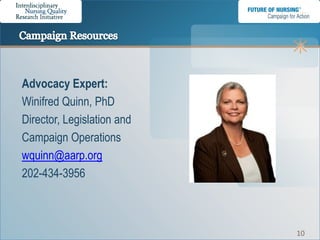
Advocacy Expert:
Winifred Quinn, PhD
Director, Legislation and
Campaign Operations
wquinn@aarp.org
202-434-3956


                            10
• Policy Change requires Power Shift
• Strategic Plan
   – Identify who can give you what you want
   – Determine your specific ask(s)
   – Who will make this ask and how
• Coalition, Coalition, Coalition
   – Broad stakeholders
   – This issue is important for consumers, payers
     (employers/businesses), nurses


                                                     11
• Options Exist at the Federal Level
   –   CMS‟ hospital conditions of participation rules
   –   Home Health Bill
   –   Rural Health Bill
   –   The FTC and state bills
• CCNA „s Technical Assistance
   – AARP State Office Assistance
   – Products
   – More in the planning stages


                                                         12
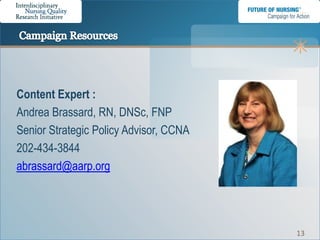
Content Expert :
Andrea Brassard, RN, DNSc, FNP
Senior Strategic Policy Advisor, CCNA
202-434-3844
abrassard@aarp.org


                                        13
• CCNA Resources www.championnursing.org
   – Who are APRNs & Types of APRNs (charts)
   – “Southern States”
   – Improving Access to Primary Care: The Growing Role of
     APRNs
   – Removing Barriers to APRN Practice & Care
      • Hospital Privileges
      • [forthcoming] Home Care and Hospice


                                                         14
• Other Resources
   – Campaign for Action “Standard Presentation” cites Newhouse
   et al 2011 “Advanced Practice Nurse Outcomes”
   – Pittman & Williams research
   – Missouri APRN white paper
   – NCSBN APRN Consensus Model Toolkit
   – Citizen Advocacy Center – Scope of Practice Initiative
• For links to these resources and MORE Sign Up for the
  Campaign for Action Extranet (see handout)
   – Contact Barbara Akinwole bakinwole@aarp.org with questions

                                                                  15
16
• Upcoming Webinars on Removing Barriers to APRN
  Practice and Care
   – The North Dakota experience: Strategies and tactics for
     successful legislation
   – Certified Registered Nurse Anesthetists (CRNAs): Cost
     Savings and “Opt-Out” Update
   – Federal Trade Commission: Update on how the FTC can help
     remove barriers to practice and care

• Learning Collaborative on Removing Barriers to APRN
  Practice and Care
                                                                17
• INQRI Webinar Regarding IOM Recommendation 6:
   – Lifelong Learning: Creating Partnerships to Build a
     Culture for Professional Growth
   – Thursday, May 17 at 1pm-2pm ET
   – Register at www.inqri.org.


                                                           18
Visit us on the Web
      http://thefutureofnursing.org
      http://championnursing.org

            Follow us on twitter
     www.twitter.com/futureofnursing
  http://twitter.com/#!/championnursing

             Join us on Facebook
    http://facebook.com/futureofnursing
http://www.facebook.com/championnursing


                                          19

Removing Barriers to APRN Practice and Care: The Consumer Perspective

  • 2.
    Susan Reinhard, PhD,RN, FAAN Senior Vice President & Director, AARP Public Policy Institute; Chief Strategist, Center to Champion Nursing in America 2
  • 3.
    High-quality, patient- centered healthcare for all will require a transformation of the health care delivery system One of the most-viewed online reports in IOM history 3
  • 4.
    Advancing Education Removing Barriers to Nursing Leadership Transformation Practice and Care Interprofessional Collaboration Diversity DATA 4
  • 5.
    All practitioners shouldpractice to the full extent of their education and training Physicians, nurses and other health professionals work in a patient centered team-based model of care delivery Models of care maximize time that providers can spend on their respective roles and responsibilities to patients 5
  • 6.
    Evidence Studies show thatAPRNs permitted to practice to full extent of education and training provide equal or better care Systematic review of published literature between 1990 and 2008 indicate patient outcomes of care provided by APRNs and equivalent or better than MD Patient satisfaction • Length of stay • NPs: BP, glucose, lipid control • CNMs: Fewer C-sections, fewer episiotomies 6
  • 7.
  • 8.
    Barbara Safriet, JD,LLM Visiting Professor of Health Law at Lewis & Clark Law School, Portland, Oregon; Former Associate Dean for Academic Affairs and Lecturer in Law at Yale Law School The Future of Nursing: Leading Change, Advancing Health - Appendix H: “Federal Options for Maximizing the Value of Advanced Practice Nurses in Providing Quality, Cost-Effective Health Care” 8
  • 9.
    Removing Barriers toAPRN Practice and Care can – Increase access to highly qualified health care providers – Decrease costs (unnecessary duplication, additional visits, etc.) – Increase patient satisfaction – Improve continuity of care – Improve health care outcomes – Enhance flexibility in delivery of care. 9
  • 10.
    Advocacy Expert: Winifred Quinn,PhD Director, Legislation and Campaign Operations wquinn@aarp.org 202-434-3956 10
  • 11.
    • Policy Changerequires Power Shift • Strategic Plan – Identify who can give you what you want – Determine your specific ask(s) – Who will make this ask and how • Coalition, Coalition, Coalition – Broad stakeholders – This issue is important for consumers, payers (employers/businesses), nurses 11
  • 12.
    • Options Existat the Federal Level – CMS‟ hospital conditions of participation rules – Home Health Bill – Rural Health Bill – The FTC and state bills • CCNA „s Technical Assistance – AARP State Office Assistance – Products – More in the planning stages 12
  • 13.
    Content Expert : AndreaBrassard, RN, DNSc, FNP Senior Strategic Policy Advisor, CCNA 202-434-3844 abrassard@aarp.org 13
  • 14.
    • CCNA Resourceswww.championnursing.org – Who are APRNs & Types of APRNs (charts) – “Southern States” – Improving Access to Primary Care: The Growing Role of APRNs – Removing Barriers to APRN Practice & Care • Hospital Privileges • [forthcoming] Home Care and Hospice 14
  • 15.
    • Other Resources – Campaign for Action “Standard Presentation” cites Newhouse et al 2011 “Advanced Practice Nurse Outcomes” – Pittman & Williams research – Missouri APRN white paper – NCSBN APRN Consensus Model Toolkit – Citizen Advocacy Center – Scope of Practice Initiative • For links to these resources and MORE Sign Up for the Campaign for Action Extranet (see handout) – Contact Barbara Akinwole bakinwole@aarp.org with questions 15
  • 16.
  • 17.
    • Upcoming Webinarson Removing Barriers to APRN Practice and Care – The North Dakota experience: Strategies and tactics for successful legislation – Certified Registered Nurse Anesthetists (CRNAs): Cost Savings and “Opt-Out” Update – Federal Trade Commission: Update on how the FTC can help remove barriers to practice and care • Learning Collaborative on Removing Barriers to APRN Practice and Care 17
  • 18.
    • INQRI WebinarRegarding IOM Recommendation 6: – Lifelong Learning: Creating Partnerships to Build a Culture for Professional Growth – Thursday, May 17 at 1pm-2pm ET – Register at www.inqri.org. 18
  • 19.
    Visit us onthe Web http://thefutureofnursing.org http://championnursing.org Follow us on twitter www.twitter.com/futureofnursing http://twitter.com/#!/championnursing Join us on Facebook http://facebook.com/futureofnursing http://www.facebook.com/championnursing 19

Editor's Notes

  • #3 Susan ReinhardWelcome to today’s webinar “Removing Barriers to APRN Practice and Care: The Consumer Perspective”. We are happy to be co-sponsoring this webinar with the Interdisciplinary Nursing Quality Research Initiative also known as INQRI. I know Mary Naylor is on the line with us, Mary is the is the director of the INQRI program and the Marian S. Ware Professor in Gerontology and Director of NewCourtland Center for Transitions and Health at the University of Pennsylvania School of Nursing.Before we go further, I wanted to mention that we are recording today’s webinar, so if you miss a section or would like to pass it on to a colleague, you can find the recording and materials by going to  www.championnursing.org/events.
  • #4 Susan ReinhardAs all of you know, In October 2010, the Institute of Medicine released a landmark report that outlines a blueprint for transforming the nursing profession to enhance the quality and value of U.S. health care in ways that meet future needs of diverse populations. The first of the eight recommendations made in the report is to remove scope of practice barriers to that “advanced practice registered nurses should be able to practice to the full extent of their education and training”.
  • #5 Susan ReinhardTo implement the recommendations of the IOM reportRWJF, AARP and the AARP Foundation have launched the Future of Nursing: Campaign for Action. The campaign and its 48 Action Coalitions are focused on key pillars based on the IOM report. Advancing Education TransformationRemoving Barriers to Practice and CareNursing LeadershipInterprofessional collaboration and diversity are threads woven through each pillar.And the foundation is data.Our focus today is on removing barriers and practice to care, specifically APRN careWe will: Consider the consumer’s perspective on APRN practice and careIdentify advocacy strategies and resources for removing these barriers
  • #6 Susan ReinhardThis slide has several points that will place today’s webinar in context. Primary care in the United States is struggling to meet patients’ needs, and healthcare workforce shortages will be exacerbated as millions of Americans seek care and the population continues to age. For both immediate and long-term needs, solutions must enable all nurses, RNs and APRNs, as well as other health professionals, to practice to the full level of their education and training in a patient -centered team-based model of care delivery. Practicing to the full extent of their education and training creates more efficient models of care.
  • #7 Susan ReinhardYou are probably already familiar with the source for this slide, the research review conducted by Robin Newhouse from Johns Hopkins University and her colleagues from several other institutions in Baltimore and Washington, D.C. This research review summarized data from 69 randomized controlled clinical trials and 49 observational studies between 1990 and 2008.   No studies suggest care is better in states that require APRNs to practice under required physician supervision or collaboration.These results extend what is known about APRN outcomes from previous reviews by assessing all types of APRNs over a span of 18 years, using a systematic process with intentionally broad inclusion of outcomes, patient populations and settings.The results indicate APRNs provide effective and high-quality patient care;have an important role in improving the quality of patient care in the United States; and supports reform efforts aimed at expanding access to care.And if you are not familiar with this research, you can click on the handout icon in the upper right hand corner of the screen for more information.(Slide source is Newhouse, et al, 2011, Advanced Practice Nurse Outcomes 1990 – 2008: A Systematic Review,Journal of Nursing Economic$)
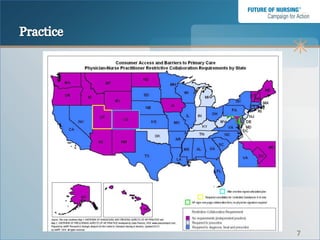
  • #8 Susan ReinhardThis slide shows that many states have outdated regulations and barriers that prevent nurse practitioners from practicing to the full extent of their education and training. For example, nurse practitioners in Washington and Oregon can see patients and prescribe medicine without physicianoversight; their counterparts in neighboring California and Nevada cannot.  
  • #9 Susan ReinhardI would like to welcome Barbara Safriet, Visiting Professor of Health Law at Lewis & Clark Law School, Portland, Oregon; and Former Associate Dean for Academic Affairs and Lecturer in Law at Yale Law SchoolBarbara has influenced professional regulation in her teachings, her writings and her advocacy. We hope that you are familiar with the commissioned paper that she wrote for the IOM Report on the Future of Nursing. If not, you can find it by clicking on the handout icon in the upper right hand corner of the screen. We have asked Barbara to comment from the consumer perspective on barriers to APRN practice and care.
  • #10 Barbara Safriet 
  • #11 Susan ReinhardThank you, Barbara. Before we open the line to questions, I would like to introduce the two members of the Center to Champion Nursing in America team who focus on the first IOM recommendation – removing barriers to APRN scope of practice, Winifred Quinn and Andrea Brassard.Winifred Quinn, Director, Legislation and Campaign OperationsDr. Quinn advocates for progressive nursing policy changes at the state and federal level so that healthcare consumers have a highly skilled nurse when and where they need one. Winifred’s federal work includes removing federal barriers to APRN practice and care. Her state level work is to provide technical assistance to teams that are working to modernize scope of practice laws. Dr. Quinn also helps organize a broad coalition that champions nurses’ issues and works with representatives of other consumer organizations, businesses, insurers, and provider organizations. 
  • #12 Winifred Quinn
  • #13 Winifred Quinn
  • #14 Susan ReinhardThank you, Winifred. Andrea Brassard is the Senior Strategic Policy Advisor at CCNA. She works on the Campaign for Action “Practice pillar” advancing health policy solutions to fully realize nurses’ contributions to a patient-centered transformed health care system. Dr. Brassard brought us the map you saw earlier and informs our advocacy efforts to implement the IOM Report Recommendation #1 – Remove Scope of Practice Barriers. She is the author of “Removing Barriers to APRN Practice and Care: Hospital Privileges.” In addition to being our “content expert” on APRN practice and care, she is a practicing FNP, who volunteers as an “attending” at the George Washington University medical student run clinic providing primary care to underserved DC residents. Andrea will tell you about some of the resources that are available on the CCNA website and the Campaign for Action extranet.  
  • #15 Andrea BrassardExplain resources APRN charts (data from 2008 National Sample Survey of Registered Nurses)2010 July “Southern States” Access to Care and Advanced Practice Nurses:A Review of Southern U.S. Practice Laws 2010 “ Improving Access to Primary Care” 2 page brief IOM Report chapter – “Recommendations and Research Priorities” – impetus for my PPI Insight on the Issues papers 
  • #16 Andrea BrassardExplain resources Action Coalition members can find these resources and more on the Campaign for Action’s Extranet.Instructions for accessing the Extranet are found in the handout. After you sign up you will receive an email reply from no-reply@projectspace.com Once you have logged in visit the Resources section and find the folder titled “Barriers to APRN practice and care”  
  • #17 Susan ReinhardOpen the lines with the operator Susan Reinhard,Barbara Safriet, Winifred Quinn and Andrea Brassard available to answer questions
  • #18 Susan ReinhardCCNA has an exciting series of webinars on Removing Barriers to APRN Practice and Care which we will host throughout the year.  Be on the lookout in the Campaign for Action’s Weekly Updates for announcements on webinars topics including: The North Dakota experience:  Strategies and tactics for successful legislation   Certified Registered Nurse Anesthetists (CRNAs): Cost Savings and “Opt-Out” UpdatesFederal Trade Commission : Update on how the FTC can help remove barriers to practice and care   These Webinars are being planned for the summer and fall. A learning collaborative – a group of Action Coalitions working on removing barriers to APRN practice and care – is being formed.  This learning collaborative will receive targeted technical assistance from Winifred, Andrea and other CCNA staff.  Stay tuned.    
  • #19 Susan ReinhardOn May 17, INQRI will be hosting a webinar on Lifelong Learning: Creating Partnerships to Build a Culture for Professional Growth. You must register at www.inqri.com.
  • #20 Susan ReinhardThat concludes today’s webinar. As I mentioned earlier, you can find the recording and materials by going to  www.championnursing.org/events.Check us out on the web, visit the CCNA website and sign up for the Campaign for Action Extranet, follow us on twitter, or join us on Facebook!Thank you and goodbye.