Hosting an Action Coalition Event
Hosting an event can be a great opportunity for your Action Coalition to engage local
communities, organizations, funders, and state leaders as well as to increase support to
advance the work of the Future of Nursing: Campaign for Action.
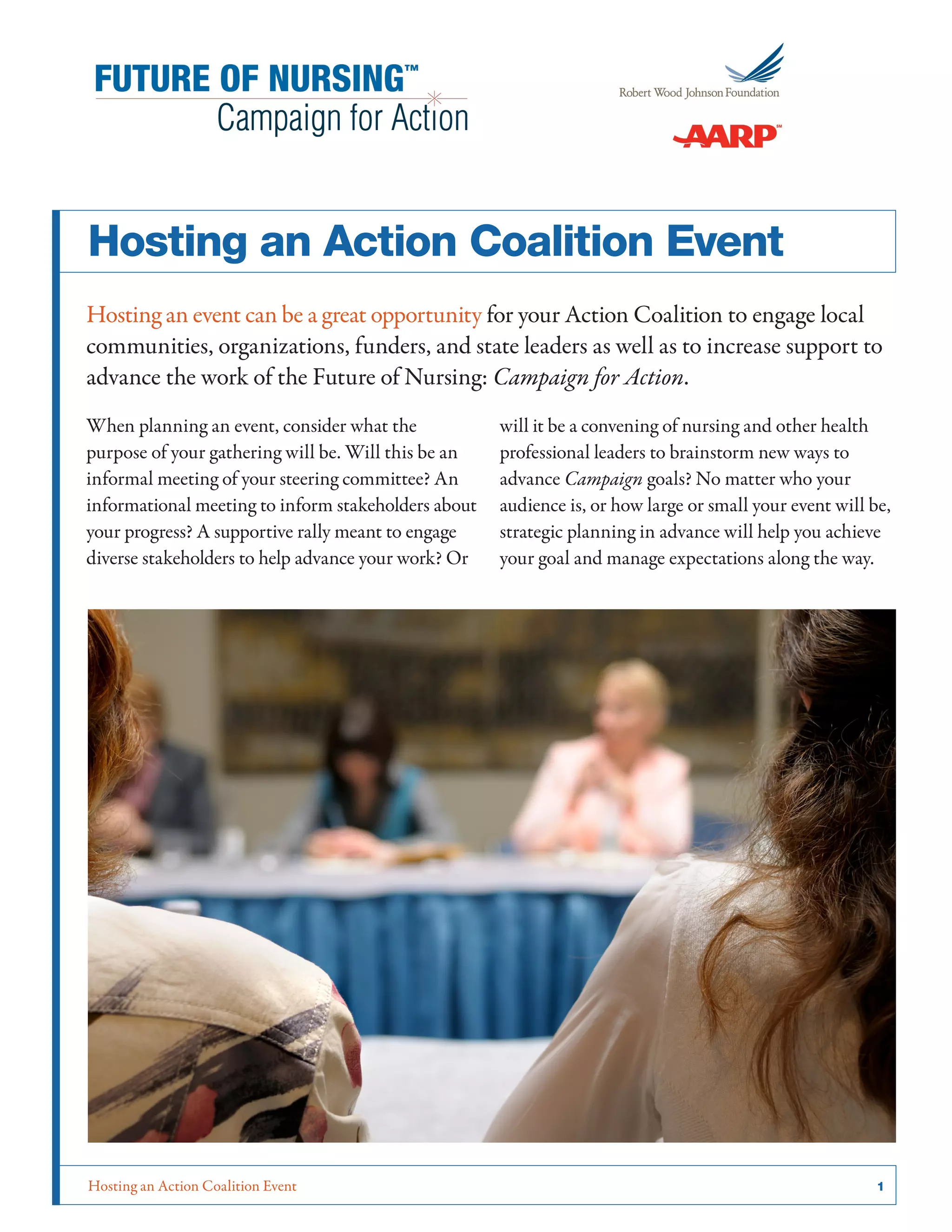
When planning an event, consider what the
purpose of your gathering will be. Will this be an
informal meeting of your steering committee? An
informational meeting to inform stakeholders about
your progress? A supportive rally meant to engage
diverse stakeholders to help advance your work? Or

Hosting an Action Coalition Event	

will it be a convening of nursing and other health
professional leaders to brainstorm new ways to
advance Campaign goals? No matter who your
audience is, or how large or small your event will be,
strategic planning in advance will help you achieve
your goal and manage expectations along the way.

1
Planning an Event:
Strategic Planning Questions
Effective planning will help ensure that your event targets the right audience and gets
you the results you want. When thinking about hosting an event, you should consider
several questions. You might not be able to answer all of these right away, but it’s
important to think about them before your event.
Goals and Objectives:

•• What are your budgetary constraints? Does your
budget permit offering light beverages and
•• What do you hope to achieve as a result of this event?
snacks, which can be a great way to keep
•• What do you want attendees to take away from
participants satisfied and engaged?
this experience?
•• How will this event be archived? Does it make
•• Is an event the best or most appropriate way to
sense to hire a photographer or videographer?
achieve your goals?
•• Have you considered web-streaming and
•• How will this event strengthen or advance your
recording your event so audiences outside the
Campaign efforts and address the pillars or focus
area can participate in or view the event?
of your Campaign work?
Depending on the goal of the event, having a
•• Will there be next steps or actions that you want
video archive could help extend your impact.
participants to take? If so, how will you track them?
•• What is your post-event strategy? Will attendees
be asked to join a listserv? Will they be asked to
Planning and Production:
engage their organizations as members of your
•• Have you consulted with your Campaign liaison
Action Coalition? What is the “ask”? How will
or the Center to Champion Nursing in America
you ensure that attendees engage or do what you
(CCNA) to determine how they might provide
are asking? How will you measure success?
support or counsel?
•• Are there opportunities for your coalition
partners to help develop the event, promote it,
or even host it at their offices? Can you align
with another organization that is hosting an
event to consolidate resources and potentially
increase attendance?

•• How will participants provide feedback or
evaluate the event? Will you provide a
questionnaire as a handout?

•• Consider managing your event planning and
logistics by assembling a team and recruiting
student interns as additional support. Remember,
you can tap into technology such as Constant
•• What is the best date and location for your event?
Contact or Survey Monkey to help you with
Have you checked local community calendars to
organization and tracking event invitations.
determine any conflicts or opportunities?

Hosting an Action Coalition Event	

2
Planning an Event:
Strategic Planning Questions (continued)
Communications and Marketing:
•• Who is your audience?

•• If there are multiple speakers, what are their roles
and what is expected of them?

•• Will speakers only be asking to give oral
•• What is your event’s primary message? How
presentations, or will you plan to have slide
does it tie into the Campaign for Action messages?
presentations?
Connect with your Campaign liaison to get the
•• Will copies of presentations be available to
latest campaign messages.
participants after the event?
•• Will you present something new or groundbreaking
that local media may cover? If so, consider inviting •• If you are inviting local or state businesses,
policy-makers, and leaders, would you like a
select reporters to attend (remember, a meeting
representative from the Campaign to present?
itself is generally not considered newsworthy).
If so, fill out the Speaking Request Form,
•• How will you promote this event, and what
available from CCNA.
resources do you need to help you get the
word out?
•• Do your event materials (invitations,
advisory, agenda, etc.) match the Campaign
branding guidelines?
•• Have you considered distributing Campaign
flyers or backgrounders? Have you consulted
with your Campaign liaison to discuss what is
available from the national office?
•• If you plan to have speakers, who are your best
candidates? For example, if you are working
toward education progression, can you include a
local nursing school dean, student, or professor?

Hosting an Action Coalition Event	

•• Is there a personal story someone can tell or a
story you can capture and share on your website?
•• Once you’re ready to promote your event,
make sure to reference the toolkit modules
“Introduction to Traditional Media Outreach”
and “Creating Effective Media Materials.”
There are many considerations when planning an
event, and the questions above are a good starting
point. But make sure to contact your Campaign
liaison for additional support. The sample eventplanning timeline and agenda included in this
document will help you put some of these ideas
into action.

3
Building Your Audience
Whether you are celebrating your Action Coalition’s achievements or raising awareness
of planned future activities, events can be an excellent way to engage and build your
audience, as well as to solicit ideas and input to help your Action Coalition find
innovative approaches to advancing the IOM recommendations. We suggest inviting a
diverse group of dynamic attendees that reflect the many target audiences of your
specific activities. Most importantly, be sure to invite any support staff who have
participated or helped you since the start of your program.
Consider the following stakeholders when
developing your event outreach list:
•• Philanthropic, community, and other
potential program partners and funders
•• Hospital leaders and executives, including,
but not limited to, the CEOs and CNOs of
local hospitals and health care systems
•• Frontline nursing staff
•• Local business stakeholders, including the
local Chamber of Commerce, business owners,
and chairs of businesses and boards
•• Other health care organizations and associations,
such as your state hospital association
•• Public health and policy leaders
•• State chapter organizations, including AARP
and professional medical associations
•• Disease advocacy groups and caregiving groups
•• National State Nurses Association, nursing
associations within your state, including state
chapters of minority nursing associations and
other diversity organizations
•• Local nursing school programs, nursing
students, and new RNs
•• A representative from the mayor’s office

Hosting an Action Coalition Event	

•• Directors of local foundations. Begin by
visiting the Forum of Regional Associations
of Grantmakers at www.givingforum.org
for potential funders in your state.
•• Community organizers and health leaders
(Department of Workforce Development,
Workforce Investment, and Department
of Labor)
•• Local chapter of the National League of Cities
(State Municipal League)
•• Local print, television, and radio media
(if appropriate)
•• Physicians and other health care providers and
leaders in your area.
•• Robert Wood Johnson Foundation grantees,
scholars, and fellows (CCNA can facilitate
connections)
It may not be appropriate to invite all of these
stakeholders to each event, and there may be others
you wish to invite who are not listed. Depending on
the topic area discussed (e.g., education, leadership,
scope of practice) or the type of event, some individuals
and organizations will have greater interest in some
topics versus others. They will also have more influence
on one topic over another. Make some strategic
decisions about whom you wish to invite, why their
presence is important, and what outcome their
attendance can help you achieve.
4
What Makes an Event Newsworthy?
If your event is newsworthy, you will want to invite and engage media in order to reach
a wider audience and gain additional support for your AC’s work. Remember, not all
events are newsworthy in and of themselves—and that’s okay. However, when you
know what reporters are looking for and prepare your event accordingly, it can increase
the odds of obtaining media coverage.
Here are some criteria to help you determine if an event is “newsworthy”:
Discovery or Novelty

Is your event focused on sharing information that is new or surprising?
Are you looking at an existing problem—such as the growing nursing
shortage—in a new way?

Timeliness

Is your event related in some way to a topic or concern of the moment?
What health care issues are trending in the news? Does your event
address how nurses can have a role in reducing hospital readmissions?
Will it address the imminent nursing shortage?

Magnitude

Is your event relevant to a large group of stakeholders? Are there several
local nursing organizations, hospitals, or health care systems that would
benefit from the information being shared at this event? Does it have
national impact?

Human Interest

Can you provide patient stories that would highlight your work and make
it more compelling? For example, sharing the patient’s perspective on how
a nurse practitioner made a critical care decision that impacted the quality
of her care can go further than simply talking about how nurses should
have a larger role in decision-making.

Notable Spokesperson

Does your event address an issue that has caught the eye of a well-known
public figure? Can you engage the participation of a high profile
spokesperson? The involvement of such a person—on a local, regional
or national level—can do wonders for getting an issue into the headlines.
You can also consider a prominent leader in health care, or a national
spokesperson from the Campaign for Action.

Milestones

Does your event have an important historical marker or anniversary,
either locally or nationally? For example, your event might be tied to
the anniversary celebration of a major public health initiative or during
National Nurses Week.

Hosting an Action Coalition Event	

5
Promoting Your Event
Once you decide that your event is newsworthy, you’ll want to make sure to promote it
so members of the media can attend or cover the event. The following list contains
elements that will help make your event more media-friendly—from the early planning
phase to post-event follow up.
Scheduling. If possible, try to hold your event in
the morning so reporters can meet their deadlines.
Avoid Mondays and Fridays, as people tend to be
out of the office those days, if they take a long
weekend. Do your research to find out what other
events are taking place in your community that
might be competing for media attention.

calendar editor, and editorial page editor. With
budget cuts to newsroom staff, it may be difficult
to encourage media to actually attend your event.
If this is the case, you could consider holding a
conference call (also known as a telebriefing)
between members of the news media and your
spokespersons. If you have interesting and important
data to present, you may wish to consider a webinar
Community counts. While the issues the Campaign
or webcast format. Is there someone’s personal story
for Action addresses are of national concern, they also
they could cover?
make an impact within your community. Even if
the topic at hand has a national impact, make sure to Media advisory. Be sure to prepare a shortened
highlight the local connection, so reporters in your version of the press release that tells the who, what,
area will want to cover the story. Your speakers and when, where, and why in an outline form. These
materials must all reflect the situation in your state. alerts are used to remind the media about your event.
Make sure to type “Media Advisory” in large print
Know the media. As you refine your media list, try
across the top of your page. Media advisories can be
to do some cursory research on the key reporters.
faxed or issued one week before an event to give
(See the Building Your List of Media Contacts
editors time to assess the story. Be clear in stating
section of the “Introduction to Traditional Media”
who is available for interviews. Make follow-up calls
document for more information.) Have they covered
a day or two before the event. (See “Creating
this issue before? What stories on health and on
Effective Media Materials” for more details.)
workforce have they covered? You can find this
information out by checking the stories they have
Handouts. Generally, you should consider
written or produced on the newspaper’s, radio
distributing a press kit that might contain a
station’s, or TV station’s website. You can also find
press release with key information; fact sheets
great opportunities to promote your story to nonor backgrounders that amplify the content and
profit media outlets online. Do they have nurses in
context of the press conference; copies of any
their families? Don’t limit the targets to health
prepared statements by speakers; and biographies
editors. Consider the business editor, photo desk,
on key spokespeople.

Hosting an Action Coalition Event	

6
Promoting Your Event (continued)
Rehearsal. Do a walk-through either by phone
or prior to the conference, so speakers know the
logistics and timing of their role. Arrive early to
situate speakers, canvass the logistics, organize
materials, set up media/stakeholder sign-ins, etc.
Follow-up. After the event, send thank you notes
to the VIPs who attended, along with a suitable
photo, if you like. Many of those speakers represent
other entities that have communications channels

on which they will run the story/photo. Distribute
press kits to key media who were unable to attend
the press conference. Track media coverage and
monitor the press. Don’t forget there are many
places where you can publish highlights of your
event and the stories you heard. You can then post
them on your website, your partnered nursing
association website, the Campaign for Action
website, and on social media.
See sample even planning timeline on next page

Hosting an Action Coalition Event	

7
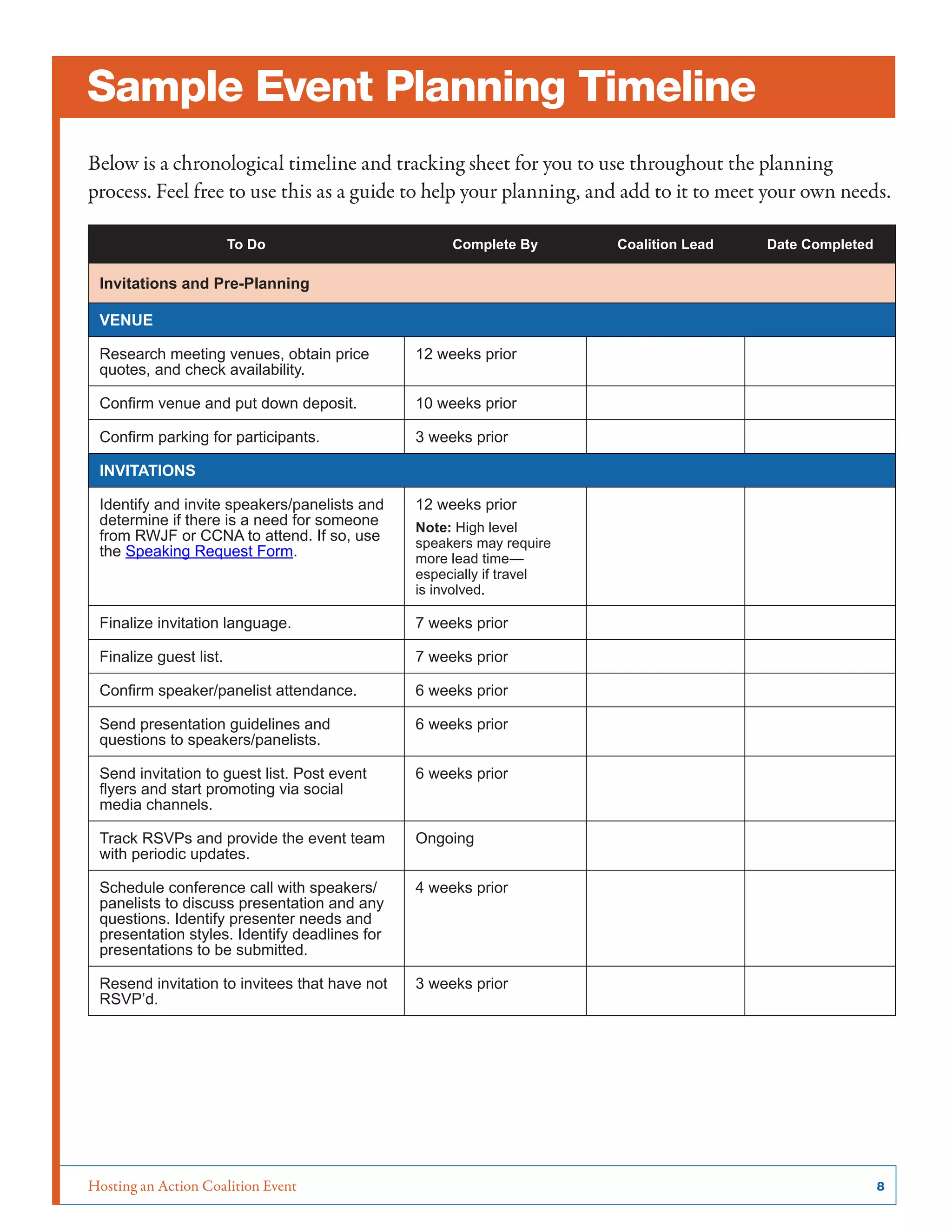
Sample Event Planning Timeline
Below is a chronological timeline and tracking sheet for you to use throughout the planning
process. Feel free to use this as a guide to help your planning, and add to it to meet your own needs.
To Do

Complete By

Coalition Lead

Date Completed

Invitations and Pre-Planning
VENUE
Research meeting venues, obtain price
quotes, and check availability.

12 weeks prior

Confirm venue and put down deposit.

10 weeks prior

Confirm parking for participants.

3 weeks prior

INVITATIONS
Identify and invite speakers/panelists and
determine if there is a need for someone
from RWJF or CCNA to attend. If so, use
the Speaking Request Form.

12 weeks prior

Finalize invitation language.

7 weeks prior

Finalize guest list.

7 weeks prior

Confirm speaker/panelist attendance.

6 weeks prior

Send presentation guidelines and
questions to speakers/panelists.

6 weeks prior

Send invitation to guest list. Post event
flyers and start promoting via social
media channels.

6 weeks prior

Track RSVPs and provide the event team
with periodic updates.

Ongoing

Schedule conference call with speakers/
panelists to discuss presentation and any
questions. Identify presenter needs and
presentation styles. Identify deadlines for
presentations to be submitted.

4 weeks prior

Resend invitation to invitees that have not
RSVP’d.

3 weeks prior

Hosting an Action Coalition Event	

Note: High level
speakers may require
more lead time—
especially if travel
is involved.

8
Sample Event Planning Timeline (continued)
To Do

Complete By

Coalition Lead

Date Completed

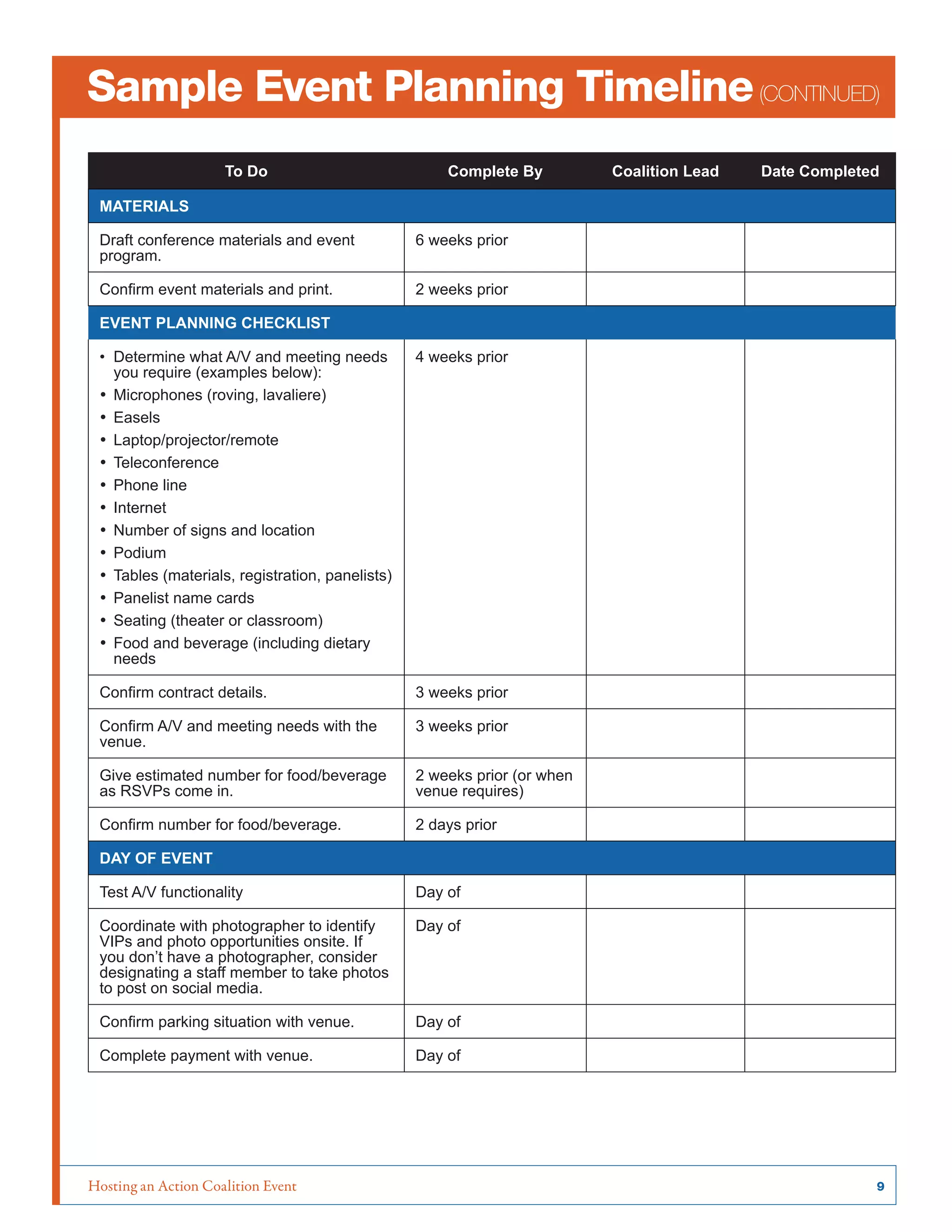
MATERIALS
Draft conference materials and event
program.

6 weeks prior

Confirm event materials and print.

2 weeks prior

EVENT PLANNING CHECKLIST
•	 Determine what A/V and meeting needs
you require (examples below):
•	 Microphones (roving, lavaliere)
•	 Easels
•	 Laptop/projector/remote
•	 Teleconference
•	 Phone line
•	 Internet
•	 Number of signs and location
•	 Podium
•	 Tables (materials, registration, panelists)
•	 Panelist name cards
•	 Seating (theater or classroom)
•	 Food and beverage (including dietary
needs

4 weeks prior

Confirm contract details.

3 weeks prior

Confirm A/V and meeting needs with the
venue.

3 weeks prior

Give estimated number for food/beverage
as RSVPs come in.

2 weeks prior (or when
venue requires)

Confirm number for food/beverage.

2 days prior

DAY OF EVENT
Test A/V functionality

Day of

Coordinate with photographer to identify
VIPs and photo opportunities onsite. If
you don’t have a photographer, consider
designating a staff member to take photos
to post on social media.

Day of

Confirm parking situation with venue.

Day of

Complete payment with venue.

Day of

Hosting an Action Coalition Event	

9
Sample Event Planning Timeline (continued)
To Do

Complete By

Coalition Lead

Date Completed

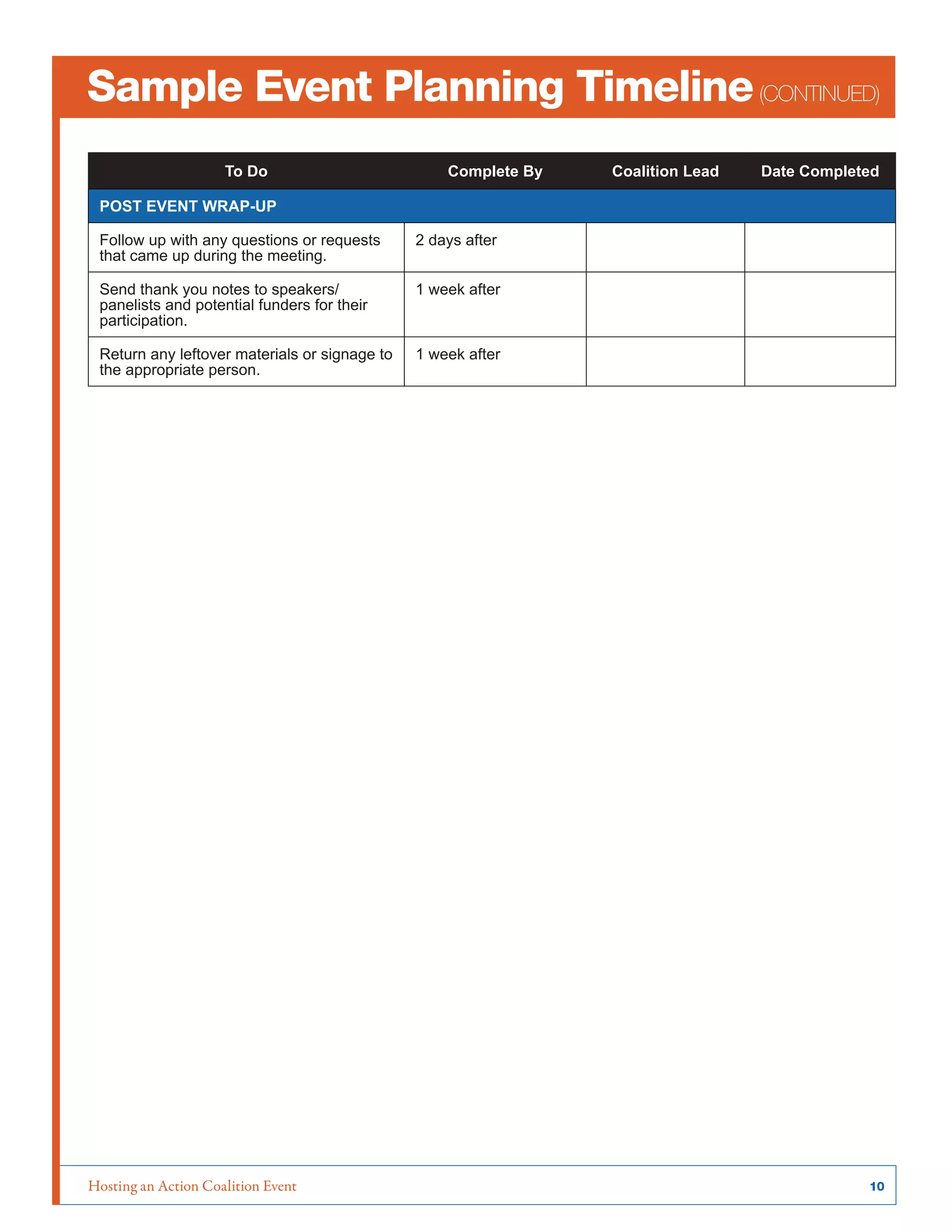
POST EVENT WRAP-UP
Follow up with any questions or requests
that came up during the meeting.

2 days after

Send thank you notes to speakers/
panelists and potential funders for their
participation.

1 week after

Return any leftover materials or signage to
the appropriate person.

1 week after

Hosting an Action Coalition Event	

10
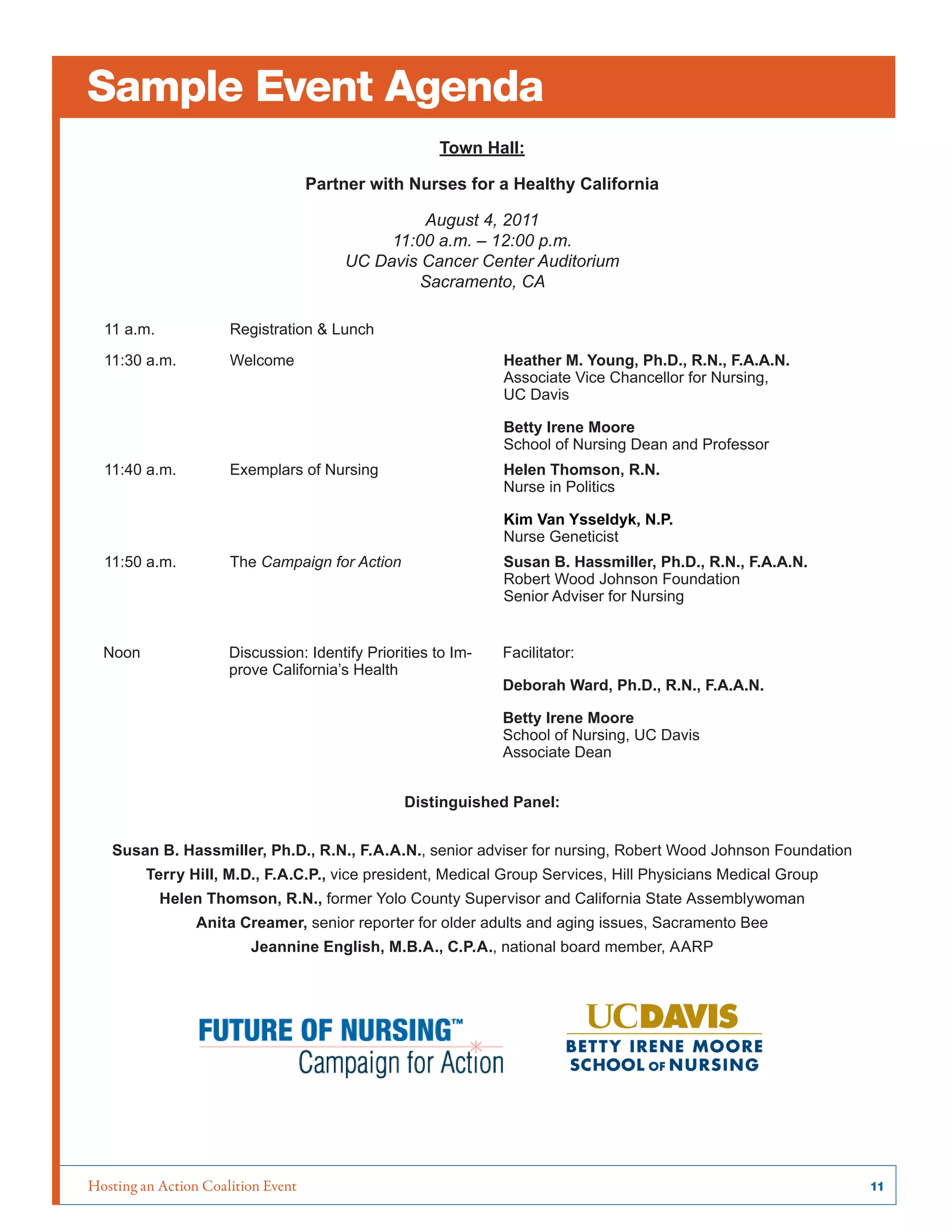
Sample Event Agenda
Town Hall:
Partner with Nurses for a Healthy California
August 4, 2011
11:00 a.m. – 12:00 p.m.
UC Davis Cancer Center Auditorium
Sacramento, CA
11 a.m.

Registration & Lunch

11:30 a.m.

Welcome

Heather M. Young, Ph.D., R.N., F.A.A.N.
Associate Vice Chancellor for Nursing,
UC Davis
Betty Irene Moore
School of Nursing Dean and Professor

11:40 a.m.

Helen Thomson, R.N.
Nurse in Politics

Exemplars of Nursing

Kim Van Ysseldyk, N.P.
Nurse Geneticist
11:50 a.m.

The Campaign for Action

Susan B. Hassmiller, Ph.D., R.N., F.A.A.N.
Robert Wood Johnson Foundation
Senior Adviser for Nursing

Noon

Discussion: Identify Priorities to Improve California’s Health

Facilitator:
Deborah Ward, Ph.D., R.N., F.A.A.N.
Betty Irene Moore
School of Nursing, UC Davis
Associate Dean

Distinguished Panel:
Susan B. Hassmiller, Ph.D., R.N., F.A.A.N., senior adviser for nursing, Robert Wood Johnson Foundation
Terry Hill, M.D., F.A.C.P., vice president, Medical Group Services, Hill Physicians Medical Group
Helen Thomson, R.N., former Yolo County Supervisor and California State Assemblywoman
Anita Creamer, senior reporter for older adults and aging issues, Sacramento Bee
Jeannine English, M.B.A., C.P.A., national board member, AARP

Hosting an Action Coalition Event	

11

Hosting an Action Coalition Event

  • 1.
    Hosting an ActionCoalition Event Hosting an event can be a great opportunity for your Action Coalition to engage local communities, organizations, funders, and state leaders as well as to increase support to advance the work of the Future of Nursing: Campaign for Action. When planning an event, consider what the purpose of your gathering will be. Will this be an informal meeting of your steering committee? An informational meeting to inform stakeholders about your progress? A supportive rally meant to engage diverse stakeholders to help advance your work? Or Hosting an Action Coalition Event will it be a convening of nursing and other health professional leaders to brainstorm new ways to advance Campaign goals? No matter who your audience is, or how large or small your event will be, strategic planning in advance will help you achieve your goal and manage expectations along the way. 1
  • 2.
    Planning an Event: StrategicPlanning Questions Effective planning will help ensure that your event targets the right audience and gets you the results you want. When thinking about hosting an event, you should consider several questions. You might not be able to answer all of these right away, but it’s important to think about them before your event. Goals and Objectives: •• What are your budgetary constraints? Does your budget permit offering light beverages and •• What do you hope to achieve as a result of this event? snacks, which can be a great way to keep •• What do you want attendees to take away from participants satisfied and engaged? this experience? •• How will this event be archived? Does it make •• Is an event the best or most appropriate way to sense to hire a photographer or videographer? achieve your goals? •• Have you considered web-streaming and •• How will this event strengthen or advance your recording your event so audiences outside the Campaign efforts and address the pillars or focus area can participate in or view the event? of your Campaign work? Depending on the goal of the event, having a •• Will there be next steps or actions that you want video archive could help extend your impact. participants to take? If so, how will you track them? •• What is your post-event strategy? Will attendees be asked to join a listserv? Will they be asked to Planning and Production: engage their organizations as members of your •• Have you consulted with your Campaign liaison Action Coalition? What is the “ask”? How will or the Center to Champion Nursing in America you ensure that attendees engage or do what you (CCNA) to determine how they might provide are asking? How will you measure success? support or counsel? •• Are there opportunities for your coalition partners to help develop the event, promote it, or even host it at their offices? Can you align with another organization that is hosting an event to consolidate resources and potentially increase attendance? •• How will participants provide feedback or evaluate the event? Will you provide a questionnaire as a handout? •• Consider managing your event planning and logistics by assembling a team and recruiting student interns as additional support. Remember, you can tap into technology such as Constant •• What is the best date and location for your event? Contact or Survey Monkey to help you with Have you checked local community calendars to organization and tracking event invitations. determine any conflicts or opportunities? Hosting an Action Coalition Event 2
  • 3.
    Planning an Event: StrategicPlanning Questions (continued) Communications and Marketing: •• Who is your audience? •• If there are multiple speakers, what are their roles and what is expected of them? •• Will speakers only be asking to give oral •• What is your event’s primary message? How presentations, or will you plan to have slide does it tie into the Campaign for Action messages? presentations? Connect with your Campaign liaison to get the •• Will copies of presentations be available to latest campaign messages. participants after the event? •• Will you present something new or groundbreaking that local media may cover? If so, consider inviting •• If you are inviting local or state businesses, policy-makers, and leaders, would you like a select reporters to attend (remember, a meeting representative from the Campaign to present? itself is generally not considered newsworthy). If so, fill out the Speaking Request Form, •• How will you promote this event, and what available from CCNA. resources do you need to help you get the word out? •• Do your event materials (invitations, advisory, agenda, etc.) match the Campaign branding guidelines? •• Have you considered distributing Campaign flyers or backgrounders? Have you consulted with your Campaign liaison to discuss what is available from the national office? •• If you plan to have speakers, who are your best candidates? For example, if you are working toward education progression, can you include a local nursing school dean, student, or professor? Hosting an Action Coalition Event •• Is there a personal story someone can tell or a story you can capture and share on your website? •• Once you’re ready to promote your event, make sure to reference the toolkit modules “Introduction to Traditional Media Outreach” and “Creating Effective Media Materials.” There are many considerations when planning an event, and the questions above are a good starting point. But make sure to contact your Campaign liaison for additional support. The sample eventplanning timeline and agenda included in this document will help you put some of these ideas into action. 3
  • 4.
    Building Your Audience Whetheryou are celebrating your Action Coalition’s achievements or raising awareness of planned future activities, events can be an excellent way to engage and build your audience, as well as to solicit ideas and input to help your Action Coalition find innovative approaches to advancing the IOM recommendations. We suggest inviting a diverse group of dynamic attendees that reflect the many target audiences of your specific activities. Most importantly, be sure to invite any support staff who have participated or helped you since the start of your program. Consider the following stakeholders when developing your event outreach list: •• Philanthropic, community, and other potential program partners and funders •• Hospital leaders and executives, including, but not limited to, the CEOs and CNOs of local hospitals and health care systems •• Frontline nursing staff •• Local business stakeholders, including the local Chamber of Commerce, business owners, and chairs of businesses and boards •• Other health care organizations and associations, such as your state hospital association •• Public health and policy leaders •• State chapter organizations, including AARP and professional medical associations •• Disease advocacy groups and caregiving groups •• National State Nurses Association, nursing associations within your state, including state chapters of minority nursing associations and other diversity organizations •• Local nursing school programs, nursing students, and new RNs •• A representative from the mayor’s office Hosting an Action Coalition Event •• Directors of local foundations. Begin by visiting the Forum of Regional Associations of Grantmakers at www.givingforum.org for potential funders in your state. •• Community organizers and health leaders (Department of Workforce Development, Workforce Investment, and Department of Labor) •• Local chapter of the National League of Cities (State Municipal League) •• Local print, television, and radio media (if appropriate) •• Physicians and other health care providers and leaders in your area. •• Robert Wood Johnson Foundation grantees, scholars, and fellows (CCNA can facilitate connections) It may not be appropriate to invite all of these stakeholders to each event, and there may be others you wish to invite who are not listed. Depending on the topic area discussed (e.g., education, leadership, scope of practice) or the type of event, some individuals and organizations will have greater interest in some topics versus others. They will also have more influence on one topic over another. Make some strategic decisions about whom you wish to invite, why their presence is important, and what outcome their attendance can help you achieve. 4
  • 5.
    What Makes anEvent Newsworthy? If your event is newsworthy, you will want to invite and engage media in order to reach a wider audience and gain additional support for your AC’s work. Remember, not all events are newsworthy in and of themselves—and that’s okay. However, when you know what reporters are looking for and prepare your event accordingly, it can increase the odds of obtaining media coverage. Here are some criteria to help you determine if an event is “newsworthy”: Discovery or Novelty Is your event focused on sharing information that is new or surprising? Are you looking at an existing problem—such as the growing nursing shortage—in a new way? Timeliness Is your event related in some way to a topic or concern of the moment? What health care issues are trending in the news? Does your event address how nurses can have a role in reducing hospital readmissions? Will it address the imminent nursing shortage? Magnitude Is your event relevant to a large group of stakeholders? Are there several local nursing organizations, hospitals, or health care systems that would benefit from the information being shared at this event? Does it have national impact? Human Interest Can you provide patient stories that would highlight your work and make it more compelling? For example, sharing the patient’s perspective on how a nurse practitioner made a critical care decision that impacted the quality of her care can go further than simply talking about how nurses should have a larger role in decision-making. Notable Spokesperson Does your event address an issue that has caught the eye of a well-known public figure? Can you engage the participation of a high profile spokesperson? The involvement of such a person—on a local, regional or national level—can do wonders for getting an issue into the headlines. You can also consider a prominent leader in health care, or a national spokesperson from the Campaign for Action. Milestones Does your event have an important historical marker or anniversary, either locally or nationally? For example, your event might be tied to the anniversary celebration of a major public health initiative or during National Nurses Week. Hosting an Action Coalition Event 5
  • 6.
    Promoting Your Event Onceyou decide that your event is newsworthy, you’ll want to make sure to promote it so members of the media can attend or cover the event. The following list contains elements that will help make your event more media-friendly—from the early planning phase to post-event follow up. Scheduling. If possible, try to hold your event in the morning so reporters can meet their deadlines. Avoid Mondays and Fridays, as people tend to be out of the office those days, if they take a long weekend. Do your research to find out what other events are taking place in your community that might be competing for media attention. calendar editor, and editorial page editor. With budget cuts to newsroom staff, it may be difficult to encourage media to actually attend your event. If this is the case, you could consider holding a conference call (also known as a telebriefing) between members of the news media and your spokespersons. If you have interesting and important data to present, you may wish to consider a webinar Community counts. While the issues the Campaign or webcast format. Is there someone’s personal story for Action addresses are of national concern, they also they could cover? make an impact within your community. Even if the topic at hand has a national impact, make sure to Media advisory. Be sure to prepare a shortened highlight the local connection, so reporters in your version of the press release that tells the who, what, area will want to cover the story. Your speakers and when, where, and why in an outline form. These materials must all reflect the situation in your state. alerts are used to remind the media about your event. Make sure to type “Media Advisory” in large print Know the media. As you refine your media list, try across the top of your page. Media advisories can be to do some cursory research on the key reporters. faxed or issued one week before an event to give (See the Building Your List of Media Contacts editors time to assess the story. Be clear in stating section of the “Introduction to Traditional Media” who is available for interviews. Make follow-up calls document for more information.) Have they covered a day or two before the event. (See “Creating this issue before? What stories on health and on Effective Media Materials” for more details.) workforce have they covered? You can find this information out by checking the stories they have Handouts. Generally, you should consider written or produced on the newspaper’s, radio distributing a press kit that might contain a station’s, or TV station’s website. You can also find press release with key information; fact sheets great opportunities to promote your story to nonor backgrounders that amplify the content and profit media outlets online. Do they have nurses in context of the press conference; copies of any their families? Don’t limit the targets to health prepared statements by speakers; and biographies editors. Consider the business editor, photo desk, on key spokespeople. Hosting an Action Coalition Event 6
  • 7.
    Promoting Your Event(continued) Rehearsal. Do a walk-through either by phone or prior to the conference, so speakers know the logistics and timing of their role. Arrive early to situate speakers, canvass the logistics, organize materials, set up media/stakeholder sign-ins, etc. Follow-up. After the event, send thank you notes to the VIPs who attended, along with a suitable photo, if you like. Many of those speakers represent other entities that have communications channels on which they will run the story/photo. Distribute press kits to key media who were unable to attend the press conference. Track media coverage and monitor the press. Don’t forget there are many places where you can publish highlights of your event and the stories you heard. You can then post them on your website, your partnered nursing association website, the Campaign for Action website, and on social media. See sample even planning timeline on next page Hosting an Action Coalition Event 7
  • 8.
    Sample Event PlanningTimeline Below is a chronological timeline and tracking sheet for you to use throughout the planning process. Feel free to use this as a guide to help your planning, and add to it to meet your own needs. To Do Complete By Coalition Lead Date Completed Invitations and Pre-Planning VENUE Research meeting venues, obtain price quotes, and check availability. 12 weeks prior Confirm venue and put down deposit. 10 weeks prior Confirm parking for participants. 3 weeks prior INVITATIONS Identify and invite speakers/panelists and determine if there is a need for someone from RWJF or CCNA to attend. If so, use the Speaking Request Form. 12 weeks prior Finalize invitation language. 7 weeks prior Finalize guest list. 7 weeks prior Confirm speaker/panelist attendance. 6 weeks prior Send presentation guidelines and questions to speakers/panelists. 6 weeks prior Send invitation to guest list. Post event flyers and start promoting via social media channels. 6 weeks prior Track RSVPs and provide the event team with periodic updates. Ongoing Schedule conference call with speakers/ panelists to discuss presentation and any questions. Identify presenter needs and presentation styles. Identify deadlines for presentations to be submitted. 4 weeks prior Resend invitation to invitees that have not RSVP’d. 3 weeks prior Hosting an Action Coalition Event Note: High level speakers may require more lead time— especially if travel is involved. 8
  • 9.
    Sample Event PlanningTimeline (continued) To Do Complete By Coalition Lead Date Completed MATERIALS Draft conference materials and event program. 6 weeks prior Confirm event materials and print. 2 weeks prior EVENT PLANNING CHECKLIST • Determine what A/V and meeting needs you require (examples below): • Microphones (roving, lavaliere) • Easels • Laptop/projector/remote • Teleconference • Phone line • Internet • Number of signs and location • Podium • Tables (materials, registration, panelists) • Panelist name cards • Seating (theater or classroom) • Food and beverage (including dietary needs 4 weeks prior Confirm contract details. 3 weeks prior Confirm A/V and meeting needs with the venue. 3 weeks prior Give estimated number for food/beverage as RSVPs come in. 2 weeks prior (or when venue requires) Confirm number for food/beverage. 2 days prior DAY OF EVENT Test A/V functionality Day of Coordinate with photographer to identify VIPs and photo opportunities onsite. If you don’t have a photographer, consider designating a staff member to take photos to post on social media. Day of Confirm parking situation with venue. Day of Complete payment with venue. Day of Hosting an Action Coalition Event 9
  • 10.
    Sample Event PlanningTimeline (continued) To Do Complete By Coalition Lead Date Completed POST EVENT WRAP-UP Follow up with any questions or requests that came up during the meeting. 2 days after Send thank you notes to speakers/ panelists and potential funders for their participation. 1 week after Return any leftover materials or signage to the appropriate person. 1 week after Hosting an Action Coalition Event 10
  • 11.
    Sample Event Agenda TownHall: Partner with Nurses for a Healthy California August 4, 2011 11:00 a.m. – 12:00 p.m. UC Davis Cancer Center Auditorium Sacramento, CA 11 a.m. Registration & Lunch 11:30 a.m. Welcome Heather M. Young, Ph.D., R.N., F.A.A.N. Associate Vice Chancellor for Nursing, UC Davis Betty Irene Moore School of Nursing Dean and Professor 11:40 a.m. Helen Thomson, R.N. Nurse in Politics Exemplars of Nursing Kim Van Ysseldyk, N.P. Nurse Geneticist 11:50 a.m. The Campaign for Action Susan B. Hassmiller, Ph.D., R.N., F.A.A.N. Robert Wood Johnson Foundation Senior Adviser for Nursing Noon Discussion: Identify Priorities to Improve California’s Health Facilitator: Deborah Ward, Ph.D., R.N., F.A.A.N. Betty Irene Moore School of Nursing, UC Davis Associate Dean Distinguished Panel: Susan B. Hassmiller, Ph.D., R.N., F.A.A.N., senior adviser for nursing, Robert Wood Johnson Foundation Terry Hill, M.D., F.A.C.P., vice president, Medical Group Services, Hill Physicians Medical Group Helen Thomson, R.N., former Yolo County Supervisor and California State Assemblywoman Anita Creamer, senior reporter for older adults and aging issues, Sacramento Bee Jeannine English, M.B.A., C.P.A., national board member, AARP Hosting an Action Coalition Event 11