SBAR: A solution to
shift report problems?
By Kadera Ferguson, Brittany Kurtz,
Janae McGallicher and Aimie Terry
Mission Moment
In adult medical-surgical patients, does
the use of SBAR by nurses in the shift
change report improve
communication between nurses and
patient outcomes, compared to not
using a shift change reporting tool?
PICO Question
Research information
● Search databases: EBSCOhost, Cochrane, Joanna Briggs
Institute, Pubmed, JSTOR
● Search terms: nurse to nurse communication, SBAR,
Communication tools, shift report, nursing shift report, handoff
communication
● Number of articles accessed: 24
● Number of articles reviewed: 8
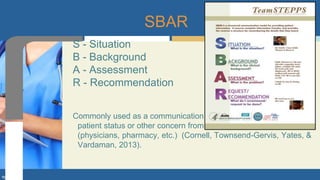
S - Situation
B - Background
A - Assessment
R - Recommendation
Commonly used as a communication tool to report a change in
patient status or other concern from nursing to other departments
(physicians, pharmacy, etc.) (Cornell, Townsend-Gervis, Yates, &
Vardaman, 2013).
SBAR
Other Definitions
shift report - the transfer of information from one
nurse to another about patients at change of
shift in order to provide safe, quality patient
care (Poletick & Holly, 2010)
• Other names may include: handoff report,
nurse to nurse report, handover report and
sign-off
There are many ways in which the practice of shift report or handoff is performed in
different settings. These include: (Staggers & Blaz, 2012)
● bed side handoff
● taped verbal handoff
● verbal handoff with print supplement
● electronic templates with verbal handoff
Some of the common issues with handoff report include: (Cornell, Townsend-Gervis, Yates,
& Vardaman, 2013)
● ambiguous information (unclear, unnecessary)
● lack of key information (missing or forgotten)
● unstructured
● time consuming
Current Practice and Common Complaints
● This method of handoff shift report has improved accountability and the critical
thinking approach to events(Boaro et al., 2010).
● Use of the tool helps nurses to relay information in an objective and professional
manner while increasing their ability to justify the recommendations chosen (Boaro et
al., 2010).
○ Handoff communication becomes more comprehensive and decreases human
error.
● Increased nurse confidence in relaying information (Ardoin & Broussard, 2011).
Research Findings
● The nurse spent less time writing information and more time providing patient care and
critically thinking about the patient progression Cornell, Townsend-Gervis, Yates, &
Vardaman, 2014).
● SBAR decreases the overall time nurses spent on shift report, indicating a more
focused process of information transfer (Cornell, et al., 2014).
● SBAR levels the playing field for all nurses regardless of their level of experience
(Cornell, et al., 2014).
Research Findings cont.
● Implementation of an SBAR shift report tool resulted in:
○ greater focus and consistency of nursing shift reports (Cornell et al., 2013).
○ increased nurse to nurse communication and decreased amount of transcribing
occurred when a print form of SBAR was provided.
● SBAR reduced adverse events and drug events (Haig, Sutton, & Whittington, 2006).
● SBAR decreases the amount of unexpected deaths (Meester, Verspuy, Monsieurs, &
Van Bogaert, 2013).
Research Findings cont.
● In order to facilitate change within a unit, helpful encouragement and reminders
should be placed throughout the unit. This could include:
○ Placing SBAR posters in the nursing station
○ Adhering SBAR stickers on telephones
○ Encouraging peer practice and observation with the use of SBAR (Ardoin &
Broussard, 2011).
● An electronic SBAR tool would help decrease the amount of transcribed information
and allow for more verbal dialogue between nurses at shift report (Cornell et al.,
2013).
● Before implementing change, a pilot study with a small group of nurses should be
conducted in order to test the feasibility of using SBAR during shift handoffs (Ardoin
& Broussard, 2011).
Recommendations .
● Expand the use of SBAR from simply a nurse-physician communication process to a
tool for nursing shift report (Cornell et al., 2014)
○ helps to accomplish The Joint Commission communication goals, as process
consistency and standardization are major pillars of the recommendations
(Cornell et al., 2013).
● Physicians should be educated in the use of SBAR and critical thinking to promote
better communication with nurses (Meester et al., 2013).
● Further higher level quantitative research should be conducted about using SBAR
during nurse-to-nurse shift handoffs (Staggers & Blaz, 2012).
Recommendations cont.
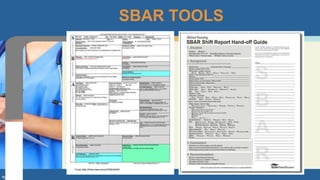
SBAR TOOLS
From http://links.lww.com/JONA/A240
PICO: In adult medical-surgical patients, does the use of SBAR by nurses in the
shift change report improve communication between nurses and improve patient
outcomes as opposed to not using a shift change reporting tool?
• Current practice includes a variety of shift report tools and styles, with varying levels
of effectiveness
• Research findings have supported the use of SBAR during shift handoff with the
benefits of
– organized and consistent reports
– effective use of report time
– improved nurse to nurse communication
• Recommendations based on research are to advocate for the adoption of SBAR into
clinical practice, taking into account the unique dynamics and function of each unit.
Conclusion
• Ardoin, K. B. & Broussard, L. (2011). Implementing handoff communication. Journal for Nurses in Staff
Development, 27 (3). http://0-dx.doi.org/.alvin.iii.com/10.1097/NND.0b013e318217b3dd
• Boaro, N., Fancott, C., Baker, R., Velji, K., & Andreoli, A. (2010). Using SBAR to improve communication in
interprofessional rehabilitation teams. Journal of Interprofessional Care, 24(1), 111-114.
http://dx.doi.org/10.3109/13561820902881601
• Cornell, P., Townsend Gervis, M., Yates, L., & Vardaman, J.M. (2013). Improving shift report focus and consistency
with the situation, background, assessment and recommendation protocol. The Journal of Nursing Administration,
43(7/8), 422-428. http://dx.doi.org/10.1097/NNA.0b013e31829d6303
• Cornell, P., Townsend Gervis, M., Yates, L., & Vardaman, J. M. (2014). Impact of SBAR on nurse shift reports and
staff rounding. MEDSURG Nursing, 23(5), 334-342. http://www.ajj.com/services/pblshng/msnj/default.htm
• De Meester, K., Verspuy, M., Monsieurs, K. G., & Van Bogaert, P. (2013). SBAR improves nurse–physician
communication and reduces unexpected death: A pre and post intervention study. Resuscitation, 84(9), 1192-
1196. doi:http://dx.doi.org.ezproxy.hacc.edu/10.1016/j.resuscitation.2013.03.016
References
• Haig, K. M., Sutton, S., & Whittington, J. (2006). National patient safety goals. SBAR: A shared mental
model for improving communication between clinicians. Joint Commission Journal on Quality & Patient
Safety, 32(3), 167-175. http://www.jcrinc.com/subscribers/journal.asp?durki=463
• Poletick, E. & Holly, C. (2010). A Systematic review of nurses’ inter-shift handoff reports in acute care
hospitals. JBI Library of Systematic Reviews. 8(4), 121-172. http://0-ovidsp.tx.ovid.com.alvin.iii.com/
• Staggers, N. & Blaz, J.(2012). Research on nursing handoffs for medical and surgical settings: an
integrative review. Journal of Advanced Nursing, 69(2), 247-262. http://dx.doi.org/10.1111/j.1365-
2648.2012.06987.x.
References Cont.

SBAR Communication in Nursing Shift Report

  • 1.
    SBAR: A solutionto shift report problems? By Kadera Ferguson, Brittany Kurtz, Janae McGallicher and Aimie Terry
  • 2.
  • 3.
    In adult medical-surgicalpatients, does the use of SBAR by nurses in the shift change report improve communication between nurses and patient outcomes, compared to not using a shift change reporting tool? PICO Question
  • 4.
    Research information ● Searchdatabases: EBSCOhost, Cochrane, Joanna Briggs Institute, Pubmed, JSTOR ● Search terms: nurse to nurse communication, SBAR, Communication tools, shift report, nursing shift report, handoff communication ● Number of articles accessed: 24 ● Number of articles reviewed: 8
  • 5.
    S - Situation B- Background A - Assessment R - Recommendation Commonly used as a communication tool to report a change in patient status or other concern from nursing to other departments (physicians, pharmacy, etc.) (Cornell, Townsend-Gervis, Yates, & Vardaman, 2013). SBAR
  • 6.
    Other Definitions shift report- the transfer of information from one nurse to another about patients at change of shift in order to provide safe, quality patient care (Poletick & Holly, 2010) • Other names may include: handoff report, nurse to nurse report, handover report and sign-off
  • 7.
    There are manyways in which the practice of shift report or handoff is performed in different settings. These include: (Staggers & Blaz, 2012) ● bed side handoff ● taped verbal handoff ● verbal handoff with print supplement ● electronic templates with verbal handoff Some of the common issues with handoff report include: (Cornell, Townsend-Gervis, Yates, & Vardaman, 2013) ● ambiguous information (unclear, unnecessary) ● lack of key information (missing or forgotten) ● unstructured ● time consuming Current Practice and Common Complaints
  • 8.
    ● This methodof handoff shift report has improved accountability and the critical thinking approach to events(Boaro et al., 2010). ● Use of the tool helps nurses to relay information in an objective and professional manner while increasing their ability to justify the recommendations chosen (Boaro et al., 2010). ○ Handoff communication becomes more comprehensive and decreases human error. ● Increased nurse confidence in relaying information (Ardoin & Broussard, 2011). Research Findings
  • 9.
    ● The nursespent less time writing information and more time providing patient care and critically thinking about the patient progression Cornell, Townsend-Gervis, Yates, & Vardaman, 2014). ● SBAR decreases the overall time nurses spent on shift report, indicating a more focused process of information transfer (Cornell, et al., 2014). ● SBAR levels the playing field for all nurses regardless of their level of experience (Cornell, et al., 2014). Research Findings cont.
  • 10.
    ● Implementation ofan SBAR shift report tool resulted in: ○ greater focus and consistency of nursing shift reports (Cornell et al., 2013). ○ increased nurse to nurse communication and decreased amount of transcribing occurred when a print form of SBAR was provided. ● SBAR reduced adverse events and drug events (Haig, Sutton, & Whittington, 2006). ● SBAR decreases the amount of unexpected deaths (Meester, Verspuy, Monsieurs, & Van Bogaert, 2013). Research Findings cont.
  • 11.
    ● In orderto facilitate change within a unit, helpful encouragement and reminders should be placed throughout the unit. This could include: ○ Placing SBAR posters in the nursing station ○ Adhering SBAR stickers on telephones ○ Encouraging peer practice and observation with the use of SBAR (Ardoin & Broussard, 2011). ● An electronic SBAR tool would help decrease the amount of transcribed information and allow for more verbal dialogue between nurses at shift report (Cornell et al., 2013). ● Before implementing change, a pilot study with a small group of nurses should be conducted in order to test the feasibility of using SBAR during shift handoffs (Ardoin & Broussard, 2011). Recommendations .
  • 12.
    ● Expand theuse of SBAR from simply a nurse-physician communication process to a tool for nursing shift report (Cornell et al., 2014) ○ helps to accomplish The Joint Commission communication goals, as process consistency and standardization are major pillars of the recommendations (Cornell et al., 2013). ● Physicians should be educated in the use of SBAR and critical thinking to promote better communication with nurses (Meester et al., 2013). ● Further higher level quantitative research should be conducted about using SBAR during nurse-to-nurse shift handoffs (Staggers & Blaz, 2012). Recommendations cont.
  • 13.
  • 14.
    PICO: In adultmedical-surgical patients, does the use of SBAR by nurses in the shift change report improve communication between nurses and improve patient outcomes as opposed to not using a shift change reporting tool? • Current practice includes a variety of shift report tools and styles, with varying levels of effectiveness • Research findings have supported the use of SBAR during shift handoff with the benefits of – organized and consistent reports – effective use of report time – improved nurse to nurse communication • Recommendations based on research are to advocate for the adoption of SBAR into clinical practice, taking into account the unique dynamics and function of each unit. Conclusion
  • 15.
    • Ardoin, K.B. & Broussard, L. (2011). Implementing handoff communication. Journal for Nurses in Staff Development, 27 (3). http://0-dx.doi.org/.alvin.iii.com/10.1097/NND.0b013e318217b3dd • Boaro, N., Fancott, C., Baker, R., Velji, K., & Andreoli, A. (2010). Using SBAR to improve communication in interprofessional rehabilitation teams. Journal of Interprofessional Care, 24(1), 111-114. http://dx.doi.org/10.3109/13561820902881601 • Cornell, P., Townsend Gervis, M., Yates, L., & Vardaman, J.M. (2013). Improving shift report focus and consistency with the situation, background, assessment and recommendation protocol. The Journal of Nursing Administration, 43(7/8), 422-428. http://dx.doi.org/10.1097/NNA.0b013e31829d6303 • Cornell, P., Townsend Gervis, M., Yates, L., & Vardaman, J. M. (2014). Impact of SBAR on nurse shift reports and staff rounding. MEDSURG Nursing, 23(5), 334-342. http://www.ajj.com/services/pblshng/msnj/default.htm • De Meester, K., Verspuy, M., Monsieurs, K. G., & Van Bogaert, P. (2013). SBAR improves nurse–physician communication and reduces unexpected death: A pre and post intervention study. Resuscitation, 84(9), 1192- 1196. doi:http://dx.doi.org.ezproxy.hacc.edu/10.1016/j.resuscitation.2013.03.016 References
  • 16.
    • Haig, K.M., Sutton, S., & Whittington, J. (2006). National patient safety goals. SBAR: A shared mental model for improving communication between clinicians. Joint Commission Journal on Quality & Patient Safety, 32(3), 167-175. http://www.jcrinc.com/subscribers/journal.asp?durki=463 • Poletick, E. & Holly, C. (2010). A Systematic review of nurses’ inter-shift handoff reports in acute care hospitals. JBI Library of Systematic Reviews. 8(4), 121-172. http://0-ovidsp.tx.ovid.com.alvin.iii.com/ • Staggers, N. & Blaz, J.(2012). Research on nursing handoffs for medical and surgical settings: an integrative review. Journal of Advanced Nursing, 69(2), 247-262. http://dx.doi.org/10.1111/j.1365- 2648.2012.06987.x. References Cont.

Editor's Notes

  • #5 the first person would present up through this slide
  • #6 http://www.health.mil/~/media/MHS/General%20Images/PSMaterials/SBAR_POSTER_border.ashx http://www.saferhealthcare.com/default/assets/image/slatwall/product/default/3-0006.jpg
  • #9 This would be where the second presenter ends
  • #14 The last person would present from here to the end and ask for questions (which we have been assured there will be questions!)