ETHICAL DILEMMAS
IRIS WILKINS, RN
HEALTH LAW AND ETHICS
HCS / 478
PAUL LORETO, J.D., M.B.A., L.L.M., B.M.E.
MARCH 2, 2015
AGENDA
•Description of the Allen Family from
The Neighborhood
•Description of two ethical dilemmas
•Discussion of ethical principles
•Roles of Nurse
•Ethical Decision Making Model
•Conclusion
•References
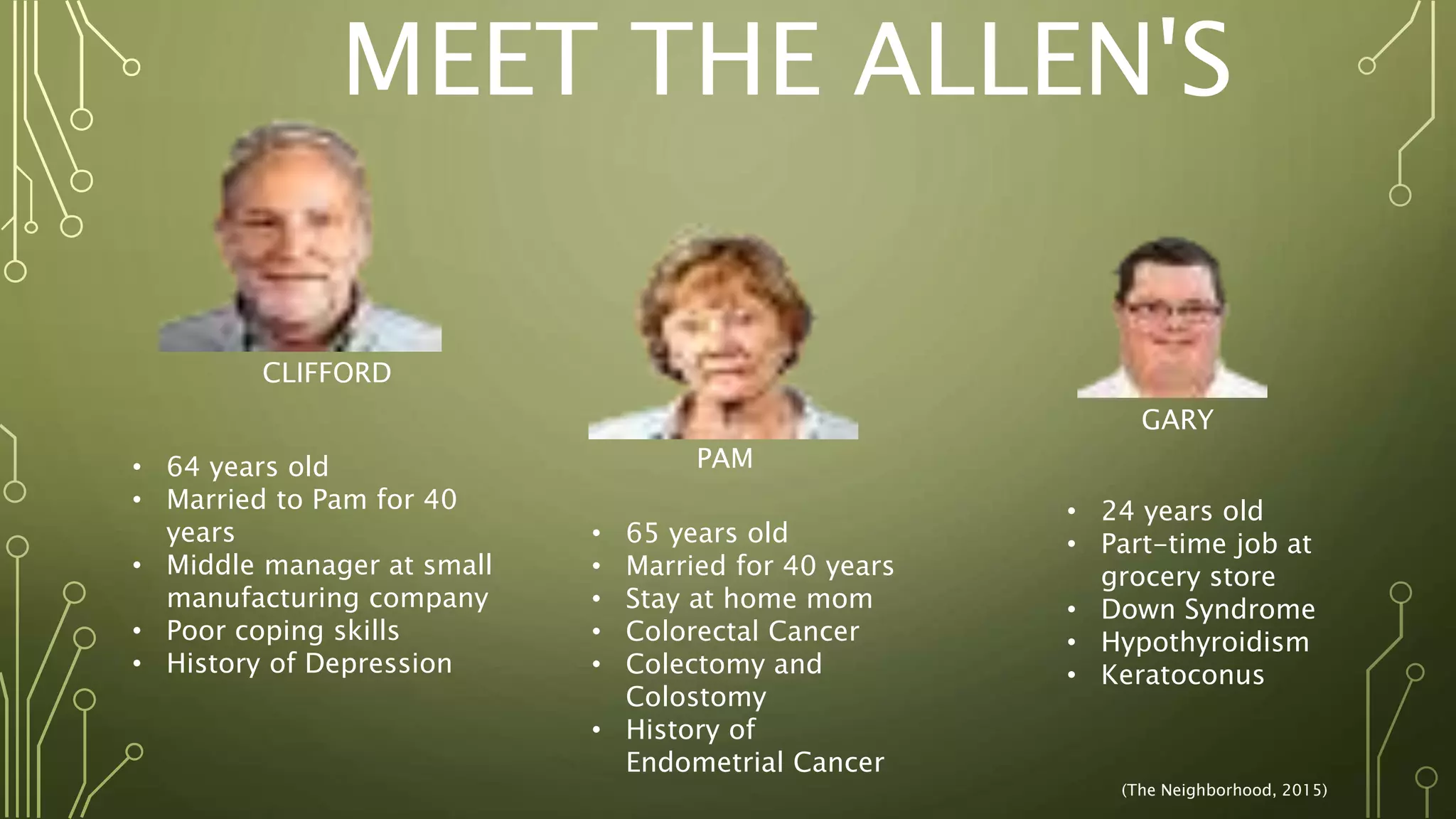
MEET THE ALLEN'S
CLIFFORD
PAM
GARY
• 65 years old
• Married for 40 years
• Stay at home mom
• Colorectal Cancer
• Colectomy and
Colostomy
• History of
Endometrial Cancer
• 64 years old
• Married to Pam for 40
years
• Middle manager at small
manufacturing company
• Poor coping skills
• History of Depression
• 24 years old
• Part-time job at
grocery store
• Down Syndrome
• Hypothyroidism
• Keratoconus
(The Neighborhood, 2015)
ETHICAL DILEMMA #1
Clifford exhibits poor coping skills and depression. He has
begun to self-medicate and refuses to get help.
Clifford presents with
• Increased levels of stress
• Not being able to retire as soon as he hoped
• Not receiving medical care for his depression
ETHICAL DILEMMA #2
Pam is dealing with colorectal cancer, colectomy and a
colostomy and is ambivalent about the benefits of radiation
and chemo-therapy.
Pam presents with
• Increased levels of stress and self esteem issues
• Unable to care for herself, her family and her home.
• She is unable to attend church regularly ( a strong source of
support)
ETHICAL PRINCIPLES
•Autonomy
•Beneficence
•Fidelity
•Advocacy
(Nursingworld, 1990)
AUTONOMY/ ADVOCACY
•Autonomy (self-rule, individual’s
ability to make informed decisions)
•Advocacy (to support, give voice to
patients, families and care-givers)
(Nursingworld, 1990)
BENEFICENCE/ FIDELITY
•Beneficence (compassion, taking positive
actions to help others).
•Fidelity (loyalty, fairness, truthfulness and
dedication).
(Nursingworld, 1990)
ROLE OF THE NURSE
• I - Identify the Facts
• D - Determine relevant ethical principles
• E – Explore the options
• A – Act, Recommend and Implement
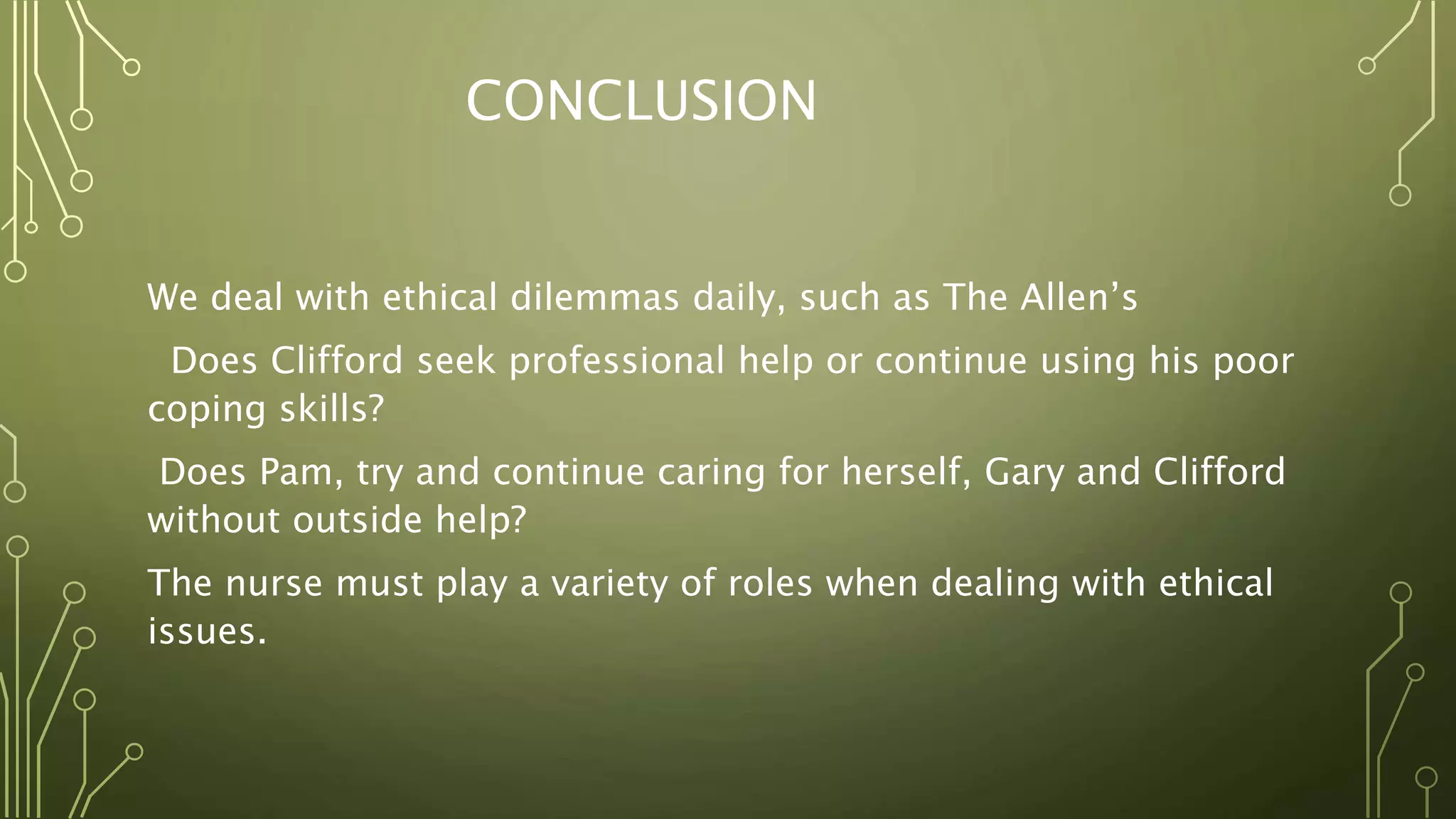
ETHICAL DECISION-MAKING MODEL
Baird Method Model
Be
Attentive
Be
Intelligent
Be
Reasonable
Be
Responsible
Be
Reflective
(Baird, 2011)
CONCLUSION
We deal with ethical dilemmas daily, such as The Allen’s
Does Clifford seek professional help or continue using his poor
coping skills?
Does Pam, try and continue caring for herself, Gary and Clifford
without outside help?
The nurse must play a variety of roles when dealing with ethical
issues.
REFERENCES
• Baird, C. (2011). The Ethics Game. Retrieved February, 28,
2015, from www.ethicsgame.com
• Nursing Ethics. (1990). Retrieved from
www.nursingworld.org//Ethics-Definitions
• The Neighborhood. (2008-2014). Retrieved from https://new
classroom3.phoenix.edu/classroom

Ethical dilemmas powerpoint3

  • 1.
    ETHICAL DILEMMAS IRIS WILKINS,RN HEALTH LAW AND ETHICS HCS / 478 PAUL LORETO, J.D., M.B.A., L.L.M., B.M.E. MARCH 2, 2015
  • 2.
    AGENDA •Description of theAllen Family from The Neighborhood •Description of two ethical dilemmas •Discussion of ethical principles •Roles of Nurse •Ethical Decision Making Model •Conclusion •References
  • 3.
    MEET THE ALLEN'S CLIFFORD PAM GARY •65 years old • Married for 40 years • Stay at home mom • Colorectal Cancer • Colectomy and Colostomy • History of Endometrial Cancer • 64 years old • Married to Pam for 40 years • Middle manager at small manufacturing company • Poor coping skills • History of Depression • 24 years old • Part-time job at grocery store • Down Syndrome • Hypothyroidism • Keratoconus (The Neighborhood, 2015)
  • 4.
    ETHICAL DILEMMA #1 Cliffordexhibits poor coping skills and depression. He has begun to self-medicate and refuses to get help. Clifford presents with • Increased levels of stress • Not being able to retire as soon as he hoped • Not receiving medical care for his depression
  • 5.
    ETHICAL DILEMMA #2 Pamis dealing with colorectal cancer, colectomy and a colostomy and is ambivalent about the benefits of radiation and chemo-therapy. Pam presents with • Increased levels of stress and self esteem issues • Unable to care for herself, her family and her home. • She is unable to attend church regularly ( a strong source of support)
  • 6.
  • 7.
    AUTONOMY/ ADVOCACY •Autonomy (self-rule,individual’s ability to make informed decisions) •Advocacy (to support, give voice to patients, families and care-givers) (Nursingworld, 1990)
  • 8.
    BENEFICENCE/ FIDELITY •Beneficence (compassion,taking positive actions to help others). •Fidelity (loyalty, fairness, truthfulness and dedication). (Nursingworld, 1990)
  • 9.
    ROLE OF THENURSE • I - Identify the Facts • D - Determine relevant ethical principles • E – Explore the options • A – Act, Recommend and Implement
  • 10.
    ETHICAL DECISION-MAKING MODEL BairdMethod Model Be Attentive Be Intelligent Be Reasonable Be Responsible Be Reflective (Baird, 2011)
  • 11.
    CONCLUSION We deal withethical dilemmas daily, such as The Allen’s Does Clifford seek professional help or continue using his poor coping skills? Does Pam, try and continue caring for herself, Gary and Clifford without outside help? The nurse must play a variety of roles when dealing with ethical issues.
  • 12.
    REFERENCES • Baird, C.(2011). The Ethics Game. Retrieved February, 28, 2015, from www.ethicsgame.com • Nursing Ethics. (1990). Retrieved from www.nursingworld.org//Ethics-Definitions • The Neighborhood. (2008-2014). Retrieved from https://new classroom3.phoenix.edu/classroom

Editor's Notes

  • #2 Nurses are faced with making difficult decisions in our personal and professional lives daily.……It is difficult at best to always try and do the right thing for the good of all concerned and be able to rest well at night. Many times we are caught up in never-ending vortex's, sometimes known as ethical dilemmas.
  • #5 Clifford has been treated for depression in the past and worries about the stigma of depression as a sign of weakness. Clifford is also afraid of how his employer will respond if he undergoes treatment for mental health. Clifford has also taken to self medicating with alcohol. He added on his to-do list where he should stash his bottles of liquor, and became angry when confronted about his drinking by his wife. His son cannot figure out the changes in his father’s behaviors and moods, except noticing he is “mean” Clifford requires referrals to deal with his caregiver burnout and the fear of his wife’s poor prognosis and raising a developmentally challenged son, possible alone.
  • #6 Pam is concerned about her relationship with her husband, when she looks in the mirror she sees a “skinny, bald woman” and says no wonder her husband has lost interest in her. I think it may be safer for Pam to concentrate on the smaller picture, baldness, weightloss, Clifford’s declining interest in her, as opposed to dealing with the larger picture, the fear of dying and how her family’s will change without her.
  • #7 The Ethical principles that I chosen to discus for the Allen's
  • #8 Autonomy: Clifford has the right to make his own decisions about seeking medical care for his depression. Pam has the right to refuse additional chemo or radiation treatments, if called for. Advocacy, Pam is a staunch supporter of her son, by trying to maintain consistency in his life, e.g. getting him back and forth to his job as best she can to maintain a sense of normalcy in his life.
  • #9 Beneficence: Pam cares for Gary who has Down Syndrome., Pam tries to maintain a consistent environment for Gary, it seems that he has difficulty dealing with changes in his routines. Fidelity: Both Clifford and Pam are loyal to their son. Clifford is loyal to his job. Gary is loyal to his activities at church and the Special Olympics.
  • #10 Using the Acronym: IDEA. Identify the facts, Determine relevant ethical issues, Explore options and Act, Recommend and Implement Nurses must be advocates for the patient and family. The Nurse must maintain therapeutic and professional boundaries, provide education and teaching for patient and Caregiver. The nurse must maintain Culture Sensitivity at all times. She must remain neutral, in family matters of the head and heart Identify medical disciplines that may be helpful to the family, such as social workers, case managers, etc. The nurse must also help the family tap into local, state and resources that are available to them. The nurse also practice truthful and confidential communications with the patient
  • #11 I selected the Relationship lens has my focus for the Allen Family, because the ethical action is one which will sustain integrity building relationships. The community, is extremely supportive of the family and has time progresses. The community will need to rally around the family, even more.
  • #12 As, a nurse we must do what is right, even if, our heart says one thing and our head says another.