BY:
SARATU GARBA ABDULLAHI
CRITICAL THINKING & DECISION
MAKING
CRITICAL THINKING
INTRODUCTION
To become a professional nurse requires that you
learn to think like a nurse. What makes the thinking
of a nurse different from a doctor, a dentist or an
engineer? It is how we view the client and the type
of problems we deal with in practice when we
engage in client care. To think like a nurse requires
that we learn the content of nursing; the ideas,
concepts and theories of nursing and develop our
intellectual capacities and skills so that we become
disciplined, self-directed, critical thinkers.
DEFINITION:
Critical thinking is the disciplined, intellectual
process of applying skilful reasoning as a guide to
belief or action (Paul, Ennis & Norris).
In nursing, critical thinking for clinical decision-
making is the ability to think in a systematic and
logical manner with openness to question and reflect
on the reasoning process used to ensure safe nursing
practice and quality care (Penny Heaslip 1993).
CONCEPT OF CRITICAL THINKING:
The National League for Nursing, responsible for
accrediting educational programs, requires
documentation of critical thinking as an outcome of
nursing education. This emphasis on critical
thinking in the education of nurses recognizes the
complex, technological environment of health care
today. Nurses must be able to process large amounts
of information to make complex decisions in the
delivery of patient care (Facione & Facione, 1994).
CONT>>>>>>>>>>
The concept of critical thinking is well represented in both general
and nursing education literature. Less has been written about the
critical thinking skills needed by nursing managers. Formal
education and support are needed for nurse managers to
effectively function in their role in the current health care
environment. Many nurse managers assume their positions based
on expertise in a clinical role with little expertise in managerial
and leadership skills. Effective functioning in the management
role requires knowledge and skills related to financial
management, human resources, collective bargaining,
communication with multiple departments and levels of staff, and
quality management
SKILLS IN CRITICAL THINKING:
1. Interpretation – The ability to understand and explain the meaning of
information or an event.
2. Analysis – The investigation of a course of action based on objective and
subjective data.
3. Evaluation – The process of assessing the value of the information obtained.
Is it credible, reliable, and relevant? This skill is also applied in determining
if desired outcomes have been reached. Based on the previous three steps the
nurse can apply the skill of clinical reasoning to determine the problem.
These decisions are based on sound reasoning.
CONT>>>>>>>>
4. Explanation – The ability to clearly and concisely explain
one’s conclusions. The nurse should be able to provide sound
rationale for his/her answers.
5. Self-regulation – Involves monitoring one’s own thinking. This
means reflecting on the process leading to the conclusions. The
individual should self-correct the thinking process as needed,
being alert for biases and incorrect assumptions.
PITFALLS OF CRITICAL THINKING
1. Critical thinking fails as a process when logic is not used. A common fallacy
arises from using a circular argument. For example, a nurse might write the
nursing diagnosis “Ineffective coping, as evidenced by inability to cope.”
This does not define the problem, it simply makes a circle.
2. Another illogical process is called appeal to tradition. This is the argument
that we have “always done it this way.” New strategies and creative
approaches are ignored.
3. Errors in logic also occur when the thinker makes hasty generalizations
without considering the evidence. The critical thinker does not jump to
conclusion.
BIAS IN CRITICAL THINKING:
1. Everyone has biases. Critical thinkers examine their biases
and do not allow them to compromise the integrity of their
thinking processes.
2. Biases can interfere with patient care. For example, if we
believe patients with alcoholism are manipulative, when
the patient complains of anxiety, we ignore their complaint
and miss the signs of delirium tremens.
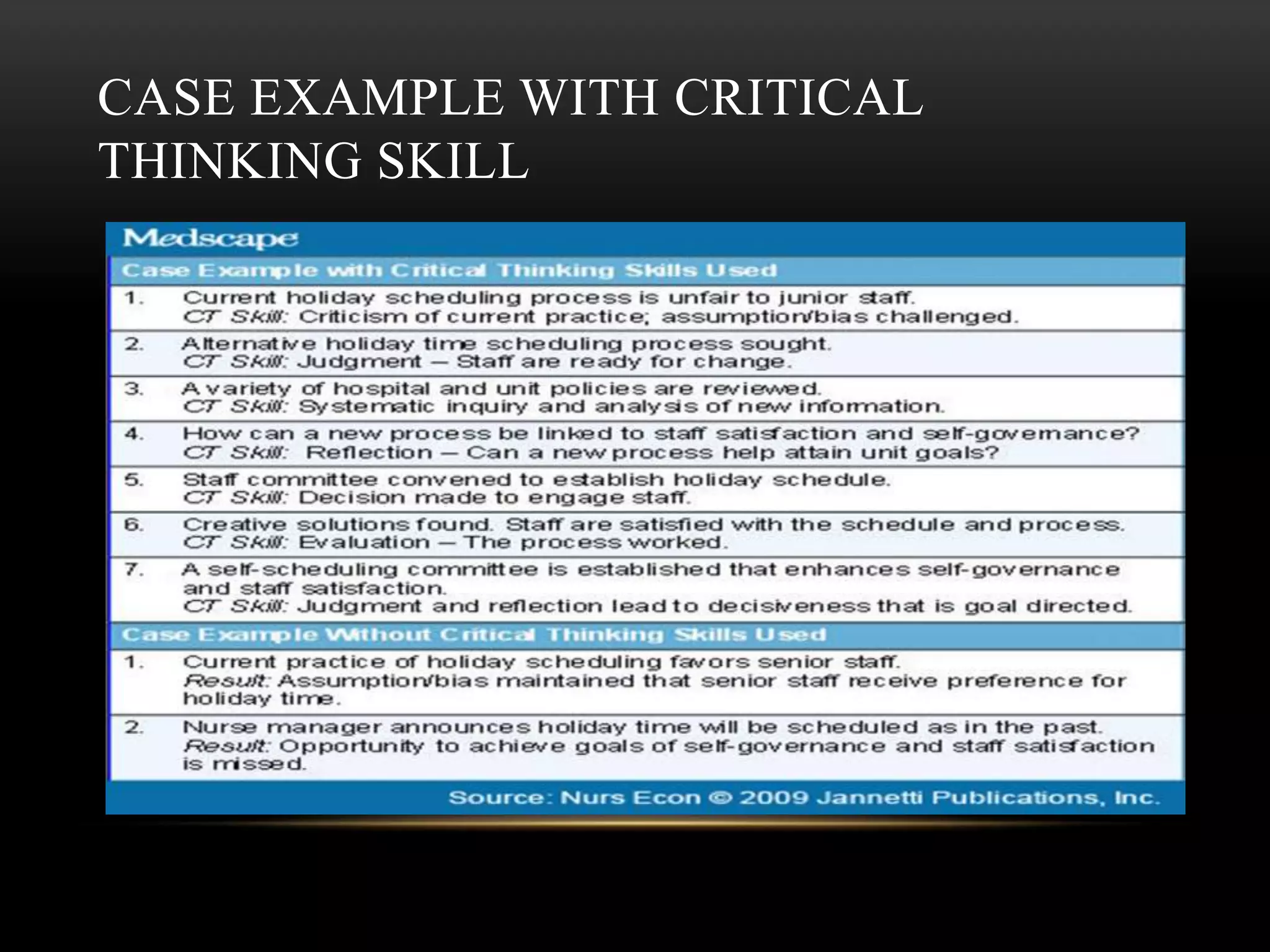
CASE EXAMPLE WITH CRITICAL
THINKING SKILL
IMPLICATION FOR NURSING LEADERS
• Nursing leaders are challenged to think creatively about ways to foster the
development of both critical thinking skills and the dispositions that lead to
use of critical thinking in nurse managers. Formal educational programs that
teach managerial and leadership skills are necessary. When these programs
are being developed, strategies known to foster the development of critical
thinking must be included. Inquiry-based learning techniques such as
questioning, discussion, debates, case studies, and critical incident analysis
can be used when planning curriculum for management and leadership
education programs (Edwards, 2007).
CONT>>>>>>>
In addition to developing critical thinking skills, the dispositions that
encourage the use of critical thinking must be nurtured in nurse
managers. Encouraging the development of critical thinking dispositions
can occur in formal or informal settings. Mentoring programs that
encourage critical thinking related to discussions of
leadership/management situations can be effective in developing and
using critical thinking. Critical thinking is developed by the use of
questioning and appreciative inquiry that challenges one to envision what
might be and should be are encouraged (Cooperrider & Whitney, 2005).
Techniques that encourage self-reflection and self-assessment such as
reflective journaling, writing prompts that require thought-provoking re-
sponses to a question or situation, role modeling, questioning, and
concept mapping have been useful in developing critical thinking
(Profetto-McGrath, 2005).
TIPS TO INCREASE CRITICAL THINKING:
• Establishing electronic
communication
• Nurse mangers can create a journal
club.
ANTECEDENT OF CRITICAL THINKING:
CONCLUSION:
The current and future generations of nurse managers have a pivotal role
that is at the forefront of managing the rapidly changing health care
system. Nurse managers who are adept at using critical thinking and have
the “habits of mind” of a critical thinker are in a good position to assume
a leadership role and create the changes that will achieve positive
outcomes in health care organizations. Nursing leaders are challenged to
create formal and informal education and mentoring programs to support
the development of critical thinking in nurse managers.
DECISION MAKING
INTRODUCTION
Nurse managers play a pivotal role in creating
healthcare work environments that are conducive to
patient care quality and safety. Throughout each 24-
hour day, nurse managers make countless rapid fire
decisions that impact patient, staff and
organizational outcomes. These decisions take place
in complex, real-world practice environments often
with incomplete information, time pressures, role
overload and frequent interruptions.
DEFINITION:
Decision making can be regarded as the
cognitive process resulting in the selection of
a course of action among several alternative
scenarios. Every decision making process
produces a final choice. The output can be an
action or an opinion of choice.
FREQUENCY OF DECISION MAKING
The number and types of decisions faced by nurses
are related to the work environment, perceptions of
their clinical role, operational autonomy, and the
degree to which they see themselves as active and
influential decision makers. Nurses working on a
busy medical admissions unit admitting 50 patients
per day face a different set of decision challenges
compared with health visitors (HVs) or public health
nurses, who may see 10 patients per day. Consider
the extent to which judgment and choices feature in
this HV’s consultation
CASE EXAMPLE
"“She was breast-feeding but had very sore cracked and bleeding
nipples on her left breast and she did not know what to do about it.
[What did the HV think? The mother asked] The HV thought and
replied that she had not come across this problem before, but
asked if it was painful. Mum said that it was and she had tried to
feed her from this breast but it was so painful that she had not
done so. She had only fed from the right breast and for the past
three evenings the baby had fed continuously for six hours and
then slept all night. Someone had suggested using Camillosan
cream for her cracked nipples but it had not helped at all. However
she knew that chamomile was a relaxant and maybe that was why
the baby had slept for so long the last three nights.
The HV mentioned a nipple shield but said that she had no
experience of using them. The mum said that she wondered if
she should just stop feeding from that breast altogether until
they had healed, to which the HV agreed. The HV then said
that if she was having pain in her breast, that could indicate
that she had a thrush infection on her breast. She then asked
if she had seen any white patches on the baby’s tongue or in
her mouth and mum replied that she had not. No more was
said about that. They agreed that mum would not feed from
her left breast and only use her right until it healed up. The
HV said that as the baby was feeding well from her right
breast then that was OK.” (Field notes, health visitor)."
CASE ANALYSIS
This quote illustrates at least 5 judgment or decision
challenges for the HV, all of which generate
potential information needs: (1) ascertain the likely
causes of sore and cracked nipples; (2) choose a
management strategy in the context of little or no
experiential knowledge; (3) judge whether the baby
is getting sufficient breast milk; (4) choose between
the merits of Camillosan, Chamomile, or a nipple
shield; and (5) identify the cause of pain (possibly
thrush)
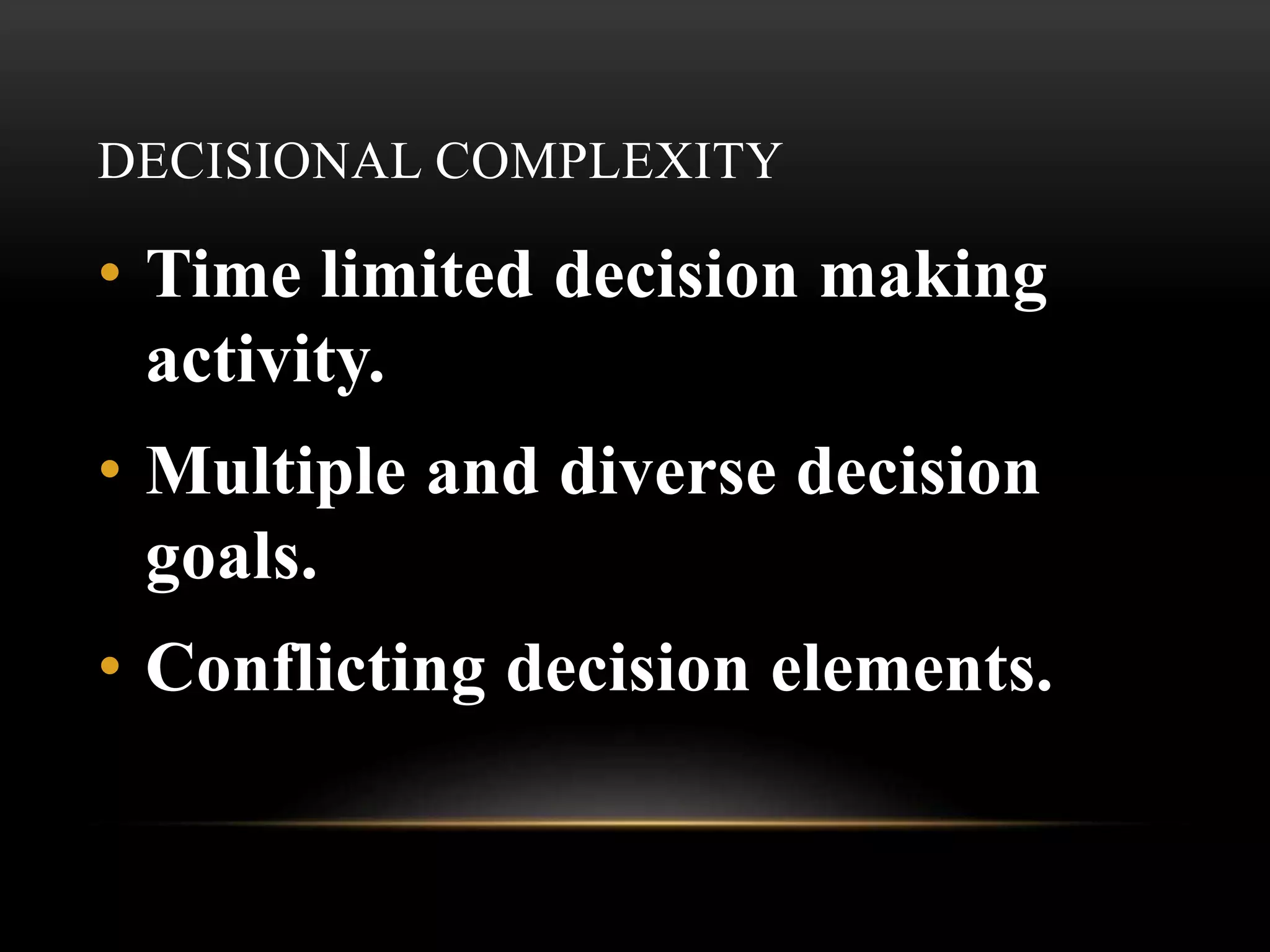
DECISIONAL COMPLEXITY
• Time limited decision making
activity.
• Multiple and diverse decision
goals.
• Conflicting decision elements.
EXAMPLE
"“When S came back she cleaned the patient’s left leg with
gauze soaked in saline and then applied a dressing (Jelonet).
She said that she felt Jelonet was not ideal but the patient’s
consultant preferred it despite the fact that ‘when you take it
off you are removing the good tissue as well.’ Even if I
change the dressing, when the patient goes to the outpatients’
department and sees the consultant they will come back with
Jelonet and clear instructions that we are to use Jelonet.” "
THE IMPLEMENTATION OF RESEARCH
KNOWLEDGE
Many theoretical models of research utilisation implicitly
recognise the importance of decision making as a vital step
in the process of converting knowledge into action. Despite
this implicit recognition, most models fail to account for the
relation between decision characteristics, information use,
and information processing. For example, Lomas has
proposed a coordinated model of research implementation,
which proposes that one end point of knowledge diffusion is
negotiating the application of research findings with patients
during the course of clinical practice. In other works, Lomas
also calls for researchers and decision makers to have
increased levels of understanding of each other’s worlds if
research and policy (or practice) are to be better linked.
CONCLUSION
Nurses are increasingly regarded as key
decision makers within the healthcare
team. They are also expected to use the
best available evidence in their
judgments and decisions. The
prescriptive model of evidence-based
decision making and the search-appraise-
implement process that accompanies it is
an active process.
THANK
YOU

Critical Thinking and Decision Making

  • 1.
    BY: SARATU GARBA ABDULLAHI CRITICALTHINKING & DECISION MAKING
  • 2.
  • 3.
    INTRODUCTION To become aprofessional nurse requires that you learn to think like a nurse. What makes the thinking of a nurse different from a doctor, a dentist or an engineer? It is how we view the client and the type of problems we deal with in practice when we engage in client care. To think like a nurse requires that we learn the content of nursing; the ideas, concepts and theories of nursing and develop our intellectual capacities and skills so that we become disciplined, self-directed, critical thinkers.
  • 4.
    DEFINITION: Critical thinking isthe disciplined, intellectual process of applying skilful reasoning as a guide to belief or action (Paul, Ennis & Norris). In nursing, critical thinking for clinical decision- making is the ability to think in a systematic and logical manner with openness to question and reflect on the reasoning process used to ensure safe nursing practice and quality care (Penny Heaslip 1993).
  • 5.
    CONCEPT OF CRITICALTHINKING: The National League for Nursing, responsible for accrediting educational programs, requires documentation of critical thinking as an outcome of nursing education. This emphasis on critical thinking in the education of nurses recognizes the complex, technological environment of health care today. Nurses must be able to process large amounts of information to make complex decisions in the delivery of patient care (Facione & Facione, 1994).
  • 6.
    CONT>>>>>>>>>> The concept ofcritical thinking is well represented in both general and nursing education literature. Less has been written about the critical thinking skills needed by nursing managers. Formal education and support are needed for nurse managers to effectively function in their role in the current health care environment. Many nurse managers assume their positions based on expertise in a clinical role with little expertise in managerial and leadership skills. Effective functioning in the management role requires knowledge and skills related to financial management, human resources, collective bargaining, communication with multiple departments and levels of staff, and quality management
  • 7.
    SKILLS IN CRITICALTHINKING: 1. Interpretation – The ability to understand and explain the meaning of information or an event. 2. Analysis – The investigation of a course of action based on objective and subjective data. 3. Evaluation – The process of assessing the value of the information obtained. Is it credible, reliable, and relevant? This skill is also applied in determining if desired outcomes have been reached. Based on the previous three steps the nurse can apply the skill of clinical reasoning to determine the problem. These decisions are based on sound reasoning.
  • 8.
    CONT>>>>>>>> 4. Explanation –The ability to clearly and concisely explain one’s conclusions. The nurse should be able to provide sound rationale for his/her answers. 5. Self-regulation – Involves monitoring one’s own thinking. This means reflecting on the process leading to the conclusions. The individual should self-correct the thinking process as needed, being alert for biases and incorrect assumptions.
  • 9.
    PITFALLS OF CRITICALTHINKING 1. Critical thinking fails as a process when logic is not used. A common fallacy arises from using a circular argument. For example, a nurse might write the nursing diagnosis “Ineffective coping, as evidenced by inability to cope.” This does not define the problem, it simply makes a circle. 2. Another illogical process is called appeal to tradition. This is the argument that we have “always done it this way.” New strategies and creative approaches are ignored. 3. Errors in logic also occur when the thinker makes hasty generalizations without considering the evidence. The critical thinker does not jump to conclusion.
  • 10.
    BIAS IN CRITICALTHINKING: 1. Everyone has biases. Critical thinkers examine their biases and do not allow them to compromise the integrity of their thinking processes. 2. Biases can interfere with patient care. For example, if we believe patients with alcoholism are manipulative, when the patient complains of anxiety, we ignore their complaint and miss the signs of delirium tremens.
  • 11.
    CASE EXAMPLE WITHCRITICAL THINKING SKILL
  • 12.
    IMPLICATION FOR NURSINGLEADERS • Nursing leaders are challenged to think creatively about ways to foster the development of both critical thinking skills and the dispositions that lead to use of critical thinking in nurse managers. Formal educational programs that teach managerial and leadership skills are necessary. When these programs are being developed, strategies known to foster the development of critical thinking must be included. Inquiry-based learning techniques such as questioning, discussion, debates, case studies, and critical incident analysis can be used when planning curriculum for management and leadership education programs (Edwards, 2007).
  • 13.
    CONT>>>>>>> In addition todeveloping critical thinking skills, the dispositions that encourage the use of critical thinking must be nurtured in nurse managers. Encouraging the development of critical thinking dispositions can occur in formal or informal settings. Mentoring programs that encourage critical thinking related to discussions of leadership/management situations can be effective in developing and using critical thinking. Critical thinking is developed by the use of questioning and appreciative inquiry that challenges one to envision what might be and should be are encouraged (Cooperrider & Whitney, 2005). Techniques that encourage self-reflection and self-assessment such as reflective journaling, writing prompts that require thought-provoking re- sponses to a question or situation, role modeling, questioning, and concept mapping have been useful in developing critical thinking (Profetto-McGrath, 2005).
  • 14.
    TIPS TO INCREASECRITICAL THINKING: • Establishing electronic communication • Nurse mangers can create a journal club.
  • 15.
  • 16.
    CONCLUSION: The current andfuture generations of nurse managers have a pivotal role that is at the forefront of managing the rapidly changing health care system. Nurse managers who are adept at using critical thinking and have the “habits of mind” of a critical thinker are in a good position to assume a leadership role and create the changes that will achieve positive outcomes in health care organizations. Nursing leaders are challenged to create formal and informal education and mentoring programs to support the development of critical thinking in nurse managers.
  • 17.
  • 18.
    INTRODUCTION Nurse managers playa pivotal role in creating healthcare work environments that are conducive to patient care quality and safety. Throughout each 24- hour day, nurse managers make countless rapid fire decisions that impact patient, staff and organizational outcomes. These decisions take place in complex, real-world practice environments often with incomplete information, time pressures, role overload and frequent interruptions.
  • 19.
    DEFINITION: Decision making canbe regarded as the cognitive process resulting in the selection of a course of action among several alternative scenarios. Every decision making process produces a final choice. The output can be an action or an opinion of choice.
  • 20.
    FREQUENCY OF DECISIONMAKING The number and types of decisions faced by nurses are related to the work environment, perceptions of their clinical role, operational autonomy, and the degree to which they see themselves as active and influential decision makers. Nurses working on a busy medical admissions unit admitting 50 patients per day face a different set of decision challenges compared with health visitors (HVs) or public health nurses, who may see 10 patients per day. Consider the extent to which judgment and choices feature in this HV’s consultation
  • 21.
    CASE EXAMPLE "“She wasbreast-feeding but had very sore cracked and bleeding nipples on her left breast and she did not know what to do about it. [What did the HV think? The mother asked] The HV thought and replied that she had not come across this problem before, but asked if it was painful. Mum said that it was and she had tried to feed her from this breast but it was so painful that she had not done so. She had only fed from the right breast and for the past three evenings the baby had fed continuously for six hours and then slept all night. Someone had suggested using Camillosan cream for her cracked nipples but it had not helped at all. However she knew that chamomile was a relaxant and maybe that was why the baby had slept for so long the last three nights.
  • 22.
    The HV mentioneda nipple shield but said that she had no experience of using them. The mum said that she wondered if she should just stop feeding from that breast altogether until they had healed, to which the HV agreed. The HV then said that if she was having pain in her breast, that could indicate that she had a thrush infection on her breast. She then asked if she had seen any white patches on the baby’s tongue or in her mouth and mum replied that she had not. No more was said about that. They agreed that mum would not feed from her left breast and only use her right until it healed up. The HV said that as the baby was feeding well from her right breast then that was OK.” (Field notes, health visitor)."
  • 23.
    CASE ANALYSIS This quoteillustrates at least 5 judgment or decision challenges for the HV, all of which generate potential information needs: (1) ascertain the likely causes of sore and cracked nipples; (2) choose a management strategy in the context of little or no experiential knowledge; (3) judge whether the baby is getting sufficient breast milk; (4) choose between the merits of Camillosan, Chamomile, or a nipple shield; and (5) identify the cause of pain (possibly thrush)
  • 24.
    DECISIONAL COMPLEXITY • Timelimited decision making activity. • Multiple and diverse decision goals. • Conflicting decision elements.
  • 25.
    EXAMPLE "“When S cameback she cleaned the patient’s left leg with gauze soaked in saline and then applied a dressing (Jelonet). She said that she felt Jelonet was not ideal but the patient’s consultant preferred it despite the fact that ‘when you take it off you are removing the good tissue as well.’ Even if I change the dressing, when the patient goes to the outpatients’ department and sees the consultant they will come back with Jelonet and clear instructions that we are to use Jelonet.” "
  • 26.
    THE IMPLEMENTATION OFRESEARCH KNOWLEDGE Many theoretical models of research utilisation implicitly recognise the importance of decision making as a vital step in the process of converting knowledge into action. Despite this implicit recognition, most models fail to account for the relation between decision characteristics, information use, and information processing. For example, Lomas has proposed a coordinated model of research implementation, which proposes that one end point of knowledge diffusion is negotiating the application of research findings with patients during the course of clinical practice. In other works, Lomas also calls for researchers and decision makers to have increased levels of understanding of each other’s worlds if research and policy (or practice) are to be better linked.
  • 27.
    CONCLUSION Nurses are increasinglyregarded as key decision makers within the healthcare team. They are also expected to use the best available evidence in their judgments and decisions. The prescriptive model of evidence-based decision making and the search-appraise- implement process that accompanies it is an active process.
  • 28.