PARTICLE SWARM OPTIMIZATION
1
INTRODUCTION:
 Particle Swarm Optimization (PSO) is an
evolutionary numeric optimization algorithm.
 The algorithm is based on the motion of bird flocks.
 The fitness function depends on the objective of the
work.
 The following example problem shows how a
fitness function can be defined for a specific design
goal.
2
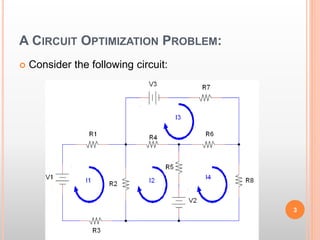
A CIRCUIT OPTIMIZATION PROBLEM:
 Consider the following circuit:
3
CIRCUIT PARAMETERS:
 The circuit parameters have the following values:
R2 = 100Ω
R3 = 47Ω
R4 = 32Ω
R6 = 22Ω
R7 = 132Ω
V1 = 8 volt
V2 = 12 volt
 The other circuit parameters are variables. The range of
values of those parameters are:
R1 = 10Ω to 50Ω
R5 = 90Ω to 150Ω
R8 = 160Ω to 250Ω
v3 = 12 volt to 18 volt 4
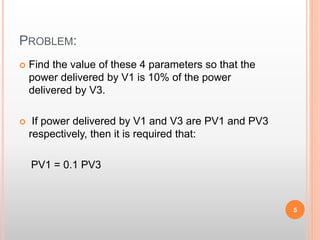
PROBLEM:
 Find the value of these 4 parameters so that the
power delivered by V1 is 10% of the power
delivered by V3.
 If power delivered by V1 and V3 are PV1 and PV3
respectively, then it is required that:
PV1 = 0.1 PV3
5
SOLUTION:
 To solve this problem, we use PSO.
 The solution space will be 4 dimensional.
 The range of the values of the parameters defines
the solution region.
6
MESH EQUATIONS:
 First we need to find the power delivered by the
sources by solving the circuit.
 We use Mesh current analysis.
 The mesh equations are:

7
 
 
 
  VRIRRRIRI
VRIRRRIRI
VRIRIRRRIRI
VRIRRRI
263865452
364764342
25443542221
1223211




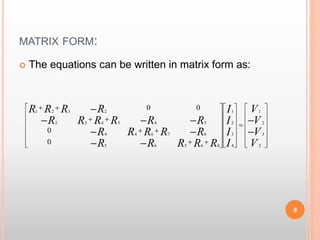
MATRIX FORM:
 The equations can be written in matrix form as:
8





















































V
V
V
V
I
I
I
I
RRRRR
RRRRR
RRRRRR
RRRR
2
3
2
1
4
3
2
1
86565
67644
545422
2321
0
0
00
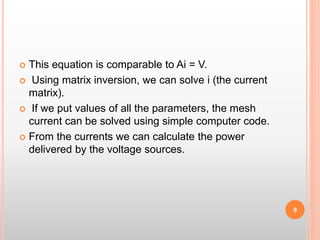
 This equation is comparable to Ai = V.
 Using matrix inversion, we can solve i (the current
matrix).
 If we put values of all the parameters, the mesh
current can be solved using simple computer code.
 From the currents we can calculate the power
delivered by the voltage sources.
9
 Now, we need to define the fitness function.
 We require that the power of the voltage sources V1
and V3 have the relation:
PV1 = 0.1 PV3.
 We define fitness function as:
fitness = -abs(PV1 - 0.1PV3)
 Here abs denotes absolute value.
 We note that when our condition is satisfied, the
fitness function will have zero value.
 In other cases, we will a negative fitness value.
 So, maximizing this fitness function will give us the
desired results. 10
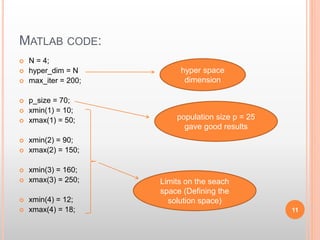
MATLAB CODE:
 N = 4;
 hyper_dim = N
 max_iter = 200;
 p_size = 70;
 xmin(1) = 10;
 xmax(1) = 50;
 xmin(2) = 90;
 xmax(2) = 150;
 xmin(3) = 160;
 xmax(3) = 250;
 xmin(4) = 12;
 xmax(4) = 18; 11
hyper space
dimension
population size p = 25
gave good results
Limits on the seach
space (Defining the
solution space)
 vmax = .02*(xmax - xmin);
 x = rand(p_size,hyper_dim);
 for m = 1:hyper_dim
 x(:,m) = x(:,m)*(xmax(m) - xmin(m)) + xmin(m);
 end
 v = 2*( rand(p_size,hyper_dim) - 0.5 );
 for m = 1:hyper_dim
 v(:,m) = v(:,m)* vmax(m);
 end 12
Limiting maximum
velocity
uniformly distributed
values from 0 to 1
Converting the random values to the
relevant range between xmin and xmax
in every dimensions.
initializing
random swarm
velocity
 pbest = x;
 pbest_val(1) = fitness(x(1,:));
 gbest_val = fitness(x(1,:));
 gbest = x(1,:);
 for m = 2:p_size
 temp = fitness(x(m,:));
 pbest_val(m) = temp;
 if temp > gbest_val
 gbest_val = temp;
 gbest = x(m,:);
 end
 end 13
initial pbest
and gbest
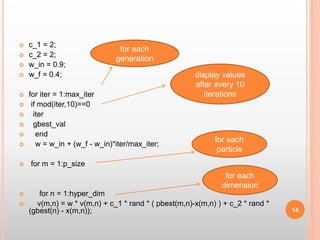
 c_1 = 2;
 c_2 = 2;
 w_in = 0.9;
 w_f = 0.4;
 for iter = 1:max_iter
 if mod(iter,10)==0
 iter
 gbest_val
 end
 w = w_in + (w_f - w_in)*iter/max_iter;
 for m = 1:p_size
 for n = 1:hyper_dim
 v(m,n) = w * v(m,n) + c_1 * rand * ( pbest(m,n)-x(m,n) ) + c_2 * rand *
(gbest(n) - x(m,n)); 14
for each
dimension
for each
particle
display values
after every 10
iterations
for each
generation
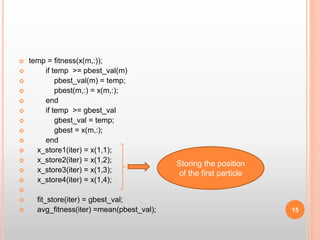
 temp = fitness(x(m,:));
 if temp >= pbest_val(m)
 pbest_val(m) = temp;
 pbest(m,:) = x(m,:);
 end
 if temp >= gbest_val
 gbest_val = temp;
 gbest = x(m,:);
 end
 x_store1(iter) = x(1,1);
 x_store2(iter) = x(1,2);
 x_store3(iter) = x(1,3);
 x_store4(iter) = x(1,4);

 fit_store(iter) = gbest_val;
 avg_fitness(iter) =mean(pbest_val); 15
Storing the position
of the first particle
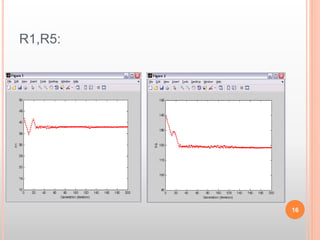
R1,R5:
16
R8,V3:
17
FITNESS FUNCTION:
18

Particle Swarm Optimization (A Circuit Optimization Problem)

  • 1.
  • 2.
    INTRODUCTION:  Particle SwarmOptimization (PSO) is an evolutionary numeric optimization algorithm.  The algorithm is based on the motion of bird flocks.  The fitness function depends on the objective of the work.  The following example problem shows how a fitness function can be defined for a specific design goal. 2
  • 3.
    A CIRCUIT OPTIMIZATIONPROBLEM:  Consider the following circuit: 3
  • 4.
    CIRCUIT PARAMETERS:  Thecircuit parameters have the following values: R2 = 100Ω R3 = 47Ω R4 = 32Ω R6 = 22Ω R7 = 132Ω V1 = 8 volt V2 = 12 volt  The other circuit parameters are variables. The range of values of those parameters are: R1 = 10Ω to 50Ω R5 = 90Ω to 150Ω R8 = 160Ω to 250Ω v3 = 12 volt to 18 volt 4
  • 5.
    PROBLEM:  Find thevalue of these 4 parameters so that the power delivered by V1 is 10% of the power delivered by V3.  If power delivered by V1 and V3 are PV1 and PV3 respectively, then it is required that: PV1 = 0.1 PV3 5
  • 6.
    SOLUTION:  To solvethis problem, we use PSO.  The solution space will be 4 dimensional.  The range of the values of the parameters defines the solution region. 6
  • 7.
    MESH EQUATIONS:  Firstwe need to find the power delivered by the sources by solving the circuit.  We use Mesh current analysis.  The mesh equations are:  7         VRIRRRIRI VRIRRRIRI VRIRIRRRIRI VRIRRRI 263865452 364764342 25443542221 1223211    
  • 8.
    MATRIX FORM:  Theequations can be written in matrix form as: 8                                                      V V V V I I I I RRRRR RRRRR RRRRRR RRRR 2 3 2 1 4 3 2 1 86565 67644 545422 2321 0 0 00
  • 9.
     This equationis comparable to Ai = V.  Using matrix inversion, we can solve i (the current matrix).  If we put values of all the parameters, the mesh current can be solved using simple computer code.  From the currents we can calculate the power delivered by the voltage sources. 9
  • 10.
     Now, weneed to define the fitness function.  We require that the power of the voltage sources V1 and V3 have the relation: PV1 = 0.1 PV3.  We define fitness function as: fitness = -abs(PV1 - 0.1PV3)  Here abs denotes absolute value.  We note that when our condition is satisfied, the fitness function will have zero value.  In other cases, we will a negative fitness value.  So, maximizing this fitness function will give us the desired results. 10
  • 11.
    MATLAB CODE:  N= 4;  hyper_dim = N  max_iter = 200;  p_size = 70;  xmin(1) = 10;  xmax(1) = 50;  xmin(2) = 90;  xmax(2) = 150;  xmin(3) = 160;  xmax(3) = 250;  xmin(4) = 12;  xmax(4) = 18; 11 hyper space dimension population size p = 25 gave good results Limits on the seach space (Defining the solution space)
  • 12.
     vmax =.02*(xmax - xmin);  x = rand(p_size,hyper_dim);  for m = 1:hyper_dim  x(:,m) = x(:,m)*(xmax(m) - xmin(m)) + xmin(m);  end  v = 2*( rand(p_size,hyper_dim) - 0.5 );  for m = 1:hyper_dim  v(:,m) = v(:,m)* vmax(m);  end 12 Limiting maximum velocity uniformly distributed values from 0 to 1 Converting the random values to the relevant range between xmin and xmax in every dimensions. initializing random swarm velocity
  • 13.
     pbest =x;  pbest_val(1) = fitness(x(1,:));  gbest_val = fitness(x(1,:));  gbest = x(1,:);  for m = 2:p_size  temp = fitness(x(m,:));  pbest_val(m) = temp;  if temp > gbest_val  gbest_val = temp;  gbest = x(m,:);  end  end 13 initial pbest and gbest
  • 14.
     c_1 =2;  c_2 = 2;  w_in = 0.9;  w_f = 0.4;  for iter = 1:max_iter  if mod(iter,10)==0  iter  gbest_val  end  w = w_in + (w_f - w_in)*iter/max_iter;  for m = 1:p_size  for n = 1:hyper_dim  v(m,n) = w * v(m,n) + c_1 * rand * ( pbest(m,n)-x(m,n) ) + c_2 * rand * (gbest(n) - x(m,n)); 14 for each dimension for each particle display values after every 10 iterations for each generation
  • 15.
     temp =fitness(x(m,:));  if temp >= pbest_val(m)  pbest_val(m) = temp;  pbest(m,:) = x(m,:);  end  if temp >= gbest_val  gbest_val = temp;  gbest = x(m,:);  end  x_store1(iter) = x(1,1);  x_store2(iter) = x(1,2);  x_store3(iter) = x(1,3);  x_store4(iter) = x(1,4);   fit_store(iter) = gbest_val;  avg_fitness(iter) =mean(pbest_val); 15 Storing the position of the first particle
  • 16.
  • 17.
  • 18.