Transformer Dissection: A Unified
Understanding of Transformer’s
Attention via the Lens of Kernel
Yao-Hung Hubert Tsai, Shaojie Bai, Makoto Yamada, Louis-Philippe
Morency and Ruslan Salakhutdinov
CMU, Kyoto University and RIKEN AIP
EMNLP 2019
Abstract
• Transformer is a powerful architecture that achieves superior
performance in NLP domain.
• Present a new formulation of attention via the lens of the kernel.
• Achieve competitive performance to the current state of the art
model with less computation in the experiments.
Introduction
• Transformer is a relative new architecture outperforming
traditional deep learning models such as RNN and Temporal
Convolutional Networks (TCNs) in NLP and CV domain.
• Instead of performing recurrence or convolution, Transformer
concurrently processes the entire sequence in the feed-forward
manner.
Introduction (cont’d)
• At the core of the Transformer is its attention mechanism, which
can be seen as a weighted combination of the input sequence,
where the weights are determined by the similarities between
elements of the input sequence.
• Be inspired to connect Transformer’s attention to kernel learning
due to the fact that they both calculate the similarity of given
sequences.
Introduction (cont’d)
• Develop a new variant of attention which considers a product of
symmetric kernels.
• Conduct the experiment on neural machine translation and
sequence prediction.
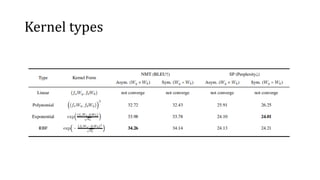
• Empirically study multiple kernel forms and find that the best
kernel is the RBF kernel.
Background
Linear algebra (in real number)
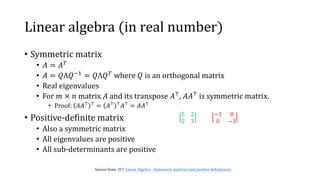
• Symmetric matrix
• 𝐴 = 𝐴 𝑇
• 𝐴 = 𝑄Λ𝑄−1 = 𝑄Λ𝑄 𝑇 where 𝑄 is an orthogonal matrix
• Real eigenvalues
• For 𝑚 × 𝑛 matrix 𝐴 and its transpose 𝐴⊤
, 𝐴𝐴⊤
is symmetric matrix.
• Proof: 𝐴𝐴⊤ ⊤
= 𝐴⊤ ⊤
𝐴⊤
= 𝐴𝐴⊤
• Positive-definite matrix
• Also a symmetric matrix
• All eigenvalues are positive
• All sub-determinants are positive
Source from: MIT Linear Algebra - Symmetric matrices and positive definiteness
5 2
2 3
−1 0
0 −3
Kernels
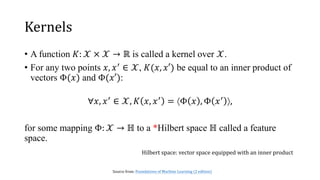
• A function 𝐾: 𝒳 × 𝒳 → ℝ is called a kernel over 𝒳.
• For any two points 𝑥, 𝑥′ ∈ 𝒳, 𝐾(𝑥, 𝑥′) be equal to an inner product of
vectors Φ(𝑥) and Φ(𝑥′):
∀𝑥, 𝑥′ ∈ 𝒳, 𝐾 𝑥, 𝑥′ = Φ 𝑥 , Φ 𝑥′ ,
for some mapping Φ: 𝒳 → ℍ to a *Hilbert space ℍ called a feature
space.
Source from: Foundations of Machine Learning (2 edition)
Hilbert space: vector space equipped with an inner product
Kernel
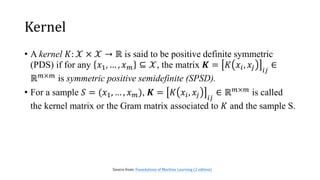
• A kernel 𝐾: 𝒳 × 𝒳 → ℝ is said to be positive definite symmetric
(PDS) if for any 𝑥1, … , 𝑥 𝑚 ⊆ 𝒳, the matrix 𝑲 = 𝐾 𝑥𝑖, 𝑥𝑗 𝑖𝑗
∈
ℝ 𝑚×𝑚 is symmetric positive semidefinite (SPSD).
• For a sample 𝑆 = (𝑥1, … , 𝑥 𝑚), 𝑲 = 𝐾 𝑥𝑖, 𝑥𝑗 𝑖𝑗
∈ ℝ 𝑚×𝑚 is called
the kernel matrix or the Gram matrix associated to 𝐾 and the sample S.
Source from: Foundations of Machine Learning (2 edition)
Kernel type
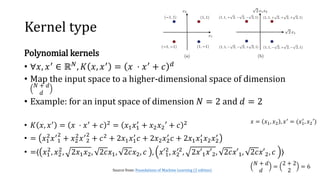
Polynomial kernels
• ∀𝑥, 𝑥′ ∈ ℝ 𝑁, 𝐾 𝑥, 𝑥′ = 𝑥 ⋅ 𝑥′ + 𝑐 𝑑
• Map the input space to a higher-dimensional space of dimension
𝑁 + 𝑑
𝑑
• Example: for an input space of dimension 𝑁 = 2 and 𝑑 = 2
• 𝐾 𝑥, 𝑥′ = 𝑥 ⋅ 𝑥′ + 𝑐 2 = 𝑥1 𝑥1
′
+ 𝑥2 𝑥2′ + 𝑐 2
• = 𝑥1
2
𝑥′
1
2
+ 𝑥2
2
𝑥′
2
2
+ 𝑐2 + 2𝑥1 𝑥1
′
𝑐 + 2𝑥2 𝑥2
′
𝑐 + 2𝑥1 𝑥1
′
𝑥2 𝑥2
′
• =〈 𝑥1
2
, 𝑥2
2
, 2𝑥1 𝑥2, 2𝑐𝑥1, 2𝑐𝑥2, 𝑐 , 𝑥′1
2
, 𝑥2
′2
, 2𝑥′1 𝑥′2, 2𝑐𝑥′1, 2𝑐𝑥′2, 𝑐 〉
Source from: Foundations of Machine Learning (2 edition)
𝑥 = 𝑥1, 𝑥2 , 𝑥′
= (𝑥1
′
, 𝑥2′)
𝑁 + 𝑑
𝑑
=
2 + 2
2
= 6
Kernel type (cont’d)
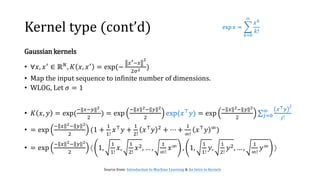
Gaussian kernels
• ∀𝑥, 𝑥′
∈ ℝ 𝑁
, 𝐾 𝑥, 𝑥′
= exp(−
𝑥′−𝑥
2
2𝜎2 )
• Map the input sequence to infinite number of dimensions.
• WLOG, Let 𝜎 = 1
• 𝐾 𝑥, 𝑦 = exp(
−‖𝑥−𝑦‖2
2
) = exp
− 𝑥 2− 𝑦 2
2
exp(𝑥⊤ 𝑦) = exp
− 𝑥 2− 𝑦 2
2
σ 𝑗=0
∞ 𝑥⊤ 𝑦
𝑗
𝑗!
• = exp
− 𝑥 2− 𝑦 2
2
(1 +
1
1!
𝑥⊤ 𝑦 +
1
2!
𝑥⊤ 𝑦 2 + ⋯ +
1
∞!
𝑥⊤ 𝑦 ∞)
• = exp
− 𝑥 2− 𝑦 2
2
 1,
1
1!
𝑥,
1
2!
𝑥2, … ,
1
∞!
𝑥∞ , 1,
1
1!
𝑦,
1
2!
𝑦2, … ,
1
∞!
𝑦∞ 
exp 𝑥 = ෍
𝑘=0
∞
𝑥 𝑘
𝑘!
Source from: Introduction to Machine Learning & An Intro to Kernels
Transformer
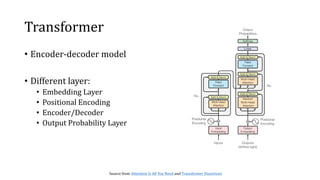
• Encoder-decoder model
• Different layer:
• Embedding Layer
• Positional Encoding
• Encoder/Decoder
• Output Probability Layer
Source from Attention Is All You Need and Transformer Dissection
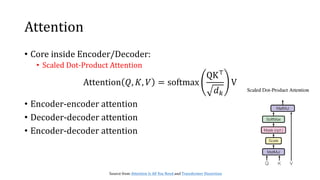
Attention
• Core inside Encoder/Decoder:
• Scaled Dot-Product Attention
Attention 𝑄, 𝐾, 𝑉 = softmax
QK⊤
𝑑 𝑘
V
• Encoder-encoder attention
• Decoder-decoder attention
• Encoder-decoder attention
Source from Attention Is All You Need and Transformer Dissection
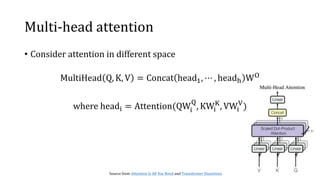
Multi-head attention
• Consider attention in different space
MultiHead Q, K, V = Concat head1, ⋯ , headh WO
where headi = Attention(QWi
Q
, KWi
K
, VWi
V
)
Source from Attention Is All You Need and Transformer Dissection
Attention
• Transformer’s attention is an order-agnostic operation given the
order in the inputs.
• Transformer introduced positional embedding to indicate the
positional relation for the inputs.
• 𝒙 = [𝑥1, 𝑥2, ⋯ , 𝑥 𝑇]
• 𝑥𝑖 = (𝑓𝑖, 𝑡𝑖) with
• 𝑓𝑖 ∈ ℱ non-temporal feature (E.g., word representation, frame in a video etc.)
• 𝑡𝑖 ∈ 𝒯 temporal feature (E.g., sine and cosine functions)
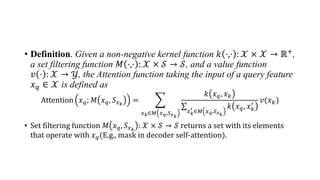
• Definition. Given a non-negative kernel function 𝑘 ⋅,⋅ : 𝒳 × 𝒳 → ℝ+
,
a set filtering function 𝑀 ⋅,⋅ : 𝒳 × 𝒮 → 𝒮, and a value function
𝑣 ⋅ : 𝒳 → 𝒴, the Attention function taking the input of a query feature
𝑥 𝑞 ∈ 𝒳 is defined as
Attention 𝑥 𝑞; 𝑀 𝑥 𝑞, 𝑆 𝑥 𝑘
= ෍
𝑥 𝑘∈𝑀 𝑥 𝑞,𝑆 𝑥 𝑘
𝑘 𝑥 𝑞, 𝑥 𝑘
σ
𝑥 𝑘
′ ∈𝑀 𝑥 𝑞,𝑆 𝑥 𝑘
𝑘 𝑥 𝑞, 𝑥 𝑘
′
𝑣(𝑥 𝑘)
• Set filtering function 𝑀 𝑥 𝑞, 𝑆 𝑥 𝑘
: 𝒳 × 𝒮 → 𝒮 returns a set with its elements
that operate with 𝑥 𝑞(E.g., mask in decoder self-attention).
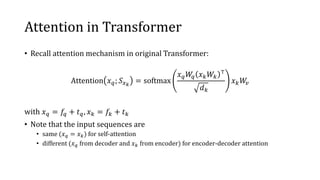
Attention in Transformer
• Recall attention mechanism in original Transformer:
Attention 𝑥 𝑞; 𝑆 𝑥 𝑘
= softmax
𝑥 𝑞 𝑊𝑞 𝑥 𝑘 𝑊𝑘
⊤
𝑑 𝑘
𝑥 𝑘 𝑊𝑣
with 𝑥 𝑞 = 𝑓𝑞 + 𝑡 𝑞, 𝑥 𝑘 = 𝑓𝑘 + 𝑡 𝑘
• Note that the input sequences are
• same (𝑥 𝑞 = 𝑥 𝑘) for self-attention
• different (𝑥 𝑞 from decoder and 𝑥 𝑘 from encoder) for encoder-decoder attention
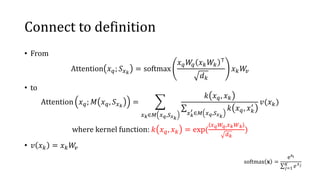
Connect to definition
• From
Attention 𝑥 𝑞; 𝑆 𝑥 𝑘
= softmax
𝑥 𝑞 𝑊𝑞 𝑥 𝑘 𝑊𝑘
⊤
𝑑 𝑘
𝑥 𝑘 𝑊𝑣
• to
Attention 𝑥 𝑞; 𝑀 𝑥 𝑞, 𝑆 𝑥 𝑘
= ෍
𝑥 𝑘∈𝑀 𝑥 𝑞,𝑆 𝑥 𝑘
𝑘 𝑥 𝑞, 𝑥 𝑘
σ
𝑥 𝑘
′ ∈𝑀 𝑥 𝑞,𝑆 𝑥 𝑘
𝑘 𝑥 𝑞, 𝑥 𝑘
′
𝑣(𝑥 𝑘)
where kernel function: 𝑘 𝑥 𝑞, 𝑥 𝑘 = exp(
𝑥 𝑞 𝑊𝑞,𝑥 𝑘 𝑊 𝑘
𝑑 𝑘
)
• 𝑣 𝑥 𝑘 = 𝑥 𝑘 𝑊𝑣
softmax 𝐱 =
exi
σ 𝑗=1
𝐾
𝑒 𝑥 𝑗
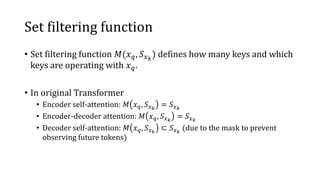
Set filtering function
• Set filtering function 𝑀(𝑥 𝑞, 𝑆 𝑥 𝑘
) defines how many keys and which
keys are operating with 𝑥 𝑞.
• In original Transformer
• Encoder self-attention: 𝑀 𝑥 𝑞, 𝑆 𝑥 𝑘
= 𝑆 𝑥 𝑘
• Encoder-decoder attention: 𝑀 𝑥 𝑞, 𝑆 𝑥 𝑘
= 𝑆 𝑥 𝑘
• Decoder self-attention: 𝑀 𝑥 𝑞, 𝑆 𝑥 𝑘
⊂ 𝑆 𝑥 𝑘
(due to the mask to prevent
observing future tokens)
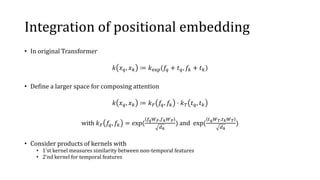
Integration of positional embedding
• In original Transformer
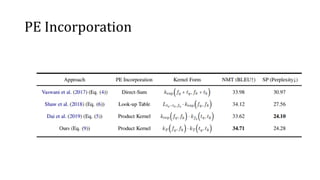
𝑘 𝑥 𝑞, 𝑥 𝑘 ≔ 𝑘exp(𝑓𝑞 + 𝑡 𝑞, 𝑓𝑘 + 𝑡 𝑘)
• Define a larger space for composing attention
𝑘 𝑥 𝑞, 𝑥 𝑘 ≔ 𝑘 𝐹 𝑓𝑞, 𝑓𝑘 ⋅ 𝑘 𝑇 𝑡 𝑞, 𝑡 𝑘
with 𝑘 𝐹 𝑓𝑞, 𝑓𝑘 = exp(
𝑓𝑞 𝑊 𝐹,𝑓 𝑘 𝑊 𝐹
𝑑 𝑘
) and exp(
𝑡 𝑞 𝑊 𝑇,𝑡 𝑘 𝑊 𝑇
𝑑 𝑘
)
• Consider products of kernels with
• 1’st kernel measures similarity between non-temporal features
• 2’nd kernel for temporal features
Experiments
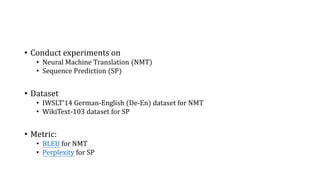
• Conduct experiments on
• Neural Machine Translation (NMT)
• Sequence Prediction (SP)
• Dataset
• IWSLT’14 German-English (De-En) dataset for NMT
• WikiText-103 dataset for SP
• Metric:
• BLEU for NMT
• Perplexity for SP
PE Incorporation
Kernel types
Conclusions
• Present a kernel formulation for the attention mechanism in
Transformer allowing us to define a larger space for designing
attention.
• Study different kernel forms and the ways to integrate positional
embedding on NMT and SP.

Paper Study: Transformer dissection

  • 1.
    Transformer Dissection: AUnified Understanding of Transformer’s Attention via the Lens of Kernel Yao-Hung Hubert Tsai, Shaojie Bai, Makoto Yamada, Louis-Philippe Morency and Ruslan Salakhutdinov CMU, Kyoto University and RIKEN AIP EMNLP 2019
  • 2.
    Abstract • Transformer isa powerful architecture that achieves superior performance in NLP domain. • Present a new formulation of attention via the lens of the kernel. • Achieve competitive performance to the current state of the art model with less computation in the experiments.
  • 3.
    Introduction • Transformer isa relative new architecture outperforming traditional deep learning models such as RNN and Temporal Convolutional Networks (TCNs) in NLP and CV domain. • Instead of performing recurrence or convolution, Transformer concurrently processes the entire sequence in the feed-forward manner.
  • 4.
    Introduction (cont’d) • Atthe core of the Transformer is its attention mechanism, which can be seen as a weighted combination of the input sequence, where the weights are determined by the similarities between elements of the input sequence. • Be inspired to connect Transformer’s attention to kernel learning due to the fact that they both calculate the similarity of given sequences.
  • 5.
    Introduction (cont’d) • Developa new variant of attention which considers a product of symmetric kernels. • Conduct the experiment on neural machine translation and sequence prediction. • Empirically study multiple kernel forms and find that the best kernel is the RBF kernel.
  • 6.
  • 7.
    Linear algebra (inreal number) • Symmetric matrix • 𝐴 = 𝐴 𝑇 • 𝐴 = 𝑄Λ𝑄−1 = 𝑄Λ𝑄 𝑇 where 𝑄 is an orthogonal matrix • Real eigenvalues • For 𝑚 × 𝑛 matrix 𝐴 and its transpose 𝐴⊤ , 𝐴𝐴⊤ is symmetric matrix. • Proof: 𝐴𝐴⊤ ⊤ = 𝐴⊤ ⊤ 𝐴⊤ = 𝐴𝐴⊤ • Positive-definite matrix • Also a symmetric matrix • All eigenvalues are positive • All sub-determinants are positive Source from: MIT Linear Algebra - Symmetric matrices and positive definiteness 5 2 2 3 −1 0 0 −3
  • 8.
    Kernels • A function𝐾: 𝒳 × 𝒳 → ℝ is called a kernel over 𝒳. • For any two points 𝑥, 𝑥′ ∈ 𝒳, 𝐾(𝑥, 𝑥′) be equal to an inner product of vectors Φ(𝑥) and Φ(𝑥′): ∀𝑥, 𝑥′ ∈ 𝒳, 𝐾 𝑥, 𝑥′ = Φ 𝑥 , Φ 𝑥′ , for some mapping Φ: 𝒳 → ℍ to a *Hilbert space ℍ called a feature space. Source from: Foundations of Machine Learning (2 edition) Hilbert space: vector space equipped with an inner product
  • 9.
    Kernel • A kernel𝐾: 𝒳 × 𝒳 → ℝ is said to be positive definite symmetric (PDS) if for any 𝑥1, … , 𝑥 𝑚 ⊆ 𝒳, the matrix 𝑲 = 𝐾 𝑥𝑖, 𝑥𝑗 𝑖𝑗 ∈ ℝ 𝑚×𝑚 is symmetric positive semidefinite (SPSD). • For a sample 𝑆 = (𝑥1, … , 𝑥 𝑚), 𝑲 = 𝐾 𝑥𝑖, 𝑥𝑗 𝑖𝑗 ∈ ℝ 𝑚×𝑚 is called the kernel matrix or the Gram matrix associated to 𝐾 and the sample S. Source from: Foundations of Machine Learning (2 edition)
  • 10.
    Kernel type Polynomial kernels •∀𝑥, 𝑥′ ∈ ℝ 𝑁, 𝐾 𝑥, 𝑥′ = 𝑥 ⋅ 𝑥′ + 𝑐 𝑑 • Map the input space to a higher-dimensional space of dimension 𝑁 + 𝑑 𝑑 • Example: for an input space of dimension 𝑁 = 2 and 𝑑 = 2 • 𝐾 𝑥, 𝑥′ = 𝑥 ⋅ 𝑥′ + 𝑐 2 = 𝑥1 𝑥1 ′ + 𝑥2 𝑥2′ + 𝑐 2 • = 𝑥1 2 𝑥′ 1 2 + 𝑥2 2 𝑥′ 2 2 + 𝑐2 + 2𝑥1 𝑥1 ′ 𝑐 + 2𝑥2 𝑥2 ′ 𝑐 + 2𝑥1 𝑥1 ′ 𝑥2 𝑥2 ′ • =〈 𝑥1 2 , 𝑥2 2 , 2𝑥1 𝑥2, 2𝑐𝑥1, 2𝑐𝑥2, 𝑐 , 𝑥′1 2 , 𝑥2 ′2 , 2𝑥′1 𝑥′2, 2𝑐𝑥′1, 2𝑐𝑥′2, 𝑐 〉 Source from: Foundations of Machine Learning (2 edition) 𝑥 = 𝑥1, 𝑥2 , 𝑥′ = (𝑥1 ′ , 𝑥2′) 𝑁 + 𝑑 𝑑 = 2 + 2 2 = 6
  • 11.
    Kernel type (cont’d) Gaussiankernels • ∀𝑥, 𝑥′ ∈ ℝ 𝑁 , 𝐾 𝑥, 𝑥′ = exp(− 𝑥′−𝑥 2 2𝜎2 ) • Map the input sequence to infinite number of dimensions. • WLOG, Let 𝜎 = 1 • 𝐾 𝑥, 𝑦 = exp( −‖𝑥−𝑦‖2 2 ) = exp − 𝑥 2− 𝑦 2 2 exp(𝑥⊤ 𝑦) = exp − 𝑥 2− 𝑦 2 2 σ 𝑗=0 ∞ 𝑥⊤ 𝑦 𝑗 𝑗! • = exp − 𝑥 2− 𝑦 2 2 (1 + 1 1! 𝑥⊤ 𝑦 + 1 2! 𝑥⊤ 𝑦 2 + ⋯ + 1 ∞! 𝑥⊤ 𝑦 ∞) • = exp − 𝑥 2− 𝑦 2 2  1, 1 1! 𝑥, 1 2! 𝑥2, … , 1 ∞! 𝑥∞ , 1, 1 1! 𝑦, 1 2! 𝑦2, … , 1 ∞! 𝑦∞  exp 𝑥 = ෍ 𝑘=0 ∞ 𝑥 𝑘 𝑘! Source from: Introduction to Machine Learning & An Intro to Kernels
  • 12.
    Transformer • Encoder-decoder model •Different layer: • Embedding Layer • Positional Encoding • Encoder/Decoder • Output Probability Layer Source from Attention Is All You Need and Transformer Dissection
  • 13.
    Attention • Core insideEncoder/Decoder: • Scaled Dot-Product Attention Attention 𝑄, 𝐾, 𝑉 = softmax QK⊤ 𝑑 𝑘 V • Encoder-encoder attention • Decoder-decoder attention • Encoder-decoder attention Source from Attention Is All You Need and Transformer Dissection
  • 14.
    Multi-head attention • Considerattention in different space MultiHead Q, K, V = Concat head1, ⋯ , headh WO where headi = Attention(QWi Q , KWi K , VWi V ) Source from Attention Is All You Need and Transformer Dissection
  • 15.
  • 16.
    • Transformer’s attentionis an order-agnostic operation given the order in the inputs. • Transformer introduced positional embedding to indicate the positional relation for the inputs. • 𝒙 = [𝑥1, 𝑥2, ⋯ , 𝑥 𝑇] • 𝑥𝑖 = (𝑓𝑖, 𝑡𝑖) with • 𝑓𝑖 ∈ ℱ non-temporal feature (E.g., word representation, frame in a video etc.) • 𝑡𝑖 ∈ 𝒯 temporal feature (E.g., sine and cosine functions)
  • 17.
    • Definition. Givena non-negative kernel function 𝑘 ⋅,⋅ : 𝒳 × 𝒳 → ℝ+ , a set filtering function 𝑀 ⋅,⋅ : 𝒳 × 𝒮 → 𝒮, and a value function 𝑣 ⋅ : 𝒳 → 𝒴, the Attention function taking the input of a query feature 𝑥 𝑞 ∈ 𝒳 is defined as Attention 𝑥 𝑞; 𝑀 𝑥 𝑞, 𝑆 𝑥 𝑘 = ෍ 𝑥 𝑘∈𝑀 𝑥 𝑞,𝑆 𝑥 𝑘 𝑘 𝑥 𝑞, 𝑥 𝑘 σ 𝑥 𝑘 ′ ∈𝑀 𝑥 𝑞,𝑆 𝑥 𝑘 𝑘 𝑥 𝑞, 𝑥 𝑘 ′ 𝑣(𝑥 𝑘) • Set filtering function 𝑀 𝑥 𝑞, 𝑆 𝑥 𝑘 : 𝒳 × 𝒮 → 𝒮 returns a set with its elements that operate with 𝑥 𝑞(E.g., mask in decoder self-attention).
  • 18.
    Attention in Transformer •Recall attention mechanism in original Transformer: Attention 𝑥 𝑞; 𝑆 𝑥 𝑘 = softmax 𝑥 𝑞 𝑊𝑞 𝑥 𝑘 𝑊𝑘 ⊤ 𝑑 𝑘 𝑥 𝑘 𝑊𝑣 with 𝑥 𝑞 = 𝑓𝑞 + 𝑡 𝑞, 𝑥 𝑘 = 𝑓𝑘 + 𝑡 𝑘 • Note that the input sequences are • same (𝑥 𝑞 = 𝑥 𝑘) for self-attention • different (𝑥 𝑞 from decoder and 𝑥 𝑘 from encoder) for encoder-decoder attention
  • 19.
    Connect to definition •From Attention 𝑥 𝑞; 𝑆 𝑥 𝑘 = softmax 𝑥 𝑞 𝑊𝑞 𝑥 𝑘 𝑊𝑘 ⊤ 𝑑 𝑘 𝑥 𝑘 𝑊𝑣 • to Attention 𝑥 𝑞; 𝑀 𝑥 𝑞, 𝑆 𝑥 𝑘 = ෍ 𝑥 𝑘∈𝑀 𝑥 𝑞,𝑆 𝑥 𝑘 𝑘 𝑥 𝑞, 𝑥 𝑘 σ 𝑥 𝑘 ′ ∈𝑀 𝑥 𝑞,𝑆 𝑥 𝑘 𝑘 𝑥 𝑞, 𝑥 𝑘 ′ 𝑣(𝑥 𝑘) where kernel function: 𝑘 𝑥 𝑞, 𝑥 𝑘 = exp( 𝑥 𝑞 𝑊𝑞,𝑥 𝑘 𝑊 𝑘 𝑑 𝑘 ) • 𝑣 𝑥 𝑘 = 𝑥 𝑘 𝑊𝑣 softmax 𝐱 = exi σ 𝑗=1 𝐾 𝑒 𝑥 𝑗
  • 20.
    Set filtering function •Set filtering function 𝑀(𝑥 𝑞, 𝑆 𝑥 𝑘 ) defines how many keys and which keys are operating with 𝑥 𝑞. • In original Transformer • Encoder self-attention: 𝑀 𝑥 𝑞, 𝑆 𝑥 𝑘 = 𝑆 𝑥 𝑘 • Encoder-decoder attention: 𝑀 𝑥 𝑞, 𝑆 𝑥 𝑘 = 𝑆 𝑥 𝑘 • Decoder self-attention: 𝑀 𝑥 𝑞, 𝑆 𝑥 𝑘 ⊂ 𝑆 𝑥 𝑘 (due to the mask to prevent observing future tokens)
  • 21.
    Integration of positionalembedding • In original Transformer 𝑘 𝑥 𝑞, 𝑥 𝑘 ≔ 𝑘exp(𝑓𝑞 + 𝑡 𝑞, 𝑓𝑘 + 𝑡 𝑘) • Define a larger space for composing attention 𝑘 𝑥 𝑞, 𝑥 𝑘 ≔ 𝑘 𝐹 𝑓𝑞, 𝑓𝑘 ⋅ 𝑘 𝑇 𝑡 𝑞, 𝑡 𝑘 with 𝑘 𝐹 𝑓𝑞, 𝑓𝑘 = exp( 𝑓𝑞 𝑊 𝐹,𝑓 𝑘 𝑊 𝐹 𝑑 𝑘 ) and exp( 𝑡 𝑞 𝑊 𝑇,𝑡 𝑘 𝑊 𝑇 𝑑 𝑘 ) • Consider products of kernels with • 1’st kernel measures similarity between non-temporal features • 2’nd kernel for temporal features
  • 22.
  • 23.
    • Conduct experimentson • Neural Machine Translation (NMT) • Sequence Prediction (SP) • Dataset • IWSLT’14 German-English (De-En) dataset for NMT • WikiText-103 dataset for SP • Metric: • BLEU for NMT • Perplexity for SP
  • 24.
  • 25.
  • 26.
    Conclusions • Present akernel formulation for the attention mechanism in Transformer allowing us to define a larger space for designing attention. • Study different kernel forms and the ways to integrate positional embedding on NMT and SP.