
andand
thethe GGoldenolden
RRatioatio
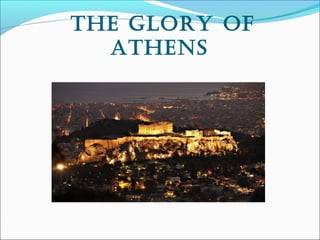
the GloRy of
athens
What PaRthenon stands
foR
A Masterpiece of Classic Age, 5th
B.C.
Not only a Temple dedicated to goddess
Athena
Mostly a Sculpture manifesting the Athenian
Imperium at its full Power and Sovereign
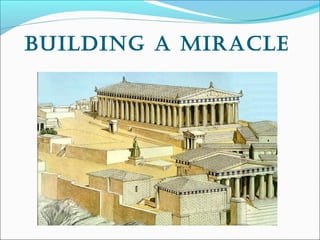
BuildinG a miRacle
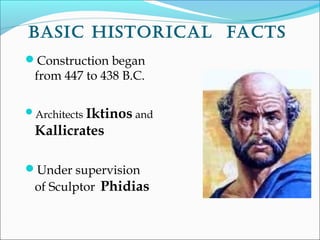
Basic histoRical facts
Construction began
from 447 to 438 B.C.
Architects Iktinos and
Kallicrates
Under supervision
of Sculptor Phidias
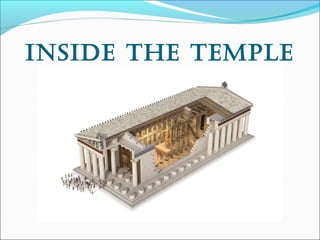
inside the temPle
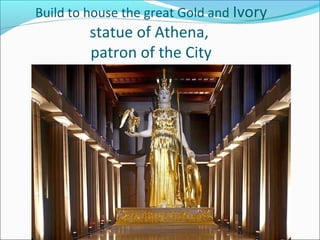
Build to house the great Gold and Ivory
statue of Athena,
patron of the City
aRchitectuRal featuRes
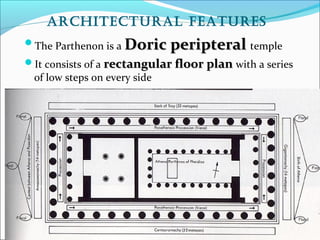
The Parthenon is a Doric peripteralDoric peripteral temple
It consists of a rectangular floor planrectangular floor plan with a series
of low steps on every side
The OuTer
sTrucTure
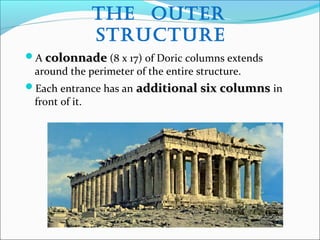
A colonnadecolonnade (8 x 17) of Doric columns extends
around the perimeter of the entire structure.
Each entrance has an additional six columnsadditional six columns in
front of it.
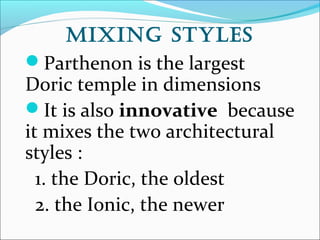
Mixing sTyles
Parthenon is the largest
Doric temple in dimensions
It is also innovative because
it mixes the two architectural
styles :
1. the Doric, the oldest
2. the Ionic, the newer
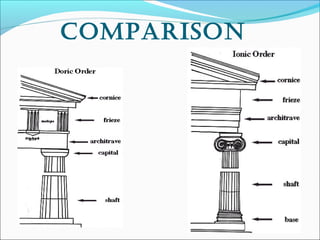
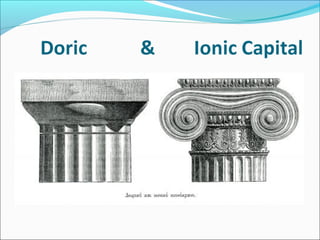
cOMparisOn
WhaT abOuT gOlden
raTiO ? The debaTe …
Some believe that Parthenon illustrates
the application of Golden Ratio in design
Others debate on the matter asserting that
Golden Ratio was not used in its design
The Truth always comes in between …
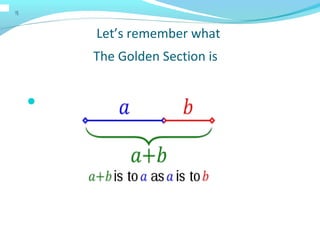
Let’s remember what
The Golden Section is

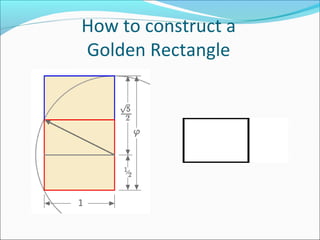
How to construct a
Golden Rectangle
challenging facTs
abOuT parThenOn
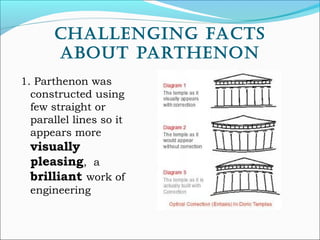
1. Parthenon was
constructed using
few straight or
parallel lines so it
appears more
visually
pleasing, a
brilliant work of
engineering
2. Even if Golden Ratio wasn’t intentionally
used in its design, Golden Ratio
proportions appear on the structure
and dimensions of Parthenon
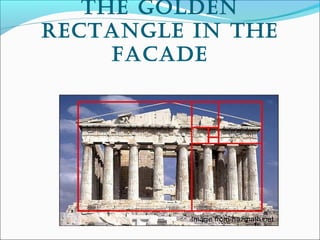
The golden
recTangle in The
facade
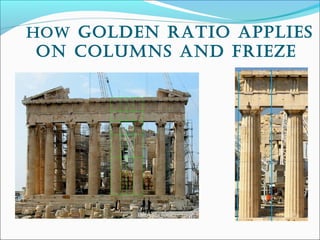
how golden raTio applies
on columns and frieze
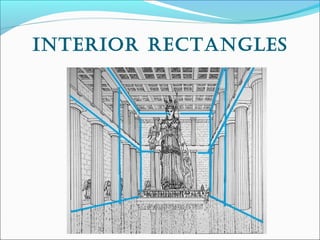
inTerior recTangles
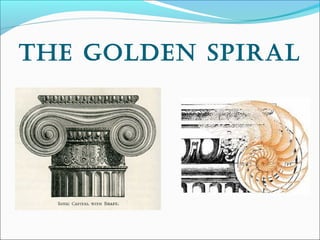
The golden spiral
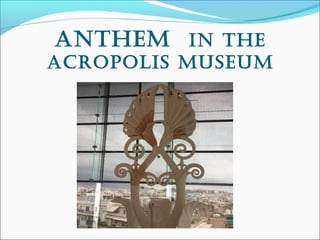
anThem in The
acropolis museum
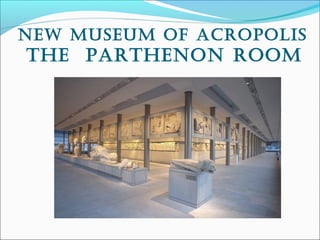
new museum of acropolis
The parThenon room
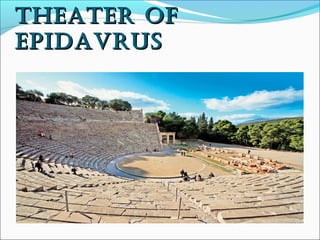
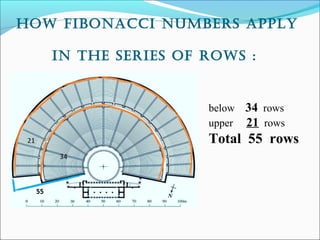
TheaTer ofTheaTer of
epidavrusepidavrus
How Fibonacci numbers apply
in tHe series oF rows :
below 34 rows
upper 21 rows
Total 55 rows
Coming to Conclusions
Maths and Art : a Harmony Conjuction
Had Greeks of the 5th
century B.C. full knowledge and
intentionally used Golden Ratio Proportions to build
temples, theaters, statues and various work of art ?
How is Harmony expressed in Art ?
How do humans evaluate Beauty ?
Maths & Art : a Harmony Conjuction
Ancient Greeks used many proportions on their
artistic creations, not Golden Ratio alone
Beauty in Art isn’t measured by geometry alone
Our perception of Beauty is not fully explained yet by
psychologists
The human Eye is most likely to admire Golden
Proportions on masterpieces of Art
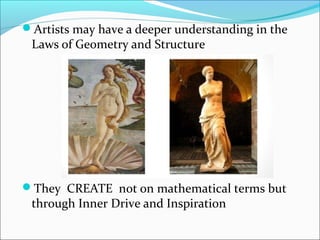
Artists may have a deeper understanding in the
Laws of Geometry and Structure
They CREATE not on mathematical terms but
through Inner Drive and Inspiration
Resources

Parthenon and golden ratio

Editor's Notes

  • #3 Parthenon not only a landmark but mostly a masterpiece showing off Athenian Power LeCorbusier calls it a Sculpture not only a temple
  • #5 Acropolis is a hill in the heart of city of Athens Many public building and services were founded on it. Actually, the heart of the city was beating on it and in the surrounding
  • #7 First of all I’d like to show you some basic architectural features, before we proceed to of golden ratio on Parthenon
  • #9 Looking from above : 1. It consists of a rectangular floor plan with a series of low steps on every side, 2. and a colonnade (8 x 17) of Doric columns extending around the perimetry of the entire structure. Each entrance has an additional six columns in front of it. The larger of the two interior rooms, the naos, housed the cult statue. The smaller room (the opisthodomos) was used as a treasury.
  • #10 The outside
  • #11 What is : 1. The Doric order much older , 2. The Ionic, the newer
  • #12 How to distinguish between two orders. The main difference is on the style of columns and capital
  • #14 Not intentionally at least
  • #15 A way to separate a straight line in two parts, not exactly in the middle, but in a way most pleasing to the eye Pythagoras first noticed and theorised on this cut, which is perceived to appears most pleasing to the human eye. In mathematics, two quantities are in the golden ratio if their ratio is the same as the ratio of their sum to the larger of the two quantities. The figure on the right illustrates the geometric relationship. Expressed algebraically, for quantities a and b with a > b > 0,
  • #17 Parthenon is an optical illusion. Full of curves
  • #19 This is how the face of Parthenon is divided in two Golden Rectangles consisting of six smaller ones
  • #23 One of the sculptures you’ ll see tomorrow in the museum expressing golden spiral