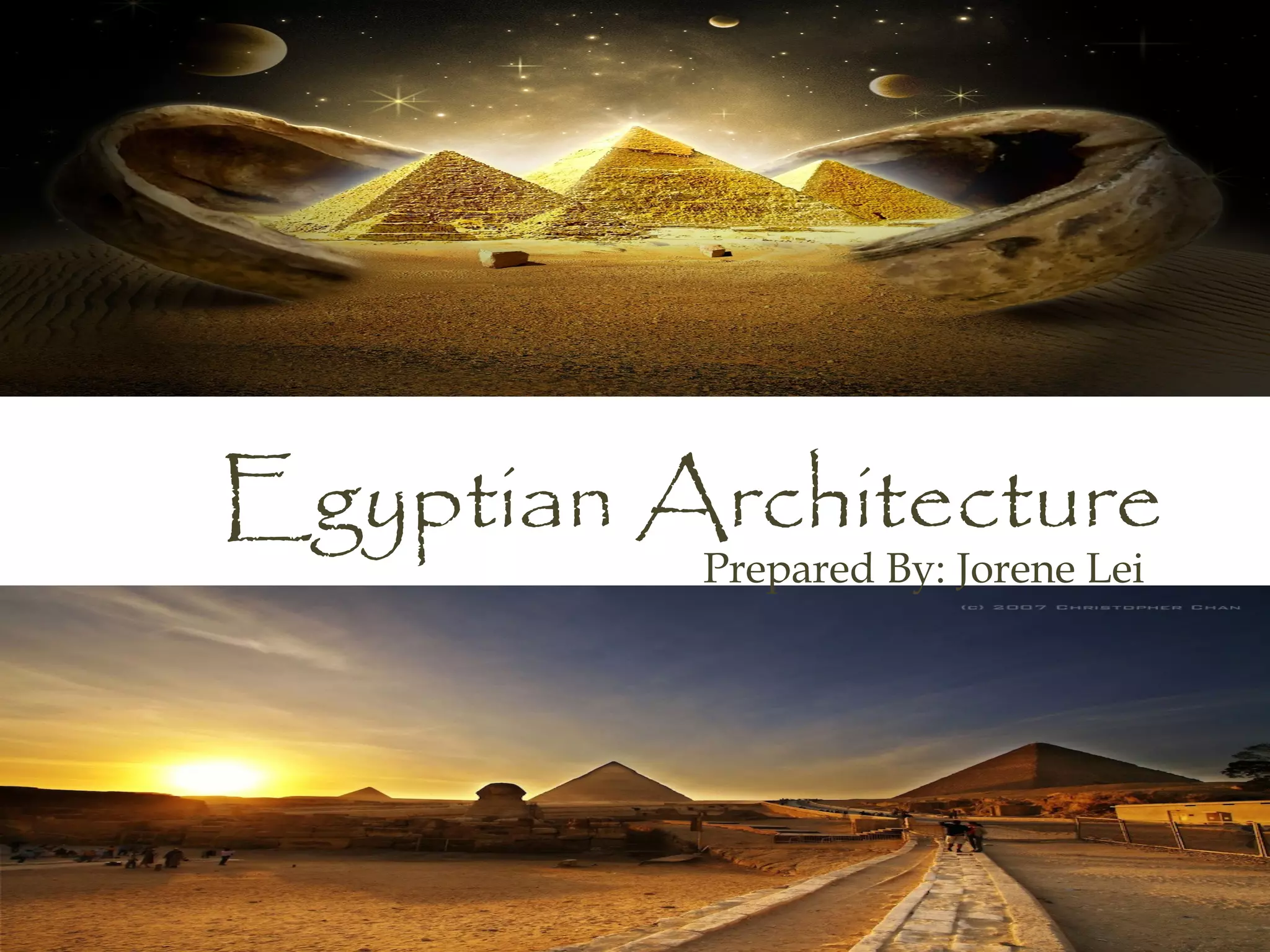
Egyptian Architecture
          Prepared By: Jorene Lei
Introduction


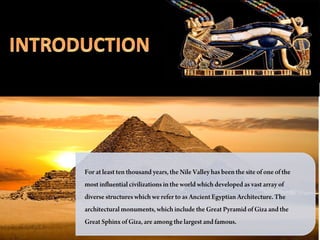
For at least ten thousand years, the Nile Valley has been the site of one of the
most influential civilizations in the world which developed as vast array of
diverse structures which we refer to as Ancient Egyptian Architecture. The
architectural monuments, which include the Great Pyramid of Giza and the
Great Sphinx of Giza, are among the largest and famous.
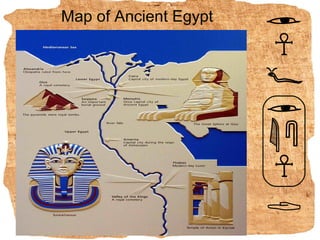
Map of Ancient Egypt
Characteristics of
 EGYPTIAN Architecture:
• Architecture - The style developed during the Pre-
  dynastic period remained unchanged for 2000 years
• Crafts & Sculpture  - Symbolic elements were widely
  used and strict laws were applied
• Paintings  - The pictures found in Egyptian tombs
  were connected with the idea of afterlife.

Due to the scarcity of wood. the two predominant
  building materials used in ancient Egypt were sun-
  baked mud brick and stone, mainly limestone, but
  also sandstone and granite in considerable quantities.
Characteristics of
 EGYPTIAN Architecture:
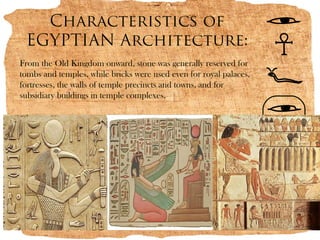
From the Old Kingdom onward, stone was generally reserved for
tombs and temples, while bricks were used even for royal palaces,
fortresses, the walls of temple precincts and towns, and for
subsidiary buildings in temple complexes.
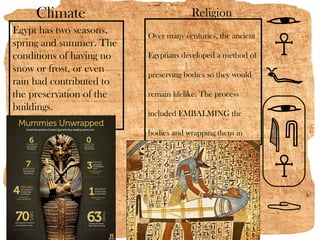
Climate                            Religion
Egypt has two seasons,    Over many centuries, the ancient
spring and summer. The
conditions of having no   Egyptians developed a method of
snow or frost, or even
                          preserving bodies so they would
rain had contributed to
the preservation of the   remain lifelike. The process
buildings.
                          included EMBALMING the

                          bodies and wrapping them in

                          strips of linen. Today we call this

                          process mummification.
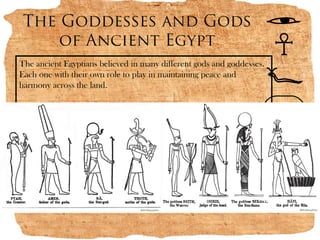
The Goddesses and Gods
    of Ancient Egypt
The ancient Egyptians believed in many different gods and goddesses.
Each one with their own role to play in maintaining peace and
harmony across the land.
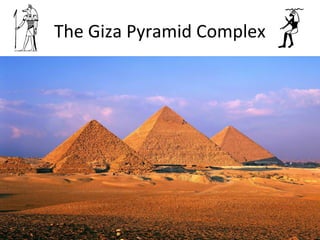
The Giza Pyramid Complex
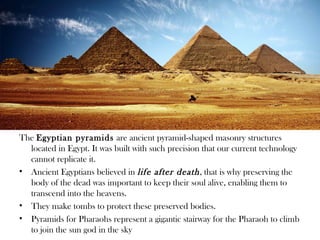
The Egyptian pyramids are ancient pyramid-shaped masonry structures
  located in Egypt. It was built with such precision that our current technology
  cannot replicate it.
• Ancient Egyptians believed in life after death , that is why preserving the
  body of the dead was important to keep their soul alive, enabling them to
  transcend into the heavens.
• They make tombs to protect these preserved bodies.
• Pyramids for Pharaohs represent a gigantic stairway for the Pharaoh to climb
  to join the sun god in the sky
Description:


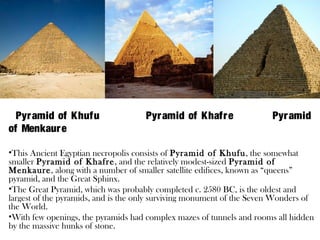
  Pyr amid of Khufu                  Pyr amid of Khafr e               Pyr amid
of Menkaur e

•This Ancient Egyptian necropolis consists of Pyramid of Khufu, the somewhat
smaller Pyramid of Khafre , and the relatively modest-sized Pyramid of
Menkaure, along with a number of smaller satellite edifices, known as “queens”
pyramid, and the Great Sphinx.
•The Great Pyramid, which was probably completed c. 2580 BC, is the oldest and
largest of the pyramids, and is the only surviving monument of the Seven Wonders of
the World.
•With few openings, the pyramids had complex mazes of tunnels and rooms all hidden
by the massive hunks of stone.
Inside the Pyramid
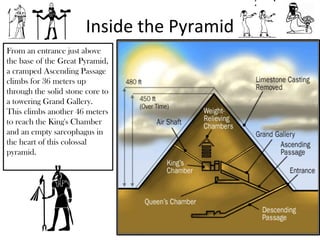
From an entrance just above
the base of the Great Pyramid,
a cramped Ascending Passage
climbs for 36 meters up
through the solid stone core to
a towering Grand Gallery. 
This climbs another 46 meters
to reach the King's Chamber
and an empty sarcophagus in
the heart of this colossal
pyramid. 
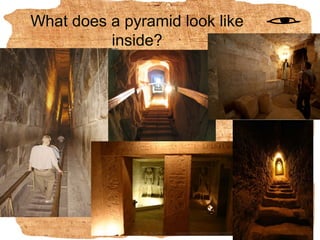
What does a pyramid look like
          inside?
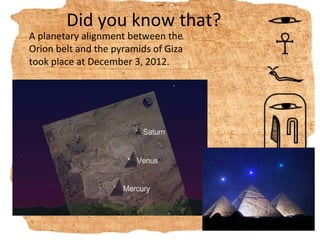
Did you know that?
A planetary alignment between the
Orion belt and the pyramids of Giza
took place at December 3, 2012.
Did you know that?
•   The relationship between Pi (p) and Phi (F) is expressed
    in the fundamental proportions of the Great Pyramid.
    The key to this relationship is knowledge of the value of
    Pi and designing the angle of the pyramid to be exactly
    51 degrees, 51 minutes, and 14.3 seconds.
•   The pyramid is estimated to have about 2,300,000 stone
    blocks weighing from 2-30 Tons each with some
    weighing as much as 70 tons
•   The Great Pyramid is located at the center of the land
    mass of the earth. The east/west parallel that crosses
    the most land and the north/south meridian that crosses
    the most land intersect in two places on the earth, one in
    the ocean and the other at the Great Pyramid.
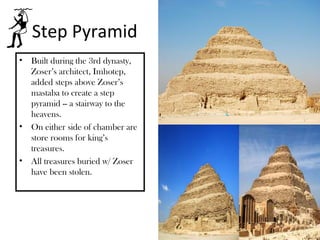
Step Pyramid
•   Built during the 3rd dynasty,
    Zoser’s architect, Imhotep,
    added steps above Zoser’s
    mastaba to create a step
    pyramid -- a stairway to the
    heavens.
•   On either side of chamber are
    store rooms for king’s
    treasures.
•   All treasures buried w/ Zoser
    have been stolen.
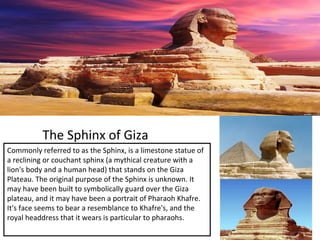
The Sphinx of Giza
Commonly referred to as the Sphinx, is a limestone statue of
a reclining or couchant sphinx (a mythical creature with a
lion's body and a human head) that stands on the Giza
Plateau. The original purpose of the Sphinx is unknown. It
may have been built to symbolically guard over the Giza
plateau, and it may have been a portrait of Pharaoh Khafre.
It's face seems to bear a resemblance to Khafre's, and the
royal headdress that it wears is particular to pharaohs.
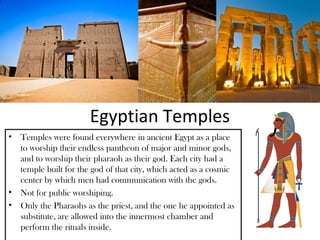
Egyptian Temples
• Temples were found everywhere in ancient Egypt as a place
  to worship their endless pantheon of major and minor gods,
  and to worship their pharaoh as their god. Each city had a
  temple built for the god of that city, which acted as a cosmic
  center by which men had communication with the gods.
• Not for public worshiping.
• Only the Pharaohs as the priest, and the one he appointed as
  substitute, are allowed into the innermost chamber and
  perform the rituals inside.
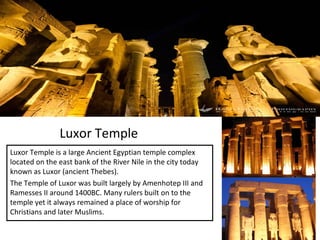
Luxor Temple
Luxor Temple is a large Ancient Egyptian temple complex
located on the east bank of the River Nile in the city today
known as Luxor (ancient Thebes).
The Temple of Luxor was built largely by Amenhotep III and
Ramesses II around 1400BC. Many rulers built on to the
temple yet it always remained a place of worship for
Christians and later Muslims.
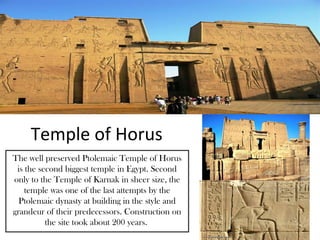
Temple of Horus
The well preserved Ptolemaic Temple of Horus
 is the second biggest temple in Egypt. Second
only to the Temple of Karnak in sheer size, the
    temple was one of the last attempts by the
  Ptolemaic dynasty at building in the style and
grandeur of their predecessors. Construction on
          the site took about 200 years.
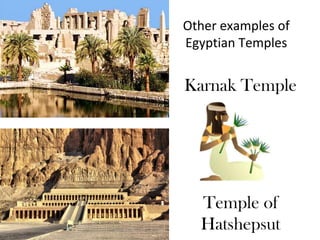
Other examples of
Egyptian Temples


Karnak Temple


  Temple of
  Hatshepsut
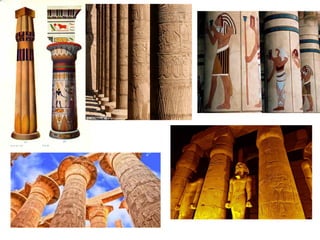
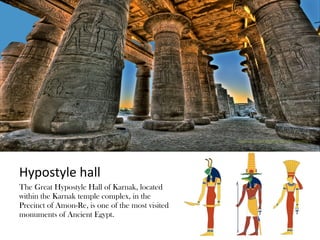
Hypostyle hall
The Great Hypostyle Hall of Karnak, located
within the Karnak temple complex, in the
Precinct of Amon-Re, is one of the most visited
monuments of Ancient Egypt.
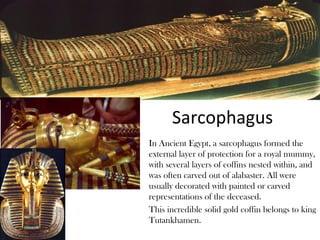
Sarcophagus
In Ancient Egypt, a sarcophagus formed the
external layer of protection for a royal mummy,
with several layers of coffins nested within, and
was often carved out of alabaster. All were
usually decorated with painted or carved
representations of the deceased.
This incredible solid gold coffin belongs to king
Tutankhamen.
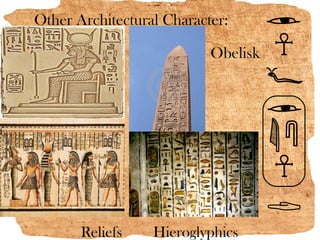
Other Architectural Character:

                           Obelisk


       Reliefs    Hieroglyphics
Did you know that?
• Egyptians invented the 365 days calendar.
• The Great Pyramid has always been a mysterious symbol. It
  has attracted the attention of a virtual directory of the orthodox
  as well as unconventional disciplines.
• Ancient Egyptian writings often talk of beings from the sky, the
  sky opening and bright lights coming down to teach them
  technology and give them wisdom. Many pictures and symbols
  resemble UFOs and aliens.
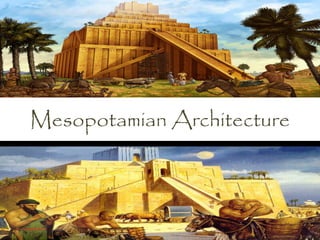
Mesopotamian Architecture
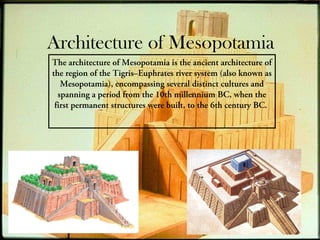
Architecture of Mesopotamia
The architecture of Mesopotamia is the ancient architecture of
the region of the Tigris–Euphrates river system (also known as
   Mesopotamia), encompassing several distinct cultures and
  spanning a period from the 10th millennium BC, when the
 first permanent structures were built, to the 6th century BC.
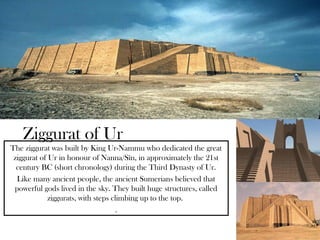
Ziggurat of Ur
The ziggurat was built by King Ur-Nammu who dedicated the great
 ziggurat of Ur in honour of Nanna/Sîn, in approximately the 21st
  century BC (short chronology) during the Third Dynasty of Ur.
  Like many ancient people, the ancient Sumerians believed that
 powerful gods lived in the sky. They built huge structures, called
             ziggurats, with steps climbing up to the top.
                                     .
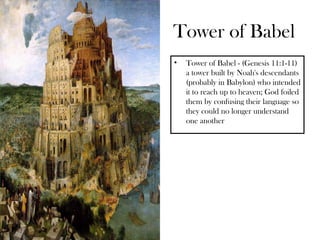
Tower of Babel
•   Tower of Babel - (Genesis 11:1-11)
    a tower built by Noah's descendants
    (probably in Babylon) who intended
    it to reach up to heaven; God foiled
    them by confusing their language so
    they could no longer understand
    one another
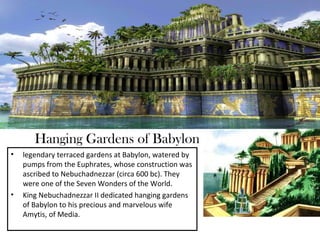
Hanging Gardens of Babylon
•   legendary terraced gardens at Babylon, watered by
    pumps from the Euphrates, whose construction was
    ascribed to Nebuchadnezzar (circa 600 bc). They
    were one of the Seven Wonders of the World.
•   King Nebuchadnezzar II dedicated hanging gardens
    of Babylon to his precious and marvelous wife
    Amytis, of Media.
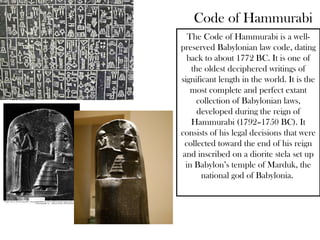
Code of Hammurabi
   The Code of Hammurabi is a well-
preserved Babylonian law code, dating
  back to about 1772 BC. It is one of
    the oldest deciphered writings of
significant length in the world. It is the
    most complete and perfect extant
      collection of Babylonian laws,
      developed during the reign of
    Hammurabi (1792–1750 BC). It
consists of his legal decisions that were
 collected toward the end of his reign
 and inscribed on a diorite stela set up
  in Babylon’s temple of Marduk, the
       national god of Babylonia.
Egyptian Architecture and Mesopotamian Architecture

Egyptian Architecture and Mesopotamian Architecture

  • 1.
    Egyptian Architecture Prepared By: Jorene Lei
  • 3.
    Introduction For at leastten thousand years, the Nile Valley has been the site of one of the most influential civilizations in the world which developed as vast array of diverse structures which we refer to as Ancient Egyptian Architecture. The architectural monuments, which include the Great Pyramid of Giza and the Great Sphinx of Giza, are among the largest and famous.
  • 4.
  • 5.
    Characteristics of EGYPTIANArchitecture: • Architecture - The style developed during the Pre- dynastic period remained unchanged for 2000 years • Crafts & Sculpture  - Symbolic elements were widely used and strict laws were applied • Paintings  - The pictures found in Egyptian tombs were connected with the idea of afterlife. Due to the scarcity of wood. the two predominant building materials used in ancient Egypt were sun- baked mud brick and stone, mainly limestone, but also sandstone and granite in considerable quantities.
  • 6.
    Characteristics of EGYPTIANArchitecture: From the Old Kingdom onward, stone was generally reserved for tombs and temples, while bricks were used even for royal palaces, fortresses, the walls of temple precincts and towns, and for subsidiary buildings in temple complexes.
  • 8.
    Climate Religion Egypt has two seasons, Over many centuries, the ancient spring and summer. The conditions of having no Egyptians developed a method of snow or frost, or even preserving bodies so they would rain had contributed to the preservation of the remain lifelike. The process buildings. included EMBALMING the bodies and wrapping them in strips of linen. Today we call this process mummification.
  • 9.
    The Goddesses andGods of Ancient Egypt The ancient Egyptians believed in many different gods and goddesses. Each one with their own role to play in maintaining peace and harmony across the land.
  • 10.
  • 11.
    The Egyptian pyramidsare ancient pyramid-shaped masonry structures located in Egypt. It was built with such precision that our current technology cannot replicate it. • Ancient Egyptians believed in life after death , that is why preserving the body of the dead was important to keep their soul alive, enabling them to transcend into the heavens. • They make tombs to protect these preserved bodies. • Pyramids for Pharaohs represent a gigantic stairway for the Pharaoh to climb to join the sun god in the sky
  • 12.
    Description: Pyramid of Khufu Pyr amid of Khafr e Pyr amid of Menkaur e •This Ancient Egyptian necropolis consists of Pyramid of Khufu, the somewhat smaller Pyramid of Khafre , and the relatively modest-sized Pyramid of Menkaure, along with a number of smaller satellite edifices, known as “queens” pyramid, and the Great Sphinx. •The Great Pyramid, which was probably completed c. 2580 BC, is the oldest and largest of the pyramids, and is the only surviving monument of the Seven Wonders of the World. •With few openings, the pyramids had complex mazes of tunnels and rooms all hidden by the massive hunks of stone.
  • 13.
    Inside the Pyramid Froman entrance just above the base of the Great Pyramid, a cramped Ascending Passage climbs for 36 meters up through the solid stone core to a towering Grand Gallery.  This climbs another 46 meters to reach the King's Chamber and an empty sarcophagus in the heart of this colossal pyramid. 
  • 14.
    What does apyramid look like inside?
  • 15.
    Did you knowthat? A planetary alignment between the Orion belt and the pyramids of Giza took place at December 3, 2012.
  • 16.
    Did you knowthat? • The relationship between Pi (p) and Phi (F) is expressed in the fundamental proportions of the Great Pyramid. The key to this relationship is knowledge of the value of Pi and designing the angle of the pyramid to be exactly 51 degrees, 51 minutes, and 14.3 seconds. • The pyramid is estimated to have about 2,300,000 stone blocks weighing from 2-30 Tons each with some weighing as much as 70 tons • The Great Pyramid is located at the center of the land mass of the earth. The east/west parallel that crosses the most land and the north/south meridian that crosses the most land intersect in two places on the earth, one in the ocean and the other at the Great Pyramid.
  • 17.
    Step Pyramid • Built during the 3rd dynasty, Zoser’s architect, Imhotep, added steps above Zoser’s mastaba to create a step pyramid -- a stairway to the heavens. • On either side of chamber are store rooms for king’s treasures. • All treasures buried w/ Zoser have been stolen.
  • 18.
    The Sphinx ofGiza Commonly referred to as the Sphinx, is a limestone statue of a reclining or couchant sphinx (a mythical creature with a lion's body and a human head) that stands on the Giza Plateau. The original purpose of the Sphinx is unknown. It may have been built to symbolically guard over the Giza plateau, and it may have been a portrait of Pharaoh Khafre. It's face seems to bear a resemblance to Khafre's, and the royal headdress that it wears is particular to pharaohs.
  • 19.
    Egyptian Temples • Templeswere found everywhere in ancient Egypt as a place to worship their endless pantheon of major and minor gods, and to worship their pharaoh as their god. Each city had a temple built for the god of that city, which acted as a cosmic center by which men had communication with the gods. • Not for public worshiping. • Only the Pharaohs as the priest, and the one he appointed as substitute, are allowed into the innermost chamber and perform the rituals inside.
  • 20.
    Luxor Temple Luxor Templeis a large Ancient Egyptian temple complex located on the east bank of the River Nile in the city today known as Luxor (ancient Thebes). The Temple of Luxor was built largely by Amenhotep III and Ramesses II around 1400BC. Many rulers built on to the temple yet it always remained a place of worship for Christians and later Muslims.
  • 21.
    Temple of Horus Thewell preserved Ptolemaic Temple of Horus is the second biggest temple in Egypt. Second only to the Temple of Karnak in sheer size, the temple was one of the last attempts by the Ptolemaic dynasty at building in the style and grandeur of their predecessors. Construction on the site took about 200 years.
  • 22.
    Other examples of EgyptianTemples Karnak Temple Temple of Hatshepsut
  • 23.
    Hypostyle hall The GreatHypostyle Hall of Karnak, located within the Karnak temple complex, in the Precinct of Amon-Re, is one of the most visited monuments of Ancient Egypt.
  • 24.
    Sarcophagus In Ancient Egypt,a sarcophagus formed the external layer of protection for a royal mummy, with several layers of coffins nested within, and was often carved out of alabaster. All were usually decorated with painted or carved representations of the deceased. This incredible solid gold coffin belongs to king Tutankhamen.
  • 25.
    Other Architectural Character: Obelisk Reliefs Hieroglyphics
  • 26.
    Did you knowthat? • Egyptians invented the 365 days calendar. • The Great Pyramid has always been a mysterious symbol. It has attracted the attention of a virtual directory of the orthodox as well as unconventional disciplines. • Ancient Egyptian writings often talk of beings from the sky, the sky opening and bright lights coming down to teach them technology and give them wisdom. Many pictures and symbols resemble UFOs and aliens.
  • 27.
  • 28.
    Architecture of Mesopotamia Thearchitecture of Mesopotamia is the ancient architecture of the region of the Tigris–Euphrates river system (also known as Mesopotamia), encompassing several distinct cultures and spanning a period from the 10th millennium BC, when the first permanent structures were built, to the 6th century BC.
  • 29.
    Ziggurat of Ur Theziggurat was built by King Ur-Nammu who dedicated the great ziggurat of Ur in honour of Nanna/Sîn, in approximately the 21st century BC (short chronology) during the Third Dynasty of Ur. Like many ancient people, the ancient Sumerians believed that powerful gods lived in the sky. They built huge structures, called ziggurats, with steps climbing up to the top. .
  • 30.
    Tower of Babel • Tower of Babel - (Genesis 11:1-11) a tower built by Noah's descendants (probably in Babylon) who intended it to reach up to heaven; God foiled them by confusing their language so they could no longer understand one another
  • 31.
    Hanging Gardens ofBabylon • legendary terraced gardens at Babylon, watered by pumps from the Euphrates, whose construction was ascribed to Nebuchadnezzar (circa 600 bc). They were one of the Seven Wonders of the World. • King Nebuchadnezzar II dedicated hanging gardens of Babylon to his precious and marvelous wife Amytis, of Media.
  • 32.
    Code of Hammurabi The Code of Hammurabi is a well- preserved Babylonian law code, dating back to about 1772 BC. It is one of the oldest deciphered writings of significant length in the world. It is the most complete and perfect extant collection of Babylonian laws, developed during the reign of Hammurabi (1792–1750 BC). It consists of his legal decisions that were collected toward the end of his reign and inscribed on a diorite stela set up in Babylon’s temple of Marduk, the national god of Babylonia.