GOLDEN RATIO IN ARCHITECTURE
RIYA BAGCHI
III YEAR ‘B’
ROLL NO. 22
GOLDEN RATIO IN ARCHITECTURE
THEORY OF ARCHITECTURE
RIYA BAGCHI
III YEAR B
ROLL NO. 22
SHEET
2
INTRODUCTION
The golden ratio, also known as the divine
proportion, golden mean, or golden section, is a
number often encountered when taking the
ratios of distances in simple geometric figures
such as the pentagon, pentagram, decagon and
dodecahedron. It is denoted phi, or sometimes
tau.
In Euclid’s words, a straight line is said to have
been cut in extreme and mean ratio as the
whole line is to the greater segment, so is the
greater to the lesser.
If the ratio of the length AC to that of CB is the
same as the ratio of AB to AC, then the line has
been cut in extreme and mean ratio, or in a
Golden Ratio.
The Golden Ratio is thus the ratio of the larger
sub segment to the smaller.
If the whole segment has length 1 and the larger
sub segment has length x, then:
GOLDEN RECTANGLE
Solving this equation, we get
X = (1+ 5) / 2 ≈ 1.618
The Egyptians thought that the golden ratio was
sacred. They thought that if the proportions of their
buildings weren't according to the golden ratio, the
deceased might not make it to the afterlife or the
temple would not be pleasing to the gods.
The pyraminds is one of the oldest structures on the
face of the Earth and was built around 2560 BC .
This Egyptian pyramid is remarkably close to a
"golden pyramid"
The golden rectangle based on Fibonacci series, is the one whose side lengths are in golden ratio.
a
b
a
a b
b
a/b = (a+b)/a
This fraction, (a+b)/a, is called the golden
ratio.
EGYPTIAN PYRAMIDS
The Golden Ratio is the relationship
between two numbers on the
Fibonacci Series where plotting the
relationships on scale results in a
spiral shape.
GOLDEN RATIO IN ARCHITECTURE
THEORY OF ARCHITECTURE
RIYA BAGCHI
III YEAR B
ROLL NO. 22
SHEET
3
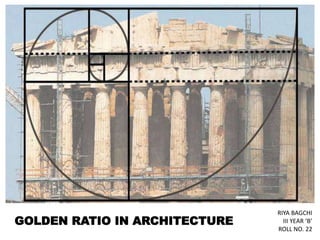
GOLDEN RATIO IN PARTHENON, GREECE
The Parthenon, showing a golden spiral overlay, illustrating a phi, or golden
ratio proportions.
•The Parthenon was constructed using few straight or parallel
lines to make it appear more visually pleasing, a brilliant feat of
engineering.
•It is now in ruins, making its original features and height
dimension subject to some conjecture.
•Even if the Golden Ratio wasn’t used intentionally in its design,
Golden Ratio proportions may still be present as the appearance
of the Golden Ratio in nature and the human body influences
what humans perceive as aesthetically pleasing.
•Photos of the Parthenon used for the analysis often introduce
an element of distortion due to the angle from which they are
taken or the optics of the camera used.
GOLDEN RATIO IN NOTRE DAME, PARIS
The Parthenon, showing a golden spiral
overlay, illustrating a phi, or golden
ratio proportions.
Phi and the use of the golden ratio are
found in the design of Notre Dame in
Paris, France. The Gothic Cathedral
was built beginning in the year 1163,
and completed in the year
1345. Claimed as the first Christian
church in Paris, Notre Name was built
upon the Roman temple of
Jupiter. The west façade of the church
was completed around the year 1200,
and it is here where the presence of
the use of the golden ratios is visible.
GOLDEN RATIO IN EIFFEL TOWER
The taper of the tower at the major
subdivisions (first stage, second stage, the
intermediate "platform" and the third stage or
top) appears to follow multiples of the golden
ratio.
GOLDEN RATIO IN ARCHITECTURE
THEORY OF ARCHITECTURE
RIYA BAGCHI
III YEAR B
ROLL NO. 22
SHEET
4
GOLDEN RATIO IN TAJ MAHAL, INDIA
• The Taj Mahal displays golden proportions in the width of its grand
central arch to its width, and also in the height of the windows
inside the arch to the height of the main section below the domes.
• The main building of the Taj Mahal was designed
• using the Golden Ratio.
• The rectangles that served as the basic outline for the exterior of
the building were all in the Golden Proportion.
GOLDEN RATIO IN UN BUILDING
• When looking closely at the
building we observe that many of
the windows in fact have the
golden ratio when comparing
their width and height.
• The more obvious application of
the United Nations headquarters
to the golden ratio is found when
looking at the width of the entire
building and comparing it to the
height of every ten floors.
GOLDEN RATIO IN CN TOWER, TORONTO
GOLDEN RATIO IN
CONTEMPORARY ARCHITECTURE
The CN Tower in Toronto, the tallest
tower and freestanding structure in
the world, has contains the golden
ratio in its design. The ratio of
observation deck at 342 meters to
the total height of 553.33 is 0.618 or
phi, the reciprocal of Phi!
Contemporary architecture shows many
examples of the use of the golden ratio. The
Guggenheim museum in New York was
designed by the American architect Franck
Lloyd Wright in the XXth century. It is
shaped like the golden spiral- a geometric
interpretation of the golden number.

Golden ratio

  • 1.
    GOLDEN RATIO INARCHITECTURE RIYA BAGCHI III YEAR ‘B’ ROLL NO. 22
  • 2.
    GOLDEN RATIO INARCHITECTURE THEORY OF ARCHITECTURE RIYA BAGCHI III YEAR B ROLL NO. 22 SHEET 2 INTRODUCTION The golden ratio, also known as the divine proportion, golden mean, or golden section, is a number often encountered when taking the ratios of distances in simple geometric figures such as the pentagon, pentagram, decagon and dodecahedron. It is denoted phi, or sometimes tau. In Euclid’s words, a straight line is said to have been cut in extreme and mean ratio as the whole line is to the greater segment, so is the greater to the lesser. If the ratio of the length AC to that of CB is the same as the ratio of AB to AC, then the line has been cut in extreme and mean ratio, or in a Golden Ratio. The Golden Ratio is thus the ratio of the larger sub segment to the smaller. If the whole segment has length 1 and the larger sub segment has length x, then: GOLDEN RECTANGLE Solving this equation, we get X = (1+ 5) / 2 ≈ 1.618 The Egyptians thought that the golden ratio was sacred. They thought that if the proportions of their buildings weren't according to the golden ratio, the deceased might not make it to the afterlife or the temple would not be pleasing to the gods. The pyraminds is one of the oldest structures on the face of the Earth and was built around 2560 BC . This Egyptian pyramid is remarkably close to a "golden pyramid" The golden rectangle based on Fibonacci series, is the one whose side lengths are in golden ratio. a b a a b b a/b = (a+b)/a This fraction, (a+b)/a, is called the golden ratio. EGYPTIAN PYRAMIDS The Golden Ratio is the relationship between two numbers on the Fibonacci Series where plotting the relationships on scale results in a spiral shape.
  • 3.
    GOLDEN RATIO INARCHITECTURE THEORY OF ARCHITECTURE RIYA BAGCHI III YEAR B ROLL NO. 22 SHEET 3 GOLDEN RATIO IN PARTHENON, GREECE The Parthenon, showing a golden spiral overlay, illustrating a phi, or golden ratio proportions. •The Parthenon was constructed using few straight or parallel lines to make it appear more visually pleasing, a brilliant feat of engineering. •It is now in ruins, making its original features and height dimension subject to some conjecture. •Even if the Golden Ratio wasn’t used intentionally in its design, Golden Ratio proportions may still be present as the appearance of the Golden Ratio in nature and the human body influences what humans perceive as aesthetically pleasing. •Photos of the Parthenon used for the analysis often introduce an element of distortion due to the angle from which they are taken or the optics of the camera used. GOLDEN RATIO IN NOTRE DAME, PARIS The Parthenon, showing a golden spiral overlay, illustrating a phi, or golden ratio proportions. Phi and the use of the golden ratio are found in the design of Notre Dame in Paris, France. The Gothic Cathedral was built beginning in the year 1163, and completed in the year 1345. Claimed as the first Christian church in Paris, Notre Name was built upon the Roman temple of Jupiter. The west façade of the church was completed around the year 1200, and it is here where the presence of the use of the golden ratios is visible. GOLDEN RATIO IN EIFFEL TOWER The taper of the tower at the major subdivisions (first stage, second stage, the intermediate "platform" and the third stage or top) appears to follow multiples of the golden ratio.
  • 4.
    GOLDEN RATIO INARCHITECTURE THEORY OF ARCHITECTURE RIYA BAGCHI III YEAR B ROLL NO. 22 SHEET 4 GOLDEN RATIO IN TAJ MAHAL, INDIA • The Taj Mahal displays golden proportions in the width of its grand central arch to its width, and also in the height of the windows inside the arch to the height of the main section below the domes. • The main building of the Taj Mahal was designed • using the Golden Ratio. • The rectangles that served as the basic outline for the exterior of the building were all in the Golden Proportion. GOLDEN RATIO IN UN BUILDING • When looking closely at the building we observe that many of the windows in fact have the golden ratio when comparing their width and height. • The more obvious application of the United Nations headquarters to the golden ratio is found when looking at the width of the entire building and comparing it to the height of every ten floors. GOLDEN RATIO IN CN TOWER, TORONTO GOLDEN RATIO IN CONTEMPORARY ARCHITECTURE The CN Tower in Toronto, the tallest tower and freestanding structure in the world, has contains the golden ratio in its design. The ratio of observation deck at 342 meters to the total height of 553.33 is 0.618 or phi, the reciprocal of Phi! Contemporary architecture shows many examples of the use of the golden ratio. The Guggenheim museum in New York was designed by the American architect Franck Lloyd Wright in the XXth century. It is shaped like the golden spiral- a geometric interpretation of the golden number.