Part 9
Congestion control
© O. Bonaventure, UCLouvain, 2023. Supplementary material for the
Computer Networking : Principles, Protocols and Practice ebook, https://www.computer-networking.info
Agenda
• Congestion Control
• Principles
• Additive Increase/Multiplicative
Decrease
• Explicit Congestion Notification
• Modern TCP Congestion control
• Router behavior
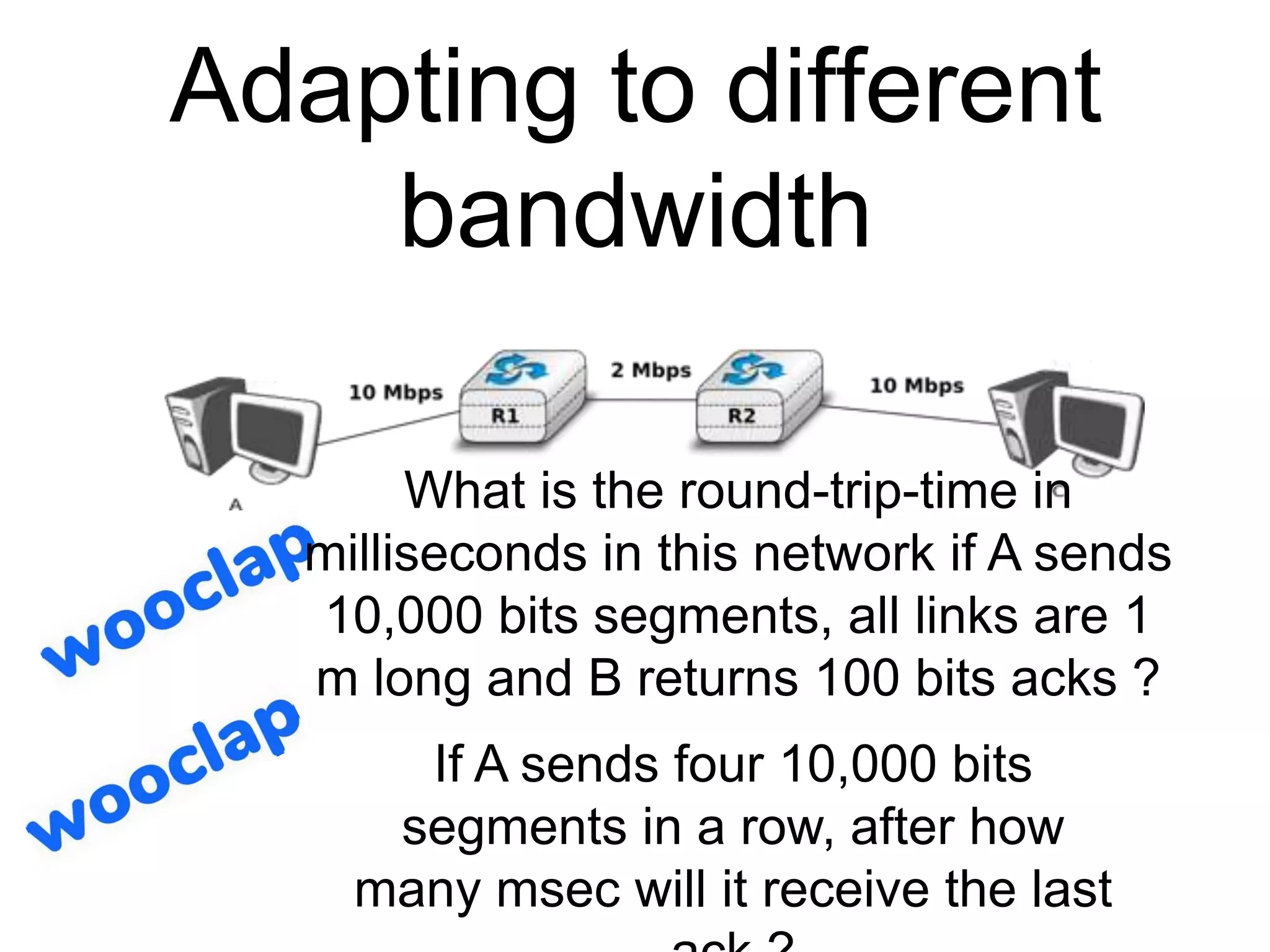
Adapting to different
bandwidth
What is the round-trip-time in
milliseconds in this network if A sends
10,000 bits segments, all links are 1
m long and B returns 100 bits acks ?
If A sends four 10,000 bits
segments in a row, after how
many msec will it receive the last
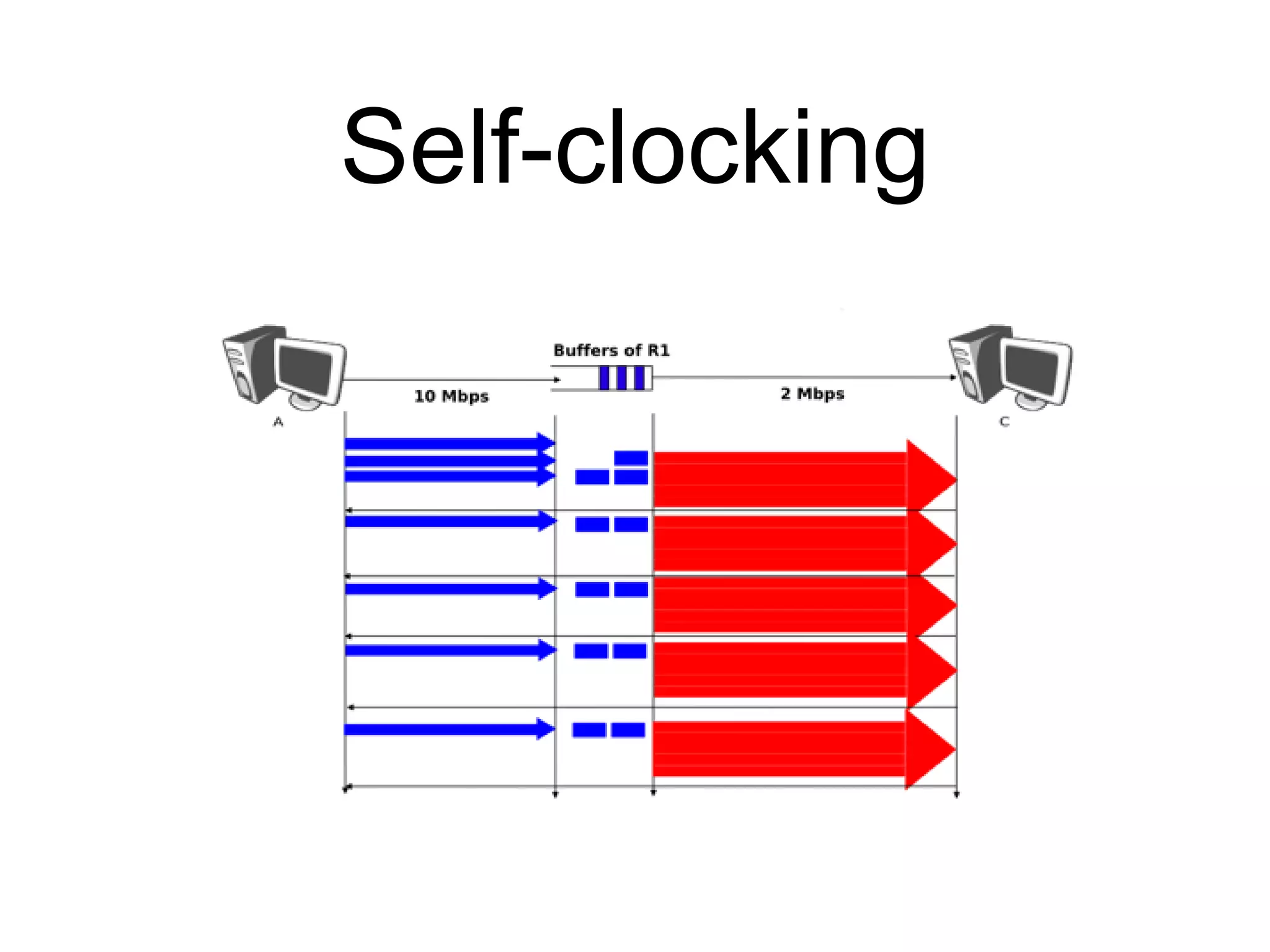
Self-clocking
The congestion
problem
• If R1 has a buffer of five 10,000 bits long
packets, how many packets will be dropped
if A and B send a burst of ten packets at
line rate ?
Fairness
• How should bandwidth be distributed
among different flows ?
• On a single link
• Fair share
• In a large network
• Max-min fairness
Max-min fairness
• a max-min allocation of bandwidth is an
allocation of bandwidth which
maximises the allocation of bandwidth
to the sources receiving the smallest
allocation
• a max-min fair allocation is such that
in order to increase the bandwidth
allocated to one source, it is
necessary to decrease the bandwidth
allocated to another source which
already receives a lower allocation
Max-min fairness
• a max-min allocation maximises the
allocation of bandwidth to the sources
receiving the smallest allocation
• Property
• to increase the bandwidth allocated to
one source, it is necessary to
decrease the bandwidth allocated to
another source which already
receives a lower allocation
Example
• Max-min fair bandwidth allocation
R
R
R
R
R
1000 Mbps
100 Mbps
S1
S2
S3 S4 S5 S6 S7 S8
D1 D3 D4
D2
D5
D6
D7
D8
Link1
Link2
Link3
Link4
How to achieve
max-min fairness ?
• Two possible approaches
• Modify the routers to reach max-min
fairness
• Modify the endhosts to reach max-min
fairness
How to detect
congestion ?
• Packet losses
• Increased delay
• Routers add information to packets
• Forward binary feedback
• Backward binary feedback
• Rate feedback
Agenda
• Congestion Control
• Principles
• Additive Increase/Multiplicative
Decrease
• Explicit Congestion Notification
• Modern TCP Congestion control
• Router behavior
The congestion
problem
Bottleneck link
N Mbps
How to efficiently
share the bandwidth
?
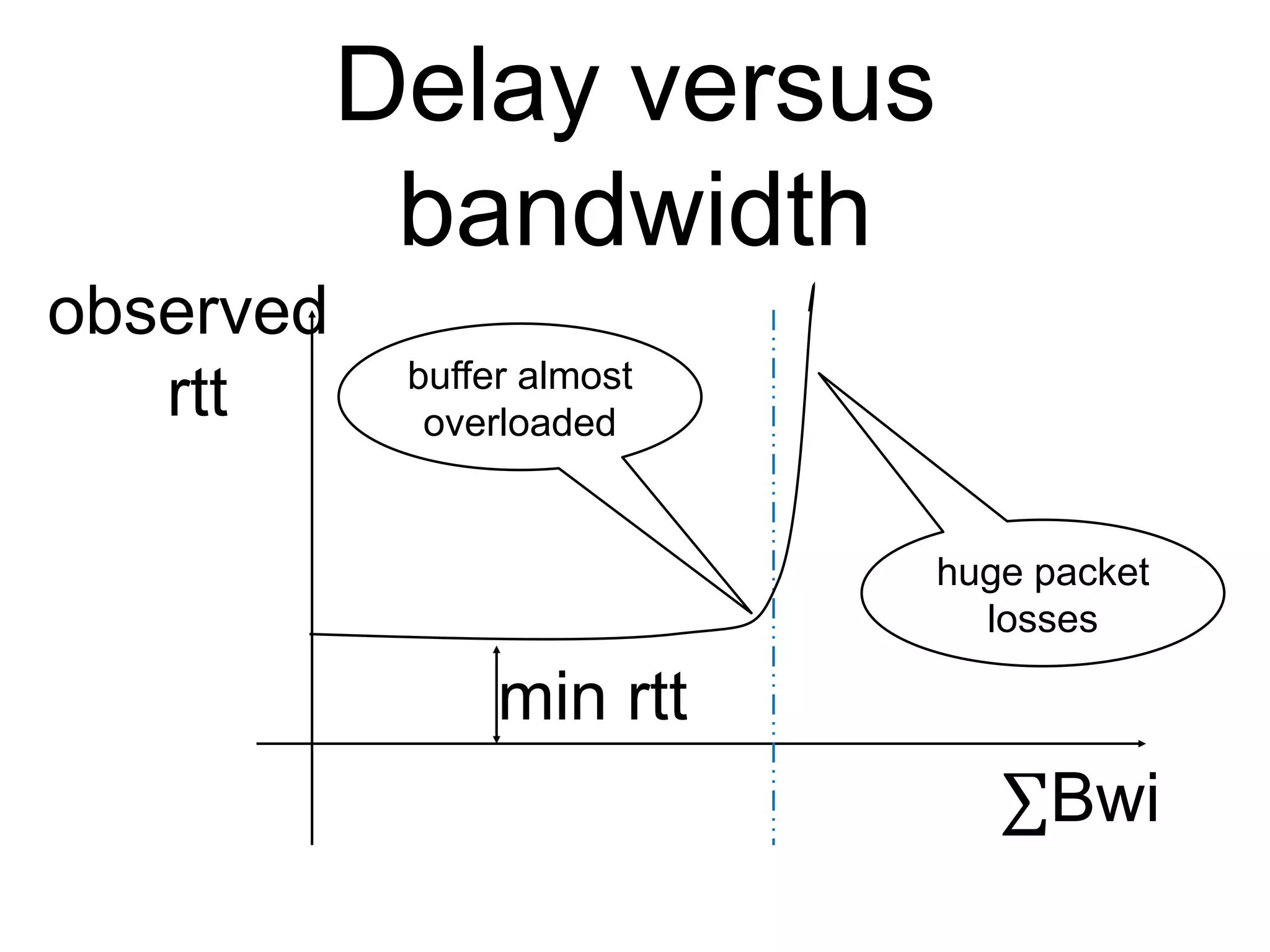
Delay versus
bandwidth
∑Bwi
observed
rtt
min rtt
buffer almost
overloaded
huge packet
losses
Router buffers
• Rule of thumb
• Routers should have RTT * C of
buffers
• RTT is average rtt for flows
• C is bandwidth of output link
• Backbone routers
• 𝐵𝑢𝑓𝑓𝑒𝑟 ≥
𝑅𝑇𝑇 ∗𝐶
√𝑁
N. McKeown, G. Appenzeller, I. Keslassy, Sizing Router Buffers (Redux),
SIGCOMM CCR October 2019
Congestion signals
• Main types of congestion signals
• Packet loss
• most popular signal
• Explicit Congestion Notification
• requires router cooperation
• Increase in measured round-trip-time
• can be fragile
Congestion control
Congestion control
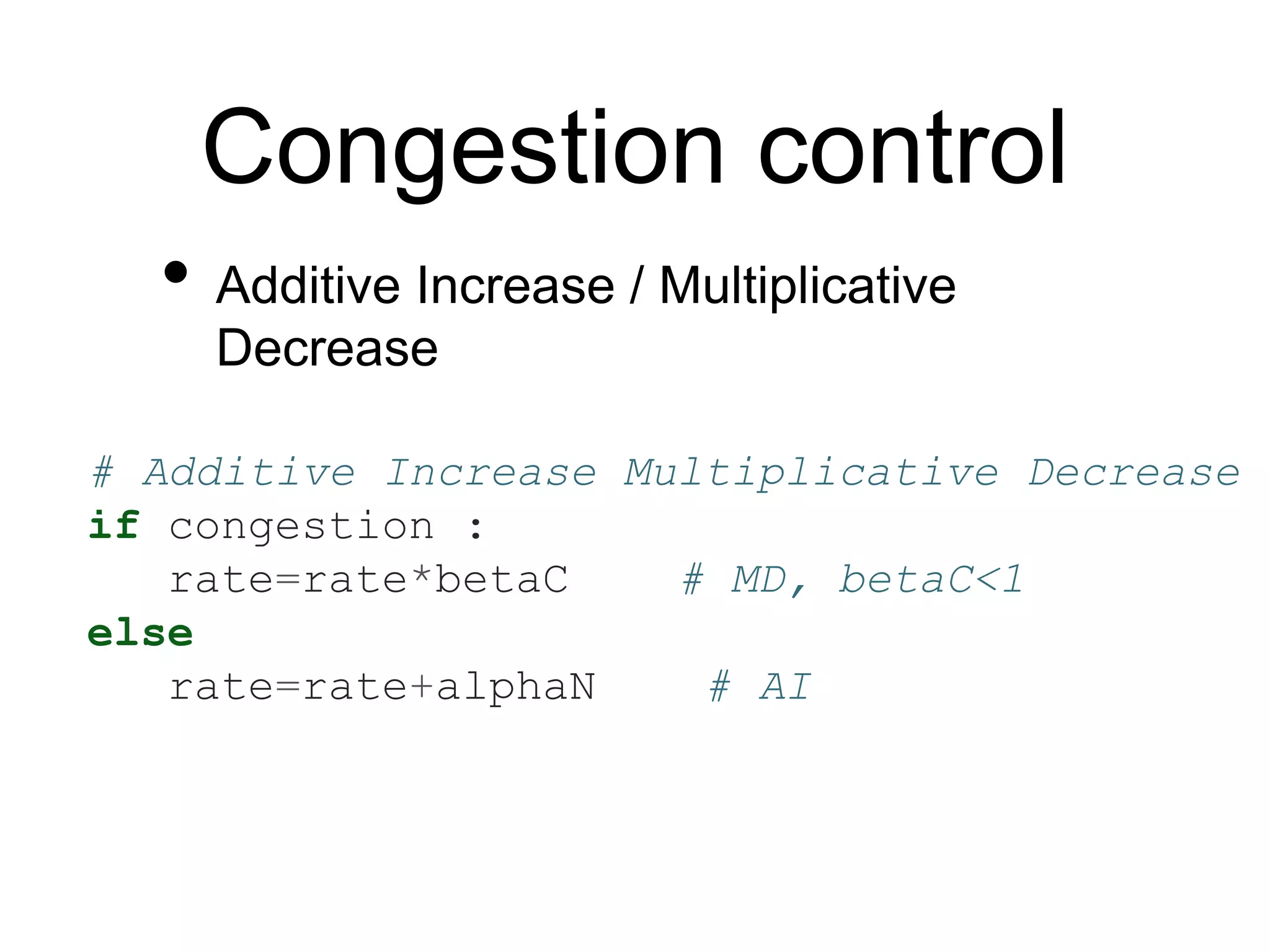
• Additive Increase / Multiplicative
Decrease
# Additive Increase Multiplicative Decrease
if congestion :
rate=rate*betaC # MD, betaC<1
else
rate=rate+alphaN # AI
Additive Increase
• No congestion ?
• All acks move window
• Additive increase
• Increment cwnd by one MSS every rtt
Cwnd
Time
Faster increase
• How to speed up the growth of the
congestion window at connection
startup ?
• Slow-start
• Double cwnd every rtt
Cwnd
Slow-start
exponential increase of cwnd
Time
Max window
Multiplicative
decrease
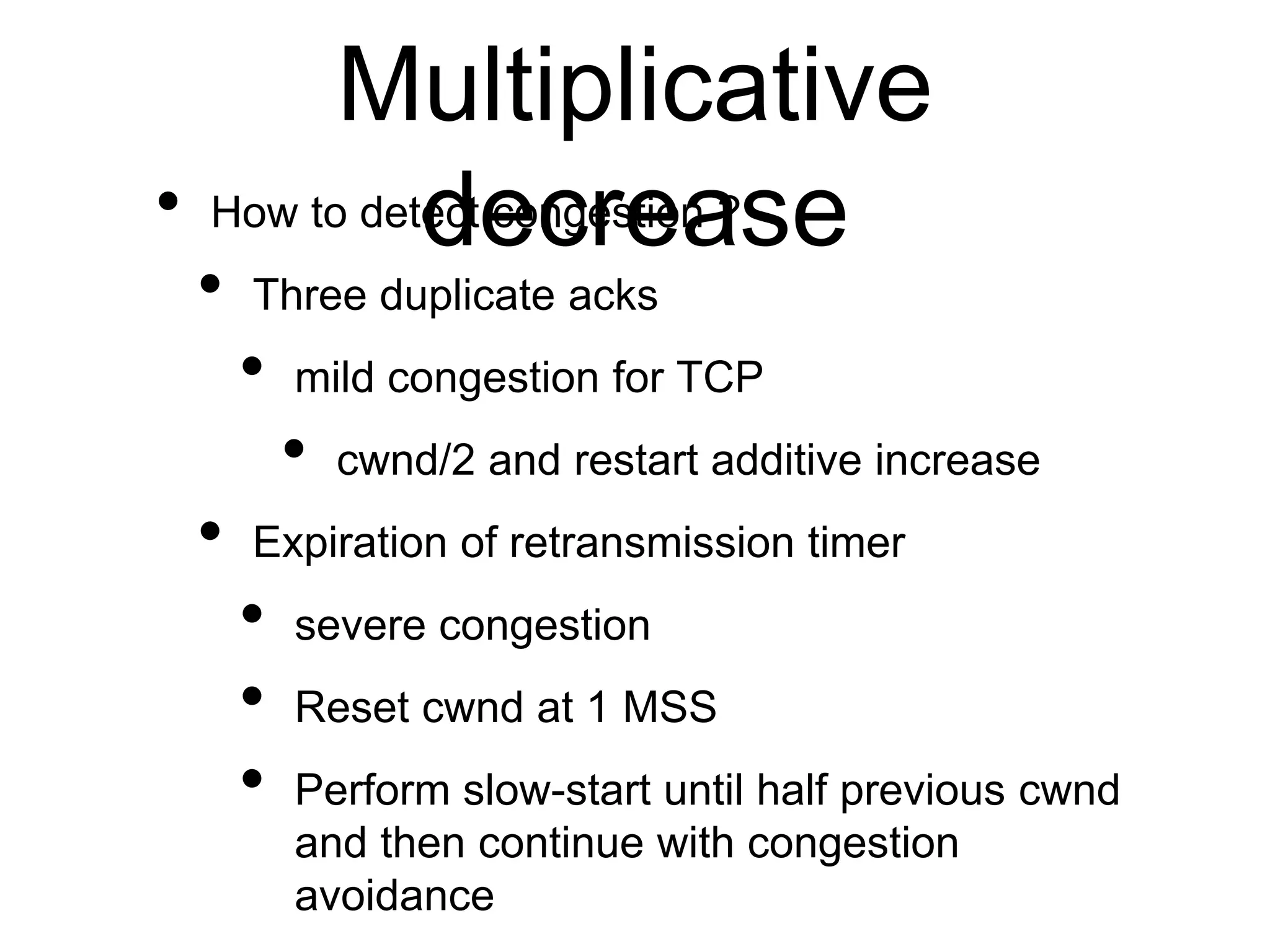
• How to detect congestion ?
• Three duplicate acks
• mild congestion for TCP
• cwnd/2 and restart additive increase
• Expiration of retransmission timer
• severe congestion
• Reset cwnd at 1 MSS
• Perform slow-start until half previous cwnd
and then continue with congestion
avoidance
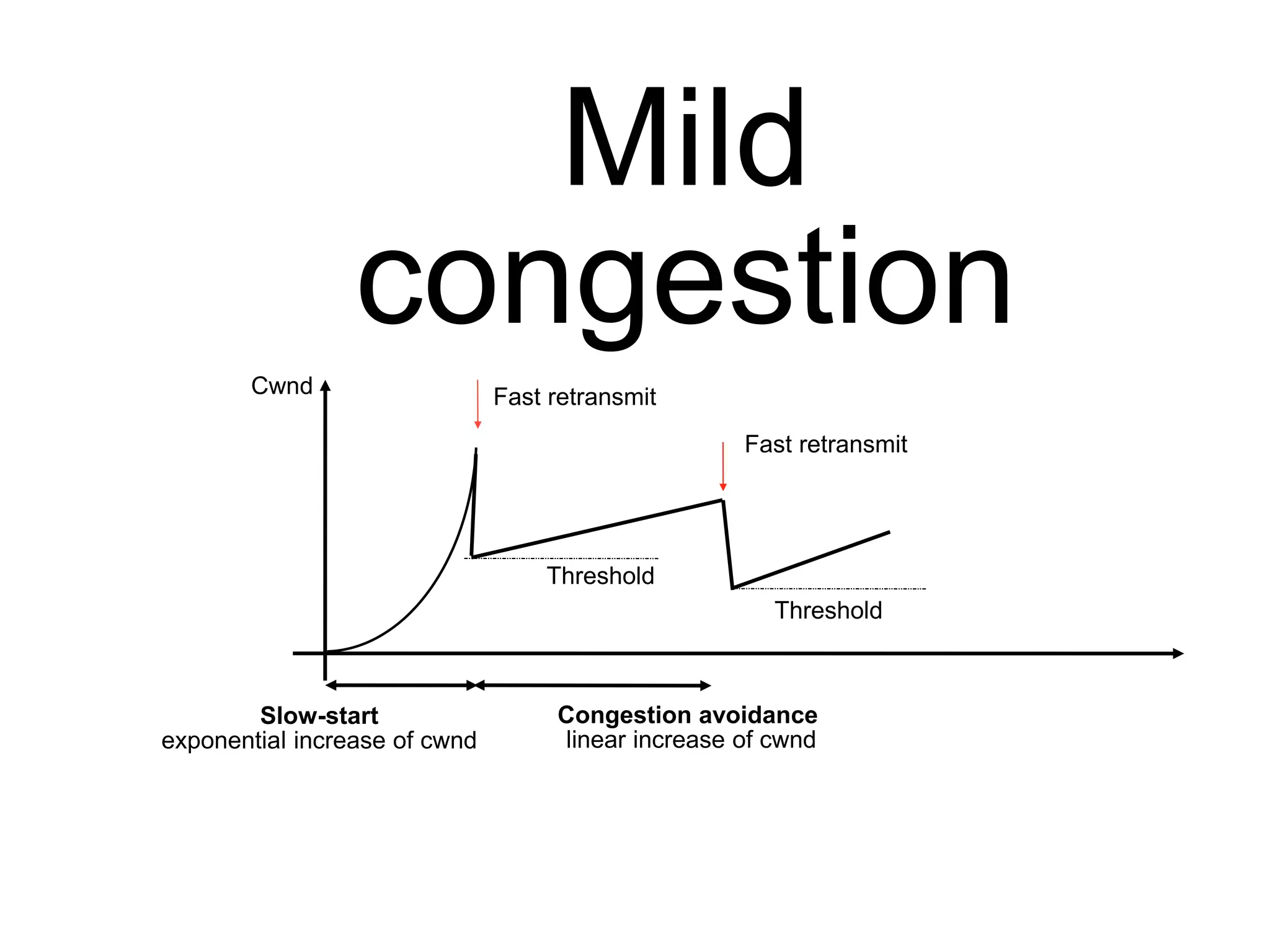
Cwnd Fast retransmit
Threshold
Threshold
Slow-start
exponential increase of cwnd
Congestion avoidance
linear increase of cwnd
Fast retransmit
Mild
congestion
Severe congestion
Cwnd
Time
Timer expiration
Threshold
Timer expiration
Threshold
Slow-start
exponential increase of cwnd
Congestion avoidance
linear increase of cwnd
AIMD in TCP
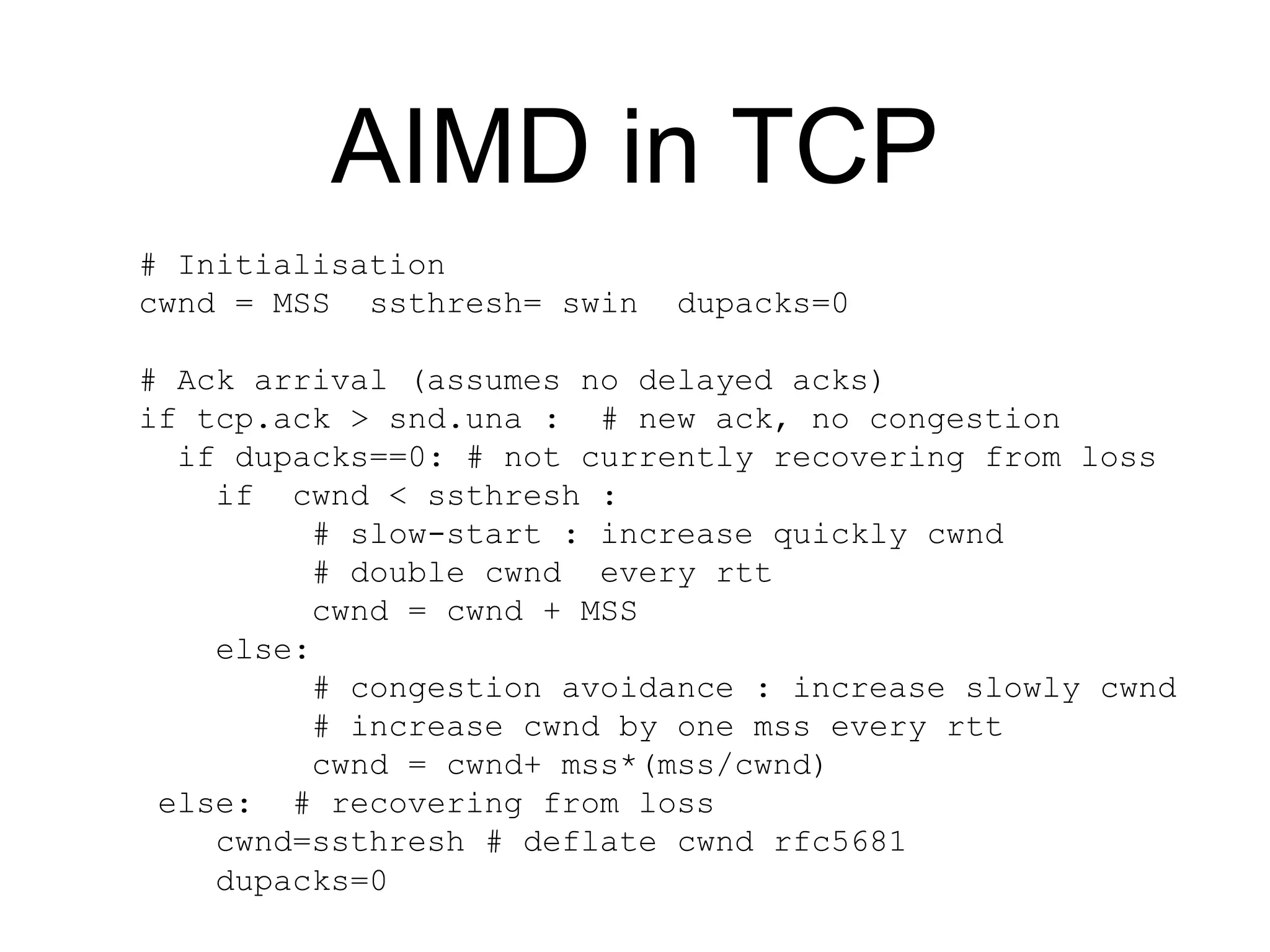
# Initialisation
cwnd = MSS ssthresh= swin dupacks=0
# Ack arrival (assumes no delayed acks)
if tcp.ack > snd.una : # new ack, no congestion
if dupacks==0: # not currently recovering from loss
if cwnd < ssthresh :
# slow-start : increase quickly cwnd
# double cwnd every rtt
cwnd = cwnd + MSS
else:
# congestion avoidance : increase slowly cwnd
# increase cwnd by one mss every rtt
cwnd = cwnd+ mss*(mss/cwnd)
else: # recovering from loss
cwnd=ssthresh # deflate cwnd rfc5681
dupacks=0
Slow-start
cwnd=1000
ssthresh=64000 0-999
ACK(1000)
1000-1999
2000-2999
ACK(2000) ACK(3000)
cwnd=2000
ssthresh=64000
cwnd=3000
ssthresh=64000
cwnd=4000
ssthresh=64000
3000-3999
4000-4999
5000-5999
6000-6999
ACK(4000
)
ACK(7000
)
cwnd ?
Congestion
avoidance
cwnd=2000
ssthresh=4000 1000-1999
2000-2999
ACK(2000)
ACK(3000)
cwnd=3000
ssthresh=4000
cwnd=4000
ssthresh=4000
cwnd=4000+(1000*1000/4000)=4250
3000-3999
4000-4999
5000-5999
6000-6999
ACK(4000
)
ACK(7000
)
cwnd=4250+(1000*1000/4250)=4485
cwnd=4485+(1000*1000/4485)=4707
cwnd=4707+(1000*1000/4707)=4919
cwnd ?
AIMD in TCP
else: # duplicate or old ack
if tcp.ack==snd.una: # duplicate acknowledgment
dupacks++
if dupacks==1 or dupacks==2:
send_next_unacked_segment # rfc3042
if dupacks==3:
retransmitsegment(snd.una)
ssthresh=max(cwnd/2,2*MSS)
cwnd=ssthresh
if dupacks>3: # rfc5681
cwnd=cwnd+MSS # inflate cwnd
else: # ack for old segment, ignored
Expiration of the retransmission timer:
send(snd.una) # retransmit first lost segment
sshtresh=max(cwnd/2,2*MSS)
cwnd=MSS
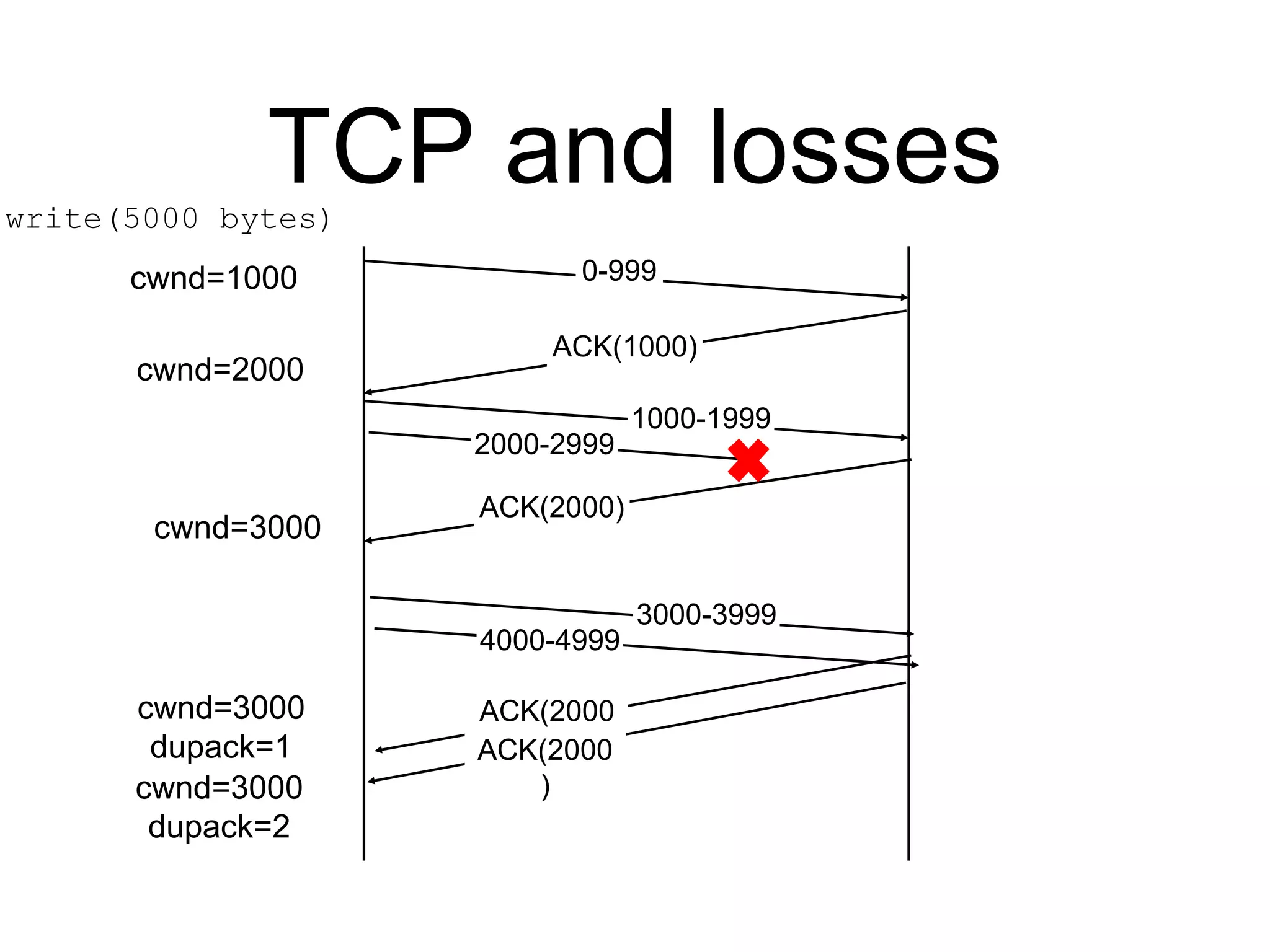
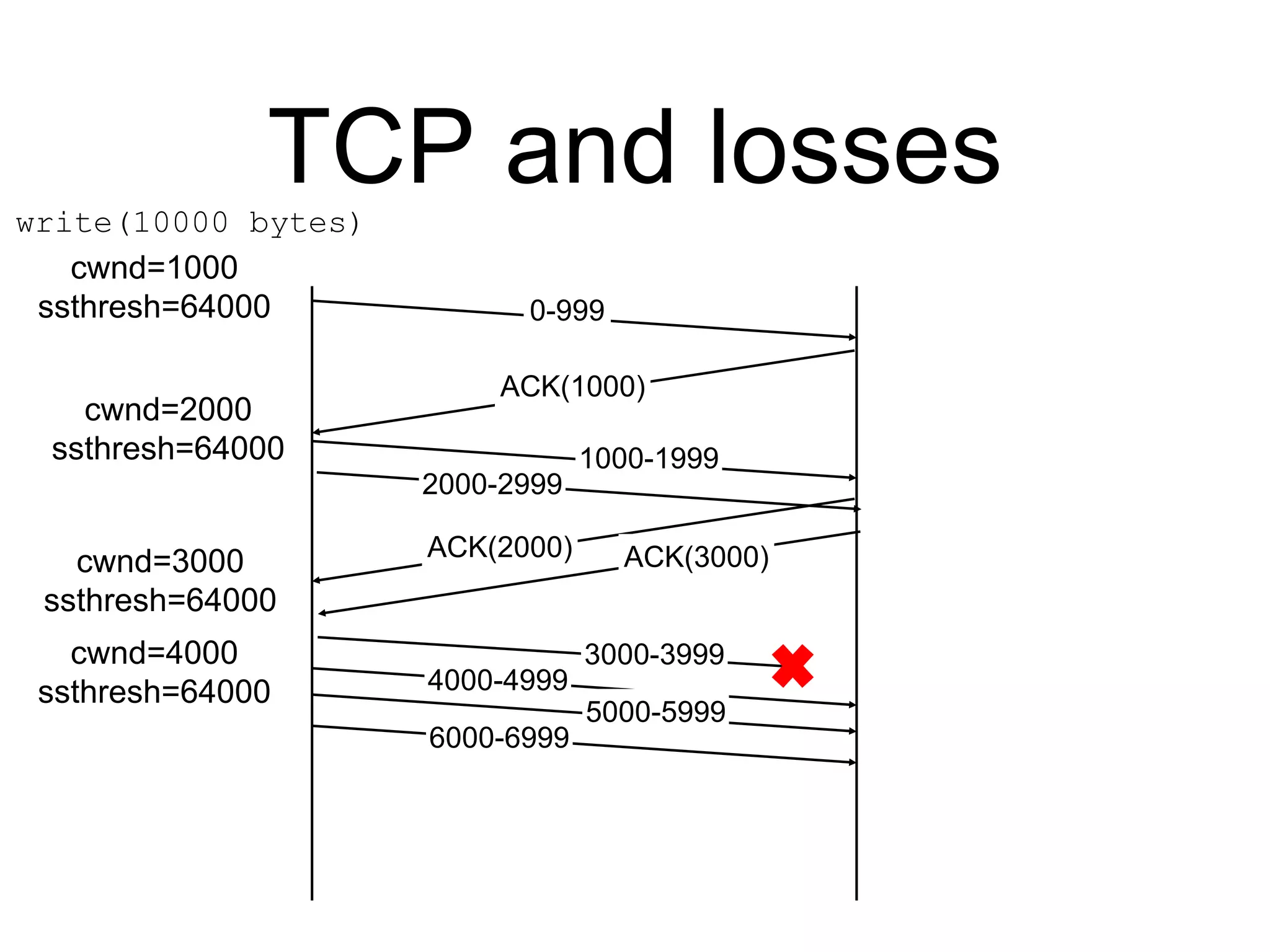
TCP and losses
cwnd=1000 0-999
ACK(1000)
1000-1999
2000-2999
ACK(2000)
cwnd=2000
cwnd=3000
3000-3999
4000-4999
ACK(2000
)
ACK(2000
)
cwnd=3000
dupack=1
cwnd=3000
dupack=2
write(5000 bytes)
TCP and losses
cwnd=3000
dupack=2
2000-2999
RTO expires
cwnd=1000
dupack=0
ssthresh=2000
ACK(5000
)
cwnd=2000
dupack=0
TCP and losses
cwnd=1000
ssthresh=64000 0-999
ACK(1000)
1000-1999
2000-2999
ACK(2000) ACK(3000)
cwnd=2000
ssthresh=64000
cwnd=3000
ssthresh=64000
cwnd=4000
ssthresh=64000
3000-3999
4000-4999
5000-5999
6000-6999
write(10000 bytes)
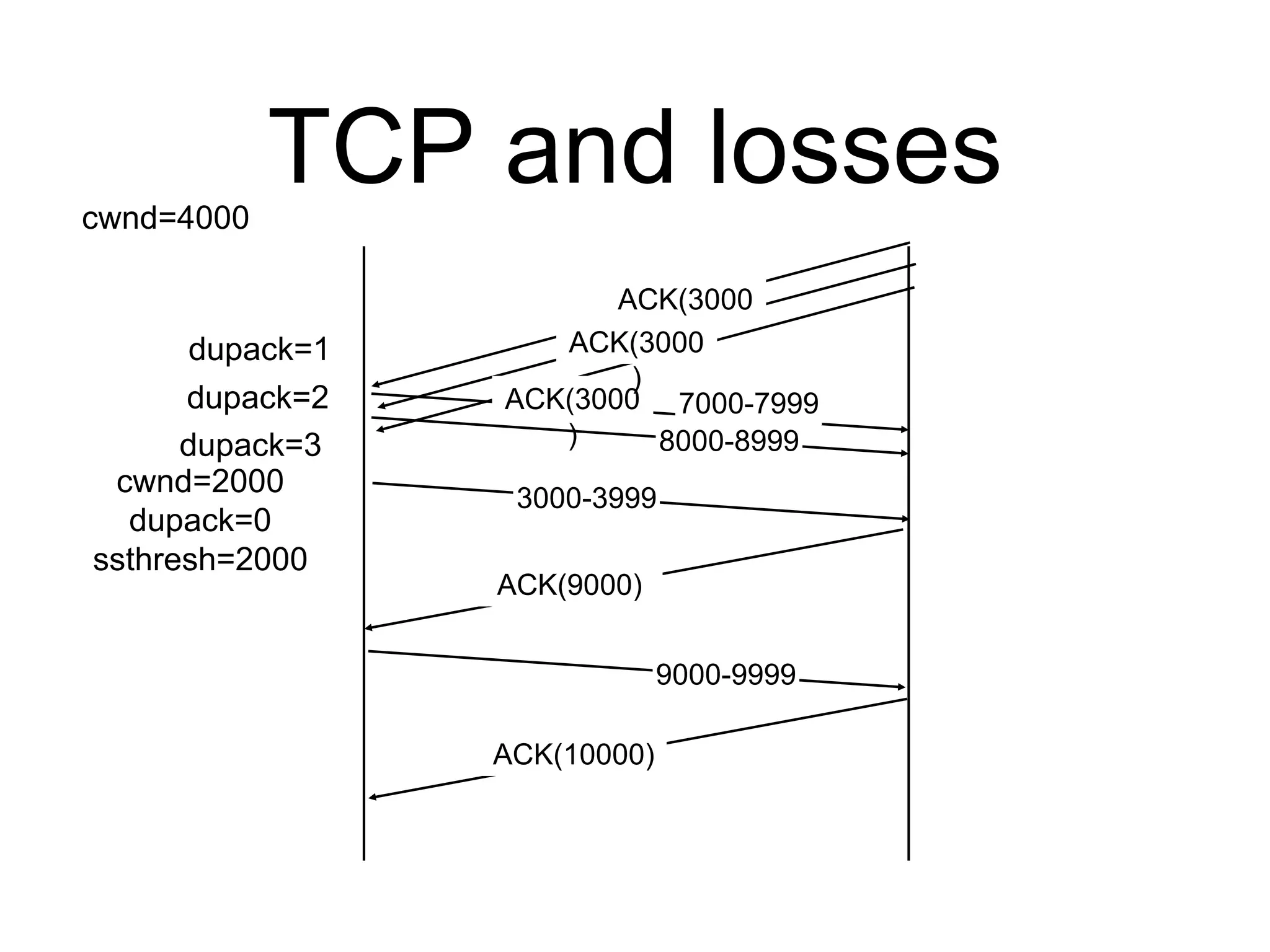
TCP and losses
cwnd=4000
3000-3999
cwnd=2000
dupack=0
ssthresh=2000
ACK(9000)
7000-7999
8000-8999
ACK(3000
)
ACK(3000
)
ACK(3000
)
dupack=1
dupack=2
dupack=3
9000-9999
ACK(10000)
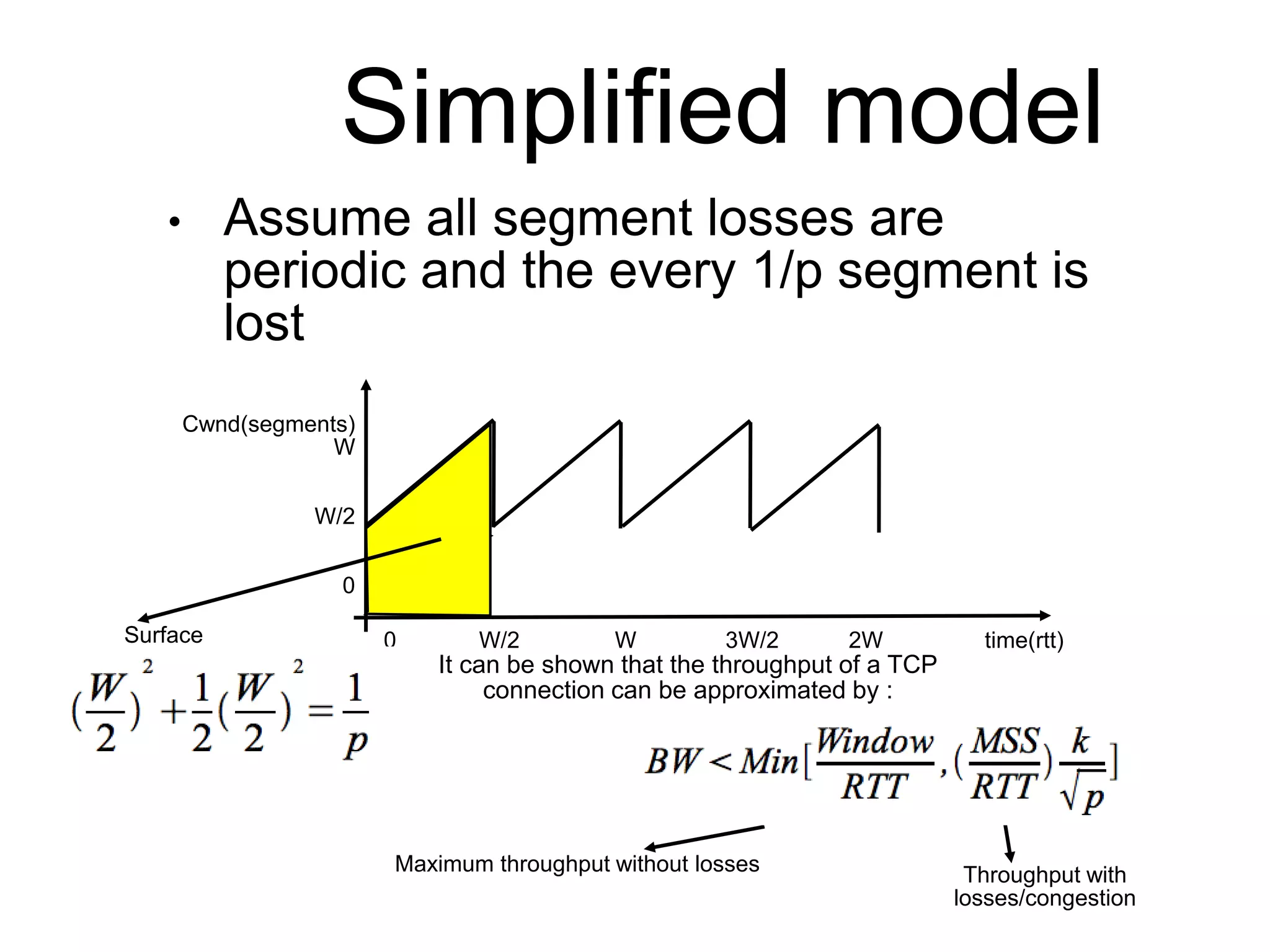
Simplified model
• Assume all segment losses are
periodic and the every 1/p segment is
lost
Cwnd(segments)
W
W/2
0
0 W/2 W 3W/2 2W time(rtt)
Surface
It can be shown that the throughput of a TCP
connection can be approximated by :
Maximum throughput without losses Throughput with
losses/congestion
Agenda
• Congestion Control
• Principles
• Additive Increase/Multiplicative
Decrease
• Explicit Congestion Notification
• Modern TCP Congestion control
• Router behavior
Limitations of packet
drops
• Router drops packets when it is
congested
• The packets that are dropped by the
congested router have already
consummed resources upstream
• How can we control congestion without
dropping packets to inform the senders
of the current level of congestion ?
Basic ECN
• Issues
• What happens if the returning ECN-echo
is lost ?
• How can we deploy ECN?
R1 R2
A D
Congestion Notification
Mark the IP packet that caused congestion
by setting one bit flag (CE: Congestion Experienced)
TCP source behaviour
Upon reception of a ECN-Echo=1 TCP ack,
behave as if the corresponding segment was lost
(perform congestion avoidance).
TCP destination behaviour
Upon reception of a CE=1 IP packet indicate the
congestion to the source by setting a special
flag (ECN-Echo) in the returning TCP ack
Dealing with lost acks
R1 R2
A D
TCP receiver behavior
Upon reception of a CE=1 IP packet indicate the
congestion to the source by setting a special
flag (ECN-Echo) in all returning TCP acks until
a TCP TPDU with CWR set is received
TCP sender behavior
Upon reception of a ECN-Echo=1 TCP ack,
perform congestion avoidance and set CWR
flag in next TCP PDU
Deploying ECN
• On endhosts
• Update the TCP stack to support ECN
• Negotiate ECN usage in SYN
• Encode ECN info in
packets/segments
• For other transport protocols…
Deploying ECN
• On routers
• Routers need to distinguish between
• ECN-capable hosts that react to
ECN
• If congestion, such packets are
marked
• Other hosts that do not react to ECN
• If congestion, such packets are
dropped
ECN support on
routers
• Specialised buffer acceptance
algorithms
R1 R2
A D
In case of congestion
If ECT bit is set
Mark the IP packet that caused congestion
by setting on bit flag (CE: Congestion Experienced)
If ECT bit is not set
Discard the IP packet that caused congestion
ECN-capable source
If destination is also ECN capable
Set ECT bit in all IP packets towards destination
Otherwise
Reset ECT bit
Agenda
• Congestion Control
• Principles
• Additive Increase/Multiplicative
Decrease
• Explicit Congestion Notification
• Modern TCP Congestion control
• Router behavior
Issues with AIMD
• Performance on high bandwidth*delay links
• Each loss forces TCP in congestion
avoidance and grows slowly
• Bufferbloat
• TCP AIMD tries to saturate buffers until it
causes congestion
• Inflates round-trip-times
• Fairness
• TCP sources with a lower rtt are favored
Tuning TCP @google
• Objectives
• Minimize time to receive result from
search engine
• HTTP GET fits a single segment
• HTTP Response in <16 KBytes
Initial congestion
window
• What is the impact of initial congestion
window and the slow-start on the time to
receive an HTTP response ?
Initial TCP
congestion window
today
Source: M. Bagnulo, tcpmp mailing list, Nov 16th, 2016
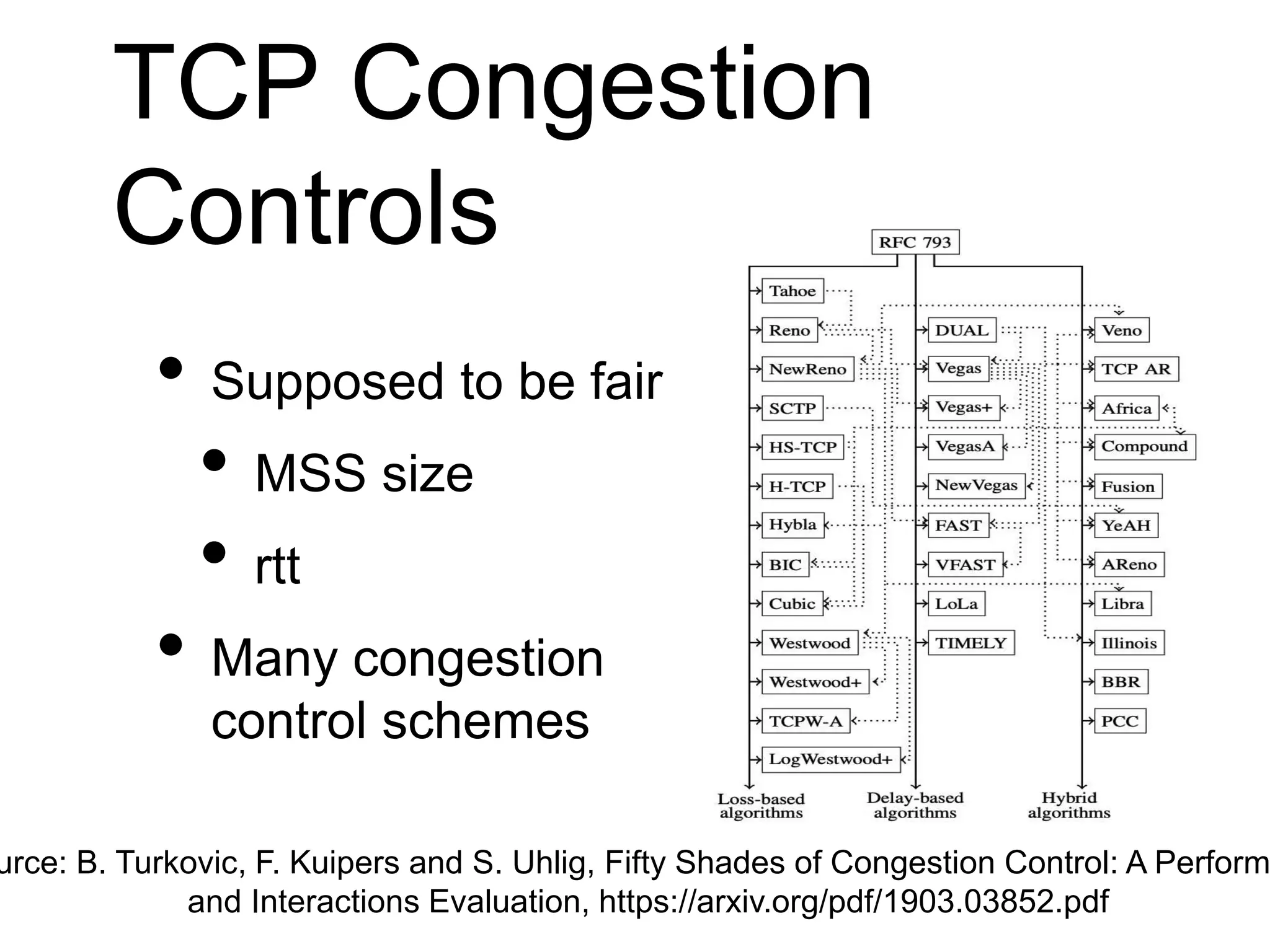
TCP Congestion
Controls
• Supposed to be fair
• MSS size
• rtt
• Many congestion
control schemes
urce: B. Turkovic, F. Kuipers and S. Uhlig, Fifty Shades of Congestion Control: A Perform
and Interactions Evaluation, https://arxiv.org/pdf/1903.03852.pdf
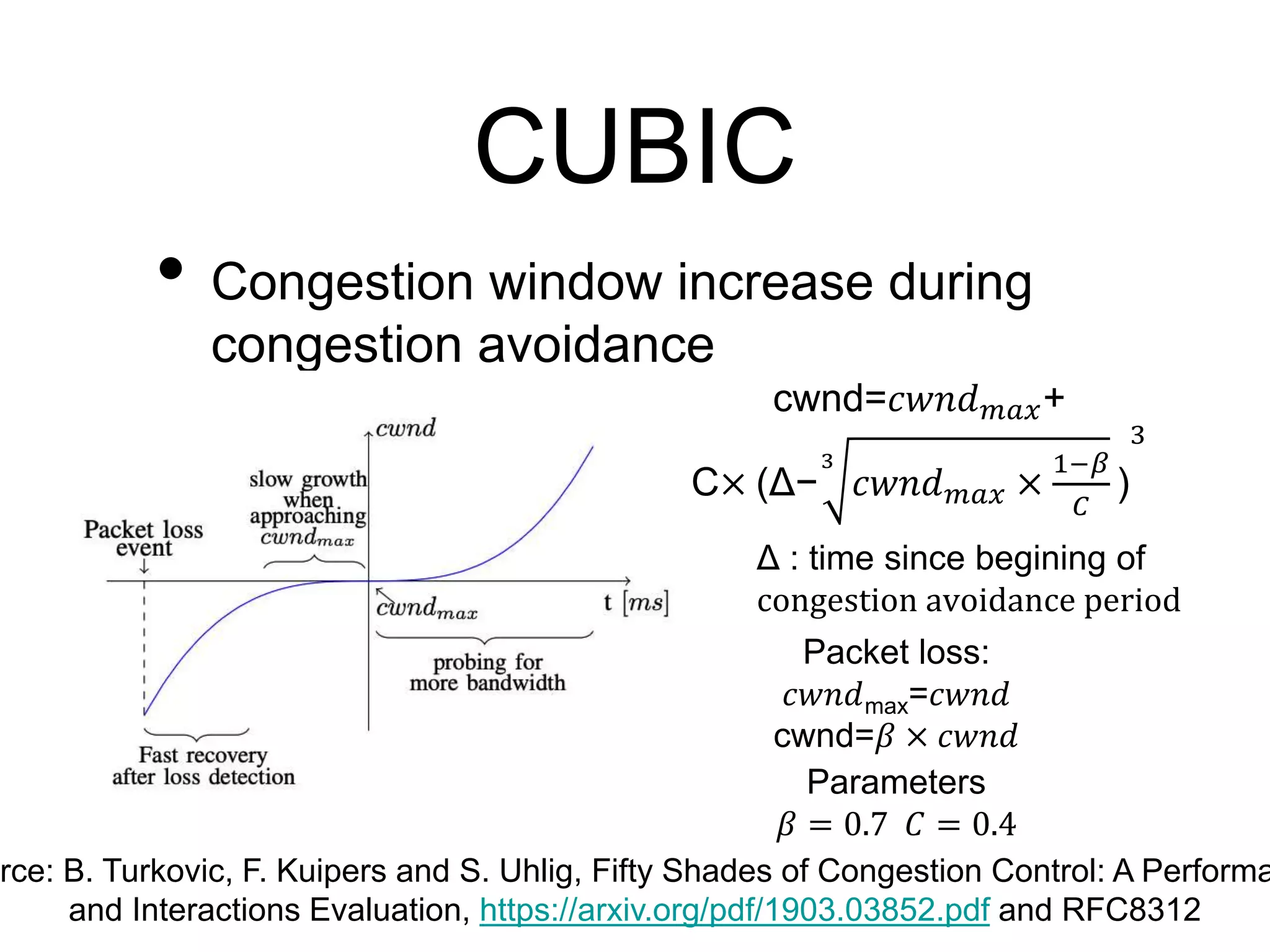
CUBIC
• A modern congestion controller designed for
high bandwidth*delay product links
• Default on Linux, Apple and Microsoft
• Principles
• Use concave and convex profiles of cubic
function to increase cwnd
• CUBIC behaves like AIMD with small rtt/bw
• CUBIC provides linear bw sharing among
flows with different rtt
CUBIC
• Congestion window increase during
congestion avoidance
rce: B. Turkovic, F. Kuipers and S. Uhlig, Fifty Shades of Congestion Control: A Performa
and Interactions Evaluation, https://arxiv.org/pdf/1903.03852.pdf and RFC8312
cwnd=𝑐𝑤𝑛𝑑𝑚𝑎𝑥+
C× (Δ−
3
𝑐𝑤𝑛𝑑𝑚𝑎𝑥 ×
1−𝛽
𝐶
)
3
Packet loss:
𝑐𝑤𝑛𝑑max=𝑐𝑤𝑛𝑑
cwnd=𝛽 × 𝑐𝑤𝑛𝑑
Parameters
𝛽 = 0.7 𝐶 = 0.4
Δ : time since begining of
congestion avoidance period
Bottleneck Bandwidth
and Round-Trip-Time
(BBR)
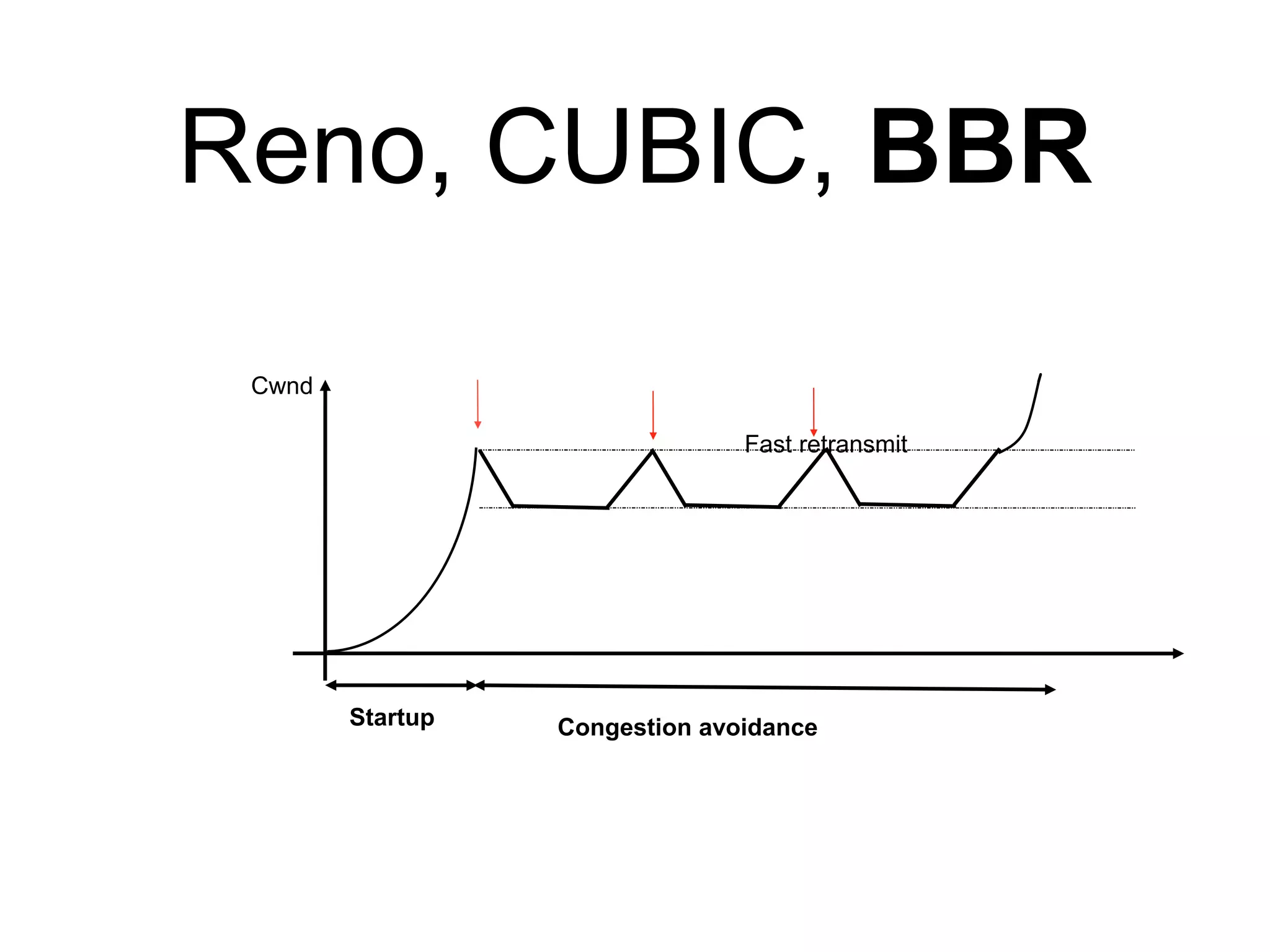
• Recent congestion control scheme that aims at
achieving high throughput and low delay
• Operates in four phases
• Startup (similar to slow-start until measured rate
stops increase)
• Drain (empty the queues, send at 0.75 rate)
• compute rttmin over last 10 seconds
• Probe bandwidth every 8 rtt (send at 1.25 rate for
one rtt and then at 0.75 rate)
• Probe RTT (reduce rate for more precise rttmin)
Reno, CUBIC, BBR
Cwnd
ssthresh
Slow-start
exponential increase of cwnd
Congestion avoidance
linear increase of cwnd
Reno, CUBIC, BBR
Cwnd
Slow-start
exponential increase of cwnd
Congestion avoidance
ssthresh
W_max
Reno, CUBIC, BBR
Cwnd
Startup Congestion avoidance
Fast retransmit
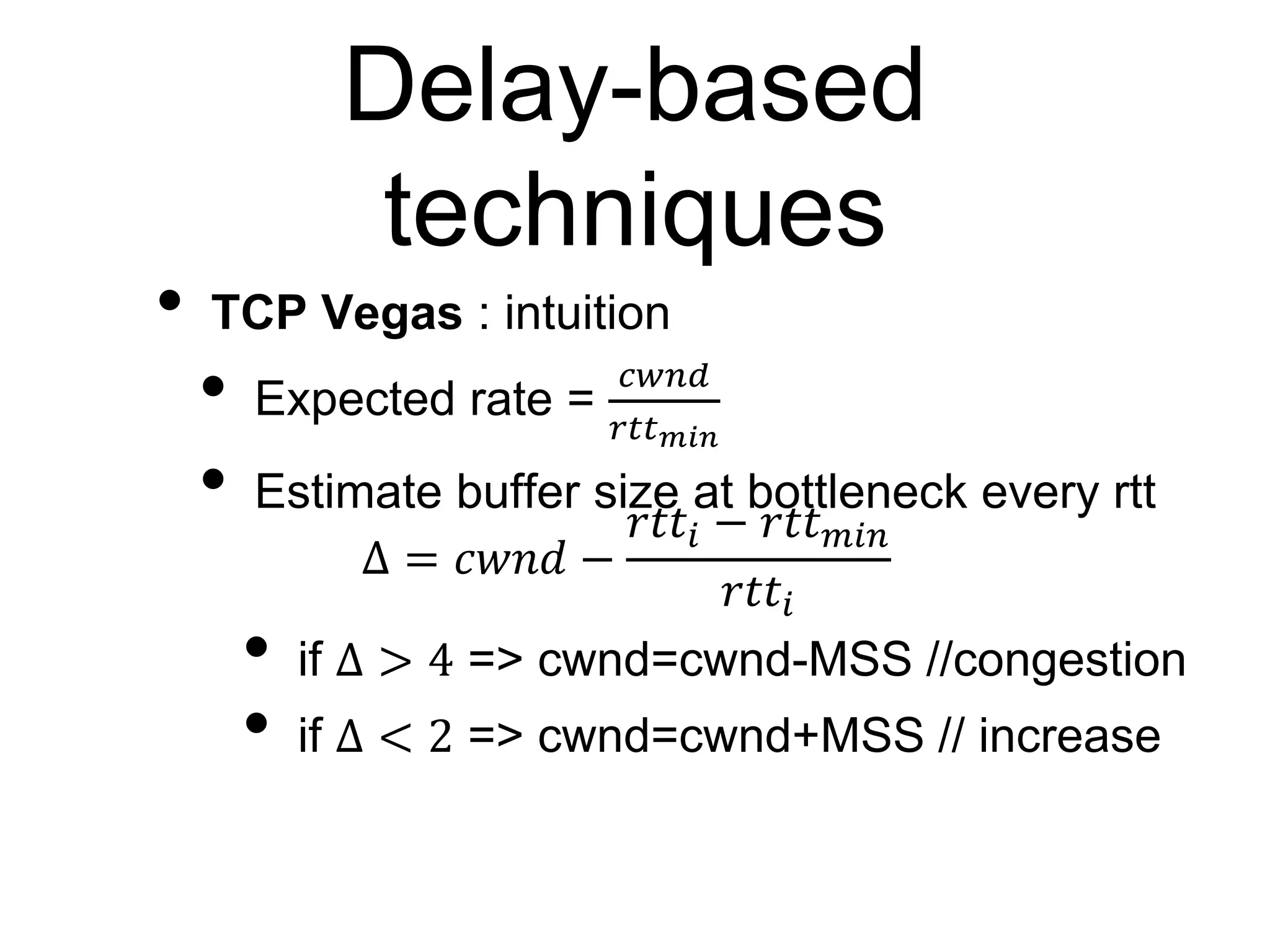
Delay-based
techniques
• TCP Vegas : intuition
• Expected rate =
𝑐𝑤𝑛𝑑
𝑟𝑡𝑡𝑚𝑖𝑛
• Estimate buffer size at bottleneck every rtt
Δ = 𝑐𝑤𝑛𝑑 −
𝑟𝑡𝑡𝑖 − 𝑟𝑡𝑡𝑚𝑖𝑛
𝑟𝑡𝑡𝑖
• if Δ > 4 => cwnd=cwnd-MSS //congestion
• if Δ < 2 => cwnd=cwnd+MSS // increase
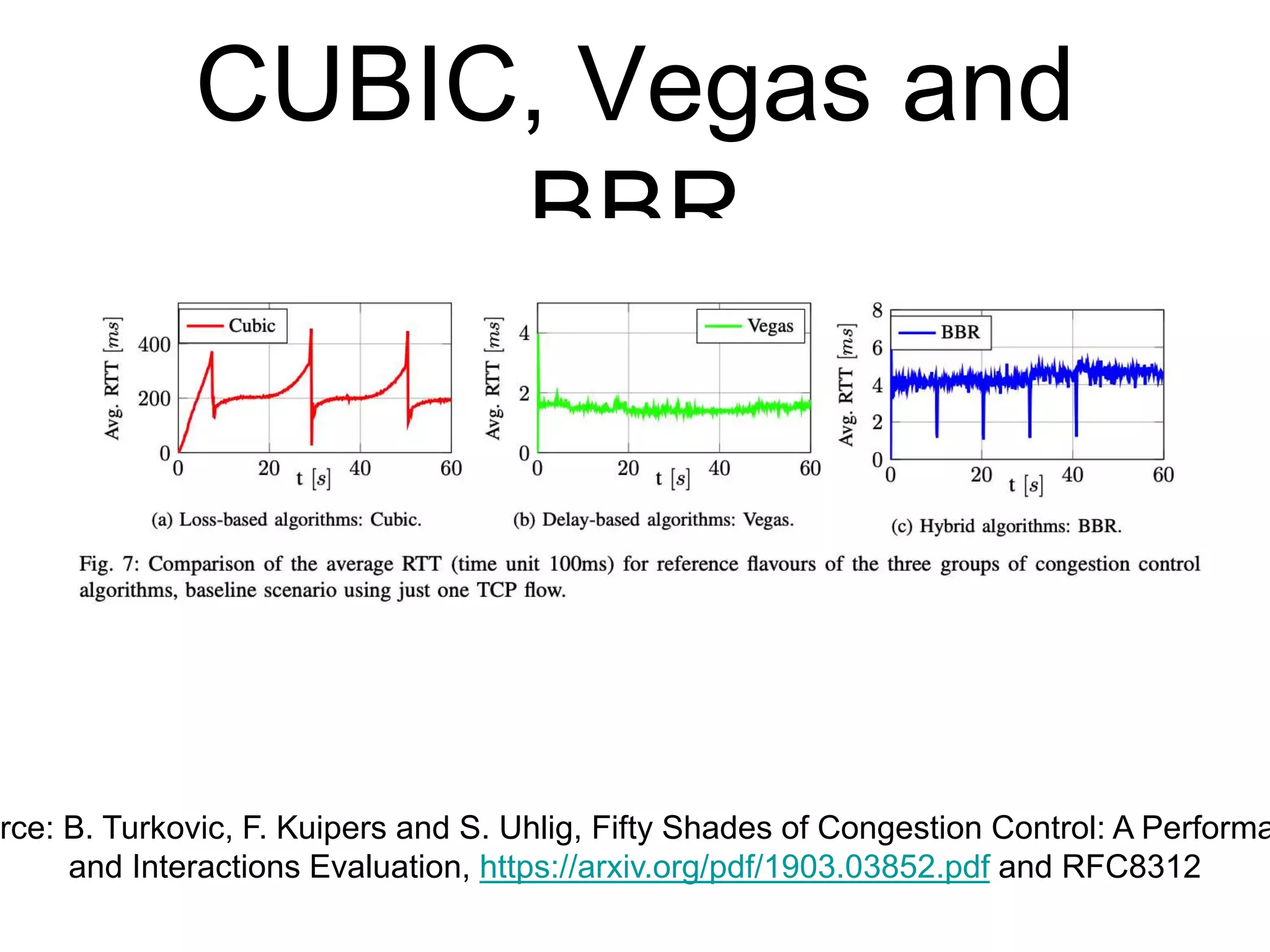
CUBIC, Vegas and
BBR
rce: B. Turkovic, F. Kuipers and S. Uhlig, Fifty Shades of Congestion Control: A Performa
and Interactions Evaluation, https://arxiv.org/pdf/1903.03852.pdf and RFC8312
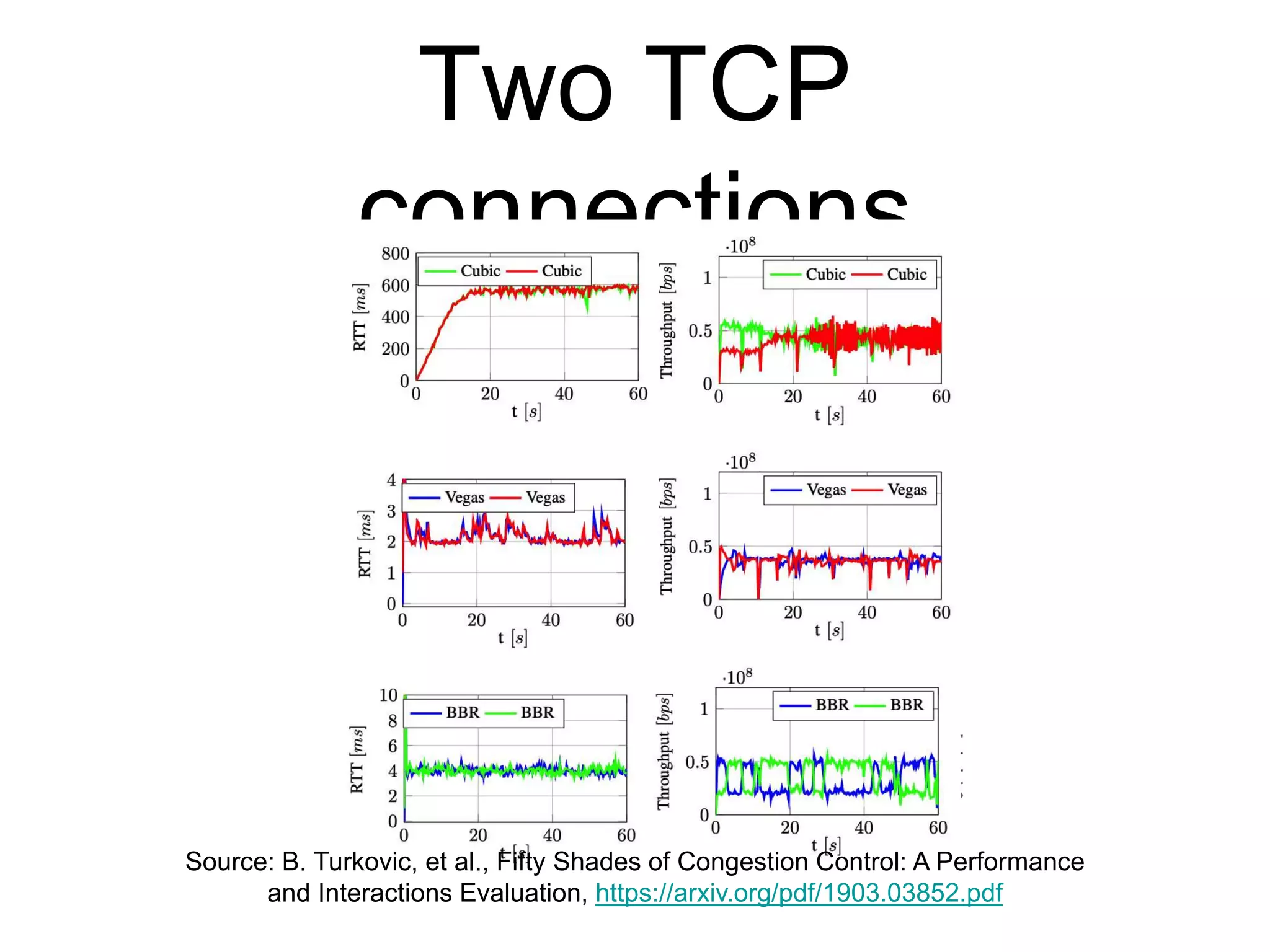
Two TCP
connections
Source: B. Turkovic, et al., Fifty Shades of Congestion Control: A Performance
and Interactions Evaluation, https://arxiv.org/pdf/1903.03852.pdf
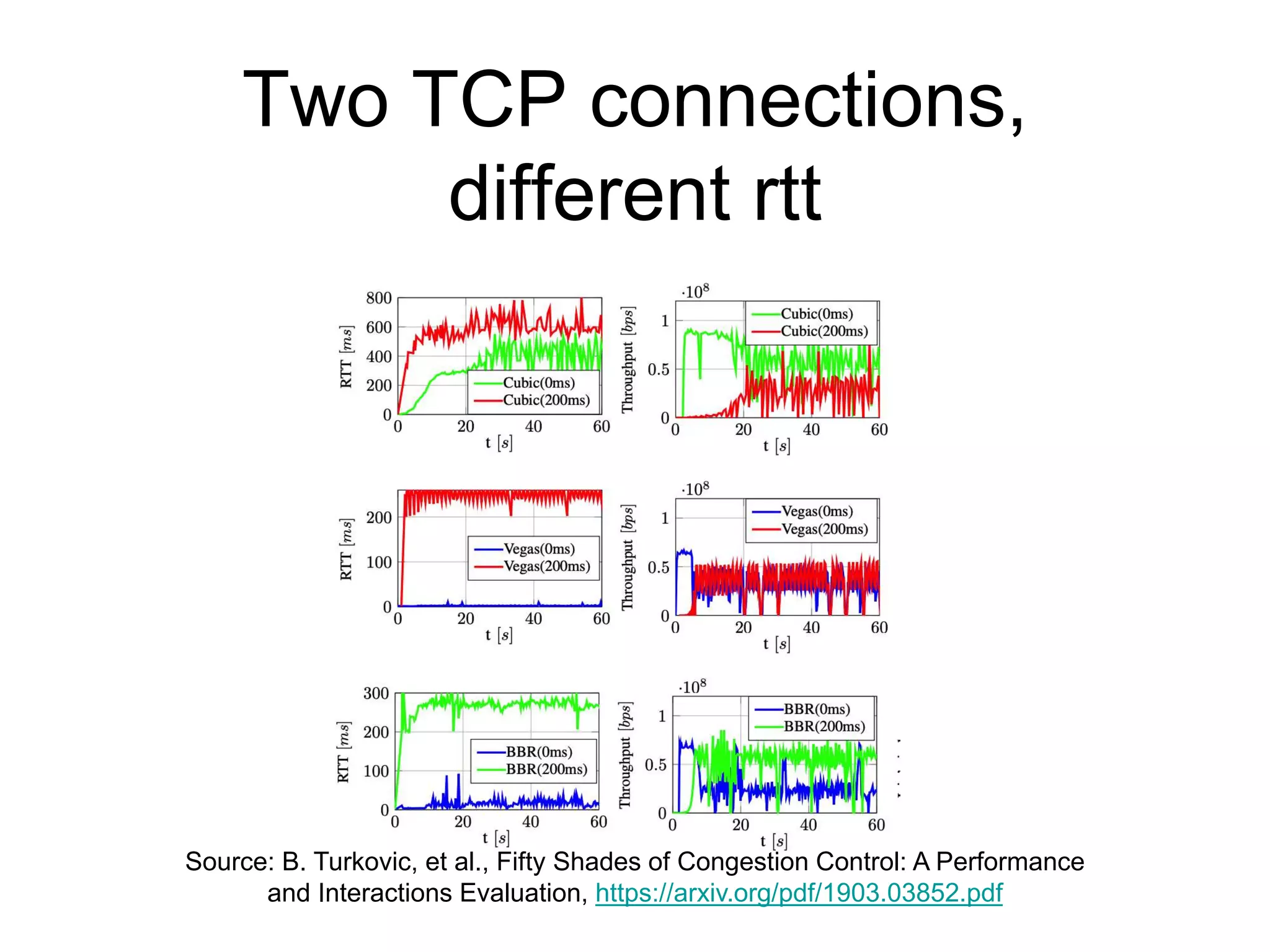
Two TCP connections,
different rtt
Source: B. Turkovic, et al., Fifty Shades of Congestion Control: A Performance
and Interactions Evaluation, https://arxiv.org/pdf/1903.03852.pdf
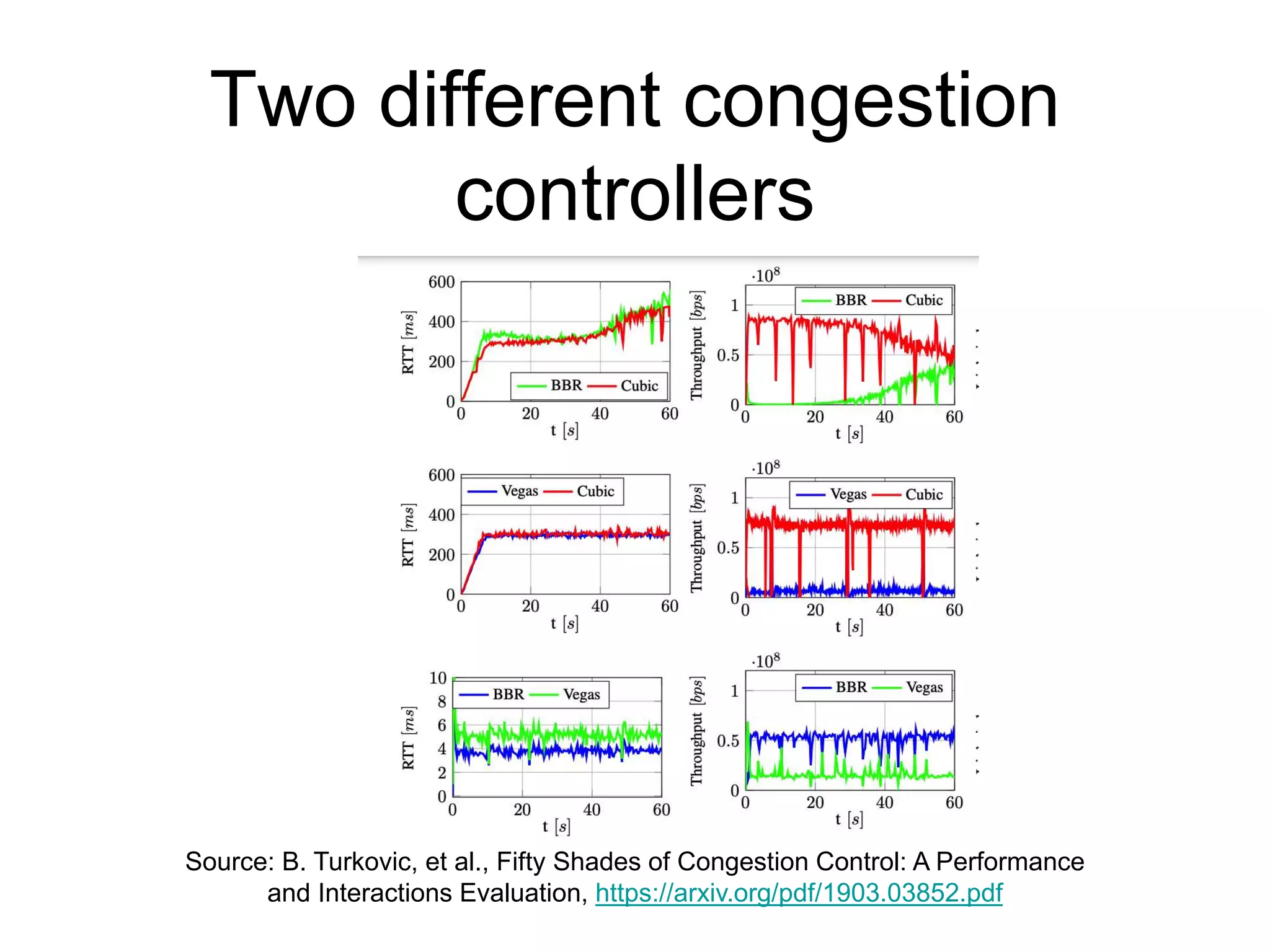
Two different congestion
controllers
Source: B. Turkovic, et al., Fifty Shades of Congestion Control: A Performance
and Interactions Evaluation, https://arxiv.org/pdf/1903.03852.pdf

Part9-congestion.pptx

  • 1.
    Part 9 Congestion control ©O. Bonaventure, UCLouvain, 2023. Supplementary material for the Computer Networking : Principles, Protocols and Practice ebook, https://www.computer-networking.info
  • 2.
    Agenda • Congestion Control •Principles • Additive Increase/Multiplicative Decrease • Explicit Congestion Notification • Modern TCP Congestion control • Router behavior
  • 3.
    Adapting to different bandwidth Whatis the round-trip-time in milliseconds in this network if A sends 10,000 bits segments, all links are 1 m long and B returns 100 bits acks ? If A sends four 10,000 bits segments in a row, after how many msec will it receive the last
  • 4.
  • 5.
    The congestion problem • IfR1 has a buffer of five 10,000 bits long packets, how many packets will be dropped if A and B send a burst of ten packets at line rate ?
  • 6.
    Fairness • How shouldbandwidth be distributed among different flows ? • On a single link • Fair share • In a large network • Max-min fairness
  • 7.
    Max-min fairness • amax-min allocation of bandwidth is an allocation of bandwidth which maximises the allocation of bandwidth to the sources receiving the smallest allocation • a max-min fair allocation is such that in order to increase the bandwidth allocated to one source, it is necessary to decrease the bandwidth allocated to another source which already receives a lower allocation
  • 8.
    Max-min fairness • amax-min allocation maximises the allocation of bandwidth to the sources receiving the smallest allocation • Property • to increase the bandwidth allocated to one source, it is necessary to decrease the bandwidth allocated to another source which already receives a lower allocation
  • 9.
    Example • Max-min fairbandwidth allocation R R R R R 1000 Mbps 100 Mbps S1 S2 S3 S4 S5 S6 S7 S8 D1 D3 D4 D2 D5 D6 D7 D8 Link1 Link2 Link3 Link4
  • 10.
    How to achieve max-minfairness ? • Two possible approaches • Modify the routers to reach max-min fairness • Modify the endhosts to reach max-min fairness
  • 11.
    How to detect congestion? • Packet losses • Increased delay • Routers add information to packets • Forward binary feedback • Backward binary feedback • Rate feedback
  • 12.
    Agenda • Congestion Control •Principles • Additive Increase/Multiplicative Decrease • Explicit Congestion Notification • Modern TCP Congestion control • Router behavior
  • 13.
    The congestion problem Bottleneck link NMbps How to efficiently share the bandwidth ?
  • 14.
  • 15.
    Router buffers • Ruleof thumb • Routers should have RTT * C of buffers • RTT is average rtt for flows • C is bandwidth of output link • Backbone routers • 𝐵𝑢𝑓𝑓𝑒𝑟 ≥ 𝑅𝑇𝑇 ∗𝐶 √𝑁 N. McKeown, G. Appenzeller, I. Keslassy, Sizing Router Buffers (Redux), SIGCOMM CCR October 2019
  • 16.
    Congestion signals • Maintypes of congestion signals • Packet loss • most popular signal • Explicit Congestion Notification • requires router cooperation • Increase in measured round-trip-time • can be fragile
  • 17.
  • 18.
    Congestion control • AdditiveIncrease / Multiplicative Decrease # Additive Increase Multiplicative Decrease if congestion : rate=rate*betaC # MD, betaC<1 else rate=rate+alphaN # AI
  • 19.
    Additive Increase • Nocongestion ? • All acks move window • Additive increase • Increment cwnd by one MSS every rtt Cwnd Time
  • 20.
    Faster increase • Howto speed up the growth of the congestion window at connection startup ? • Slow-start • Double cwnd every rtt Cwnd Slow-start exponential increase of cwnd Time Max window
  • 21.
    Multiplicative decrease • How todetect congestion ? • Three duplicate acks • mild congestion for TCP • cwnd/2 and restart additive increase • Expiration of retransmission timer • severe congestion • Reset cwnd at 1 MSS • Perform slow-start until half previous cwnd and then continue with congestion avoidance
  • 22.
    Cwnd Fast retransmit Threshold Threshold Slow-start exponentialincrease of cwnd Congestion avoidance linear increase of cwnd Fast retransmit Mild congestion
  • 23.
    Severe congestion Cwnd Time Timer expiration Threshold Timerexpiration Threshold Slow-start exponential increase of cwnd Congestion avoidance linear increase of cwnd
  • 24.
    AIMD in TCP #Initialisation cwnd = MSS ssthresh= swin dupacks=0 # Ack arrival (assumes no delayed acks) if tcp.ack > snd.una : # new ack, no congestion if dupacks==0: # not currently recovering from loss if cwnd < ssthresh : # slow-start : increase quickly cwnd # double cwnd every rtt cwnd = cwnd + MSS else: # congestion avoidance : increase slowly cwnd # increase cwnd by one mss every rtt cwnd = cwnd+ mss*(mss/cwnd) else: # recovering from loss cwnd=ssthresh # deflate cwnd rfc5681 dupacks=0
  • 25.
  • 26.
  • 27.
    AIMD in TCP else:# duplicate or old ack if tcp.ack==snd.una: # duplicate acknowledgment dupacks++ if dupacks==1 or dupacks==2: send_next_unacked_segment # rfc3042 if dupacks==3: retransmitsegment(snd.una) ssthresh=max(cwnd/2,2*MSS) cwnd=ssthresh if dupacks>3: # rfc5681 cwnd=cwnd+MSS # inflate cwnd else: # ack for old segment, ignored Expiration of the retransmission timer: send(snd.una) # retransmit first lost segment sshtresh=max(cwnd/2,2*MSS) cwnd=MSS
  • 28.
    TCP and losses cwnd=10000-999 ACK(1000) 1000-1999 2000-2999 ACK(2000) cwnd=2000 cwnd=3000 3000-3999 4000-4999 ACK(2000 ) ACK(2000 ) cwnd=3000 dupack=1 cwnd=3000 dupack=2 write(5000 bytes)
  • 29.
    TCP and losses cwnd=3000 dupack=2 2000-2999 RTOexpires cwnd=1000 dupack=0 ssthresh=2000 ACK(5000 ) cwnd=2000 dupack=0
  • 30.
    TCP and losses cwnd=1000 ssthresh=640000-999 ACK(1000) 1000-1999 2000-2999 ACK(2000) ACK(3000) cwnd=2000 ssthresh=64000 cwnd=3000 ssthresh=64000 cwnd=4000 ssthresh=64000 3000-3999 4000-4999 5000-5999 6000-6999 write(10000 bytes)
  • 31.
  • 32.
    Simplified model • Assumeall segment losses are periodic and the every 1/p segment is lost Cwnd(segments) W W/2 0 0 W/2 W 3W/2 2W time(rtt) Surface It can be shown that the throughput of a TCP connection can be approximated by : Maximum throughput without losses Throughput with losses/congestion
  • 33.
    Agenda • Congestion Control •Principles • Additive Increase/Multiplicative Decrease • Explicit Congestion Notification • Modern TCP Congestion control • Router behavior
  • 34.
    Limitations of packet drops •Router drops packets when it is congested • The packets that are dropped by the congested router have already consummed resources upstream • How can we control congestion without dropping packets to inform the senders of the current level of congestion ?
  • 35.
    Basic ECN • Issues •What happens if the returning ECN-echo is lost ? • How can we deploy ECN? R1 R2 A D Congestion Notification Mark the IP packet that caused congestion by setting one bit flag (CE: Congestion Experienced) TCP source behaviour Upon reception of a ECN-Echo=1 TCP ack, behave as if the corresponding segment was lost (perform congestion avoidance). TCP destination behaviour Upon reception of a CE=1 IP packet indicate the congestion to the source by setting a special flag (ECN-Echo) in the returning TCP ack
  • 36.
    Dealing with lostacks R1 R2 A D TCP receiver behavior Upon reception of a CE=1 IP packet indicate the congestion to the source by setting a special flag (ECN-Echo) in all returning TCP acks until a TCP TPDU with CWR set is received TCP sender behavior Upon reception of a ECN-Echo=1 TCP ack, perform congestion avoidance and set CWR flag in next TCP PDU
  • 37.
    Deploying ECN • Onendhosts • Update the TCP stack to support ECN • Negotiate ECN usage in SYN • Encode ECN info in packets/segments • For other transport protocols…
  • 38.
    Deploying ECN • Onrouters • Routers need to distinguish between • ECN-capable hosts that react to ECN • If congestion, such packets are marked • Other hosts that do not react to ECN • If congestion, such packets are dropped
  • 39.
    ECN support on routers •Specialised buffer acceptance algorithms R1 R2 A D In case of congestion If ECT bit is set Mark the IP packet that caused congestion by setting on bit flag (CE: Congestion Experienced) If ECT bit is not set Discard the IP packet that caused congestion ECN-capable source If destination is also ECN capable Set ECT bit in all IP packets towards destination Otherwise Reset ECT bit
  • 40.
    Agenda • Congestion Control •Principles • Additive Increase/Multiplicative Decrease • Explicit Congestion Notification • Modern TCP Congestion control • Router behavior
  • 41.
    Issues with AIMD •Performance on high bandwidth*delay links • Each loss forces TCP in congestion avoidance and grows slowly • Bufferbloat • TCP AIMD tries to saturate buffers until it causes congestion • Inflates round-trip-times • Fairness • TCP sources with a lower rtt are favored
  • 42.
    Tuning TCP @google •Objectives • Minimize time to receive result from search engine • HTTP GET fits a single segment • HTTP Response in <16 KBytes
  • 43.
    Initial congestion window • Whatis the impact of initial congestion window and the slow-start on the time to receive an HTTP response ?
  • 44.
    Initial TCP congestion window today Source:M. Bagnulo, tcpmp mailing list, Nov 16th, 2016
  • 45.
    TCP Congestion Controls • Supposedto be fair • MSS size • rtt • Many congestion control schemes urce: B. Turkovic, F. Kuipers and S. Uhlig, Fifty Shades of Congestion Control: A Perform and Interactions Evaluation, https://arxiv.org/pdf/1903.03852.pdf
  • 46.
    CUBIC • A moderncongestion controller designed for high bandwidth*delay product links • Default on Linux, Apple and Microsoft • Principles • Use concave and convex profiles of cubic function to increase cwnd • CUBIC behaves like AIMD with small rtt/bw • CUBIC provides linear bw sharing among flows with different rtt
  • 47.
    CUBIC • Congestion windowincrease during congestion avoidance rce: B. Turkovic, F. Kuipers and S. Uhlig, Fifty Shades of Congestion Control: A Performa and Interactions Evaluation, https://arxiv.org/pdf/1903.03852.pdf and RFC8312 cwnd=𝑐𝑤𝑛𝑑𝑚𝑎𝑥+ C× (Δ− 3 𝑐𝑤𝑛𝑑𝑚𝑎𝑥 × 1−𝛽 𝐶 ) 3 Packet loss: 𝑐𝑤𝑛𝑑max=𝑐𝑤𝑛𝑑 cwnd=𝛽 × 𝑐𝑤𝑛𝑑 Parameters 𝛽 = 0.7 𝐶 = 0.4 Δ : time since begining of congestion avoidance period
  • 48.
    Bottleneck Bandwidth and Round-Trip-Time (BBR) •Recent congestion control scheme that aims at achieving high throughput and low delay • Operates in four phases • Startup (similar to slow-start until measured rate stops increase) • Drain (empty the queues, send at 0.75 rate) • compute rttmin over last 10 seconds • Probe bandwidth every 8 rtt (send at 1.25 rate for one rtt and then at 0.75 rate) • Probe RTT (reduce rate for more precise rttmin)
  • 49.
    Reno, CUBIC, BBR Cwnd ssthresh Slow-start exponentialincrease of cwnd Congestion avoidance linear increase of cwnd
  • 50.
    Reno, CUBIC, BBR Cwnd Slow-start exponentialincrease of cwnd Congestion avoidance ssthresh W_max
  • 51.
    Reno, CUBIC, BBR Cwnd StartupCongestion avoidance Fast retransmit
  • 52.
    Delay-based techniques • TCP Vegas: intuition • Expected rate = 𝑐𝑤𝑛𝑑 𝑟𝑡𝑡𝑚𝑖𝑛 • Estimate buffer size at bottleneck every rtt Δ = 𝑐𝑤𝑛𝑑 − 𝑟𝑡𝑡𝑖 − 𝑟𝑡𝑡𝑚𝑖𝑛 𝑟𝑡𝑡𝑖 • if Δ > 4 => cwnd=cwnd-MSS //congestion • if Δ < 2 => cwnd=cwnd+MSS // increase
  • 53.
    CUBIC, Vegas and BBR rce:B. Turkovic, F. Kuipers and S. Uhlig, Fifty Shades of Congestion Control: A Performa and Interactions Evaluation, https://arxiv.org/pdf/1903.03852.pdf and RFC8312
  • 54.
    Two TCP connections Source: B.Turkovic, et al., Fifty Shades of Congestion Control: A Performance and Interactions Evaluation, https://arxiv.org/pdf/1903.03852.pdf
  • 55.
    Two TCP connections, differentrtt Source: B. Turkovic, et al., Fifty Shades of Congestion Control: A Performance and Interactions Evaluation, https://arxiv.org/pdf/1903.03852.pdf
  • 56.
    Two different congestion controllers Source:B. Turkovic, et al., Fifty Shades of Congestion Control: A Performance and Interactions Evaluation, https://arxiv.org/pdf/1903.03852.pdf

Editor's Notes

  • #10 How to determine a max-min fair bandwidth allocation for a given network ? Algorithm [Bertsekas & Gallager, Data Networks, 2nd edition, Prentice Hall 1992] First start with an allocation of 0 Mbps for each source Then equally increment the allocation to each source until one link becomes saturated. At this point, each source which uses the saturated link receives an allocation equal to the bandwidth of this saturated link divided by the number of sources using this bottleneck link. Next, the allocation of all the sources which do not use a saturated link is equally incremented until another link becomes saturated. The algorithm continues from step to step, always incrementing the allocation of the sources which do not use a saturated link, until all sources use at least one of the saturated links.
  • #33  More detailed models can be found in the scientific literature : M. Mathis,J. Semke, J. Mahdavi and T. Ott, The macroscopic behaviour of the TCP congestion avoidance algorithm, ACM Computer Communication Review, 1997