Part 3
Reliable data transfer over an unreliable network
Agenda
• Reliable data transfer over a reliable network
• How unreliable is the Internet ?
• Reliable data transfer techniques
• The Alternating Bit Protocol
• Go-Back-N
• Selective repeat
How to reliably transfer data ?
• Hypothesis
• Internet is fully reliable
A B
Data.request(a) segment(a)
Data.ind(a)
Data.request(b) segment(b)
Data.ind(b)
Data.request(c) segment(c)
Data.ind(c)
Does this always work ?
Question
• What do we need to add to our “reliable” transfer to allow a
datacenter to send data to an Internet of Things device without
overflow ?
Finite State Machine
• Sender
• Receiver
Control and data segments
A B
Data.req(b) C(OK) Data.ind(a)
D(a)
Data.req(a)
D(b)
Data.ind(b)
C(OK)
Payload
Header Trailer
Round trip time (rtt)
Question
• Two hosts are connected with a 1 Gbps (10^9 bits/sec) network. It
takes one msec to deliver a 1000 bits segment from host A to host B.
What is the bandwidth that this protocol will achieve (in bits per
second) ?
Agenda
• Reliable data transfer over a reliable network
• How unreliable is the Internet ?
• Reliable data transfer techniques
• The Alternating Bit Protocol
• Go-Back-N
• Selective repeat
The network is imperfect
• What can happen to a packet sent over the Internet ?
• Packet reaches destination
• Packet can suffer transmission errors
• Packet contents can be corrupted
• Links have typically Bit Error Rates of 10-8 to 10-11
• Wireless suffers from more errors than cable and fiber
• Packet can be dropped before reaching destination
• Packet can be delayed
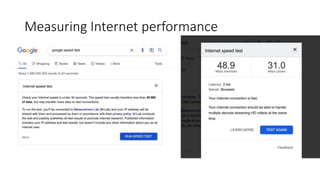
Measuring Internet performance
Internet packet losses
What can explain
these packet
loss ratios ?
Based on data extracted by François Michel from measurementlab’s big query
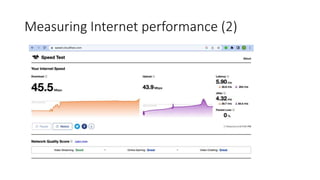
Measuring Internet performance (2)
Internet performance in Wallonia
Broadband access at 30 Mbps or better
Initiative Amélie
Améliorer Internet partout
• Objectif
• L’initiative Amélie vise à mettre sur pied une équipe d’étudiant.e.s bénévoles
afin de proposer un service de diagnostic Internet d’habitations privées.
L’objectif est d’aider les habitants à améliorer la qualité de leur connexion
Internet sans nécessairement changer d’offre ou de fournisseur
• Mise en oeuvre
• Formation à l’analyse des performances en utilisant des outils adaptés et au
diagnostic des facteurs qui réduisent les performances
• Coaching par des chercheurs qui améliorent Internet et des étudiant.e.s de
Master
Agenda
• Reliable data transfer over a reliable network
• How unreliable is the Internet ?
• Reliable data transfer techniques
• The Alternating Bit Protocol
• Go-Back-N
• Selective repeat
How to deal with transmission errors ?
• The receiver must be able to detect that the content of a segment
has been modified
• Checksum, CRC
Question
• How should a host react when it receives a data segment with an
incorrect checksum ?
Coping with errors
A B
Data.req(b) C(OK) Data.ind(a)
D(a)
Data.req(a)
D(b)
D(b)
Data.ind(b)
start timer
timer expires
What do you think of this protocol ?
Coping with errors
A B
Data.req(b) C(OK) Data.ind(a)
D(a)
Data.req(a)
D(b)
D(b)
Data.ind(b)
start timer
timer expires
C(OK) Data.ind(b)
Is this a problem for you ?
A better approach
• Key ideas
• Identify each data segment with a sequence number
• allows to prevent duplication
• one bit is sufficient
• Indicate the sequence number of the last data segment
in the acknowledgement
Alternating Bit Protocol : basics
A B
Data.req(b) C(OK0) Data.ind(a)
D(0,a)
Data.req(a)
D(1,b)
Data.ind(b)
C(OK1)
Data.ind(c)
D(0,c)
Data.req(c)
C(OK0)
Alternating Bit Protocol : reaction to losses
A B
Data.req(b) C(OK0) Data.ind(a)
D(0,a)
Data.req(a)
D(1,b)
Data.ind(b)
Data.req(c)
Lost
D(0,c)
C(OK1)
D(1,b) recvd
Retransmission timer
Data.ind(c)
D(0,c)
C(OK0)
Alternating Bit Protocol : early timer
A B
Data.req(b) C(OK0) Data.ind(a)
D(0,a)
Data.req(a)
Duplicate detected
Which ack to send ?
D(1,b)
Retransmission timer
D(1,b)
Data.ind(b)
Data.req(c)
C(OK1)
D(1,b) recvd
C(OK1)
D(1,b) recvd
Data.ind(c)
D(0,c)
Question
• Do we need to place a checksum/CRC inside the control segments ?
Alternating Bit Protocol : unprotected control
segments
A B
Data.req(b) C(OK0) Data.ind(a)
D(0,a)
Data.req(a)
Duplicate detected
D(1,b)
Retransmission timer
D(1,b)
Data.ind(b)
Data.req(c)
Lost
D(0,c)
C(OK1)
D(1,b) recvd
C(OK0)
D(0,c) recvd
Data.req(d)
D(1,d)
C(OK1)
Undetected
transmission error
Duplicate detected
Alternating bit : sender
Alternating Bit : Receiver
Alternating Bit Protocol
• Advantages
• Simple to implement
• Reliable data transfer
• Drawback
• Performance
• only one segment per round-trip-time
Agenda
• Reliable data transfer over a reliable network
• How unreliable is the Internet ?
• Reliable data transfer techniques
• The Alternating Bit Protocol
• Go-Back-N
• Selective repeat
Pipelining
• Key ideas
• Allow the sender to send several segments without having an explicit ack
• Sender stores unacked segments in a buffer called the sending window to be
able to retransmit them
Pipelining
• How many segments can A send ?
A B
Data.ind(a)
Data.req(a)
...
D(0,a)
...
D(4,e)
Data.req(b)
Data.req(e)
Data.ind(e)
The sending window
• Buffer managed by a sender
• Stores segments sent but not yet acknowledged
• Content of sending window can be retransmitted if needed
• Sending window size limits the number of segments that a host can
sent without acknowledgements
Pipelining example
A B
0 1 2 3 4 5 6 7 8
0 1 2 3 4 5 6 7 8
0 1 2 3 4 5 6 7 8
0 1 2 3 4 5 6 7 8
0 1 2 3 4 5 6 7 8 Data.req(a)
Data.ind(a)
D(0,a)
0 1 2 3 4 5 6 7 8 Data.req(b)
Data.ind(b)
D(1,b)
0 1 2 3 4 5 6 7 8
Data.req(c)
Data.ind(c)
D(2,c)
C(OK0)
C(OK1)
C(OK2)
0 1 2 3 4 5 6 7 8
Data.req(d)
Data.ind(d)
D(3,d)
0 1 2 3 4 5 6 7 8
Data.req(e)
D(4,e)
Sending window
• Sending window must be larger than
bandwidth x round-trip-time to fully use network
Sequence numbers are finite and reused
A B
0 1 2 3
0 1 2 3
0 1 2 3
0 1 2 3
0 1 2 3
Data.req(a)
Data.ind(a)
D(0,a)
Data.req(b)
Data.ind(b)
D(1,b)
Data.req(c)
Data.ind(c)
D(2,c)
C(OK0)
C(OK1)
C(OK2)
Data.req(d)
Data.ind(d)
D(3,d)
Data.req(e)
D(0,e)
Sending window
0 1 2 3
0 1 2 3
0 1 2 3
0 1 2 3
How to deal with losses ?
• Go-back-n
• Sender stores transmitted segments in sending
window to be able to retransmit them if needed
• Simple receiver, accepts only in-sequence segments. If
a segment is errored, sender retransmits all unacked
segments
• Selective repeat
• Sender stores transmitted segments in sending
window to be able to retransmit them if needed
• Advanced receiver, stores out-of-sequence segments.
If a segment is errored, sender only retransmits the
errored segments
Go-back-n
A B
0 1 2 3
0 1 2 3
0 1 2 3
0 1 2 3
0 1 2 3
Data.req(e)
Data.req(a)
Data.ind(a)
D(0,a)
Data.req(c)
D(2,c)
C(OK,0)
C(OK,0)
Sending window
Data.req(b)
D(1,b)
Lost
Not expected seq num,
discarded
Retransmission
timer expires
Sending window is full
0 1 2 3
0 1 2 3
D(1,b)
Data.ind(b)
Data.req(d)
D(3,d)
Data.ind(d)
D(2,c)
Data.ind(c)
Go-back-n : receiver
Go-back-n : sender
Go-back-n : example
A B
0 1 2 3
0 1 2 3
0 1 2 3
0 1 2 3
0 1 2 3
Data.req(e)
Data.req(a)
Data.ind(a)
D(0,a)
Data.req(c)
D(2,c)
C(OK,0)
C(OK,0)
Sending window
Data.req(b)
D(1,b)
Lost
Not expected seq num,
discarded
Retransmission
timer expires
Sending window is full
0 1 2 3
0 1 2 3
D(1,b)
Data.ind(b)
Data.req(d)
D(3,d)
Data.ind(d)
D(2,c)
Data.ind(c)
Question
• You implement a go-back-n receiver using 3 bits
to encode the sequence number. You have
correctly received segment 7 and delivered its
content. You now receive a correct segment 0,
how do you react ?
• you ignore the segment and send ACK(7)
• you accept the segment, deliver it and send ACK(7)
• you accept the segment, deliver it and send ACK(0)
Question
• Go-back-n is used in a network where all data segments are
correctly received, but every second acknowledgement is
corrupted. How many data segments will be retransmitted
by the sender if it needs to reliably send 20 data segments ?
Question
• Go-back-n is used by a protocol that encodes sequence numbers
using 5 bits. What is the largest possible sending window (in
segments) ?
Question
• Go-back-n is used in a satellite network with a round-trip-time of 1
sec. What is the minimum sending window (in segments) to fully
use a 1 Mbps link using 10.000 bits segments ?
Agenda
• Reliable data transfer over a reliable network
• How unreliable is the Internet ?
• Reliable data transfer techniques
• The Alternating Bit Protocol
• Go-Back-N
• Selective repeat
The receive window
• Buffer managed by receiver
• Stores segments received out-of-order
• Segments remain in receive window until gaps are filled
• Receive window size limits the number of segments that the sender
can send without acknowledgements
• Sending window cannot be larger than the other side receive’s window
0 1 2 3 4 5 6 7 8 9 10 11 12 13 14
Forbidden seq. num.
Window
Already delivered
Not yet received Received
Selective repeat
A B
0 1 2 3
0 1 2 3
0 1 2 3
0 1 2 3
Data.ind(b)
Data.req(a)
Data.ind(a)
D(0,a)
0 1 2 3
Data.req(c)
D(2,c)
C(OK,0)
C(OK,0)
Sending window
Data.req(b)
D(1,b)
Lost
Segment stored
D(1,b)
Retransmission
timer expires
0 1 2 3
0 1 2 3
0 1 2 3
0 1 2 3
0 1 2 3
Data.ind(c)
Data.req(d)
D(3,d)
Data.ind(d)
0 1 2 3
0 1 2 3
C(OK,2)
C(OK,3)
Rec. window
0 1 2 3
0 1 2 3
Buffer management
• A reliable transport serves a variable number of applications with a
limited buffer
• The buffer/window allocated to a given connection may need to change
dynamically as connections start and stop
Buffer management
A B
Data.req(a)
Data.ind(a)
D(0,a)
C(OK,0, w=1)
C(OK,0,w=3)
Data.req(c)
D(2,c)
2 new buffers become
available
Data.req(b)
Data.ind(b)
D(1,b)
0 1 2 3
0 1 2 3
0 1 2 3
C(OK,1,w=3)
Rwin=1
0 1 2 3
Swin=3, rwin=1
0 1 2 3
Swin=3, rwin=1
0 1 2 3
Swin=3, rwin=1
0 1 2 3
Swin=3, rwin=1
Swin=3, rwin=3
0 1 2 3
Data.req(d)
D(3,d) 0 1 2 3
Buffer management
A B
Data.req(b)
Data.ind(a)
Data.req(a)
D(0,a)
C(OK,0, w=0)
2 new buffers are
available
0 1 2 3
Rwin=1
0 1 2 3
Swin=3, rwin=1
0 1 2 3
Swin=3, rwin=1
0 1 2 3
Receiver cannot handle
segment immediately
C(OK,0,w=3)
Lost segment
0 1 2 3
Swin=3, rwin=0
Window blocked
No transmission possible
Waits for control segment Waits for data segment
How to recover from this deadlock ?
Persistence timer on receiver,
resend control segment after
timer expiration
Bidirectional transfer
• How to efficiently carry data in both directions ?
Piggybacking
A B
Data.req(a)
Data.ind(a)
D(0,0,a)
Data.req(b)
D(1,0,b)
Error
Discarded
Data.req(c)
D(2,0,c)
Segment -> buffer
Retransmission
Data.ind(b)
D(1,5,b)
Data.ind(c)
Data.req(d)
D(3,6,d)
Data.ind(d)
C(OK,2)
C(OK,3)
Data.req(x)
D(5,0,w)
Data.req(w)
Data.ind(w)
D(6,0,x)
Data.ind(x)
D(5,0,w) acks D(0,0,a)
Bytestream
• How to provide a bytestream service ?
Byte stream service (2)
A B
Data.req(ijkl)
Data.req(mnop)
Data.req(abcdef)
Data.ind(ab)
D(0,ab)
C(OK,1)
C(OK,1)
D(2,cd)
Lost segment
D(4,ef)
Placed in buffer
Data.ind(cdef)
D(2,cd)
Expiration timer
Retransmission
D(6,ijklmnop)
Data.ind(ijklmnop)
C(OK,5)
C(OK,13)
Take back lessons
• Usage of Checksums/CRCs
• Finite State Machines
• Cumulative acknowledgements
• Bandwidth x delay product

Part3-reliable.pptx

  • 1.
    Part 3 Reliable datatransfer over an unreliable network
  • 2.
    Agenda • Reliable datatransfer over a reliable network • How unreliable is the Internet ? • Reliable data transfer techniques • The Alternating Bit Protocol • Go-Back-N • Selective repeat
  • 3.
    How to reliablytransfer data ? • Hypothesis • Internet is fully reliable A B Data.request(a) segment(a) Data.ind(a) Data.request(b) segment(b) Data.ind(b) Data.request(c) segment(c) Data.ind(c)
  • 4.
  • 5.
    Question • What dowe need to add to our “reliable” transfer to allow a datacenter to send data to an Internet of Things device without overflow ?
  • 6.
    Finite State Machine •Sender • Receiver
  • 7.
    Control and datasegments A B Data.req(b) C(OK) Data.ind(a) D(a) Data.req(a) D(b) Data.ind(b) C(OK) Payload Header Trailer Round trip time (rtt)
  • 8.
    Question • Two hostsare connected with a 1 Gbps (10^9 bits/sec) network. It takes one msec to deliver a 1000 bits segment from host A to host B. What is the bandwidth that this protocol will achieve (in bits per second) ?
  • 9.
    Agenda • Reliable datatransfer over a reliable network • How unreliable is the Internet ? • Reliable data transfer techniques • The Alternating Bit Protocol • Go-Back-N • Selective repeat
  • 10.
    The network isimperfect • What can happen to a packet sent over the Internet ? • Packet reaches destination • Packet can suffer transmission errors • Packet contents can be corrupted • Links have typically Bit Error Rates of 10-8 to 10-11 • Wireless suffers from more errors than cable and fiber • Packet can be dropped before reaching destination • Packet can be delayed
  • 11.
  • 12.
    Internet packet losses Whatcan explain these packet loss ratios ? Based on data extracted by François Michel from measurementlab’s big query
  • 13.
  • 14.
    Internet performance inWallonia Broadband access at 30 Mbps or better
  • 15.
    Initiative Amélie Améliorer Internetpartout • Objectif • L’initiative Amélie vise à mettre sur pied une équipe d’étudiant.e.s bénévoles afin de proposer un service de diagnostic Internet d’habitations privées. L’objectif est d’aider les habitants à améliorer la qualité de leur connexion Internet sans nécessairement changer d’offre ou de fournisseur • Mise en oeuvre • Formation à l’analyse des performances en utilisant des outils adaptés et au diagnostic des facteurs qui réduisent les performances • Coaching par des chercheurs qui améliorent Internet et des étudiant.e.s de Master
  • 16.
    Agenda • Reliable datatransfer over a reliable network • How unreliable is the Internet ? • Reliable data transfer techniques • The Alternating Bit Protocol • Go-Back-N • Selective repeat
  • 17.
    How to dealwith transmission errors ? • The receiver must be able to detect that the content of a segment has been modified • Checksum, CRC
  • 18.
    Question • How shoulda host react when it receives a data segment with an incorrect checksum ?
  • 19.
    Coping with errors AB Data.req(b) C(OK) Data.ind(a) D(a) Data.req(a) D(b) D(b) Data.ind(b) start timer timer expires What do you think of this protocol ?
  • 20.
    Coping with errors AB Data.req(b) C(OK) Data.ind(a) D(a) Data.req(a) D(b) D(b) Data.ind(b) start timer timer expires C(OK) Data.ind(b) Is this a problem for you ?
  • 21.
    A better approach •Key ideas • Identify each data segment with a sequence number • allows to prevent duplication • one bit is sufficient • Indicate the sequence number of the last data segment in the acknowledgement
  • 22.
    Alternating Bit Protocol: basics A B Data.req(b) C(OK0) Data.ind(a) D(0,a) Data.req(a) D(1,b) Data.ind(b) C(OK1) Data.ind(c) D(0,c) Data.req(c) C(OK0)
  • 23.
    Alternating Bit Protocol: reaction to losses A B Data.req(b) C(OK0) Data.ind(a) D(0,a) Data.req(a) D(1,b) Data.ind(b) Data.req(c) Lost D(0,c) C(OK1) D(1,b) recvd Retransmission timer Data.ind(c) D(0,c) C(OK0)
  • 24.
    Alternating Bit Protocol: early timer A B Data.req(b) C(OK0) Data.ind(a) D(0,a) Data.req(a) Duplicate detected Which ack to send ? D(1,b) Retransmission timer D(1,b) Data.ind(b) Data.req(c) C(OK1) D(1,b) recvd C(OK1) D(1,b) recvd Data.ind(c) D(0,c)
  • 25.
    Question • Do weneed to place a checksum/CRC inside the control segments ?
  • 26.
    Alternating Bit Protocol: unprotected control segments A B Data.req(b) C(OK0) Data.ind(a) D(0,a) Data.req(a) Duplicate detected D(1,b) Retransmission timer D(1,b) Data.ind(b) Data.req(c) Lost D(0,c) C(OK1) D(1,b) recvd C(OK0) D(0,c) recvd Data.req(d) D(1,d) C(OK1) Undetected transmission error Duplicate detected
  • 27.
  • 28.
  • 29.
    Alternating Bit Protocol •Advantages • Simple to implement • Reliable data transfer • Drawback • Performance • only one segment per round-trip-time
  • 30.
    Agenda • Reliable datatransfer over a reliable network • How unreliable is the Internet ? • Reliable data transfer techniques • The Alternating Bit Protocol • Go-Back-N • Selective repeat
  • 31.
    Pipelining • Key ideas •Allow the sender to send several segments without having an explicit ack • Sender stores unacked segments in a buffer called the sending window to be able to retransmit them
  • 32.
    Pipelining • How manysegments can A send ? A B Data.ind(a) Data.req(a) ... D(0,a) ... D(4,e) Data.req(b) Data.req(e) Data.ind(e)
  • 33.
    The sending window •Buffer managed by a sender • Stores segments sent but not yet acknowledged • Content of sending window can be retransmitted if needed • Sending window size limits the number of segments that a host can sent without acknowledgements
  • 34.
    Pipelining example A B 01 2 3 4 5 6 7 8 0 1 2 3 4 5 6 7 8 0 1 2 3 4 5 6 7 8 0 1 2 3 4 5 6 7 8 0 1 2 3 4 5 6 7 8 Data.req(a) Data.ind(a) D(0,a) 0 1 2 3 4 5 6 7 8 Data.req(b) Data.ind(b) D(1,b) 0 1 2 3 4 5 6 7 8 Data.req(c) Data.ind(c) D(2,c) C(OK0) C(OK1) C(OK2) 0 1 2 3 4 5 6 7 8 Data.req(d) Data.ind(d) D(3,d) 0 1 2 3 4 5 6 7 8 Data.req(e) D(4,e) Sending window • Sending window must be larger than bandwidth x round-trip-time to fully use network
  • 35.
    Sequence numbers arefinite and reused A B 0 1 2 3 0 1 2 3 0 1 2 3 0 1 2 3 0 1 2 3 Data.req(a) Data.ind(a) D(0,a) Data.req(b) Data.ind(b) D(1,b) Data.req(c) Data.ind(c) D(2,c) C(OK0) C(OK1) C(OK2) Data.req(d) Data.ind(d) D(3,d) Data.req(e) D(0,e) Sending window 0 1 2 3 0 1 2 3 0 1 2 3 0 1 2 3
  • 36.
    How to dealwith losses ? • Go-back-n • Sender stores transmitted segments in sending window to be able to retransmit them if needed • Simple receiver, accepts only in-sequence segments. If a segment is errored, sender retransmits all unacked segments • Selective repeat • Sender stores transmitted segments in sending window to be able to retransmit them if needed • Advanced receiver, stores out-of-sequence segments. If a segment is errored, sender only retransmits the errored segments
  • 37.
    Go-back-n A B 0 12 3 0 1 2 3 0 1 2 3 0 1 2 3 0 1 2 3 Data.req(e) Data.req(a) Data.ind(a) D(0,a) Data.req(c) D(2,c) C(OK,0) C(OK,0) Sending window Data.req(b) D(1,b) Lost Not expected seq num, discarded Retransmission timer expires Sending window is full 0 1 2 3 0 1 2 3 D(1,b) Data.ind(b) Data.req(d) D(3,d) Data.ind(d) D(2,c) Data.ind(c)
  • 38.
  • 39.
  • 40.
    Go-back-n : example AB 0 1 2 3 0 1 2 3 0 1 2 3 0 1 2 3 0 1 2 3 Data.req(e) Data.req(a) Data.ind(a) D(0,a) Data.req(c) D(2,c) C(OK,0) C(OK,0) Sending window Data.req(b) D(1,b) Lost Not expected seq num, discarded Retransmission timer expires Sending window is full 0 1 2 3 0 1 2 3 D(1,b) Data.ind(b) Data.req(d) D(3,d) Data.ind(d) D(2,c) Data.ind(c)
  • 41.
    Question • You implementa go-back-n receiver using 3 bits to encode the sequence number. You have correctly received segment 7 and delivered its content. You now receive a correct segment 0, how do you react ? • you ignore the segment and send ACK(7) • you accept the segment, deliver it and send ACK(7) • you accept the segment, deliver it and send ACK(0)
  • 42.
    Question • Go-back-n isused in a network where all data segments are correctly received, but every second acknowledgement is corrupted. How many data segments will be retransmitted by the sender if it needs to reliably send 20 data segments ?
  • 43.
    Question • Go-back-n isused by a protocol that encodes sequence numbers using 5 bits. What is the largest possible sending window (in segments) ?
  • 44.
    Question • Go-back-n isused in a satellite network with a round-trip-time of 1 sec. What is the minimum sending window (in segments) to fully use a 1 Mbps link using 10.000 bits segments ?
  • 45.
    Agenda • Reliable datatransfer over a reliable network • How unreliable is the Internet ? • Reliable data transfer techniques • The Alternating Bit Protocol • Go-Back-N • Selective repeat
  • 46.
    The receive window •Buffer managed by receiver • Stores segments received out-of-order • Segments remain in receive window until gaps are filled • Receive window size limits the number of segments that the sender can send without acknowledgements • Sending window cannot be larger than the other side receive’s window 0 1 2 3 4 5 6 7 8 9 10 11 12 13 14 Forbidden seq. num. Window Already delivered Not yet received Received
  • 47.
    Selective repeat A B 01 2 3 0 1 2 3 0 1 2 3 0 1 2 3 Data.ind(b) Data.req(a) Data.ind(a) D(0,a) 0 1 2 3 Data.req(c) D(2,c) C(OK,0) C(OK,0) Sending window Data.req(b) D(1,b) Lost Segment stored D(1,b) Retransmission timer expires 0 1 2 3 0 1 2 3 0 1 2 3 0 1 2 3 0 1 2 3 Data.ind(c) Data.req(d) D(3,d) Data.ind(d) 0 1 2 3 0 1 2 3 C(OK,2) C(OK,3) Rec. window 0 1 2 3 0 1 2 3
  • 48.
    Buffer management • Areliable transport serves a variable number of applications with a limited buffer • The buffer/window allocated to a given connection may need to change dynamically as connections start and stop
  • 49.
    Buffer management A B Data.req(a) Data.ind(a) D(0,a) C(OK,0,w=1) C(OK,0,w=3) Data.req(c) D(2,c) 2 new buffers become available Data.req(b) Data.ind(b) D(1,b) 0 1 2 3 0 1 2 3 0 1 2 3 C(OK,1,w=3) Rwin=1 0 1 2 3 Swin=3, rwin=1 0 1 2 3 Swin=3, rwin=1 0 1 2 3 Swin=3, rwin=1 0 1 2 3 Swin=3, rwin=1 Swin=3, rwin=3 0 1 2 3 Data.req(d) D(3,d) 0 1 2 3
  • 50.
    Buffer management A B Data.req(b) Data.ind(a) Data.req(a) D(0,a) C(OK,0,w=0) 2 new buffers are available 0 1 2 3 Rwin=1 0 1 2 3 Swin=3, rwin=1 0 1 2 3 Swin=3, rwin=1 0 1 2 3 Receiver cannot handle segment immediately C(OK,0,w=3) Lost segment 0 1 2 3 Swin=3, rwin=0 Window blocked No transmission possible Waits for control segment Waits for data segment How to recover from this deadlock ? Persistence timer on receiver, resend control segment after timer expiration
  • 51.
    Bidirectional transfer • Howto efficiently carry data in both directions ?
  • 52.
    Piggybacking A B Data.req(a) Data.ind(a) D(0,0,a) Data.req(b) D(1,0,b) Error Discarded Data.req(c) D(2,0,c) Segment ->buffer Retransmission Data.ind(b) D(1,5,b) Data.ind(c) Data.req(d) D(3,6,d) Data.ind(d) C(OK,2) C(OK,3) Data.req(x) D(5,0,w) Data.req(w) Data.ind(w) D(6,0,x) Data.ind(x) D(5,0,w) acks D(0,0,a)
  • 53.
    Bytestream • How toprovide a bytestream service ?
  • 54.
    Byte stream service(2) A B Data.req(ijkl) Data.req(mnop) Data.req(abcdef) Data.ind(ab) D(0,ab) C(OK,1) C(OK,1) D(2,cd) Lost segment D(4,ef) Placed in buffer Data.ind(cdef) D(2,cd) Expiration timer Retransmission D(6,ijklmnop) Data.ind(ijklmnop) C(OK,5) C(OK,13)
  • 55.
    Take back lessons •Usage of Checksums/CRCs • Finite State Machines • Cumulative acknowledgements • Bandwidth x delay product

Editor's Notes

  • #61 MSL means Maximum Segment Lifetime