Part 10
Router traffic control
© O. Bonaventure, UCLouvain, 2023. Supplementary material for the
Computer Networking : Principles, Protocols and Practice ebook, https://www.computer-networking.info
Agenda
• Congestion Control
– Principles
– Additive Increase/Multiplicative
Decrease
– Explicit Congestion Notification
– Modern TCP Congestion control
– Router behavior
Traffic control techniques
• What are the techniques that a single router
can use to provide different types of services
to different applications ?
– First step : identify the applications that
need to obtain each service type
– Second step : allocate network ressources
to the different applications
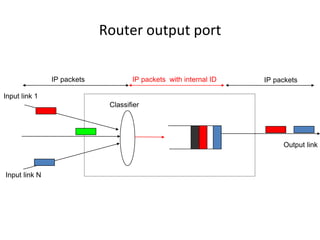
Router output port
Output link
Input link 1
Input link N
Classifier
IP packets IP packets
IP packets with internal ID
How would you implement a classifier ?
• Per source classification ?
– IP address, IP prefix, TCP/UDP ports ?
• Per destination classification ?
– IP address, IP prefix, TCP/UDP ports ?
• Per application classification ?
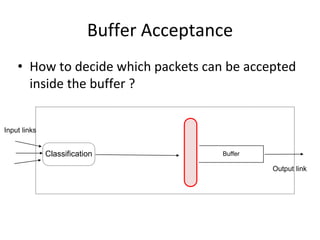
Buffer Acceptance
• How to decide which packets can be accepted
inside the buffer ?
Buffer
Classification
Input links
Output link
Buffer Acceptance
• The two key questions for a buffer acceptance
algorithm
– When should the BA algorithm decide to discard a
packet ?
– Which packet should be discarded ?
Buffer Acceptance Algorithms
• Tail drop
– Arrival (Packet p) :
if isFull(Buffer) then
discard p;
else
AddTail(Buffer, p);
• What are its advantages and drawbacks ?
The traffic control building blocks
on router
Q[1]
Q[2]
Q[3]
Q[N]
Classification
Input links
Output link
Queuing strategy
Logical organisation of the
router's buffers
Scheduler
Chooses the packet to
be transmitted first on
the output link
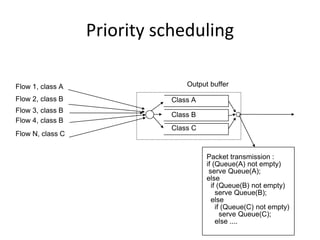
Priority scheduling
Flow 2, class B
Output buffer
Flow 1, class A
Flow 3, class B
Flow 4, class B
Flow N, class C
Class A
Class B
Class C
Packet transmission :
if (Queue(A) not empty)
serve Queue(A);
else
if (Queue(B) not empty)
serve Queue(B);
else
if (Queue(C) not empty)
serve Queue(C);
else ....
Priority scheduling
• With the priority scheduler, what is the
ordering of the packets on the output link ?
A
D
B
E
F
C
High priority Queue
Medium Priority Queue
Low Priority Queue
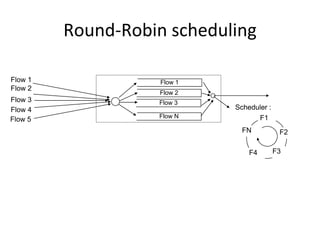
Round-Robin scheduling
Flow 2
Flow 1
Flow 3
Flow 4
Flow 5
Flow 1
Flow 2
Flow 3
Flow N
Scheduler :
F1
F2
F3
F4
FN
Round robin
• If the RR scheduler starts with queue1
and serves them in numerical order, what
is the ordering of the packets on the
output link ?
A
B
D
E
F
G
Queue 1
Queue 2
Queue 3
Round-robin : example
F1
F2
F3
Flow2 (L=2)
Flow1(L=1)
Flow3 (L=1)
F1
F2
F3
Flow1 and Flow3 send packets of size 1
Flow 2 sends packets of size 2
Example
F1
F2
F3
Flow2 (L=2)
Flow1(L=1)
Flow3 (L=1) F1
F2
F3
Flow1 and Flow3 send packets of size 1
Flow 2 sends packets of size 2
Round-Robin
• Advantage
– Can provide fairness independently of the
characteristics of the flows if flows use same
packet size
• Drawbacks
– Difficult to scale to a very large number of
flows
– Unfair with different packet sizes
Deficit Round-Robin
• associate counter d[i] to each queue
• increase d[i] by quantum every time queue[i] is visited
– if first_packet of queue[i] larger than d[i]
{ packet stays in queue[i]; }
– else
{
packet is transmitted on output link;
d[i]=d[i]- packet length;
if queue[i] is empty { d[i]=0; }
}
Flow 2
Flow 1
Flow 3
Flow 4
Flow 5
Flow 1
Flow 2
Flow 3
Flow N
Scheduler :
F1
F2
F3
F4
FN
Deficit Round-Robin : example
F1
F2
F3
Flow2 (L=2)
Flow1(L=1)
Flow3 (L=1) F1
F2
F3
Flow1 and Flow3 send packets of size 1
Flow 2 sends packets of size 2
Deficit Round robin
• If the DRR scheduler starts with queue1
and serves them in numerical order, what
is the ordering of the packets on the
output link ?
A
B
D
F
G
Queue 1
Queue 2
Queue 3
Weighted Round-Robin
Flow 2
Flow 1
Flow 3
Flow 4
Flow 5
Flow 1
Flow 2
Flow 3
Flow 5
Scheduler :
F1
F2
F3
F4
F5
F1
F2 F1
F1
• Fraction of the bandwidth for each flow ?
Weighted Round-Robin
A : 25%
B : 50%
C : 25%
Line rate
Line rate
Variable
B's share
A's share
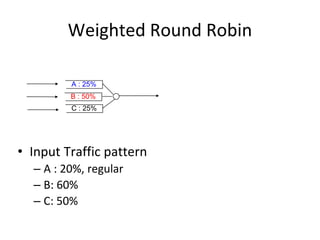
Weighted Round Robin
A : 25%
B : 50%
C : 25%
• Input Traffic pattern
– A : 20%, regular
– B: 60%
– C: 50%
Weighted Round Robin
• What is the impact of a burst of traffic ?
A : 75%
B : 24%
C : 1%
• Input Traffic pattern
– A : 20%, regular
– B: 24%
– C: 100%
Schedulers and buffer acceptance
• Which buffer acceptance strategy should be
used with DRR or WDRR ?
– Can we identify the flow/queue that is causing
congestion ?
– Which packet should be discarded ?

Part10-router.pptx

  • 1.
    Part 10 Router trafficcontrol © O. Bonaventure, UCLouvain, 2023. Supplementary material for the Computer Networking : Principles, Protocols and Practice ebook, https://www.computer-networking.info
  • 2.
    Agenda • Congestion Control –Principles – Additive Increase/Multiplicative Decrease – Explicit Congestion Notification – Modern TCP Congestion control – Router behavior
  • 3.
    Traffic control techniques •What are the techniques that a single router can use to provide different types of services to different applications ? – First step : identify the applications that need to obtain each service type – Second step : allocate network ressources to the different applications
  • 4.
    Router output port Outputlink Input link 1 Input link N Classifier IP packets IP packets IP packets with internal ID
  • 5.
    How would youimplement a classifier ? • Per source classification ? – IP address, IP prefix, TCP/UDP ports ? • Per destination classification ? – IP address, IP prefix, TCP/UDP ports ? • Per application classification ?
  • 6.
    Buffer Acceptance • Howto decide which packets can be accepted inside the buffer ? Buffer Classification Input links Output link
  • 7.
    Buffer Acceptance • Thetwo key questions for a buffer acceptance algorithm – When should the BA algorithm decide to discard a packet ? – Which packet should be discarded ?
  • 8.
    Buffer Acceptance Algorithms •Tail drop – Arrival (Packet p) : if isFull(Buffer) then discard p; else AddTail(Buffer, p); • What are its advantages and drawbacks ?
  • 9.
    The traffic controlbuilding blocks on router Q[1] Q[2] Q[3] Q[N] Classification Input links Output link Queuing strategy Logical organisation of the router's buffers Scheduler Chooses the packet to be transmitted first on the output link
  • 10.
    Priority scheduling Flow 2,class B Output buffer Flow 1, class A Flow 3, class B Flow 4, class B Flow N, class C Class A Class B Class C Packet transmission : if (Queue(A) not empty) serve Queue(A); else if (Queue(B) not empty) serve Queue(B); else if (Queue(C) not empty) serve Queue(C); else ....
  • 11.
    Priority scheduling • Withthe priority scheduler, what is the ordering of the packets on the output link ? A D B E F C High priority Queue Medium Priority Queue Low Priority Queue
  • 12.
    Round-Robin scheduling Flow 2 Flow1 Flow 3 Flow 4 Flow 5 Flow 1 Flow 2 Flow 3 Flow N Scheduler : F1 F2 F3 F4 FN
  • 13.
    Round robin • Ifthe RR scheduler starts with queue1 and serves them in numerical order, what is the ordering of the packets on the output link ? A B D E F G Queue 1 Queue 2 Queue 3
  • 14.
    Round-robin : example F1 F2 F3 Flow2(L=2) Flow1(L=1) Flow3 (L=1) F1 F2 F3 Flow1 and Flow3 send packets of size 1 Flow 2 sends packets of size 2
  • 15.
    Example F1 F2 F3 Flow2 (L=2) Flow1(L=1) Flow3 (L=1)F1 F2 F3 Flow1 and Flow3 send packets of size 1 Flow 2 sends packets of size 2
  • 16.
    Round-Robin • Advantage – Canprovide fairness independently of the characteristics of the flows if flows use same packet size • Drawbacks – Difficult to scale to a very large number of flows – Unfair with different packet sizes
  • 17.
    Deficit Round-Robin • associatecounter d[i] to each queue • increase d[i] by quantum every time queue[i] is visited – if first_packet of queue[i] larger than d[i] { packet stays in queue[i]; } – else { packet is transmitted on output link; d[i]=d[i]- packet length; if queue[i] is empty { d[i]=0; } } Flow 2 Flow 1 Flow 3 Flow 4 Flow 5 Flow 1 Flow 2 Flow 3 Flow N Scheduler : F1 F2 F3 F4 FN
  • 18.
    Deficit Round-Robin :example F1 F2 F3 Flow2 (L=2) Flow1(L=1) Flow3 (L=1) F1 F2 F3 Flow1 and Flow3 send packets of size 1 Flow 2 sends packets of size 2
  • 19.
    Deficit Round robin •If the DRR scheduler starts with queue1 and serves them in numerical order, what is the ordering of the packets on the output link ? A B D F G Queue 1 Queue 2 Queue 3
  • 20.
    Weighted Round-Robin Flow 2 Flow1 Flow 3 Flow 4 Flow 5 Flow 1 Flow 2 Flow 3 Flow 5 Scheduler : F1 F2 F3 F4 F5 F1 F2 F1 F1 • Fraction of the bandwidth for each flow ?
  • 21.
    Weighted Round-Robin A :25% B : 50% C : 25% Line rate Line rate Variable B's share A's share
  • 22.
    Weighted Round Robin A: 25% B : 50% C : 25% • Input Traffic pattern – A : 20%, regular – B: 60% – C: 50%
  • 23.
    Weighted Round Robin •What is the impact of a burst of traffic ? A : 75% B : 24% C : 1% • Input Traffic pattern – A : 20%, regular – B: 24% – C: 100%
  • 24.
    Schedulers and bufferacceptance • Which buffer acceptance strategy should be used with DRR or WDRR ? – Can we identify the flow/queue that is causing congestion ? – Which packet should be discarded ?