Lecture 5: Congestion Control
Overview 
 Internet is a network of networks 
 Narrow waist of IP: unreliable, best-effort 
datagram delivery 
 Packet forwarding: input port to output port 
 Routing protocols: computing port mappings 
 Transport: end-to-end, reliability, flow control, and 
congestion control
Transport 
 Provides end-to-end communication between 
applications 
 UDP: unreliable datagram delivery (thin layer on 
top of IP) 
 TCP: reliable stream delivery
TCP 
 Connection establishment 
 Connection teardown 
 Retransmission timeout (RTT and variance) 
 Flow control (receiver window) 
 Congestion control (transmit window)
TCP 
 Connection establishment 
 Connection teardown 
 Retransmission timeout (RTT and variance) 
 Flow control (receiver window) 
 Congestion control (transmit window)
A Bit of History 
 1974: 3-way handshake 
 1978: TCP and IP split into TCP/IP 
 1983: January 1, ARPAnet switches to TCP/IP 
 1986: Internet begins to suffer congestion collapses 
 1987-8: Van Jacobson fixes TCP, publishes seminal 
paper (Tahoe) 
 1990: Fast recovery and fast retransmit added 
(Reno)
Three questions 
 Goal: maintain TCP goodput at equilibrium 
 When does TCP retransmit packets? 
 When does TCP transmit packets? 
 When does TCP ack packets?
Flow Control 
 Part of TCP specification (pre-1988) 
 Want to make sure we don’t send more than what 
the receiver can handle 
 Sliding window protocol as described in lecture 3 
 Use window header field to tell other side how 
much space you have 
 Rule: Sent and unacknowledged bytes  window
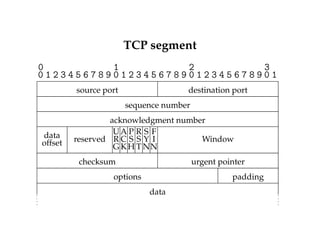
TCP segment 
0 1 2 3 
0 1 2 3 4 5 6 7 8 9 0 1 2 3 4 5 6 7 8 9 0 1 2 3 4 5 6 7 8 9 0 1 
source port destination port 
sequence number 
acknowledgment number 
data offset 
reserved 
Window 
UR 
data 
G 
A P R S F 
CK 
SH 
ST 
YN 
IN 
checksum urgent pointer 
options padding
Send Timing 
 Before Tahoe 
- On connection, nodes send full window of packets 
- Retransmit packet immediately after its timer expires 
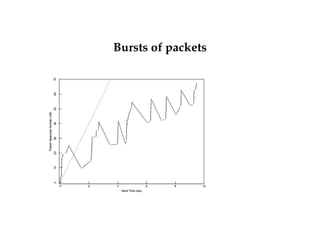
 Result: window-sized bursts of packets in network
Bursts of packets
Retransmission 
 TCP dynamically estimates round trip time 
 If segment goes unacknowledged, must retransmit 
 Use exponential backoff (in case loss from 
congestion) 
 After 10 minutes, give up and reset connection
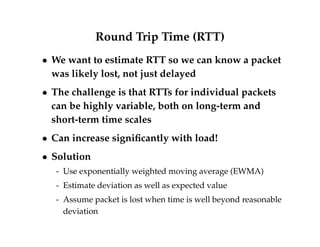
Round Trip Time (RTT) 
 We want to estimate RTT so we can know a packet 
was likely lost, not just delayed 
 The challenge is that RTTs for individual packets 
can be highly variable, both on long-term and 
short-term time scales 
 Can increase significantly with load! 
 Solution 
- Use exponentially weighted moving average (EWMA) 
- Estimate deviation as well as expected value 
- Assume packet is lost when time is well beyond reasonable 
deviation
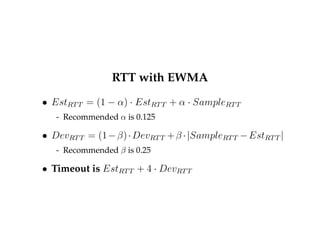
RTT with EWMA 
 EstRTT = (1  )  EstRTT +   SampleRTT 
- Recommended  is 0.125 
 DevRTT = (1
) DevRTT +
jSampleRTT EstRTT j 
- Recommended
is 0.25 
 Timeout is EstRTT + 4  DevRTT
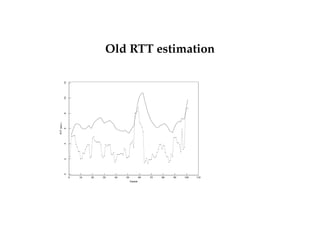
Old RTT estimation
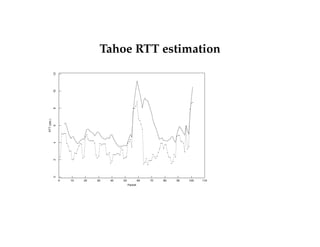
Tahoe RTT estimation
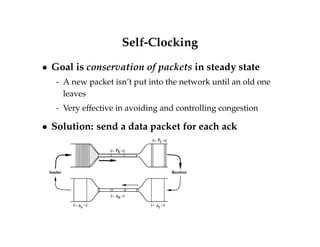
Self-Clocking 
 Goal is conservation of packets in steady state 
- A new packet isn’t put into the network until an old one 
leaves 
- Very effective in avoiding and controlling congestion 
 Solution: send a data packet for each ack
Self-Clocking, Continued 
 Assuming good RTT estimation, self-clocking 
prevents congestion by making window limit the 
number of packets in the network 
 Very simple to implement 
 But how big should the window be?
Slow start 
 But how do you start? 
 Introduce a congestion window to connection state, 
cwnd 
 Rule: Sent and unacknowledged bytes  cwnd 
 On start or loss, set cwnd to one packet (or... more 
on this later) 
 On each data ack, increase cwnd by one packet 
 Prevents bursts of packets
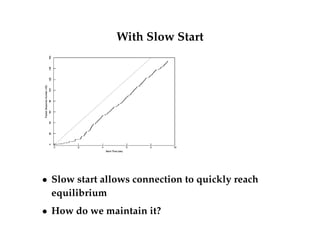
With Slow Start 
 Slow start allows connection to quickly reach 
equilibrium 
 How do we maintain it?
Two States 
 TCP has two states: Slow Start (SS) and 
Congestion Avoidance (CA) 
 A window size threshold governs the state 
transition 
- Window  threshold: slow start 
- Window  threshold: collision avoidance 
 States differ in how they respond to new acks 
- Slow start: cwnd += MSS 
- Congestion avoidance: cwnd += MSS2 
cwnd (MSS every RTT)
Congestion Control 
 Two conflicting goals 
- Provider: high utilization 
- User: fairness among users 
 Want to converge to a state where everyone gets 1 
N 
 Avoid congestion collapse
Taming Congestion 
 The optimal congestion window is the 
bandwidth/delay product 
 Sender learns this by adapting window size 
 Senders must slow down when there is congestion 
 Absence of ACKs (timeout) implies serious 
congestion 
 Duplicate ACKs imply some congestion
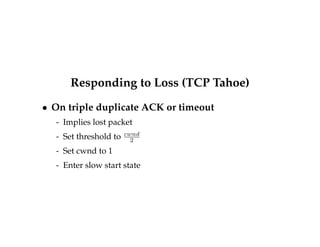
Responding to Loss (TCP Tahoe) 
 On triple duplicate ACK or timeout 
- Implies lost packet 
- Set threshold to cwnd 
2 
- Set cwnd to 1 
- Enter slow start state
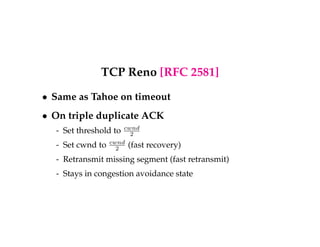
TCP Reno [RFC 2581] 
 Same as Tahoe on timeout 
 On triple duplicate ACK 
- Set threshold to cwnd 
2 
- Set cwnd to cwnd 
2 (fast recovery) 
- Retransmit missing segment (fast retransmit) 
- Stays in congestion avoidance state
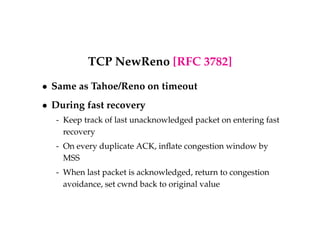
TCP NewReno [RFC 3782] 
 Same as Tahoe/Reno on timeout 
 During fast recovery 
- Keep track of last unacknowledged packet on entering fast 
recovery 
- On every duplicate ACK, inflate congestion window by 
MSS 
- When last packet is acknowledged, return to congestion 
avoidance, set cwnd back to original value
Walk Through Three Examples 
 TCP Tahoe (RTT estimation, congestion window) 
 TCP Reno (Fast retransmit, fast recovery) 
 TCP New Reno (cwnd inflation in fast recovery 
state)
2-minute stretch
AIMD 
 Additive increase, multiplicative decrease 
 Behavior in congestion avoidance mode 
 Why AIMD? Remember goals: 
- Link utilization 
- Fairness
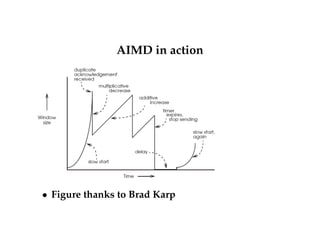
AIMD in action 
30 
AIMD in Action 
• Sender searches for correct window size 
 Figure thanks to Brad Karp
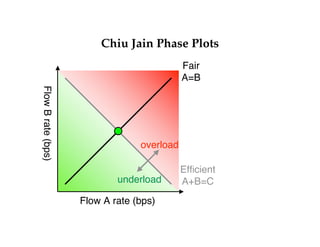
Chiu Jain Phase Plots 
Flow A rate (bps) Flow B rate (bps)
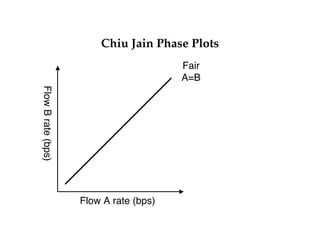
Chiu Jain Phase Plots 
Flow A rate (bps) Flow B rate (bps) 
Fair 
A=B
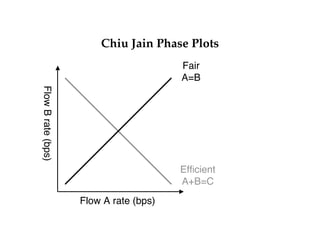
Chiu Jain Phase Plots 
Flow A rate (bps) Flow B rate (bps) 
Fair 
A=B 
Efficient 
A+B=C
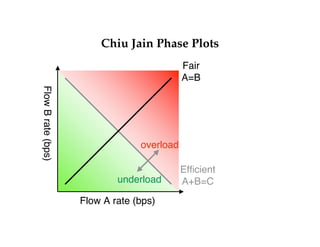
Chiu Jain Phase Plots 
Flow A rate (bps) Flow B rate (bps) 
Fair 
A=B 
Efficient 
A+B=C 
overload 
underload
Chiu Jain Phase Plots 
Flow A rate (bps) Flow B rate (bps) 
Fair 
A=B 
Efficient 
A+B=C 
overload 
underload
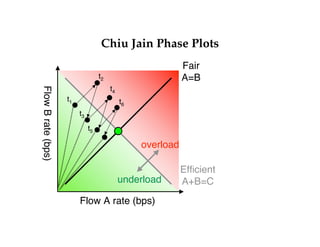
Chiu Jain Phase Plots 
Flow A rate (bps) Flow B rate (bps) 
Fair 
A=B 
Efficient 
A+B=C 
overload 
underload 
t1 
t2 
t3 
t4 
t5 
t6
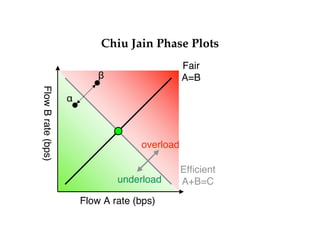
Chiu Jain Phase Plots 
Flow A rate (bps) Flow B rate (bps) 
Fair 
A=B 
Efficient 
A+B=C 
overload 
underload 
α 
β
Three questions, revisited 
 Goal: maintain TCP goodput at equilibrium 
 When does TCP retransmit packets? 
 When does TCP transmit packets? 
 When does TCP ack packets?
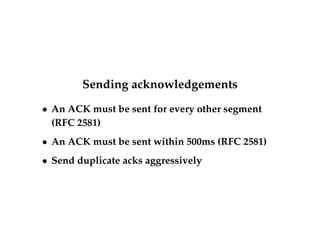
Sending acknowledgements 
 An ACK must be sent for every other segment 
(RFC 2581) 
 An ACK must be sent within 500ms (RFC 2581) 
 Send duplicate acks aggressively
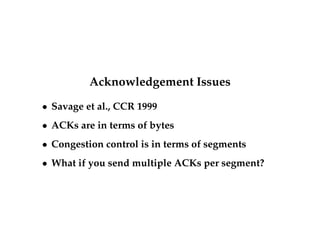
Acknowledgement Issues 
 Savage et al., CCR 1999 
 ACKs are in terms of bytes 
 Congestion control is in terms of segments 
 What if you send multiple ACKs per segment?
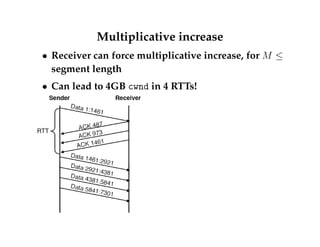
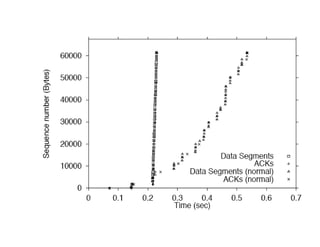
Multiplicative increase 
 Receiver can force multiplicative increase, for M  
segment length 
 Can lead to 4GB cwnd in 4 RTTs!
TCP Daytona!

Computer network (13)

  • 1.
  • 2.
    Overview Internetis a network of networks Narrow waist of IP: unreliable, best-effort datagram delivery Packet forwarding: input port to output port Routing protocols: computing port mappings Transport: end-to-end, reliability, flow control, and congestion control
  • 3.
    Transport Providesend-to-end communication between applications UDP: unreliable datagram delivery (thin layer on top of IP) TCP: reliable stream delivery
  • 4.
    TCP Connectionestablishment Connection teardown Retransmission timeout (RTT and variance) Flow control (receiver window) Congestion control (transmit window)
  • 5.
    TCP Connectionestablishment Connection teardown Retransmission timeout (RTT and variance) Flow control (receiver window) Congestion control (transmit window)
  • 6.
    A Bit ofHistory 1974: 3-way handshake 1978: TCP and IP split into TCP/IP 1983: January 1, ARPAnet switches to TCP/IP 1986: Internet begins to suffer congestion collapses 1987-8: Van Jacobson fixes TCP, publishes seminal paper (Tahoe) 1990: Fast recovery and fast retransmit added (Reno)
  • 7.
    Three questions Goal: maintain TCP goodput at equilibrium When does TCP retransmit packets? When does TCP transmit packets? When does TCP ack packets?
  • 8.
    Flow Control Part of TCP specification (pre-1988) Want to make sure we don’t send more than what the receiver can handle Sliding window protocol as described in lecture 3 Use window header field to tell other side how much space you have Rule: Sent and unacknowledged bytes window
  • 9.
    TCP segment 01 2 3 0 1 2 3 4 5 6 7 8 9 0 1 2 3 4 5 6 7 8 9 0 1 2 3 4 5 6 7 8 9 0 1 source port destination port sequence number acknowledgment number data offset reserved Window UR data G A P R S F CK SH ST YN IN checksum urgent pointer options padding
  • 10.
    Send Timing Before Tahoe - On connection, nodes send full window of packets - Retransmit packet immediately after its timer expires Result: window-sized bursts of packets in network
  • 11.
  • 12.
    Retransmission TCPdynamically estimates round trip time If segment goes unacknowledged, must retransmit Use exponential backoff (in case loss from congestion) After 10 minutes, give up and reset connection
  • 13.
    Round Trip Time(RTT) We want to estimate RTT so we can know a packet was likely lost, not just delayed The challenge is that RTTs for individual packets can be highly variable, both on long-term and short-term time scales Can increase significantly with load! Solution - Use exponentially weighted moving average (EWMA) - Estimate deviation as well as expected value - Assume packet is lost when time is well beyond reasonable deviation
  • 14.
    RTT with EWMA EstRTT = (1 ) EstRTT + SampleRTT - Recommended is 0.125 DevRTT = (1
  • 15.
  • 16.
    jSampleRTT EstRTT j - Recommended
  • 17.
    is 0.25 Timeout is EstRTT + 4 DevRTT
  • 18.
  • 19.
  • 20.
    Self-Clocking Goalis conservation of packets in steady state - A new packet isn’t put into the network until an old one leaves - Very effective in avoiding and controlling congestion Solution: send a data packet for each ack
  • 21.
    Self-Clocking, Continued Assuming good RTT estimation, self-clocking prevents congestion by making window limit the number of packets in the network Very simple to implement But how big should the window be?
  • 22.
    Slow start But how do you start? Introduce a congestion window to connection state, cwnd Rule: Sent and unacknowledged bytes cwnd On start or loss, set cwnd to one packet (or... more on this later) On each data ack, increase cwnd by one packet Prevents bursts of packets
  • 23.
    With Slow Start Slow start allows connection to quickly reach equilibrium How do we maintain it?
  • 24.
    Two States TCP has two states: Slow Start (SS) and Congestion Avoidance (CA) A window size threshold governs the state transition - Window threshold: slow start - Window threshold: collision avoidance States differ in how they respond to new acks - Slow start: cwnd += MSS - Congestion avoidance: cwnd += MSS2 cwnd (MSS every RTT)
  • 25.
    Congestion Control Two conflicting goals - Provider: high utilization - User: fairness among users Want to converge to a state where everyone gets 1 N Avoid congestion collapse
  • 26.
    Taming Congestion The optimal congestion window is the bandwidth/delay product Sender learns this by adapting window size Senders must slow down when there is congestion Absence of ACKs (timeout) implies serious congestion Duplicate ACKs imply some congestion
  • 27.
    Responding to Loss(TCP Tahoe) On triple duplicate ACK or timeout - Implies lost packet - Set threshold to cwnd 2 - Set cwnd to 1 - Enter slow start state
  • 28.
    TCP Reno [RFC2581] Same as Tahoe on timeout On triple duplicate ACK - Set threshold to cwnd 2 - Set cwnd to cwnd 2 (fast recovery) - Retransmit missing segment (fast retransmit) - Stays in congestion avoidance state
  • 29.
    TCP NewReno [RFC3782] Same as Tahoe/Reno on timeout During fast recovery - Keep track of last unacknowledged packet on entering fast recovery - On every duplicate ACK, inflate congestion window by MSS - When last packet is acknowledged, return to congestion avoidance, set cwnd back to original value
  • 30.
    Walk Through ThreeExamples TCP Tahoe (RTT estimation, congestion window) TCP Reno (Fast retransmit, fast recovery) TCP New Reno (cwnd inflation in fast recovery state)
  • 31.
  • 32.
    AIMD Additiveincrease, multiplicative decrease Behavior in congestion avoidance mode Why AIMD? Remember goals: - Link utilization - Fairness
  • 33.
    AIMD in action 30 AIMD in Action • Sender searches for correct window size Figure thanks to Brad Karp
  • 34.
    Chiu Jain PhasePlots Flow A rate (bps) Flow B rate (bps)
  • 35.
    Chiu Jain PhasePlots Flow A rate (bps) Flow B rate (bps) Fair A=B
  • 36.
    Chiu Jain PhasePlots Flow A rate (bps) Flow B rate (bps) Fair A=B Efficient A+B=C
  • 37.
    Chiu Jain PhasePlots Flow A rate (bps) Flow B rate (bps) Fair A=B Efficient A+B=C overload underload
  • 38.
    Chiu Jain PhasePlots Flow A rate (bps) Flow B rate (bps) Fair A=B Efficient A+B=C overload underload
  • 39.
    Chiu Jain PhasePlots Flow A rate (bps) Flow B rate (bps) Fair A=B Efficient A+B=C overload underload t1 t2 t3 t4 t5 t6
  • 40.
    Chiu Jain PhasePlots Flow A rate (bps) Flow B rate (bps) Fair A=B Efficient A+B=C overload underload α β
  • 41.
    Three questions, revisited Goal: maintain TCP goodput at equilibrium When does TCP retransmit packets? When does TCP transmit packets? When does TCP ack packets?
  • 42.
    Sending acknowledgements An ACK must be sent for every other segment (RFC 2581) An ACK must be sent within 500ms (RFC 2581) Send duplicate acks aggressively
  • 43.
    Acknowledgement Issues Savage et al., CCR 1999 ACKs are in terms of bytes Congestion control is in terms of segments What if you send multiple ACKs per segment?
  • 44.
    Multiplicative increase Receiver can force multiplicative increase, for M segment length Can lead to 4GB cwnd in 4 RTTs!
  • 45.