Part 7
Routing protocols
© O. Bonaventure, UCLouvain, 2023. Supplementary material for the
Computer Networking : Principles, Protocols and Practice ebook, https://www.computer-networking.info
Agenda
• Routing protocols
• Distance Vector routing
• Link state routing
• Routing in IP networks
• Interdomain routing
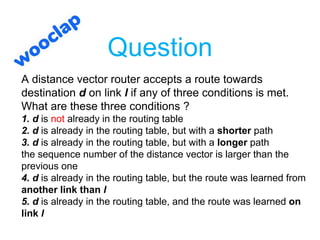
Question
A distance vector router accepts a route towards
destination d on link l if any of three conditions is met.
What are these three conditions ?
1. d is not already in the routing table
2. d is already in the routing table, but with a shorter path
3. d is already in the routing table, but with a longer path
the sequence number of the distance vector is larger than the
previous one
4. d is already in the routing table, but the route was learned from
another link than l
5. d is already in the routing table, and the route was learned on
link l
Reception of DV
Received(Vector V[],link l)
{ /* received vector from link l */
for each destination=d in V[]
{
if (d isin R[])
{ if ( ((V[d].cost+l.cost) < R[d].cost) OR
( R[d].link == l) )
{ /* better route or change to current route */
R[d].cost=V[d].cost+l.cost;
R[d].link=l;
}
}
else
{ /* new route */
R[d].cost=V[d].cost+l.cost;
R[d].link=l;
}
}
DV sent by R3 to R1 with
split horizon?
R1
R2
R3 R4
R5
R6
3
4
10
9
Default link weight is 1
Split horizon
A will not pollute D’s routing table
E
Routing table
A : 0 [ Local ]
D : 1 [South]
B : 3 [South]
C : 3 [South]
E : 2 [South]
A B C
D E
Routing table
C : 0 [Local]
E : 1 [South-West]
D : 2 [South-West]
A: 3 [South-West]
B : 1 [West]
Routing table
E : 0 [Local]
D : 1 [West]
A : 2 [West]
C : 1 [North-East]
B : 1 [North]
Routing table
D : 0 [Local]
A : 1 [North]
E : 1 [East]
C : 2 [East]
B : 2 [East]
Routing table
B : 0 [Local]
A : 3 [South]
C : 1 [East]
E : 1 [South]
D : 2 [South]
A=0
Split horizon (2)
D can also send its distance vector
C
D E
Routing table
A : 0 [ Local ]
D : 1 [South]
E :
C :
B :
A B C
D E
Routing table
C : 0 [Local]
E : 1 [South-West]
D : 2 [South-West]
A: 3 [South-West]
B : 1 [West]
Routing table
E : 0 [Local]
D : 1 [West]
A : 2 [West]
C : 1 [North-East]
B : 1 [North]
Routing table
D : 0 [Local]
A : 1 [North]
E :
C :
B :
Routing table
B : 0 [Local]
A : 3 [South]
C : 1 [East]
E : 1 [South]
D : 2 [South]
D=0;B= ;C= ;E=
Does split horizon allows to avoid all counting to infinity
problems ?
Limitations of split
horizon with poisoning
C
E
Routing table
A : 0 [ Local ]
B :
C :
E :
A B C
E
Routing table
C : 0 [Local]
E : 1 [South-West]
A : 2 [West]
B : 1 [West]
Routing table
E : 0 [Local]
A : 2 [North]
C : 1 [North-East]
B : 1 [North]
Routing table
B : 0 [Local]
A : 1 [West]
C : 1 [East]
E : 1 [South]
A=2;B=1; C=0;E=
A= ;B=0; C=1;E=
A= ;B=0; C= E=1
Limitations
E will send its own distance vector
B will discover a new route towards A
via E and will advertise it to C
New count to infinity problem
C
E
Routing table
A : 0 [ Local ]
B :
C :
E :
A B C
E
Routing table
C : 0 [Local]
E : 1 [South-West]
A : 2 [West]
B : 1 [West]
Routing table after B’s vector
E : 0 [Local]
A :
C : 1 [North-East]
B : 1 [North]
Routing table after C’s vector
E : 0 [local]
A : 3 [North-East]
C : 1 [North-East]
B : 1 [North]
Routing table
B : 0 [Local]
A : 1 [West]
C : 1 [East]
E : 1 [South]
A= ;B=0; C=1;E=
A=2;B=1; C=0;E=
Operational issue
• Operation
• At each expiration of its 30-sec timer, each router
sends its own distance vector and restarts its timer
• Problem
• After a power failure, all routers might restart at same
time and have synchronized timers
• Each router will need to process bursts of DV
messages
See The Synchronization of Periodic Routing Messages , Floyd, S., and Jacobson, V. IEEE/ACM Transactions on Networking,
V.2 N.2, p. 122-136, April 1994.
Agenda
• Routing protocols
• Distance Vector routing
• Link state routing
• Routing in IP networks
• Interdomain routing
Question
• Which of the following informations are contained
in a link state packet ?
1. sequence number
2. list of paths to reach known destinations
3. list of pairs (known dest, cost)
4. age of the link state packet
5. clock time
6. list of pairs (neighbor, cost to this neighbor)
7. CRC
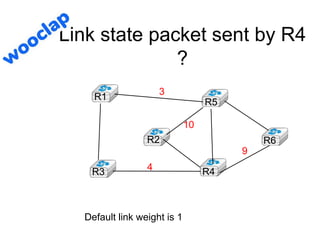
Link state packet sent by R4
?
R1
R2
R3 R4
R5
R6
3
4
10
9
Default link weight is 1
How to set link costs
?
• By manual configuration
• Based on link bandwidth
• By measurements
• Only strictly positive link weights
Two way connectivity check
C
D E
A B C
D E
Links
A-B, B-A : 1
B-E, E-B : 1
B-C, C-B : 1
E-D, D-E : 1
E-C, C-E : 1
A-D, D-A : 1
LSPs
E-0 [D:1];[B:1];[C:1]
A-0 [D:1];[B:1]
B-0 [A:1] [C:1] [E:1]
C-0 [B:1] [E:1]
D-0 [A:1] [E:1]
Links
A-B, B-A : 1
B-E, E-B : 1
B-C, C-B : 1
E-D, D-E : 1
E-C, C-E : 1
A-D, D-A : 1
LSPs
E-0 [D:1];[B:1];[C:1]
A-0 [D:1];[B:1]
B-0 [A:1] [C:1] [E:1]
C-0 [B:1] [E:1]
D-0 [A:1] [E:1]
Links
A-B, B-A : 1
B-E, E-B : 1
B-C, C-B : 1
E-D, D-E : 1
E-C, C-E : 1
A-D, D-A : 1
LSPs
E-0 [D:1];[B:1];[C:1]
A-0 [D:1];[B:1]
B-0 [A:1] [C:1] [E:1]
C-0 [B:1] [E:1]
D-0 [A:1] [E:1]
Links
A-B, B-A : 1
B-E, E-B : 1
B-C, C-B : 1
E-D, D-E : 1
E-C, C-E : 1
A-D, D-A : 1
LSPs
E-1 [D:1];[C:1]
A-0 [D:1];[B:1]
B-0 [A:1] [C:1] [E:1]
C-0 [B:1] [E:1]
D-0 [A:1] [E:1]
Links
A-B, B-A : 1
B-E, E-B : 1
B-C, C-B : 1
E-D, D-E : 1
E-C, C-E : 1
A-D, D-A : 1
LSPs
E-0 [D:1];[B:1];[C:1]
A-0 [D:1];[B:1]
B-0 [A:1] [C:1] [E:1]
C-0 [B:1] [E:1]
D-0 [A:1] [E:1]
LSP : E-1 [D:1];[C:1]
• A link is only considered useable only if both
directions have been advertised
Transient problems
when a link fails
A B
C D
100
A's FIB
B : East
C : South
D : East
D's FIB
A : North
B : North
C : North
C's FIB
A : North
B : North
D : North
B's FIB
A : West
C : West
D : South
A and B are not yet
aware of failure
Packets will be lost
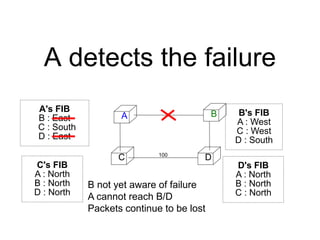
A detects the failure
A B
C D
100
A's FIB
B : East
C : South
D : East
D's FIB
A : North
B : North
C : North
C's FIB
A : North
B : North
D : North
B's FIB
A : West
C : West
D : South
B not yet aware of failure
A cannot reach B/D
Packets continue to be lost
A recomputes Dijkstra
and sends its LSP
A B
C D
100
A's FIB
B : South
C : South
D : South
D's FIB
A : North
B : North
C : North
C's FIB
A : North
B : North
D : North
B's FIB
A : West
C : West
D : South
B not yet aware of failure
A loops towards B/D
Packets continue to be lost
A:1 C=1
B detects the failure
A B
C D
100
A's FIB
B : South
C : South
D : South
D's FIB
A : North
B : North
C : North
C's FIB
A : North
B : North
D : North
B's FIB
A : West
C : West
D : South
B cannot reach A/C
A loops towards B/D
Packets continue to be lost
A:1 C=1
B recomputes Dijkstra
and sends its LSP
A B
C D
100
A's FIB
B : South
C : South
D : South
D's FIB
A : North
B : North
C : North
C's FIB
A : North
B : North
D : North
B's FIB
A : South
C : South
D : South
B cannot reach A/C
A loops towards B/D
Packets continue to be lost
B:1 D=1
C recomputes
Dijkstra
A B
C D
100
A's FIB
B : South
C : South
D : South
D's FIB
A : North
B : North
C : North
C's FIB
A : North
B : East
D : East
B's FIB
A : South
C : South
D : South
B loops towards A/C
A can reach everyone
Packets continue to be lost
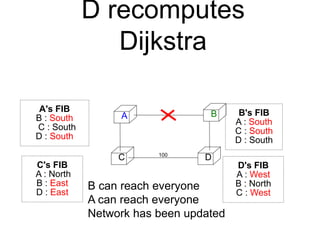
D recomputes
Dijkstra
A B
C D
100
A's FIB
B : South
C : South
D : South
D's FIB
A : West
B : North
C : West
C's FIB
A : North
B : East
D : East
B's FIB
A : South
C : South
D : South
B can reach everyone
A can reach everyone
Network has been updated
Router failures
• Planned failures
• Router reboot to upgrade OS
• Sudden failure
• due to power outage, software or hardware
crash
Comparing routing
protocols
•Neighbour detection
•Detecting link failures
•Detecting router failures
•Link weights
•What information is distributed ?
•How often ?
•How are forwarding tables built ?
Agenda
• Routing protocols
• Distance Vector routing
• Link state routing
• Routing in IP networks
• Interdomain routing
Internet routing
• Exterior Gateway Protocol (EGP)
• Routing of IP packets between domains
• Each domain is considered as a
blackbox
• Interior Gateway Protocol (IGP)
• Routing of IP packets inside each domain
• Only knows topology of its domain
Domain1
Domain2
Domain3
Domain4
Intradomain routing
• Goal
• Allow routers to transmit IP packets along
the best path towards their destination
• best usually means the shortest path
• Shortest measured in seconds or hops
• sometimes best means the less loaded
path
• Alternate routes in case of failures
• Behavior
• All routers exchange routing information
Intradomain routing
• Static routing
• Only useful in very small domains
• Distance vector routing
• Routing Information Protocol (RIP)
• Still widely used in small domains despite
its limitations
• Link-state routing
• Open Shortest Path First (OSPF)
• Widely used in enterprise networks
• Intermediate System- Intermediate-System
(IS-IS)
Agenda
• Routing Protocols
• Routing in IP networks
• Routing organization
• RIP and OSPF
• Interdomain routing
RIP
• Distance vector
• default period : 30 seconds (with jitter)
• distance vector is multicasted in UDP
message to all RIP routers in local subnets
• Optional extension :
• send distance vector after each change
• but some links flaps...
• send distance vector if routing table
changed and did not send another
vector within the last 5 seconds
RIP : message format
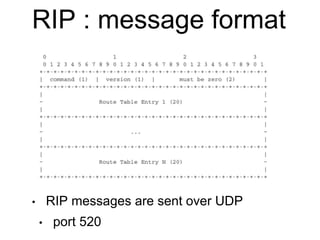
• RIP messages are sent over UDP
• port 520
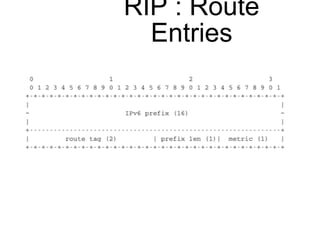
RIP : Route
Entries
OSPF
• Standard link-state routing protocol for
TCP/IP networks (IS-IS in ISP
networks)
• Builds upon link-state routing with
some extensions
• Hierarchical routing with areas
• Designated routers on subnets
• Equal Cost Multipath
OSPF
• Operation
• HELLO packets to discover neighbors
• Update of routing tables
• Link state packets
• acknowledgements, sequence
numbers, age
• periodic transmission/ link changes
• Database description
• Link state Request
• used when a router boots to request link
state packets from neighbors
Equal Cost Multipath
R1 R2
R4
R5
R6
R3 R7
R8
R9
RD
Load balancing
techniques
• Per-packet load balancing
• When a router has several equal cost
paths to a destination, it sends
packets over the different paths using
round-robin
• Advantage : fair distribution
• Drawback: can cause reordering for
TCP
Load balancing
techniques
• Per-flow load balancing
• Router identifies layer-4 flows
• Hash(IPsrc, IPdest, Portsrc, Portdest)
• Each flow assigned to path based on
hash
• Advantage : no reordering
• Drawback: if elephant flows are sent
along same path, unfairness
Agenda
• Routing Protocols
• Routing in IP networks
• Interdomain routing
• Routing policies
• BGP basics
Interdomain routing
• Goals
• Allow to transmit IP packets along the
best path towards their destination
through several transit domains while
considering their routing policies of each
domain without knowing their detailed
topology
• From an interdomain viewpoint, best path
often means cheapest path
• Each domain is free to specify inside its
routing policy the domains for which it
agrees to provide a transit service and
the method it uses to select the best path
to reach each destination
Interdomain links
• Private link
• Usually, a leased line between two routers
belonging to the two connected domains
R1 R2
DomainA DomainB
Interconnection
exchanges
• How to efficiently connect several
domains together ?
R1
R2
R3
R4
Physical link
Interdomain link
An Internet exchange
point
AMS-IX
• Largest IX in the world
Routing policies
• In theory BGP allows each domain to define
its own routing policy...
• In practice there are two common policies
• customer-provider peering
• Customer c buys Internet connectivity
from provider P
• shared-cost peering
• Domains x and y agree to exchange
packets without any payment
Customer Provider
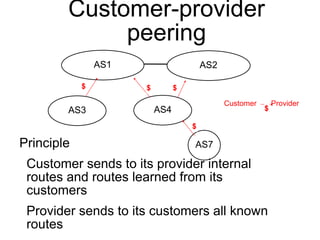
Customer-provider
peering
Principle
Customer sends to its provider internal
routes and routes learned from its
customers
Provider sends to its customers all known
routes
AS2
AS1
AS3 AS4
AS7
$ $ $
$
$
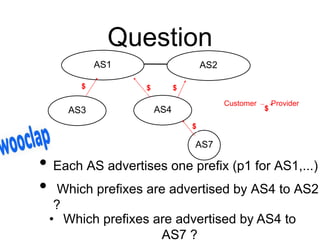
Question
• Each AS advertises one prefix (p1 for AS1,...)
• Which prefixes are advertised by AS4 to AS2
?
Customer Provider
AS2
AS1
AS3 AS4
AS7
$ $ $
$
$
• Which prefixes are advertised by AS4 to
AS7 ?
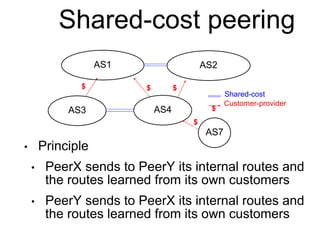
Shared-cost peering
AS2
AS1
AS3 AS4
AS7
$
Customer-provider
$ $ $
$
Shared-cost
• Principle
• PeerX sends to PeerY its internal routes and
the routes learned from its own customers
• PeerY sends to PeerX its internal routes and
the routes learned from its own customers
Question
AS2
AS1
AS3 AS4
AS7
$
Customer-provider
$ $ $
$
Shared-cost
• Each AS advertises one prefix (p1 for AS1,...)
• Which prefixes are advertised by AS4 to AS3
?
• Which prefixes are advertised by AS2 to
AS1 ?
Shared cost peerings
AS2
AS1
AS3
AS4
AS7
$
Customer-provider
$ $ $
$
Shared-cost
• Each AS advertises one prefix (p1 for AS1,...)
• Which prefixes are advertised by AS3 to AS1
?
• Which prefixes are advertised by AS1 to
AS2 ?
AS5
Routing policies
• A domain specifies its routing policy by
defining on each BGP router two sets of filters
for each peer
• Import filter
• Specifies which routes can be accepted by
the router among all the received routes
from a given peer
• Export filter
• Specifies which routes can be advertised by
the router to a given peer
Simple example with
RPSL
AS2
AS1
AS3 AS4
AS7
$
Customer-provider
$ $ $
$
Shared-cost
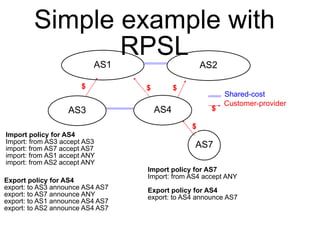
Import policy for AS4
Import: from AS3 accept AS3
import: from AS7 accept AS7
import: from AS1 accept ANY
import: from AS2 accept ANY
Export policy for AS4
export: to AS3 announce AS4 AS7
export: to AS7 announce ANY
export: to AS1 announce AS4 AS7
export: to AS2 announce AS4 AS7
Import policy for AS7
Import: from AS4 accept ANY
Export policy for AS4
export: to AS4 announce AS7
Interdomain paths
AS2
AS1
AS3 AS4
AS7
$
Customer-provider
$ $ $
$
Shared-cost
• Each AS advertises one prefix (p1 for AS1,...)
• Which path will be used from AS7 to AS2 ?
• Which path will be used from AS3 to AS2 ?
Agenda
• Routing in IP networks
• Interdomain routing
• Routing policies
• eBGP basics
• BGP convergence
Border Gateway Protocol
• Path vector protocol
• BGP router advertises its best route to each
destination
AS2
AS1
AS4
2001:db8:1/48
AS5
lprefix:2001:db8:1/48
lASPath: AS1
lprefix: 2001:db8:1/48
lASPath: AS4:AS1
lprefix: 2001:db8:1/48
ASPath: ::AS2:AS4:AS1
lprefix: 2001:db8:1/48
ASPath: AS1
l ... with incremental updates
BGP : Principles
• Principles
• BGP relies on the
incremental exchange of path vectors
BGP session established
over
TCP connection between
peers
Each peer sends all its
active routes
As long as the BGP session
remains up
Incrementally update BGP routing
tables
AS3
AS4
R1
R2
BGP
session
BGP Msgs
BGP basics
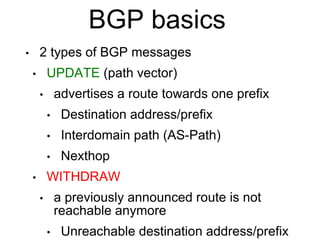
• 2 types of BGP messages
• UPDATE (path vector)
• advertises a route towards one prefix
• Destination address/prefix
• Interdomain path (AS-Path)
• Nexthop
• WITHDRAW
• a previously announced route is not
reachable anymore
• Unreachable destination address/prefix
BGP router
BGP Loc-RIB
Peer[1]
Peer[N]
Import filter
Attribute
manipulation
Peer[1]
Peer[N]
Export filter
Attribute
manipulation
BGP Routing Information Base
Contains all the acceptable routes
learned from all Peers + internal routes
l BGP decision process selects
the best route towards each destination
BGP Msgs
from Peer[1]
BGP Msgs
from Peer[N] BGP Msgs
to Peer[N]
BGP Msgs
to Peer[1]
Import filter(Peer[i])
Determines which BGM Msgs
are acceptable from Peer[i] Export filter(Peer[i])
Determines which
routes can be sent to Peer[i]
One best
route to each
destination
All
acceptable
routes
BGP Decision
Process
BGP Adj-RIB-In
BGP Adj-RIB-Out
Example
R2
AS20
AS30
R1 R3
AS10
2001:db8:12/48
BGP
R4
AS40
BGP
BGP
UPDATE
lprefix: 2001:db8:12/48,
lNextHop:R1
lASPath: AS10
UPDATE
lprefix: 2001:db8:12/48,
lNextHop:R1
lASPath: AS10
UPDATE
lprefix: 2001:db8:12/48,
lNextHop:R4
lASPath: AS40:AS10
UPDATE
lprefix: 2001:db8:12/48,
lNextHop:R2
lASPath: AS20:AS10
• What happens if link AS10-AS20 goes down ?
• What happens if link AS10-AS40 goes down ?
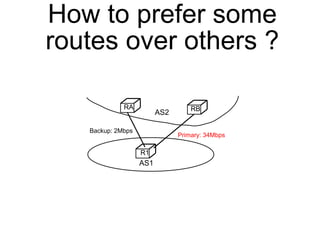
How to prefer some
routes over others ?
R1
RA RB
Backup: 2Mbps
Primary: 34Mbps
AS1
AS2
BGP router
BGP RIB
Peer[1]
Peer[N]
Import filter
Attribute
manipulation
Peer[1]
Peer[N]
Export filter
Attribute
manipulation
BGP Msgs
from Peer[1]
BGP Msgs
from Peer[N]
BGP Msgs
to Peer[N]
BGP Msgs
to Peer[1]
One best
route to each
destination
All
acceptable
routes
BGP Decision
Process
Import filter
• Selection of acceptable routes
• Addition of local-pref attribute
inside received BGP Msg
• Normal quality route : local-pref=100
• Better than normal route :local-pref=200
• Worse than normal route :local-pref=50
Simplified BGP Decision Process
• Select routes with highest
local-pref
• If there are several routes,
choose routes with the
shortest ASPath
• If there are still several routes
tie-breaking rule
BGP session
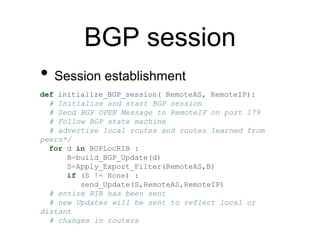
• Session establishment
def initialize_BGP_session( RemoteAS, RemoteIP):
# Initialize and start BGP session
# Send BGP OPEN Message to RemoteIP on port 179
# Follow BGP state machine
# advertise local routes and routes learned from
peers*/
for d in BGPLocRIB :
B=build_BGP_Update(d)
S=Apply_Export_Filter(RemoteAS,B)
if (S != None) :
send_Update(S,RemoteAS,RemoteIP)
# entire RIB has been sent
# new Updates will be sent to reflect local or
distant
# changes in routers
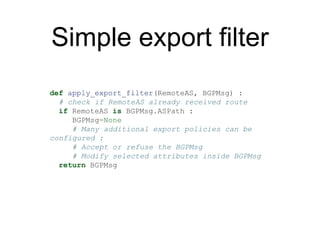
Simple export filter
def apply_export_filter(RemoteAS, BGPMsg) :
# check if RemoteAS already received route
if RemoteAS is BGPMsg.ASPath :
BGPMsg=None
# Many additional export policies can be
configured :
# Accept or refuse the BGPMsg
# Modify selected attributes inside BGPMsg
return BGPMsg
Simple import filter
def apply_import_filter(RemoteAS, BGPMsg):
if MysAS in BGPMsg.ASPath :
BGPMsg=None
# Many additional import policies can be
configured :
# Accept or refuse the BGPMsg
# Modify selected attributes inside BGPMsg
return BGPMsg
Processing UPDATE
def Recvd_BGPMsg(Msg, RemoteAS) :
B=apply_import_filer(Msg,RemoteAS)
if (B== None): # Msg not acceptable
return
if IsUPDATE(Msg):
Old_Route=BestRoute(Msg.prefix)
Insert_in_RIB(Msg)
Run_Decision_Process(RIB)
if (BestRoute(Msg.prefix) != Old_Route) :
# best route changed
B=build_BGP_Message(Msg.prefix);
S=apply_export_filter(RemoteAS,B);
if (S!=None) : # announce best route
send_UPDATE(S,RemoteAS,RemoteIP);
else if (Old_Route != None) :
send_WITHDRAW(Msg.prefix,RemoteAS, RemoteIP)
Processing
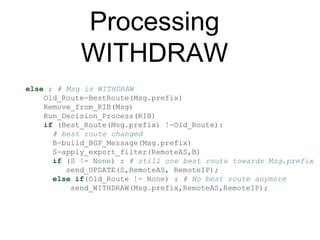
WITHDRAW
else : # Msg is WITHDRAW
Old_Route=BestRoute(Msg.prefix)
Remove_from_RIB(Msg)
Run_Decision_Process(RIB)
if (Best_Route(Msg.prefix) !=Old_Route):
# best route changed
B=build_BGP_Message(Msg.prefix)
S=apply_export_filter(RemoteAS,B)
if (S != None) : # still one best route towards Msg.prefix
send_UPDATE(S,RemoteAS, RemoteIP);
else if(Old_Route != None) : # No best route anymore
send_WITHDRAW(Msg.prefix,RemoteAS,RemoteIP);
Simple example
• AS1 announces one prefix, p
• No routing policies
AS1
AS2
AS3
AS4
AS5
• How many routes in AS5?
• How many routes in AS4?
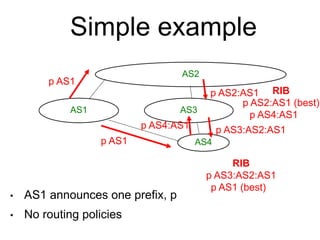
Simple example
• AS1 announces one prefix, p
• No routing policies
AS1
AS2
AS3
AS4
p AS1
p AS2:AS1
p AS3:AS2:AS1
p AS1
RIB
p AS3:AS2:AS1
p AS1 (best)
p AS4:AS1
RIB
p AS2:AS1 (best)
p AS4:AS1
Another example
• AS1 announces one prefix, p
• No routing policies
• Links are activated in the following order
• AS1-AS2, AS3-AS4, AS2-AS3, AS1-AS3
AS1
AS2
AS3
AS4
p AS1
p AS2:AS1
p AS3:AS2:AS1
• What will AS3 when receiving this update ?
p
AS1
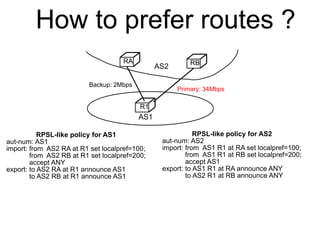
How to prefer routes ?
R1
RA RB
Backup: 2Mbps
Primary: 34Mbps
AS1
AS2
RPSL-like policy for AS1
aut-num: AS1
import: from AS2 RA at R1 set localpref=100;
from AS2 RB at R1 set localpref=200;
accept ANY
export: to AS2 RA at R1 announce AS1
to AS2 RB at R1 announce AS1
RPSL-like policy for AS2
aut-num: AS2
import: from AS1 R1 at RA set localpref=100;
from AS1 R1 at RB set localpref=200;
accept AS1
export: to AS1 R1 at RA announce ANY
to AS2 R1 at RB announce ANY
How to prefer routes ?
RA
R1 R2
R3
RB
Cheap
Expensive
AS1
AS2
AS3
AS4
R5 AS5
RPSL policy for AS1
aut-num: AS1
import: from AS2 RA at R1 set localpref=100;
from AS4 R2 at R1 set localpref=200;
accept ANY
export: to AS2 RA at R1 announce AS1
to AS4 R2 at R1 announce AS1
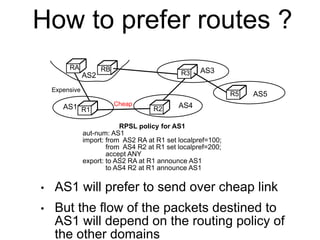
• AS1 will prefer to send over cheap link
• But the flow of the packets destined to
AS1 will depend on the routing policy of
the other domains
Agenda
• Routing in IP networks
• Interdomain routing
• Routing policies
• eBGP basics
• BGP convergence
Limitations of local-
pref
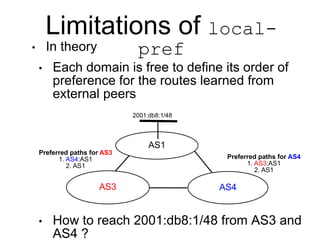
• In theory
• Each domain is free to define its order of
preference for the routes learned from
external peers
• How to reach 2001:db8:1/48 from AS3 and
AS4 ?
AS1
AS3 AS4
Preferred paths for AS4
1. AS3:AS1
2. AS1
Preferred paths for AS3
1. AS4:AS1
2. AS1
2001:db8:1/48
• AS1 sends its UPDATE messages ...
AS1
AS3 AS4
2001:db8:1/48
Preferred paths for AS3
1. AS4:AS1
2. AS1
UPDATE
lP: 2001:db8:1/48
lASPath: AS1
Routing table for AS3
2001:db8:1/48 ASPath: AS1 (best)
Preferred paths for AS4
1. AS3:AS1
2. AS1
UPDATE
lP: 2001:db8:1/48
lASPath: AS1
Routing table for AS4
2001:db8:1/48 ASPath: AS1 (best)
Limitations of local-pref
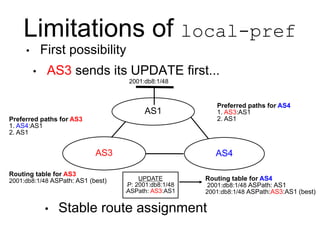
• First possibility
• AS3 sends its UPDATE first...
AS1
AS3 AS4
Preferred paths for AS3
1. AS4:AS1
2. AS1
2001:db8:1/48
Routing table for AS3
2001:db8:1/48 ASPath: AS1 (best) UPDATE
lP: 2001:db8:1/48
lASPath: AS3:AS1
Preferred paths for AS4
1. AS3:AS1
2. AS1
Routing table for AS4
2001:db8:1/48 ASPath: AS1
2001:db8:1/48 ASPath:AS3:AS1 (best)
• Stable route assignment
Limitations of local-pref
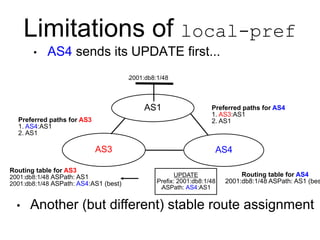
• AS4 sends its UPDATE first...
AS1
AS3 AS4
l2001:db8:1/48
Preferred paths for AS4
1. AS3:AS1
2. AS1
Routing table for AS4
2001:db8:1/48 ASPath: AS1 (bes
Preferred paths for AS3
1. AS4:AS1
2. AS1
UPDATE
lPrefix: 2001:db8:1/48
lASPath: AS4:AS1
Routing table for AS3
2001:db8:1/48 ASPath: AS1
2001:db8:1/48 ASPath: AS4:AS1 (best)
• Another (but different) stable route assignment
Limitations of local-pref
• AS3 and AS4 send their UPDATE together...
AS1
AS3 AS4
Preferred paths for AS3
1. AS4:AS1
2. AS1
2001:db8:1/48
UPDATE
lP: 2001:db8:1/48
lASPath: AS3:AS1
Preferred paths for AS4
1. AS3:AS1
2. AS1
UPDATE
lP: 2001:db8:1/48
ASPath: AS4:AS1
• AS3 prefers indirect path -> withdraw
• AS4 prefers indirect path -> withdraw
Limitations of local-pref
• AS3 and AS4 send their UPDATE together...
AS1
AS3 AS4
Preferred paths for AS3
1. AS4:AS1
2. AS1
2001:db8:1/48
Preferred paths for AS4
1. AS3:AS1
2. AS1
WITHDRAW
lP: 2001:db8:1/48
• AS3 : indirect route is not available anymore
• AS3 will reannounce its direct route...
WITHDRAW
lP: 2001:db8:1/48
• AS4 : indirect route is not available anymore
• AS4 will reannounce its direct route...
Limitations of local-pref
More limitations
local pref
• Unfortunately, interdomain routing may not
converge at all in some cases...
• How to reach a destination inside AS0 in this
case ?
AS1
AS3 AS4
Preferred paths for AS3
1. AS4:AS0
2. other paths
AS0
Preferred paths for AS4
1. AS1:AS0
2. other paths
Preferred paths for AS1
1. AS3:AS0
2. other paths
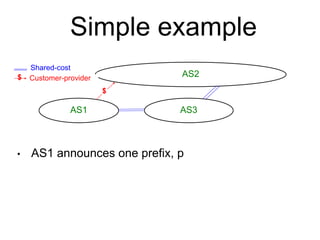
Simple example
AS1
AS2
AS3
$ Customer-provider
Shared-cost
$
• AS1 announces one prefix, p
Simple example
• AS1 announces one prefix, p
AS1
AS2
AS3
AS5
$ Customer-provider
Shared-cost
$
$
AS4
$
Simple example
• AS1 announces one prefix, p
• AS1-AS2 or AS2-AS4 fails
AS1
AS2
AS3
AS5
$ Customer-provider
Shared-cost
$
$
AS4
$
$
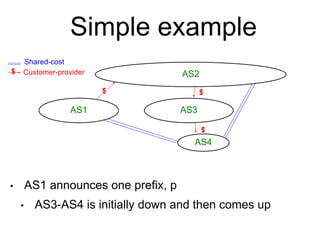
Simple example
• AS1 announces one prefix, p
• AS3-AS4 is initially down and then comes up
AS1
AS2
AS3
$ Customer-provider
Shared-cost
$
$
AS4
$
local-pref and
economic relations
• In practice, local-pref is often combined
with filters to enforce economical
relationships
AS1
Prov1 Prov2
Peer1
Peer2
Peer3
Peer4
Cust1 Cust2
$ Customer-provider
$
Shared-cost
$
$ $
Local-pref values used by AS1
> 1000 for the routes received from a Customer
500 – 999 for the routes learned from a Peer
< 500 for the routes learned from a Provider
local-pref
• Which route will be used by AS1 to reach AS5 ?
• and how will AS5 reach AS1 ?
AS1
AS4
AS2
AS3
AS5
$ Customer-provider
Shared-cost
$
$
$
$
$
AS8
$
AS6
AS7
$
$
Internet paths are often asymmetrical
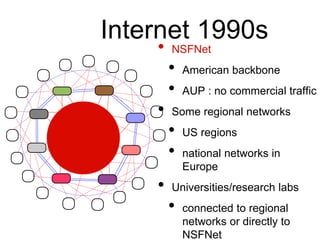
Internet 1990s
• NSFNet
• American backbone
• AUP : no commercial traffic
• Some regional networks
• US regions
• national networks in
Europe
• Universities/research labs
• connected to regional
networks or directly to
NSFNet
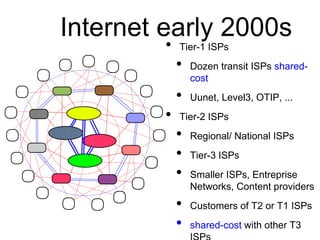
Internet early 2000s
• Tier-1 ISPs
• Dozen transit ISPs shared-
cost
• Uunet, Level3, OTIP, ...
• Tier-2 ISPs
• Regional/ National ISPs
• Tier-3 ISPs
• Smaller ISPs, Entreprise
Networks, Content providers
• Customers of T2 or T1 ISPs
• shared-cost with other T3
Today’s Internet
• Hyper Giants
• google, microsoft,
yahoo, amazon, ...
• google peers 70%
ISPs
• Tier-1 ISPs
• Tier-2 ISPs
• Tier-3 ISPs
• Many peerings at IXPs
Craig Labovitz), Scott Iekel-Johnson, Danny McPherson, Jon Oberheide, Farnam Jahanian,
Internet Inter-Domain Traffic, SIGCOMM 2010
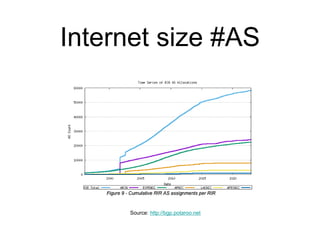
Internet size #AS
Source: http://bgp.potaroo.net
BGP IPv6 routing
tables
Source: http://bgp.potaroo.net
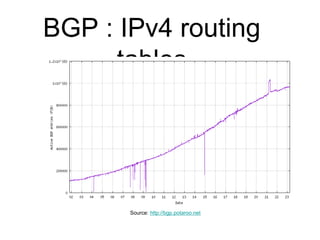
BGP : IPv4 routing
tables
Source: http://bgp.potaroo.net
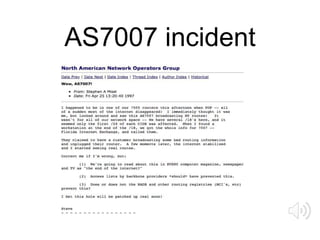
AS7007 incident
RIPE RIS
https://stat.ripe.net/widget/looking-
glass#w.resource=2001:6a8::/32
ttps://stat.ripe.net/AS2611#tabId=at-a-glan
tps://stat.ripe.net/2001:6A8::/32#tabId=rou
Youtube and
Pakistan
http://www.ripe.net/internet-
coordination/news/industry-
developments/youtube-
hijacking-a-ripe-ncc-ris-case-
study

Part7-routing.pptx

  • 1.
    Part 7 Routing protocols ©O. Bonaventure, UCLouvain, 2023. Supplementary material for the Computer Networking : Principles, Protocols and Practice ebook, https://www.computer-networking.info
  • 2.
    Agenda • Routing protocols •Distance Vector routing • Link state routing • Routing in IP networks • Interdomain routing
  • 3.
    Question A distance vectorrouter accepts a route towards destination d on link l if any of three conditions is met. What are these three conditions ? 1. d is not already in the routing table 2. d is already in the routing table, but with a shorter path 3. d is already in the routing table, but with a longer path the sequence number of the distance vector is larger than the previous one 4. d is already in the routing table, but the route was learned from another link than l 5. d is already in the routing table, and the route was learned on link l
  • 4.
    Reception of DV Received(VectorV[],link l) { /* received vector from link l */ for each destination=d in V[] { if (d isin R[]) { if ( ((V[d].cost+l.cost) < R[d].cost) OR ( R[d].link == l) ) { /* better route or change to current route */ R[d].cost=V[d].cost+l.cost; R[d].link=l; } } else { /* new route */ R[d].cost=V[d].cost+l.cost; R[d].link=l; } }
  • 5.
    DV sent byR3 to R1 with split horizon? R1 R2 R3 R4 R5 R6 3 4 10 9 Default link weight is 1
  • 6.
    Split horizon A willnot pollute D’s routing table E Routing table A : 0 [ Local ] D : 1 [South] B : 3 [South] C : 3 [South] E : 2 [South] A B C D E Routing table C : 0 [Local] E : 1 [South-West] D : 2 [South-West] A: 3 [South-West] B : 1 [West] Routing table E : 0 [Local] D : 1 [West] A : 2 [West] C : 1 [North-East] B : 1 [North] Routing table D : 0 [Local] A : 1 [North] E : 1 [East] C : 2 [East] B : 2 [East] Routing table B : 0 [Local] A : 3 [South] C : 1 [East] E : 1 [South] D : 2 [South] A=0
  • 7.
    Split horizon (2) Dcan also send its distance vector C D E Routing table A : 0 [ Local ] D : 1 [South] E : C : B : A B C D E Routing table C : 0 [Local] E : 1 [South-West] D : 2 [South-West] A: 3 [South-West] B : 1 [West] Routing table E : 0 [Local] D : 1 [West] A : 2 [West] C : 1 [North-East] B : 1 [North] Routing table D : 0 [Local] A : 1 [North] E : C : B : Routing table B : 0 [Local] A : 3 [South] C : 1 [East] E : 1 [South] D : 2 [South] D=0;B= ;C= ;E= Does split horizon allows to avoid all counting to infinity problems ?
  • 8.
    Limitations of split horizonwith poisoning C E Routing table A : 0 [ Local ] B : C : E : A B C E Routing table C : 0 [Local] E : 1 [South-West] A : 2 [West] B : 1 [West] Routing table E : 0 [Local] A : 2 [North] C : 1 [North-East] B : 1 [North] Routing table B : 0 [Local] A : 1 [West] C : 1 [East] E : 1 [South] A=2;B=1; C=0;E= A= ;B=0; C=1;E= A= ;B=0; C= E=1
  • 9.
    Limitations E will sendits own distance vector B will discover a new route towards A via E and will advertise it to C New count to infinity problem C E Routing table A : 0 [ Local ] B : C : E : A B C E Routing table C : 0 [Local] E : 1 [South-West] A : 2 [West] B : 1 [West] Routing table after B’s vector E : 0 [Local] A : C : 1 [North-East] B : 1 [North] Routing table after C’s vector E : 0 [local] A : 3 [North-East] C : 1 [North-East] B : 1 [North] Routing table B : 0 [Local] A : 1 [West] C : 1 [East] E : 1 [South] A= ;B=0; C=1;E= A=2;B=1; C=0;E=
  • 10.
    Operational issue • Operation •At each expiration of its 30-sec timer, each router sends its own distance vector and restarts its timer • Problem • After a power failure, all routers might restart at same time and have synchronized timers • Each router will need to process bursts of DV messages See The Synchronization of Periodic Routing Messages , Floyd, S., and Jacobson, V. IEEE/ACM Transactions on Networking, V.2 N.2, p. 122-136, April 1994.
  • 11.
    Agenda • Routing protocols •Distance Vector routing • Link state routing • Routing in IP networks • Interdomain routing
  • 12.
    Question • Which ofthe following informations are contained in a link state packet ? 1. sequence number 2. list of paths to reach known destinations 3. list of pairs (known dest, cost) 4. age of the link state packet 5. clock time 6. list of pairs (neighbor, cost to this neighbor) 7. CRC
  • 13.
    Link state packetsent by R4 ? R1 R2 R3 R4 R5 R6 3 4 10 9 Default link weight is 1
  • 14.
    How to setlink costs ? • By manual configuration • Based on link bandwidth • By measurements • Only strictly positive link weights
  • 15.
    Two way connectivitycheck C D E A B C D E Links A-B, B-A : 1 B-E, E-B : 1 B-C, C-B : 1 E-D, D-E : 1 E-C, C-E : 1 A-D, D-A : 1 LSPs E-0 [D:1];[B:1];[C:1] A-0 [D:1];[B:1] B-0 [A:1] [C:1] [E:1] C-0 [B:1] [E:1] D-0 [A:1] [E:1] Links A-B, B-A : 1 B-E, E-B : 1 B-C, C-B : 1 E-D, D-E : 1 E-C, C-E : 1 A-D, D-A : 1 LSPs E-0 [D:1];[B:1];[C:1] A-0 [D:1];[B:1] B-0 [A:1] [C:1] [E:1] C-0 [B:1] [E:1] D-0 [A:1] [E:1] Links A-B, B-A : 1 B-E, E-B : 1 B-C, C-B : 1 E-D, D-E : 1 E-C, C-E : 1 A-D, D-A : 1 LSPs E-0 [D:1];[B:1];[C:1] A-0 [D:1];[B:1] B-0 [A:1] [C:1] [E:1] C-0 [B:1] [E:1] D-0 [A:1] [E:1] Links A-B, B-A : 1 B-E, E-B : 1 B-C, C-B : 1 E-D, D-E : 1 E-C, C-E : 1 A-D, D-A : 1 LSPs E-1 [D:1];[C:1] A-0 [D:1];[B:1] B-0 [A:1] [C:1] [E:1] C-0 [B:1] [E:1] D-0 [A:1] [E:1] Links A-B, B-A : 1 B-E, E-B : 1 B-C, C-B : 1 E-D, D-E : 1 E-C, C-E : 1 A-D, D-A : 1 LSPs E-0 [D:1];[B:1];[C:1] A-0 [D:1];[B:1] B-0 [A:1] [C:1] [E:1] C-0 [B:1] [E:1] D-0 [A:1] [E:1] LSP : E-1 [D:1];[C:1] LSP : E-1 [D:1];[C:1] • A link is only considered useable only if both directions have been advertised
  • 16.
    Transient problems when alink fails A B C D 100 A's FIB B : East C : South D : East D's FIB A : North B : North C : North C's FIB A : North B : North D : North B's FIB A : West C : West D : South A and B are not yet aware of failure Packets will be lost
  • 17.
    A detects thefailure A B C D 100 A's FIB B : East C : South D : East D's FIB A : North B : North C : North C's FIB A : North B : North D : North B's FIB A : West C : West D : South B not yet aware of failure A cannot reach B/D Packets continue to be lost
  • 18.
    A recomputes Dijkstra andsends its LSP A B C D 100 A's FIB B : South C : South D : South D's FIB A : North B : North C : North C's FIB A : North B : North D : North B's FIB A : West C : West D : South B not yet aware of failure A loops towards B/D Packets continue to be lost A:1 C=1
  • 19.
    B detects thefailure A B C D 100 A's FIB B : South C : South D : South D's FIB A : North B : North C : North C's FIB A : North B : North D : North B's FIB A : West C : West D : South B cannot reach A/C A loops towards B/D Packets continue to be lost A:1 C=1
  • 20.
    B recomputes Dijkstra andsends its LSP A B C D 100 A's FIB B : South C : South D : South D's FIB A : North B : North C : North C's FIB A : North B : North D : North B's FIB A : South C : South D : South B cannot reach A/C A loops towards B/D Packets continue to be lost B:1 D=1
  • 21.
    C recomputes Dijkstra A B CD 100 A's FIB B : South C : South D : South D's FIB A : North B : North C : North C's FIB A : North B : East D : East B's FIB A : South C : South D : South B loops towards A/C A can reach everyone Packets continue to be lost
  • 22.
    D recomputes Dijkstra A B CD 100 A's FIB B : South C : South D : South D's FIB A : West B : North C : West C's FIB A : North B : East D : East B's FIB A : South C : South D : South B can reach everyone A can reach everyone Network has been updated
  • 23.
    Router failures • Plannedfailures • Router reboot to upgrade OS • Sudden failure • due to power outage, software or hardware crash
  • 24.
    Comparing routing protocols •Neighbour detection •Detectinglink failures •Detecting router failures •Link weights •What information is distributed ? •How often ? •How are forwarding tables built ?
  • 25.
    Agenda • Routing protocols •Distance Vector routing • Link state routing • Routing in IP networks • Interdomain routing
  • 26.
    Internet routing • ExteriorGateway Protocol (EGP) • Routing of IP packets between domains • Each domain is considered as a blackbox • Interior Gateway Protocol (IGP) • Routing of IP packets inside each domain • Only knows topology of its domain Domain1 Domain2 Domain3 Domain4
  • 27.
    Intradomain routing • Goal •Allow routers to transmit IP packets along the best path towards their destination • best usually means the shortest path • Shortest measured in seconds or hops • sometimes best means the less loaded path • Alternate routes in case of failures • Behavior • All routers exchange routing information
  • 28.
    Intradomain routing • Staticrouting • Only useful in very small domains • Distance vector routing • Routing Information Protocol (RIP) • Still widely used in small domains despite its limitations • Link-state routing • Open Shortest Path First (OSPF) • Widely used in enterprise networks • Intermediate System- Intermediate-System (IS-IS)
  • 29.
    Agenda • Routing Protocols •Routing in IP networks • Routing organization • RIP and OSPF • Interdomain routing
  • 30.
    RIP • Distance vector •default period : 30 seconds (with jitter) • distance vector is multicasted in UDP message to all RIP routers in local subnets • Optional extension : • send distance vector after each change • but some links flaps... • send distance vector if routing table changed and did not send another vector within the last 5 seconds
  • 31.
    RIP : messageformat • RIP messages are sent over UDP • port 520
  • 32.
  • 33.
    OSPF • Standard link-staterouting protocol for TCP/IP networks (IS-IS in ISP networks) • Builds upon link-state routing with some extensions • Hierarchical routing with areas • Designated routers on subnets • Equal Cost Multipath
  • 34.
    OSPF • Operation • HELLOpackets to discover neighbors • Update of routing tables • Link state packets • acknowledgements, sequence numbers, age • periodic transmission/ link changes • Database description • Link state Request • used when a router boots to request link state packets from neighbors
  • 35.
    Equal Cost Multipath R1R2 R4 R5 R6 R3 R7 R8 R9 RD
  • 36.
    Load balancing techniques • Per-packetload balancing • When a router has several equal cost paths to a destination, it sends packets over the different paths using round-robin • Advantage : fair distribution • Drawback: can cause reordering for TCP
  • 37.
    Load balancing techniques • Per-flowload balancing • Router identifies layer-4 flows • Hash(IPsrc, IPdest, Portsrc, Portdest) • Each flow assigned to path based on hash • Advantage : no reordering • Drawback: if elephant flows are sent along same path, unfairness
  • 38.
    Agenda • Routing Protocols •Routing in IP networks • Interdomain routing • Routing policies • BGP basics
  • 39.
    Interdomain routing • Goals •Allow to transmit IP packets along the best path towards their destination through several transit domains while considering their routing policies of each domain without knowing their detailed topology • From an interdomain viewpoint, best path often means cheapest path • Each domain is free to specify inside its routing policy the domains for which it agrees to provide a transit service and the method it uses to select the best path to reach each destination
  • 40.
    Interdomain links • Privatelink • Usually, a leased line between two routers belonging to the two connected domains R1 R2 DomainA DomainB
  • 41.
    Interconnection exchanges • How toefficiently connect several domains together ? R1 R2 R3 R4 Physical link Interdomain link
  • 42.
  • 43.
  • 44.
    Routing policies • Intheory BGP allows each domain to define its own routing policy... • In practice there are two common policies • customer-provider peering • Customer c buys Internet connectivity from provider P • shared-cost peering • Domains x and y agree to exchange packets without any payment
  • 45.
    Customer Provider Customer-provider peering Principle Customer sendsto its provider internal routes and routes learned from its customers Provider sends to its customers all known routes AS2 AS1 AS3 AS4 AS7 $ $ $ $ $
  • 46.
    Question • Each ASadvertises one prefix (p1 for AS1,...) • Which prefixes are advertised by AS4 to AS2 ? Customer Provider AS2 AS1 AS3 AS4 AS7 $ $ $ $ $ • Which prefixes are advertised by AS4 to AS7 ?
  • 47.
    Shared-cost peering AS2 AS1 AS3 AS4 AS7 $ Customer-provider $$ $ $ Shared-cost • Principle • PeerX sends to PeerY its internal routes and the routes learned from its own customers • PeerY sends to PeerX its internal routes and the routes learned from its own customers
  • 48.
    Question AS2 AS1 AS3 AS4 AS7 $ Customer-provider $ $$ $ Shared-cost • Each AS advertises one prefix (p1 for AS1,...) • Which prefixes are advertised by AS4 to AS3 ? • Which prefixes are advertised by AS2 to AS1 ?
  • 49.
    Shared cost peerings AS2 AS1 AS3 AS4 AS7 $ Customer-provider $$ $ $ Shared-cost • Each AS advertises one prefix (p1 for AS1,...) • Which prefixes are advertised by AS3 to AS1 ? • Which prefixes are advertised by AS1 to AS2 ? AS5
  • 50.
    Routing policies • Adomain specifies its routing policy by defining on each BGP router two sets of filters for each peer • Import filter • Specifies which routes can be accepted by the router among all the received routes from a given peer • Export filter • Specifies which routes can be advertised by the router to a given peer
  • 51.
    Simple example with RPSL AS2 AS1 AS3AS4 AS7 $ Customer-provider $ $ $ $ Shared-cost Import policy for AS4 Import: from AS3 accept AS3 import: from AS7 accept AS7 import: from AS1 accept ANY import: from AS2 accept ANY Export policy for AS4 export: to AS3 announce AS4 AS7 export: to AS7 announce ANY export: to AS1 announce AS4 AS7 export: to AS2 announce AS4 AS7 Import policy for AS7 Import: from AS4 accept ANY Export policy for AS4 export: to AS4 announce AS7
  • 52.
    Interdomain paths AS2 AS1 AS3 AS4 AS7 $ Customer-provider $$ $ $ Shared-cost • Each AS advertises one prefix (p1 for AS1,...) • Which path will be used from AS7 to AS2 ? • Which path will be used from AS3 to AS2 ?
  • 53.
    Agenda • Routing inIP networks • Interdomain routing • Routing policies • eBGP basics • BGP convergence
  • 54.
    Border Gateway Protocol •Path vector protocol • BGP router advertises its best route to each destination AS2 AS1 AS4 2001:db8:1/48 AS5 lprefix:2001:db8:1/48 lASPath: AS1 lprefix: 2001:db8:1/48 lASPath: AS4:AS1 lprefix: 2001:db8:1/48 ASPath: ::AS2:AS4:AS1 lprefix: 2001:db8:1/48 ASPath: AS1 l ... with incremental updates
  • 55.
    BGP : Principles •Principles • BGP relies on the incremental exchange of path vectors BGP session established over TCP connection between peers Each peer sends all its active routes As long as the BGP session remains up Incrementally update BGP routing tables AS3 AS4 R1 R2 BGP session BGP Msgs
  • 56.
    BGP basics • 2types of BGP messages • UPDATE (path vector) • advertises a route towards one prefix • Destination address/prefix • Interdomain path (AS-Path) • Nexthop • WITHDRAW • a previously announced route is not reachable anymore • Unreachable destination address/prefix
  • 57.
    BGP router BGP Loc-RIB Peer[1] Peer[N] Importfilter Attribute manipulation Peer[1] Peer[N] Export filter Attribute manipulation BGP Routing Information Base Contains all the acceptable routes learned from all Peers + internal routes l BGP decision process selects the best route towards each destination BGP Msgs from Peer[1] BGP Msgs from Peer[N] BGP Msgs to Peer[N] BGP Msgs to Peer[1] Import filter(Peer[i]) Determines which BGM Msgs are acceptable from Peer[i] Export filter(Peer[i]) Determines which routes can be sent to Peer[i] One best route to each destination All acceptable routes BGP Decision Process BGP Adj-RIB-In BGP Adj-RIB-Out
  • 58.
    Example R2 AS20 AS30 R1 R3 AS10 2001:db8:12/48 BGP R4 AS40 BGP BGP UPDATE lprefix: 2001:db8:12/48, lNextHop:R1 lASPath:AS10 UPDATE lprefix: 2001:db8:12/48, lNextHop:R1 lASPath: AS10 UPDATE lprefix: 2001:db8:12/48, lNextHop:R4 lASPath: AS40:AS10 UPDATE lprefix: 2001:db8:12/48, lNextHop:R2 lASPath: AS20:AS10 • What happens if link AS10-AS20 goes down ? • What happens if link AS10-AS40 goes down ?
  • 59.
    How to prefersome routes over others ? R1 RA RB Backup: 2Mbps Primary: 34Mbps AS1 AS2
  • 60.
    BGP router BGP RIB Peer[1] Peer[N] Importfilter Attribute manipulation Peer[1] Peer[N] Export filter Attribute manipulation BGP Msgs from Peer[1] BGP Msgs from Peer[N] BGP Msgs to Peer[N] BGP Msgs to Peer[1] One best route to each destination All acceptable routes BGP Decision Process Import filter • Selection of acceptable routes • Addition of local-pref attribute inside received BGP Msg • Normal quality route : local-pref=100 • Better than normal route :local-pref=200 • Worse than normal route :local-pref=50 Simplified BGP Decision Process • Select routes with highest local-pref • If there are several routes, choose routes with the shortest ASPath • If there are still several routes tie-breaking rule
  • 61.
    BGP session • Sessionestablishment def initialize_BGP_session( RemoteAS, RemoteIP): # Initialize and start BGP session # Send BGP OPEN Message to RemoteIP on port 179 # Follow BGP state machine # advertise local routes and routes learned from peers*/ for d in BGPLocRIB : B=build_BGP_Update(d) S=Apply_Export_Filter(RemoteAS,B) if (S != None) : send_Update(S,RemoteAS,RemoteIP) # entire RIB has been sent # new Updates will be sent to reflect local or distant # changes in routers
  • 62.
    Simple export filter defapply_export_filter(RemoteAS, BGPMsg) : # check if RemoteAS already received route if RemoteAS is BGPMsg.ASPath : BGPMsg=None # Many additional export policies can be configured : # Accept or refuse the BGPMsg # Modify selected attributes inside BGPMsg return BGPMsg
  • 63.
    Simple import filter defapply_import_filter(RemoteAS, BGPMsg): if MysAS in BGPMsg.ASPath : BGPMsg=None # Many additional import policies can be configured : # Accept or refuse the BGPMsg # Modify selected attributes inside BGPMsg return BGPMsg
  • 64.
    Processing UPDATE def Recvd_BGPMsg(Msg,RemoteAS) : B=apply_import_filer(Msg,RemoteAS) if (B== None): # Msg not acceptable return if IsUPDATE(Msg): Old_Route=BestRoute(Msg.prefix) Insert_in_RIB(Msg) Run_Decision_Process(RIB) if (BestRoute(Msg.prefix) != Old_Route) : # best route changed B=build_BGP_Message(Msg.prefix); S=apply_export_filter(RemoteAS,B); if (S!=None) : # announce best route send_UPDATE(S,RemoteAS,RemoteIP); else if (Old_Route != None) : send_WITHDRAW(Msg.prefix,RemoteAS, RemoteIP)
  • 65.
    Processing WITHDRAW else : #Msg is WITHDRAW Old_Route=BestRoute(Msg.prefix) Remove_from_RIB(Msg) Run_Decision_Process(RIB) if (Best_Route(Msg.prefix) !=Old_Route): # best route changed B=build_BGP_Message(Msg.prefix) S=apply_export_filter(RemoteAS,B) if (S != None) : # still one best route towards Msg.prefix send_UPDATE(S,RemoteAS, RemoteIP); else if(Old_Route != None) : # No best route anymore send_WITHDRAW(Msg.prefix,RemoteAS,RemoteIP);
  • 66.
    Simple example • AS1announces one prefix, p • No routing policies AS1 AS2 AS3 AS4 AS5 • How many routes in AS5? • How many routes in AS4?
  • 67.
    Simple example • AS1announces one prefix, p • No routing policies AS1 AS2 AS3 AS4 p AS1 p AS2:AS1 p AS3:AS2:AS1 p AS1 RIB p AS3:AS2:AS1 p AS1 (best) p AS4:AS1 RIB p AS2:AS1 (best) p AS4:AS1
  • 68.
    Another example • AS1announces one prefix, p • No routing policies • Links are activated in the following order • AS1-AS2, AS3-AS4, AS2-AS3, AS1-AS3 AS1 AS2 AS3 AS4 p AS1 p AS2:AS1 p AS3:AS2:AS1 • What will AS3 when receiving this update ? p AS1
  • 69.
    How to preferroutes ? R1 RA RB Backup: 2Mbps Primary: 34Mbps AS1 AS2 RPSL-like policy for AS1 aut-num: AS1 import: from AS2 RA at R1 set localpref=100; from AS2 RB at R1 set localpref=200; accept ANY export: to AS2 RA at R1 announce AS1 to AS2 RB at R1 announce AS1 RPSL-like policy for AS2 aut-num: AS2 import: from AS1 R1 at RA set localpref=100; from AS1 R1 at RB set localpref=200; accept AS1 export: to AS1 R1 at RA announce ANY to AS2 R1 at RB announce ANY
  • 70.
    How to preferroutes ? RA R1 R2 R3 RB Cheap Expensive AS1 AS2 AS3 AS4 R5 AS5 RPSL policy for AS1 aut-num: AS1 import: from AS2 RA at R1 set localpref=100; from AS4 R2 at R1 set localpref=200; accept ANY export: to AS2 RA at R1 announce AS1 to AS4 R2 at R1 announce AS1 • AS1 will prefer to send over cheap link • But the flow of the packets destined to AS1 will depend on the routing policy of the other domains
  • 71.
    Agenda • Routing inIP networks • Interdomain routing • Routing policies • eBGP basics • BGP convergence
  • 72.
    Limitations of local- pref •In theory • Each domain is free to define its order of preference for the routes learned from external peers • How to reach 2001:db8:1/48 from AS3 and AS4 ? AS1 AS3 AS4 Preferred paths for AS4 1. AS3:AS1 2. AS1 Preferred paths for AS3 1. AS4:AS1 2. AS1 2001:db8:1/48
  • 73.
    • AS1 sendsits UPDATE messages ... AS1 AS3 AS4 2001:db8:1/48 Preferred paths for AS3 1. AS4:AS1 2. AS1 UPDATE lP: 2001:db8:1/48 lASPath: AS1 Routing table for AS3 2001:db8:1/48 ASPath: AS1 (best) Preferred paths for AS4 1. AS3:AS1 2. AS1 UPDATE lP: 2001:db8:1/48 lASPath: AS1 Routing table for AS4 2001:db8:1/48 ASPath: AS1 (best) Limitations of local-pref
  • 74.
    • First possibility •AS3 sends its UPDATE first... AS1 AS3 AS4 Preferred paths for AS3 1. AS4:AS1 2. AS1 2001:db8:1/48 Routing table for AS3 2001:db8:1/48 ASPath: AS1 (best) UPDATE lP: 2001:db8:1/48 lASPath: AS3:AS1 Preferred paths for AS4 1. AS3:AS1 2. AS1 Routing table for AS4 2001:db8:1/48 ASPath: AS1 2001:db8:1/48 ASPath:AS3:AS1 (best) • Stable route assignment Limitations of local-pref
  • 75.
    • AS4 sendsits UPDATE first... AS1 AS3 AS4 l2001:db8:1/48 Preferred paths for AS4 1. AS3:AS1 2. AS1 Routing table for AS4 2001:db8:1/48 ASPath: AS1 (bes Preferred paths for AS3 1. AS4:AS1 2. AS1 UPDATE lPrefix: 2001:db8:1/48 lASPath: AS4:AS1 Routing table for AS3 2001:db8:1/48 ASPath: AS1 2001:db8:1/48 ASPath: AS4:AS1 (best) • Another (but different) stable route assignment Limitations of local-pref
  • 76.
    • AS3 andAS4 send their UPDATE together... AS1 AS3 AS4 Preferred paths for AS3 1. AS4:AS1 2. AS1 2001:db8:1/48 UPDATE lP: 2001:db8:1/48 lASPath: AS3:AS1 Preferred paths for AS4 1. AS3:AS1 2. AS1 UPDATE lP: 2001:db8:1/48 ASPath: AS4:AS1 • AS3 prefers indirect path -> withdraw • AS4 prefers indirect path -> withdraw Limitations of local-pref
  • 77.
    • AS3 andAS4 send their UPDATE together... AS1 AS3 AS4 Preferred paths for AS3 1. AS4:AS1 2. AS1 2001:db8:1/48 Preferred paths for AS4 1. AS3:AS1 2. AS1 WITHDRAW lP: 2001:db8:1/48 • AS3 : indirect route is not available anymore • AS3 will reannounce its direct route... WITHDRAW lP: 2001:db8:1/48 • AS4 : indirect route is not available anymore • AS4 will reannounce its direct route... Limitations of local-pref
  • 78.
    More limitations local pref •Unfortunately, interdomain routing may not converge at all in some cases... • How to reach a destination inside AS0 in this case ? AS1 AS3 AS4 Preferred paths for AS3 1. AS4:AS0 2. other paths AS0 Preferred paths for AS4 1. AS1:AS0 2. other paths Preferred paths for AS1 1. AS3:AS0 2. other paths
  • 79.
  • 80.
    Simple example • AS1announces one prefix, p AS1 AS2 AS3 AS5 $ Customer-provider Shared-cost $ $ AS4 $
  • 81.
    Simple example • AS1announces one prefix, p • AS1-AS2 or AS2-AS4 fails AS1 AS2 AS3 AS5 $ Customer-provider Shared-cost $ $ AS4 $ $
  • 82.
    Simple example • AS1announces one prefix, p • AS3-AS4 is initially down and then comes up AS1 AS2 AS3 $ Customer-provider Shared-cost $ $ AS4 $
  • 83.
    local-pref and economic relations •In practice, local-pref is often combined with filters to enforce economical relationships AS1 Prov1 Prov2 Peer1 Peer2 Peer3 Peer4 Cust1 Cust2 $ Customer-provider $ Shared-cost $ $ $ Local-pref values used by AS1 > 1000 for the routes received from a Customer 500 – 999 for the routes learned from a Peer < 500 for the routes learned from a Provider
  • 84.
    local-pref • Which routewill be used by AS1 to reach AS5 ? • and how will AS5 reach AS1 ? AS1 AS4 AS2 AS3 AS5 $ Customer-provider Shared-cost $ $ $ $ $ AS8 $ AS6 AS7 $ $ Internet paths are often asymmetrical
  • 85.
    Internet 1990s • NSFNet •American backbone • AUP : no commercial traffic • Some regional networks • US regions • national networks in Europe • Universities/research labs • connected to regional networks or directly to NSFNet
  • 86.
    Internet early 2000s •Tier-1 ISPs • Dozen transit ISPs shared- cost • Uunet, Level3, OTIP, ... • Tier-2 ISPs • Regional/ National ISPs • Tier-3 ISPs • Smaller ISPs, Entreprise Networks, Content providers • Customers of T2 or T1 ISPs • shared-cost with other T3
  • 87.
    Today’s Internet • HyperGiants • google, microsoft, yahoo, amazon, ... • google peers 70% ISPs • Tier-1 ISPs • Tier-2 ISPs • Tier-3 ISPs • Many peerings at IXPs Craig Labovitz), Scott Iekel-Johnson, Danny McPherson, Jon Oberheide, Farnam Jahanian, Internet Inter-Domain Traffic, SIGCOMM 2010
  • 88.
    Internet size #AS Source:http://bgp.potaroo.net
  • 89.
    BGP IPv6 routing tables Source:http://bgp.potaroo.net
  • 90.
    BGP : IPv4routing tables Source: http://bgp.potaroo.net
  • 91.
  • 92.
  • 93.

Editor's Notes

  • #11  The Synchronization of Periodic Routing Messages , Floyd, S., and Jacobson, V. IEEE/ACM Transactions on Networking, V.2 N.2, p. 122-136, April 1994.
  • #31 RFC2453 RIP Version 2. G. Malkin. November 1998 Gary Malkin, RIP : an intra-domain routing protocol, Addison-Wesley, 2002
  • #35  RFC2328 OSPF Version 2. J. Moy. April 1998. J. Moy, OSPF: Anatomy of an Internet Routing Protocol, Addison Wesley, 1998
  • #41 For more information on the organization of the Internet, see : G. Huston, Peerings and settlements, Internet Protocol Journal, Vol. 2, N1 et 2, 1999, http://www.cisco.com/warp/public/759/ipj_Volume2.html For more information on interconnection points or Internet exchanges, see : http://www.euro-ix.net/ http://www.ripe.net/ripe/wg/eix/index.html http://www.ep.net/ep-main.html
  • #46 On link AS7-AS4 AS7 advertises its own routes to AS4 AS4 advertises to AS7 the routes that allow to reach the entire Internet On link AS4-AS2 AS4 advertises its own routes and the routes belonging to AS7 AS2 advertises the routes that allow to reach the entire Internet
  • #48 On link AS3-AS4 AS3 advertises its internal routes AS4 advertises its internal routes and the routes learned from AS7 (its customer) On link AS1-AS2 AS1 advertises its internal routes and the routes received from AS3 and AS4 (its customers) AS2 advertises its internal routes and the routes learned from AS74(its customer)
  • #51 RFC 2622 Routing Policy Specification Language (RPSL). C. Alaettinoglu, C. Villamizar, E. Gerich, D. Kessens, D. Meyer, T. Bates, D. Karrenberg, M. Terpstra. June 1999. RFC 2650 Using RPSL in Practice. D. Meyer, J. Schmitz, C. Orange, M. Prior, C. Alaettinoglu. August 1999. Internet Routing Registries contain the routing policies of various ISPs, see : http://www.ripe.net/ripencc/pub-services/whois.html http://www.arin.net/whois/index.html http://www.apnic.net/apnic-bin/whois.pl
  • #59 If link AS10-AS20 goes down, AS20 will not consider anymore the path learned from AS10. It will thus remove this path from its routing table and will instead select the path learned from AS40. This will force AS20 to send the following UPDATE to AS30 :
  • #67 Due to the utilization of the local-pref attribute, some paths on the Internet are longer than their optimum length, see : Lixin Gao and Feng Wang , The Extent of AS Path Inflation by Routing Policies, GlobalInternet 2002
  • #68 Due to the utilization of the local-pref attribute, some paths on the Internet are longer than their optimum length, see : Lixin Gao and Feng Wang , The Extent of AS Path Inflation by Routing Policies, GlobalInternet 2002
  • #69 Due to the utilization of the local-pref attribute, some paths on the Internet are longer than their optimum length, see : Lixin Gao and Feng Wang , The Extent of AS Path Inflation by Routing Policies, GlobalInternet 2002
  • #70 Note that in RPSL, the set localpref construct does not exist. It is replaced with action preference=x. Unfortunately, in RPSL the routes with the lowest preference are preferred. RPSL uses thus the opposite of local-pref....
  • #79 In practice, the exchange of BGP UPDATE messages will cease due to the utilization of timers by BGP routers and the routing will stabilize on one of the two stable route assignments.
  • #80 Due to the utilization of the local-pref attribute, some paths on the Internet are longer than their optimum length, see : Lixin Gao and Feng Wang , The Extent of AS Path Inflation by Routing Policies, GlobalInternet 2002
  • #81 Due to the utilization of the local-pref attribute, some paths on the Internet are longer than their optimum length, see : Lixin Gao and Feng Wang , The Extent of AS Path Inflation by Routing Policies, GlobalInternet 2002
  • #82 Due to the utilization of the local-pref attribute, some paths on the Internet are longer than their optimum length, see : Lixin Gao and Feng Wang , The Extent of AS Path Inflation by Routing Policies, GlobalInternet 2002
  • #83 Due to the utilization of the local-pref attribute, some paths on the Internet are longer than their optimum length, see : Lixin Gao and Feng Wang , The Extent of AS Path Inflation by Routing Policies, GlobalInternet 2002
  • #84 This local-pref settings corresponds to the economical relationships between the various ASes. Since AS1 is paid to carry packets towards Cust1 and Cust2, it will select a route towards those networks whenever possible. Since AS1 does not need to pay to carry packets towards Peer1-4, AS1 will select a route towards those networks whenever possible. AS1 will only utilize the routes receive from its providers when there is no other choice. It is shown in the following papers that this way of utilizing the local-pref attribute leads to stable BGP routes : Lixin Gao, Timothy G. Griffin, and Jennifer Rexford, "Inherently safe backup routing with BGP," Proc. IEEE INFOCOM, April 2001 Lixin Gao and Jennifer Rexford, "Stable Internet routing without global coordination," IEEE/ACM Transactions on Networking, December 2001, pp. 681-692 The RPSL policy of AS1 could be as follows : RPSL policy for AS1 aut-num: AS1 import: from Cust1 action set localpref=200; accept Cust1 from Cust2 action set localpref=200; accept Cust2 from Peer1 action set localpref=150; accept Peer1 from Peer2 action set localpref=160; accept Peer2 from Peer3 action set localpref=170; accept Peer3 from Peer4 action set localpref=180; accept Peer4 from Prov1 action set localpref=100; accept ANY from Prov2 action set localpref=100; accept ANY
  • #85 Due to the utilization of the local-pref attribute, some paths on the Internet are longer than their optimum length, see : Lixin Gao and Feng Wang , The Extent of AS Path Inflation by Routing Policies, GlobalInternet 2002
  • #87 See : L. Subramanian, S. Agarwal, J. Rexford, and RH Katz. Characterizing the Internet hierarchy from multiple vantage points. In IEEE INFOCOM, 2002