Part 8
iBGP and Segment Routing
© O. Bonaventure, UCLouvain, 2023. Supplementary material for the
Computer Networking : Principles, Protocols and Practice ebook, https://www.computer-networking.info
Agenda
• Interdomain Routing
– iBGP
• Segment Routing
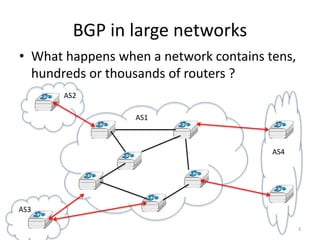
BGP in large networks
• What happens when a network contains tens,
hundreds or thousands of routers ?
AS1
AS2
AS3
AS4
3
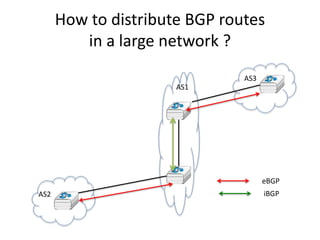
How to distribute BGP routes
in a large network ?
AS1
AS2
AS3
eBGP
iBGP
IP addresses used on routers
AS1
AS2
AS3
A /64 prefix belonging
to the AS1, 2001:11:1:/64
A /64 prefix belonging
to AS2, e.g. 2001:222:12:/64 A /64 prefix belonging
to AS1, e.g. 2001:222:11:13:/64
A closer look at the BGP messages
AS1
AS2
2001:222:11:13::33
Prefix: p
AS Path : AS3
BGP Nexhop : 2001:222:11:13::33
AS3
Prefix: p
AS Path : AS3
BGP Nexhop : 2001:222:11:13::33
Prefix: p
AS Path : AS1:AS3
BGP Nexhop : 2001:222:12::1234
2001:222:12::1234
p
Endpoints of the eBGP sessions
• eBGP sessions are TCP connections
established between
the IP addresses of
the two routers
on the peering link
AS1
AS2
2001:222:11:13::33
AS3
2001:222:12::1234
2001:222:12::5678
How to distribute BGP routes
in a large network ?
• Full mesh of iBGP sessions
– Why ?
Draw iBGP sessions in AS1
AS1
AS2
AS3
AS4
iBGP session
Endpoints of the iBGP sessions
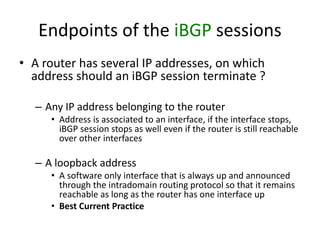
• A router has several IP addresses, on which
address should an iBGP session terminate ?
– Any IP address belonging to the router
• Address is associated to an interface, if the interface stops,
iBGP session stops as well even if the router is still reachable
over other interfaces
– A loopback address
• A software only interface that is always up and announced
through the intradomain routing protocol so that it remains
reachable as long as the router has one interface up
• Best Current Practice
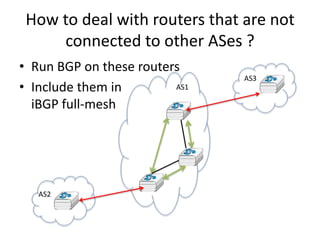
How to deal with routers that are not
connected to other ASes ?
• Run BGP on these routers
• Include them in
iBGP full-mesh
AS1
AS2
AS3
How to deal with routers that are not
connected to other ASes ?
• Make sure that they wlll
never have to
forward a packet
to an external
destination
• MPLS
AS1
AS2
AS3
What are the roles of the IGP ?
• The intradomain routing protocol distributes
information about the reachability of :
– IP prefixes associated to internal links between
routers of the AS
– IP addresses associated to loopback interfaces or
routers of the AS
– IP prefixes associated to peering links between a
router of this AS and another AS
BGP Nexthop self
• Helps to reduce # routes in the IGP
AS1
AS2
2001:222:11:13::33
AS3
Prefix: p
AS Path : AS3
BGP Nexhop : 2001:11:1001::1
Prefix: p
AS Path : AS1:AS3
BGP Nexhop : 2001:222:12::1234
2001:11:1001::2
Prefix: p
AS Path : AS3
BGP Nexhop : 2001:222:11:13::33
2001:11:1001::1
2001:222:12::1234
The BGP decision process
1. Ignore routes having an unreachable BGP
nexthop
2. Prefer routes having the highest local-pref
3. Prefer routes having the shortest AS-Path
4. Prefer routes having the smallest MED
5. Prefer routes learned via eBGP sessions over
routes learned via iBGP sessions
6. Prefer routes having the closest next-hop
7. Tie breaking rules : prefer route learned from
the router with lowest router id
1st step of BGP decision process
• 1. Ignore routes having an unreachable BGP
nexthop
– Why would a BGP route contain an unreachable
nexthop ?
Unreachable nexthop
• Usually a transient issue
AS1
AS3
AS2
2nd step of BGP decision process
• 2. Prefer routes having the highest local-pref
– Implement routing policies
• Prefer customer routes over shared-cost and provide
routers
– Support backup routes
• Local-pref attribute to added by the import
filter on eBGP session and distributed to all
routers over iBGP sessions
BGP routes towards prefix p on all
routers inside AS1
AS1
R1
AS4
R2
R3
R4
R5
R6
p
Path towards p
3rd step of BGP decision process
• 3. Prefer routes having the shortest AS-Path
– Some operators believe that a BGP route with a
long AS Path has a lower performance than a
route with a longer AS Path
• This is not always true…
5th step of BGP decision process
• 5. Prefer routes learned via eBGP sessions
over routes learned via iBGP sessions
– Motivation : Hot potato routing
• Routers should try to forward packets towards external
destinations to another AS a quickly as possible
6th step of BGP decision process
• 6. Prefer routes having the closest next-hop
– Motivation : Hot potato routing
• Routers should try to forward packets towards external
destinations to another AS a quickly as possible
BGP routes towards prefix p on all
routers inside AS1
AS1
R1
AS4
R2
R3
R4
R5
R6
p
Path towards p
7th step of the BGP decision process
• 7. Tie breaking rules : prefer route learned from
the router with lowest router id
– Motivation : select a single best route towards each
destination prefix
• This best route is the route that can be advertised over eBGP
session
– Note that recent routers sometimes load balance
(BGP Multipath) the traffic towards a given prefix over
several routes (having the same BGP attributes)
Differences between
iBGP and eBGP
– Which routes are advertised by a router over iBGP
and eBGP sessions ?
• Over an eBGP session, a router advertises its best route
towards each destination prefix
– Provided this advertisement is allowed by the export filter
– At most one route per destination prefix
• Over an iBGP session, a router advertises its best route
towards each destination prefix provided that this best
route was learned over an eBGP session
– Since iBGP sessions are in full-mesh, there is no need to
readvertise a route learned over another iBGP session
Differences between
iBGP and eBGP
– Which filters are used over iBGP and eBGP sessions
?
• Import and export filters are used over all eBGP sessions
– Usually, there is a series of import filters attached to each
peering link
– Filters are usually implemented as modules that are combined
together and associated to similar peering links (e.g. customer
filter, provider filter, …)
• No filter is applied on iBGP sessions
Differences between
iBGP and eBGP
– What are the attributes carried by iBGP and eBGP
• Prefix : iBGP and eBGP
• AS Path : iBGP and eBGP
– AS Path is updated when a BGP message is sent over an eBGP
session
• Local-pref : iBGP
– Local-pref cannot be used on eBGP sessions
• MED : iBGP and eBGP
• Nexthop : iBGP and eBGP
– Nexthop is updated when a BGP message is sent over an eBGP
session
Conclusion
• BGP depends on the underlying intradomain
routing protocol
– Establishment of the iBGP sessions
– Resolution of the BGP nexthop
• iBGP and eBGP play different roles
– eBGP over sessions with routers in other ASes
– iBGP sessions (in full mesh) inside an AS
• The BGP decision process ranks routes
– Hot potato versus cold potato routing
Reading list
1st edition, BGP section
http://cnp3book.info.ucl.ac.be/network/networ
k/#the-border-gateway-protocol
Agenda
• Interdomain Routing
– iBGP
• Segment Routing
IPv6 Segment Routing
• Objectives
– Allow operators to use non-shortest paths inside
their networks using
Source routing paradigm
– Provide advanced services
• Traffic engineering
• Middleboxing
See http://www.segment-routing.org and http://www.segment-routing.net
Source routing
• Each packet contains intermediate nodes
R1 R2
R4
R5
R6
R3 R7
R8
R9
RD
RD via R5,R4 RD via R5,R4 RD via R5,R4
RD via R5,R4
What is a segment ?
• An IPv6 address that identifies
– A router in the network (node)
• Advertised by the routing protocol
– An outgoing link on a router
• Advertised by the routing protocol
• Can be used to realise specific paths
– An abstract service (e.g. firewall)
IPv6 SR Header
32 bits
NxtHdr HLen RType SLeft
Segment List[0]
Segment List[1]
First Flags Res.
Segment List[n]
Number of segments left.
Pointer in address list
Type Length Res.
HMAC Key ID
HMAC (32 bytes)
IPv6SR Example
2001:6a8:3080:4::d
R1 R R R3 R
2001:6a8:3080:1::a 2001:6a8:3080:1::a 2001:6a8:3080:3::FF
R2
2001:6a8:3080:22::CC
R R
NxtHdr HLen RType 1
2001:6A8:3080:22::CC
Reserved
SRC: 2001:6A8:3080:1::A
2001:6A8:3080:4::D
2001:6A8:3080:22::CC
NxtHdr HLen RType 0
2001:6A8:3080:22::CC
Reserved
SRC: 2001:6A8:3080:1::A
2001:6A8:3080:4::D
2001:6A8:3080:4::D

Part8-ibgp.pptx

  • 1.
    Part 8 iBGP andSegment Routing © O. Bonaventure, UCLouvain, 2023. Supplementary material for the Computer Networking : Principles, Protocols and Practice ebook, https://www.computer-networking.info
  • 2.
    Agenda • Interdomain Routing –iBGP • Segment Routing
  • 3.
    BGP in largenetworks • What happens when a network contains tens, hundreds or thousands of routers ? AS1 AS2 AS3 AS4 3
  • 4.
    How to distributeBGP routes in a large network ? AS1 AS2 AS3 eBGP iBGP
  • 5.
    IP addresses usedon routers AS1 AS2 AS3 A /64 prefix belonging to the AS1, 2001:11:1:/64 A /64 prefix belonging to AS2, e.g. 2001:222:12:/64 A /64 prefix belonging to AS1, e.g. 2001:222:11:13:/64
  • 6.
    A closer lookat the BGP messages AS1 AS2 2001:222:11:13::33 Prefix: p AS Path : AS3 BGP Nexhop : 2001:222:11:13::33 AS3 Prefix: p AS Path : AS3 BGP Nexhop : 2001:222:11:13::33 Prefix: p AS Path : AS1:AS3 BGP Nexhop : 2001:222:12::1234 2001:222:12::1234 p
  • 7.
    Endpoints of theeBGP sessions • eBGP sessions are TCP connections established between the IP addresses of the two routers on the peering link AS1 AS2 2001:222:11:13::33 AS3 2001:222:12::1234 2001:222:12::5678
  • 8.
    How to distributeBGP routes in a large network ? • Full mesh of iBGP sessions – Why ?
  • 9.
    Draw iBGP sessionsin AS1 AS1 AS2 AS3 AS4 iBGP session
  • 10.
    Endpoints of theiBGP sessions • A router has several IP addresses, on which address should an iBGP session terminate ? – Any IP address belonging to the router • Address is associated to an interface, if the interface stops, iBGP session stops as well even if the router is still reachable over other interfaces – A loopback address • A software only interface that is always up and announced through the intradomain routing protocol so that it remains reachable as long as the router has one interface up • Best Current Practice
  • 11.
    How to dealwith routers that are not connected to other ASes ? • Run BGP on these routers • Include them in iBGP full-mesh AS1 AS2 AS3
  • 12.
    How to dealwith routers that are not connected to other ASes ? • Make sure that they wlll never have to forward a packet to an external destination • MPLS AS1 AS2 AS3
  • 13.
    What are theroles of the IGP ? • The intradomain routing protocol distributes information about the reachability of : – IP prefixes associated to internal links between routers of the AS – IP addresses associated to loopback interfaces or routers of the AS – IP prefixes associated to peering links between a router of this AS and another AS
  • 14.
    BGP Nexthop self •Helps to reduce # routes in the IGP AS1 AS2 2001:222:11:13::33 AS3 Prefix: p AS Path : AS3 BGP Nexhop : 2001:11:1001::1 Prefix: p AS Path : AS1:AS3 BGP Nexhop : 2001:222:12::1234 2001:11:1001::2 Prefix: p AS Path : AS3 BGP Nexhop : 2001:222:11:13::33 2001:11:1001::1 2001:222:12::1234
  • 15.
    The BGP decisionprocess 1. Ignore routes having an unreachable BGP nexthop 2. Prefer routes having the highest local-pref 3. Prefer routes having the shortest AS-Path 4. Prefer routes having the smallest MED 5. Prefer routes learned via eBGP sessions over routes learned via iBGP sessions 6. Prefer routes having the closest next-hop 7. Tie breaking rules : prefer route learned from the router with lowest router id
  • 16.
    1st step ofBGP decision process • 1. Ignore routes having an unreachable BGP nexthop – Why would a BGP route contain an unreachable nexthop ?
  • 17.
    Unreachable nexthop • Usuallya transient issue AS1 AS3 AS2
  • 18.
    2nd step ofBGP decision process • 2. Prefer routes having the highest local-pref – Implement routing policies • Prefer customer routes over shared-cost and provide routers – Support backup routes • Local-pref attribute to added by the import filter on eBGP session and distributed to all routers over iBGP sessions
  • 19.
    BGP routes towardsprefix p on all routers inside AS1 AS1 R1 AS4 R2 R3 R4 R5 R6 p Path towards p
  • 20.
    3rd step ofBGP decision process • 3. Prefer routes having the shortest AS-Path – Some operators believe that a BGP route with a long AS Path has a lower performance than a route with a longer AS Path • This is not always true…
  • 21.
    5th step ofBGP decision process • 5. Prefer routes learned via eBGP sessions over routes learned via iBGP sessions – Motivation : Hot potato routing • Routers should try to forward packets towards external destinations to another AS a quickly as possible
  • 22.
    6th step ofBGP decision process • 6. Prefer routes having the closest next-hop – Motivation : Hot potato routing • Routers should try to forward packets towards external destinations to another AS a quickly as possible
  • 23.
    BGP routes towardsprefix p on all routers inside AS1 AS1 R1 AS4 R2 R3 R4 R5 R6 p Path towards p
  • 24.
    7th step ofthe BGP decision process • 7. Tie breaking rules : prefer route learned from the router with lowest router id – Motivation : select a single best route towards each destination prefix • This best route is the route that can be advertised over eBGP session – Note that recent routers sometimes load balance (BGP Multipath) the traffic towards a given prefix over several routes (having the same BGP attributes)
  • 25.
    Differences between iBGP andeBGP – Which routes are advertised by a router over iBGP and eBGP sessions ? • Over an eBGP session, a router advertises its best route towards each destination prefix – Provided this advertisement is allowed by the export filter – At most one route per destination prefix • Over an iBGP session, a router advertises its best route towards each destination prefix provided that this best route was learned over an eBGP session – Since iBGP sessions are in full-mesh, there is no need to readvertise a route learned over another iBGP session
  • 26.
    Differences between iBGP andeBGP – Which filters are used over iBGP and eBGP sessions ? • Import and export filters are used over all eBGP sessions – Usually, there is a series of import filters attached to each peering link – Filters are usually implemented as modules that are combined together and associated to similar peering links (e.g. customer filter, provider filter, …) • No filter is applied on iBGP sessions
  • 27.
    Differences between iBGP andeBGP – What are the attributes carried by iBGP and eBGP • Prefix : iBGP and eBGP • AS Path : iBGP and eBGP – AS Path is updated when a BGP message is sent over an eBGP session • Local-pref : iBGP – Local-pref cannot be used on eBGP sessions • MED : iBGP and eBGP • Nexthop : iBGP and eBGP – Nexthop is updated when a BGP message is sent over an eBGP session
  • 28.
    Conclusion • BGP dependson the underlying intradomain routing protocol – Establishment of the iBGP sessions – Resolution of the BGP nexthop • iBGP and eBGP play different roles – eBGP over sessions with routers in other ASes – iBGP sessions (in full mesh) inside an AS • The BGP decision process ranks routes – Hot potato versus cold potato routing
  • 29.
    Reading list 1st edition,BGP section http://cnp3book.info.ucl.ac.be/network/networ k/#the-border-gateway-protocol
  • 30.
    Agenda • Interdomain Routing –iBGP • Segment Routing
  • 31.
    IPv6 Segment Routing •Objectives – Allow operators to use non-shortest paths inside their networks using Source routing paradigm – Provide advanced services • Traffic engineering • Middleboxing See http://www.segment-routing.org and http://www.segment-routing.net
  • 32.
    Source routing • Eachpacket contains intermediate nodes R1 R2 R4 R5 R6 R3 R7 R8 R9 RD RD via R5,R4 RD via R5,R4 RD via R5,R4 RD via R5,R4
  • 33.
    What is asegment ? • An IPv6 address that identifies – A router in the network (node) • Advertised by the routing protocol – An outgoing link on a router • Advertised by the routing protocol • Can be used to realise specific paths – An abstract service (e.g. firewall)
  • 34.
    IPv6 SR Header 32bits NxtHdr HLen RType SLeft Segment List[0] Segment List[1] First Flags Res. Segment List[n] Number of segments left. Pointer in address list Type Length Res. HMAC Key ID HMAC (32 bytes)
  • 35.
    IPv6SR Example 2001:6a8:3080:4::d R1 RR R3 R 2001:6a8:3080:1::a 2001:6a8:3080:1::a 2001:6a8:3080:3::FF R2 2001:6a8:3080:22::CC R R NxtHdr HLen RType 1 2001:6A8:3080:22::CC Reserved SRC: 2001:6A8:3080:1::A 2001:6A8:3080:4::D 2001:6A8:3080:22::CC NxtHdr HLen RType 0 2001:6A8:3080:22::CC Reserved SRC: 2001:6A8:3080:1::A 2001:6A8:3080:4::D 2001:6A8:3080:4::D

Editor's Notes

  • #43 The Type 0 Routing header is specified in RFC2460 Two other types of routing headers have been defined. Type 1 is experimental and never used. Type 2 is specific for Mobile IPv6 that will be covered later.