Part 4
Reliable transport and TCP
Agenda
• Managing a connection
• Connection establishment
• Connection release
• TCP
• Connection establishment
• Data transfer
• Connection release
• Modern TCP
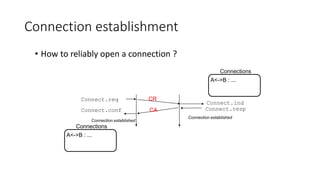
Connection establishment
• How to reliably open a connection ?
Connect.req
Connect.ind
CR
CA
Connection established
Connect.resp
Connect.conf
Connection established
Connections
A<->B : ...
Connections
A<->B : ...
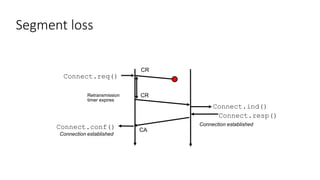
Segment loss
Connect.req()
Connect.ind()
Connect.conf() CA
Connection established
CR
CR
Retransmission
timer expires
Connect.resp()
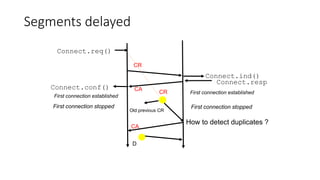
Segments delayed
Connect.ind()
CR
Connect.conf() CA
CR
Old previous CR
First connection established
How to detect duplicates ?
Connect.req()
D
CA
Connect.resp
First connection established
First connection stopped First connection stopped
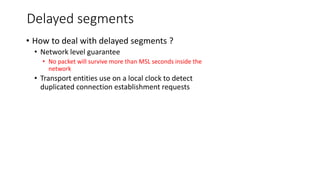
Delayed segments
• How to deal with delayed segments ?
• Network level guarantee
• No packet will survive more than MSL seconds inside the
network
• Transport entities use on a local clock to detect
duplicated connection establishment requests
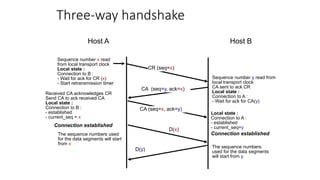
Three-way handshake
CR (seq=x)
CA (seq=y, ack=x)
CA (seq=x, ack=y)
Sequence number x read
from local transport clock
Local state :
Connection to B :
- Wait for ack for CR (x)
- Start retransmission timer
Sequence number y read from
local transport clock
CA sent to ack CR
Local state :
Connection to A :
- Wait for ack for CA(y)
Received CA acknowledges CR
Send CA to ack received CA
Local state :
Connection to B :
- established
- current_seq = x
The sequence numbers used
for the data segments will start
from x
The sequence numbers
used for the data segments
will start from y
D(x)
D(y)
Local state :
Connection to A :
- established
- current_seq=y
Connection established
Host A Host B
Agenda
• Managing a connection
• Connection establishment
• Connection release
• TCP
• Connection establishment
• Data transfer
• Connection release
• Modern TCP
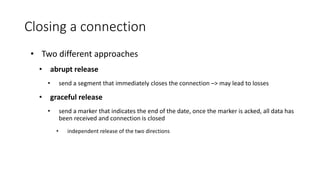
Closing a connection
• Two different approaches
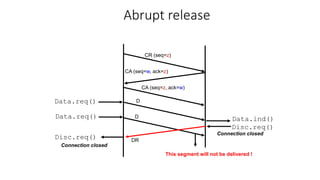
• abrupt release
• send a segment that immediately closes the connection –> may lead to losses
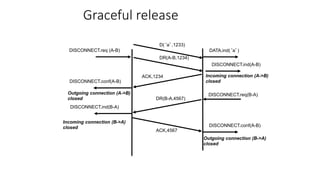
• graceful release
• send a marker that indicates the end of the date, once the marker is acked, all data has
been received and connection is closed
• independent release of the two directions
Abrupt release
CR (seq=z)
CA (seq=w, ack=z)
CA (seq=z, ack=w)
D
Data.req()
Data.ind()
Disc.req()
D
Data.req()
DR
Disc.req()
Connection closed
Connection closed
This segment will not be delivered !
Graceful release
D(‘a’,1233)
DISCONNECT.req (A-B)
DISCONNECT.ind(A-B)
ACK,1234
DISCONNECT.conf(A-B)
ACK,4567
DISCONNECT.conf(A-B)
DISCONNECT.req(B-A)
DISCONNECT.ind(B-A)
DR(B-A,4567)
Outgoing connection (A->B)
closed
Incoming connection (A->B)
closed
Incoming connection (B->A)
closed
Outgoing connection (B->A)
closed
DR(A-B,1234)
DATA.ind(‘a’)
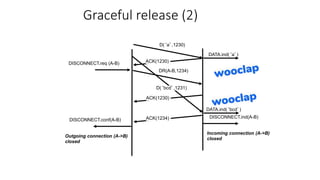
Graceful release (2)
D(‘a’,1230)
DISCONNECT.req (A-B)
DISCONNECT.ind(A-B)
ACK(1230)
DISCONNECT.conf(A-B)
Outgoing connection (A->B)
closed
Incoming connection (A->B)
closed
DR(A-B,1234)
DATA.ind(‘a’)
D(‘bcd’,1231)
ACK(1230)
DATA.ind(‘bcd’)
ACK(1234)
Agenda
• Managing a connection
• Connection establishment
• Connection release
• TCP
• Connection establishment
• Data transfer
• Connection release
• Modern TCP
TCP
• Service provided
• Connection-oriented
• Reliable
• No losses, no errors, no duplications
• Bytestream
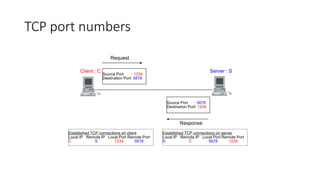
TCP port numbers
Server : S
Client : C
Source Port : 1234
Destination Port: 5678
Request
Response
Source Port : 5678
Destination Port: 1234
Established TCP connections on client
Local IP Remote IP Local Port Remote Port
C S 1234 5678
Established TCP connections on server
Local IP Remote IP Local Port Remote Port
S C 5678 1234
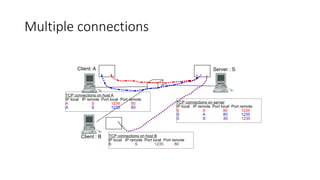
Multiple connections
Client: A
Client : B
Server : S
TCP connections on server
IP local IP remote Port local Port remote
S A 80 1234
S A 80 1235
S B 80 1235
TCP connections on host A
IP local IP remote Port local Port remote
A S 1234 80
A S 1235 80
TCP connections on host B
IP local IP remote Port local Port remote
B S 1235 80
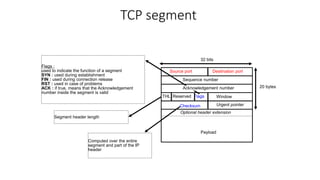
TCP segment
Source port Destination port
Payload
32 bits
Checksum Urgent pointer
THL Reserved Flags
20 bytes
Sequence number
Optional header extension
Window
Flags :
used to indicate the function of a segment
SYN : used during establishment
FIN : used during connection release
RST : used in case of problems
ACK : if true, means that the Acknowledgement
number inside the segment is valid
Computed over the entire
segment and part of the IP
header
Acknowledgement number
Segment header length
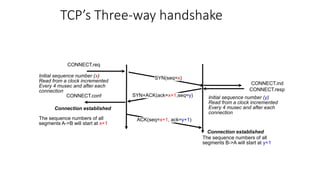
TCP’s Three-way handshake
ACK(seq=x+1, ack=y+1)
CONNECT.req
CONNECT.ind
SYN+ACK(ack=x+1,seq=y)
CONNECT.resp
CONNECT.conf
Initial sequence number (x)
Read from a clock incremented
Every 4 musec and after each
connection
Initial sequence number (y)
Read from a clock incremented
Every 4 musec and after each
connection
SYN(seq=x)
Connection established
The sequence numbers of all
segments A->B will start at x+1
The sequence numbers of all
segments B->A will start at y+1
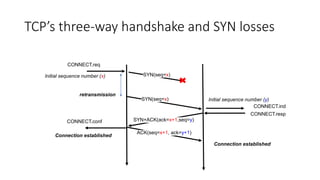
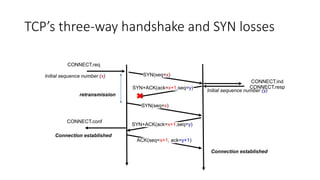
TCP’s three-way handshake and SYN losses
ACK(seq=x+1, ack=y+1)
CONNECT.req
CONNECT.ind
CONNECT.conf
Initial sequence number (x)
Initial sequence number (y)
SYN(seq=x)
Connection established
SYN(seq=x)
SYN+ACK(ack=x+1,seq=y)
CONNECT.resp
retransmission
TCP’s three-way handshake and SYN losses
ACK(seq=x+1, ack=y+1)
CONNECT.req
CONNECT.ind
CONNECT.conf
Initial sequence number (x)
Initial sequence number (y)
SYN(seq=x)
Connection established
SYN(seq=x)
SYN+ACK(ack=x+1,seq=y)
retransmission
SYN+ACK(ack=x+1,seq=y) CONNECT.resp
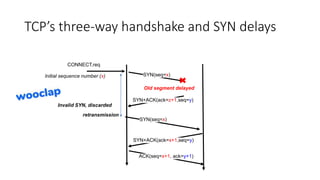
TCP’s three-way handshake and SYN delays
ACK(seq=x+1, ack=y+1)
CONNECT.req
Initial sequence number (x) SYN(seq=x)
SYN+ACK(ack=z+1,seq=y)
Old segment delayed
SYN+ACK(ack=x+1,seq=y)
SYN(seq=x)
Invalid SYN, discarded
retransmission
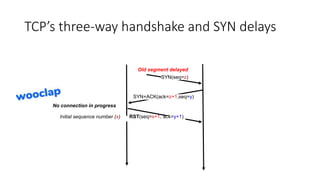
TCP’s three-way handshake and SYN delays
RST(seq=x+1, ack=y+1)
SYN(seq=z)
No connection in progress
SYN+ACK(ack=z+1,seq=y)
Old segment delayed
Initial sequence number (x)
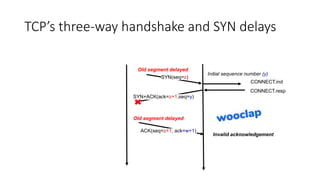
TCP’s three-way handshake and SYN delays
ACK(seq=z+1, ack=w+1)
CONNECT.ind
Initial sequence number (y)
SYN(seq=z)
Invalid acknowledgement
SYN+ACK(ack=z+1,seq=y)
CONNECT.resp
Old segment delayed
Old segment delayed
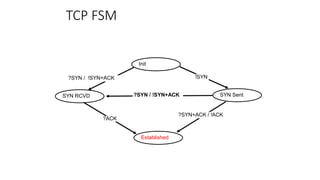
TCP FSM
Init
SYN RCVD SYN Sent
Established
?SYN / !SYN+ACK !SYN
?SYN+ACK / !ACK
?SYN / !SYN+ACK
?ACK
!SYN
?ACK
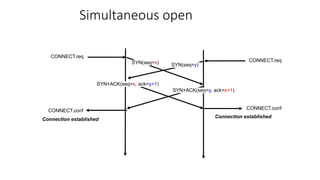
Simultaneous open
CONNECT.conf
SYN(seq=y)
CONNECT.req
CONNECT.req
SYN(seq=x)
Connection established
CONNECT.conf
SYN+ACK(seq=y, ack=x+1)
SYN+ACK(seq=x, ack=y+1)
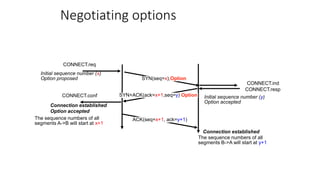
Negotiating options
ACK(seq=x+1, ack=y+1)
CONNECT.req
CONNECT.ind
SYN+ACK(ack=x+1,seq=y) Option
CONNECT.resp
CONNECT.conf
Initial sequence number (x)
Option proposed
Initial sequence number (y)
Option accepted
SYN(seq=x),Option
Connection established
Option accepted
Connection established
The sequence numbers of all
segments A->B will start at x+1
The sequence numbers of all
segments B->A will start at y+1
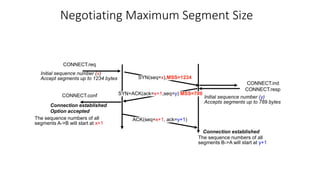
Negotiating Maximum Segment Size
ACK(seq=x+1, ack=y+1)
CONNECT.req
CONNECT.ind
SYN+ACK(ack=x+1,seq=y) MSS=789
CONNECT.resp
CONNECT.conf
Initial sequence number (x)
Accept segments up to 1234 bytes
Initial sequence number (y)
Accepts segments up to 789 bytes
SYN(seq=x),MSS=1234
Connection established
Option accepted
Connection established
The sequence numbers of all
segments A->B will start at x+1
The sequence numbers of all
segments B->A will start at y+1
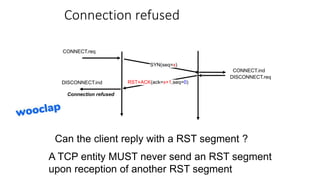
Connection refused
RST+ACK(ack=x+1,seq=0)
DISCONNECT.req
DISCONNECT.ind
CONNECT.req
CONNECT.ind
SYN(seq=x)
Connection refused
A TCP entity MUST never send an RST segment
upon reception of another RST segment
Can the client reply with a RST segment ?
Agenda
• Managing a connection
• Connection establishment
• Connection release
• TCP
• Connection establishment
• Data transfer
• Connection release
• Modern TCP
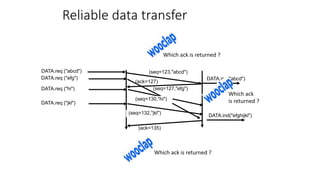
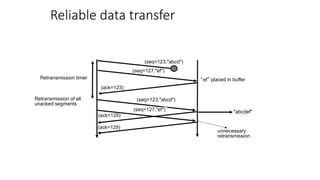
Reliable data transfer
DATA.req ("abcd")
DATA.ind("abcd")
(seq=123,"abcd")
DATA.req ("jkl")
(seq=132,"jkl")
(seq=127,"efg")
DATA.req ("efg")
(ack=127)
(ack=135)
DATA.ind("efghijkl")
DATA.req ("hi")
(seq=130,"hi")
Which ack is returned ?
Which ack
is returned ?
Reliable data transfer
(seq=127,"ef")
(seq=123,"abcd")
(seq=123,"abcd")
(seq=127,"ef")
(ack=123)
Retransmission timer
(ack=129)
(ack=129)
unnecessary
retransmission
"abcdef"
Retransmission of all
unacked segments
“ef” placed in buffer
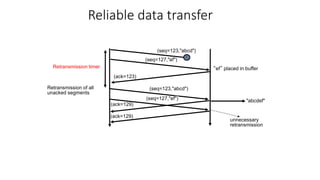
Reliable data transfer
(seq=127,"ef")
(seq=123,"abcd")
(seq=123,"abcd")
(seq=127,"ef")
(ack=123)
Retransmission timer
(ack=129)
(ack=129)
unnecessary
retransmission
"abcdef"
Retransmission of all
unacked segments
“ef” placed in buffer
Retransmission timer
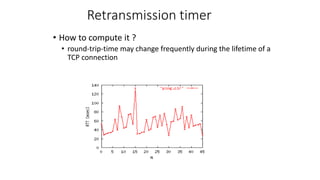
• How to compute it ?
• round-trip-time may change frequently during the lifetime of a
TCP connection
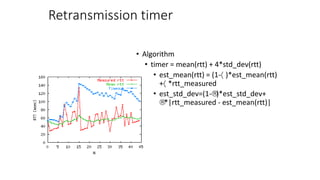
Retransmission timer
• Algorithm
• timer = mean(rtt) + 4*std_dev(rtt)
• est_mean(rtt) = (1- )*est_mean(rtt)
+ *rtt_measured
• est_std_dev=(1-)*est_std_dev+
*|rtt_measured - est_mean(rtt)|
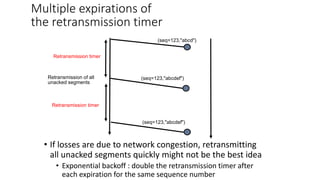
Multiple expirations of
the retransmission timer
(seq=123,"abcd")
(seq=123,"abcdef")
Retransmission timer
Retransmission of all
unacked segments
Retransmission timer
(seq=123,"abcdef")
• If losses are due to network congestion, retransmitting
all unacked segments quickly might not be the best idea
• Exponential backoff : double the retransmission timer after
each expiration for the same sequence number
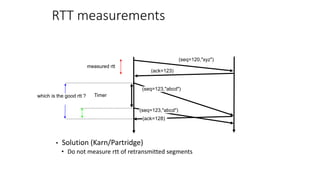
RTT measurements
• Solution (Karn/Partridge)
• Do not measure rtt of retransmitted segments
(seq=123,"abcd")
(seq=120,"xyz")
(ack=123)
(ack=128)
measured rtt
Timer
which is the good rtt ?
(seq=123,"abcd")
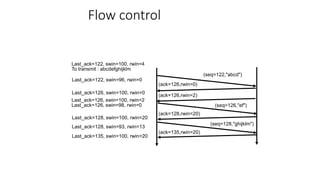
Flow control
(seq=122,"abcd")
(ack=126,rwin=0)
Last_ack=122, swin=100, rwin=4
To transmit : abcdefghijklm
Last_ack=122, swin=96, rwin=0
Last_ack=126, swin=100, rwin=0
(ack=126,rwin=2)
(seq=126,"ef")
(ack=128,rwin=20)
Last_ack=126, swin=100, rwin=2
Last_ack=126, swin=98, rwin=0
Last_ack=128, swin=100, rwin=20
Last_ack=128, swin=93, rwin=13
(seq=128,"ghijklm")
(ack=135,rwin=20)
Last_ack=135, swin=100, rwin=20
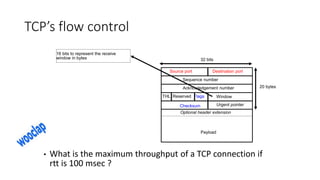
TCP’s flow control
Source port Destination port
Payload
32 bits
Checksum Urgent pointer
THL Reserved Flags
20 bytes
Sequence number
Optional header extension
Window
Acknowledgement number
16 bits to represent the receive
window in bytes
• What is the maximum throughput of a TCP connection if
rtt is 100 msec ?
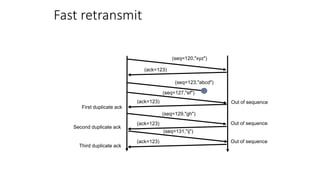
Fast retransmit
(seq=123,"abcd")
(seq=120,"xyz")
(ack=123)
(seq=129,"gh")
(seq=131,"ij")
(ack=123)
First duplicate ack
(ack=123)
Second duplicate ack
(ack=123)
Third duplicate ack
(seq=127,"ef")
Out of sequence
Out of sequence
Out of sequence
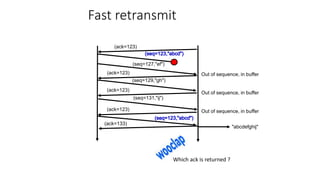
Fast retransmit
(ack=123)
(ack=123)
(ack=123)
(ack=123)
(ack=133)
"abcdefghij"
(seq=127,"ef")
Out of sequence, in buffer
(seq=129,"gh")
Out of sequence, in buffer
(seq=131,"ij")
Out of sequence, in buffer
Which ack is returned ?
Agenda
• Managing a connection
• Connection establishment
• Connection release
• TCP
• Connection establishment
• Data transfer
• Connection release
• Modern TCP
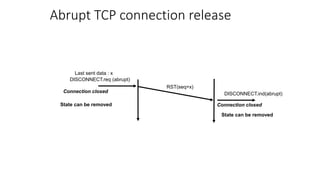
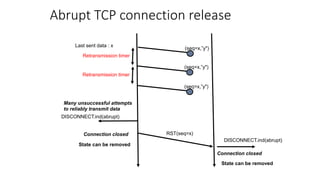
Abrupt TCP connection release
RST(seq=x)
DISCONNECT.req (abrupt)
DISCONNECT.ind(abrupt)
Connection closed
Connection closed
State can be removed
Last sent data : x
Abrupt TCP connection release
RST(seq=x)
DISCONNECT.ind(abrupt)
Connection closed
Many unsuccessful attempts
to reliably transmit data
State can be removed
Last sent data : x
Connection closed
(seq=x,”y")
Retransmission timer
(seq=x,”y")
(seq=x,”y")
DISCONNECT.ind(abrupt)
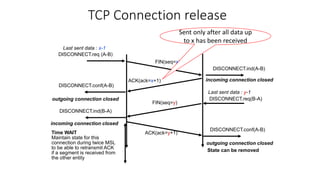
TCP Connection release
FIN(seq=x)
DISCONNECT.req (A-B)
DISCONNECT.ind(A-B)
ACK(ack=x+1)
DISCONNECT.conf(A-B)
ACK(ack=y+1)
DISCONNECT.conf(A-B)
DISCONNECT.req(B-A)
DISCONNECT.ind(B-A)
FIN(seq=y)
Time WAIT
Maintain state for this
connection during twice MSL
to be able to retransmit ACK
if a segment is received from
the other entity
outgoing connection closed
incoming connection closed
outgoing connection closed
State can be removed
Last sent data : x-1
Last sent data : y-1
Sent only after all data up
to x has been received
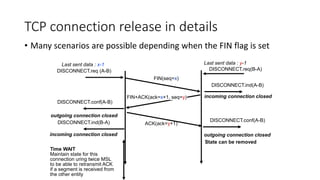
TCP connection release in details
• Many scenarios are possible depending when the FIN flag is set
FIN(seq=x)
DISCONNECT.req (A-B)
DISCONNECT.ind(A-B)
FIN+ACK(ack=x+1, seq=y)
DISCONNECT.conf(A-B)
ACK(ack=y+1)
DISCONNECT.conf(A-B)
DISCONNECT.req(B-A)
DISCONNECT.ind(B-A)
Time WAIT
Maintain state for this
connection uring twice MSL
to be able to retransmit ACK
if a segment is received from
the other entity
outgoing connection closed
incoming connection closed
incoming connection closed outgoing connection closed
State can be removed
Last sent data : x-1 Last sent data : y-1
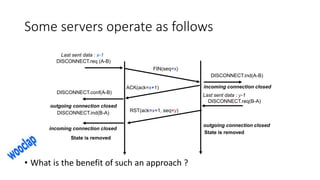
Some servers operate as follows
• What is the benefit of such an approach ?
FIN(seq=x)
DISCONNECT.req (A-B)
DISCONNECT.ind(A-B)
ACK(ack=x+1)
DISCONNECT.conf(A-B)
DISCONNECT.req(B-A)
DISCONNECT.ind(B-A)
State is removed
outgoing connection closed
incoming connection closed
outgoing connection closed
State is removed
Last sent data : x-1
Last sent data : y-1
RST(ack=x+1, seq=y)
TCP connection release
FIN Wait1
SYN RCVD
CLOSE Wait
Established
FIN Wait2
LAST-ACK
TIME Wait
Closing
Closed
?FIN/!ACK
!FIN
?ACK
Timeout[2MSL]
?FIN/!ACK
?ACK
!FIN
?ACK
?FIN/!ACK
!FIN
Agenda
• Managing a connection
• Connection establishment
• Connection release
• TCP
• Connection establishment
• Data transfer
• Connection release
• Modern TCP
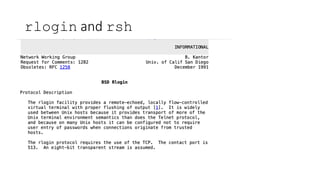
rlogin and rsh
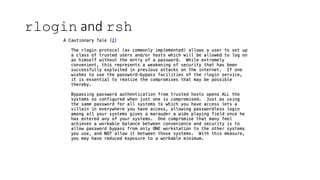
rlogin and rsh
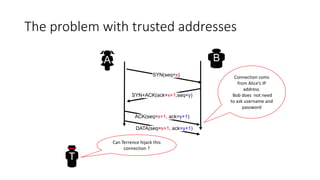
The problem with trusted addresses
B
T
A
ACK(seq=x+1, ack=y+1)
SYN+ACK(ack=x+1,seq=y)
SYN(seq=x) Connection coms
from Alice’s IP
address.
Bob does not need
to ask username and
password
DATA(seq=x+1, ack=y+1)
Can Terrence hijack this
connection ?
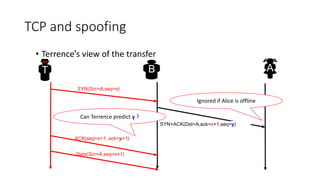
TCP and spoofing
• Terrence's view of the transfer
SYN+ACK(Dst=A,ack=x+1,seq=y)
SYN(Src=A,seq=x)
ACK(seq=x+1, ack=y+1)
Data(Src=A,seq=x+1)
Ignored if Alice is offline
Can Terrence predict y ?
Bob
T A
B
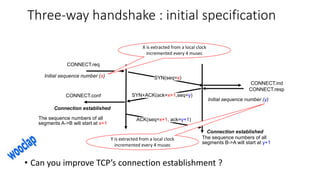
Three-way handshake : initial specification
ACK(seq=x+1, ack=y+1)
CONNECT.req
CONNECT.ind
SYN+ACK(ack=x+1,seq=y)
CONNECT.resp
CONNECT.conf
Initial sequence number (x)
Initial sequence number (y)
SYN(seq=x)
Connection established
The sequence numbers of all
segments A->B will start at x+1
The sequence numbers of all
segments B->A will start at y+1
X is extracted from a local clock
incremented every 4 musec
Y is extracted from a local clock
incremented every 4 musec
• Can you improve TCP’s connection establishment ?
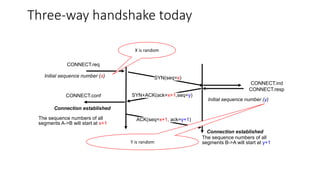
Three-way handshake today
ACK(seq=x+1, ack=y+1)
CONNECT.req
CONNECT.ind
SYN+ACK(ack=x+1,seq=y)
CONNECT.resp
CONNECT.conf
Initial sequence number (x)
Initial sequence number (y)
SYN(seq=x)
Connection established
The sequence numbers of all
segments A->B will start at x+1
The sequence numbers of all
segments B->A will start at y+1
X is random
Y is random
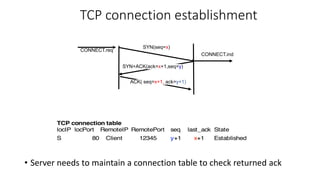
TCP connection establishment
SYN(seq=x)
CONNECT.ind
SYN+ACK(ack=x+1,seq=y)
ACK( seq=x+1, ack=y+1)
CONNECT.req
• Server needs to maintain a connection table to check returned ack
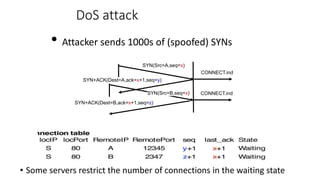
DoS attack
SYN(Src=A,seq=x)
CONNECT.ind
CONNECT.ind
SYN+ACK(Dest=A,ack=x+1,seq=y)
SYN+ACK(Dest=B,ack=x+1,seq=z)
SYN(Src=B,seq=x)
• Attacker sends 1000s of (spoofed) SYNs
• Some servers restrict the number of connections in the waiting state
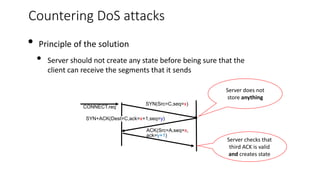
Countering DoS attacks
• Principle of the solution
• Server should not create any state before being sure that the
client can receive the segments that it sends
SYN(Src=C,seq=x)
SYN+ACK(Dest=C,ack=x+1,seq=y)
ACK(Src=A,seq=x,
ack=y+1)
CONNECT.req
Server does not
store anything
Server checks that
third ACK is valid
and creates state
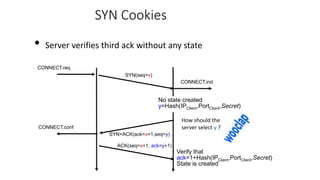
SYN Cookies
SYN+ACK(ack=x+1,seq=y)
SYN(seq=x)
ACK(seq=x+1, ack=y+1)
CONNECT.req
CONNECT.ind
CONNECT.conf
No state created
y=Hash(IPClient,PortClient,Secret)
Verify that
ack=1+Hash(IPClient,PortClient,Secret)
State is created
• Server verifies third ack without any state
How should the
server select y ?
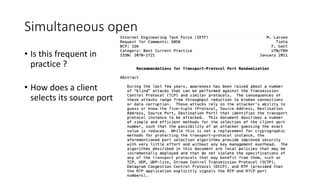
Simultaneous open
• Is this frequent in
practice ?
• How does a client
selects its source port ?

Part4-reliable-tcp.pptx

  • 1.
  • 2.
    Agenda • Managing aconnection • Connection establishment • Connection release • TCP • Connection establishment • Data transfer • Connection release • Modern TCP
  • 3.
    Connection establishment • Howto reliably open a connection ? Connect.req Connect.ind CR CA Connection established Connect.resp Connect.conf Connection established Connections A<->B : ... Connections A<->B : ...
  • 4.
    Segment loss Connect.req() Connect.ind() Connect.conf() CA Connectionestablished Connection established CR CR Retransmission timer expires Connect.resp()
  • 5.
    Segments delayed Connect.ind() CR Connect.conf() CA CR Oldprevious CR First connection established How to detect duplicates ? Connect.req() D CA Connect.resp First connection established First connection stopped First connection stopped
  • 6.
    Delayed segments • Howto deal with delayed segments ? • Network level guarantee • No packet will survive more than MSL seconds inside the network • Transport entities use on a local clock to detect duplicated connection establishment requests
  • 7.
    Three-way handshake CR (seq=x) CA(seq=y, ack=x) CA (seq=x, ack=y) Sequence number x read from local transport clock Local state : Connection to B : - Wait for ack for CR (x) - Start retransmission timer Sequence number y read from local transport clock CA sent to ack CR Local state : Connection to A : - Wait for ack for CA(y) Received CA acknowledges CR Send CA to ack received CA Local state : Connection to B : - established - current_seq = x The sequence numbers used for the data segments will start from x The sequence numbers used for the data segments will start from y D(x) D(y) Local state : Connection to A : - established - current_seq=y Connection established Connection established Host A Host B
  • 8.
    Agenda • Managing aconnection • Connection establishment • Connection release • TCP • Connection establishment • Data transfer • Connection release • Modern TCP
  • 9.
    Closing a connection •Two different approaches • abrupt release • send a segment that immediately closes the connection –> may lead to losses • graceful release • send a marker that indicates the end of the date, once the marker is acked, all data has been received and connection is closed • independent release of the two directions
  • 10.
    Abrupt release CR (seq=z) CA(seq=w, ack=z) CA (seq=z, ack=w) D Data.req() Data.ind() Disc.req() D Data.req() DR Disc.req() Connection closed Connection closed This segment will not be delivered !
  • 11.
    Graceful release D(‘a’,1233) DISCONNECT.req (A-B) DISCONNECT.ind(A-B) ACK,1234 DISCONNECT.conf(A-B) ACK,4567 DISCONNECT.conf(A-B) DISCONNECT.req(B-A) DISCONNECT.ind(B-A) DR(B-A,4567) Outgoingconnection (A->B) closed Incoming connection (A->B) closed Incoming connection (B->A) closed Outgoing connection (B->A) closed DR(A-B,1234) DATA.ind(‘a’)
  • 12.
    Graceful release (2) D(‘a’,1230) DISCONNECT.req(A-B) DISCONNECT.ind(A-B) ACK(1230) DISCONNECT.conf(A-B) Outgoing connection (A->B) closed Incoming connection (A->B) closed DR(A-B,1234) DATA.ind(‘a’) D(‘bcd’,1231) ACK(1230) DATA.ind(‘bcd’) ACK(1234)
  • 13.
    Agenda • Managing aconnection • Connection establishment • Connection release • TCP • Connection establishment • Data transfer • Connection release • Modern TCP
  • 14.
    TCP • Service provided •Connection-oriented • Reliable • No losses, no errors, no duplications • Bytestream
  • 15.
    TCP port numbers Server: S Client : C Source Port : 1234 Destination Port: 5678 Request Response Source Port : 5678 Destination Port: 1234 Established TCP connections on client Local IP Remote IP Local Port Remote Port C S 1234 5678 Established TCP connections on server Local IP Remote IP Local Port Remote Port S C 5678 1234
  • 16.
    Multiple connections Client: A Client: B Server : S TCP connections on server IP local IP remote Port local Port remote S A 80 1234 S A 80 1235 S B 80 1235 TCP connections on host A IP local IP remote Port local Port remote A S 1234 80 A S 1235 80 TCP connections on host B IP local IP remote Port local Port remote B S 1235 80
  • 17.
    TCP segment Source portDestination port Payload 32 bits Checksum Urgent pointer THL Reserved Flags 20 bytes Sequence number Optional header extension Window Flags : used to indicate the function of a segment SYN : used during establishment FIN : used during connection release RST : used in case of problems ACK : if true, means that the Acknowledgement number inside the segment is valid Computed over the entire segment and part of the IP header Acknowledgement number Segment header length
  • 18.
    TCP’s Three-way handshake ACK(seq=x+1,ack=y+1) CONNECT.req CONNECT.ind SYN+ACK(ack=x+1,seq=y) CONNECT.resp CONNECT.conf Initial sequence number (x) Read from a clock incremented Every 4 musec and after each connection Initial sequence number (y) Read from a clock incremented Every 4 musec and after each connection SYN(seq=x) Connection established Connection established The sequence numbers of all segments A->B will start at x+1 The sequence numbers of all segments B->A will start at y+1
  • 19.
    TCP’s three-way handshakeand SYN losses ACK(seq=x+1, ack=y+1) CONNECT.req CONNECT.ind CONNECT.conf Initial sequence number (x) Initial sequence number (y) SYN(seq=x) Connection established Connection established SYN(seq=x) SYN+ACK(ack=x+1,seq=y) CONNECT.resp retransmission
  • 20.
    TCP’s three-way handshakeand SYN losses ACK(seq=x+1, ack=y+1) CONNECT.req CONNECT.ind CONNECT.conf Initial sequence number (x) Initial sequence number (y) SYN(seq=x) Connection established Connection established SYN(seq=x) SYN+ACK(ack=x+1,seq=y) retransmission SYN+ACK(ack=x+1,seq=y) CONNECT.resp
  • 21.
    TCP’s three-way handshakeand SYN delays ACK(seq=x+1, ack=y+1) CONNECT.req Initial sequence number (x) SYN(seq=x) SYN+ACK(ack=z+1,seq=y) Old segment delayed SYN+ACK(ack=x+1,seq=y) SYN(seq=x) Invalid SYN, discarded retransmission
  • 22.
    TCP’s three-way handshakeand SYN delays RST(seq=x+1, ack=y+1) SYN(seq=z) No connection in progress SYN+ACK(ack=z+1,seq=y) Old segment delayed Initial sequence number (x)
  • 23.
    TCP’s three-way handshakeand SYN delays ACK(seq=z+1, ack=w+1) CONNECT.ind Initial sequence number (y) SYN(seq=z) Invalid acknowledgement SYN+ACK(ack=z+1,seq=y) CONNECT.resp Old segment delayed Old segment delayed
  • 24.
    TCP FSM Init SYN RCVDSYN Sent Established ?SYN / !SYN+ACK !SYN ?SYN+ACK / !ACK ?SYN / !SYN+ACK ?ACK !SYN ?ACK
  • 25.
  • 26.
    Negotiating options ACK(seq=x+1, ack=y+1) CONNECT.req CONNECT.ind SYN+ACK(ack=x+1,seq=y)Option CONNECT.resp CONNECT.conf Initial sequence number (x) Option proposed Initial sequence number (y) Option accepted SYN(seq=x),Option Connection established Option accepted Connection established The sequence numbers of all segments A->B will start at x+1 The sequence numbers of all segments B->A will start at y+1
  • 27.
    Negotiating Maximum SegmentSize ACK(seq=x+1, ack=y+1) CONNECT.req CONNECT.ind SYN+ACK(ack=x+1,seq=y) MSS=789 CONNECT.resp CONNECT.conf Initial sequence number (x) Accept segments up to 1234 bytes Initial sequence number (y) Accepts segments up to 789 bytes SYN(seq=x),MSS=1234 Connection established Option accepted Connection established The sequence numbers of all segments A->B will start at x+1 The sequence numbers of all segments B->A will start at y+1
  • 28.
    Connection refused RST+ACK(ack=x+1,seq=0) DISCONNECT.req DISCONNECT.ind CONNECT.req CONNECT.ind SYN(seq=x) Connection refused ATCP entity MUST never send an RST segment upon reception of another RST segment Can the client reply with a RST segment ?
  • 29.
    Agenda • Managing aconnection • Connection establishment • Connection release • TCP • Connection establishment • Data transfer • Connection release • Modern TCP
  • 30.
    Reliable data transfer DATA.req("abcd") DATA.ind("abcd") (seq=123,"abcd") DATA.req ("jkl") (seq=132,"jkl") (seq=127,"efg") DATA.req ("efg") (ack=127) (ack=135) DATA.ind("efghijkl") DATA.req ("hi") (seq=130,"hi") Which ack is returned ? Which ack is returned ? Which ack is returned ?
  • 31.
    Reliable data transfer (seq=127,"ef") (seq=123,"abcd") (seq=123,"abcd") (seq=127,"ef") (ack=123) Retransmissiontimer (ack=129) (ack=129) unnecessary retransmission "abcdef" Retransmission of all unacked segments “ef” placed in buffer
  • 32.
    Reliable data transfer (seq=127,"ef") (seq=123,"abcd") (seq=123,"abcd") (seq=127,"ef") (ack=123) Retransmissiontimer (ack=129) (ack=129) unnecessary retransmission "abcdef" Retransmission of all unacked segments “ef” placed in buffer
  • 33.
    Retransmission timer • Howto compute it ? • round-trip-time may change frequently during the lifetime of a TCP connection
  • 34.
    Retransmission timer • Algorithm •timer = mean(rtt) + 4*std_dev(rtt) • est_mean(rtt) = (1- )*est_mean(rtt) + *rtt_measured • est_std_dev=(1-)*est_std_dev+ *|rtt_measured - est_mean(rtt)|
  • 35.
    Multiple expirations of theretransmission timer (seq=123,"abcd") (seq=123,"abcdef") Retransmission timer Retransmission of all unacked segments Retransmission timer (seq=123,"abcdef") • If losses are due to network congestion, retransmitting all unacked segments quickly might not be the best idea • Exponential backoff : double the retransmission timer after each expiration for the same sequence number
  • 36.
    RTT measurements • Solution(Karn/Partridge) • Do not measure rtt of retransmitted segments (seq=123,"abcd") (seq=120,"xyz") (ack=123) (ack=128) measured rtt Timer which is the good rtt ? (seq=123,"abcd")
  • 37.
    Flow control (seq=122,"abcd") (ack=126,rwin=0) Last_ack=122, swin=100,rwin=4 To transmit : abcdefghijklm Last_ack=122, swin=96, rwin=0 Last_ack=126, swin=100, rwin=0 (ack=126,rwin=2) (seq=126,"ef") (ack=128,rwin=20) Last_ack=126, swin=100, rwin=2 Last_ack=126, swin=98, rwin=0 Last_ack=128, swin=100, rwin=20 Last_ack=128, swin=93, rwin=13 (seq=128,"ghijklm") (ack=135,rwin=20) Last_ack=135, swin=100, rwin=20
  • 38.
    TCP’s flow control Sourceport Destination port Payload 32 bits Checksum Urgent pointer THL Reserved Flags 20 bytes Sequence number Optional header extension Window Acknowledgement number 16 bits to represent the receive window in bytes • What is the maximum throughput of a TCP connection if rtt is 100 msec ?
  • 39.
    Fast retransmit (seq=123,"abcd") (seq=120,"xyz") (ack=123) (seq=129,"gh") (seq=131,"ij") (ack=123) First duplicateack (ack=123) Second duplicate ack (ack=123) Third duplicate ack (seq=127,"ef") Out of sequence Out of sequence Out of sequence
  • 40.
    Fast retransmit (ack=123) (ack=123) (ack=123) (ack=123) (ack=133) "abcdefghij" (seq=127,"ef") Out ofsequence, in buffer (seq=129,"gh") Out of sequence, in buffer (seq=131,"ij") Out of sequence, in buffer Which ack is returned ?
  • 41.
    Agenda • Managing aconnection • Connection establishment • Connection release • TCP • Connection establishment • Data transfer • Connection release • Modern TCP
  • 42.
    Abrupt TCP connectionrelease RST(seq=x) DISCONNECT.req (abrupt) DISCONNECT.ind(abrupt) Connection closed Connection closed State can be removed State can be removed Last sent data : x
  • 43.
    Abrupt TCP connectionrelease RST(seq=x) DISCONNECT.ind(abrupt) Connection closed Many unsuccessful attempts to reliably transmit data State can be removed State can be removed Last sent data : x Connection closed (seq=x,”y") Retransmission timer Retransmission timer (seq=x,”y") (seq=x,”y") DISCONNECT.ind(abrupt)
  • 44.
    TCP Connection release FIN(seq=x) DISCONNECT.req(A-B) DISCONNECT.ind(A-B) ACK(ack=x+1) DISCONNECT.conf(A-B) ACK(ack=y+1) DISCONNECT.conf(A-B) DISCONNECT.req(B-A) DISCONNECT.ind(B-A) FIN(seq=y) Time WAIT Maintain state for this connection during twice MSL to be able to retransmit ACK if a segment is received from the other entity outgoing connection closed incoming connection closed incoming connection closed outgoing connection closed State can be removed Last sent data : x-1 Last sent data : y-1 Sent only after all data up to x has been received
  • 45.
    TCP connection releasein details • Many scenarios are possible depending when the FIN flag is set FIN(seq=x) DISCONNECT.req (A-B) DISCONNECT.ind(A-B) FIN+ACK(ack=x+1, seq=y) DISCONNECT.conf(A-B) ACK(ack=y+1) DISCONNECT.conf(A-B) DISCONNECT.req(B-A) DISCONNECT.ind(B-A) Time WAIT Maintain state for this connection uring twice MSL to be able to retransmit ACK if a segment is received from the other entity outgoing connection closed incoming connection closed incoming connection closed outgoing connection closed State can be removed Last sent data : x-1 Last sent data : y-1
  • 46.
    Some servers operateas follows • What is the benefit of such an approach ? FIN(seq=x) DISCONNECT.req (A-B) DISCONNECT.ind(A-B) ACK(ack=x+1) DISCONNECT.conf(A-B) DISCONNECT.req(B-A) DISCONNECT.ind(B-A) State is removed outgoing connection closed incoming connection closed incoming connection closed outgoing connection closed State is removed Last sent data : x-1 Last sent data : y-1 RST(ack=x+1, seq=y)
  • 47.
    TCP connection release FINWait1 SYN RCVD CLOSE Wait Established FIN Wait2 LAST-ACK TIME Wait Closing Closed ?FIN/!ACK !FIN ?ACK Timeout[2MSL] ?FIN/!ACK ?ACK !FIN ?ACK ?FIN/!ACK !FIN
  • 48.
    Agenda • Managing aconnection • Connection establishment • Connection release • TCP • Connection establishment • Data transfer • Connection release • Modern TCP
  • 49.
  • 50.
  • 51.
    The problem withtrusted addresses B T A ACK(seq=x+1, ack=y+1) SYN+ACK(ack=x+1,seq=y) SYN(seq=x) Connection coms from Alice’s IP address. Bob does not need to ask username and password DATA(seq=x+1, ack=y+1) Can Terrence hijack this connection ?
  • 52.
    TCP and spoofing •Terrence's view of the transfer SYN+ACK(Dst=A,ack=x+1,seq=y) SYN(Src=A,seq=x) ACK(seq=x+1, ack=y+1) Data(Src=A,seq=x+1) Ignored if Alice is offline Can Terrence predict y ? Bob T A B
  • 53.
    Three-way handshake :initial specification ACK(seq=x+1, ack=y+1) CONNECT.req CONNECT.ind SYN+ACK(ack=x+1,seq=y) CONNECT.resp CONNECT.conf Initial sequence number (x) Initial sequence number (y) SYN(seq=x) Connection established Connection established The sequence numbers of all segments A->B will start at x+1 The sequence numbers of all segments B->A will start at y+1 X is extracted from a local clock incremented every 4 musec Y is extracted from a local clock incremented every 4 musec • Can you improve TCP’s connection establishment ?
  • 54.
    Three-way handshake today ACK(seq=x+1,ack=y+1) CONNECT.req CONNECT.ind SYN+ACK(ack=x+1,seq=y) CONNECT.resp CONNECT.conf Initial sequence number (x) Initial sequence number (y) SYN(seq=x) Connection established Connection established The sequence numbers of all segments A->B will start at x+1 The sequence numbers of all segments B->A will start at y+1 X is random Y is random
  • 55.
    TCP connection establishment SYN(seq=x) CONNECT.ind SYN+ACK(ack=x+1,seq=y) ACK(seq=x+1, ack=y+1) CONNECT.req • Server needs to maintain a connection table to check returned ack
  • 56.
    DoS attack SYN(Src=A,seq=x) CONNECT.ind CONNECT.ind SYN+ACK(Dest=A,ack=x+1,seq=y) SYN+ACK(Dest=B,ack=x+1,seq=z) SYN(Src=B,seq=x) • Attackersends 1000s of (spoofed) SYNs • Some servers restrict the number of connections in the waiting state
  • 57.
    Countering DoS attacks •Principle of the solution • Server should not create any state before being sure that the client can receive the segments that it sends SYN(Src=C,seq=x) SYN+ACK(Dest=C,ack=x+1,seq=y) ACK(Src=A,seq=x, ack=y+1) CONNECT.req Server does not store anything Server checks that third ACK is valid and creates state
  • 58.
    SYN Cookies SYN+ACK(ack=x+1,seq=y) SYN(seq=x) ACK(seq=x+1, ack=y+1) CONNECT.req CONNECT.ind CONNECT.conf Nostate created y=Hash(IPClient,PortClient,Secret) Verify that ack=1+Hash(IPClient,PortClient,Secret) State is created • Server verifies third ack without any state How should the server select y ?
  • 59.
    Simultaneous open • Isthis frequent in practice ? • How does a client selects its source port ?

Editor's Notes

  • #6 In this example, the duplicate CR is likely to be a previous retransmission of the CR that was delayed in the network.
  • #18 Urgent pointer is rarely used and will not be described. The THL is indicated in blocs of 32 bits. The TCP header may contain options, these will be discussed later.
  • #19 MSL in IP networks : 120 seconds
  • #27 MSL in IP networks : 120 seconds
  • #28 MSL in IP networks : 120 seconds
  • #35 The computation of TCP’s retransmission timer is described in RFC2988 Computing TCP's Retransmission Timer. V. Paxson, M. Allman. November 2000. Usual values for alpha and beta are 1/8 and 1/4.
  • #37 See P. Karn, C. Partridge, Improving round-trip time estimates in reliable transport protocols, Proc. ACM SIGCOMM87, August 1987
  • #41 Don’t forget that TCP’s acknowledgements are cumulative.
  • #42 See e.g. RFC2001 TCP Slow Start, Congestion Avoidance, Fast Retransmit, and Fast Recovery Algorithms. W. Stevens. January 1997.
  • #44 Some heavily loaded web servers, use abrupt release to close their connection to avoid maintaining state for 2*MSL seconds.
  • #45 Some heavily loaded web servers, use abrupt release to close their connection to avoid maintaining state for 2*MSL seconds.
  • #56 MSL in IP networks : 120 seconds
  • #57 MSL in IP networks : 120 seconds
  • #59 Most TCP implementations today have fixes for those problems. We will discuss them later.
  • #60 Most TCP implementations today have fixes for those problems. We will discuss them later.
  • #61 This utilization of a hash function to compute the value of the initial sequence number is usually called a SYN cookie. In practice, the computation of the SYN cookie is slightly more complex than a simple hash function because the server must also remember inside the cookie the following information : - the MSS value advertised by the client - the optional utilization of TCP options such as RFC1323 large windows or timestamps or SACK by the sender The original discussions that lead to the development of the SYN cookie solution may be found in : http://cr.yp.to/syncookies/archive