WWW.GLOBALWEBTUTORS.COM
Globalwebtutors.com is an online tutors Platform Which has
following Services:
•HOMEWORK HELP
•DISSERTATION EDITING
•ASSIGNMENT HELP
•QUESTION HELP
Send Requirement at Support@globalwebtutors.com or
connect to us on Live chat instant anytime.
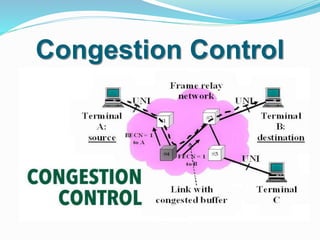
Congestion Control
Congestion
Congestion is a state occurring in network
layer when the message traffic is so heavy
that it slows down network response time.
Effects of Congestion
As delay increases, performance decreases.
If delay increases, retransmission occurs
making situation worse.
Traffic shaping
One of the causes of congestion is the inherent
burstiness of computer network traffic.
Traffic shaping means to smooth, or otherwise alter,
the offered traffic as a function of time.
Smooth traffic is easier to deal with the bursty traffic.
 Traffic shaping is the whole idea of agreeing with a
network service provider to a flow specification.
 A flow specification describes what sort of traffic you
will put into the net, and what sort of quality if service
you expect from it.
The quality of service
parameters
loss sensitivity (number of lost bytes per unit of time)
loss interval (the unit of time for calculating loss)
burst loss sensitivity (how long of a loss burst can be
tolerated)
minimum delay (how large of a delay before the app
notices)
maximum delay variation (the variance or jitter in the
inter-packet delay)
quality of guarantee (how serious the spec is to the
application)
Congestion Control
 mild congestion: TCP considers that the network is lightly congested if it
receives three duplicate acknowledgements and performs a fast retransmit.
If the fast retransmit is successful, this implies that only one segment has
been lost. In this case, TCP performs multiplicative decrease and the
congestion window is divided by 2. The slow-start threshold is set to the
new value of the congestion window.
 severe congestion. TCP considers that the network is severely congested
when its retransmission timer expires. In this case, TCP retransmits the first
segment, sets the slow-start threshold to 50% of the congestion window.
The congestion window is reset to its initial value and TCP performs a slow-
start.
Congestion Control
Algorithms
Leaky Bucket
Algorithm
Leaky Bucket
Algorithm
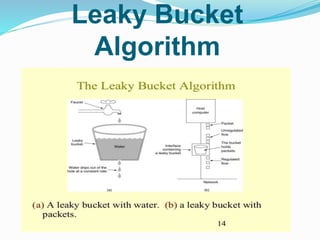
Steps involved in leaky bucket algorithm:
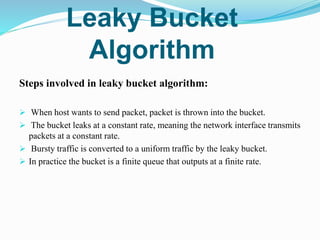
 When host wants to send packet, packet is thrown into the bucket.
 The bucket leaks at a constant rate, meaning the network interface transmits
packets at a constant rate.
 Bursty traffic is converted to a uniform traffic by the leaky bucket.
 In practice the bucket is a finite queue that outputs at a finite rate.
Token bucket
Algorithm
Token bucket Algorithm
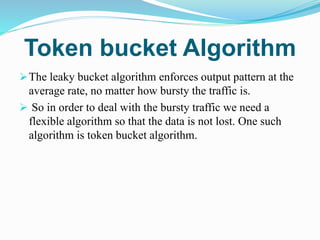
The leaky bucket algorithm enforces output pattern at the
average rate, no matter how bursty the traffic is.
 So in order to deal with the bursty traffic we need a
flexible algorithm so that the data is not lost. One such
algorithm is token bucket algorithm.
Token bucket
Algorithm
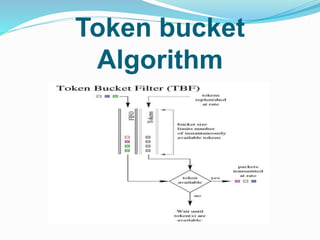
Steps of this algorithm can be described as follows:
In regular intervals tokens are thrown into the bucket. ƒ
The bucket has a maximum capacity. ƒ
If there is a ready packet, a token is removed from the
bucket, and the packet is send.
If there is no token in the bucket, the packet cannot be
send.
Congestion Window
Reduced (CWR) bit.
Congestion Window
Reduced (CWR) bit
 The CWR bit of the TCP header provides some form of
acknowledgement for the ECE bit.
 When a TCP receiver detects a packet marked with the CE bit, it sets
the ECE bit in all segments that it returns to the sender.
 Upon reception of an acknowledgement with the ECE bit set, the
sender reduces its congestion window to reflect a mild congestion
and sets the CWR bit.
 This bit remains set as long as the segments received contained
the ECE bit set.
 A sender should only react once per round-trip-time to marked
packets.
Modeling TCP
congestion control
Modeling TCP congestion
control
 TCP adapts its transmission rate to the losses that occur in the network.
Intuitively, the TCP transmission rate decreases when the percentage of
losses increases.
 This model considers a hypothetical TCP connection that suffers from
equally spaced segment losses. If pp is the segment loss ratio, then the TCP
connection successfully transfers 1p−11p−1 segments and the next segment
is lost.
 If we ignore the slow-start at the beginning of the connection, TCP in this
environment is always in congestion avoidance as there are only isolated
losses that can be recovered by using fast retransmit.
FOR MORE INFORMATION YOU CAN GO TO THIS
LINK
http://www.globalwebtutors.com/congestion-control-
assignments-help

Congestion control Assignment Help

  • 1.
    WWW.GLOBALWEBTUTORS.COM Globalwebtutors.com is anonline tutors Platform Which has following Services: •HOMEWORK HELP •DISSERTATION EDITING •ASSIGNMENT HELP •QUESTION HELP Send Requirement at Support@globalwebtutors.com or connect to us on Live chat instant anytime.
  • 2.
  • 3.
    Congestion Congestion is astate occurring in network layer when the message traffic is so heavy that it slows down network response time. Effects of Congestion As delay increases, performance decreases. If delay increases, retransmission occurs making situation worse.
  • 4.
    Traffic shaping One ofthe causes of congestion is the inherent burstiness of computer network traffic. Traffic shaping means to smooth, or otherwise alter, the offered traffic as a function of time. Smooth traffic is easier to deal with the bursty traffic.  Traffic shaping is the whole idea of agreeing with a network service provider to a flow specification.  A flow specification describes what sort of traffic you will put into the net, and what sort of quality if service you expect from it.
  • 5.
    The quality ofservice parameters loss sensitivity (number of lost bytes per unit of time) loss interval (the unit of time for calculating loss) burst loss sensitivity (how long of a loss burst can be tolerated) minimum delay (how large of a delay before the app notices) maximum delay variation (the variance or jitter in the inter-packet delay) quality of guarantee (how serious the spec is to the application)
  • 6.
    Congestion Control  mildcongestion: TCP considers that the network is lightly congested if it receives three duplicate acknowledgements and performs a fast retransmit. If the fast retransmit is successful, this implies that only one segment has been lost. In this case, TCP performs multiplicative decrease and the congestion window is divided by 2. The slow-start threshold is set to the new value of the congestion window.  severe congestion. TCP considers that the network is severely congested when its retransmission timer expires. In this case, TCP retransmits the first segment, sets the slow-start threshold to 50% of the congestion window. The congestion window is reset to its initial value and TCP performs a slow- start.
  • 7.
  • 8.
  • 9.
    Leaky Bucket Algorithm Steps involvedin leaky bucket algorithm:  When host wants to send packet, packet is thrown into the bucket.  The bucket leaks at a constant rate, meaning the network interface transmits packets at a constant rate.  Bursty traffic is converted to a uniform traffic by the leaky bucket.  In practice the bucket is a finite queue that outputs at a finite rate.
  • 10.
  • 11.
    Token bucket Algorithm Theleaky bucket algorithm enforces output pattern at the average rate, no matter how bursty the traffic is.  So in order to deal with the bursty traffic we need a flexible algorithm so that the data is not lost. One such algorithm is token bucket algorithm.
  • 12.
    Token bucket Algorithm Steps ofthis algorithm can be described as follows: In regular intervals tokens are thrown into the bucket. ƒ The bucket has a maximum capacity. ƒ If there is a ready packet, a token is removed from the bucket, and the packet is send. If there is no token in the bucket, the packet cannot be send.
  • 13.
  • 14.
    Congestion Window Reduced (CWR)bit  The CWR bit of the TCP header provides some form of acknowledgement for the ECE bit.  When a TCP receiver detects a packet marked with the CE bit, it sets the ECE bit in all segments that it returns to the sender.  Upon reception of an acknowledgement with the ECE bit set, the sender reduces its congestion window to reflect a mild congestion and sets the CWR bit.  This bit remains set as long as the segments received contained the ECE bit set.  A sender should only react once per round-trip-time to marked packets.
  • 15.
  • 16.
    Modeling TCP congestion control TCP adapts its transmission rate to the losses that occur in the network. Intuitively, the TCP transmission rate decreases when the percentage of losses increases.  This model considers a hypothetical TCP connection that suffers from equally spaced segment losses. If pp is the segment loss ratio, then the TCP connection successfully transfers 1p−11p−1 segments and the next segment is lost.  If we ignore the slow-start at the beginning of the connection, TCP in this environment is always in congestion avoidance as there are only isolated losses that can be recovered by using fast retransmit.
  • 17.
    FOR MORE INFORMATIONYOU CAN GO TO THIS LINK http://www.globalwebtutors.com/congestion-control- assignments-help