TABLE OF CONTENTS
01ABOUT THE PROJECT
02 KEY FEATURES
03 OUR IMPACTS
04 PROJECT GOALS
05 ML Recommendation System
4.
ZYNK
Zynk’s primary aimis to help users discover events efficiently,
stay connected with relevant communities, and enhance their
overall event experience. Whether it's a , workshop, or local
meetup, it provides an easy-to-navigate platform where users can
explore events tailored to their preferences
KEY FEATURES
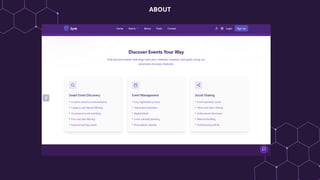
Event Discovery:Zynk offers a wide array of events, from conferences to local
meetups. Users can search and filter events based on categories, locations, dates, and
specific interests.
ML-Powered Recommendations: By leveraging machine learning algorithms, Zynk
tailors event recommendations to users based on their previous interactions,
preferences, and social behaviors.
Networking Opportunities: Zynk facilitates connections among users by allowing
them to engage with event attendees through profiles, messaging, and discussions.
7.
KEY FEATURES
Community Engagement:Users can join event-specific communities, participate in
discussions, and network with other participants before, during, and after events.
Ticketing and Registration: Zynk simplifies event registration and ticketing by providing
seamless booking.
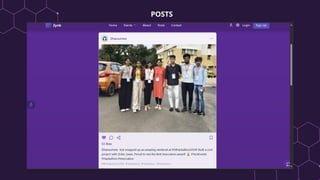
Feedback and Reviews: After attending an event, users can leave reviews and share
feedback,Upload posts helping other attendees and the event organizers improve future
experiences.
8.
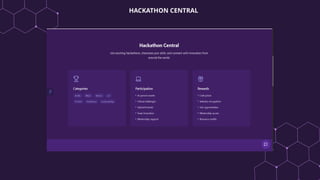
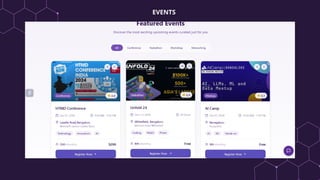
Popular Events andHackathons
Zynk Hackathon
A 24-hour coding challenge where students develop innovative solutions to
pressing problems.
Idea Pitch Competition
Students present their business ideas and compete for funding and mentorship.
Design Thinking Workshop
Interactive sessions that teach students the principles of design thinking and
problem-solving.
9.
OUR IMPACTS
Zynk's focuson teamwork and design
thinking encourages students to work
together and learn from each other.
events inspire students to think
creatively and develop innovative
solutions to real-world problems.
Collaborative Learning
Fostering Innovation
10.
ML in theEvent Recommendation System
◆ Simplify Event Discovery
• Personalized event recommendations using ML.
• Filters by location, interests, and past participation.
• Saves users' time and reduces the hassle of fragmented
event discovery.
◆ Promote Community Engagement
• Continuous interaction via content sharing (images,
posts).
• Dynamic discussions through comments and reactions.
• Builds a sense of belonging beyond event participation.
11.
◆ Provide SeamlessTicketing and Registration
• Integrated ticketing system within the platform.
• Simplified steps for registration and payment.
◆ Enable Scalable and Flexible Event Management
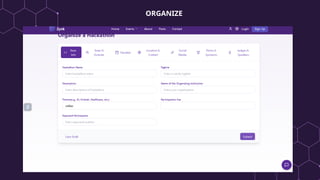
• Tools for event creation, scheduling, and analytics.
• Suitable for small meetups and large conferences.
• Integration with virtual and hybrid event platforms.
12.
Features
◆ Personalized EventDiscovery:
Zynk uses NLP and ML-powered algorithms to deliver personalized event recommendations
◆ ML-Powered Networking Features
◆ Seamless Ticketing and Registration
13.
◆ Frontend Technologies
React.js:
JavaScriptlibrary for building dynamic, modular UIs.
Enables real-time updates without page reloads.
Vite:
Development tool offering faster builds and live updates.
Optimized for high-performance production apps.
Tailwind CSS:
• Utility-first CSS framework for rapid styling.
• Ensures responsive designs across devices.
14.
◆ MongoDB:
◆ Storesstructured and unstructured data, including event and user information.
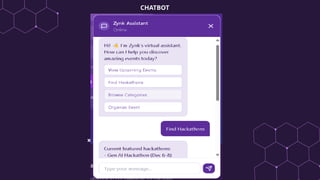
◆ Chatbot Integration
◆ Title: Intelligent Chatbot for User Support
• Key Features:
• Natural Language Processing (NLP):
• Enables understanding and responding to user queries.
• Capabilities:
• Handles FAQs like ticketing, event details, and support issues.
• Real-time interaction to enhance user experience.Redirects complex queries to
human support if needed.
15.
◆ Machine LearningFeatures
• Key Components:
• NLP (Natural Language Processing):
• Extracts insights from user queries for personalized recommendations and
chatbot responses.
• Recommendation System:
• Collaborative filtering to suggest events based on user history and interests.
• Cosine similarity to match user preferences with event descriptions.
• Algorithm Workflow:
• Input TF-IDF Cosine Similarity Recommended Events.
→ → →
16.
◆ Containerization withDocker
◆ Title: Containerized Ecosystem with Docker
• Key Points:
• Docker for Modular Deployment:
• Frontend, backend, chatbot, and ML models run in isolated containers.
• Advantages:
• Ensures consistent performance across environments.
• Simplifies deployment and scalability.
17.
◆ User Interaction(Frontend)
• Web Application:
• Built with React.js for dynamic, reusable components.
• Enables seamless event search, filtering, and registration.
18.
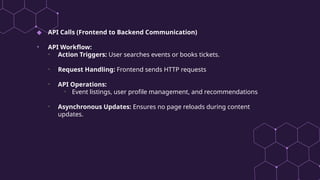
◆ API Calls(Frontend to Backend Communication)
• API Workflow:
• Action Triggers: User searches events or books tickets.
• Request Handling: Frontend sends HTTP requests
• API Operations:
• Event listings, user profile management, and recommendations
• Asynchronous Updates: Ensures no page reloads during content
updates.
19.
Recommendation Workflow :Input Collection: The user
specifies a domain and location through an interactive
prompt.
Data Processing: The system processes event data stored
in a JSON file, including event descriptions, locations, and
domains.
Vectorization: Event descriptions are combined with their
respective locations to create a richer context for
vectorization using TF-IDF.
Similarity Scoring: Cosine similarity compares the user
query with the vectorized event data to calculate relevance
scores.
Output Ranking: Events are sorted based on their
similarity scores and presented to the user, including event
names, locations, and scores
20.
Interactive Features: Thesystem is designed to handle
cases where no exact matches are found. For instance: If
no events match the specified domain, it informs the user
and exits gracefully. If no events match the location filter, it
provides domain-specific recommendations without the
location constraint.
Practical Applications : Personalization: Users receive
customized event suggestions based on their field of
interest and geographical preference.
Scalability: The ML-driven approach can handle large
datasets of events, making it suitable for applications like
hackathon recommendations, tech meetups, or even
general event discovery platforms.
Flexibility: The system can be extended to include
additional filters like event dates, organizers, or even
online/offline preferences.
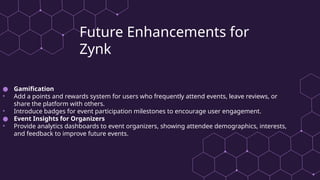
Future Enhancements for
Zynk
●Gamification
• Add a points and rewards system for users who frequently attend events, leave reviews, or
share the platform with others.
• Introduce badges for event participation milestones to encourage user engagement.
● Event Insights for Organizers
• Provide analytics dashboards to event organizers, showing attendee demographics, interests,
and feedback to improve future events.
30.
Future Enhancements
● BlockchainIntegration
• Use blockchain for secure ticketing systems to prevent fraud and scalping.
• Payment Options
● Mobile App Features
• Add offline mode for saving events or registration data when connectivity is limited.
• Provide push notifications with event reminders, schedule changes, or nearby event
suggestions.
● Third-Party Integrations
• Integrate with professional networking platforms like LinkedIn to enhance attendee profiles.
• Allow event organizers to sync with tools like Google Calendar, Slack, or Microsoft Teams for
seamless collaboration.
31.
CONCLUSION
•Seamless & Interactive:Combines modern tech for a user-friendly
experience.
•Personalized Suggestions: AI-driven recommendations tailored to
user interests.
•Secure & Scalable: Built with robust security and cloud-based
deployment.
•Future-Ready: Plans include blockchain for ticketing and AR for event
previews.
•Global Impact: Simplifying event discovery and fostering meaningful
connections.