Huffman Codes
 Huffman codes are an effective technique of
‘lossless data compression’ which means no
information is lost.
 The algorithm builds a table of the
frequencies of each character in a file
 The table is then used to determine an optimal
way of representing each character as a binary
string
Huffman Codes
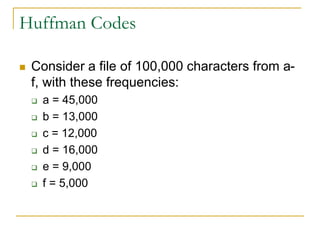
 Consider a file of 100,000 characters from a-
f, with these frequencies:
 a = 45,000
 b = 13,000
 c = 12,000
 d = 16,000
 e = 9,000
 f = 5,000
Huffman Codes
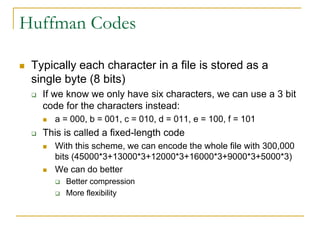
 Typically each character in a file is stored as a
single byte (8 bits)
 If we know we only have six characters, we can use a 3 bit
code for the characters instead:
 a = 000, b = 001, c = 010, d = 011, e = 100, f = 101
 This is called a fixed-length code
 With this scheme, we can encode the whole file with 300,000
bits (45000*3+13000*3+12000*3+16000*3+9000*3+5000*3)
 We can do better
 Better compression
 More flexibility
Huffman Codes
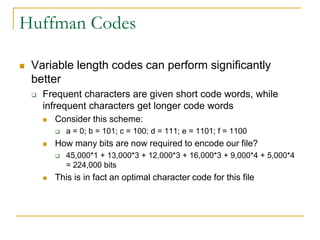
 Variable length codes can perform significantly
better
 Frequent characters are given short code words, while
infrequent characters get longer code words
 Consider this scheme:
 a = 0; b = 101; c = 100; d = 111; e = 1101; f = 1100
 How many bits are now required to encode our file?
 45,000*1 + 13,000*3 + 12,000*3 + 16,000*3 + 9,000*4 + 5,000*4
= 224,000 bits
 This is in fact an optimal character code for this file
Huffman Codes
 Prefix codes
 Huffman codes are constructed in such a way that they can
be unambiguously translated back to the original data, yet
still be an optimal character code
 Huffman codes are really considered “prefix codes”
 No code word is a prefix of any other code word
Prefix code (9,55,50)
Not a prefix code (9,5,55,59) because 5 is present in 55 and 59
 This guarantees unambiguous decoding
 Once a code is recognized, we can replace with the decoded
data, without worrying about whether we may also match some
other code
Huffman Codes
 Both the encoder and decoder make use of a binary
tree to recognize codes
 The leaves of the tree represent the unencoded characters
 Each left branch indicates a “0” placed in the encoded bit
string
 Each right branch indicates a “1” placed in the bit string
Huffman Codes
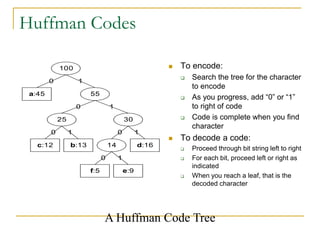
100
a:45
0
55
1
25
0
c:12
0
b:13
1
30
1
14
0
d:16
1
f:5 e:9
0 1
A Huffman Code Tree
 To encode:
 Search the tree for the character
to encode
 As you progress, add “0” or “1”
to right of code
 Code is complete when you find
character
 To decode a code:
 Proceed through bit string left to right
 For each bit, proceed left or right as
indicated
 When you reach a leaf, that is the
decoded character
Huffman Codes
 Using this representation, an optimal code will
always be represented by a full binary tree
 Every non-leaf node has two children
 If this were not true, then there would be “waste” bits, as in the
fixed-length code, leading to a non-optimal compression
 For a set of c characters, this requires c leaves, and c-1
internal nodes
Huffman Codes
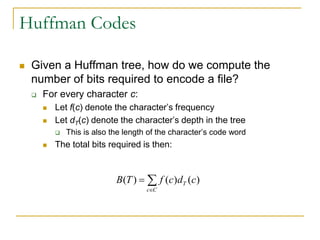
 Given a Huffman tree, how do we compute the
number of bits required to encode a file?
 For every character c:
 Let f(c) denote the character’s frequency
 Let dT(c) denote the character’s depth in the tree
 This is also the length of the character’s code word
 The total bits required is then:



Cc
T cdcfTB )()()(
Constructing a Huffman Code
 Huffman developed a greedy algorithm for
constructing an optimal prefix code
 The algorithm builds the tree in a bottom-up manner
 It begins with the leaves, then performs merging operations
to build up the tree
 At each step, it merges the two least frequent members
together
 It removes these characters from the set, and replaces them
with a “metacharacter” with frequency = sum of the removed
characters’ frequencies
Example
 For example, we code the 3 letter file ‘abc’ as
000.001.010

Huffman codes

  • 1.
    Huffman Codes  Huffmancodes are an effective technique of ‘lossless data compression’ which means no information is lost.  The algorithm builds a table of the frequencies of each character in a file  The table is then used to determine an optimal way of representing each character as a binary string
  • 2.
    Huffman Codes  Considera file of 100,000 characters from a- f, with these frequencies:  a = 45,000  b = 13,000  c = 12,000  d = 16,000  e = 9,000  f = 5,000
  • 3.
    Huffman Codes  Typicallyeach character in a file is stored as a single byte (8 bits)  If we know we only have six characters, we can use a 3 bit code for the characters instead:  a = 000, b = 001, c = 010, d = 011, e = 100, f = 101  This is called a fixed-length code  With this scheme, we can encode the whole file with 300,000 bits (45000*3+13000*3+12000*3+16000*3+9000*3+5000*3)  We can do better  Better compression  More flexibility
  • 4.
    Huffman Codes  Variablelength codes can perform significantly better  Frequent characters are given short code words, while infrequent characters get longer code words  Consider this scheme:  a = 0; b = 101; c = 100; d = 111; e = 1101; f = 1100  How many bits are now required to encode our file?  45,000*1 + 13,000*3 + 12,000*3 + 16,000*3 + 9,000*4 + 5,000*4 = 224,000 bits  This is in fact an optimal character code for this file
  • 5.
    Huffman Codes  Prefixcodes  Huffman codes are constructed in such a way that they can be unambiguously translated back to the original data, yet still be an optimal character code  Huffman codes are really considered “prefix codes”  No code word is a prefix of any other code word Prefix code (9,55,50) Not a prefix code (9,5,55,59) because 5 is present in 55 and 59  This guarantees unambiguous decoding  Once a code is recognized, we can replace with the decoded data, without worrying about whether we may also match some other code
  • 6.
    Huffman Codes  Boththe encoder and decoder make use of a binary tree to recognize codes  The leaves of the tree represent the unencoded characters  Each left branch indicates a “0” placed in the encoded bit string  Each right branch indicates a “1” placed in the bit string
  • 7.
    Huffman Codes 100 a:45 0 55 1 25 0 c:12 0 b:13 1 30 1 14 0 d:16 1 f:5 e:9 01 A Huffman Code Tree  To encode:  Search the tree for the character to encode  As you progress, add “0” or “1” to right of code  Code is complete when you find character  To decode a code:  Proceed through bit string left to right  For each bit, proceed left or right as indicated  When you reach a leaf, that is the decoded character
  • 8.
    Huffman Codes  Usingthis representation, an optimal code will always be represented by a full binary tree  Every non-leaf node has two children  If this were not true, then there would be “waste” bits, as in the fixed-length code, leading to a non-optimal compression  For a set of c characters, this requires c leaves, and c-1 internal nodes
  • 9.
    Huffman Codes  Givena Huffman tree, how do we compute the number of bits required to encode a file?  For every character c:  Let f(c) denote the character’s frequency  Let dT(c) denote the character’s depth in the tree  This is also the length of the character’s code word  The total bits required is then:    Cc T cdcfTB )()()(
  • 10.
    Constructing a HuffmanCode  Huffman developed a greedy algorithm for constructing an optimal prefix code  The algorithm builds the tree in a bottom-up manner  It begins with the leaves, then performs merging operations to build up the tree  At each step, it merges the two least frequent members together  It removes these characters from the set, and replaces them with a “metacharacter” with frequency = sum of the removed characters’ frequencies
  • 11.
  • 16.
     For example,we code the 3 letter file ‘abc’ as 000.001.010