1
Context-Free Languages &
Grammars
(CFLs & CFGs)
Reading: Chapter 5
Not all languages are regular
 So what happens to the languages
which are not regular?
 Can we still come up with a language
recognizer?
 i.e., something that will accept (or reject)
strings that belong (or do not belong) to the
language?
2
3
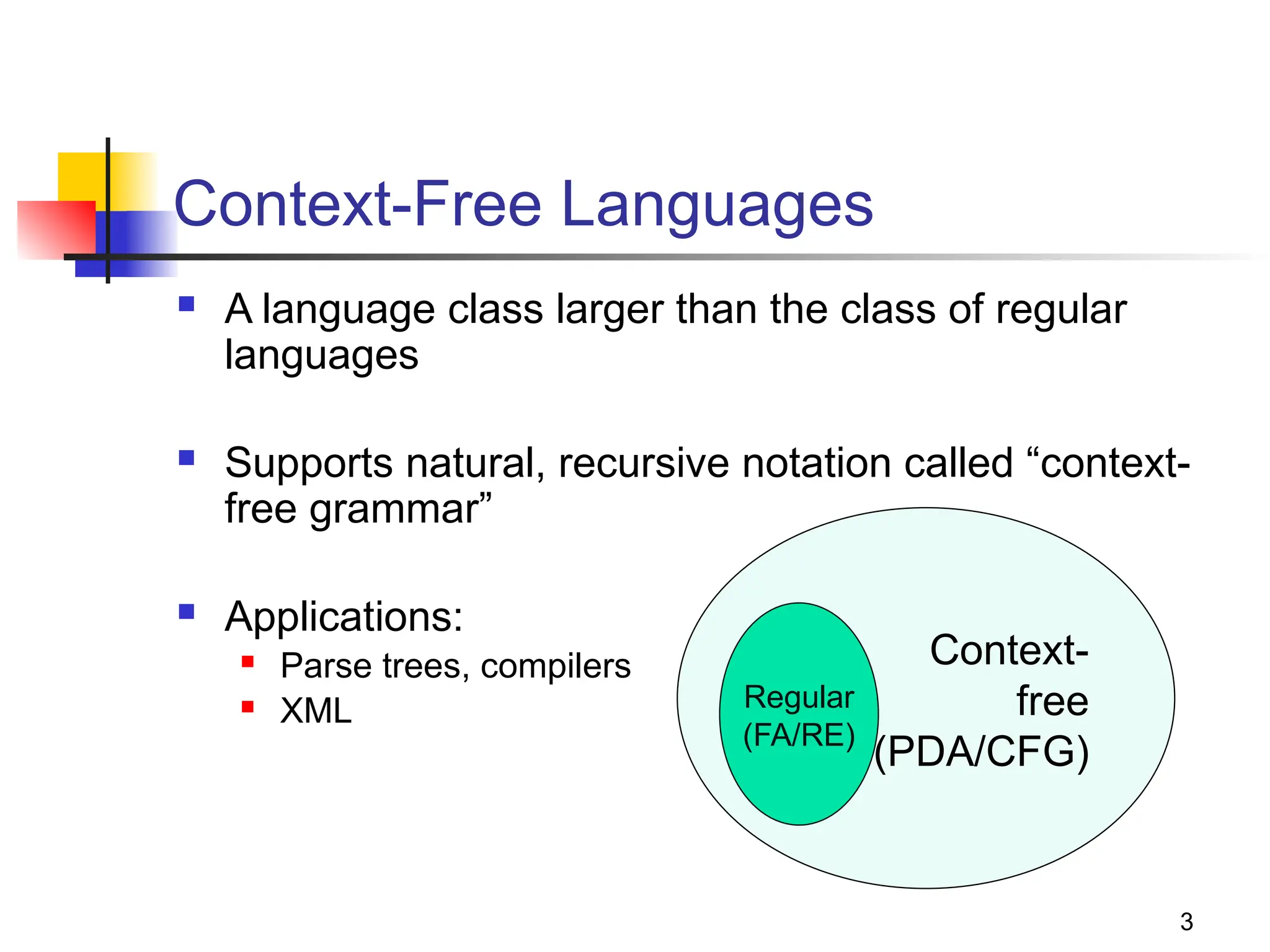
Context-Free Languages
 A language class larger than the class of regular
languages
 Supports natural, recursive notation called “context-
free grammar”
 Applications:
 Parse trees, compilers
 XML Regular
(FA/RE)
Context-
free
(PDA/CFG)
4
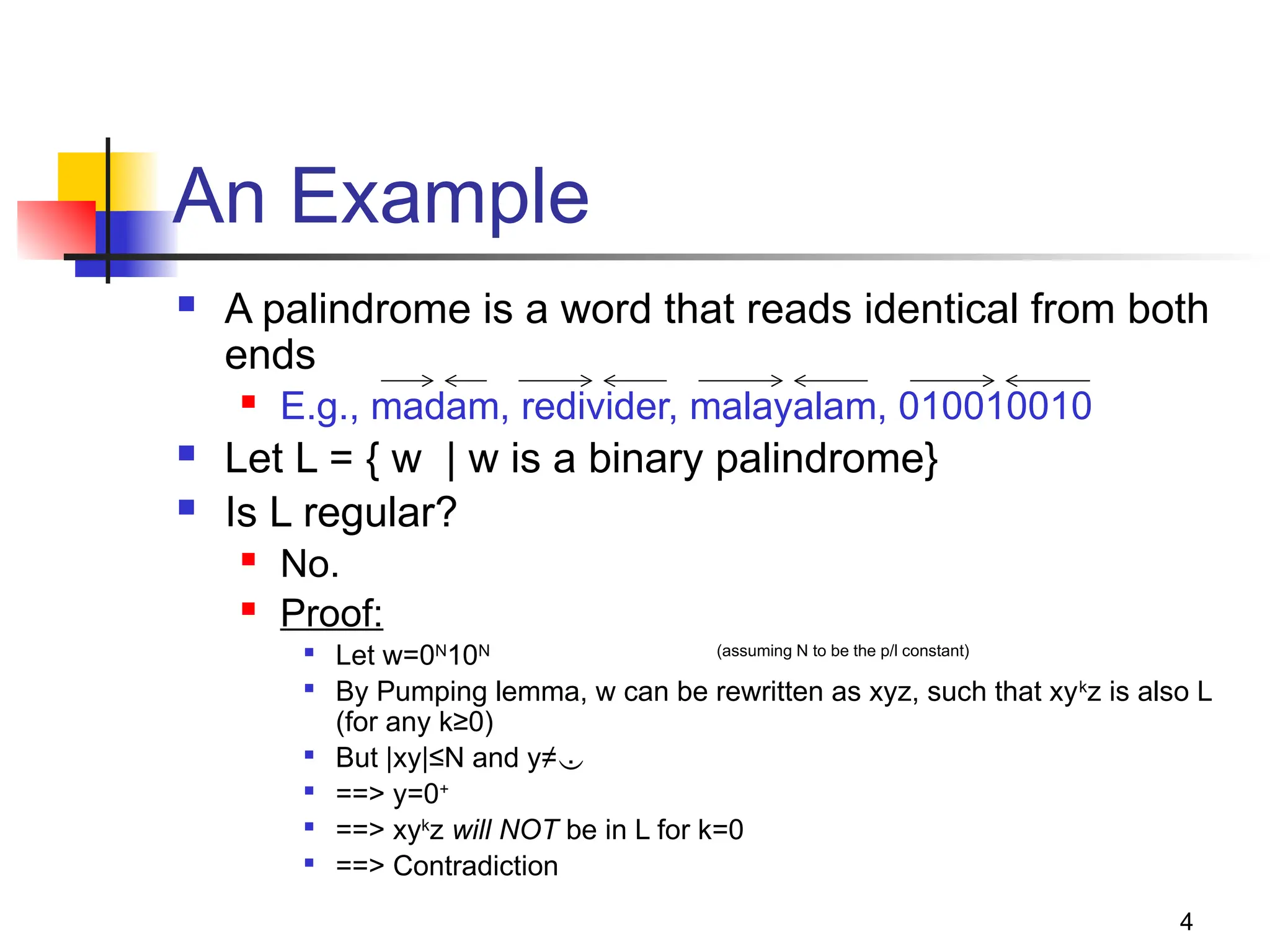
An Example
 A palindrome is a word that reads identical from both
ends
 E.g., madam, redivider, malayalam, 010010010
 Let L = { w | w is a binary palindrome}
 Is L regular?
 No.
 Proof:

Let w=0N
10N (assuming N to be the p/l constant)

By Pumping lemma, w can be rewritten as xyz, such that xyk
z is also L
(for any k≥0)

But |xy|≤N and y≠

==> y=0+

==> xyk
z will NOT be in L for k=0

==> Contradiction
5
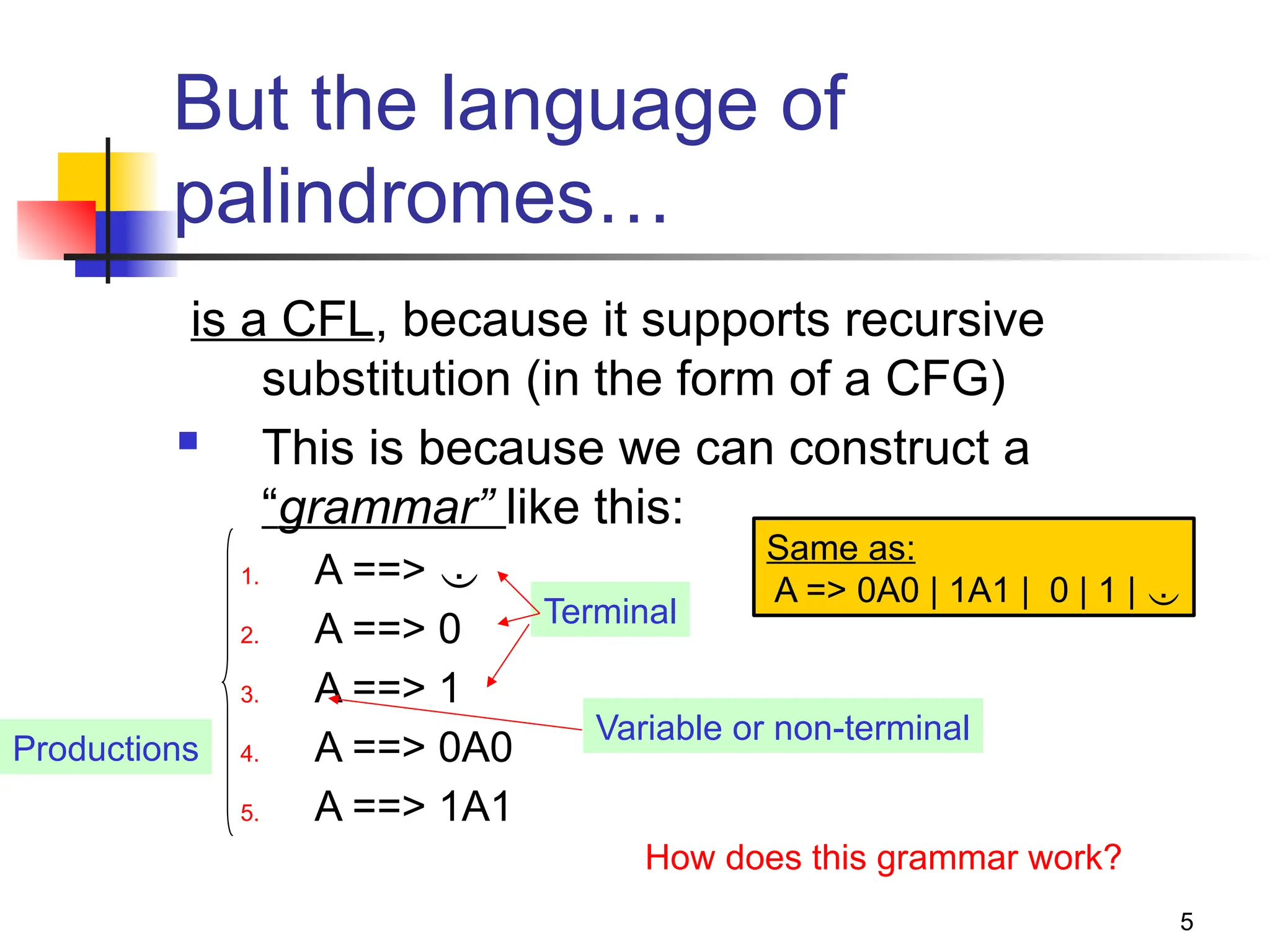
But the language of
palindromes…
is a CFL, because it supports recursive
substitution (in the form of a CFG)
 This is because we can construct a
“grammar” like this:
1. A ==> 
2. A ==> 0
3. A ==> 1
4. A ==> 0A0
5. A ==> 1A1
Terminal
Productions
Variable or non-terminal
How does this grammar work?
Same as:
A => 0A0 | 1A1 | 0 | 1 | 
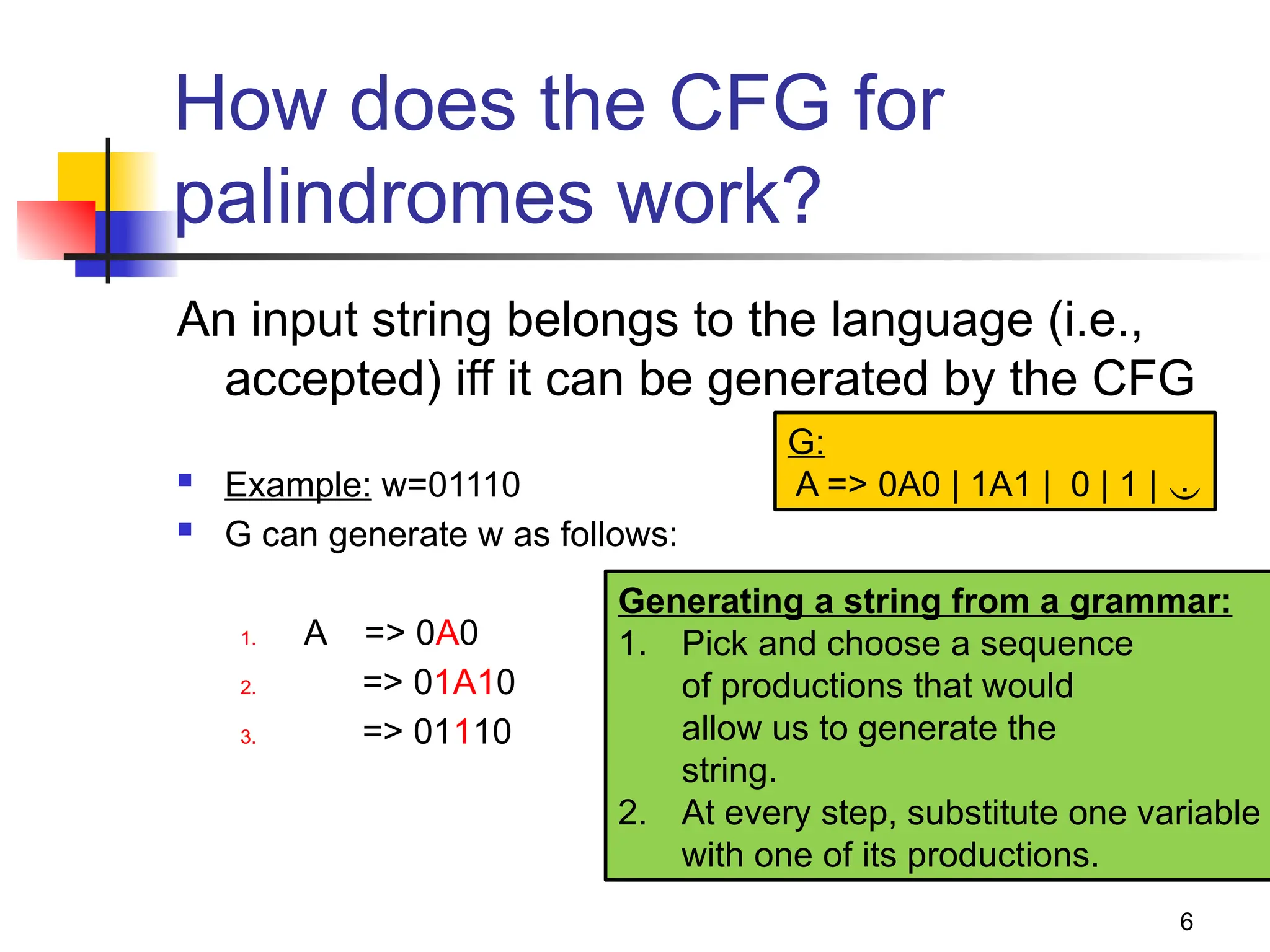
How does the CFG for
palindromes work?
An input string belongs to the language (i.e.,
accepted) iff it can be generated by the CFG
 Example: w=01110
 G can generate w as follows:
1. A => 0A0
2. => 01A10
3. => 01110
6
G:
A => 0A0 | 1A1 | 0 | 1 | 
Generating a string from a grammar:
1. Pick and choose a sequence
of productions that would
allow us to generate the
string.
2. At every step, substitute one variable
with one of its productions.
7
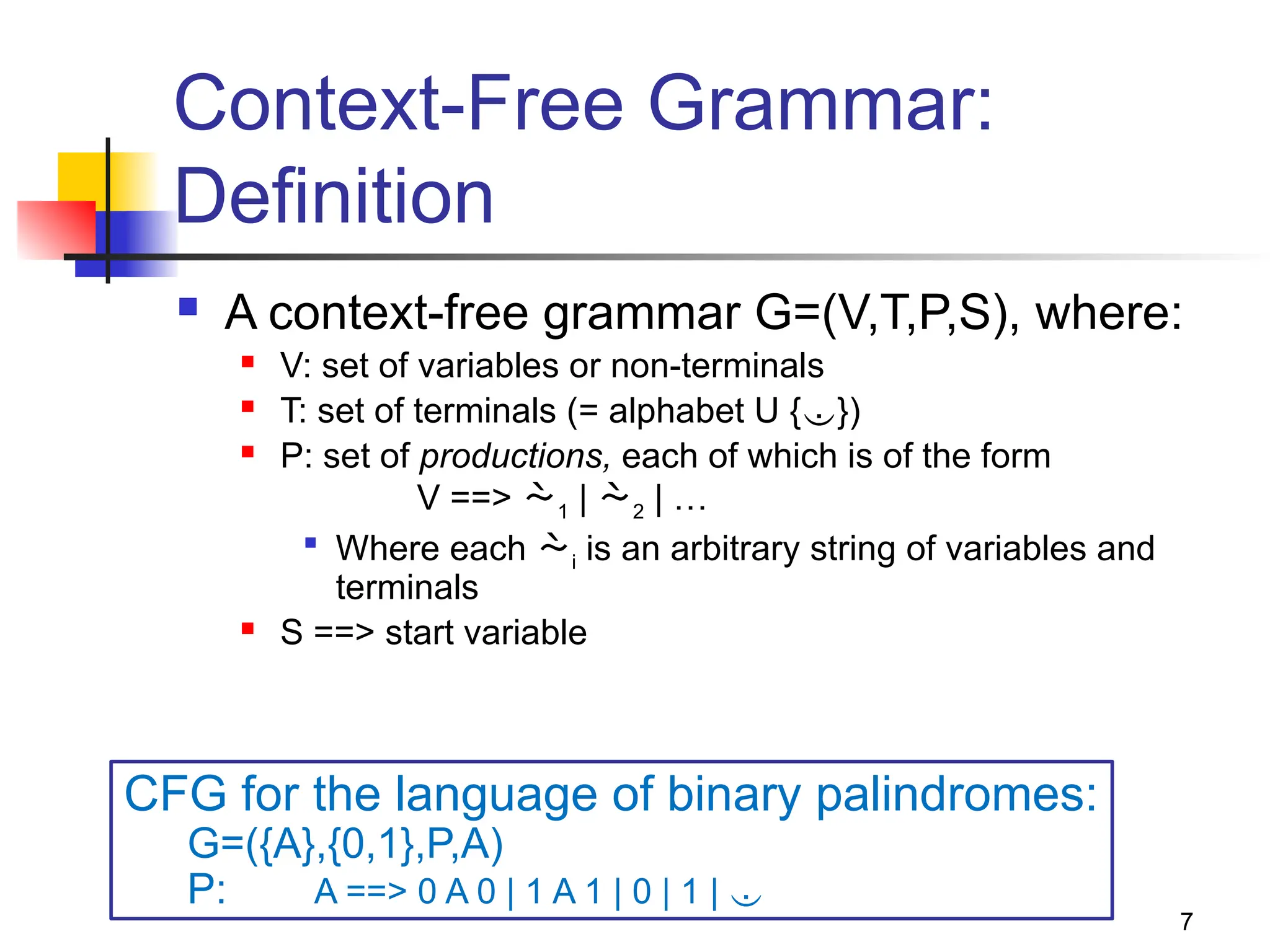
Context-Free Grammar:
Definition
 A context-free grammar G=(V,T,P,S), where:
 V: set of variables or non-terminals
 T: set of terminals (= alphabet U {})
 P: set of productions, each of which is of the form
V ==> 1 | 2 | …

Where each i is an arbitrary string of variables and
terminals
 S ==> start variable
CFG for the language of binary palindromes:
G=({A},{0,1},P,A)
P: A ==> 0 A 0 | 1 A 1 | 0 | 1 | 
8
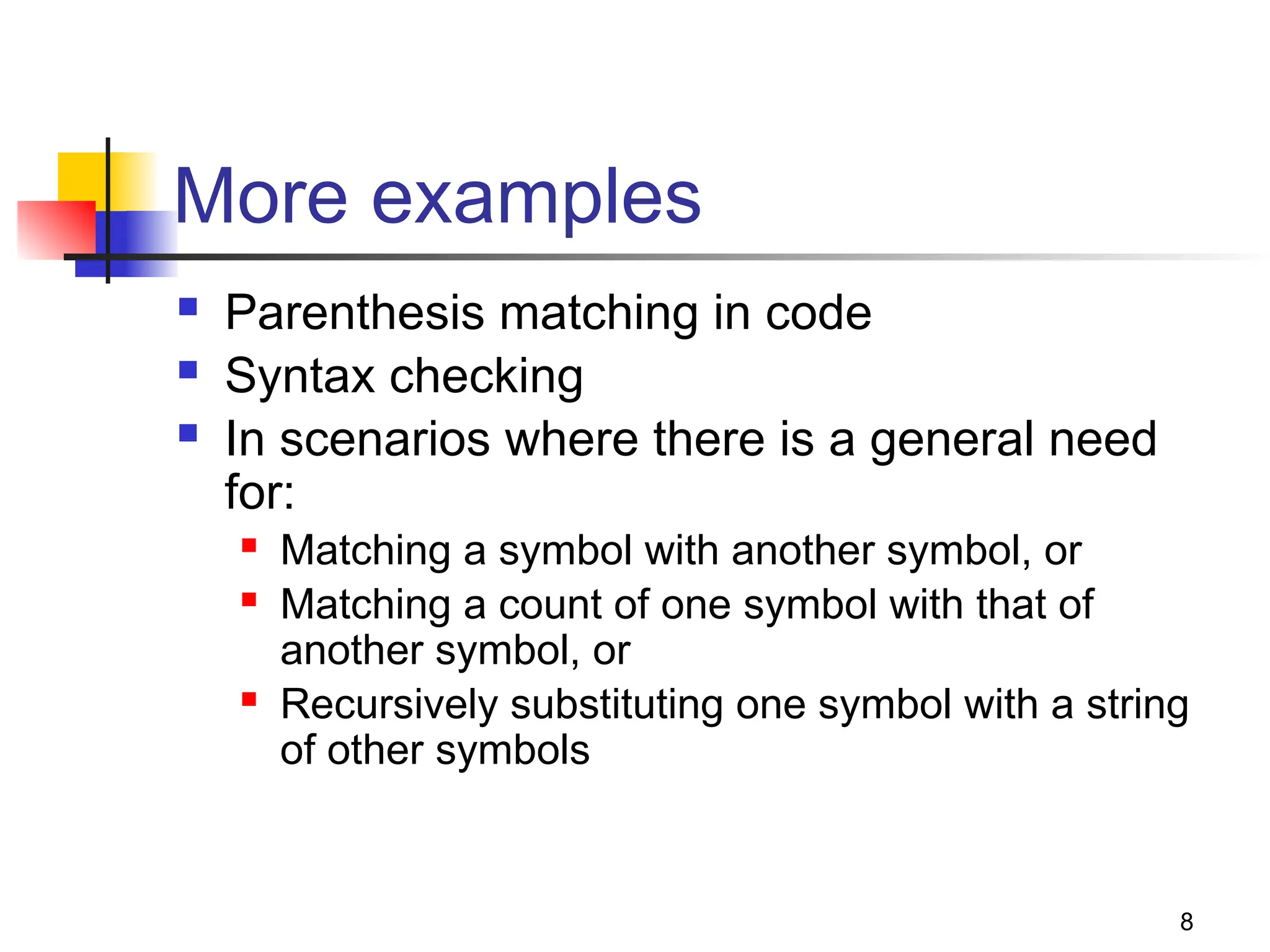
More examples
 Parenthesis matching in code
 Syntax checking
 In scenarios where there is a general need
for:
 Matching a symbol with another symbol, or
 Matching a count of one symbol with that of
another symbol, or
 Recursively substituting one symbol with a string
of other symbols
9
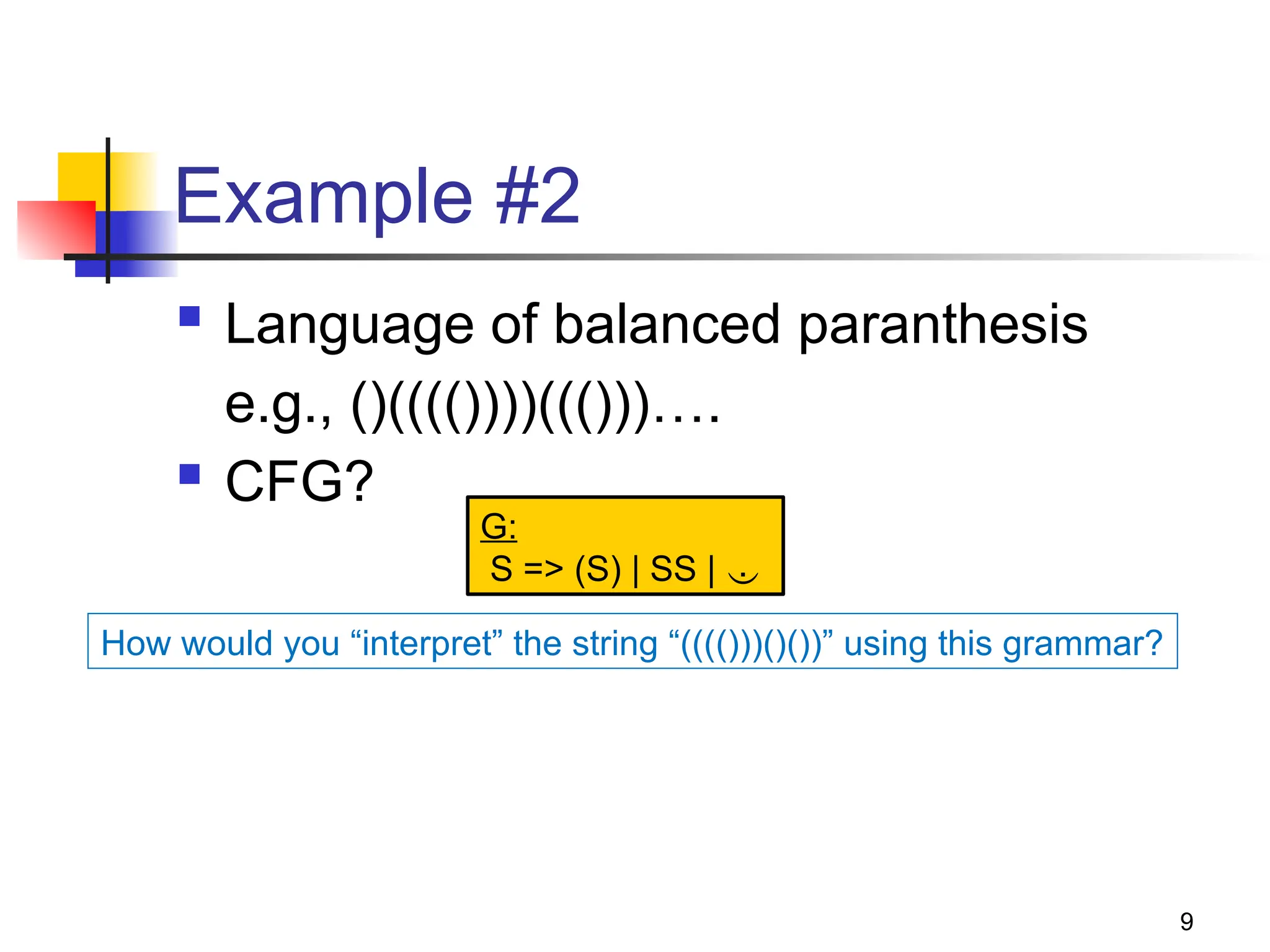
Example #2
 Language of balanced paranthesis
e.g., ()(((())))((()))….
 CFG?
G:
S => (S) | SS | 
How would you “interpret” the string “(((()))()())” using this grammar?
10
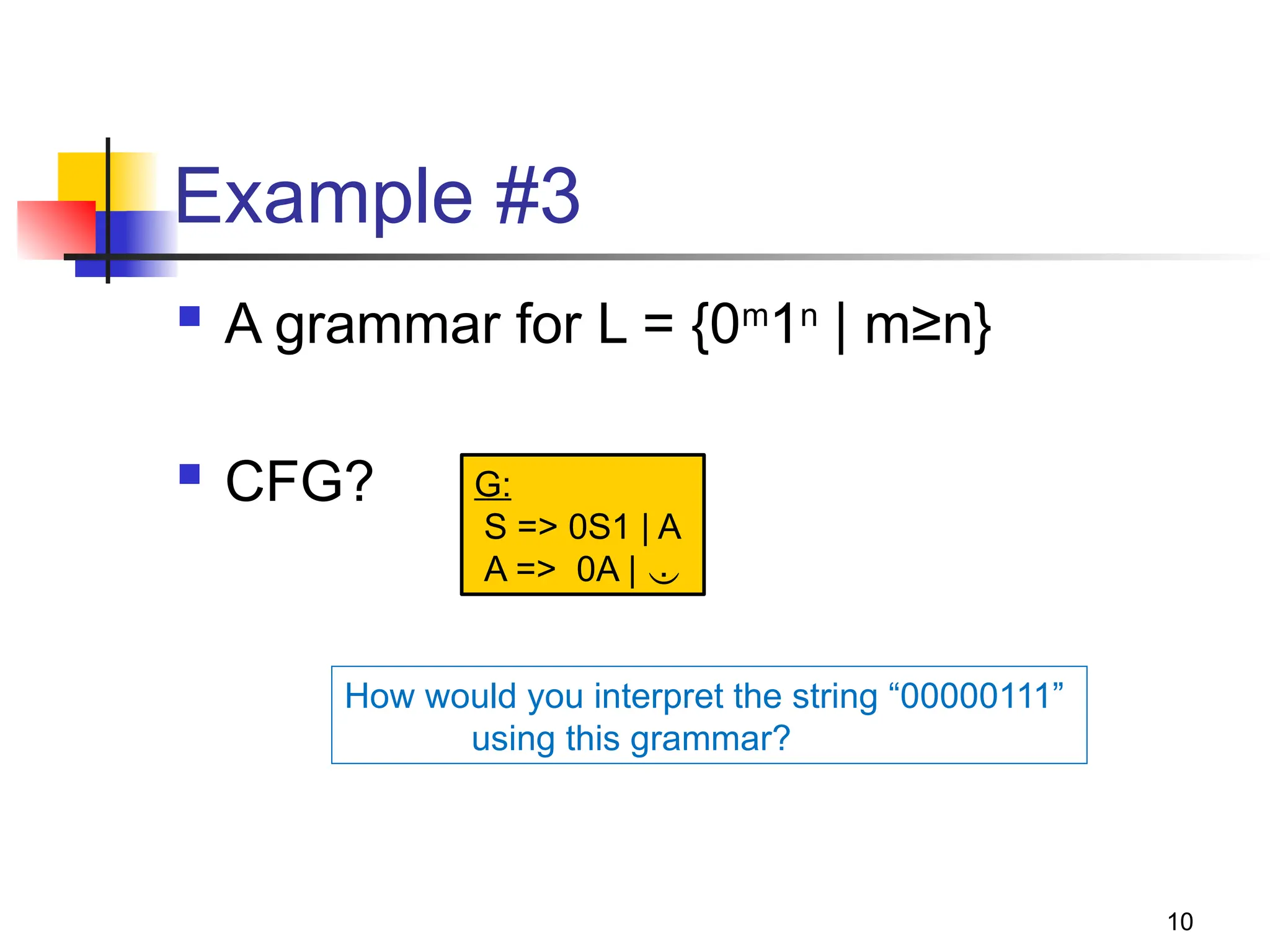
Example #3
 A grammar for L = {0m
1n
| m≥n}
 CFG? G:
S => 0S1 | A
A => 0A | 
How would you interpret the string “00000111”
using this grammar?
11
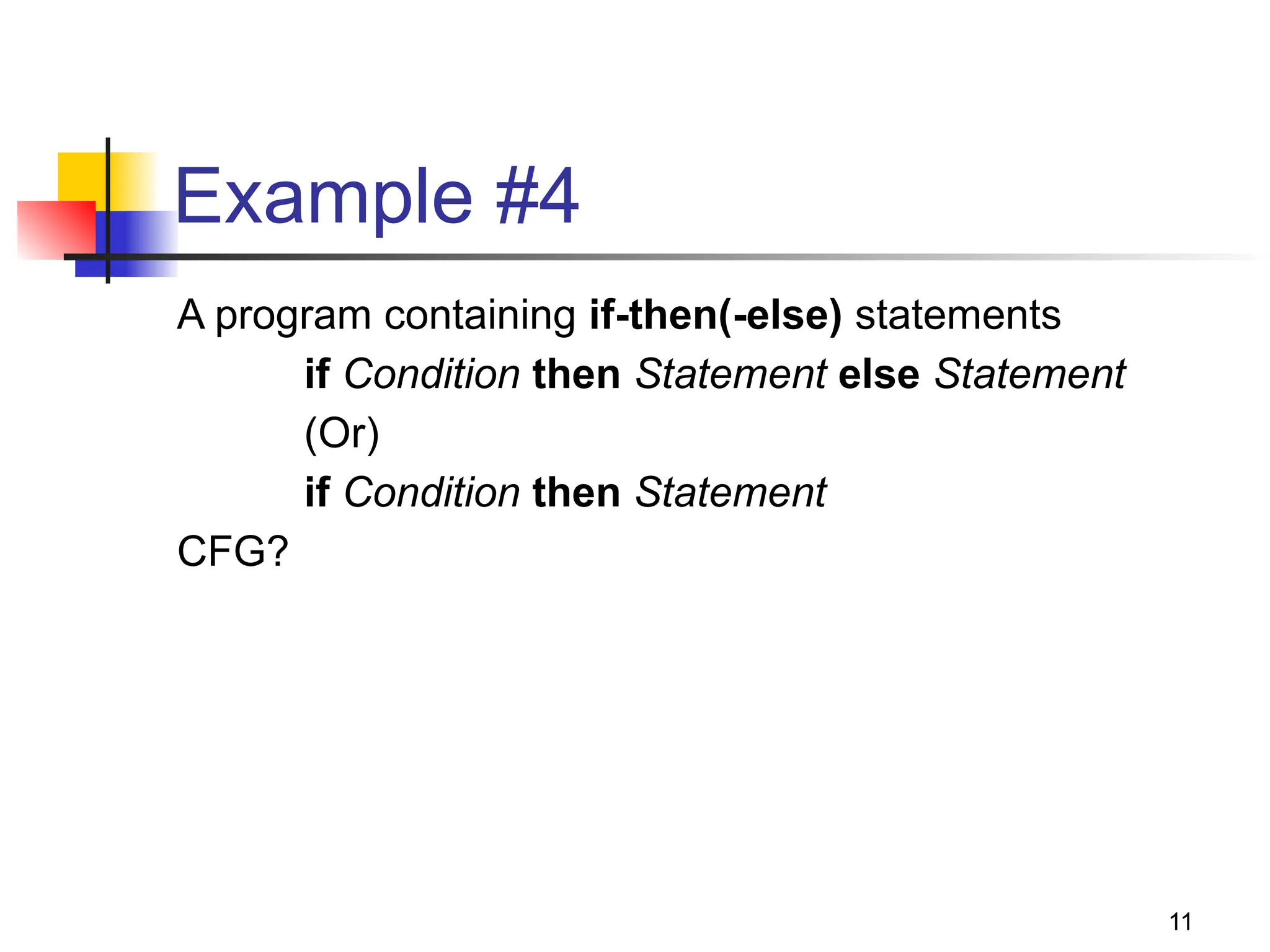
Example #4
A program containing if-then(-else) statements
if Condition then Statement else Statement
(Or)
if Condition then Statement
CFG?
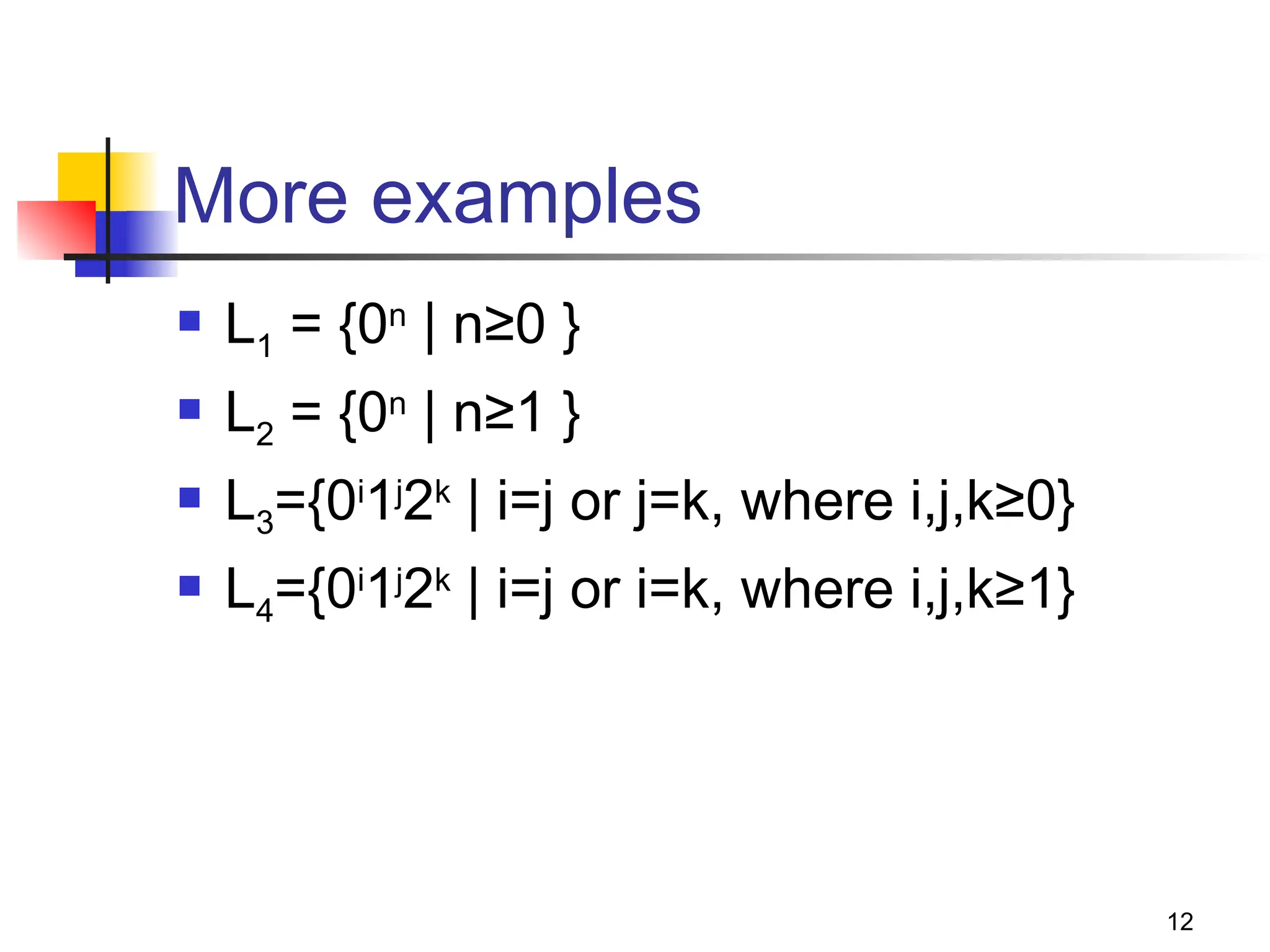
More examples
 L1 = {0n
| n≥0 }
 L2 = {0n
| n≥1 }
 L3={0i
1j
2k
| i=j or j=k, where i,j,k≥0}
 L4={0i
1j
2k
| i=j or i=k, where i,j,k≥1}
12
13
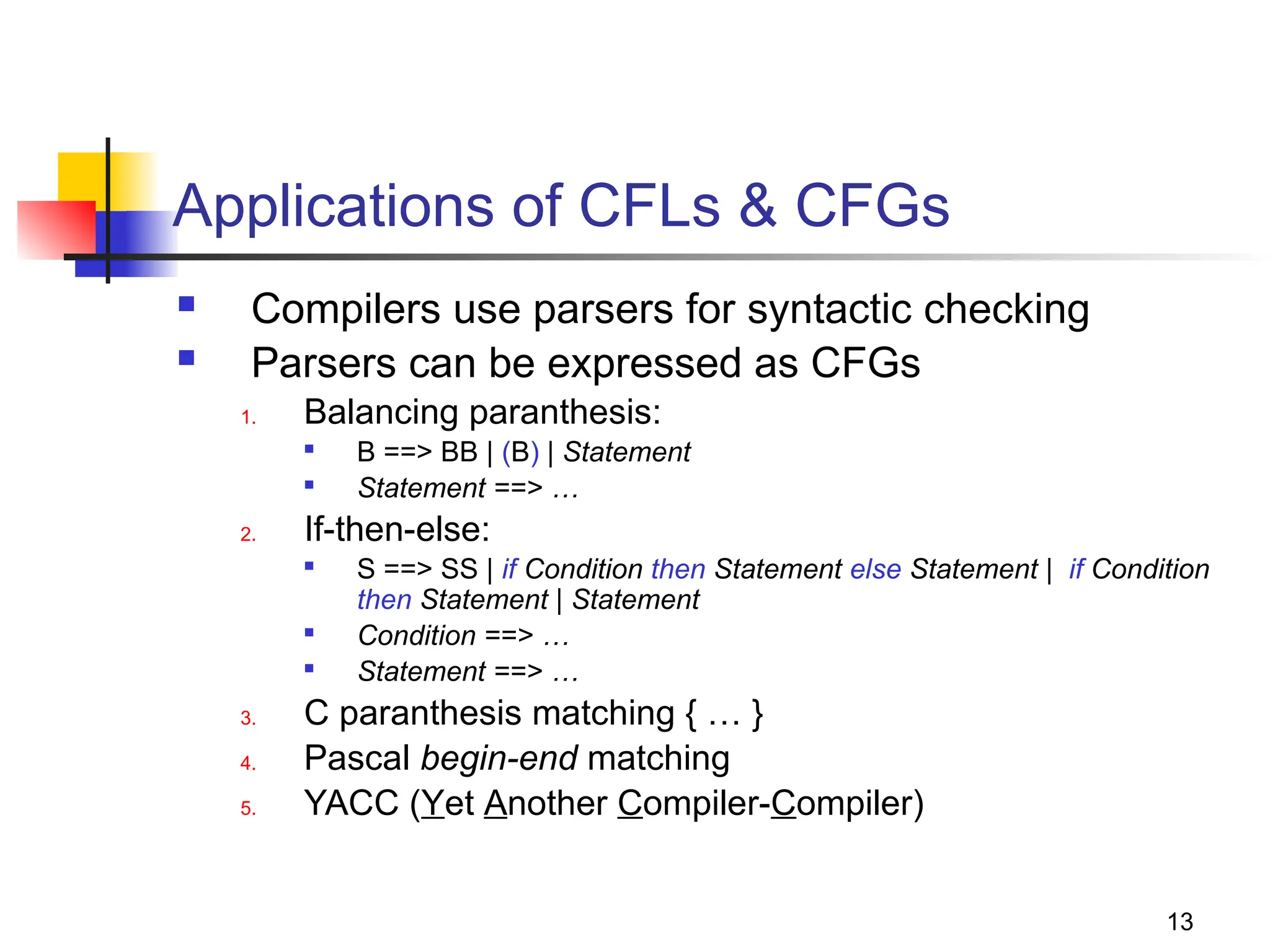
Applications of CFLs & CFGs
 Compilers use parsers for syntactic checking
 Parsers can be expressed as CFGs
1. Balancing paranthesis:

B ==> BB | (B) | Statement

Statement ==> …
2. If-then-else:

S ==> SS | if Condition then Statement else Statement | if Condition
then Statement | Statement

Condition ==> …

Statement ==> …
3. C paranthesis matching { … }
4. Pascal begin-end matching
5. YACC (Yet Another Compiler-Compiler)
14
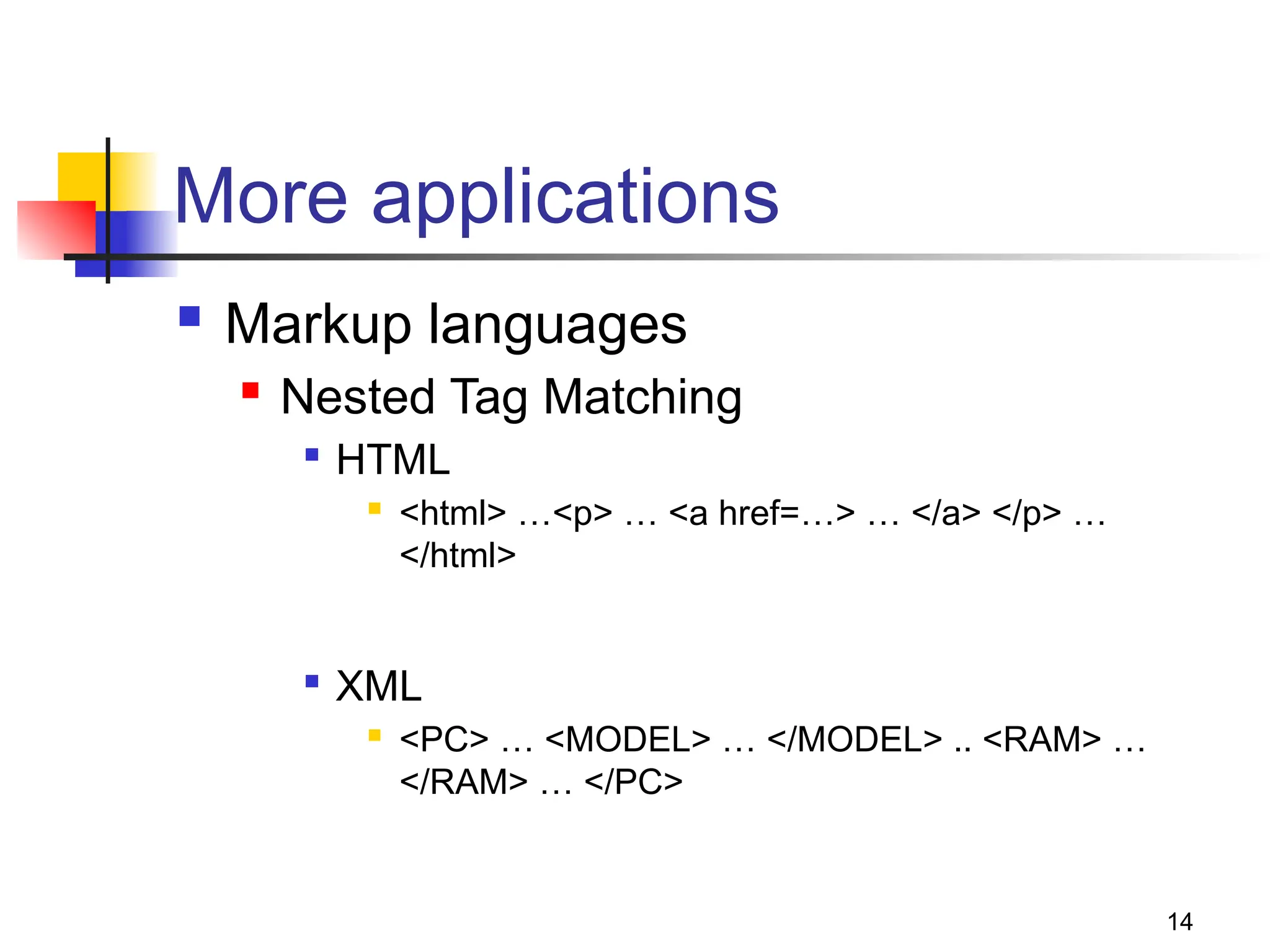
More applications
 Markup languages
 Nested Tag Matching

HTML
 <html> …<p> … <a href=…> … </a> </p> …
</html>

XML
 <PC> … <MODEL> … </MODEL> .. <RAM> …
</RAM> … </PC>
15
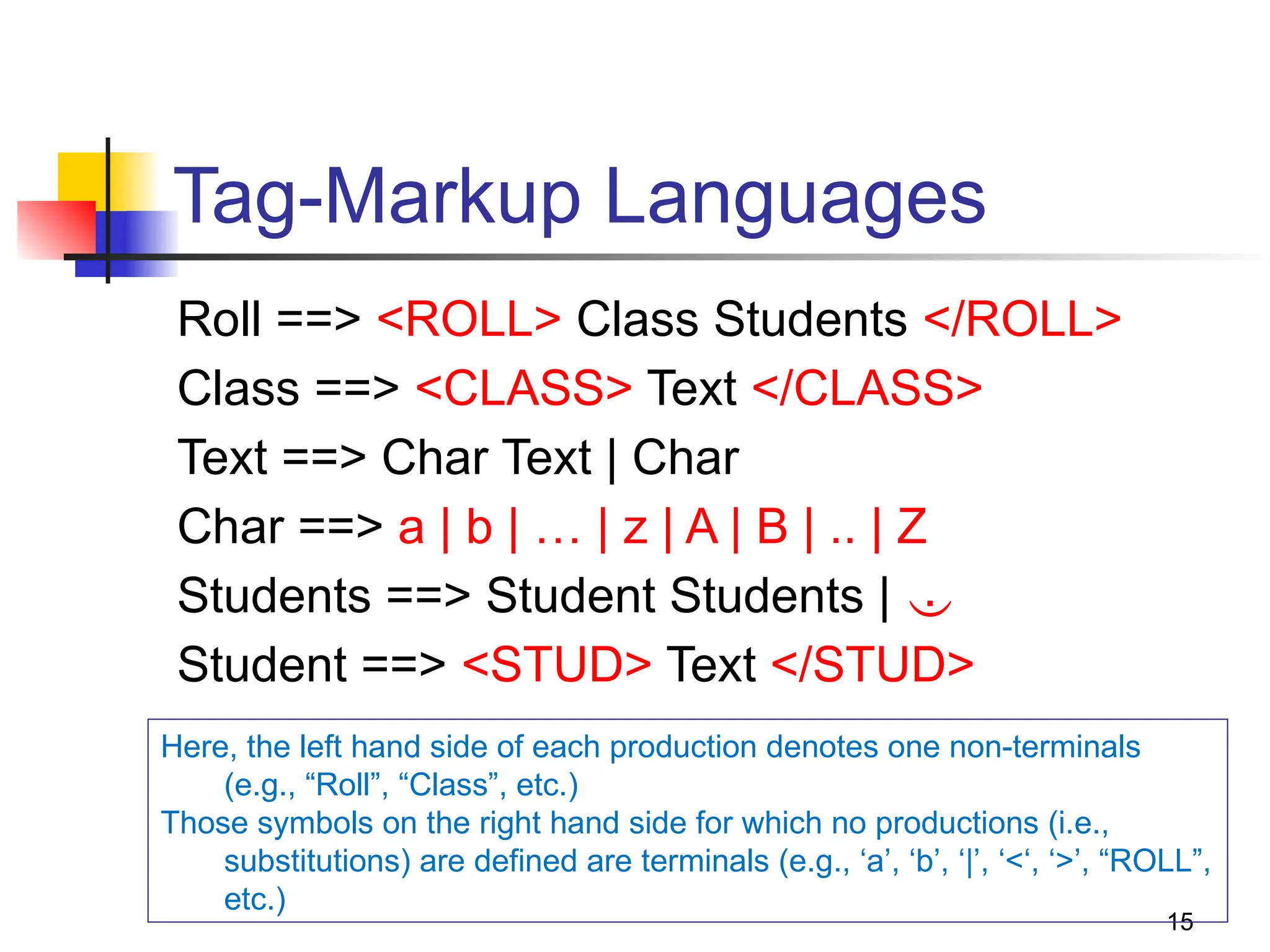
Tag-Markup Languages
Roll ==> <ROLL> Class Students </ROLL>
Class ==> <CLASS> Text </CLASS>
Text ==> Char Text | Char
Char ==> a | b | … | z | A | B | .. | Z
Students ==> Student Students | 
Student ==> <STUD> Text </STUD>
Here, the left hand side of each production denotes one non-terminals
(e.g., “Roll”, “Class”, etc.)
Those symbols on the right hand side for which no productions (i.e.,
substitutions) are defined are terminals (e.g., ‘a’, ‘b’, ‘|’, ‘<‘, ‘>’, “ROLL”,
etc.)
16
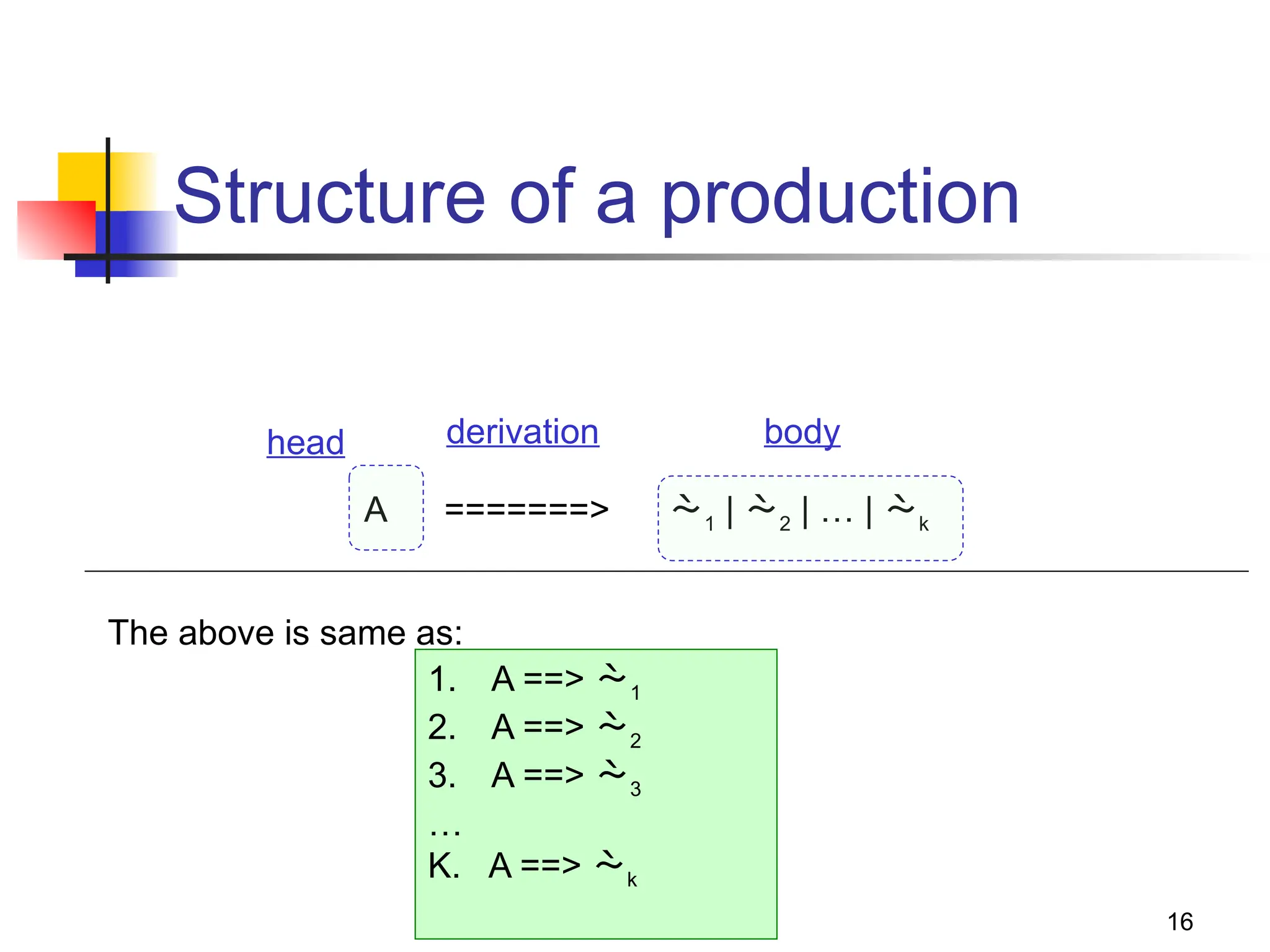
Structure of a production
A =======> 1 | 2 | … | k
head body
derivation
1. A ==> 1
2. A ==> 2
3. A ==> 3
…
K. A ==> k
The above is same as:
17
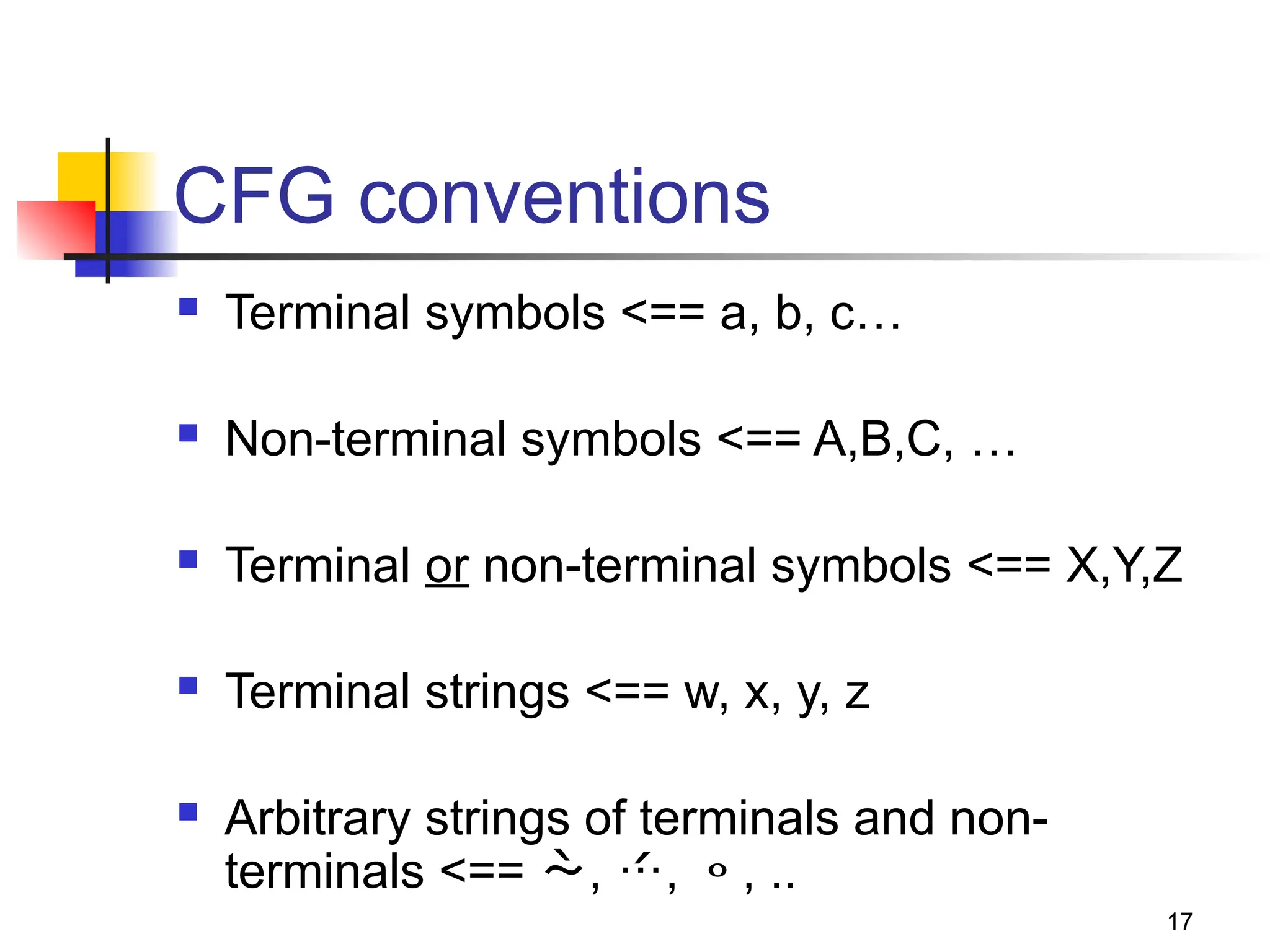
CFG conventions
 Terminal symbols <== a, b, c…
 Non-terminal symbols <== A,B,C, …
 Terminal or non-terminal symbols <== X,Y,Z
 Terminal strings <== w, x, y, z
 Arbitrary strings of terminals and non-
terminals <== , , , ..
18
Syntactic Expressions in
Programming Languages
result = a*b + score + 10 * distance + c
Regular languages have only terminals
 Reg expression = [a-z][a-z0-1]*
 If we allow only letters a & b, and 0 & 1 for
constants (for simplification)

Regular expression = (a+b)(a+b+0+1)*
terminals variables Operators are also
terminals
19
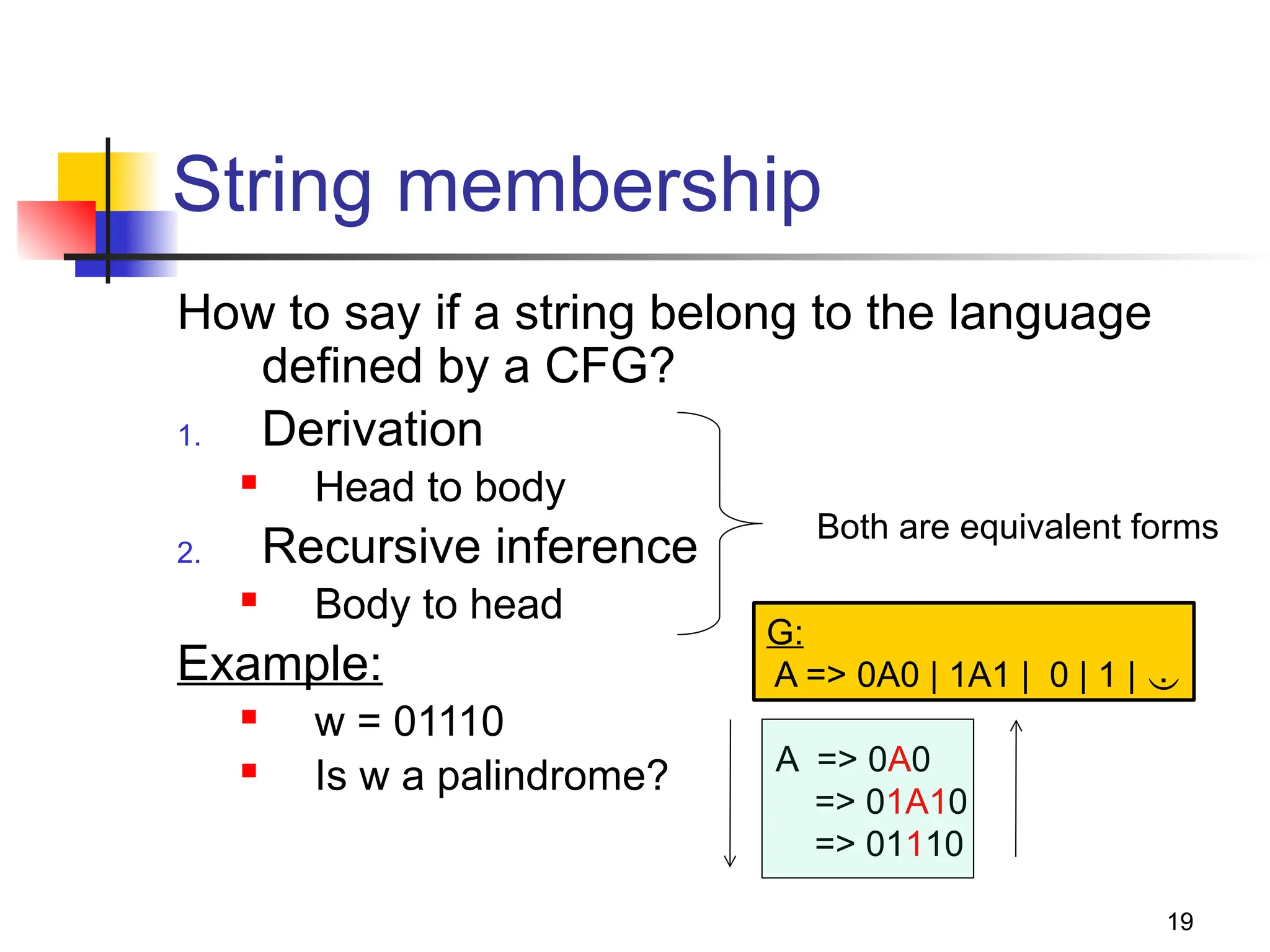
String membership
How to say if a string belong to the language
defined by a CFG?
1. Derivation
 Head to body
2. Recursive inference
 Body to head
Example:
 w = 01110
 Is w a palindrome?
Both are equivalent forms
G:
A => 0A0 | 1A1 | 0 | 1 | 
A => 0A0
=> 01A10
=> 01110
20
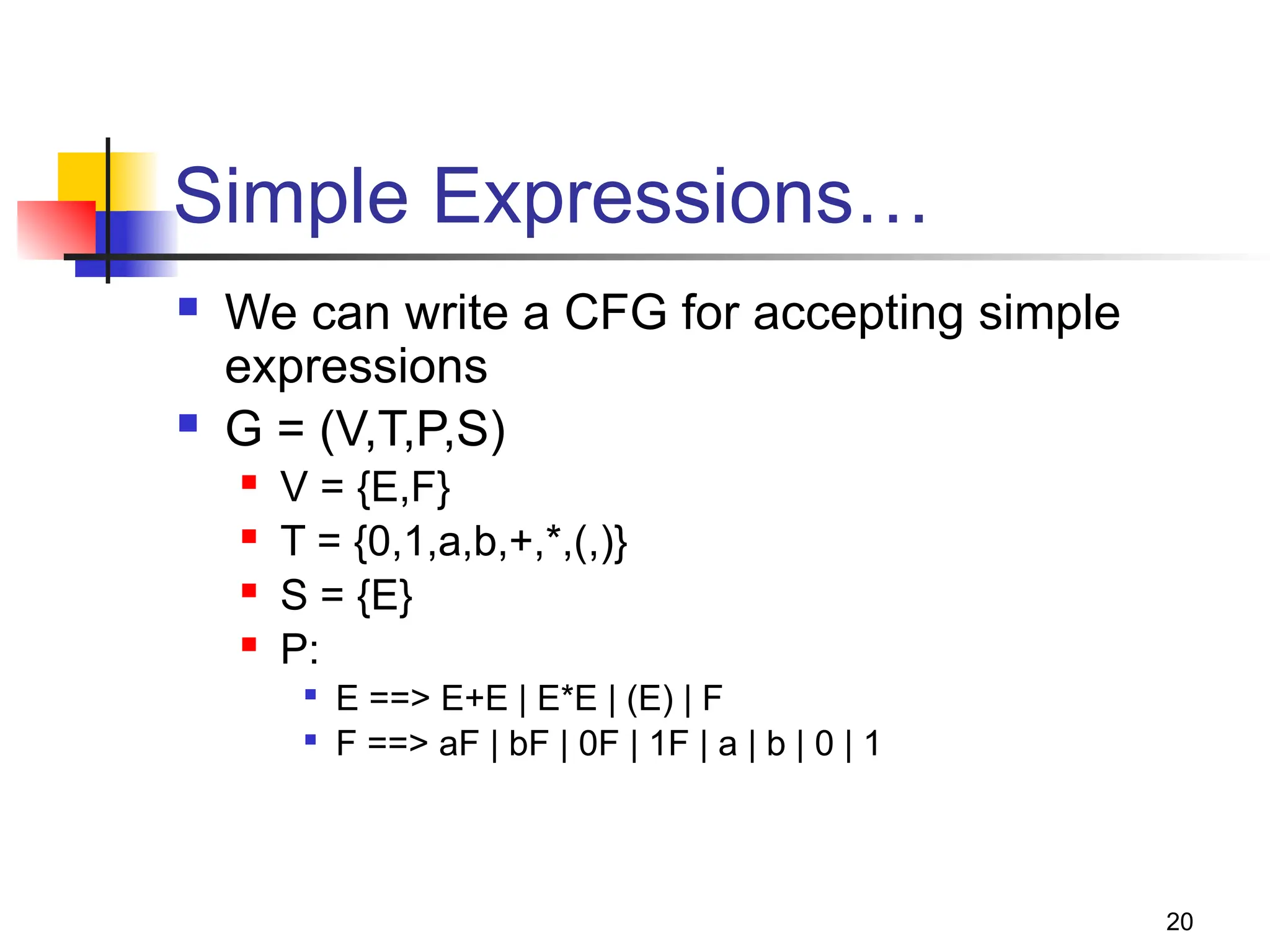
Simple Expressions…
 We can write a CFG for accepting simple
expressions
 G = (V,T,P,S)
 V = {E,F}
 T = {0,1,a,b,+,*,(,)}
 S = {E}
 P:

E ==> E+E | E*E | (E) | F

F ==> aF | bF | 0F | 1F | a | b | 0 | 1
21
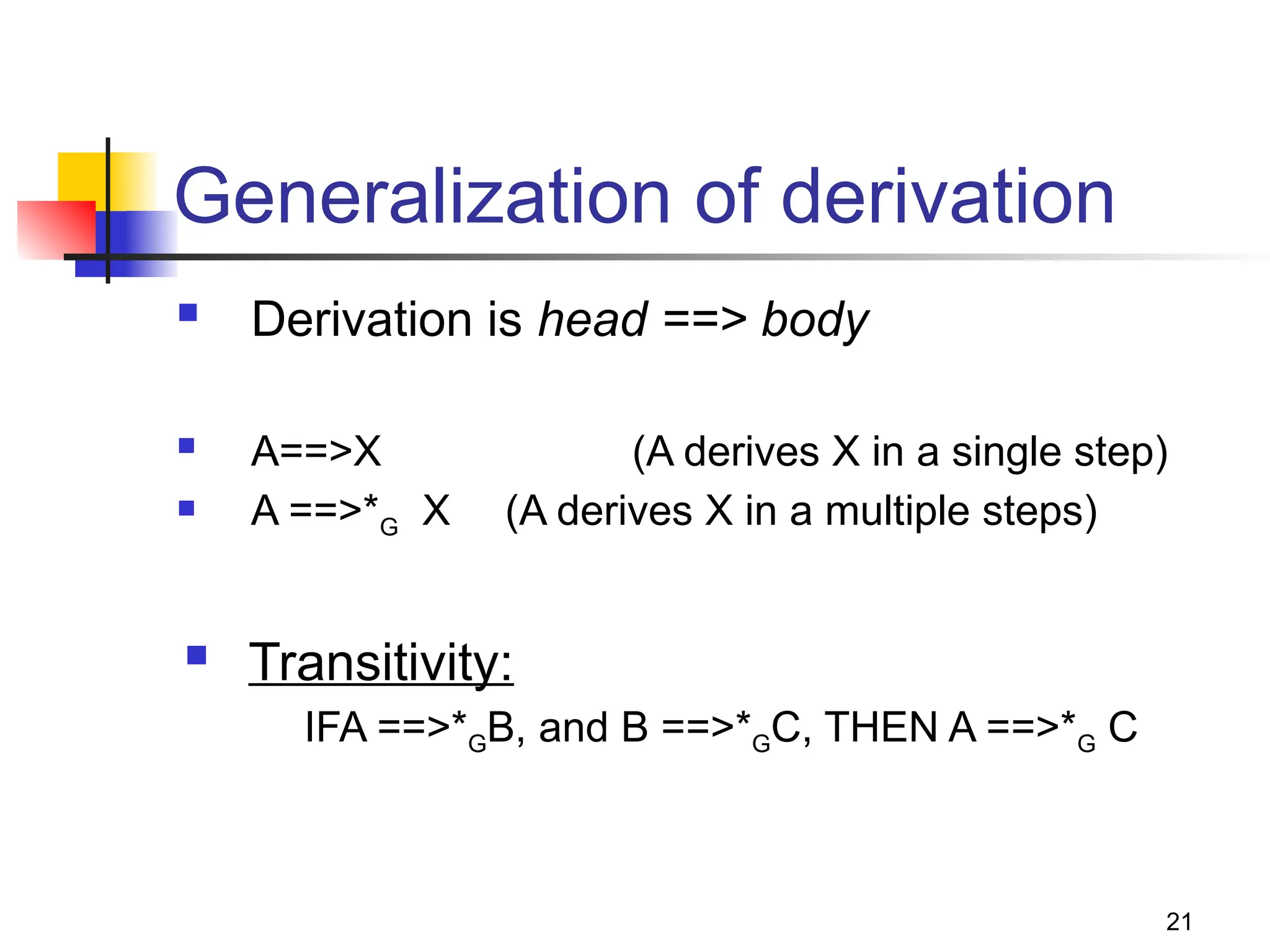
Generalization of derivation
 Derivation is head ==> body
 A==>X (A derives X in a single step)
 A ==>*G X (A derives X in a multiple steps)
 Transitivity:
IFA ==>*GB, and B ==>*GC, THEN A ==>*G C
22
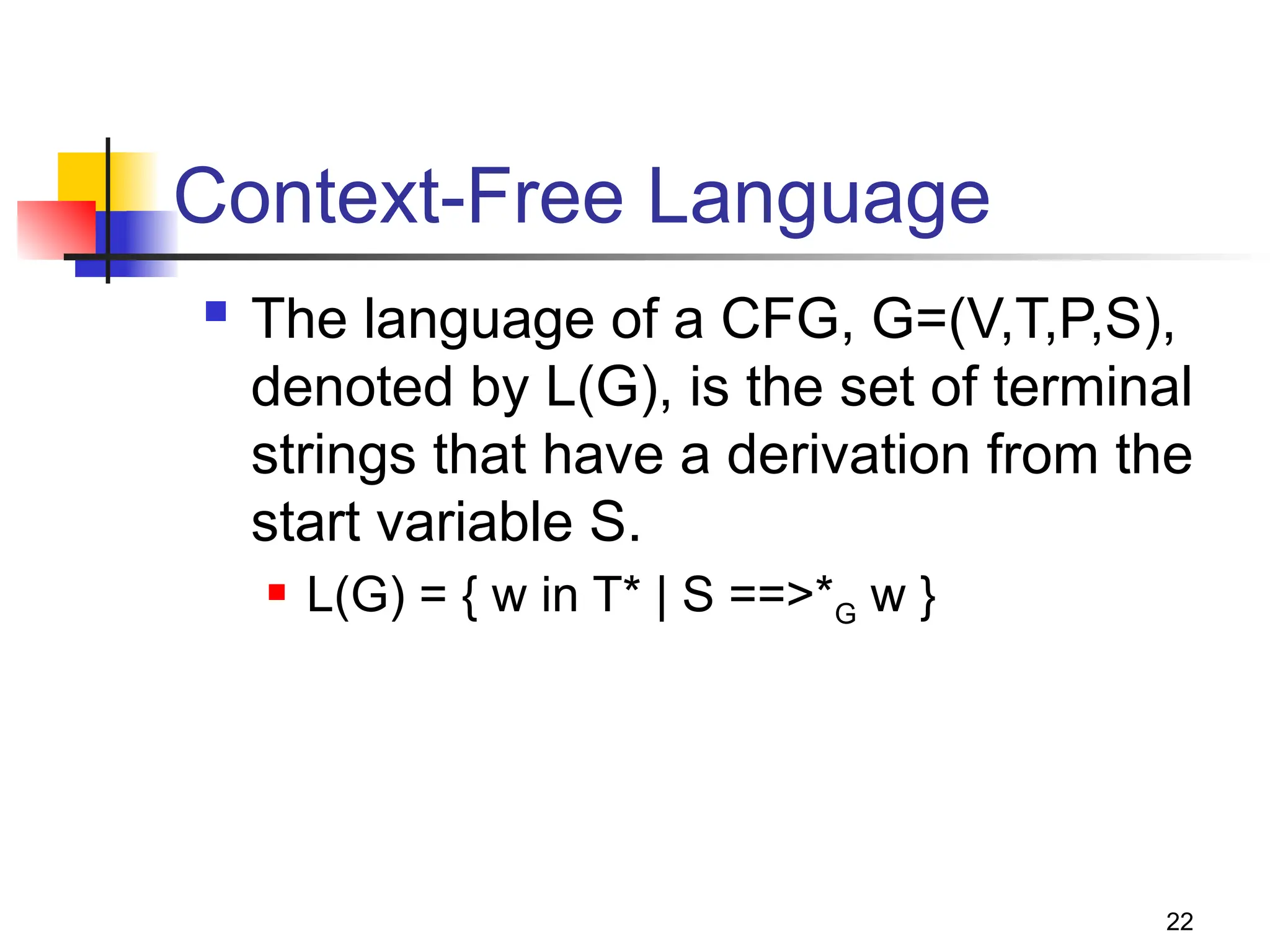
Context-Free Language
 The language of a CFG, G=(V,T,P,S),
denoted by L(G), is the set of terminal
strings that have a derivation from the
start variable S.
 L(G) = { w in T* | S ==>*G w }
23
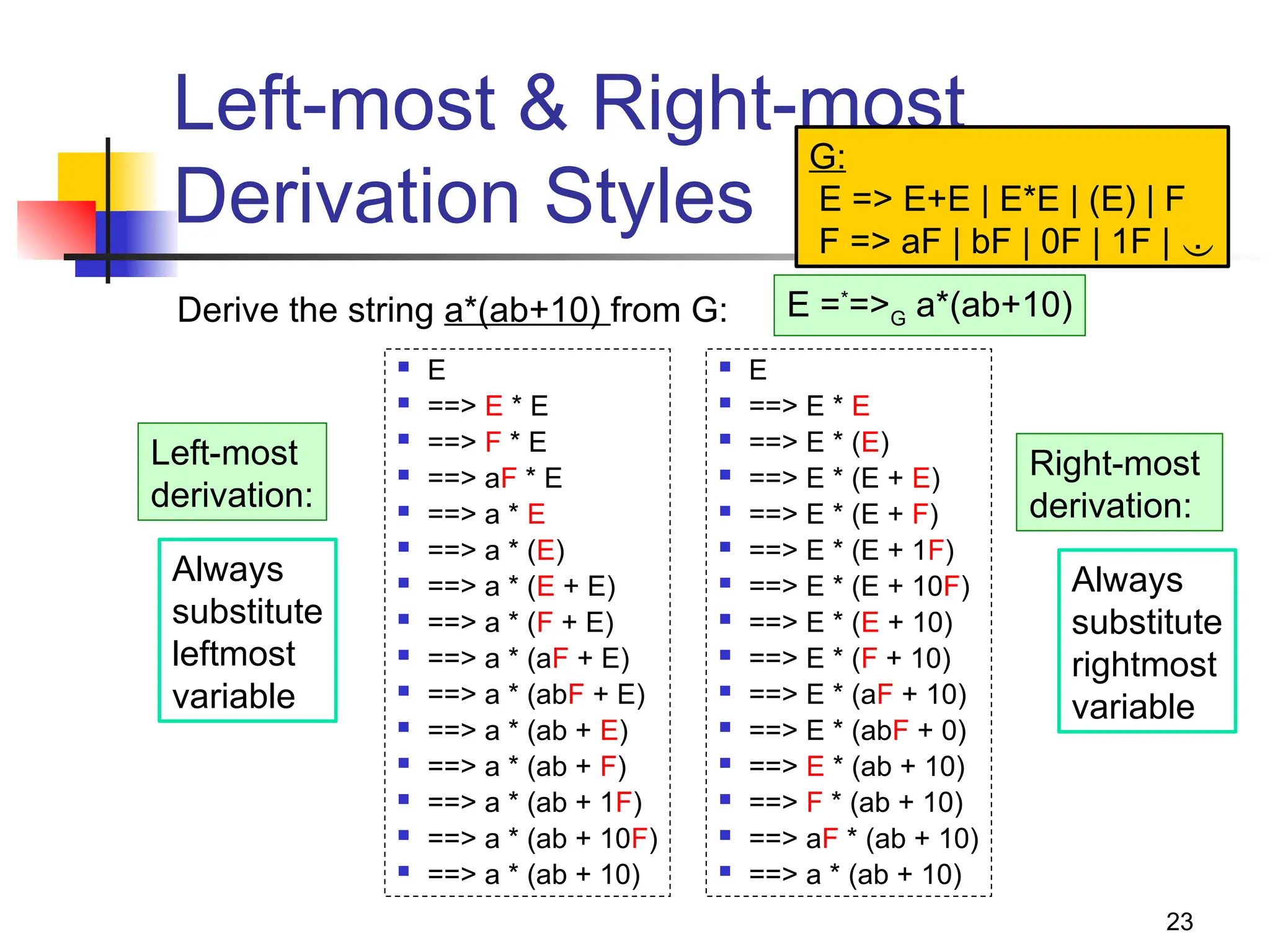
Left-most & Right-most
Derivation Styles
Derive the string a*(ab+10) from G:
 E
 ==> E * E
 ==> F * E
 ==> aF * E
 ==> a * E
 ==> a * (E)
 ==> a * (E + E)
 ==> a * (F + E)
 ==> a * (aF + E)
 ==> a * (abF + E)
 ==> a * (ab + E)
 ==> a * (ab + F)
 ==> a * (ab + 1F)
 ==> a * (ab + 10F)
 ==> a * (ab + 10)
E =*
=>G a*(ab+10)
Left-most
derivation:
 E
 ==> E * E
 ==> E * (E)
 ==> E * (E + E)
 ==> E * (E + F)
 ==> E * (E + 1F)
 ==> E * (E + 10F)
 ==> E * (E + 10)
 ==> E * (F + 10)
 ==> E * (aF + 10)
 ==> E * (abF + 0)
 ==> E * (ab + 10)
 ==> F * (ab + 10)
 ==> aF * (ab + 10)
 ==> a * (ab + 10)
Right-most
derivation:
G:
E => E+E | E*E | (E) | F
F => aF | bF | 0F | 1F | 
Always
substitute
leftmost
variable
Always
substitute
rightmost
variable
24
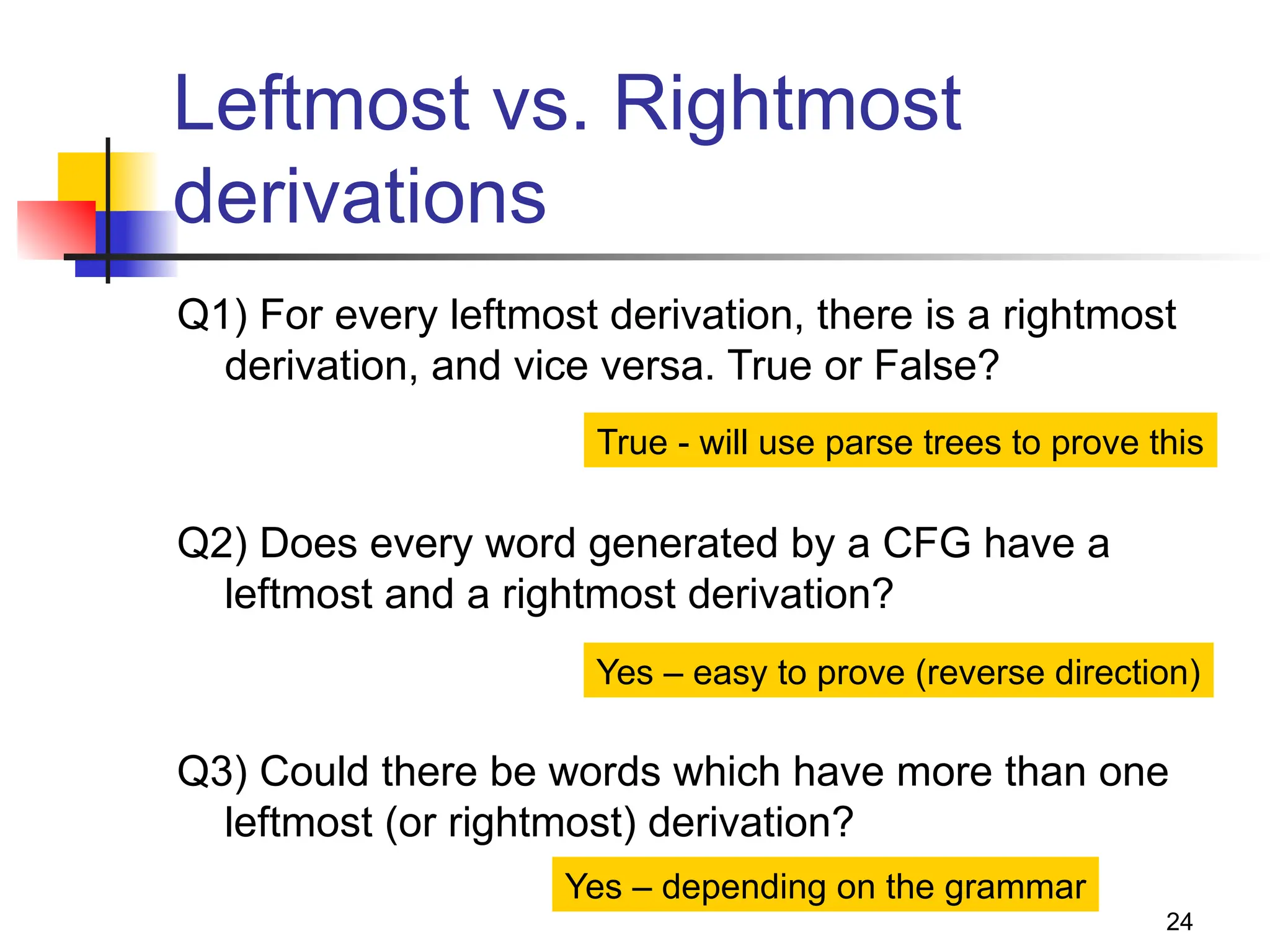
Leftmost vs. Rightmost
derivations
Q1) For every leftmost derivation, there is a rightmost
derivation, and vice versa. True or False?
Q2) Does every word generated by a CFG have a
leftmost and a rightmost derivation?
Q3) Could there be words which have more than one
leftmost (or rightmost) derivation?
True - will use parse trees to prove this
Yes – easy to prove (reverse direction)
Yes – depending on the grammar
How to prove that your CFGs
are correct?
(using induction)
25
26
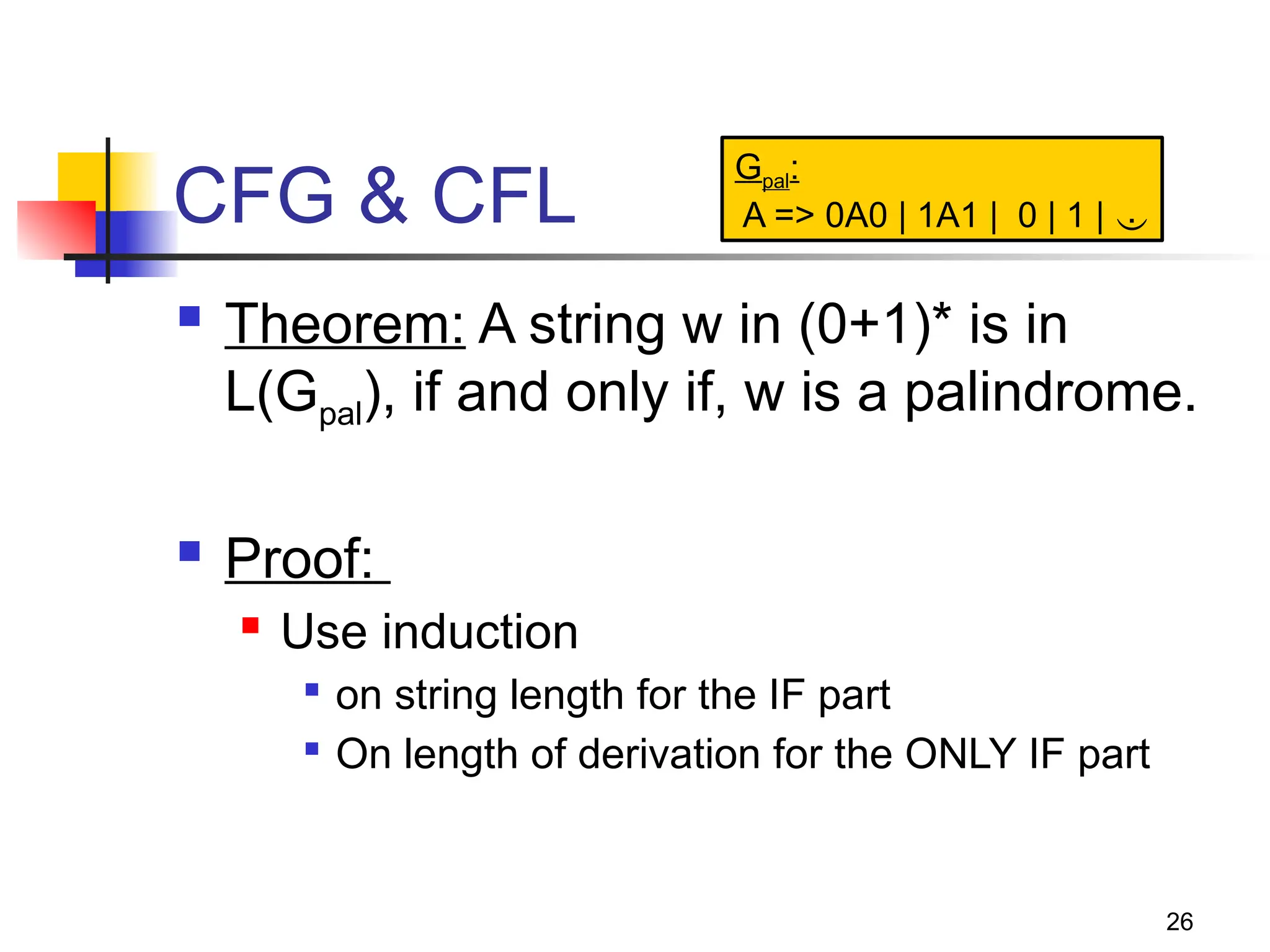
CFG & CFL
 Theorem: A string w in (0+1)* is in
L(Gpal), if and only if, w is a palindrome.
 Proof:
 Use induction

on string length for the IF part

On length of derivation for the ONLY IF part
Gpal:
A => 0A0 | 1A1 | 0 | 1 | 
Parse trees
27
28
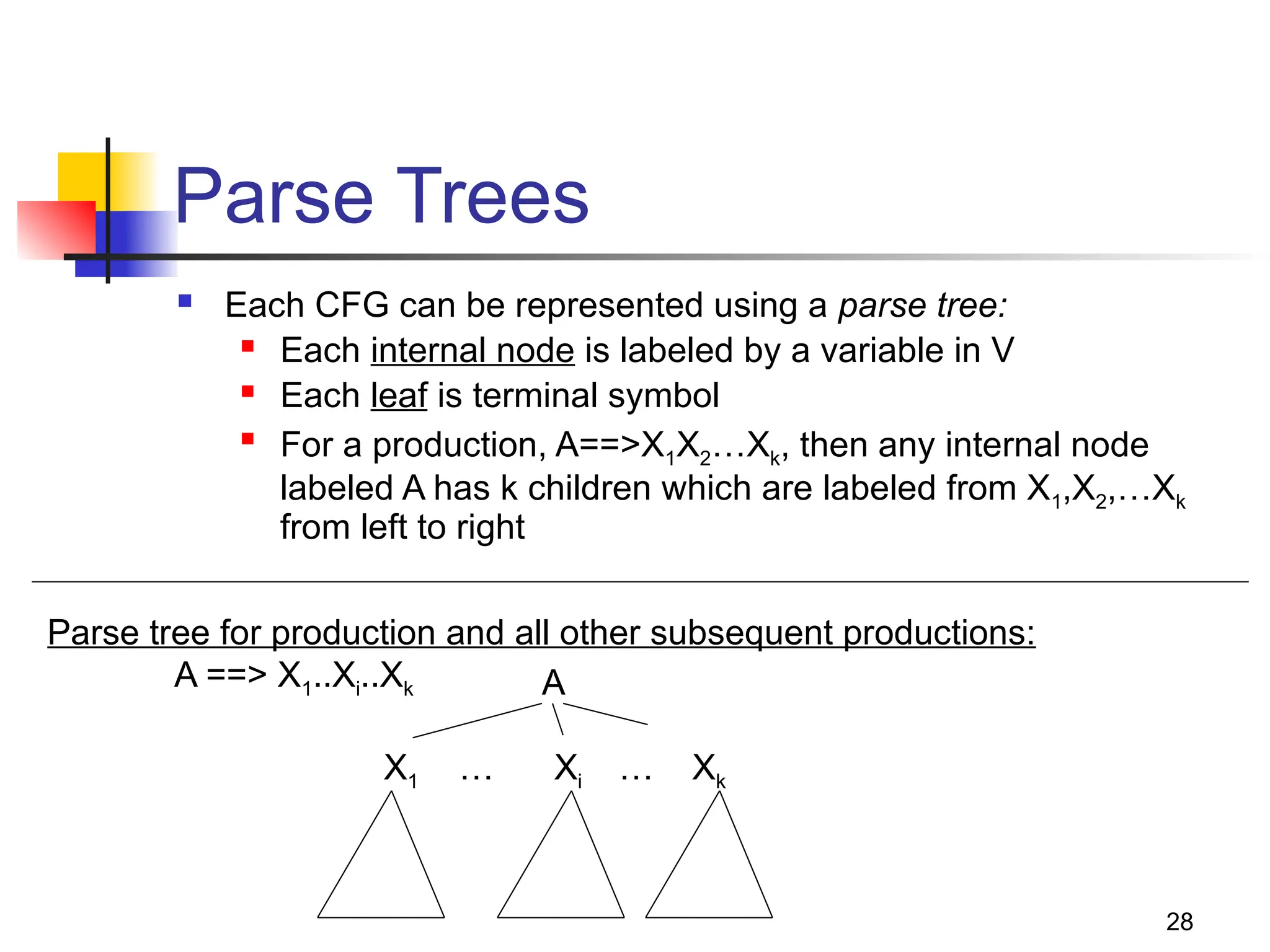
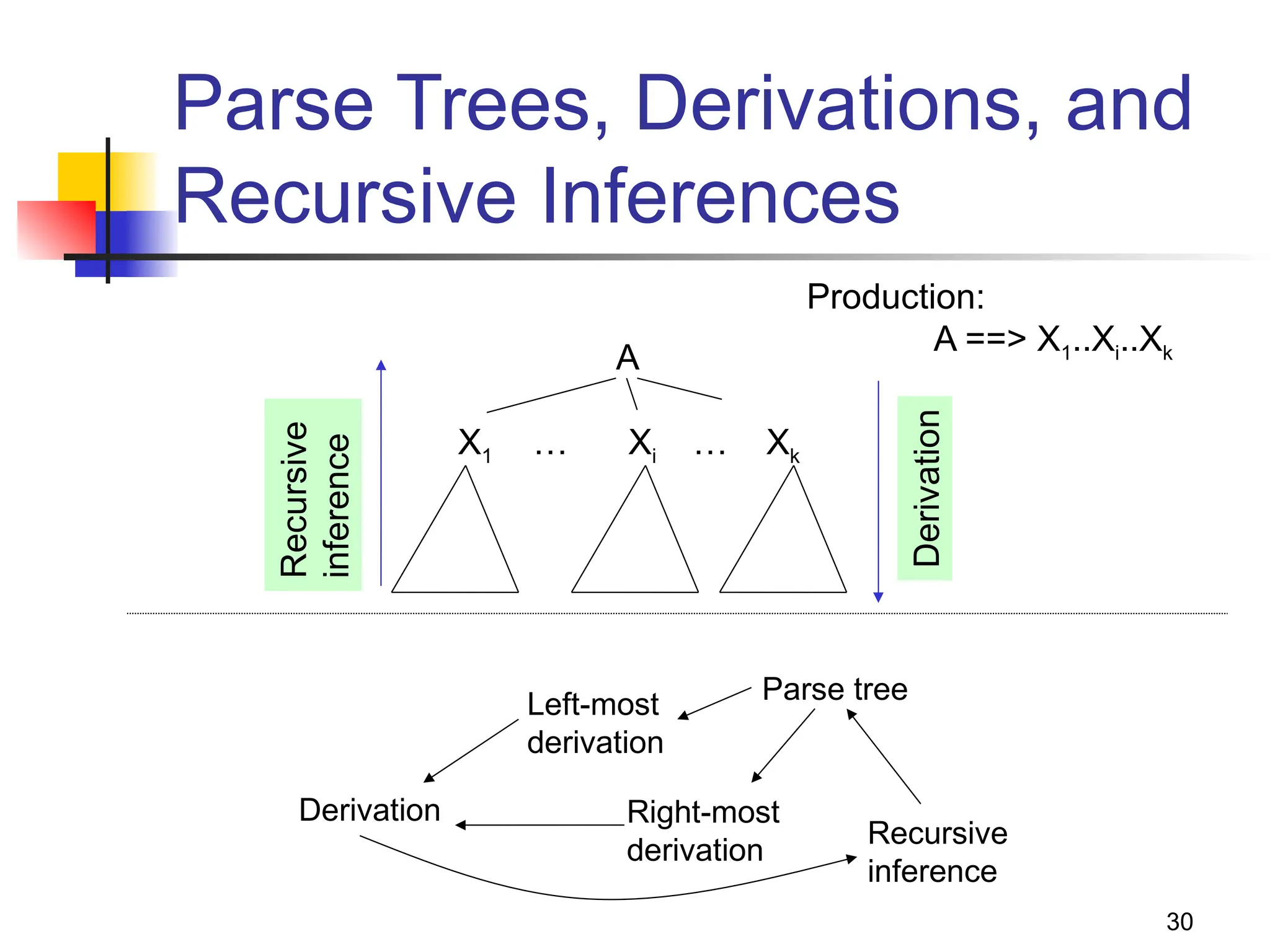
Parse Trees
 Each CFG can be represented using a parse tree:
 Each internal node is labeled by a variable in V
 Each leaf is terminal symbol

For a production, A==>X1X2…Xk, then any internal node
labeled A has k children which are labeled from X1,X2,…Xk
from left to right
A
X1 Xi Xk
… …
Parse tree for production and all other subsequent productions:
A ==> X1..Xi..Xk
29
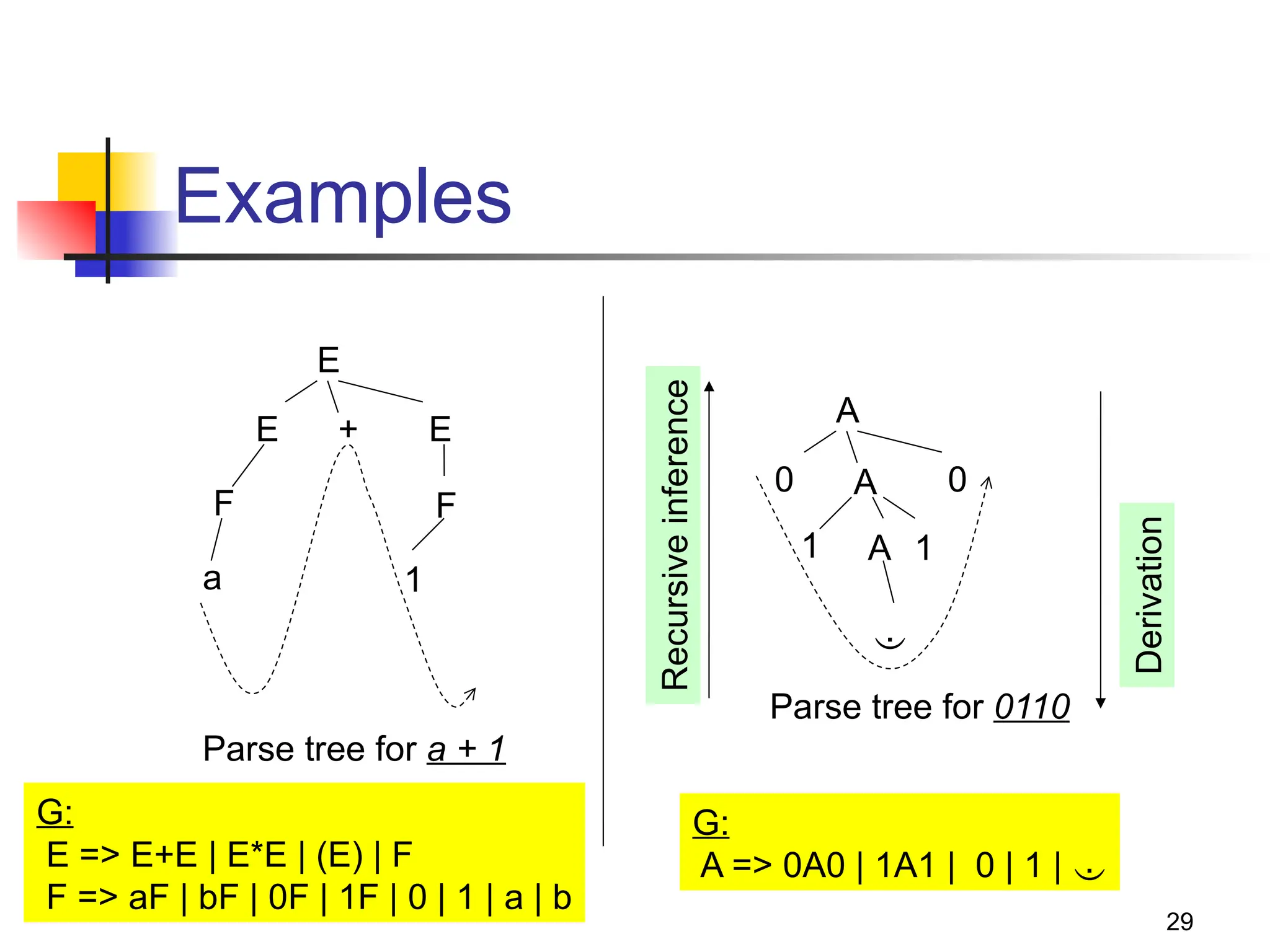
Examples
E
E + E
F F
a 1
Parse tree for a + 1
A
0 A 0
1 1
A

Parse tree for 0110
Recursive
inference
Derivation
G:
E => E+E | E*E | (E) | F
F => aF | bF | 0F | 1F | 0 | 1 | a | b
G:
A => 0A0 | 1A1 | 0 | 1 | 
30
Parse Trees, Derivations, and
Recursive Inferences
A
X1 Xi Xk
… …
Recursive
inference
Derivation
Production:
A ==> X1..Xi..Xk
Parse tree
Left-most
derivation
Right-most
derivation
Derivation
Recursive
inference
31
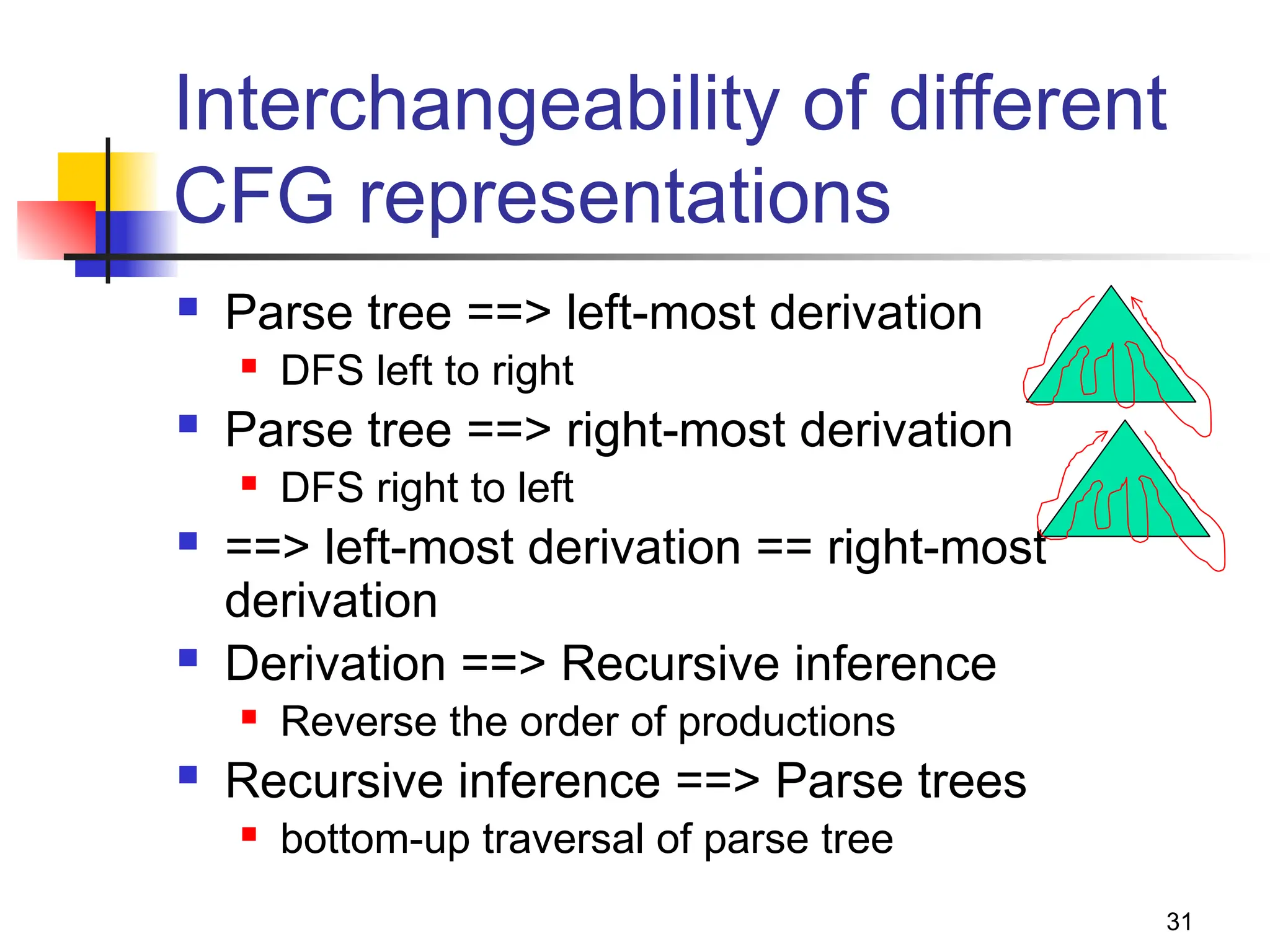
Interchangeability of different
CFG representations
 Parse tree ==> left-most derivation
 DFS left to right
 Parse tree ==> right-most derivation
 DFS right to left
 ==> left-most derivation == right-most
derivation
 Derivation ==> Recursive inference
 Reverse the order of productions
 Recursive inference ==> Parse trees
 bottom-up traversal of parse tree
Connection between CFLs
and RLs
32
33
CFLs & Regular Languages
 A CFG is said to be right-linear if all the
productions are one of the following two
forms: A ==> wB (or) A ==> w
 Theorem 1: Every right-linear CFG generates
a regular language
 Theorem 2: Every regular language has a
right-linear grammar
 Theorem 3: Left-linear CFGs also represent
RLs
Where:
• A & B are variables,
• w is a string of terminals
What kind of grammars result for regular languages?
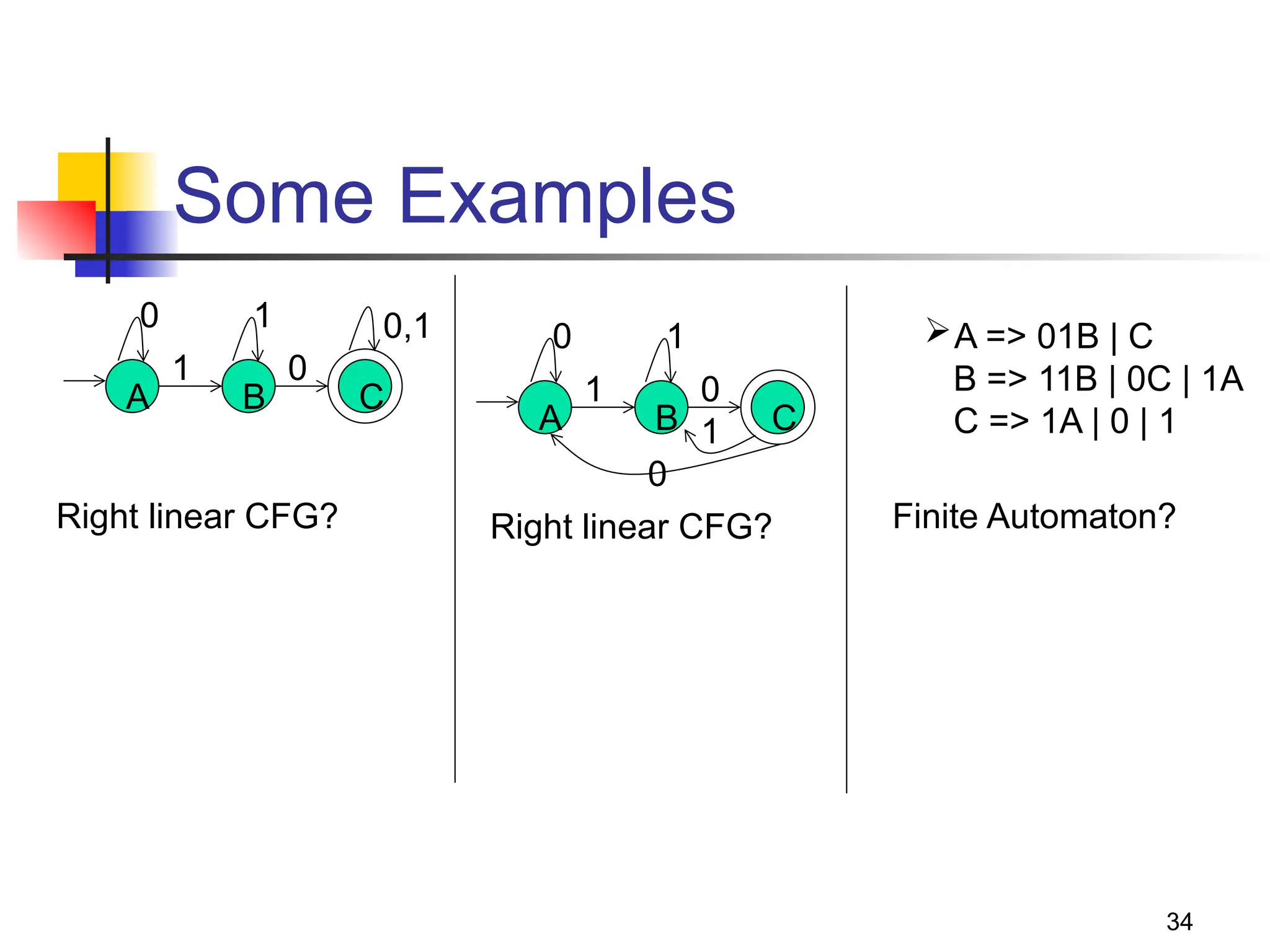
Some Examples
34
A B C
0
1 0
1 0,1
A B C
0
1 0
1
1
0
A => 01B | C
B => 11B | 0C | 1A
C => 1A | 0 | 1
Right linear CFG? Right linear CFG? Finite Automaton?
Ambiguity in CFGs and CFLs
35
36
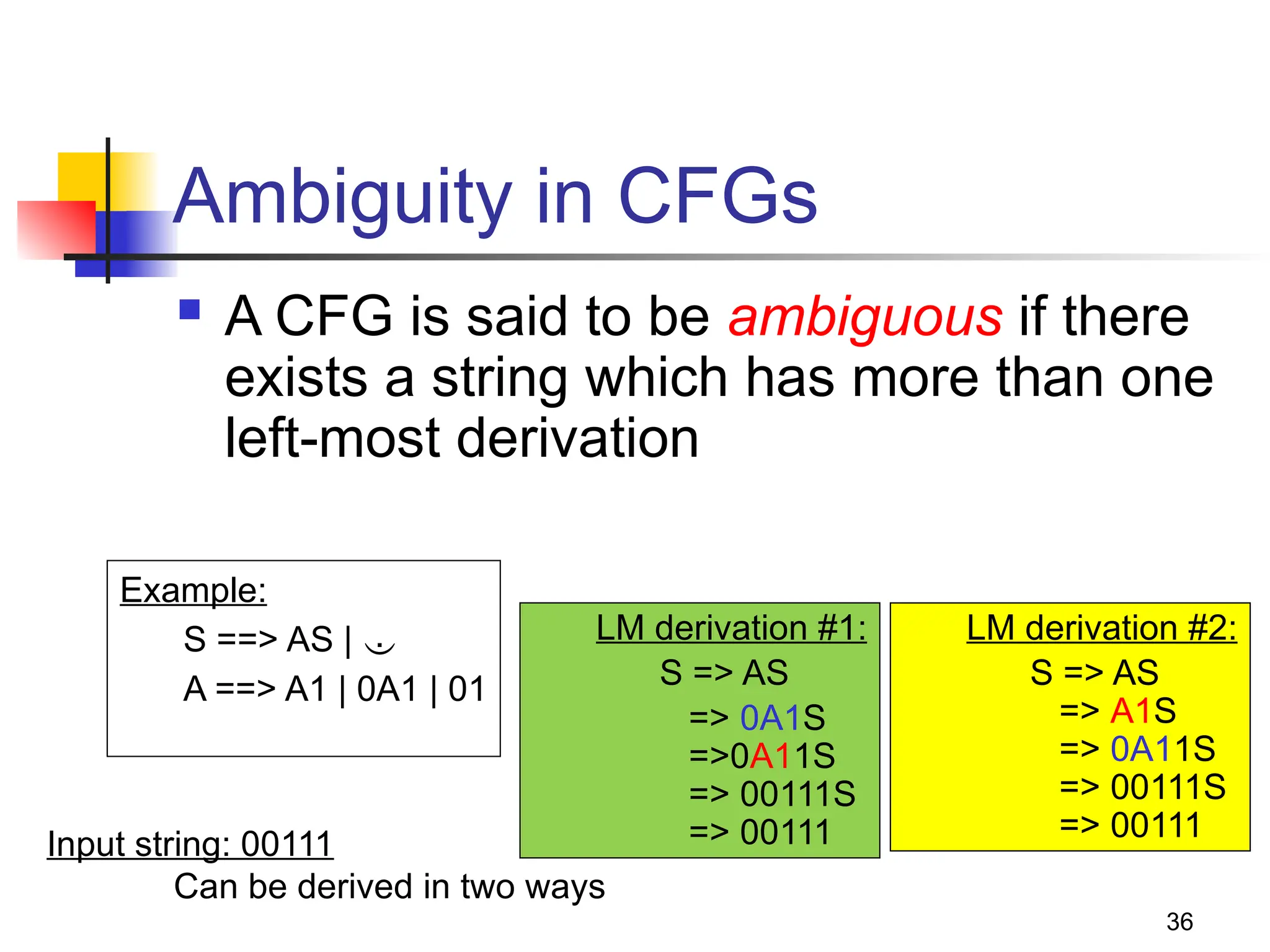
Ambiguity in CFGs
 A CFG is said to be ambiguous if there
exists a string which has more than one
left-most derivation
LM derivation #1:
S => AS
=> 0A1S
=>0A11S
=> 00111S
=> 00111
Example:
S ==> AS | 
A ==> A1 | 0A1 | 01
Input string: 00111
Can be derived in two ways
LM derivation #2:
S => AS
=> A1S
=> 0A11S
=> 00111S
=> 00111
37
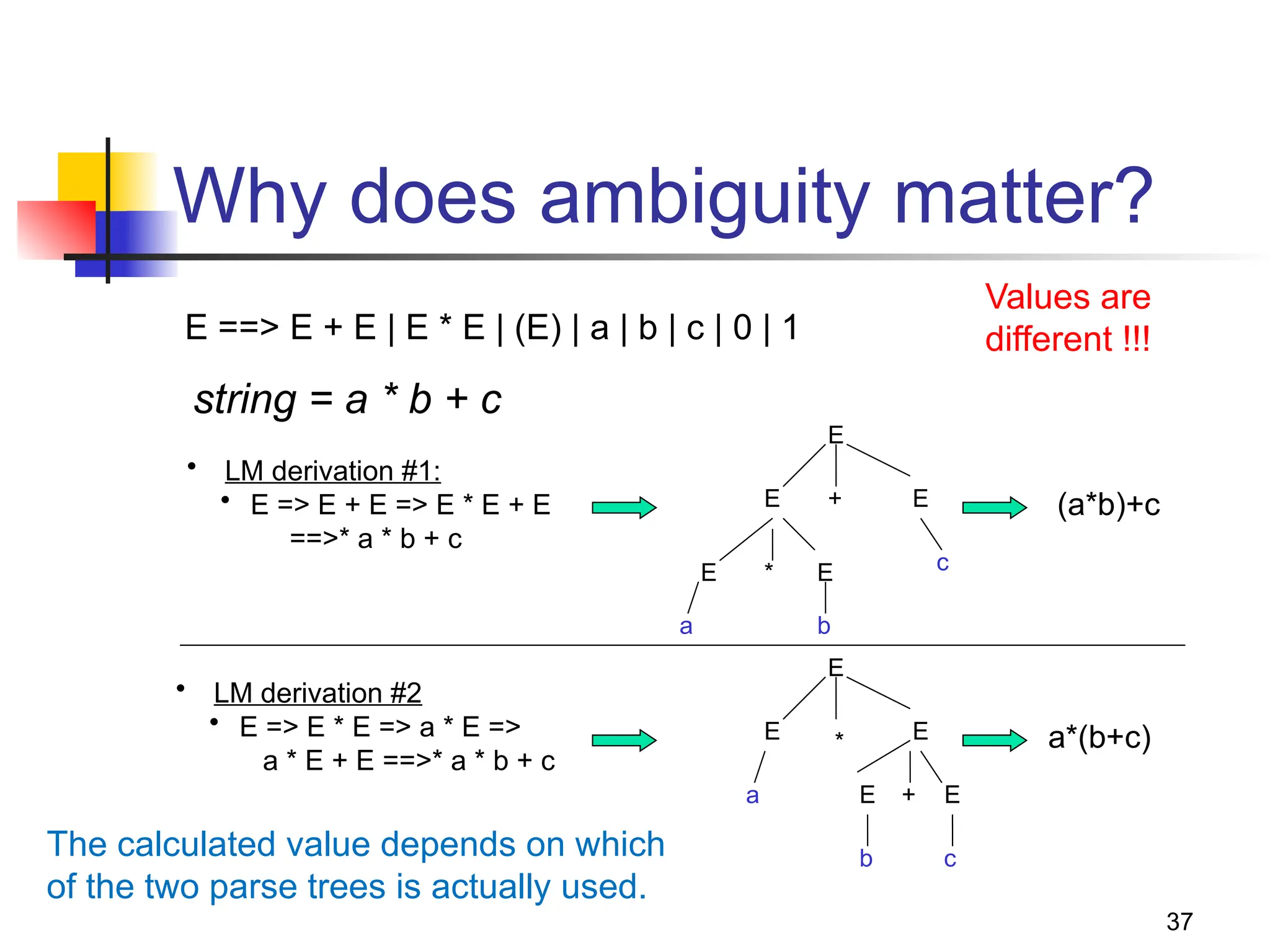
Why does ambiguity matter?
string = a * b + c
E ==> E + E | E * E | (E) | a | b | c | 0 | 1
• LM derivation #1:
• E => E + E => E * E + E
==>* a * b + c
• LM derivation #2
• E => E * E => a * E =>
a * E + E ==>* a * b + c
E
E + E
E * E
a b
c
(a*b)+c
E
E * E
E
+
E
a
b c
a*(b+c)
Values are
different !!!
The calculated value depends on which
of the two parse trees is actually used.
38
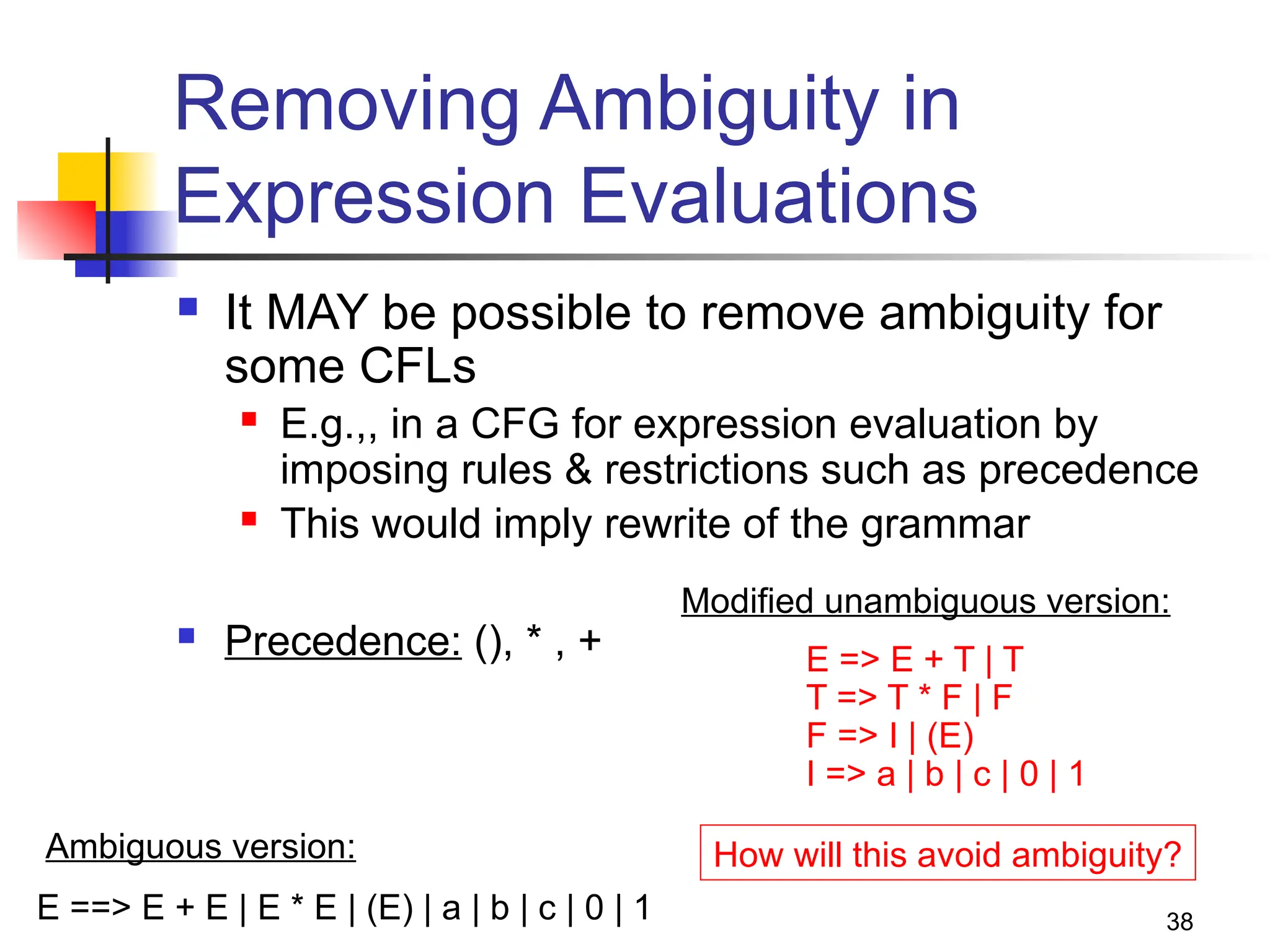
Removing Ambiguity in
Expression Evaluations
 It MAY be possible to remove ambiguity for
some CFLs
 E.g.,, in a CFG for expression evaluation by
imposing rules & restrictions such as precedence
 This would imply rewrite of the grammar
 Precedence: (), * , +
How will this avoid ambiguity?
E => E + T | T
T => T * F | F
F => I | (E)
I => a | b | c | 0 | 1
Modified unambiguous version:
Ambiguous version:
E ==> E + E | E * E | (E) | a | b | c | 0 | 1
39
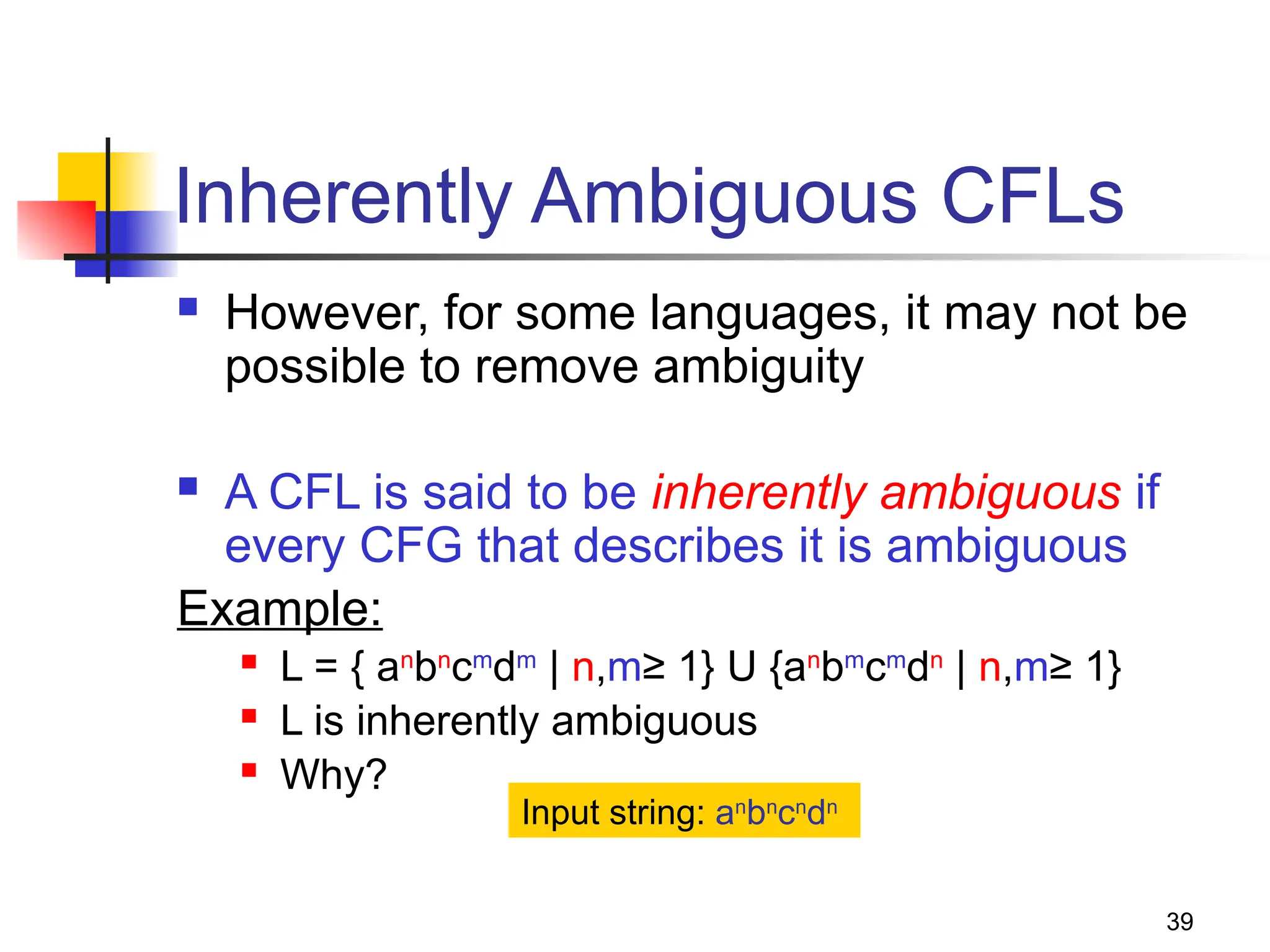
Inherently Ambiguous CFLs
 However, for some languages, it may not be
possible to remove ambiguity
 A CFL is said to be inherently ambiguous if
every CFG that describes it is ambiguous
Example:
 L = { an
bn
cm
dm
| n,m≥ 1} U {an
bm
cm
dn
| n,m≥ 1}
 L is inherently ambiguous
 Why?
Input string: an
bn
cn
dn
40
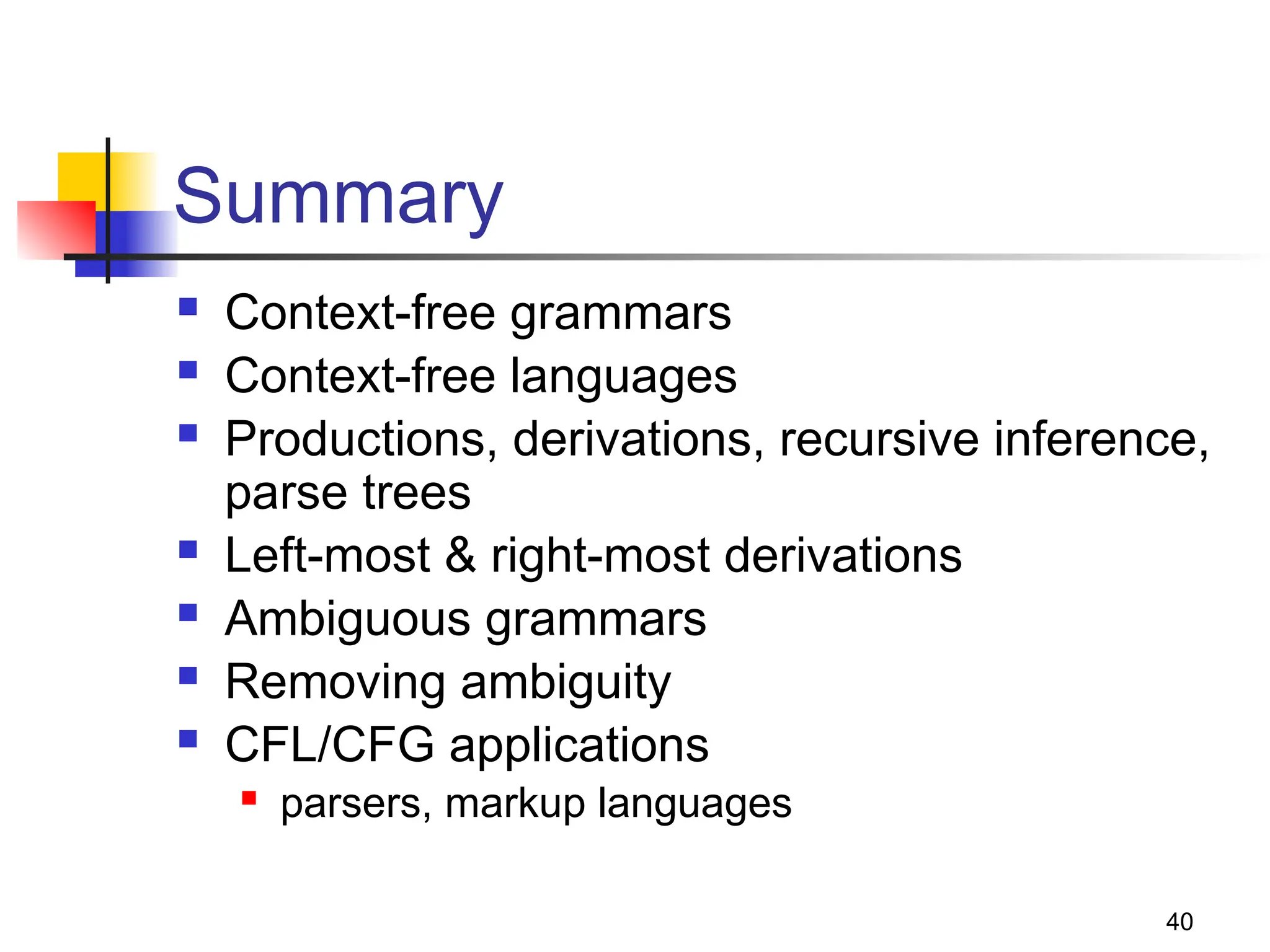
Summary
 Context-free grammars
 Context-free languages
 Productions, derivations, recursive inference,
parse trees
 Left-most & right-most derivations
 Ambiguous grammars
 Removing ambiguity
 CFL/CFG applications
 parsers, markup languages

AUTOMATA AUTOMATA AUTOMATA Automata6Chapter5.pptx

  • 1.
  • 2.
    Not all languagesare regular  So what happens to the languages which are not regular?  Can we still come up with a language recognizer?  i.e., something that will accept (or reject) strings that belong (or do not belong) to the language? 2
  • 3.
    3 Context-Free Languages  Alanguage class larger than the class of regular languages  Supports natural, recursive notation called “context- free grammar”  Applications:  Parse trees, compilers  XML Regular (FA/RE) Context- free (PDA/CFG)
  • 4.
    4 An Example  Apalindrome is a word that reads identical from both ends  E.g., madam, redivider, malayalam, 010010010  Let L = { w | w is a binary palindrome}  Is L regular?  No.  Proof:  Let w=0N 10N (assuming N to be the p/l constant)  By Pumping lemma, w can be rewritten as xyz, such that xyk z is also L (for any k≥0)  But |xy|≤N and y≠  ==> y=0+  ==> xyk z will NOT be in L for k=0  ==> Contradiction
  • 5.
    5 But the languageof palindromes… is a CFL, because it supports recursive substitution (in the form of a CFG)  This is because we can construct a “grammar” like this: 1. A ==>  2. A ==> 0 3. A ==> 1 4. A ==> 0A0 5. A ==> 1A1 Terminal Productions Variable or non-terminal How does this grammar work? Same as: A => 0A0 | 1A1 | 0 | 1 | 
  • 6.
    How does theCFG for palindromes work? An input string belongs to the language (i.e., accepted) iff it can be generated by the CFG  Example: w=01110  G can generate w as follows: 1. A => 0A0 2. => 01A10 3. => 01110 6 G: A => 0A0 | 1A1 | 0 | 1 |  Generating a string from a grammar: 1. Pick and choose a sequence of productions that would allow us to generate the string. 2. At every step, substitute one variable with one of its productions.
  • 7.
    7 Context-Free Grammar: Definition  Acontext-free grammar G=(V,T,P,S), where:  V: set of variables or non-terminals  T: set of terminals (= alphabet U {})  P: set of productions, each of which is of the form V ==> 1 | 2 | …  Where each i is an arbitrary string of variables and terminals  S ==> start variable CFG for the language of binary palindromes: G=({A},{0,1},P,A) P: A ==> 0 A 0 | 1 A 1 | 0 | 1 | 
  • 8.
    8 More examples  Parenthesismatching in code  Syntax checking  In scenarios where there is a general need for:  Matching a symbol with another symbol, or  Matching a count of one symbol with that of another symbol, or  Recursively substituting one symbol with a string of other symbols
  • 9.
    9 Example #2  Languageof balanced paranthesis e.g., ()(((())))((()))….  CFG? G: S => (S) | SS |  How would you “interpret” the string “(((()))()())” using this grammar?
  • 10.
    10 Example #3  Agrammar for L = {0m 1n | m≥n}  CFG? G: S => 0S1 | A A => 0A |  How would you interpret the string “00000111” using this grammar?
  • 11.
    11 Example #4 A programcontaining if-then(-else) statements if Condition then Statement else Statement (Or) if Condition then Statement CFG?
  • 12.
    More examples  L1= {0n | n≥0 }  L2 = {0n | n≥1 }  L3={0i 1j 2k | i=j or j=k, where i,j,k≥0}  L4={0i 1j 2k | i=j or i=k, where i,j,k≥1} 12
  • 13.
    13 Applications of CFLs& CFGs  Compilers use parsers for syntactic checking  Parsers can be expressed as CFGs 1. Balancing paranthesis:  B ==> BB | (B) | Statement  Statement ==> … 2. If-then-else:  S ==> SS | if Condition then Statement else Statement | if Condition then Statement | Statement  Condition ==> …  Statement ==> … 3. C paranthesis matching { … } 4. Pascal begin-end matching 5. YACC (Yet Another Compiler-Compiler)
  • 14.
    14 More applications  Markuplanguages  Nested Tag Matching  HTML  <html> …<p> … <a href=…> … </a> </p> … </html>  XML  <PC> … <MODEL> … </MODEL> .. <RAM> … </RAM> … </PC>
  • 15.
    15 Tag-Markup Languages Roll ==><ROLL> Class Students </ROLL> Class ==> <CLASS> Text </CLASS> Text ==> Char Text | Char Char ==> a | b | … | z | A | B | .. | Z Students ==> Student Students |  Student ==> <STUD> Text </STUD> Here, the left hand side of each production denotes one non-terminals (e.g., “Roll”, “Class”, etc.) Those symbols on the right hand side for which no productions (i.e., substitutions) are defined are terminals (e.g., ‘a’, ‘b’, ‘|’, ‘<‘, ‘>’, “ROLL”, etc.)
  • 16.
    16 Structure of aproduction A =======> 1 | 2 | … | k head body derivation 1. A ==> 1 2. A ==> 2 3. A ==> 3 … K. A ==> k The above is same as:
  • 17.
    17 CFG conventions  Terminalsymbols <== a, b, c…  Non-terminal symbols <== A,B,C, …  Terminal or non-terminal symbols <== X,Y,Z  Terminal strings <== w, x, y, z  Arbitrary strings of terminals and non- terminals <== , , , ..
  • 18.
    18 Syntactic Expressions in ProgrammingLanguages result = a*b + score + 10 * distance + c Regular languages have only terminals  Reg expression = [a-z][a-z0-1]*  If we allow only letters a & b, and 0 & 1 for constants (for simplification)  Regular expression = (a+b)(a+b+0+1)* terminals variables Operators are also terminals
  • 19.
    19 String membership How tosay if a string belong to the language defined by a CFG? 1. Derivation  Head to body 2. Recursive inference  Body to head Example:  w = 01110  Is w a palindrome? Both are equivalent forms G: A => 0A0 | 1A1 | 0 | 1 |  A => 0A0 => 01A10 => 01110
  • 20.
    20 Simple Expressions…  Wecan write a CFG for accepting simple expressions  G = (V,T,P,S)  V = {E,F}  T = {0,1,a,b,+,*,(,)}  S = {E}  P:  E ==> E+E | E*E | (E) | F  F ==> aF | bF | 0F | 1F | a | b | 0 | 1
  • 21.
    21 Generalization of derivation Derivation is head ==> body  A==>X (A derives X in a single step)  A ==>*G X (A derives X in a multiple steps)  Transitivity: IFA ==>*GB, and B ==>*GC, THEN A ==>*G C
  • 22.
    22 Context-Free Language  Thelanguage of a CFG, G=(V,T,P,S), denoted by L(G), is the set of terminal strings that have a derivation from the start variable S.  L(G) = { w in T* | S ==>*G w }
  • 23.
    23 Left-most & Right-most DerivationStyles Derive the string a*(ab+10) from G:  E  ==> E * E  ==> F * E  ==> aF * E  ==> a * E  ==> a * (E)  ==> a * (E + E)  ==> a * (F + E)  ==> a * (aF + E)  ==> a * (abF + E)  ==> a * (ab + E)  ==> a * (ab + F)  ==> a * (ab + 1F)  ==> a * (ab + 10F)  ==> a * (ab + 10) E =* =>G a*(ab+10) Left-most derivation:  E  ==> E * E  ==> E * (E)  ==> E * (E + E)  ==> E * (E + F)  ==> E * (E + 1F)  ==> E * (E + 10F)  ==> E * (E + 10)  ==> E * (F + 10)  ==> E * (aF + 10)  ==> E * (abF + 0)  ==> E * (ab + 10)  ==> F * (ab + 10)  ==> aF * (ab + 10)  ==> a * (ab + 10) Right-most derivation: G: E => E+E | E*E | (E) | F F => aF | bF | 0F | 1F |  Always substitute leftmost variable Always substitute rightmost variable
  • 24.
    24 Leftmost vs. Rightmost derivations Q1)For every leftmost derivation, there is a rightmost derivation, and vice versa. True or False? Q2) Does every word generated by a CFG have a leftmost and a rightmost derivation? Q3) Could there be words which have more than one leftmost (or rightmost) derivation? True - will use parse trees to prove this Yes – easy to prove (reverse direction) Yes – depending on the grammar
  • 25.
    How to provethat your CFGs are correct? (using induction) 25
  • 26.
    26 CFG & CFL Theorem: A string w in (0+1)* is in L(Gpal), if and only if, w is a palindrome.  Proof:  Use induction  on string length for the IF part  On length of derivation for the ONLY IF part Gpal: A => 0A0 | 1A1 | 0 | 1 | 
  • 27.
  • 28.
    28 Parse Trees  EachCFG can be represented using a parse tree:  Each internal node is labeled by a variable in V  Each leaf is terminal symbol  For a production, A==>X1X2…Xk, then any internal node labeled A has k children which are labeled from X1,X2,…Xk from left to right A X1 Xi Xk … … Parse tree for production and all other subsequent productions: A ==> X1..Xi..Xk
  • 29.
    29 Examples E E + E FF a 1 Parse tree for a + 1 A 0 A 0 1 1 A  Parse tree for 0110 Recursive inference Derivation G: E => E+E | E*E | (E) | F F => aF | bF | 0F | 1F | 0 | 1 | a | b G: A => 0A0 | 1A1 | 0 | 1 | 
  • 30.
    30 Parse Trees, Derivations,and Recursive Inferences A X1 Xi Xk … … Recursive inference Derivation Production: A ==> X1..Xi..Xk Parse tree Left-most derivation Right-most derivation Derivation Recursive inference
  • 31.
    31 Interchangeability of different CFGrepresentations  Parse tree ==> left-most derivation  DFS left to right  Parse tree ==> right-most derivation  DFS right to left  ==> left-most derivation == right-most derivation  Derivation ==> Recursive inference  Reverse the order of productions  Recursive inference ==> Parse trees  bottom-up traversal of parse tree
  • 32.
  • 33.
    33 CFLs & RegularLanguages  A CFG is said to be right-linear if all the productions are one of the following two forms: A ==> wB (or) A ==> w  Theorem 1: Every right-linear CFG generates a regular language  Theorem 2: Every regular language has a right-linear grammar  Theorem 3: Left-linear CFGs also represent RLs Where: • A & B are variables, • w is a string of terminals What kind of grammars result for regular languages?
  • 34.
    Some Examples 34 A BC 0 1 0 1 0,1 A B C 0 1 0 1 1 0 A => 01B | C B => 11B | 0C | 1A C => 1A | 0 | 1 Right linear CFG? Right linear CFG? Finite Automaton?
  • 35.
    Ambiguity in CFGsand CFLs 35
  • 36.
    36 Ambiguity in CFGs A CFG is said to be ambiguous if there exists a string which has more than one left-most derivation LM derivation #1: S => AS => 0A1S =>0A11S => 00111S => 00111 Example: S ==> AS |  A ==> A1 | 0A1 | 01 Input string: 00111 Can be derived in two ways LM derivation #2: S => AS => A1S => 0A11S => 00111S => 00111
  • 37.
    37 Why does ambiguitymatter? string = a * b + c E ==> E + E | E * E | (E) | a | b | c | 0 | 1 • LM derivation #1: • E => E + E => E * E + E ==>* a * b + c • LM derivation #2 • E => E * E => a * E => a * E + E ==>* a * b + c E E + E E * E a b c (a*b)+c E E * E E + E a b c a*(b+c) Values are different !!! The calculated value depends on which of the two parse trees is actually used.
  • 38.
    38 Removing Ambiguity in ExpressionEvaluations  It MAY be possible to remove ambiguity for some CFLs  E.g.,, in a CFG for expression evaluation by imposing rules & restrictions such as precedence  This would imply rewrite of the grammar  Precedence: (), * , + How will this avoid ambiguity? E => E + T | T T => T * F | F F => I | (E) I => a | b | c | 0 | 1 Modified unambiguous version: Ambiguous version: E ==> E + E | E * E | (E) | a | b | c | 0 | 1
  • 39.
    39 Inherently Ambiguous CFLs However, for some languages, it may not be possible to remove ambiguity  A CFL is said to be inherently ambiguous if every CFG that describes it is ambiguous Example:  L = { an bn cm dm | n,m≥ 1} U {an bm cm dn | n,m≥ 1}  L is inherently ambiguous  Why? Input string: an bn cn dn
  • 40.
    40 Summary  Context-free grammars Context-free languages  Productions, derivations, recursive inference, parse trees  Left-most & right-most derivations  Ambiguous grammars  Removing ambiguity  CFL/CFG applications  parsers, markup languages