Parsing : Part-I
Parsing
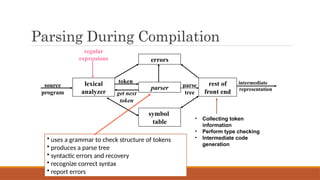
Parsing During Compilation
intermediate
representation
errors
lexical
analyzer
parser
rest of
front end
symbol
table
source
program
parse
tree
get next
token
token
regular
expressions
• Collecting token
information
• Perform type checking
• Intermediate code
generation
• uses a grammar to check structure of tokens
• produces a parse tree
• syntactic errors and recovery
• recognize correct syntax
• report errors
Parsers
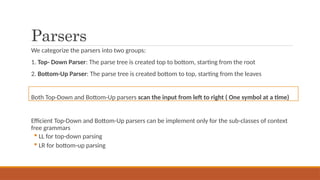
We categorize the parsers into two groups:
1. Top- Down Parser: The parse tree is created top to bottom, starting from the root
2. Bottom-Up Parser: The parse tree is created bottom to top, starting from the leaves
Both Top-Down and Bottom-Up parsers scan the input from left to right ( One symbol at a time)
Efficient Top-Down and Bottom-Up parsers can be implement only for the sub-classes of context
free grammars
 LL for top-down parsing
 LR for bottom-up parsing
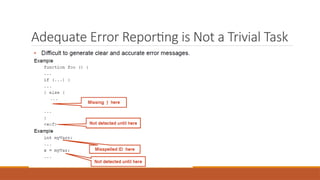
Adequate Error Reporting is Not a Trivial Task
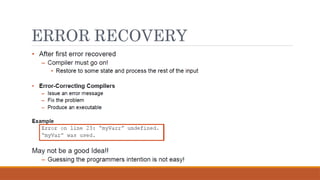
ERROR RECOVERY
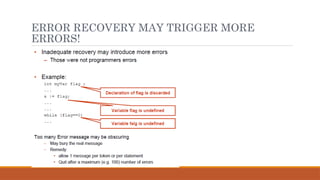
ERROR RECOVERY MAY TRIGGER MORE
ERRORS!
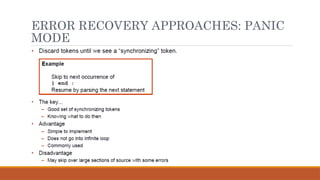
ERROR RECOVERY APPROACHES: PANIC
MODE
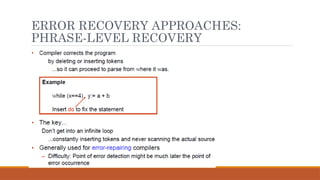
ERROR RECOVERY APPROACHES:
PHRASE-LEVEL RECOVERY
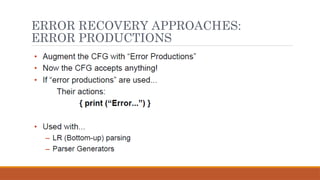
ERROR RECOVERY APPROACHES:
ERROR PRODUCTIONS
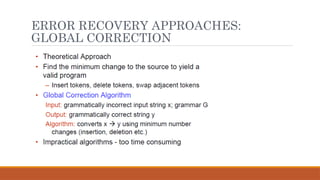
ERROR RECOVERY APPROACHES:
GLOBAL CORRECTION
Syntactical Analysis
Each language definition has rules that describe the syntax of well formed programs.
• Format of the rules: context-free grammars
• Why not regular expressions/NFA’s/DFA’s?
Source program constructs have recursive structure:
digits = [0-9]+;
expr = digits | “(“ expr “+” expr “)”
◦ Finite automata can’t recognize recursive constructs, so cannot ensure expressions are
well-bracketed: a machine with N states cannot remember parenthesis—nesting depth
greater than N
◦ CFG’s are more powerful, but also more costly to implement
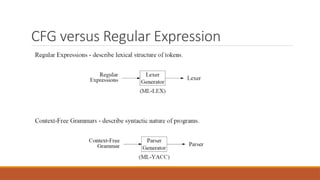
CFG versus Regular Expression
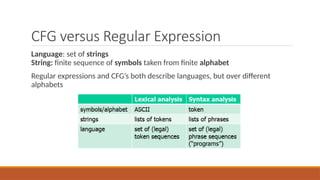
Language: set of strings
String: finite sequence of symbols taken from finite alphabet
Regular expressions and CFG’s both describe languages, but over different
alphabets
CFG versus Regular Expression
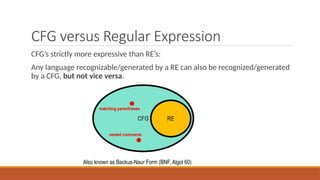
CFG’s strictly more expressive than RE’s:
Any language recognizable/generated by a RE can also be recognized/generated
by a CFG, but not vice versa.
Also known as Backus-Naur Form (BNF, Algol 60)
CONTEXT FREE GRAMMARS (CFG)
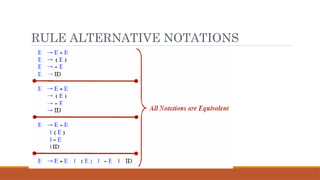
RULE ALTERNATIVE NOTATIONS
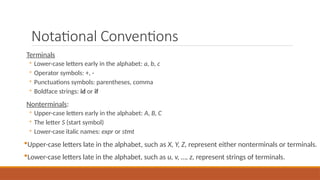
Notational Conventions
Terminals
◦ Lower-case letters early in the alphabet: a, b, c
◦ Operator symbols: +, -
◦ Punctuations symbols: parentheses, comma
◦ Boldface strings: id or if
Nonterminals:
◦ Upper-case letters early in the alphabet: A, B, C
◦ The letter S (start symbol)
◦ Lower-case italic names: expr or stmt
Upper-case letters late in the alphabet, such as X, Y, Z, represent either nonterminals or terminals.
Lower-case letters late in the alphabet, such as u, v, …, z, represent strings of terminals.
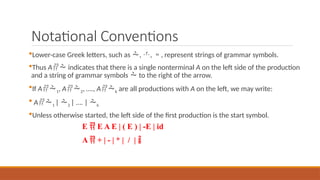
Notational Conventions
Lower-case Greek letters, such as , , , represent strings of grammar symbols.
Thus A  indicates that there is a single nonterminal A on the left side of the production
and a string of grammar symbols  to the right of the arrow.
If A 1, A 2, …., A k are all productions with A on the left, we may write:
 A 1 | 2 | …. | k
Unless otherwise started, the left side of the first production is the start symbol.
E  E A E | ( E ) | -E | id
A  + | - | * | / | 
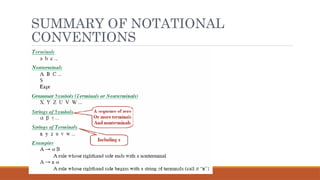
SUMMARY OF NOTATIONAL
CONVENTIONS
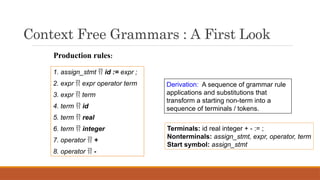
Context Free Grammars : A First Look
1. assign_stmt  id := expr ;
2. expr  expr operator term
3. expr  term
4. term  id
5. term  real
6. term  integer
7. operator  +
8. operator  -
Derivation: A sequence of grammar rule
applications and substitutions that
transform a starting non-term into a
sequence of terminals / tokens.
Production rules:
Terminals: id real integer + - := ;
Nonterminals: assign_stmt, expr, operator, term
Start symbol: assign_stmt
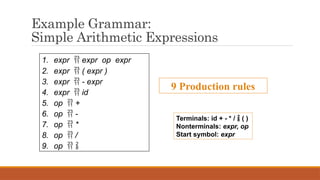
Example Grammar:
Simple Arithmetic Expressions
1. expr  expr op expr
2. expr  ( expr )
3. expr  - expr
4. expr  id
5. op  +
6. op  -
7. op  *
8. op  /
9. op  
9 Production rules
Terminals: id + - * /  ( )
Nonterminals: expr, op
Start symbol: expr
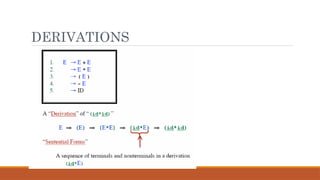
DERIVATIONS
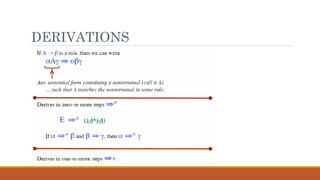
DERIVATIONS
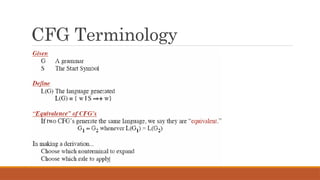
CFG Terminology
Derivation
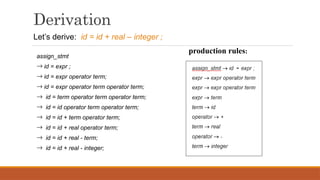
Let’s derive: id = id + real – integer ;
assign_stmt
® id = expr ;
® id = expr operator term;
® id = expr operator term operator term;
® id = term operator term operator term;
® id = id operator term operator term;
® id = id + term operator term;
® id = id + real operator term;
® id = id + real - term;
® id = id + real - integer;
production rules:
=
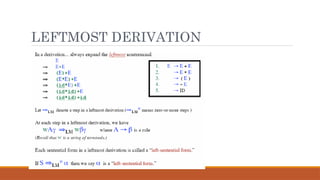
LEFTMOST DERIVATION
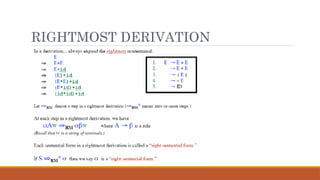
RIGHTMOST DERIVATION
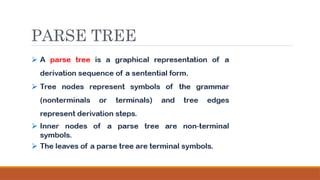
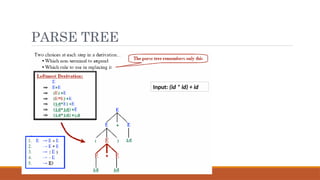
PARSE TREE
PARSE TREE
Input: (id * id) + id
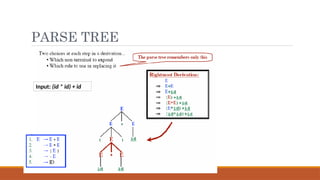
PARSE TREE
Input: (id * id) + id
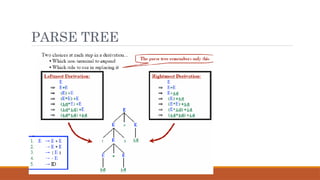
PARSE TREE
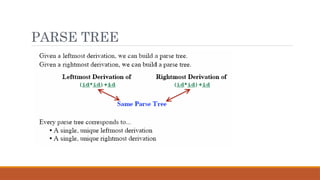
PARSE TREE
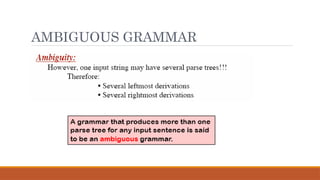
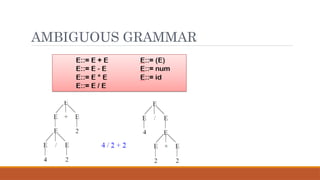
AMBIGUOUS GRAMMAR
AMBIGUOUS GRAMMAR
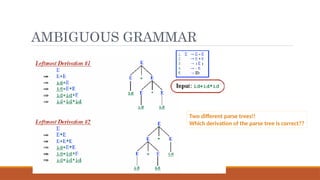
Two different parse trees!!
Which derivation of the parse tree is correct??
AMBIGUOUS GRAMMAR
AMBIGUOUS GRAMMAR
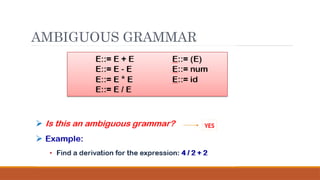
YES
AMBIGUOUS GRAMMAR
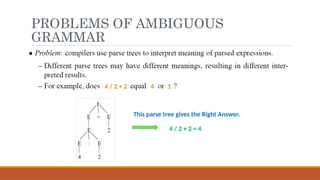
PROBLEMS OF AMBIGUOUS
GRAMMAR
4 / 2 + 2 4 1
4 / 2 + 2 = 4
This parse tree gives the Right Answer.
PROBLEMS OF AMBIGUOUS
GRAMMAR
The Ambiguous Grammar does not consider the
Precedence and Associativity
SOLUTION: REMOVING AMBIGUITY
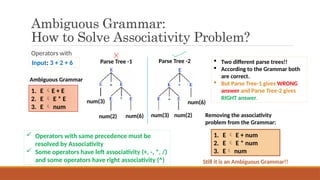
Ambiguous Grammar:
How to Solve Associativity Problem?
Operators with
1. E E + E
2. E  E * E
3. E  num
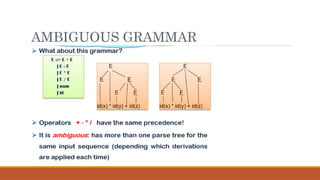
 Two different parse trees!!
 According to the Grammar both
are correct.
 But Parse Tree-1 gives WRONG
answer and Parse Tree-2 gives
RIGHT answer.
Parse Tree -1 Parse Tree -2
Ambiguous Grammar
Input: 3 + 2 + 6
 Operators with same precedence must be
resolved by Associativity
 Some operators have left associativity (+, -, *, /)
and some operators have right associativity (^)
1. E  E + num
2. E  E * num
3. E num
Removing the associativity
problem from the Grammar:
Still it is an Ambiguous Grammar!!
num(6)
num(2)
num(3) num(6)
num(2)
num(3)
Ambiguous Grammar:
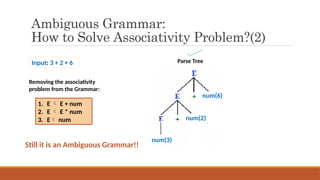
How to Solve Associativity Problem?(2)
Parse Tree
Input: 3 + 2 + 6
1. E  E + num
2. E  E * num
3. E num
Removing the associativity
problem from the Grammar:
Still it is an Ambiguous Grammar!!
num(3)
num(6)
num(2)
Ambiguous Grammar:
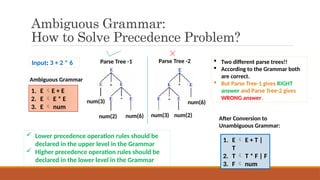
How to Solve Precedence Problem?
1. E E + E
2. E  E * E
3. E  num
 Two different parse trees!!
 According to the Grammar both
are correct.
 But Parse Tree-1 gives RIGHT
answer and Parse Tree-2 gives
WRONG answer.
Parse Tree -1 Parse Tree -2
Ambiguous Grammar
Input: 3 + 2 * 6
 Lower precedence operation rules should be
declared in the upper level in the Grammar
 Higher precedence operation rules should be
declared in the lower level in the Grammar
1. E  E + T |
T
2. T  T * F | F
3. F  num
After Conversion to
Unambiguous Grammar:
num(6)
num(2)
num(3) num(6)
num(2)
num(3)
Ambiguous Grammar:
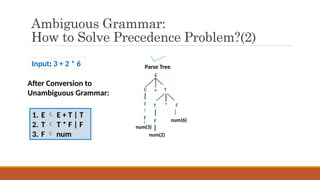
How to Solve Precedence Problem?(2)
Parse Tree
Input: 3 + 2 * 6
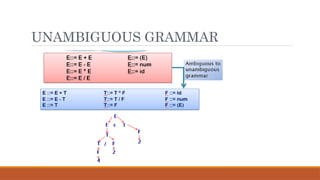
1. E  E + T | T
2. T  T * F | F
3. F  num
After Conversion to
Unambiguous Grammar:
num(6)
num(3)
num(2)
T
F
T
T
F
F
UNAMBIGUOUS GRAMMAR
Reading Materials
Chapter -4 of your Text book:
 Compilers: Principles, Techniques, and Tools
THE END

compiler design syntax analysis top down parsing

  • 1.
  • 3.
  • 4.
    Parsing During Compilation intermediate representation errors lexical analyzer parser restof front end symbol table source program parse tree get next token token regular expressions • Collecting token information • Perform type checking • Intermediate code generation • uses a grammar to check structure of tokens • produces a parse tree • syntactic errors and recovery • recognize correct syntax • report errors
  • 5.
    Parsers We categorize theparsers into two groups: 1. Top- Down Parser: The parse tree is created top to bottom, starting from the root 2. Bottom-Up Parser: The parse tree is created bottom to top, starting from the leaves Both Top-Down and Bottom-Up parsers scan the input from left to right ( One symbol at a time) Efficient Top-Down and Bottom-Up parsers can be implement only for the sub-classes of context free grammars  LL for top-down parsing  LR for bottom-up parsing
  • 6.
    Adequate Error Reportingis Not a Trivial Task
  • 7.
  • 8.
    ERROR RECOVERY MAYTRIGGER MORE ERRORS!
  • 9.
  • 10.
  • 11.
  • 12.
  • 13.
    Syntactical Analysis Each languagedefinition has rules that describe the syntax of well formed programs. • Format of the rules: context-free grammars • Why not regular expressions/NFA’s/DFA’s? Source program constructs have recursive structure: digits = [0-9]+; expr = digits | “(“ expr “+” expr “)” ◦ Finite automata can’t recognize recursive constructs, so cannot ensure expressions are well-bracketed: a machine with N states cannot remember parenthesis—nesting depth greater than N ◦ CFG’s are more powerful, but also more costly to implement
  • 14.
  • 15.
    CFG versus RegularExpression Language: set of strings String: finite sequence of symbols taken from finite alphabet Regular expressions and CFG’s both describe languages, but over different alphabets
  • 16.
    CFG versus RegularExpression CFG’s strictly more expressive than RE’s: Any language recognizable/generated by a RE can also be recognized/generated by a CFG, but not vice versa. Also known as Backus-Naur Form (BNF, Algol 60)
  • 17.
  • 18.
  • 19.
    Notational Conventions Terminals ◦ Lower-caseletters early in the alphabet: a, b, c ◦ Operator symbols: +, - ◦ Punctuations symbols: parentheses, comma ◦ Boldface strings: id or if Nonterminals: ◦ Upper-case letters early in the alphabet: A, B, C ◦ The letter S (start symbol) ◦ Lower-case italic names: expr or stmt Upper-case letters late in the alphabet, such as X, Y, Z, represent either nonterminals or terminals. Lower-case letters late in the alphabet, such as u, v, …, z, represent strings of terminals.
  • 20.
    Notational Conventions Lower-case Greekletters, such as , , , represent strings of grammar symbols. Thus A  indicates that there is a single nonterminal A on the left side of the production and a string of grammar symbols  to the right of the arrow. If A 1, A 2, …., A k are all productions with A on the left, we may write:  A 1 | 2 | …. | k Unless otherwise started, the left side of the first production is the start symbol. E  E A E | ( E ) | -E | id A  + | - | * | / | 
  • 21.
  • 22.
    Context Free Grammars: A First Look 1. assign_stmt  id := expr ; 2. expr  expr operator term 3. expr  term 4. term  id 5. term  real 6. term  integer 7. operator  + 8. operator  - Derivation: A sequence of grammar rule applications and substitutions that transform a starting non-term into a sequence of terminals / tokens. Production rules: Terminals: id real integer + - := ; Nonterminals: assign_stmt, expr, operator, term Start symbol: assign_stmt
  • 23.
    Example Grammar: Simple ArithmeticExpressions 1. expr  expr op expr 2. expr  ( expr ) 3. expr  - expr 4. expr  id 5. op  + 6. op  - 7. op  * 8. op  / 9. op   9 Production rules Terminals: id + - * /  ( ) Nonterminals: expr, op Start symbol: expr
  • 24.
  • 25.
  • 26.
  • 27.
    Derivation Let’s derive: id= id + real – integer ; assign_stmt ® id = expr ; ® id = expr operator term; ® id = expr operator term operator term; ® id = term operator term operator term; ® id = id operator term operator term; ® id = id + term operator term; ® id = id + real operator term; ® id = id + real - term; ® id = id + real - integer; production rules: =
  • 28.
  • 29.
  • 30.
  • 31.
  • 32.
  • 33.
  • 34.
  • 35.
  • 36.
    AMBIGUOUS GRAMMAR Two differentparse trees!! Which derivation of the parse tree is correct??
  • 37.
  • 38.
  • 39.
  • 40.
    PROBLEMS OF AMBIGUOUS GRAMMAR 4/ 2 + 2 4 1 4 / 2 + 2 = 4 This parse tree gives the Right Answer.
  • 41.
    PROBLEMS OF AMBIGUOUS GRAMMAR TheAmbiguous Grammar does not consider the Precedence and Associativity
  • 42.
  • 43.
    Ambiguous Grammar: How toSolve Associativity Problem? Operators with 1. E E + E 2. E  E * E 3. E  num  Two different parse trees!!  According to the Grammar both are correct.  But Parse Tree-1 gives WRONG answer and Parse Tree-2 gives RIGHT answer. Parse Tree -1 Parse Tree -2 Ambiguous Grammar Input: 3 + 2 + 6  Operators with same precedence must be resolved by Associativity  Some operators have left associativity (+, -, *, /) and some operators have right associativity (^) 1. E  E + num 2. E  E * num 3. E num Removing the associativity problem from the Grammar: Still it is an Ambiguous Grammar!! num(6) num(2) num(3) num(6) num(2) num(3)
  • 44.
    Ambiguous Grammar: How toSolve Associativity Problem?(2) Parse Tree Input: 3 + 2 + 6 1. E  E + num 2. E  E * num 3. E num Removing the associativity problem from the Grammar: Still it is an Ambiguous Grammar!! num(3) num(6) num(2)
  • 45.
    Ambiguous Grammar: How toSolve Precedence Problem? 1. E E + E 2. E  E * E 3. E  num  Two different parse trees!!  According to the Grammar both are correct.  But Parse Tree-1 gives RIGHT answer and Parse Tree-2 gives WRONG answer. Parse Tree -1 Parse Tree -2 Ambiguous Grammar Input: 3 + 2 * 6  Lower precedence operation rules should be declared in the upper level in the Grammar  Higher precedence operation rules should be declared in the lower level in the Grammar 1. E  E + T | T 2. T  T * F | F 3. F  num After Conversion to Unambiguous Grammar: num(6) num(2) num(3) num(6) num(2) num(3)
  • 46.
    Ambiguous Grammar: How toSolve Precedence Problem?(2) Parse Tree Input: 3 + 2 * 6 1. E  E + T | T 2. T  T * F | F 3. F  num After Conversion to Unambiguous Grammar: num(6) num(3) num(2) T F T T F F
  • 47.
  • 48.
    Reading Materials Chapter -4of your Text book:  Compilers: Principles, Techniques, and Tools
  • 49.

Editor's Notes

  • #33 , the phrase “x = +y", which is recognized as four tokens, representing “x", “=“ and “+" and “y", has the structure =(x,+(y)), i.e., an assignment expression, that operates on “x" and the expression “+(y)".