Dr. Amiya Ranjan Panda
Assistant Professor [II]
School of Computer Engineering,
Kalinga Institute of Industrial Technology (KIIT),
Deemed to be University,Odisha
ER Diagram Design Issues
KALINGA INSTITUTE OF INDUSTRIAL
TECHNOLOGY
School Of Computer
Engineering
4 Credit Lecture Note 07
Chapter Contents
q ER Diagram design Issues
q ER Diagram design Methodologies
2
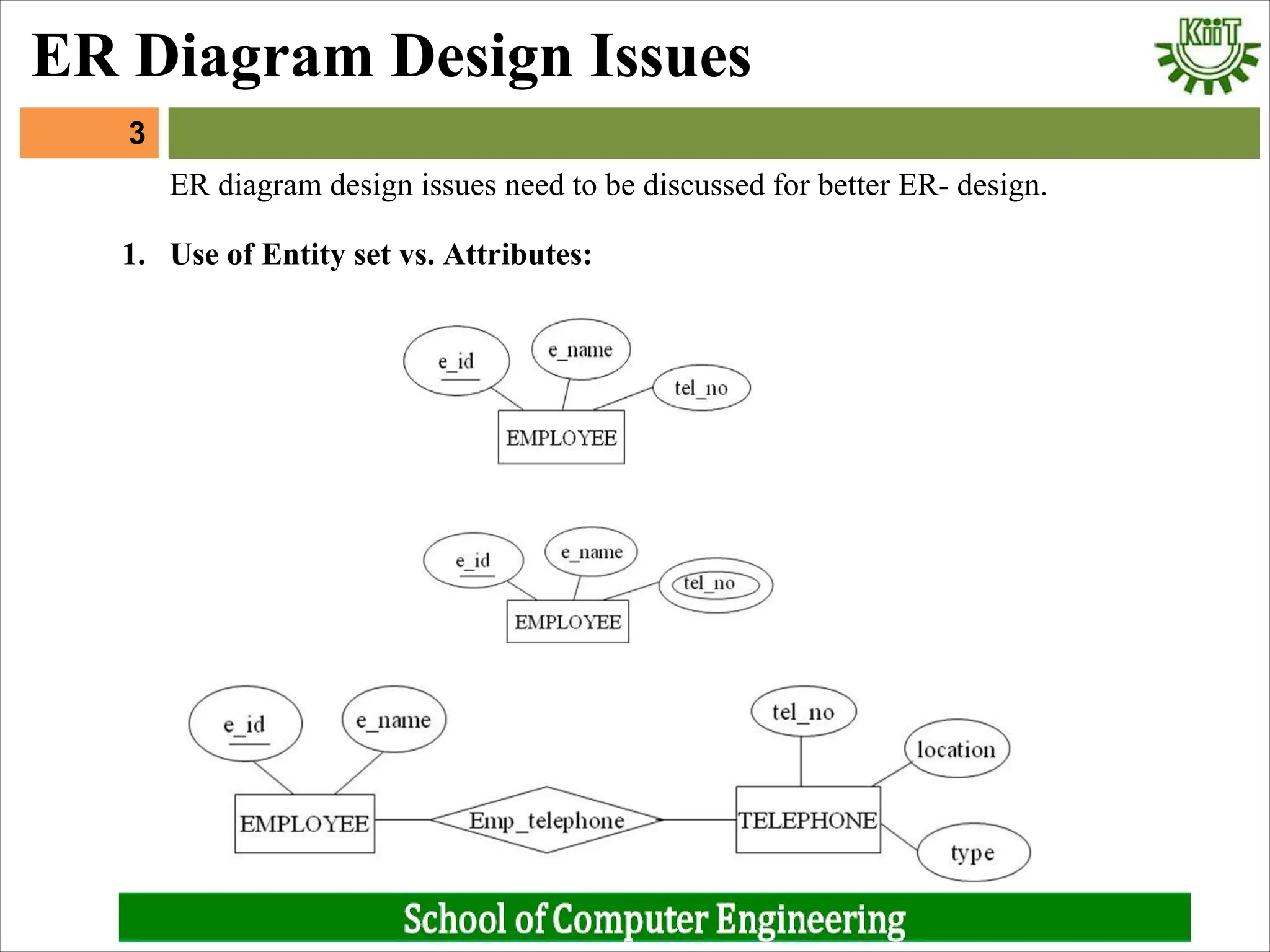
ER diagram design issues need to be discussed for better ER- design.
3
ER Diagram Design Issues
1. Use of Entity set vs. Attributes:
4
ER Diagram Design Issues…
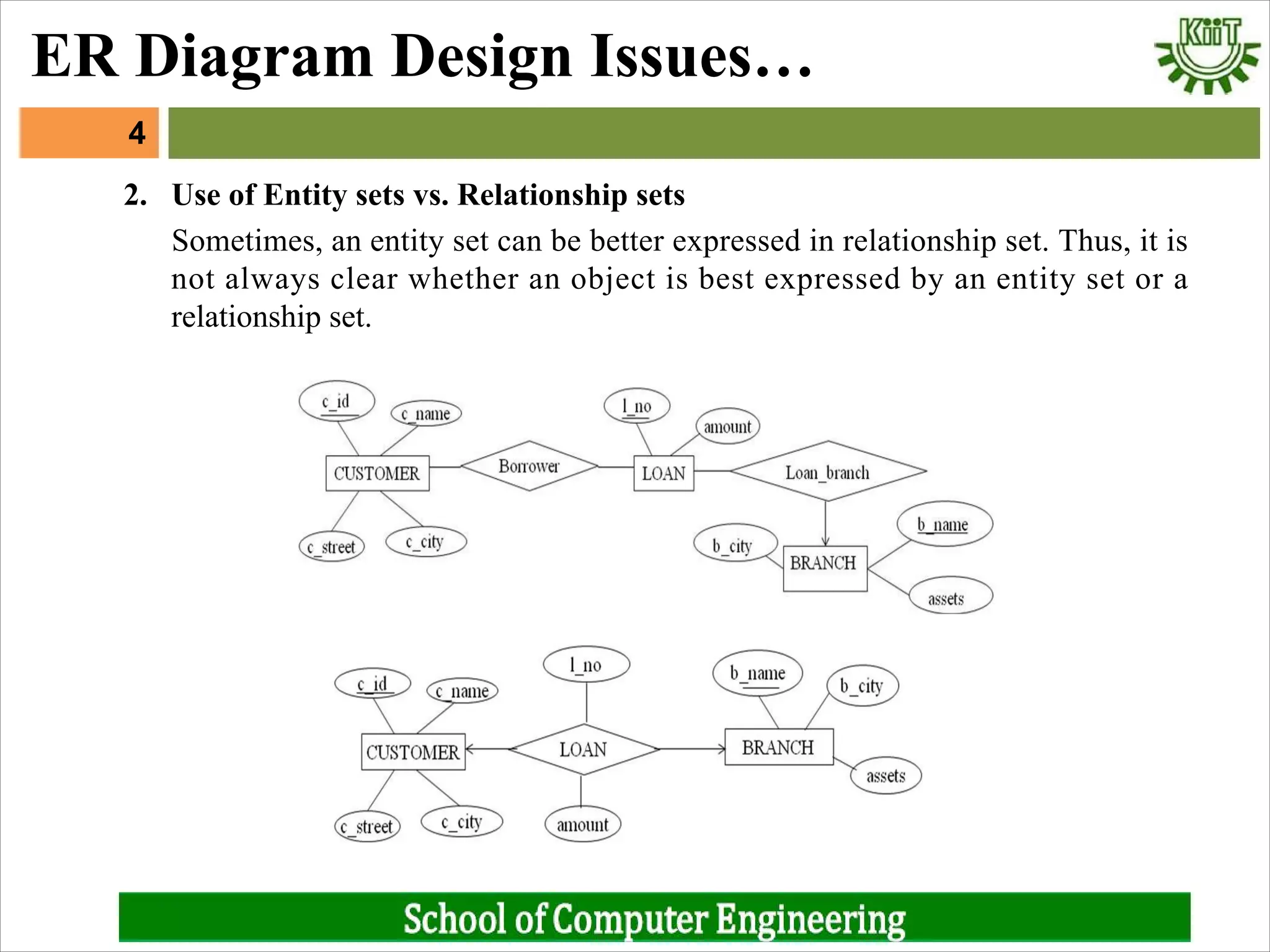
2. Use of Entity sets vs. Relationship sets
Sometimes, an entity set can be better expressed in relationship set. Thus, it is
not always clear whether an object is best expressed by an entity set or a
relationship set.
5
ER Diagram Design Issues…
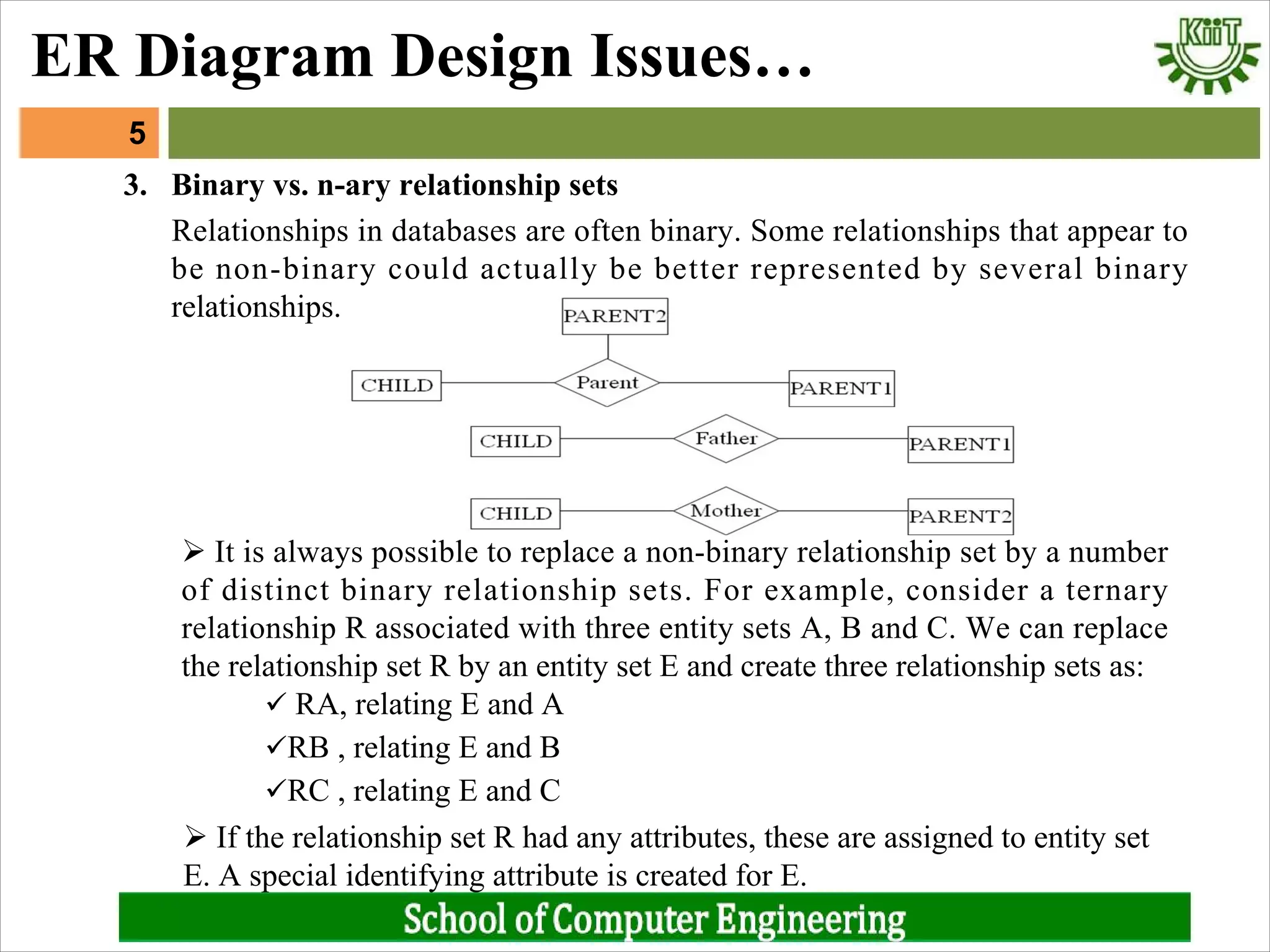
3. Binary vs. n-ary relationship sets
Relationships in databases are often binary. Some relationships that appear to
be non-binary could actually be better represented by several binary
relationships.
Ø It is always possible to replace a non-binary relationship set by a number
of distinct binary relationship sets. For example, consider a ternary
relationship R associated with three entity sets A, B and C. We can replace
the relationship set R by an entity set E and create three relationship sets as:
ü RA, relating E and A
üRB , relating E and B
üRC , relating E and C
Ø If the relationship set R had any attributes, these are assigned to entity set
E. A special identifying attribute is created for E.
6
ER Diagram Design Issues…
4. Placement of Relationship Attributes
The cardinality ratio of a relationship can affect the placement of relationship
attributes:
ü One-to-Many: Attributes of 1:M relationship set can be repositioned to only
the entity set on the many side of the relationship.
ü One-to-One: The relationship attribute can be associated with either one of the
participating entities.
ü Many-to-Many: Here, the relationship attributes can not be represented to the
entity sets; rather they will be represented by the entity set to be created for the
relationship set.
Ø The guidelines that should be followed while designing an ER diagram are
discussed below:
ü Recognize entity sets
ü Recognize relationship sets and participating entity sets
ü Recognize attributes of entity sets and attributes of relationship sets
ü Define binary relationship types and existence dependencies
ü Define general cardinality, constraints, keys, and discriminators
ü Design diagram
7
ER Diagram Design Methodologies
8

Dbms 7: ER Diagram Design Issue

  • 1.
    Dr. Amiya RanjanPanda Assistant Professor [II] School of Computer Engineering, Kalinga Institute of Industrial Technology (KIIT), Deemed to be University,Odisha ER Diagram Design Issues KALINGA INSTITUTE OF INDUSTRIAL TECHNOLOGY School Of Computer Engineering 4 Credit Lecture Note 07
  • 2.
    Chapter Contents q ERDiagram design Issues q ER Diagram design Methodologies 2
  • 3.
    ER diagram designissues need to be discussed for better ER- design. 3 ER Diagram Design Issues 1. Use of Entity set vs. Attributes:
  • 4.
    4 ER Diagram DesignIssues… 2. Use of Entity sets vs. Relationship sets Sometimes, an entity set can be better expressed in relationship set. Thus, it is not always clear whether an object is best expressed by an entity set or a relationship set.
  • 5.
    5 ER Diagram DesignIssues… 3. Binary vs. n-ary relationship sets Relationships in databases are often binary. Some relationships that appear to be non-binary could actually be better represented by several binary relationships. Ø It is always possible to replace a non-binary relationship set by a number of distinct binary relationship sets. For example, consider a ternary relationship R associated with three entity sets A, B and C. We can replace the relationship set R by an entity set E and create three relationship sets as: ü RA, relating E and A üRB , relating E and B üRC , relating E and C Ø If the relationship set R had any attributes, these are assigned to entity set E. A special identifying attribute is created for E.
  • 6.
    6 ER Diagram DesignIssues… 4. Placement of Relationship Attributes The cardinality ratio of a relationship can affect the placement of relationship attributes: ü One-to-Many: Attributes of 1:M relationship set can be repositioned to only the entity set on the many side of the relationship. ü One-to-One: The relationship attribute can be associated with either one of the participating entities. ü Many-to-Many: Here, the relationship attributes can not be represented to the entity sets; rather they will be represented by the entity set to be created for the relationship set.
  • 7.
    Ø The guidelinesthat should be followed while designing an ER diagram are discussed below: ü Recognize entity sets ü Recognize relationship sets and participating entity sets ü Recognize attributes of entity sets and attributes of relationship sets ü Define binary relationship types and existence dependencies ü Define general cardinality, constraints, keys, and discriminators ü Design diagram 7 ER Diagram Design Methodologies
  • 8.