Top-Down Parsing
1
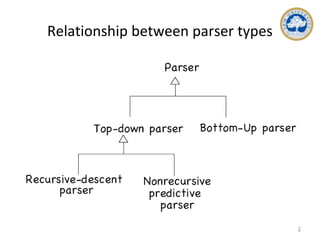
Relationship between parser types
2
Recursive descent
• Recursive descent parsers simply try to build a
top-down parse tree.
• It would be better if we always knew the
correct action to take.
• It would be better if we could avoid recursive
procedure calls during parsing.
3
Predictive parsers
• A predictive parser always knows which
production to use, ( to avoid backtracking )
• Example: for the productions
•
stmt -> if ( expr ) stmt else stmt
| while ( expr ) stmt
| for ( stmt expr stmt ) stmt
• a recursive descent parser would always know
which production to use, depending on the input
token.
4
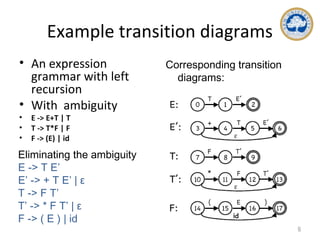
Transition diagrams
• Transition diagrams can describe recursive parsers,
just like they can describe lexical analyzers,
• (but the diagrams are slightly different.)
• Construction:
1. Eliminate left recursion from G
2. Left factor G
3. For each non-terminal A, do
1. Create an initial and final (return) state
2. For each production A -> X1 X2 … Xn, create a path from
the initial to the final state with edges X1 X2 … Xn.
5
Example transition diagrams
• An expression
grammar with left
recursion
• With ambiguity
• E -> E+T | T
• T -> T*F | F
• F -> (E) | id
6
Corresponding transition
diagrams:
Eliminating the ambiguity
E -> T E’
E’ -> + T E’ | ε
T -> F T’
T’ -> * F T’ | ε
F -> ( E ) | id
The parsing table and parsing program
• The table is a 2D array M[A,a] where A is a
nonterminal symbol and a is a terminal or $.
• At each step, the parser considers the top-of-
stack symbol X and input symbol a:
If both are $, accept
If they are the same (nonterminals), pop X, advance
input
If X is a nonterminal, consult M[X,a].
– If M[X,a] is “ERROR” call an error recovery routine.
Otherwise, if M[X,a] is a production of the
grammar X -> UVW, replace X on the stack with WVU
(U on top)
7
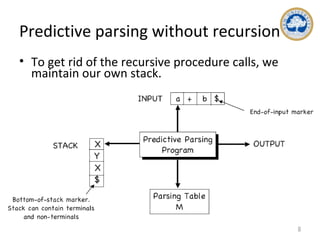
Predictive parsing without recursion
• To get rid of the recursive procedure calls, we
maintain our own stack.
8
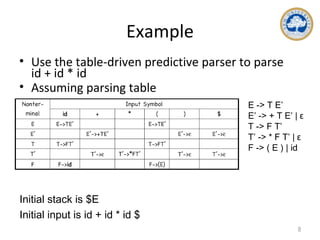
Example
• Use the table-driven predictive parser to parse
id + id * id
• Assuming parsing table
9
Initial stack is $E
Initial input is id + id * id $
E -> T E’
E’ -> + T E’ | ε
T -> F T’
T’ -> * F T’ | ε
F -> ( E ) | id
Building a predictive parse table
• The construction requires two functions:
• 1. FIRST
• 2. FOLLOW
10
For First
• For a string of grammar symbols α, FIRST(α) is
the set of terminals that begin all possible
strings derived from α. If α =*
> ε, then ε is also
in FIRST(α).
• E -> T E’
• E’ -> + T E’ | ε
• T -> F T’
• T’ -> * F T’ | ε
• F -> ( E ) | id
11
FIRST(E) = FIRST (T) = FIRST (F) = {( , id }
FIRST(E’) = {+ , ε}
FIRST(T) = {( , id}
FIRST(T’) = { *, ε}
FIRST(F) = {( , id }
For Follow
• FOLLOW(A) for non terminal A is the set of terminals
that can appear immediately to the right of A in some
sentential form. If A can be the last symbol in a
sentential form, then $ is also in FOLLOW(A).
• E -> T E’
• E’ -> + T E’ | ε
• T -> F T’
• T’ -> * F T’ | ε
• F -> ( E ) | id
12
Follow (E) = { ) , $ }
Follow (E’) = Follow (E)= { ) ,$ }
Follow (T) = { +, Follow (E)}= {+ , ) , $}
Follow (T’) = {+, ) ,$}
Follow ( F) = {*, +, ), $ }
How to compute FIRST(α)
1. If X is a terminal, FIRST(X) = X.
2. Otherwise (X is a nonterminal),
1. 1. If X -> ε is a production, add ε to FIRST(X)
2. 2. If X -> Y1 … Yk is a production, then place a in
FIRST(X) if for some i, a is in FIRST(Yi) and Y1…Yi-1 =*
> ε.
• Given FIRST(X) for all single symbols X,
• Let FIRST(X1…Xn) = FIRST(X1)
• If ε FIRST(X∈ 1), then add FIRST(X2), and so on…
13
How to compute FOLLOW(A)
• Place $ in FOLLOW(S) (for S the start symbol)
• If A -> α B β, then FIRST(β)-ε is placed in
FOLLOW(B)
• If there is a production A -> α B or a
production A -> α B β where β =*
> ε, then
everything in FOLLOW(A) is in FOLLOW(B).
• Repeatedly apply these rules until no FOLLOW
set changes.
14
Example FIRST and FOLLOW
• For our favorite grammar:
E -> TE’
E’ -> +TE | ε
T -> FT’
T’ -> *FT’ | ε
F -> (E) | id
• What is FIRST() and FOLLOW() for all
nonterminals?
15
Parse table construction with
FIRST/FOLLOW
• Basic idea: if A -> α and a is in FIRST(α), then we expand A to α any time
the current input is a and the top of stack is A.
• Algorithm:
• For each production A -> α in G, do:
• For each terminal a in FIRST(α) add A -> α to M[A,a]
• If ε FIRST(α), for each terminal b in FOLLOW(A), do:∈
• add A -> α to M[A,b]
• If ε FIRST(α) and $ is in FOLLOW(A), add A -> α to M[A,$]∈
• Make each undefined entry in M[ ] an ERROR
16
Example predictive parse table construction
• For our favorite grammar:
E -> TE’
E’ -> +TE | ε
T -> FT’
T’ -> *FT’ | ε
F -> (E) | id
• What the predictive parsing table?
17
LL(1) grammars
• The predictive parser algorithm can be applied to
ANY grammar.
• But sometimes, M[ ] might have multiply defined
entries.
• Example: for if-else statements and left factoring:
stmt -> if ( expr ) stmt optelse
optelse -> else stmt | ε
• When we have “optelse” on the stack and “else”
in the input, we have a choice of how to expand
optelse (“else” is in FOLLOW(optelse) so either
rule is possible)
18
LL(1) grammars
• If the predictive parsing construction for G leads to a
parse table M[ ] WITHOUT multiply defined entries,
we say “G is LL(1)”
19
1 symbol of lookahead
Leftmost derivation
Left-to-right scan of the input
LL(1) grammars
• Necessary and sufficient conditions for G to
be LL(1):
• If A -> α | β
1. There does not exist a terminal a such that
a FIRST(α) and a FIRST(∈ ∈ β)
2. At most one of α and β derive ε
3. If β =*
> ε, then FIRST(α) does not intersect with
FOLLOW(β).
20
This is the same as saying the
predictive parser always
knows what to do!
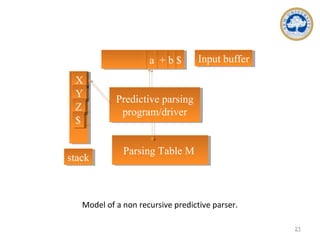
Model of a non recursive predictive parser.
21
a + b $a + b $
XX
YY
ZZ
$$
Input bufferInput buffer
stackstack
Predictive parsing
program/driver
Predictive parsing
program/driver
Parsing Table MParsing Table M
Moves made by predictive parser on input id + id * id
STACKSTACK INPUTINPUT OUTPUTOUTPUT
$$EE
$$EE' T' T
$$EE' T' F' T' F
$$EE' T'' T' idid
$$EE' T'' T'
$$EE''
$$EE' T' T ++
$$EE' T' T
$$EE' T' F' T' F
$$EE' T'' T' idid
$$EE' T'' T'
$$EE' T' F' T' F **
$$EE' T' F' T' F
$$EE' T'' T' idid
$$EE' T'' T'
$$EE''
$$
idid ++ idid ** idid$$
++ idid ** idid$$
++ idid ** idid$$
++ idid ** idid$$
idid ** idid$$
idid ** idid$$
idid ** idid$$
** idid$$
** idid$$
idid$$
idid$$
$$
$$
$$
EE →→ TT EE''
TT →→ F TF T''
FF →→ idid
TT'' →→ εε
EE'' →→ ++ TT EE''
TT →→ F TF T''
FF →→ idid
TT'' →→ ** F TF T''
FF →→ idid
TT'' →→ εε
EE'' →→ εε
22
Nonrecursive Predictive Parsing
• 1. If X = a = $, the parser halts and announces successful completion of parsing.
• 2. If X = a ≠ $, the parser pops X off the stack and advances the input pointer to the next
input symbol.
• 3. If X is a nonterminal, the program consults entry M[X, a] of the parsing table M. This
entry will be either an X-production of the grammar or an error entry. If, for example, M[X, a]
= {X → UVW}, the parser replaces X on top of the stack by WVU (with U on top). As output,
we shall assume that the parser just prints the production used; any other code could be
executed here. If M[X, a] = error, the parser calls an error recovery routine.
23
Parsing table M for grammar
NONTER-NONTER-
MINALMINAL
INPUT SYMBOLINPUT SYMBOL
IdId ++ ** (( )) $$
EE
EE''
TT
TT''
FF
EE →→ TE'TE'
TT →→ FT'FT'
FF →→ idid
E'E' →→ ++TE'TE'
T'T' →→ εε T'T' →→ **FT'FT'
EE →→ TE'TE'
TT →→ FT'FT'
FF →→ ((EE))
E'E' →→ εε
T'T' →→ εε
E'E' →→ εε
T'T' →→ εε
24
Top-down parsing recap
• RECURSIVE DESCENT parsers are easy to build, but inefficient,
and might require backtracking.
• TRANSITION DIAGRAMS help us build recursive descent
parsers.
• For LL(1) grammars, it is possible to build PREDICTIVE
PARSERS with no recursion automatically.
 Compute FIRST() and FOLLOW() for all nonterminals
 Fill in the predictive parsing table
 Use the table-driven predictive parsing algorithm
25

Top down parsing

  • 1.
  • 2.
  • 3.
    Recursive descent • Recursivedescent parsers simply try to build a top-down parse tree. • It would be better if we always knew the correct action to take. • It would be better if we could avoid recursive procedure calls during parsing. 3
  • 4.
    Predictive parsers • Apredictive parser always knows which production to use, ( to avoid backtracking ) • Example: for the productions • stmt -> if ( expr ) stmt else stmt | while ( expr ) stmt | for ( stmt expr stmt ) stmt • a recursive descent parser would always know which production to use, depending on the input token. 4
  • 5.
    Transition diagrams • Transitiondiagrams can describe recursive parsers, just like they can describe lexical analyzers, • (but the diagrams are slightly different.) • Construction: 1. Eliminate left recursion from G 2. Left factor G 3. For each non-terminal A, do 1. Create an initial and final (return) state 2. For each production A -> X1 X2 … Xn, create a path from the initial to the final state with edges X1 X2 … Xn. 5
  • 6.
    Example transition diagrams •An expression grammar with left recursion • With ambiguity • E -> E+T | T • T -> T*F | F • F -> (E) | id 6 Corresponding transition diagrams: Eliminating the ambiguity E -> T E’ E’ -> + T E’ | ε T -> F T’ T’ -> * F T’ | ε F -> ( E ) | id
  • 7.
    The parsing tableand parsing program • The table is a 2D array M[A,a] where A is a nonterminal symbol and a is a terminal or $. • At each step, the parser considers the top-of- stack symbol X and input symbol a: If both are $, accept If they are the same (nonterminals), pop X, advance input If X is a nonterminal, consult M[X,a]. – If M[X,a] is “ERROR” call an error recovery routine. Otherwise, if M[X,a] is a production of the grammar X -> UVW, replace X on the stack with WVU (U on top) 7
  • 8.
    Predictive parsing withoutrecursion • To get rid of the recursive procedure calls, we maintain our own stack. 8
  • 9.
    Example • Use thetable-driven predictive parser to parse id + id * id • Assuming parsing table 9 Initial stack is $E Initial input is id + id * id $ E -> T E’ E’ -> + T E’ | ε T -> F T’ T’ -> * F T’ | ε F -> ( E ) | id
  • 10.
    Building a predictiveparse table • The construction requires two functions: • 1. FIRST • 2. FOLLOW 10
  • 11.
    For First • Fora string of grammar symbols α, FIRST(α) is the set of terminals that begin all possible strings derived from α. If α =* > ε, then ε is also in FIRST(α). • E -> T E’ • E’ -> + T E’ | ε • T -> F T’ • T’ -> * F T’ | ε • F -> ( E ) | id 11 FIRST(E) = FIRST (T) = FIRST (F) = {( , id } FIRST(E’) = {+ , ε} FIRST(T) = {( , id} FIRST(T’) = { *, ε} FIRST(F) = {( , id }
  • 12.
    For Follow • FOLLOW(A)for non terminal A is the set of terminals that can appear immediately to the right of A in some sentential form. If A can be the last symbol in a sentential form, then $ is also in FOLLOW(A). • E -> T E’ • E’ -> + T E’ | ε • T -> F T’ • T’ -> * F T’ | ε • F -> ( E ) | id 12 Follow (E) = { ) , $ } Follow (E’) = Follow (E)= { ) ,$ } Follow (T) = { +, Follow (E)}= {+ , ) , $} Follow (T’) = {+, ) ,$} Follow ( F) = {*, +, ), $ }
  • 13.
    How to computeFIRST(α) 1. If X is a terminal, FIRST(X) = X. 2. Otherwise (X is a nonterminal), 1. 1. If X -> ε is a production, add ε to FIRST(X) 2. 2. If X -> Y1 … Yk is a production, then place a in FIRST(X) if for some i, a is in FIRST(Yi) and Y1…Yi-1 =* > ε. • Given FIRST(X) for all single symbols X, • Let FIRST(X1…Xn) = FIRST(X1) • If ε FIRST(X∈ 1), then add FIRST(X2), and so on… 13
  • 14.
    How to computeFOLLOW(A) • Place $ in FOLLOW(S) (for S the start symbol) • If A -> α B β, then FIRST(β)-ε is placed in FOLLOW(B) • If there is a production A -> α B or a production A -> α B β where β =* > ε, then everything in FOLLOW(A) is in FOLLOW(B). • Repeatedly apply these rules until no FOLLOW set changes. 14
  • 15.
    Example FIRST andFOLLOW • For our favorite grammar: E -> TE’ E’ -> +TE | ε T -> FT’ T’ -> *FT’ | ε F -> (E) | id • What is FIRST() and FOLLOW() for all nonterminals? 15
  • 16.
    Parse table constructionwith FIRST/FOLLOW • Basic idea: if A -> α and a is in FIRST(α), then we expand A to α any time the current input is a and the top of stack is A. • Algorithm: • For each production A -> α in G, do: • For each terminal a in FIRST(α) add A -> α to M[A,a] • If ε FIRST(α), for each terminal b in FOLLOW(A), do:∈ • add A -> α to M[A,b] • If ε FIRST(α) and $ is in FOLLOW(A), add A -> α to M[A,$]∈ • Make each undefined entry in M[ ] an ERROR 16
  • 17.
    Example predictive parsetable construction • For our favorite grammar: E -> TE’ E’ -> +TE | ε T -> FT’ T’ -> *FT’ | ε F -> (E) | id • What the predictive parsing table? 17
  • 18.
    LL(1) grammars • Thepredictive parser algorithm can be applied to ANY grammar. • But sometimes, M[ ] might have multiply defined entries. • Example: for if-else statements and left factoring: stmt -> if ( expr ) stmt optelse optelse -> else stmt | ε • When we have “optelse” on the stack and “else” in the input, we have a choice of how to expand optelse (“else” is in FOLLOW(optelse) so either rule is possible) 18
  • 19.
    LL(1) grammars • Ifthe predictive parsing construction for G leads to a parse table M[ ] WITHOUT multiply defined entries, we say “G is LL(1)” 19 1 symbol of lookahead Leftmost derivation Left-to-right scan of the input
  • 20.
    LL(1) grammars • Necessaryand sufficient conditions for G to be LL(1): • If A -> α | β 1. There does not exist a terminal a such that a FIRST(α) and a FIRST(∈ ∈ β) 2. At most one of α and β derive ε 3. If β =* > ε, then FIRST(α) does not intersect with FOLLOW(β). 20 This is the same as saying the predictive parser always knows what to do!
  • 21.
    Model of anon recursive predictive parser. 21 a + b $a + b $ XX YY ZZ $$ Input bufferInput buffer stackstack Predictive parsing program/driver Predictive parsing program/driver Parsing Table MParsing Table M
  • 22.
    Moves made bypredictive parser on input id + id * id STACKSTACK INPUTINPUT OUTPUTOUTPUT $$EE $$EE' T' T $$EE' T' F' T' F $$EE' T'' T' idid $$EE' T'' T' $$EE'' $$EE' T' T ++ $$EE' T' T $$EE' T' F' T' F $$EE' T'' T' idid $$EE' T'' T' $$EE' T' F' T' F ** $$EE' T' F' T' F $$EE' T'' T' idid $$EE' T'' T' $$EE'' $$ idid ++ idid ** idid$$ idid ++ idid ** idid$$ idid ++ idid ** idid$$ idid ++ idid ** idid$$ ++ idid ** idid$$ ++ idid ** idid$$ ++ idid ** idid$$ idid ** idid$$ idid ** idid$$ idid ** idid$$ ** idid$$ ** idid$$ idid$$ idid$$ $$ $$ $$ EE →→ TT EE'' TT →→ F TF T'' FF →→ idid TT'' →→ εε EE'' →→ ++ TT EE'' TT →→ F TF T'' FF →→ idid TT'' →→ ** F TF T'' FF →→ idid TT'' →→ εε EE'' →→ εε 22
  • 23.
    Nonrecursive Predictive Parsing •1. If X = a = $, the parser halts and announces successful completion of parsing. • 2. If X = a ≠ $, the parser pops X off the stack and advances the input pointer to the next input symbol. • 3. If X is a nonterminal, the program consults entry M[X, a] of the parsing table M. This entry will be either an X-production of the grammar or an error entry. If, for example, M[X, a] = {X → UVW}, the parser replaces X on top of the stack by WVU (with U on top). As output, we shall assume that the parser just prints the production used; any other code could be executed here. If M[X, a] = error, the parser calls an error recovery routine. 23
  • 24.
    Parsing table Mfor grammar NONTER-NONTER- MINALMINAL INPUT SYMBOLINPUT SYMBOL IdId ++ ** (( )) $$ EE EE'' TT TT'' FF EE →→ TE'TE' TT →→ FT'FT' FF →→ idid E'E' →→ ++TE'TE' T'T' →→ εε T'T' →→ **FT'FT' EE →→ TE'TE' TT →→ FT'FT' FF →→ ((EE)) E'E' →→ εε T'T' →→ εε E'E' →→ εε T'T' →→ εε 24
  • 25.
    Top-down parsing recap •RECURSIVE DESCENT parsers are easy to build, but inefficient, and might require backtracking. • TRANSITION DIAGRAMS help us build recursive descent parsers. • For LL(1) grammars, it is possible to build PREDICTIVE PARSERS with no recursion automatically.  Compute FIRST() and FOLLOW() for all nonterminals  Fill in the predictive parsing table  Use the table-driven predictive parsing algorithm 25