Chapter 4Chapter 4
Informed search & ExplorationInformed search & Exploration
CSE 4701
Review: Tree searchReview: Tree search
A search strategy is defined by picking the
order of node expansion
Uninformed search strategies use only the
information available in the problem definition
◦ Breadth-first search
◦ Uniform-cost search
◦ Depth-first search
◦ Depth-limited search
◦ Iterative deepening search
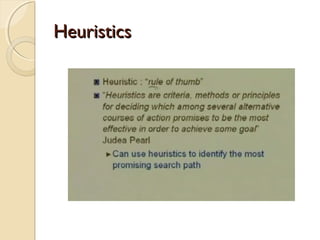
HeuristicsHeuristics
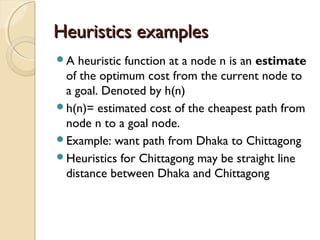
Heuristics examplesHeuristics examples
A heuristic function at a node n is an estimate
of the optimum cost from the current node to
a goal. Denoted by h(n)
h(n)= estimated cost of the cheapest path from
node n to a goal node.
Example: want path from Dhaka to Chittagong
Heuristics for Chittagong may be straight line
distance between Dhaka and Chittagong
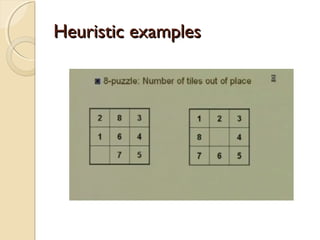
Heuristic examplesHeuristic examples
Best-first searchBest-first search
 Idea: use an evaluation function f(n) for each node
◦ estimate of "desirability“
1. Greedy Best-First Search
2. A*
search
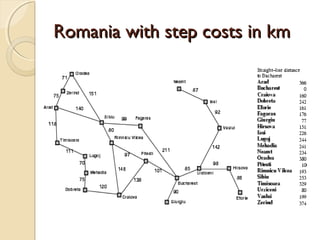
Romania with step costs in kmRomania with step costs in km
Greedy best-first searchGreedy best-first search
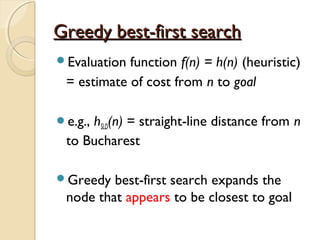
Evaluation function f(n) = h(n) (heuristic)
= estimate of cost from n to goal
e.g., hSLD(n) = straight-line distance from n
to Bucharest
Greedy best-first search expands the
node that appears to be closest to goal
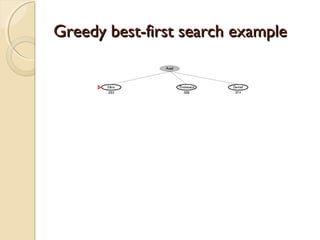
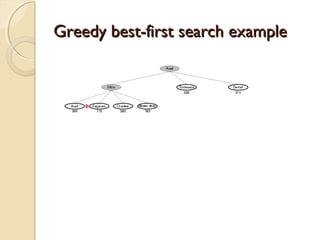
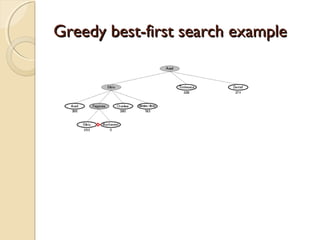
Greedy best-first search exampleGreedy best-first search example
But is this solution optimal?
No, because instead of using the via Sibiu and
fagaras to Bucharest, if we follow the path
through Rimmicu Vilcea and Pitesti, then we
have to go 32 km less than the first path.
This shows why the algorithm is called
“greedy”- at every step it tries to get as close
to the goal as it can.
Drawbacks of greedy searchDrawbacks of greedy search
Minimizing h(n) is susceptible to false
starts. Consider the problem of getting
from Iasi to Fagaras. The heuristic
suggests that Neamt be expanded first,
because it is closest to Fagaras, but this is
a dead end. The solution is to go first to
vaslui- a step that is actually farther from
the goal according to the heuristis
Properties of greedy best-firstProperties of greedy best-first
searchsearch
 Greedy Best first search resembles depth first search in
the way it prefers to follow a single path all the way to
the goal, but will back up when it hits a dead end.
 Complete? No – can get stuck in loops, e.g., Iasi 
Neamt  Iasi  Neamt 
 Time? O(bm
), but a good heuristic can give dramatic
improvement
 Space? O(bm
) -- keeps all nodes in memory
 Optimal? No
AA**
searchsearch
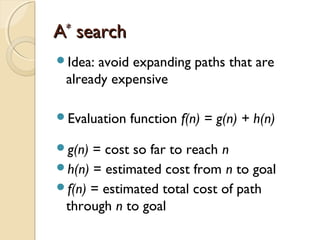
Idea: avoid expanding paths that are
already expensive
Evaluation function f(n) = g(n) + h(n)
g(n) = cost so far to reach n
h(n) = estimated cost from n to goal
f(n) = estimated total cost of path
through n to goal
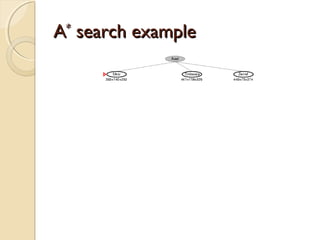
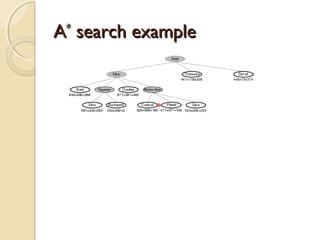
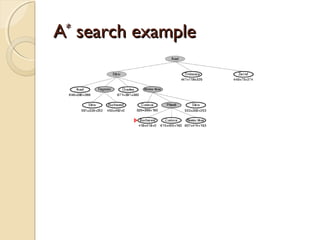
AA**
search examplesearch example
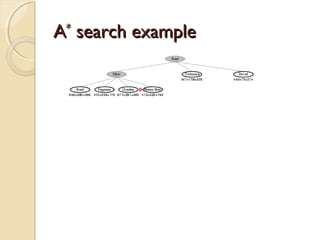
AA**
search examplesearch example
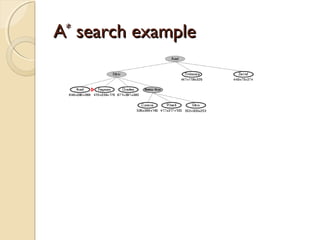
AA**
search examplesearch example
AA**
search examplesearch example
AA**
search examplesearch example
AA**
search examplesearch example
Admissible heuristicsAdmissible heuristics
 A heuristic h(n) is admissible if for every node n,
h(n) ≤ h*
(n), where h*
(n) is the true cost to reach the
goal state from n.
 An admissible heuristic never overestimates the cost to
reach the goal, i.e., it is optimistic
 Example: hSLD(n) (never overestimates the actual road
distance)
 Theorem: If h(n) is admissible, A*
using TREE-SEARCH
is optimal



Properties of A*Properties of A*
Complete? Yes (unless there are infinitely
many nodes with f ≤ f(G) )
Time? Exponential
Space? Keeps all nodes in memory
Optimal? Yes
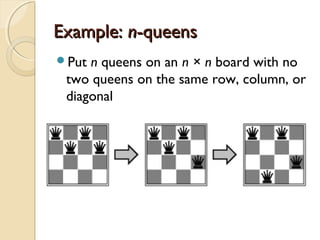
Example:Example: nn-queens-queens
Put n queens on an n × n board with no
two queens on the same row, column, or
diagonal
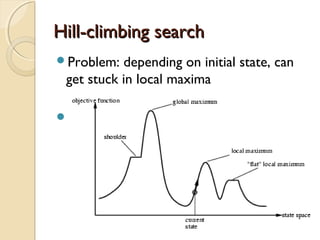
Hill-climbing searchHill-climbing search
Problem: depending on initial state, can
get stuck in local maxima

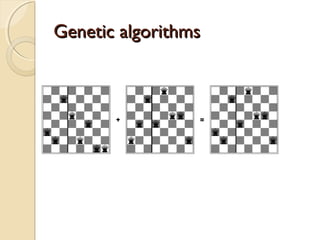
Genetic algorithmsGenetic algorithms
 A successor state is generated by combining two parent
states
 Start with k randomly generated states (population)
 A state is represented as a string over a finite alphabet
(often a string of 0s and 1s)
 Evaluation function (fitness function). Higher values for
better states.
 Produce the next generation of states by selection,
crossover, and mutation
ExampleExample
 Example: 8 queens problem.
A state could be represented as 8 digits each in the range from 1 to
8
Each state is rated by the evaluation function or fitness function. A
Fitness function returns higher values for better states.
Suppose for 8 queens problem fitness function will be based on the
number of non attacking pairs of queens. Suppose fitness value 28
provides a solution.
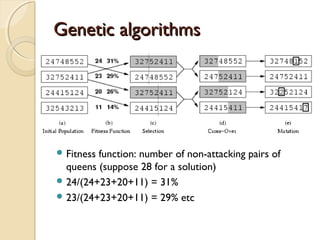
In the example, the values of 4 states are 24,23, 20 and 11 and for
this variant of genetic algorithm the probability of being chosen a
state for reproducing is directly proportional to be fitness score.
The next steps are selection of parents for reproducing, crossover
and mutation.
Crossover point is randomly selected
from the positions in the string.
Lastly, each location is subject to random
mutation with a small independent
probability
Genetic algorithmsGenetic algorithms
 Fitness function: number of non-attacking pairs of
queens (suppose 28 for a solution)
 24/(24+23+20+11) = 31%
 23/(24+23+20+11) = 29% etc

Informed search (heuristics)

  • 1.
    Chapter 4Chapter 4 Informedsearch & ExplorationInformed search & Exploration CSE 4701
  • 2.
    Review: Tree searchReview:Tree search A search strategy is defined by picking the order of node expansion Uninformed search strategies use only the information available in the problem definition ◦ Breadth-first search ◦ Uniform-cost search ◦ Depth-first search ◦ Depth-limited search ◦ Iterative deepening search
  • 3.
  • 4.
    Heuristics examplesHeuristics examples Aheuristic function at a node n is an estimate of the optimum cost from the current node to a goal. Denoted by h(n) h(n)= estimated cost of the cheapest path from node n to a goal node. Example: want path from Dhaka to Chittagong Heuristics for Chittagong may be straight line distance between Dhaka and Chittagong
  • 5.
  • 6.
    Best-first searchBest-first search Idea: use an evaluation function f(n) for each node ◦ estimate of "desirability“ 1. Greedy Best-First Search 2. A* search
  • 7.
    Romania with stepcosts in kmRomania with step costs in km
  • 8.
    Greedy best-first searchGreedybest-first search Evaluation function f(n) = h(n) (heuristic) = estimate of cost from n to goal e.g., hSLD(n) = straight-line distance from n to Bucharest Greedy best-first search expands the node that appears to be closest to goal
  • 9.
    Greedy best-first searchexampleGreedy best-first search example
  • 10.
    Greedy best-first searchexampleGreedy best-first search example
  • 11.
    Greedy best-first searchexampleGreedy best-first search example
  • 12.
    Greedy best-first searchexampleGreedy best-first search example
  • 13.
    But is thissolution optimal? No, because instead of using the via Sibiu and fagaras to Bucharest, if we follow the path through Rimmicu Vilcea and Pitesti, then we have to go 32 km less than the first path. This shows why the algorithm is called “greedy”- at every step it tries to get as close to the goal as it can.
  • 14.
    Drawbacks of greedysearchDrawbacks of greedy search Minimizing h(n) is susceptible to false starts. Consider the problem of getting from Iasi to Fagaras. The heuristic suggests that Neamt be expanded first, because it is closest to Fagaras, but this is a dead end. The solution is to go first to vaslui- a step that is actually farther from the goal according to the heuristis
  • 15.
    Properties of greedybest-firstProperties of greedy best-first searchsearch  Greedy Best first search resembles depth first search in the way it prefers to follow a single path all the way to the goal, but will back up when it hits a dead end.  Complete? No – can get stuck in loops, e.g., Iasi  Neamt  Iasi  Neamt   Time? O(bm ), but a good heuristic can give dramatic improvement  Space? O(bm ) -- keeps all nodes in memory  Optimal? No
  • 16.
    AA** searchsearch Idea: avoid expandingpaths that are already expensive Evaluation function f(n) = g(n) + h(n) g(n) = cost so far to reach n h(n) = estimated cost from n to goal f(n) = estimated total cost of path through n to goal
  • 17.
  • 18.
  • 19.
  • 20.
  • 21.
  • 22.
  • 23.
    Admissible heuristicsAdmissible heuristics A heuristic h(n) is admissible if for every node n, h(n) ≤ h* (n), where h* (n) is the true cost to reach the goal state from n.  An admissible heuristic never overestimates the cost to reach the goal, i.e., it is optimistic  Example: hSLD(n) (never overestimates the actual road distance)  Theorem: If h(n) is admissible, A* using TREE-SEARCH is optimal   
  • 24.
    Properties of A*Propertiesof A* Complete? Yes (unless there are infinitely many nodes with f ≤ f(G) ) Time? Exponential Space? Keeps all nodes in memory Optimal? Yes
  • 25.
    Example:Example: nn-queens-queens Put nqueens on an n × n board with no two queens on the same row, column, or diagonal
  • 26.
    Hill-climbing searchHill-climbing search Problem:depending on initial state, can get stuck in local maxima 
  • 27.
    Genetic algorithmsGenetic algorithms A successor state is generated by combining two parent states  Start with k randomly generated states (population)  A state is represented as a string over a finite alphabet (often a string of 0s and 1s)  Evaluation function (fitness function). Higher values for better states.  Produce the next generation of states by selection, crossover, and mutation
  • 28.
    ExampleExample  Example: 8queens problem. A state could be represented as 8 digits each in the range from 1 to 8 Each state is rated by the evaluation function or fitness function. A Fitness function returns higher values for better states. Suppose for 8 queens problem fitness function will be based on the number of non attacking pairs of queens. Suppose fitness value 28 provides a solution. In the example, the values of 4 states are 24,23, 20 and 11 and for this variant of genetic algorithm the probability of being chosen a state for reproducing is directly proportional to be fitness score. The next steps are selection of parents for reproducing, crossover and mutation.
  • 29.
    Crossover point israndomly selected from the positions in the string. Lastly, each location is subject to random mutation with a small independent probability
  • 30.
  • 31.
    Genetic algorithmsGenetic algorithms Fitness function: number of non-attacking pairs of queens (suppose 28 for a solution)  24/(24+23+20+11) = 31%  23/(24+23+20+11) = 29% etc