Assignment Statements
Topics
• Names in the symbol table
• Reusing temporary names
• Addressing array elements
• The translation scheme for addressing array
elements.
• Accessing fields in records
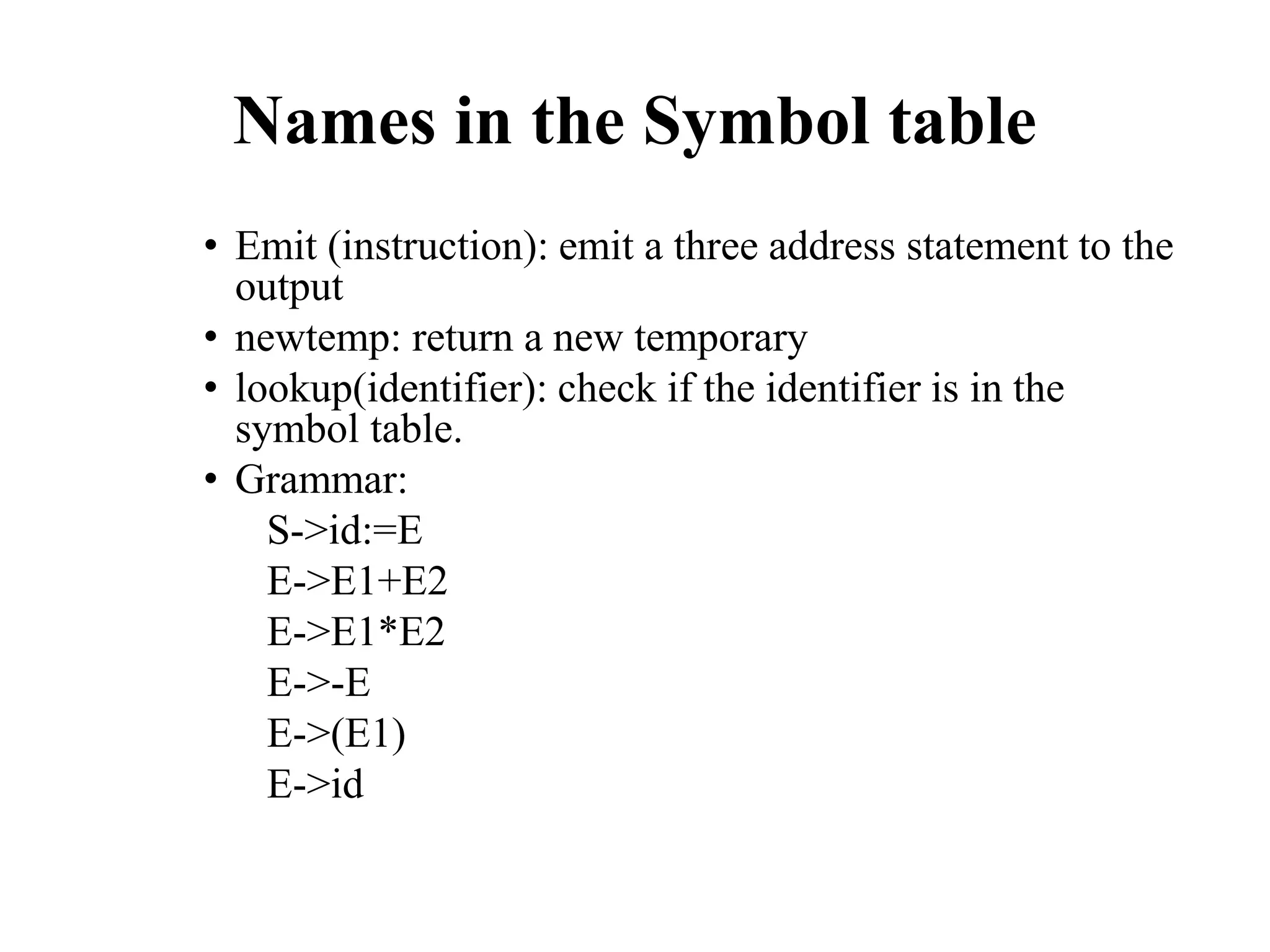
Names in the Symbol table
• Emit (instruction): emit a three address statement to the
output
• newtemp: return a new temporary
• lookup(identifier): check if the identifier is in the
symbol table.
• Grammar:
S->id:=E
E->E1+E2
E->E1*E2
E->-E
E->(E1)
E->id
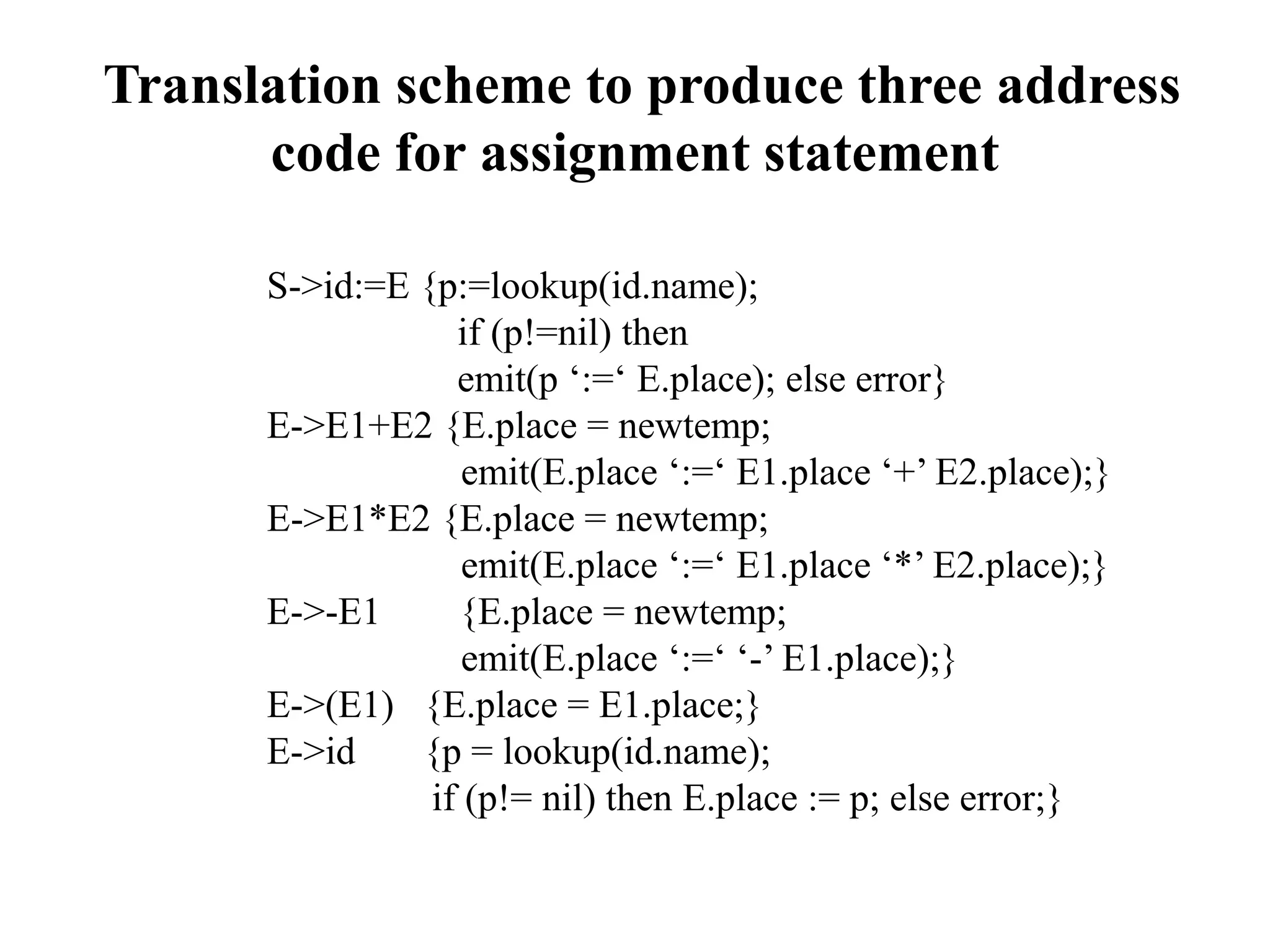
Translation scheme to produce three address
code for assignment statement
S->id:=E {p:=lookup(id.name);
if (p!=nil) then
emit(p ‘:=‘ E.place); else error}
E->E1+E2 {E.place = newtemp;
emit(E.place ‘:=‘ E1.place ‘+’ E2.place);}
E->E1*E2 {E.place = newtemp;
emit(E.place ‘:=‘ E1.place ‘*’ E2.place);}
E->-E1 {E.place = newtemp;
emit(E.place ‘:=‘ ‘-’ E1.place);}
E->(E1) {E.place = E1.place;}
E->id {p = lookup(id.name);
if (p!= nil) then E.place := p; else error;}
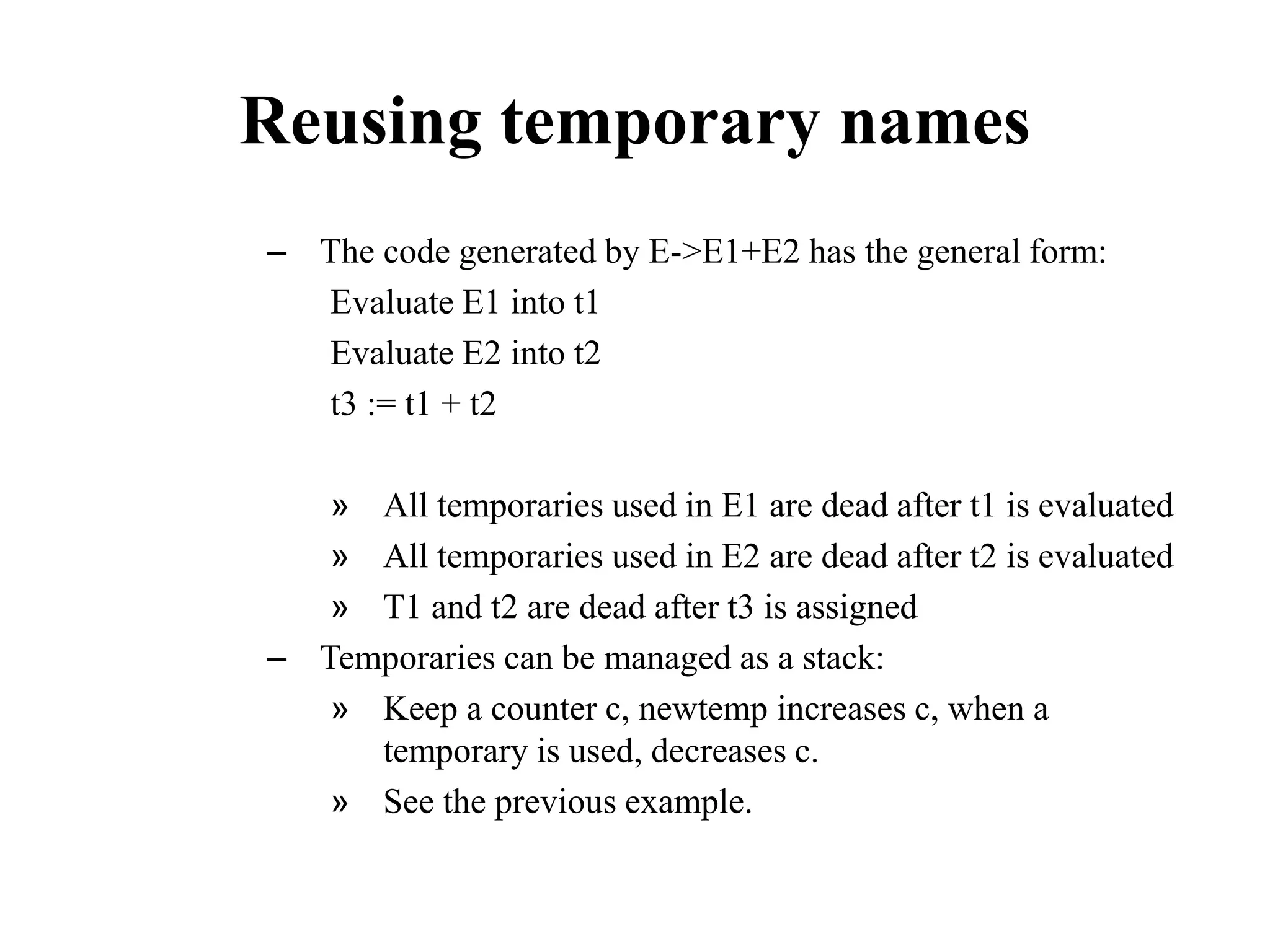
Reusing temporary names
– The code generated by E->E1+E2 has the general form:
Evaluate E1 into t1
Evaluate E2 into t2
t3 := t1 + t2
» All temporaries used in E1 are dead after t1 is evaluated
» All temporaries used in E2 are dead after t2 is evaluated
» T1 and t2 are dead after t3 is assigned
– Temporaries can be managed as a stack:
» Keep a counter c, newtemp increases c, when a
temporary is used, decreases c.
» See the previous example.
Addressing array elements
– Arrays are typically stored in block of consecutive locations.
– One-dimensional arrays
• A: array[low..high] of …
• the ith elements is at:
base + (i-low)*width  i*width + (base – low*width)
– Multi-dimensional arrays:
• Row major or column major forms
– Row major: a[1,1], a[1,2], a[1,3], a[2,1], a[2,2], a[2,3]
– Column major: a[1,1], a[2,1], a[1, 2], a[2, 2],a[1, 3],a[2,3]
• In raw major form, the address of a[i1, i2] is
Base+((i1-low1)*(high2-low2+1)+i2-low2)*width
Addressing array elements
• In raw major form, the address of a[i1, i2] is
Base+((i1-low1)*(high2-low2+1)+i2-low2)*width
– In general, for any dimensional array, the address of
a[i1, i2, i3, …, ik] can be computed as follows:
• Let highj and lowj be for bounds for ij
• Let nj = highj – lowj + 1
• The address is
• ((…(i1*n2+i2)*n3+…)nk+ik)*width + base –
((…low1*n2+low2)*n3+…)nk+lowk) * width
– When generating code for array references, we need to
explicitly compute the address.
Translation scheme for array elements
• Limit(array, j) returns nj=highj-lowj+1
• .place: the temporarys or variables
• .offset: offset from the base, null if not an array reference
• Grammar:
S->L := E
E->E+E
E->(E)
E->L
L->Elist ]
L->id
Elist->Elist, E
Elist->id[E
S->L := E { if L.offset = null then emit(L.place ‘:=‘ E.place)
else emit(L.place’[‘L.offset ‘]’ ‘:=‘ E.place);}
E->E1+E2 {E.place := newtemp;
emit(E.place ‘:=‘ E1.place ‘+’ E2.place);}
E->(E1) {E.place := E1.place;}
E->L {if L.offset = null then E.place = L.place
else {E.place = newtemp;
emit(E.place ‘:=‘ L.place ‘[‘ L.offset ‘]’);
}
}
L->Elist ] {L.place = newtemp; L.offset = newtemp;
emit(L.place ‘:=‘ c(Elist.array));
emit(L.offset ‘:=‘ Elist.place ‘*’ width(Elist.array);
}
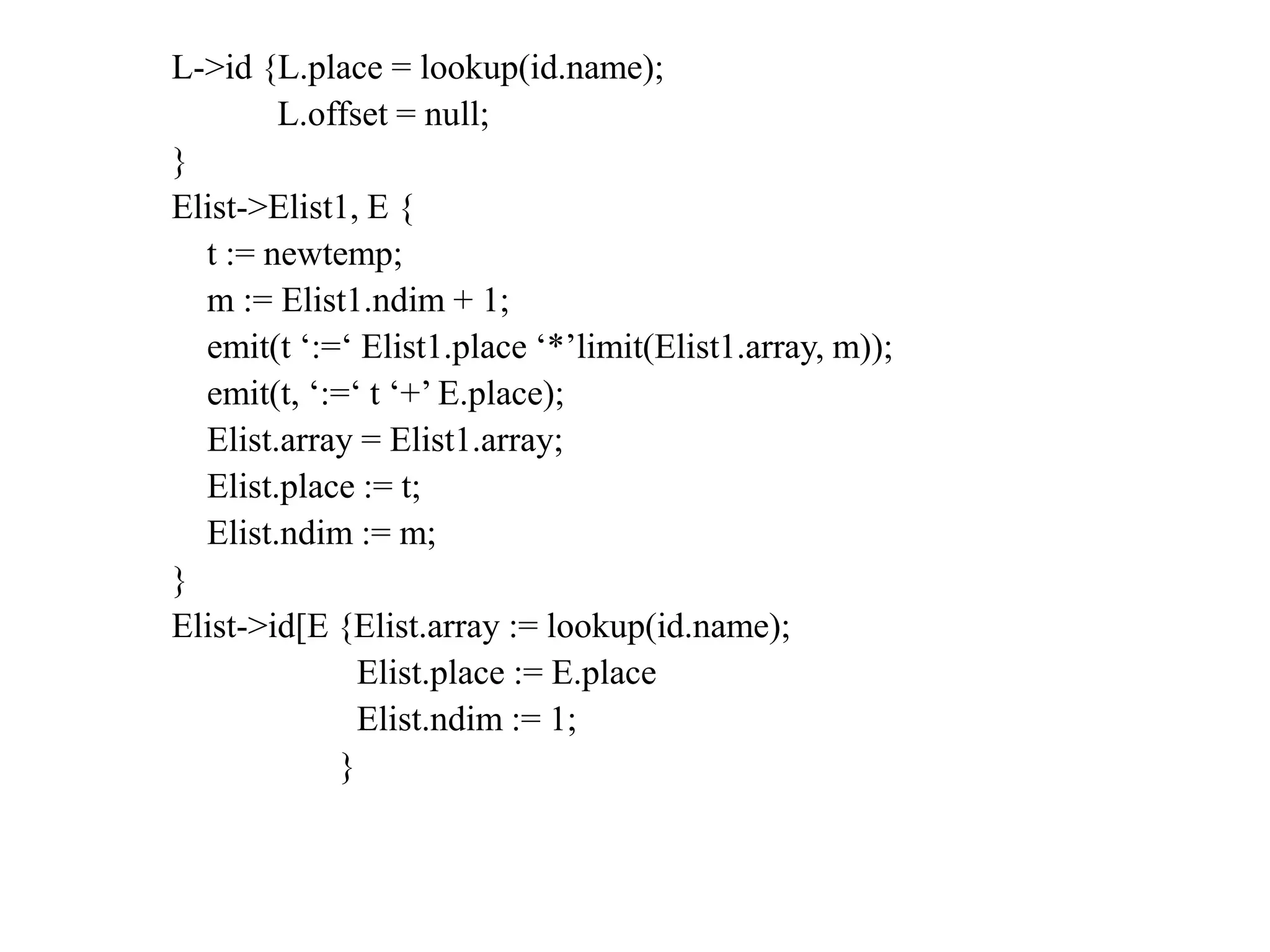
L->id {L.place = lookup(id.name);
L.offset = null;
}
Elist->Elist1, E {
t := newtemp;
m := Elist1.ndim + 1;
emit(t ‘:=‘ Elist1.place ‘*’limit(Elist1.array, m));
emit(t, ‘:=‘ t ‘+’ E.place);
Elist.array = Elist1.array;
Elist.place := t;
Elist.ndim := m;
}
Elist->id[E {Elist.array := lookup(id.name);
Elist.place := E.place
Elist.ndim := 1;
}
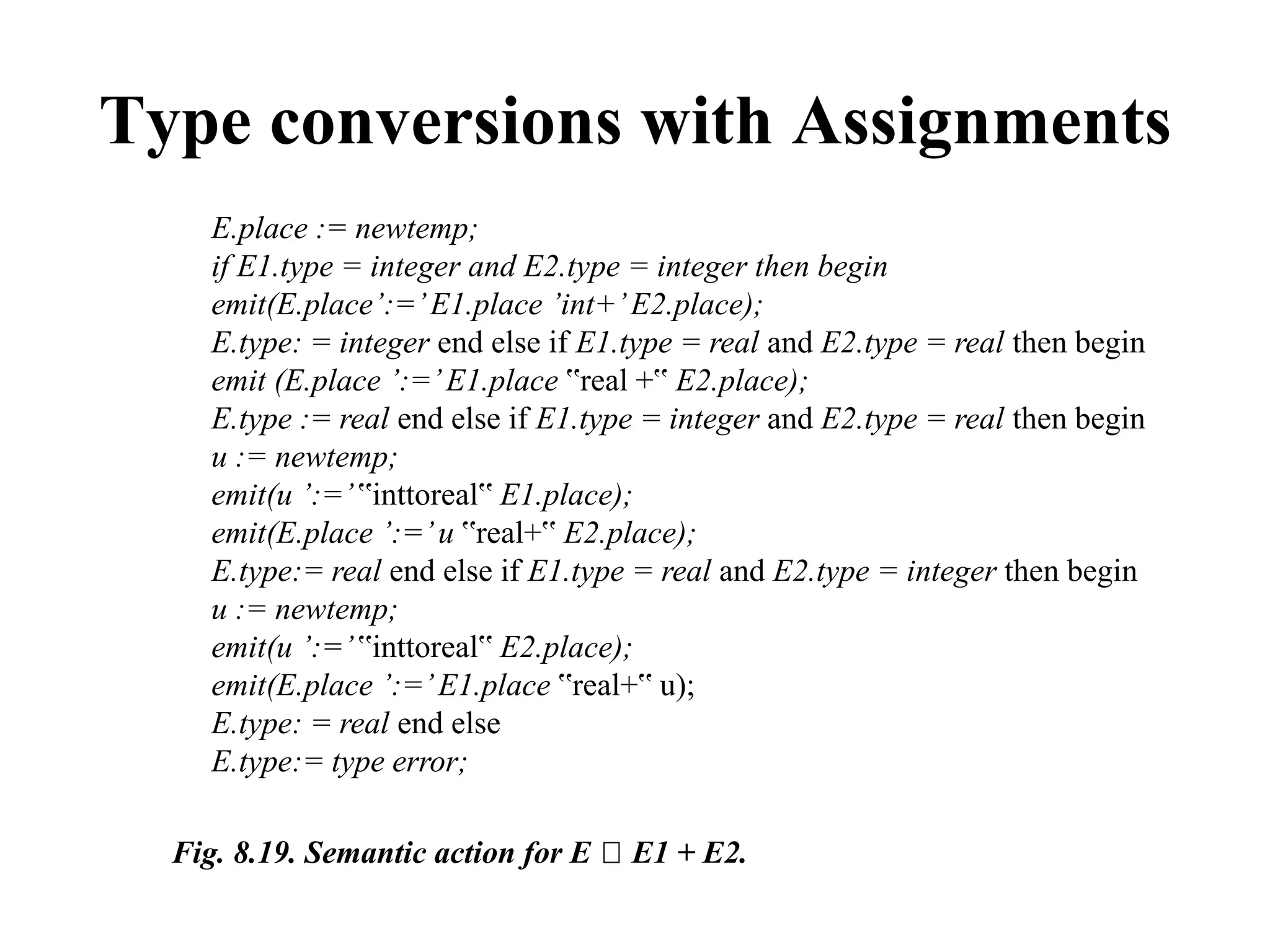
E.place := newtemp;
if E1.type = integer and E2.type = integer then begin
emit(E.place’:=’E1.place ’int+’E2.place);
E.type: = integer end else if E1.type = real and E2.type = real then begin
emit (E.place ’:=’E1.place ‟real +‟ E2.place);
E.type := real end else if E1.type = integer and E2.type = real then begin
u := newtemp;
emit(u ’:=’‟inttoreal‟ E1.place);
emit(E.place ’:=’u ‟real+‟ E2.place);
E.type:= real end else if E1.type = real and E2.type = integer then begin
u := newtemp;
emit(u ’:=’‟inttoreal‟ E2.place);
emit(E.place ’:=’E1.place ‟real+‟ u);
E.type: = real end else
E.type:= type error;
Fig. 8.19. Semantic action for E E1 + E2.
Type conversions with Assignments
Cont…
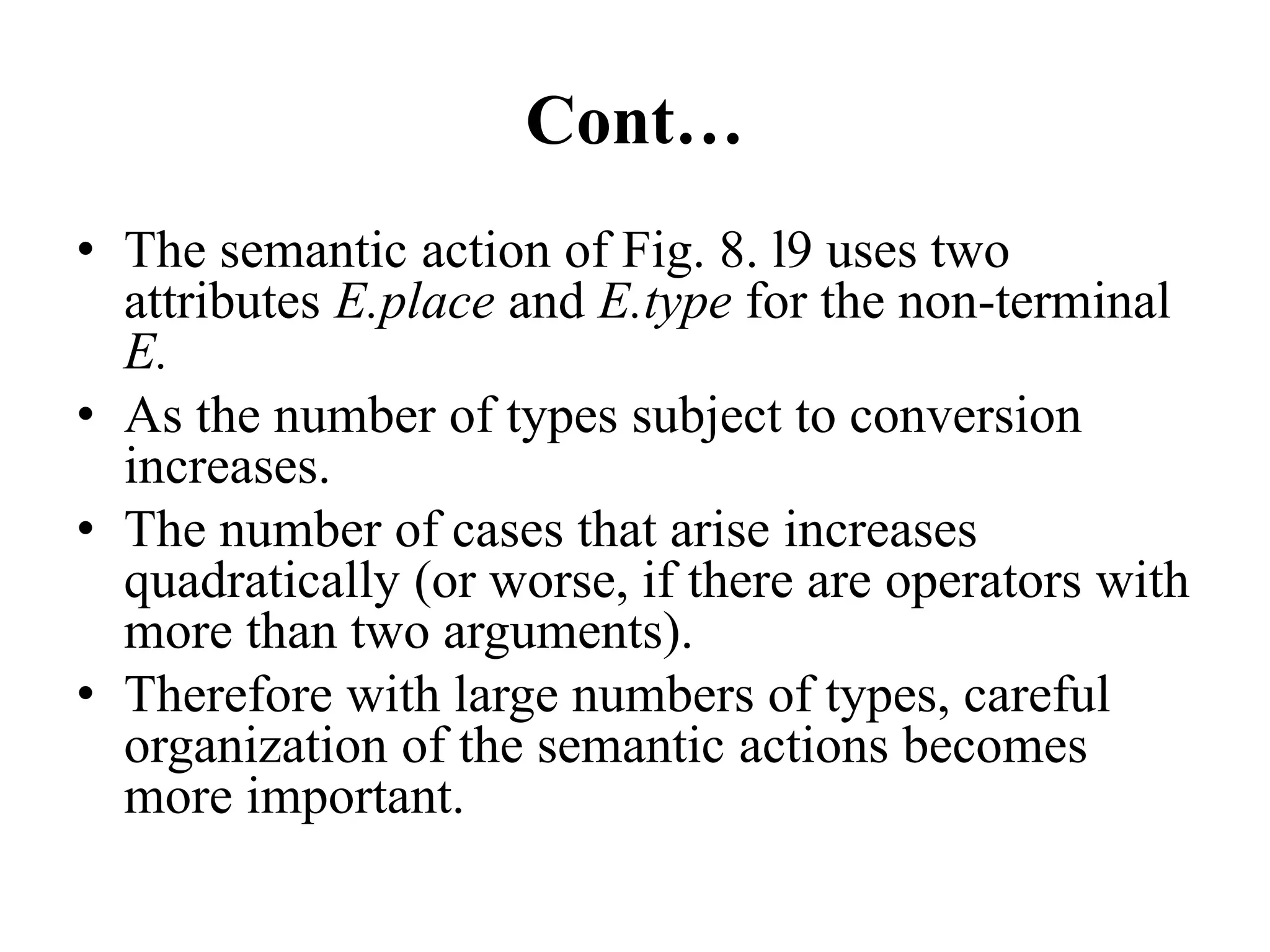
• The semantic action of Fig. 8. l9 uses two
attributes E.place and E.type for the non-terminal
E.
• As the number of types subject to conversion
increases.
• The number of cases that arise increases
quadratically (or worse, if there are operators with
more than two arguments).
• Therefore with large numbers of types, careful
organization of the semantic actions becomes
more important.
Accessing Fields in Records
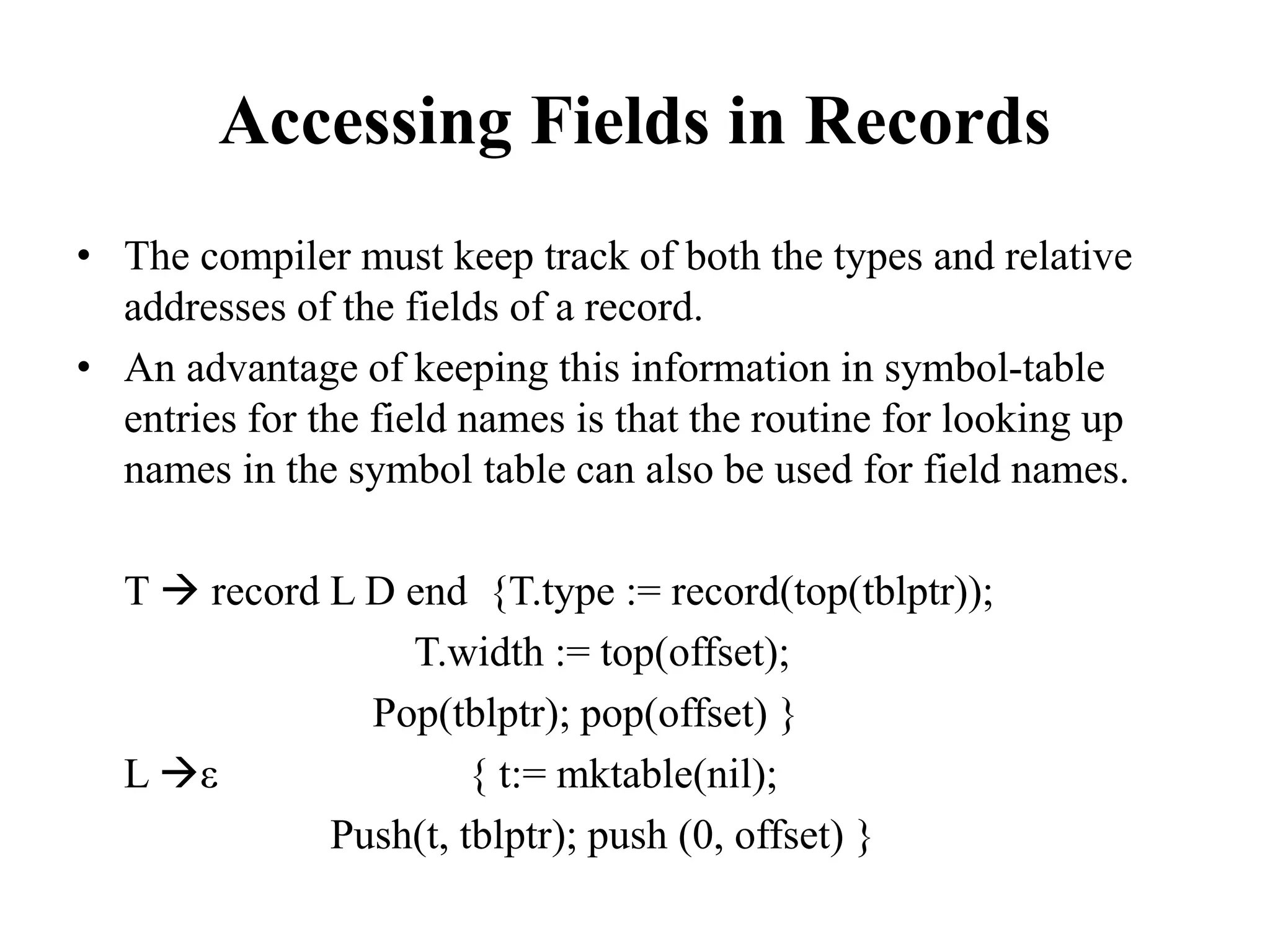
• The compiler must keep track of both the types and relative
addresses of the fields of a record.
• An advantage of keeping this information in symbol-table
entries for the field names is that the routine for looking up
names in the symbol table can also be used for field names.
T  record L D end {T.type := record(top(tblptr));
T.width := top(offset);
Pop(tblptr); pop(offset) }
L ε { t:= mktable(nil);
Push(t, tblptr); push (0, offset) }
Cont…
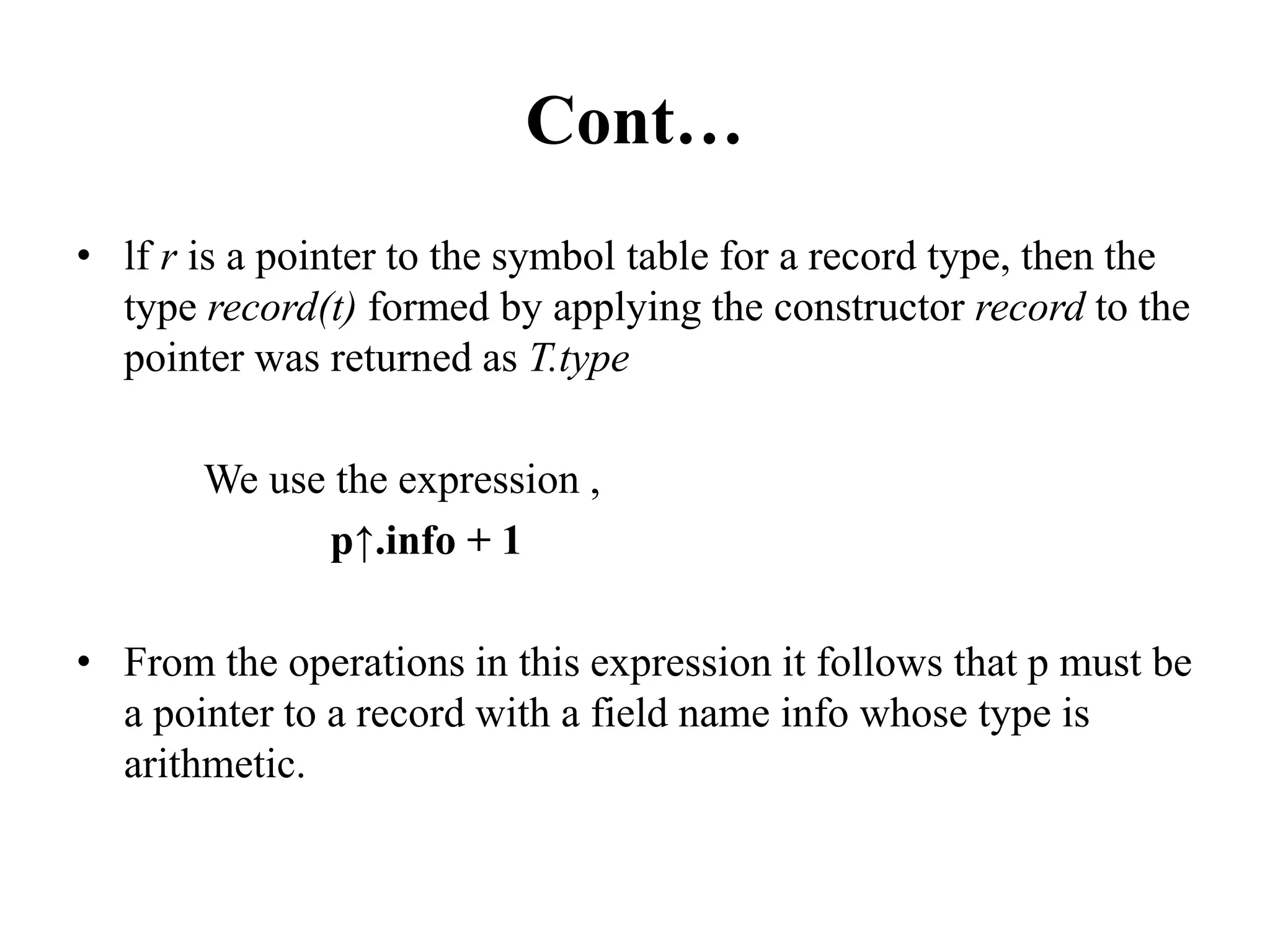
• lf r is a pointer to the symbol table for a record type, then the
type record(t) formed by applying the constructor record to the
pointer was returned as T.type
We use the expression ,
p↑.info + 1
• From the operations in this expression it follows that p must be
a pointer to a record with a field name info whose type is
arithmetic.
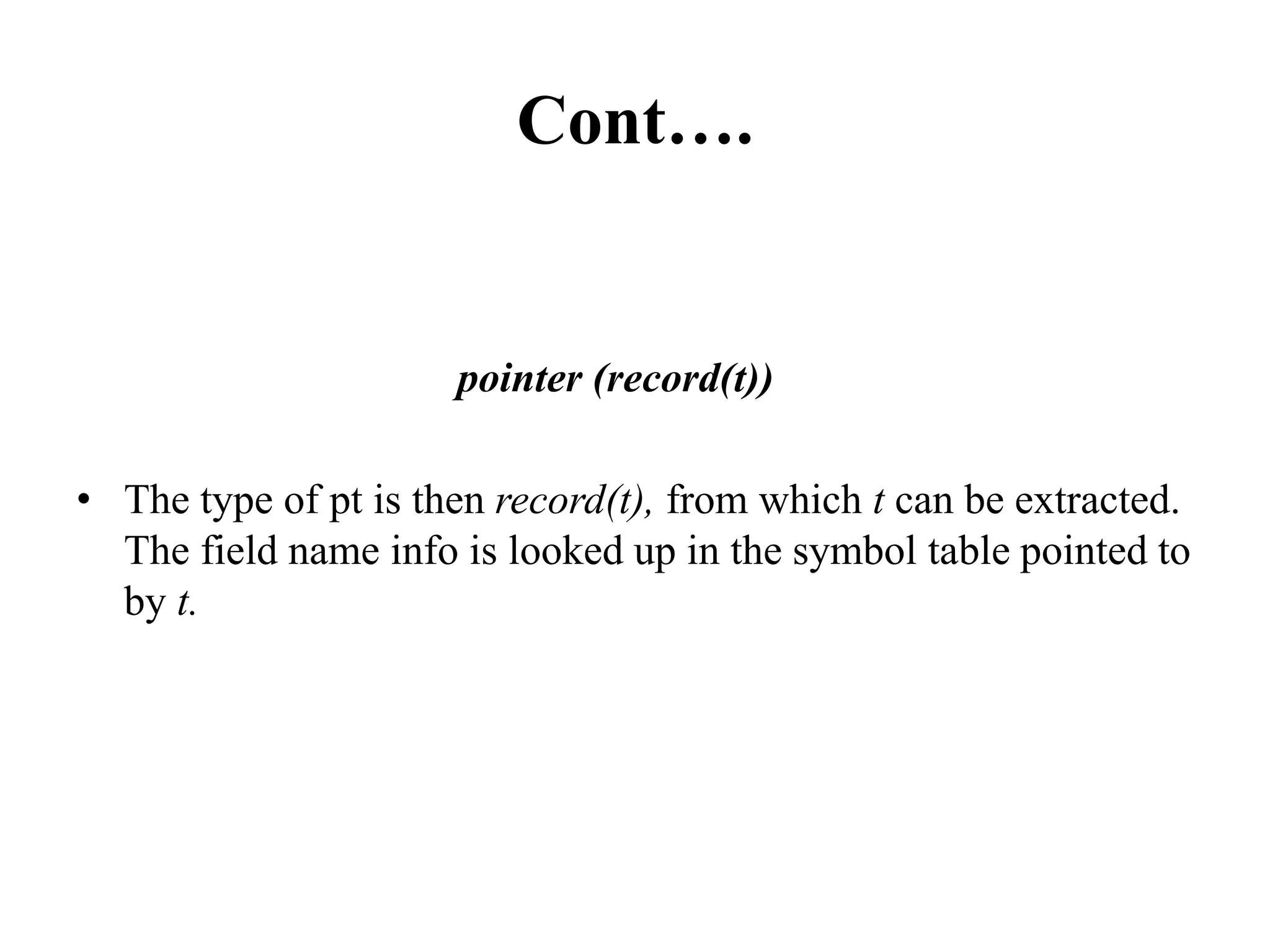
Cont….
pointer (record(t))
• The type of pt is then record(t), from which t can be extracted.
The field name info is looked up in the symbol table pointed to
by t.
?

Assignment statements

  • 1.
  • 2.
    Topics • Names inthe symbol table • Reusing temporary names • Addressing array elements • The translation scheme for addressing array elements. • Accessing fields in records
  • 3.
    Names in theSymbol table • Emit (instruction): emit a three address statement to the output • newtemp: return a new temporary • lookup(identifier): check if the identifier is in the symbol table. • Grammar: S->id:=E E->E1+E2 E->E1*E2 E->-E E->(E1) E->id
  • 4.
    Translation scheme toproduce three address code for assignment statement S->id:=E {p:=lookup(id.name); if (p!=nil) then emit(p ‘:=‘ E.place); else error} E->E1+E2 {E.place = newtemp; emit(E.place ‘:=‘ E1.place ‘+’ E2.place);} E->E1*E2 {E.place = newtemp; emit(E.place ‘:=‘ E1.place ‘*’ E2.place);} E->-E1 {E.place = newtemp; emit(E.place ‘:=‘ ‘-’ E1.place);} E->(E1) {E.place = E1.place;} E->id {p = lookup(id.name); if (p!= nil) then E.place := p; else error;}
  • 5.
    Reusing temporary names –The code generated by E->E1+E2 has the general form: Evaluate E1 into t1 Evaluate E2 into t2 t3 := t1 + t2 » All temporaries used in E1 are dead after t1 is evaluated » All temporaries used in E2 are dead after t2 is evaluated » T1 and t2 are dead after t3 is assigned – Temporaries can be managed as a stack: » Keep a counter c, newtemp increases c, when a temporary is used, decreases c. » See the previous example.
  • 6.
    Addressing array elements –Arrays are typically stored in block of consecutive locations. – One-dimensional arrays • A: array[low..high] of … • the ith elements is at: base + (i-low)*width  i*width + (base – low*width) – Multi-dimensional arrays: • Row major or column major forms – Row major: a[1,1], a[1,2], a[1,3], a[2,1], a[2,2], a[2,3] – Column major: a[1,1], a[2,1], a[1, 2], a[2, 2],a[1, 3],a[2,3] • In raw major form, the address of a[i1, i2] is Base+((i1-low1)*(high2-low2+1)+i2-low2)*width
  • 7.
    Addressing array elements •In raw major form, the address of a[i1, i2] is Base+((i1-low1)*(high2-low2+1)+i2-low2)*width
  • 8.
    – In general,for any dimensional array, the address of a[i1, i2, i3, …, ik] can be computed as follows: • Let highj and lowj be for bounds for ij • Let nj = highj – lowj + 1 • The address is • ((…(i1*n2+i2)*n3+…)nk+ik)*width + base – ((…low1*n2+low2)*n3+…)nk+lowk) * width – When generating code for array references, we need to explicitly compute the address.
  • 9.
    Translation scheme forarray elements • Limit(array, j) returns nj=highj-lowj+1 • .place: the temporarys or variables • .offset: offset from the base, null if not an array reference • Grammar: S->L := E E->E+E E->(E) E->L L->Elist ] L->id Elist->Elist, E Elist->id[E
  • 10.
    S->L := E{ if L.offset = null then emit(L.place ‘:=‘ E.place) else emit(L.place’[‘L.offset ‘]’ ‘:=‘ E.place);} E->E1+E2 {E.place := newtemp; emit(E.place ‘:=‘ E1.place ‘+’ E2.place);} E->(E1) {E.place := E1.place;} E->L {if L.offset = null then E.place = L.place else {E.place = newtemp; emit(E.place ‘:=‘ L.place ‘[‘ L.offset ‘]’); } } L->Elist ] {L.place = newtemp; L.offset = newtemp; emit(L.place ‘:=‘ c(Elist.array)); emit(L.offset ‘:=‘ Elist.place ‘*’ width(Elist.array); }
  • 11.
    L->id {L.place =lookup(id.name); L.offset = null; } Elist->Elist1, E { t := newtemp; m := Elist1.ndim + 1; emit(t ‘:=‘ Elist1.place ‘*’limit(Elist1.array, m)); emit(t, ‘:=‘ t ‘+’ E.place); Elist.array = Elist1.array; Elist.place := t; Elist.ndim := m; } Elist->id[E {Elist.array := lookup(id.name); Elist.place := E.place Elist.ndim := 1; }
  • 12.
    E.place := newtemp; ifE1.type = integer and E2.type = integer then begin emit(E.place’:=’E1.place ’int+’E2.place); E.type: = integer end else if E1.type = real and E2.type = real then begin emit (E.place ’:=’E1.place ‟real +‟ E2.place); E.type := real end else if E1.type = integer and E2.type = real then begin u := newtemp; emit(u ’:=’‟inttoreal‟ E1.place); emit(E.place ’:=’u ‟real+‟ E2.place); E.type:= real end else if E1.type = real and E2.type = integer then begin u := newtemp; emit(u ’:=’‟inttoreal‟ E2.place); emit(E.place ’:=’E1.place ‟real+‟ u); E.type: = real end else E.type:= type error; Fig. 8.19. Semantic action for E E1 + E2. Type conversions with Assignments
  • 13.
    Cont… • The semanticaction of Fig. 8. l9 uses two attributes E.place and E.type for the non-terminal E. • As the number of types subject to conversion increases. • The number of cases that arise increases quadratically (or worse, if there are operators with more than two arguments). • Therefore with large numbers of types, careful organization of the semantic actions becomes more important.
  • 14.
    Accessing Fields inRecords • The compiler must keep track of both the types and relative addresses of the fields of a record. • An advantage of keeping this information in symbol-table entries for the field names is that the routine for looking up names in the symbol table can also be used for field names. T  record L D end {T.type := record(top(tblptr)); T.width := top(offset); Pop(tblptr); pop(offset) } L ε { t:= mktable(nil); Push(t, tblptr); push (0, offset) }
  • 15.
    Cont… • lf ris a pointer to the symbol table for a record type, then the type record(t) formed by applying the constructor record to the pointer was returned as T.type We use the expression , p↑.info + 1 • From the operations in this expression it follows that p must be a pointer to a record with a field name info whose type is arithmetic.
  • 16.
    Cont…. pointer (record(t)) • Thetype of pt is then record(t), from which t can be extracted. The field name info is looked up in the symbol table pointed to by t.
  • 17.