PARKINSON’S
DISEASE
Parkinson’s Disease
Parkinson’s disease , is named after
James Parkinson who in 1817 wrote a
classic “shaking palsy”a disease for which
the reason is still unknown .
 Definition

:It is a chronic degenerative disorder that
primarily affects the neurons of the basal
ganglia.
It is a syndrome that consists of slowing
down in the initiation and execution of
movement (brady kinesia), increased
muscle tone (rigidity), tremor and impaired
postural reflexes
The famous internationally known boxer
Mr. Mohammed Ali suffered from this
disease.
incidence:
Occurs in the age group of 60s. Mostly men
are affected than women.
Classifiation
 Post

encephalitic parkinsonism , which
occured after the large epidemic of
encephalitisin 1919.
 Drug induced parkinsonism, occuring after
long term use of phenothiazines .
 Toxin induced parkinsonism ,
sometimesresulting from carbon
monoxide, mercury, or manganese
exposure.
 Exposure

to agricultural herbicides and

pesticides
 Trauma or injury to the midbrain.
Etiology
 Heredity
 Antipsychotic

drugs (or neuroleptic agents)
 Encephalitis infection in response to brain
trauma, tumors, hydrocephalus or ischaemia
 Arteriosclerosis
 Neurotoxins such as cyanide, manganese and
carbon monoxide
 Drugs like reserpine (hydropress), meyhyl dopa
(aldomet), haloperidol (haldol) and
phenothiazine (thorazine)
Pathophysiology
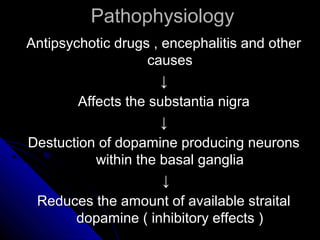
Antipsychotic drugs , encephalitis and other
causes
↓
Affects the substantia nigra
↓
Destuction of dopamine producing neurons
within the basal ganglia
↓
Reduces the amount of available straital
dopamine ( inhibitory effects )
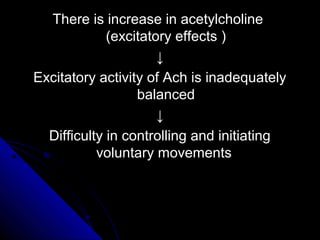
There is increase in acetylcholine
(excitatory effects )
↓
Excitatory activity of Ach is inadequately
balanced
↓
Difficulty in controlling and initiating
voluntary movements
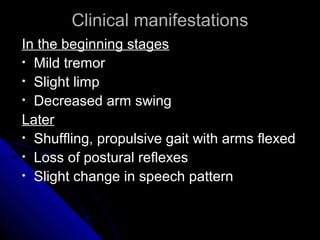
Clinical manifestations
In the beginning stages
• Mild tremor
• Slight limp
• Decreased arm swing
Later
• Shuffling, propulsive gait with arms flexed
• Loss of postural reflexes
• Slight change in speech pattern
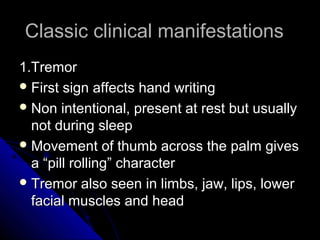
Classic clinical manifestations
1.Tremor
 First sign affects hand writing
 Non intentional, present at rest but usually
not during sleep
 Movement of thumb across the palm gives
a “pill rolling” character
 Tremor also seen in limbs, jaw, lips, lower
facial muscles and head
2. Rigidity
• Increased resistance to passive motion
when the limbs are moved through their
range of motion
• Muscles feel stiff and required increased
effort to move
• Discomfort or pain may be percieved in
muscle when rigidity is severe
• “Cog wheel” rigidity refer to rachet – like
rhythmic contractions of the muscle that
occur when the limbs are passively
stretched
3. Bradykinesia (akinesia)
• Slowness of active movement
• Difficulty in initiating movement
• Often the most disabling symptom:
interferes with ADK and predisposes
patient to complication related to
constipation , circulatory stasis, skin
breakdown and related complications of
immobility .
4.Postural instability
• i) Changes in gait
• Tendency to walk forward on the toes
with small shuffling steps
• Once initiated, movement may accelerate
almost to trot
• Festination may occur, which propels the
patient either forward or backward
propulsively until falling is inevitable.
ii) Changes in balance
• Stooped- over posture when erect
• Arms are semi flexed and do not swing
with walking
• Difficulty in maintaining balance and
sitting erect
• Cannot ‘right’ or brace self to prevent
falling ,when balance is lost
Secondary manifestations

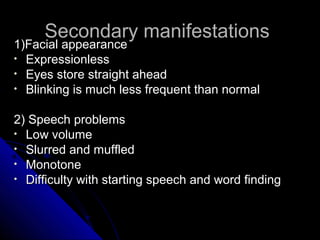
1)Facial appearance
• Expressionless
• Eyes store straight ahead
• Blinking is much less frequent than normal

2) Speech problems
• Low volume
• Slurred and muffled
• Monotone
• Difficulty with starting speech and word finding
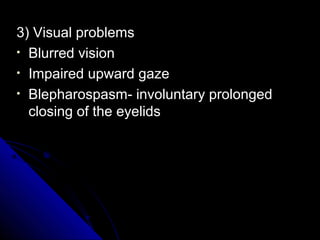
3) Visual problems
• Blurred vision
• Impaired upward gaze
• Blepharospasm- involuntary prolonged
closing of the eyelids
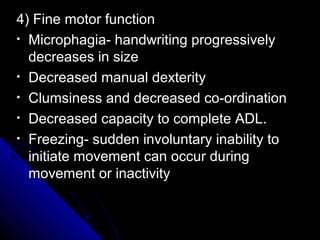
4) Fine motor function
• Microphagia- handwriting progressively
decreases in size
• Decreased manual dexterity
• Clumsiness and decreased co-ordination
• Decreased capacity to complete ADL.
• Freezing- sudden involuntary inability to
initiate movement can occur during
movement or inactivity
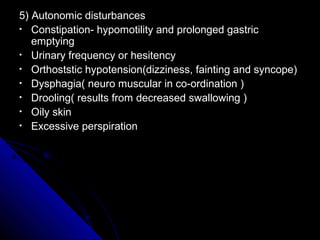
5) Autonomic disturbances
• Constipation- hypomotility and prolonged gastric
emptying
• Urinary frequency or hesitency
• Orthoststic hypotension(dizziness, fainting and syncope)
• Dysphagia( neuro muscular in co-ordination )
• Drooling( results from decreased swallowing )
• Oily skin
• Excessive perspiration
6)Cognitive / behavioral
• Depression
• Slowed responsiveness
• Memory deficit
• Visual-spacial deficit
• Dementia
Pharmacological management
 Anti-

cholinergics
 Anti- histaminics
 Dopaminergics
 Dopamin agonists
 MAO inhibitors
Surgical treatment
 Thalamotomy
 Pallidotomy
 Fetal

tissue transplantation( no cases
resulted in complete reversal of
parkinsonian symptoms)
 Transplantation of genetically engineering
cell lines or vector mediated gene
transfection.
Parkinson’s disease

Parkinson’s disease

  • 1.
  • 2.
    Parkinson’s Disease Parkinson’s disease, is named after James Parkinson who in 1817 wrote a classic “shaking palsy”a disease for which the reason is still unknown .
  • 3.
     Definition :It isa chronic degenerative disorder that primarily affects the neurons of the basal ganglia. It is a syndrome that consists of slowing down in the initiation and execution of movement (brady kinesia), increased muscle tone (rigidity), tremor and impaired postural reflexes
  • 4.
    The famous internationallyknown boxer Mr. Mohammed Ali suffered from this disease. incidence: Occurs in the age group of 60s. Mostly men are affected than women.
  • 5.
    Classifiation  Post encephalitic parkinsonism, which occured after the large epidemic of encephalitisin 1919.  Drug induced parkinsonism, occuring after long term use of phenothiazines .  Toxin induced parkinsonism , sometimesresulting from carbon monoxide, mercury, or manganese exposure.
  • 6.
     Exposure to agriculturalherbicides and pesticides  Trauma or injury to the midbrain.
  • 7.
    Etiology  Heredity  Antipsychotic drugs(or neuroleptic agents)  Encephalitis infection in response to brain trauma, tumors, hydrocephalus or ischaemia  Arteriosclerosis  Neurotoxins such as cyanide, manganese and carbon monoxide  Drugs like reserpine (hydropress), meyhyl dopa (aldomet), haloperidol (haldol) and phenothiazine (thorazine)
  • 8.
    Pathophysiology Antipsychotic drugs ,encephalitis and other causes ↓ Affects the substantia nigra ↓ Destuction of dopamine producing neurons within the basal ganglia ↓ Reduces the amount of available straital dopamine ( inhibitory effects )
  • 9.
    There is increasein acetylcholine (excitatory effects ) ↓ Excitatory activity of Ach is inadequately balanced ↓ Difficulty in controlling and initiating voluntary movements
  • 10.
    Clinical manifestations In thebeginning stages • Mild tremor • Slight limp • Decreased arm swing Later • Shuffling, propulsive gait with arms flexed • Loss of postural reflexes • Slight change in speech pattern
  • 11.
    Classic clinical manifestations 1.Tremor First sign affects hand writing  Non intentional, present at rest but usually not during sleep  Movement of thumb across the palm gives a “pill rolling” character  Tremor also seen in limbs, jaw, lips, lower facial muscles and head
  • 12.
    2. Rigidity • Increasedresistance to passive motion when the limbs are moved through their range of motion • Muscles feel stiff and required increased effort to move • Discomfort or pain may be percieved in muscle when rigidity is severe • “Cog wheel” rigidity refer to rachet – like rhythmic contractions of the muscle that occur when the limbs are passively stretched
  • 13.
    3. Bradykinesia (akinesia) •Slowness of active movement • Difficulty in initiating movement • Often the most disabling symptom: interferes with ADK and predisposes patient to complication related to constipation , circulatory stasis, skin breakdown and related complications of immobility .
  • 14.
    4.Postural instability • i)Changes in gait • Tendency to walk forward on the toes with small shuffling steps • Once initiated, movement may accelerate almost to trot • Festination may occur, which propels the patient either forward or backward propulsively until falling is inevitable.
  • 15.
    ii) Changes inbalance • Stooped- over posture when erect • Arms are semi flexed and do not swing with walking • Difficulty in maintaining balance and sitting erect • Cannot ‘right’ or brace self to prevent falling ,when balance is lost
  • 16.
    Secondary manifestations 1)Facial appearance •Expressionless • Eyes store straight ahead • Blinking is much less frequent than normal 2) Speech problems • Low volume • Slurred and muffled • Monotone • Difficulty with starting speech and word finding
  • 17.
    3) Visual problems •Blurred vision • Impaired upward gaze • Blepharospasm- involuntary prolonged closing of the eyelids
  • 18.
    4) Fine motorfunction • Microphagia- handwriting progressively decreases in size • Decreased manual dexterity • Clumsiness and decreased co-ordination • Decreased capacity to complete ADL. • Freezing- sudden involuntary inability to initiate movement can occur during movement or inactivity
  • 19.
    5) Autonomic disturbances •Constipation- hypomotility and prolonged gastric emptying • Urinary frequency or hesitency • Orthoststic hypotension(dizziness, fainting and syncope) • Dysphagia( neuro muscular in co-ordination ) • Drooling( results from decreased swallowing ) • Oily skin • Excessive perspiration
  • 20.
    6)Cognitive / behavioral •Depression • Slowed responsiveness • Memory deficit • Visual-spacial deficit • Dementia
  • 21.
    Pharmacological management  Anti- cholinergics Anti- histaminics  Dopaminergics  Dopamin agonists  MAO inhibitors
  • 22.
    Surgical treatment  Thalamotomy Pallidotomy  Fetal tissue transplantation( no cases resulted in complete reversal of parkinsonian symptoms)  Transplantation of genetically engineering cell lines or vector mediated gene transfection.