HARMANDEEP KAUR
Roll No.-18/2011
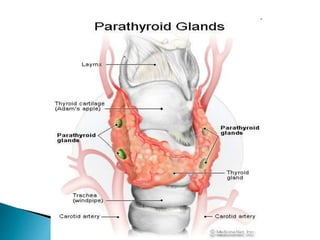
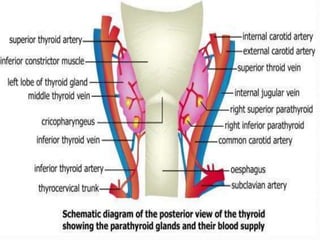
•The parathyroid glands are two pairs of glands
positioned behind the outer wings of
the thyroid I.e posterolateral aspect.
•There are typically four parathyroid glands.
• The two parathyroid glands on each side
which are positioned higher are called the
superior parathyroid glands, while the lower
two are called the inferior parathyroid glands.
•The parathyroid glands usually weigh between
25 mg and 40 mg in humans.
 The blood supply, drainage, and lymphatic
drainage of the parathyroid glands are
equivalent to the thyroid gland.
 The superior parathyroid glands receive their
blood from the superior thyroid arteries, which
are direct branches from the common carotid
arteries.
 The inferior parathyroid glands receive a variable
blood supply, from either the ascending branch
of the inferior thyroid arteries or the thyroid ima
artery. The inferior thyroid artery arises from
the subclavian arteries.
 The parathyroid artery drains into the
superior and, middle and inferior thyroid
veins.
 The superior and middle veins drain into
thejugular vein and the inferior thyroid
vein drains into the brachiocephalic
veins.
 The major function of the parathyroid glands
is to maintain the
body's calcium and phosphate levels within a
very narrow range, so that
the nervous and muscular system can function
properly. The parathyroid glands do this by
secreting parathyroid hormone.
 Parathyroid hormone (PTH, also known as
parathormone) is a small protein that takes
part in the control of calcium
and phosphate homeostasis, as well as bone
physiology. Parathyroid hormone has effects
antagonistic to those of calcitonin.
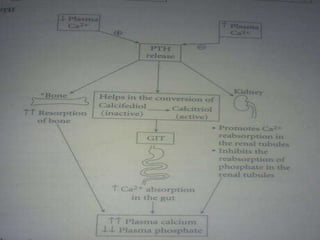
 Calcium- PTH increases blood calcium
levels by stimulating osteoclasts to break
down bone and release calcium. PTH also
increases gastrointestinal calcium
absorption by activating vitamin D, and
promotes calcium conservation
(reabsorption) by the kidneys.
 Phosphate - PTH is the major regulator of
serum phosphate concentrations via
actions on the kidney. It is an inhibitor of
proximal tubular reabsorption of
phosphorus. Through activation of Vitamin
D the absorption of Phosphate is increased.
 Regulation of serum calcium
 Parathyroid hormone regulates serum
calcium through its effects on the following
tissues.
 Regulation of serum phosphate PTH
reduces the reabsorption
of phosphate from the proximal tubule of
the kidney, which means more phosphate
is excreted through the urine.
 However, PTH enhances the uptake of
phosphate from the intestine and bones
into the blood.
 In the bone, slightly more calcium than
phosphate is released from the
breakdown of bone.
 In the intestines, absorption of both
calcium and phosphate is mediated by an
increase in activated vitamin D. The
absorption of phosphate is not as
dependent on vitamin D as is that of
calcium. The end result of PTH release is a
small net drop in the serum concentration
of phosphate.
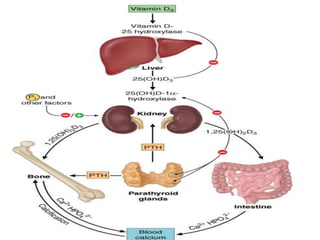
 Vitamin D synthesis
 PTH increases the activity of 1-α-
hydroxylase enzyme, which converts 25-
hydroxycholecalciferol to 1,25-
dihydroxycholecalciferol, the active form
of vitamin D.
 Parathyroid disease is conventionally
divided into states where the
parathyroid is over active
(hyperparathyroidism), and states where
the parathyroid is underactive
(hypoparathyroidism).
 Both states are characterised by their
symptoms, which relate to the excess or
deficiency of parathyroid hormone
 Excessive PTH secretion may be due to
problems in the glands themselves, in
which case it is referred to
as primary hyperparathyroidism and which
leads to hypercalcaemia (raised calcium
levels).
 It may also occur in response to low
calcium levels, as encountered in various
situations such as vitamin D
deficiency or chronic kidney disease; this is
referred to
as secondary hyperparathyroidism. In all
cases, the raised PTH levels are harmful
to bone,
 Primary
hyperparathyroidism causes hypercalce
mia
(elevated blood calcium levels) through
the excessive secretion of parathyroid
hormone (PTH), usually by
an adenoma (benign tumors) of
the parathyroid glands.
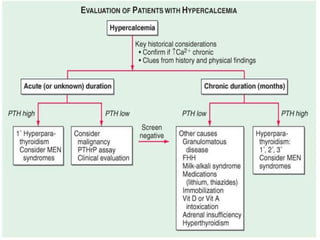
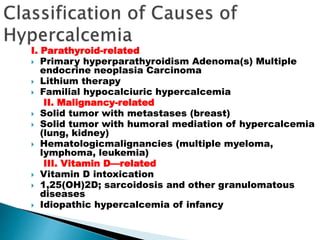
I. Parathyroid-related
 Primary hyperparathyroidism Adenoma(s) Multiple
endocrine neoplasia Carcinoma
 Lithium therapy
 Familial hypocalciuric hypercalcemia
II. Malignancy-related
 Solid tumor with metastases (breast)
 Solid tumor with humoral mediation of hypercalcemia
(lung, kidney)
 Hematologicmalignancies (multiple myeloma,
lymphoma, leukemia)
III. Vitamin D—related
 Vitamin D intoxication
 1,25(OH)2D; sarcoidosis and other granulomatous
diseases
 Idiopathic hypercalcemia of infancy
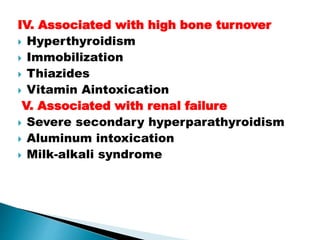
IV. Associated with high bone turnover
 Hyperthyroidism
 Immobilization
 Thiazides
 Vitamin Aintoxication
V. Associated with renal failure
 Severe secondary hyperparathyroidism
 Aluminum intoxication
 Milk-alkali syndrome
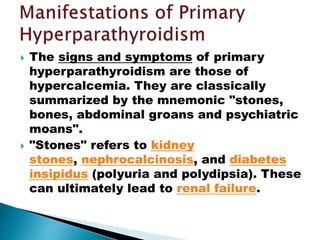
 The signs and symptoms of primary
hyperparathyroidism are those of
hypercalcemia. They are classically
summarized by the mnemonic "stones,
bones, abdominal groans and psychiatric
moans".
 "Stones" refers to kidney
stones, nephrocalcinosis, and diabetes
insipidus (polyuria and polydipsia). These
can ultimately lead to renal failure.
 "Bones" refers to bone-related
complications. The classic bone disease in
hyperparathyroidism is osteitis fibrosa
cystica, which results in pain and sometimes
pathological fractures. Other bone diseases
associated with hyperparathyroidism
are osteoporosis, osteomalacia, and arthritis.
 "Abdominal groans" refers to
gastrointestinal symptoms
of constipation, indigestion, nausea and vomiti
ng.
 Hypercalcemia can lead to peptic
ulcers and acute pancreatitis. The peptic
ulcers can be an effect of increased gastric
acid secretion by hypercalcemia,[4] but may
also be part of a multiple endocrine neoplasia
type 1 syndrome of both hyperparathyroid
neoplasia and a gastrinoma.
 "Psychiatric moans" refers to effects on
the central nervous system. Symptoms
include lethargy, fatigue,
depression, memory loss, psychosis, ataxia,
delirium, and coma.
 "Thrones" refers to polyuria and
constipation.
 Left ventricular hypertrophy.
 Increased all-cause mortality
 Other signs include proximal muscle
weakness, itching, and band keratopathy of
the eyes.
 The diagnosis of primary
hyperparathyroidism is made by blood
tests.
 Serum calcium levels are elevated,
and the parathyroid hormone level is
abnormally high compared with an
expected low level in response to the
high calcium.
 Complications
 The classic bone disease in
hyperparathyroidism is osteitis fibrosa
cystica, which results in pain and
sometimes pathological fractures. Other
bone diseases associated with
hyperparathyroidism
are osteoporosis, osteomalacia,
and arthritis.

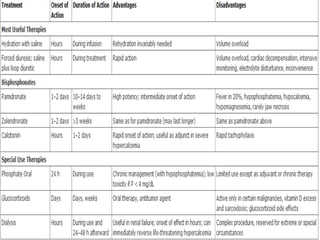
Treatment is usually surgical removal of
the gland(s) containing adenomas.
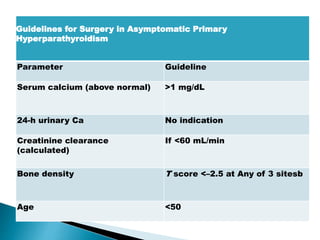
Guidelines for Surgery in Asymptomatic Primary
Hyperparathyroidism
Parameter Guideline
Serum calcium (above normal) >1 mg/dL
24-h urinary Ca No indication
Creatinine clearance
(calculated)
If <60 mL/min
Bone density T score <–2.5 at Any of 3 sitesb
Age <50
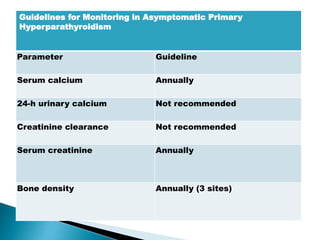
Guidelines for Monitoring in Asymptomatic Primary
Hyperparathyroidism
Parameter Guideline
Serum calcium Annually
24-h urinary calcium Not recommended
Creatinine clearance Not recommended
Serum creatinine Annually
Bone density Annually (3 sites)
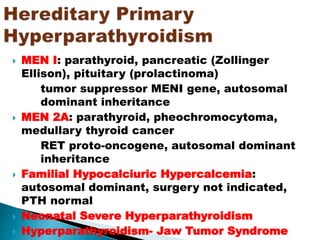
 MEN I: parathyroid, pancreatic (Zollinger
Ellison), pituitary (prolactinoma)
tumor suppressor MENI gene, autosomal
dominant inheritance
 MEN 2A: parathyroid, pheochromocytoma,
medullary thyroid cancer
RET proto-oncogene, autosomal dominant
inheritance
 Familial Hypocalciuric Hypercalcemia:
autosomal dominant, surgery not indicated,
PTH normal
 Neonatal Severe Hyperparathyroidism
 Hyperparathyroidism- Jaw Tumor Syndrome
 Secondary hyperparathyroidism refers
to the excessive secretion
of parathyroid hormone (PTH) by
the parathyroid glands in response
to hypocalcemia (low blood calcium leve
ls) and associated hypertrophy of the
glands. This disorder is especially seen
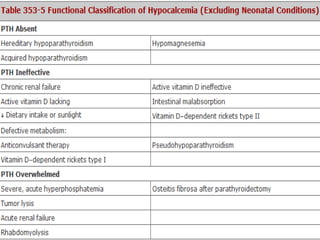
in patients with chronic renal failure.
 Chronic renal failure is the most common
cause of secondary hyperparathyroidism.
 Failing kidneys do not convert
enough vitamin D to its active form, and
they do not adequately
excrete phosphate.
 When this happens, insoluble calcium
phosphate forms in the body and removes
calcium from the circulation.
 Both processes lead to hypocalcemia and
hence secondary hyperparathyroidism.
 Secondary hyperparathyroidism can
also result from malabsorption (chronic
pancreatitis, small bowel disease,
malabsorption) in that the fat soluble
vitamin D can not get reabsorbed.
 This leads to hypocalcemia and a
subsequent increase in parathyroid
hormone secretion in an attempt to
increase the serum calcium levels
 Bone and joint pain are common, as are limb
deformities.
 The elevated PTH has also pleiotropic effects
on blood, immune system and neurological
system
 The PTH is elevated due to decreased levels
of calcium or 1,25-dihydroxy-vitamin D3.
 It is usually seen in cases of chronic renal
disease or defective calcium receptors on the
surface of parathyroid glands.
 If the underlying cause of the hypocalcemia
can be addressed, the hyperparathyroidism
will resolve.
 In patients with chronic renal failure,
treatment consists of dietary restriction of
phosphorus, supplements with an active form
of vitamin D such as calcitriol,etc.
 and phosphate binders which can be divided
into calcium-based and non-calcium based.
 Most patients with hyperparathyroidism
secondary to chronic kidney disease will
improve after renal transplantation, but many
will continue to have a degree of residual
hyperparathyroidism (tertiary
hyperparathyroidism) post-transplant with
associated risk of bone loss, etc.
 If left untreated, the disease will progress
to tertiary hyperparathyroidism, where
correction of the underlying cause will not
stop excess PTH secretion, i.e. parathyroid
gland hypertrophy becomes irreversible.
 is a state of excessive secretion of parathyroid
hormone (PTH) after a long period of secondary
hyperparathyroidism and resulting in hypercalcemia.
It reflects development of autonomous (unregulated)
parathyroid function following a period of persistent
parathyroid stimulation.
 The basis of treatment is still prevention in
chronic renal failure, starting medication and dietary
restrictions long before dialysistreatment is initiated.
 Cinacalcet has greatly reduced the number of
patients who ultimately require surgery for secondary
hyperparathyroidism; however, approximately 5% of
patients do not respond to medical therapy.
 When secondary hyperparathyroidism is
corrected and the parathyroid glands remain
hyperfunctioning, it becomes tertiary
hyperparathyroidism. The treatment of choice
is surgical removal of three and one
half parathyroid glands.
 Hypoparathyroidism is decreased function of
the parathyroid glands with underproduction
of parathyroid hormone.
 Causes
 Hypoparathyroidism can have a following
causes:
 Removal of or trauma to the parathyroid glands
due to thyroid surgery (thyroidectomy) or other
surgical interventions to the neck is a
recognized cause.
 It is now uncommon, as surgeons generally can
spare them during procedures after identifying
them.
 In a small percentage of cases, however, they
can become traumatized during surgery and/or
their blood supply can be compromised. When
this happens the parathyroids may cease
functioning for a while or stop altogether.
 Autoimmune invasion and destruction is the
most common non-surgical cause. It can
occur as part of autoimmune polyendocrine
syndromes.
 Hemochromatosis can lead to iron
accumulation and consequent dysfunction of
a number of endocrine organs, including the
parathyroids.
 Absence or dysfunction of the parathyroid
glands is one of the components
of chromosome 22q11 microdeletion
syndrome (other names: DiGeorge syndrome,
Schprintzen syndrome, velocardiofacial
syndrome).
 Magnesium deficiency
 The main symptoms of hypoparathyroidism are
the result of the low blood calcium level, which
interferes with normal muscle
contraction and nerve conduction.
 As a result, people with hypoparathyroidism can
experience paresthesia, an unpleasant tingling
sensation around the mouth and in the hands
and feet, as well as muscle cramps and severe
spasms known as "tetany" that affect the hands
and feet.
 Many also report a number of subjective
symptoms such as fatigue, headaches, bone
pain and insomnia.[
 Crampy abdominal pain may occur.
 Physical examination of someone
with hypocalcemia may show tetany, but it is also
possible to provoke tetany of the facial muscles by
tapping on the facial nerve (a phenomenon known
as Chvostek's sign) or by using the cuff of
a sphygmomanometer to temporarily obstruct the
blood flow to the arm (a phenomenon known
asTrousseau's sign of latent tetany).
 A number of medical emergencies can arise in people
with low calcium levels. These are seizures, severe
irregularities in the normal heart beat, as well as
spasm of the upper part of the airways or the smaller
airways known as the bronchi (both potentially
causing respiratory failure).[1]
 Diagnosis is by measurement
of calcium, serum albumin (for correction)
and PTH in blood.
 If necessary, measuring cAMP (cyclic AMP) in
the urine after an intravenous dose of PTH
can help in the distinction between
hypoparathyroidism and other causes.
 Severe hypocalcemia, a potentially life-threatening
condition, is treated as soon as possible
with intravenous calcium (e.g. as calcium gluconate).
 Generally, a central venous catheter is recommended,
as the calcium can irritate peripheral veins and
cause phlebitis.
 In the event of a life-threatening attack of low
calcium levels or tetany (prolonged muscle
contractions), calcium is administered by intravenous
(IV) infusion.
 Precautions are taken to prevent seizures or larynx
spasms. The heart is monitored for abnormal
rhythms until the person is stable. When the life-
threatening attack has been controlled, treatment
continues with medicine taken by mouth as often as
four times a day.
 Long-term treatment of hypoparathyroidism is
with vitamin D analogs and calcium
supplementation may be ineffective in some due
to potential renal damage.
 The use of pump delivery of synthetic PTH 1-34
provides the closest approach to physiologic
PTHreplacement therapy.
 Teriparatide, a recombinant form of PTH
(presently registered for osteoporosis) might
become the treatment of choice for PTH
supplementation.
Parathyroidppt

Parathyroidppt

  • 1.
  • 2.
    •The parathyroid glandsare two pairs of glands positioned behind the outer wings of the thyroid I.e posterolateral aspect. •There are typically four parathyroid glands. • The two parathyroid glands on each side which are positioned higher are called the superior parathyroid glands, while the lower two are called the inferior parathyroid glands. •The parathyroid glands usually weigh between 25 mg and 40 mg in humans.
  • 4.
     The bloodsupply, drainage, and lymphatic drainage of the parathyroid glands are equivalent to the thyroid gland.  The superior parathyroid glands receive their blood from the superior thyroid arteries, which are direct branches from the common carotid arteries.  The inferior parathyroid glands receive a variable blood supply, from either the ascending branch of the inferior thyroid arteries or the thyroid ima artery. The inferior thyroid artery arises from the subclavian arteries.
  • 5.
     The parathyroidartery drains into the superior and, middle and inferior thyroid veins.  The superior and middle veins drain into thejugular vein and the inferior thyroid vein drains into the brachiocephalic veins.
  • 7.
     The majorfunction of the parathyroid glands is to maintain the body's calcium and phosphate levels within a very narrow range, so that the nervous and muscular system can function properly. The parathyroid glands do this by secreting parathyroid hormone.  Parathyroid hormone (PTH, also known as parathormone) is a small protein that takes part in the control of calcium and phosphate homeostasis, as well as bone physiology. Parathyroid hormone has effects antagonistic to those of calcitonin.
  • 8.
     Calcium- PTHincreases blood calcium levels by stimulating osteoclasts to break down bone and release calcium. PTH also increases gastrointestinal calcium absorption by activating vitamin D, and promotes calcium conservation (reabsorption) by the kidneys.  Phosphate - PTH is the major regulator of serum phosphate concentrations via actions on the kidney. It is an inhibitor of proximal tubular reabsorption of phosphorus. Through activation of Vitamin D the absorption of Phosphate is increased.
  • 9.
     Regulation ofserum calcium  Parathyroid hormone regulates serum calcium through its effects on the following tissues.
  • 11.
     Regulation ofserum phosphate PTH reduces the reabsorption of phosphate from the proximal tubule of the kidney, which means more phosphate is excreted through the urine.  However, PTH enhances the uptake of phosphate from the intestine and bones into the blood.  In the bone, slightly more calcium than phosphate is released from the breakdown of bone.
  • 12.
     In theintestines, absorption of both calcium and phosphate is mediated by an increase in activated vitamin D. The absorption of phosphate is not as dependent on vitamin D as is that of calcium. The end result of PTH release is a small net drop in the serum concentration of phosphate.  Vitamin D synthesis  PTH increases the activity of 1-α- hydroxylase enzyme, which converts 25- hydroxycholecalciferol to 1,25- dihydroxycholecalciferol, the active form of vitamin D.
  • 14.
     Parathyroid diseaseis conventionally divided into states where the parathyroid is over active (hyperparathyroidism), and states where the parathyroid is underactive (hypoparathyroidism).  Both states are characterised by their symptoms, which relate to the excess or deficiency of parathyroid hormone
  • 15.
     Excessive PTHsecretion may be due to problems in the glands themselves, in which case it is referred to as primary hyperparathyroidism and which leads to hypercalcaemia (raised calcium levels).  It may also occur in response to low calcium levels, as encountered in various situations such as vitamin D deficiency or chronic kidney disease; this is referred to as secondary hyperparathyroidism. In all cases, the raised PTH levels are harmful to bone,
  • 16.
     Primary hyperparathyroidism causeshypercalce mia (elevated blood calcium levels) through the excessive secretion of parathyroid hormone (PTH), usually by an adenoma (benign tumors) of the parathyroid glands.
  • 17.
    I. Parathyroid-related  Primaryhyperparathyroidism Adenoma(s) Multiple endocrine neoplasia Carcinoma  Lithium therapy  Familial hypocalciuric hypercalcemia II. Malignancy-related  Solid tumor with metastases (breast)  Solid tumor with humoral mediation of hypercalcemia (lung, kidney)  Hematologicmalignancies (multiple myeloma, lymphoma, leukemia) III. Vitamin D—related  Vitamin D intoxication  1,25(OH)2D; sarcoidosis and other granulomatous diseases  Idiopathic hypercalcemia of infancy
  • 18.
    IV. Associated withhigh bone turnover  Hyperthyroidism  Immobilization  Thiazides  Vitamin Aintoxication V. Associated with renal failure  Severe secondary hyperparathyroidism  Aluminum intoxication  Milk-alkali syndrome
  • 19.
     The signsand symptoms of primary hyperparathyroidism are those of hypercalcemia. They are classically summarized by the mnemonic "stones, bones, abdominal groans and psychiatric moans".  "Stones" refers to kidney stones, nephrocalcinosis, and diabetes insipidus (polyuria and polydipsia). These can ultimately lead to renal failure.
  • 20.
     "Bones" refersto bone-related complications. The classic bone disease in hyperparathyroidism is osteitis fibrosa cystica, which results in pain and sometimes pathological fractures. Other bone diseases associated with hyperparathyroidism are osteoporosis, osteomalacia, and arthritis.  "Abdominal groans" refers to gastrointestinal symptoms of constipation, indigestion, nausea and vomiti ng.  Hypercalcemia can lead to peptic ulcers and acute pancreatitis. The peptic ulcers can be an effect of increased gastric acid secretion by hypercalcemia,[4] but may also be part of a multiple endocrine neoplasia type 1 syndrome of both hyperparathyroid neoplasia and a gastrinoma.
  • 21.
     "Psychiatric moans"refers to effects on the central nervous system. Symptoms include lethargy, fatigue, depression, memory loss, psychosis, ataxia, delirium, and coma.  "Thrones" refers to polyuria and constipation.  Left ventricular hypertrophy.  Increased all-cause mortality  Other signs include proximal muscle weakness, itching, and band keratopathy of the eyes.
  • 22.
     The diagnosisof primary hyperparathyroidism is made by blood tests.  Serum calcium levels are elevated, and the parathyroid hormone level is abnormally high compared with an expected low level in response to the high calcium.
  • 23.
     Complications  Theclassic bone disease in hyperparathyroidism is osteitis fibrosa cystica, which results in pain and sometimes pathological fractures. Other bone diseases associated with hyperparathyroidism are osteoporosis, osteomalacia, and arthritis.
  • 26.
     Treatment is usuallysurgical removal of the gland(s) containing adenomas.
  • 27.
    Guidelines for Surgeryin Asymptomatic Primary Hyperparathyroidism Parameter Guideline Serum calcium (above normal) >1 mg/dL 24-h urinary Ca No indication Creatinine clearance (calculated) If <60 mL/min Bone density T score <–2.5 at Any of 3 sitesb Age <50
  • 28.
    Guidelines for Monitoringin Asymptomatic Primary Hyperparathyroidism Parameter Guideline Serum calcium Annually 24-h urinary calcium Not recommended Creatinine clearance Not recommended Serum creatinine Annually Bone density Annually (3 sites)
  • 29.
     MEN I:parathyroid, pancreatic (Zollinger Ellison), pituitary (prolactinoma) tumor suppressor MENI gene, autosomal dominant inheritance  MEN 2A: parathyroid, pheochromocytoma, medullary thyroid cancer RET proto-oncogene, autosomal dominant inheritance  Familial Hypocalciuric Hypercalcemia: autosomal dominant, surgery not indicated, PTH normal  Neonatal Severe Hyperparathyroidism  Hyperparathyroidism- Jaw Tumor Syndrome
  • 30.
     Secondary hyperparathyroidismrefers to the excessive secretion of parathyroid hormone (PTH) by the parathyroid glands in response to hypocalcemia (low blood calcium leve ls) and associated hypertrophy of the glands. This disorder is especially seen in patients with chronic renal failure.
  • 31.
     Chronic renalfailure is the most common cause of secondary hyperparathyroidism.  Failing kidneys do not convert enough vitamin D to its active form, and they do not adequately excrete phosphate.  When this happens, insoluble calcium phosphate forms in the body and removes calcium from the circulation.  Both processes lead to hypocalcemia and hence secondary hyperparathyroidism.
  • 32.
     Secondary hyperparathyroidismcan also result from malabsorption (chronic pancreatitis, small bowel disease, malabsorption) in that the fat soluble vitamin D can not get reabsorbed.  This leads to hypocalcemia and a subsequent increase in parathyroid hormone secretion in an attempt to increase the serum calcium levels
  • 34.
     Bone andjoint pain are common, as are limb deformities.  The elevated PTH has also pleiotropic effects on blood, immune system and neurological system
  • 35.
     The PTHis elevated due to decreased levels of calcium or 1,25-dihydroxy-vitamin D3.  It is usually seen in cases of chronic renal disease or defective calcium receptors on the surface of parathyroid glands.
  • 36.
     If theunderlying cause of the hypocalcemia can be addressed, the hyperparathyroidism will resolve.  In patients with chronic renal failure, treatment consists of dietary restriction of phosphorus, supplements with an active form of vitamin D such as calcitriol,etc.  and phosphate binders which can be divided into calcium-based and non-calcium based.
  • 37.
     Most patientswith hyperparathyroidism secondary to chronic kidney disease will improve after renal transplantation, but many will continue to have a degree of residual hyperparathyroidism (tertiary hyperparathyroidism) post-transplant with associated risk of bone loss, etc.
  • 38.
     If leftuntreated, the disease will progress to tertiary hyperparathyroidism, where correction of the underlying cause will not stop excess PTH secretion, i.e. parathyroid gland hypertrophy becomes irreversible.
  • 39.
     is astate of excessive secretion of parathyroid hormone (PTH) after a long period of secondary hyperparathyroidism and resulting in hypercalcemia. It reflects development of autonomous (unregulated) parathyroid function following a period of persistent parathyroid stimulation.  The basis of treatment is still prevention in chronic renal failure, starting medication and dietary restrictions long before dialysistreatment is initiated.  Cinacalcet has greatly reduced the number of patients who ultimately require surgery for secondary hyperparathyroidism; however, approximately 5% of patients do not respond to medical therapy.
  • 40.
     When secondaryhyperparathyroidism is corrected and the parathyroid glands remain hyperfunctioning, it becomes tertiary hyperparathyroidism. The treatment of choice is surgical removal of three and one half parathyroid glands.
  • 41.
     Hypoparathyroidism isdecreased function of the parathyroid glands with underproduction of parathyroid hormone.  Causes  Hypoparathyroidism can have a following causes:  Removal of or trauma to the parathyroid glands due to thyroid surgery (thyroidectomy) or other surgical interventions to the neck is a recognized cause.  It is now uncommon, as surgeons generally can spare them during procedures after identifying them.  In a small percentage of cases, however, they can become traumatized during surgery and/or their blood supply can be compromised. When this happens the parathyroids may cease functioning for a while or stop altogether.
  • 42.
     Autoimmune invasionand destruction is the most common non-surgical cause. It can occur as part of autoimmune polyendocrine syndromes.  Hemochromatosis can lead to iron accumulation and consequent dysfunction of a number of endocrine organs, including the parathyroids.
  • 43.
     Absence ordysfunction of the parathyroid glands is one of the components of chromosome 22q11 microdeletion syndrome (other names: DiGeorge syndrome, Schprintzen syndrome, velocardiofacial syndrome).  Magnesium deficiency
  • 44.
     The mainsymptoms of hypoparathyroidism are the result of the low blood calcium level, which interferes with normal muscle contraction and nerve conduction.  As a result, people with hypoparathyroidism can experience paresthesia, an unpleasant tingling sensation around the mouth and in the hands and feet, as well as muscle cramps and severe spasms known as "tetany" that affect the hands and feet.  Many also report a number of subjective symptoms such as fatigue, headaches, bone pain and insomnia.[  Crampy abdominal pain may occur.
  • 45.
     Physical examinationof someone with hypocalcemia may show tetany, but it is also possible to provoke tetany of the facial muscles by tapping on the facial nerve (a phenomenon known as Chvostek's sign) or by using the cuff of a sphygmomanometer to temporarily obstruct the blood flow to the arm (a phenomenon known asTrousseau's sign of latent tetany).  A number of medical emergencies can arise in people with low calcium levels. These are seizures, severe irregularities in the normal heart beat, as well as spasm of the upper part of the airways or the smaller airways known as the bronchi (both potentially causing respiratory failure).[1]
  • 46.
     Diagnosis isby measurement of calcium, serum albumin (for correction) and PTH in blood.  If necessary, measuring cAMP (cyclic AMP) in the urine after an intravenous dose of PTH can help in the distinction between hypoparathyroidism and other causes.
  • 47.
     Severe hypocalcemia,a potentially life-threatening condition, is treated as soon as possible with intravenous calcium (e.g. as calcium gluconate).  Generally, a central venous catheter is recommended, as the calcium can irritate peripheral veins and cause phlebitis.  In the event of a life-threatening attack of low calcium levels or tetany (prolonged muscle contractions), calcium is administered by intravenous (IV) infusion.  Precautions are taken to prevent seizures or larynx spasms. The heart is monitored for abnormal rhythms until the person is stable. When the life- threatening attack has been controlled, treatment continues with medicine taken by mouth as often as four times a day.
  • 48.
     Long-term treatmentof hypoparathyroidism is with vitamin D analogs and calcium supplementation may be ineffective in some due to potential renal damage.  The use of pump delivery of synthetic PTH 1-34 provides the closest approach to physiologic PTHreplacement therapy.  Teriparatide, a recombinant form of PTH (presently registered for osteoporosis) might become the treatment of choice for PTH supplementation.