Parathyroid Hormone
Dr. Osama Mahmoud
MBChB, M.Sc., M.D.
Assist. Prof. of Physiology, Faculty of Medicine,
Taif University, KSA & Al-Azhar University, Egy.
Parathyroid Glands
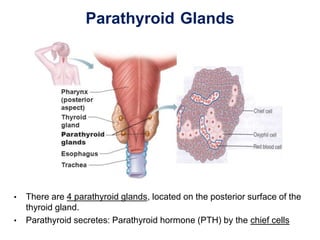
• There are 4 parathyroid glands, located on the posterior surface of the
thyroid gland.
• Parathyroid secretes: Parathyroid hormone (PTH) by the chief cells
Parathyroid Hormone (Parathormone)
• Chemistry: it is a polypeptide hormone consisting
of 84 AAs.
• Secreted from the parathyroid glands in response
to a decrease in the plasma Ca2+ level
• PTH is the most important regulator of plasma
calcium and phosphorus concentration
• Its action is opposed by the hormone calcitonin.
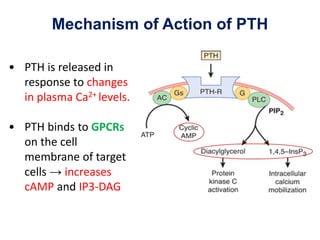
Mechanism of Action of PTH
• PTH is released in
response to changes
in plasma Ca2+ levels.
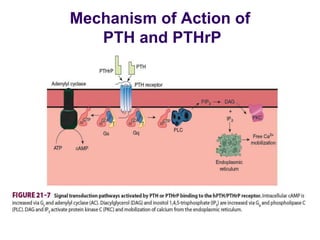
• PTH binds to GPCRs
on the cell
membrane of target
cells → increases
cAMP and IP3-DAG
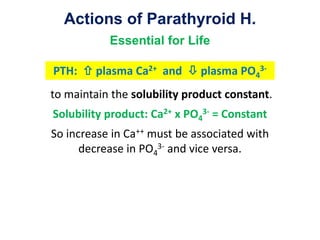
Actions of Parathyroid H.
Essential for Life
to maintain the solubility product constant.
Solubility product: Ca2+ x PO4
3- = Constant
So increase in Ca++ must be associated with
decrease in PO4
3- and vice versa.
PTH:  plasma Ca2+ and  plasma PO4
3-
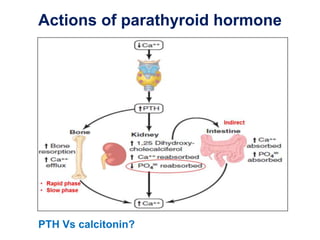
Actions of parathyroid hormone
PTH Vs calcitonin?
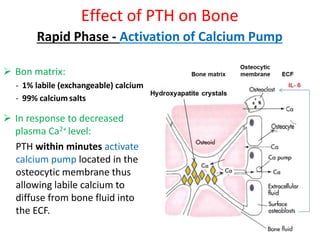
Rapid Phase - Activation of Calcium Pump
 Bon matrix:
- 1% labile (exchangeable) calcium
- 99% calciumsalts
 In response to decreased
plasma Ca2+ level:
PTH within minutes activate
calcium pump located in the
osteocytic membrane thus
allowing labile calcium to
diffuse from bone fluid into
the ECF.
Effect of PTH on Bone
Slow phase- Activation of Osteoclasts
• Requires several days or even weeks to become fully developed
• PTH indirectly (via osteoblasts) stimulates osteoclasts
Activation of the osteoclastic system in 2 stages:
1. Immediate activation of the already formed osteoclasts.
2. Formation of new osteoclasts (proliferation).
The activated osteoclasts then secrete:
1. Proteolytic Enzymes from lysosomes that digest organic
matrix (osteoid).
2. Citric acid and lactic acid from mitochondria → solubilize
hydroxyapatite crystals → mobilizing both Ca2+ and PO4
3-
Effect of PTH on Bone
Parathyroid Hormone
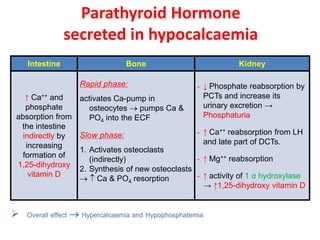
secreted in hypocalcaemia
Intestine Bone Kidney
↑ Ca++ and
phosphate
absorption from
the intestine
indirectly by
increasing
formation of
1,25-dihydroxy
vitamin D
Rapid phase:
activates Ca-pump in
osteocytes  pumps Ca &
PO4 into the ECF
Slow phase:
1. Activates osteoclasts
(indirectly)
2. Synthesis of new osteoclasts
  Ca & PO4 resorption
- ↓ Phosphate reabsorption by
PCTs and increase its
urinary excretion →
Phosphaturia
- ↑ Ca++ reabsorption from LH
and late part of DCTs.
- ↑ Mg++ reabsorption
- ↑ activity of 1 α hydroxylase
→ ↑1,25-dihydroxy vitamin D
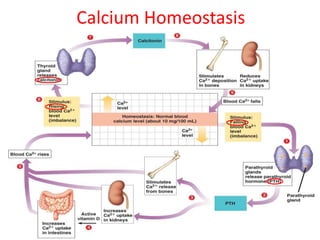
Calcium Homeostasis
Parathyroid H. Regulation
Plasma Ca++ level: PTH secretion is determined chiefly by serum
ionized calcium conc. through negative feedback (parathyroid cells
express calcium-sensing receptors on the cell surface)
 Ca++ →  PTH secretion and vice versa
Plasma phosphate level:
 Plasma phosphate level →  PTH secretion
Mg++:
 Mg++ →  PTH secretion and vice versa
1,25-dihydroxy vitamin D:
Its increase → increase Ca++ → decreased PTH
PTH related protein - (PTHrP)
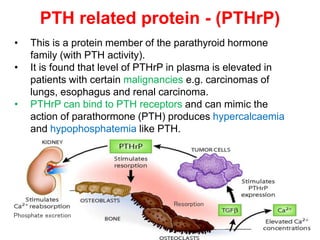
• This is a protein member of the parathyroid hormone
family (with PTH activity).
• It is found that level of PTHrP in plasma is elevated in
patients with certain malignancies e.g. carcinomas of
lungs, esophagus and renal carcinoma.
• PTHrP can bind to PTH receptors and can mimic the
action of parathormone (PTH) produces hypercalcaemia
and hypophosphatemia like PTH.
Phosphate excretion
Resorption
Mechanism of Action of
PTH and PTHrP
Parathyroid disorders
 Hypoparathyroidism
 Hyperparathyroidism
Hypoparathyroidism
• A low level of PTH in the blood.
Causes:
• Accidental removal of glands during surgical
thyroidectomy (commonest)
• Autoimmune disease damaging the gland
• Pseudohypoparathyroidism: congenital receptor disorders
Manifestations:
• Hypocalcemia: numbness, tingling, intestinal and biliary
colic and cardiac arrhythmias “tetany” (main feature).
• Hyperphosphatemia.
Tetany
- Tetany is a state of increased neuromuscular excitability that
results from abnormally reduced plasma concentrations of
certain ions (Ca2+, Mg2+, or H+ [alkalosis]) → involuntary
spastic contraction of skeletal muscles.
- Manifest tetany: when plasma Ca2+ level is less 7 mg/dl
- Latent tetany: when plasma Ca2+ > 7mg % and < 9 mg%
- Pathophysiology: low Ca++ levels in ECF increase the
permeability of neuronal membranes to Na+ → progressive
depolarization
Hyperparathyroidism
• Hyperparathyroidism is an increase in PTH levels in the blood.
• This occurs from a disorder either within the parathyroid
glands (primary hyperparathyroidism) or outside the glands
(secondary hyperparathyroidism)
 Secondary hyperparathyroidism: excessive secretion of PTH
as a physiologic response to hypocalcemia (usually due to
decreased level of 1,25-dihydroxy-vitamin D3)

1. Thinning bones (osteoporosis)
2. Muscle weakness and hypotonia
3. Hypercalcuria-polyuria-renal stones
4. Cardiac arrhythmias
5. Metastatic calcification when plasma Ca2+ level ≥ 17 mg%
Thank you

Parathyroid hormone

  • 1.
    Parathyroid Hormone Dr. OsamaMahmoud MBChB, M.Sc., M.D. Assist. Prof. of Physiology, Faculty of Medicine, Taif University, KSA & Al-Azhar University, Egy.
  • 2.
    Parathyroid Glands • Thereare 4 parathyroid glands, located on the posterior surface of the thyroid gland. • Parathyroid secretes: Parathyroid hormone (PTH) by the chief cells
  • 4.
    Parathyroid Hormone (Parathormone) •Chemistry: it is a polypeptide hormone consisting of 84 AAs. • Secreted from the parathyroid glands in response to a decrease in the plasma Ca2+ level • PTH is the most important regulator of plasma calcium and phosphorus concentration • Its action is opposed by the hormone calcitonin.
  • 5.
    Mechanism of Actionof PTH • PTH is released in response to changes in plasma Ca2+ levels. • PTH binds to GPCRs on the cell membrane of target cells → increases cAMP and IP3-DAG
  • 6.
    Actions of ParathyroidH. Essential for Life to maintain the solubility product constant. Solubility product: Ca2+ x PO4 3- = Constant So increase in Ca++ must be associated with decrease in PO4 3- and vice versa. PTH:  plasma Ca2+ and  plasma PO4 3-
  • 7.
    Actions of parathyroidhormone PTH Vs calcitonin?
  • 8.
    Rapid Phase -Activation of Calcium Pump  Bon matrix: - 1% labile (exchangeable) calcium - 99% calciumsalts  In response to decreased plasma Ca2+ level: PTH within minutes activate calcium pump located in the osteocytic membrane thus allowing labile calcium to diffuse from bone fluid into the ECF. Effect of PTH on Bone
  • 9.
    Slow phase- Activationof Osteoclasts • Requires several days or even weeks to become fully developed • PTH indirectly (via osteoblasts) stimulates osteoclasts Activation of the osteoclastic system in 2 stages: 1. Immediate activation of the already formed osteoclasts. 2. Formation of new osteoclasts (proliferation). The activated osteoclasts then secrete: 1. Proteolytic Enzymes from lysosomes that digest organic matrix (osteoid). 2. Citric acid and lactic acid from mitochondria → solubilize hydroxyapatite crystals → mobilizing both Ca2+ and PO4 3- Effect of PTH on Bone
  • 10.
    Parathyroid Hormone secreted inhypocalcaemia Intestine Bone Kidney ↑ Ca++ and phosphate absorption from the intestine indirectly by increasing formation of 1,25-dihydroxy vitamin D Rapid phase: activates Ca-pump in osteocytes  pumps Ca & PO4 into the ECF Slow phase: 1. Activates osteoclasts (indirectly) 2. Synthesis of new osteoclasts   Ca & PO4 resorption - ↓ Phosphate reabsorption by PCTs and increase its urinary excretion → Phosphaturia - ↑ Ca++ reabsorption from LH and late part of DCTs. - ↑ Mg++ reabsorption - ↑ activity of 1 α hydroxylase → ↑1,25-dihydroxy vitamin D
  • 11.
  • 12.
    Parathyroid H. Regulation PlasmaCa++ level: PTH secretion is determined chiefly by serum ionized calcium conc. through negative feedback (parathyroid cells express calcium-sensing receptors on the cell surface)  Ca++ →  PTH secretion and vice versa Plasma phosphate level:  Plasma phosphate level →  PTH secretion Mg++:  Mg++ →  PTH secretion and vice versa 1,25-dihydroxy vitamin D: Its increase → increase Ca++ → decreased PTH
  • 13.
    PTH related protein- (PTHrP) • This is a protein member of the parathyroid hormone family (with PTH activity). • It is found that level of PTHrP in plasma is elevated in patients with certain malignancies e.g. carcinomas of lungs, esophagus and renal carcinoma. • PTHrP can bind to PTH receptors and can mimic the action of parathormone (PTH) produces hypercalcaemia and hypophosphatemia like PTH. Phosphate excretion Resorption
  • 14.
    Mechanism of Actionof PTH and PTHrP
  • 15.
  • 16.
    Hypoparathyroidism • A lowlevel of PTH in the blood. Causes: • Accidental removal of glands during surgical thyroidectomy (commonest) • Autoimmune disease damaging the gland • Pseudohypoparathyroidism: congenital receptor disorders Manifestations: • Hypocalcemia: numbness, tingling, intestinal and biliary colic and cardiac arrhythmias “tetany” (main feature). • Hyperphosphatemia.
  • 17.
    Tetany - Tetany isa state of increased neuromuscular excitability that results from abnormally reduced plasma concentrations of certain ions (Ca2+, Mg2+, or H+ [alkalosis]) → involuntary spastic contraction of skeletal muscles. - Manifest tetany: when plasma Ca2+ level is less 7 mg/dl - Latent tetany: when plasma Ca2+ > 7mg % and < 9 mg% - Pathophysiology: low Ca++ levels in ECF increase the permeability of neuronal membranes to Na+ → progressive depolarization
  • 18.
    Hyperparathyroidism • Hyperparathyroidism isan increase in PTH levels in the blood. • This occurs from a disorder either within the parathyroid glands (primary hyperparathyroidism) or outside the glands (secondary hyperparathyroidism)  Secondary hyperparathyroidism: excessive secretion of PTH as a physiologic response to hypocalcemia (usually due to decreased level of 1,25-dihydroxy-vitamin D3)  1. Thinning bones (osteoporosis) 2. Muscle weakness and hypotonia 3. Hypercalcuria-polyuria-renal stones 4. Cardiac arrhythmias 5. Metastatic calcification when plasma Ca2+ level ≥ 17 mg%
  • 19.