Parathyroid Hormone
Prepared by:
Shahab Ullah Khan
Ayub Medical College
11
Introduction:
 Secreted by parathyroid glands.
 Also called parathormone or parathyrin.
 Regulates extracellular calcium and phosphate
concentrations
 Methods of Regulation:
Intestinal absorption.
Renal excretion
Exchange btw ECF and bone
2
Physiological anatomy of parathyroid
glands:
 Four parathyroid glands whose dimensions are:
 Length = 6mm
 Width= 3mm
 Thickness= 2m
 Appearance dark brown fat.
 Normal Level= 9.4mg/dl
 Mol.Weight= 9500
 Removal of two parathyroid glands: No physiological abnormality.
 Removal of 3 parathyroid glands: Transient Hypo parathyroidism.
3
Secretion of PTH:
 Secreted by parathyroid gland in response to low calcium levels.
 Normal level of calcium in blood is 9.4 mg/dl.
 Low calcium level is detected by Calcium Sensing receptor in Parathyroid
cell membrane.
 Parathyroid Gland has Two types of cells:
 Chief cells.
 Oxyphil cells.
 Chief cells mostly secrete the PTH.
 Oxyphil are modified or depleted form of chief cells.
4
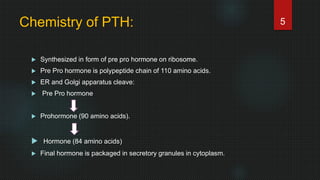
Chemistry of PTH:
 Synthesized in form of pre pro hormone on ribosome.
 Pre Pro hormone is polypeptide chain of 110 amino acids.
 ER and Golgi apparatus cleave:
 Pre Pro hormone
 Prohormone (90 amino acids).
 Hormone (84 amino acids)
 Final hormone is packaged in secretory granules in cytoplasm.
5
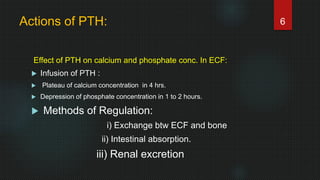
Actions of PTH:
Effect of PTH on calcium and phosphate conc. In ECF:
 Infusion of PTH :
 Plateau of calcium concentration in 4 hrs.
 Depression of phosphate concentration in 1 to 2 hours.
 Methods of Regulation:
i) Exchange btw ECF and bone
ii) Intestinal absorption.
iii) Renal excretion
6
Actions of PTH on bone:
 Rapid phase (1-3 hours)- Osteocytic osteolysis.
 Slow phase(12-24 hours)- Osteoclastic osteolysis.
7
Rapid phase:
 PTH injected in large quantities.
 Calcium concentration in blood rises with in minutes.
 Causing removal of bone salts from two areas.
 Bone matrix in vicinity of osteocytes.
 Bone matrix in vicinity of osteoblast.
But why these two?
 Osteocystic membrane, pumps calcium from bone fluid to ECF.
 Osteolysis occurs without resorption of bone fibrous and gel matrix.
 What's the Role of PTH then ?
8
Slow phase:
 Osteoclasts are activated.
 Osteoclasts have No membrane receptor proteins for PTH.
 Secondary signals are received from osteoblasts.
 Activation occurs in two phases.
 Immediate activation of already existing in osteoclasts.
 Formation of new osteoclasts.
9
 No, bone contains calcium 1000 times more than ECF.
 Prolong administration over months or years results in resorption in all bones.
 PTH injection is Administrated where ?
10
Does PTH affect bone on few PTH administrations?
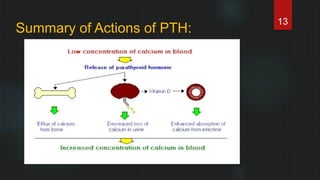
Action of PTH on Kidneys:
 PTH is administrated.
 Calcium excretion is decreased.
 PTH increases renal tubular reabsorption of calcium.
 Phosphate excretion is increased.
 PTH diminishes tubular reabsorption of phosphates.
11
Action of PTH on intestine:
 PTH enhances calcium and phosphate absorption from intestine.
 By increasing formation of 1,25 dihydroxycholecalceforal from vitamin D.
12
Summary of Actions of PTH:
13
Control of PTH by calcium ion
concentration.
Condition of decreased calcium level:
 Slight decrease in calcium ion concentration causes increase of PTH
secretion.
 If condition persists it may cause hypertrophy of parathyroid gland.
 Rickets.
 Pregnancy.
 Lactation.
14
Control of PTH by calcium ion
concentration.
Condition of increased calcium level:
 Increase in calcium ion concentration causes decrease of PTH secretion.
 If condition persists it causes parathyroid gland to reduce in size.
 Excess calcium in diet.
 Increase vitamin D in diet.
 Bone resorption due to disuse.
15
Pathophysiology of PTH
16
Hypoparathyroidism:
 Parathyroid gland do not secrete sufficient PTH.
 Osteocytic resorption of calcium ion decreases.
 Osteoblast becomes inactive.
 No calcium resorption by bones.
 Conc. Of calcium in body fluid is decreased.
17
Symptoms of Hypoparathyroidism:
 Paresthesia in finger tips, toes and lips.
 Muscle cramps in leg, feet, abdomen or face.
 Fatigue.
 Painful menstruation.
 Dry skin.
 Anxiety.
18
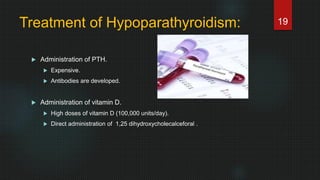
Treatment of Hypoparathyroidism:
 Administration of PTH.
 Expensive.
 Antibodies are developed.
 Administration of vitamin D.
 High doses of vitamin D (100,000 units/day).
 Direct administration of 1,25 dihydroxycholecalceforal .
19
What if parathyroid gland is removed?
 Calcium level in blood falls from normal 9.4mg/dl to 6-7 mg/dl in two three
days.
 With such low level symptoms of tetany develops.
 Most sensitive muscle to tetanic sparsm are laryngeal muscles.
 Spasms of laryngel muscles obstructs respiration.
 Usual cause of death in people with untreated tetany.
20
Hyperparathyrodism:
 Parathyroid gland secretes more PTH.
 Calcium level increases in blood.
Two types:
 Primary Hyperparathyrodism.
 Secondary Hyperparathyrodism.
21
Primary Hyperparathyrodism:
 Abnormality of parathyroid gland causes excess secretion of PTH.
 Extreme osteoclastic activity in bones.
 Elevation of calcium ion conc. In ECF.
 Depression of phosphate ions conc. in ECF.
 Often broken bone is the reason for patient to seek medical attention.
 Women are subjected more frequently to primary hyperparathyroidism.
(Pregnancy, lactation)
 Cause:
 Tumor of one of parathyroid gland.
22
Secondary Hyperparathyrodism:
 Not a primary abnormality of parathyroid gland
 High level of PTH occurs as a compensation for hypocalcemia
CAUSES:
 Vitamin D defiency.
 Chronic renal disease.
23
Formation of Kidney Stones in
Hyperparathyroidism
 Patients with hyperparathyroidism have extreme
tendency of developing kidney stones.
Reason:
 excess calcium and phosphate must eventually be excreted by kidney
 Thus there is Increase in concentration of calcium and phosphate in urine
 More tendency of crystals of calcium and phosphate to precipitate in
kidney
 Leading to calcium phosphate stones
24
Symptoms of hyperparathyroidism:
 Kidney stones.
 Excess urination.
 Fragile bones.
 Abdominal pain.
 Bone and joint pain.
 Depression.
25
Treatment of Hyperparathyroidism:
 Calcimemetics.
 Hormone Replacement theraphy.
 Biophosphonates.
26
 Reference Book: Medical Physiology by GUYTON AND HALL
THANKS
27
28

Parathyroid hormone

  • 1.
    Parathyroid Hormone Prepared by: ShahabUllah Khan Ayub Medical College 11
  • 2.
    Introduction:  Secreted byparathyroid glands.  Also called parathormone or parathyrin.  Regulates extracellular calcium and phosphate concentrations  Methods of Regulation: Intestinal absorption. Renal excretion Exchange btw ECF and bone 2
  • 3.
    Physiological anatomy ofparathyroid glands:  Four parathyroid glands whose dimensions are:  Length = 6mm  Width= 3mm  Thickness= 2m  Appearance dark brown fat.  Normal Level= 9.4mg/dl  Mol.Weight= 9500  Removal of two parathyroid glands: No physiological abnormality.  Removal of 3 parathyroid glands: Transient Hypo parathyroidism. 3
  • 4.
    Secretion of PTH: Secreted by parathyroid gland in response to low calcium levels.  Normal level of calcium in blood is 9.4 mg/dl.  Low calcium level is detected by Calcium Sensing receptor in Parathyroid cell membrane.  Parathyroid Gland has Two types of cells:  Chief cells.  Oxyphil cells.  Chief cells mostly secrete the PTH.  Oxyphil are modified or depleted form of chief cells. 4
  • 5.
    Chemistry of PTH: Synthesized in form of pre pro hormone on ribosome.  Pre Pro hormone is polypeptide chain of 110 amino acids.  ER and Golgi apparatus cleave:  Pre Pro hormone  Prohormone (90 amino acids).  Hormone (84 amino acids)  Final hormone is packaged in secretory granules in cytoplasm. 5
  • 6.
    Actions of PTH: Effectof PTH on calcium and phosphate conc. In ECF:  Infusion of PTH :  Plateau of calcium concentration in 4 hrs.  Depression of phosphate concentration in 1 to 2 hours.  Methods of Regulation: i) Exchange btw ECF and bone ii) Intestinal absorption. iii) Renal excretion 6
  • 7.
    Actions of PTHon bone:  Rapid phase (1-3 hours)- Osteocytic osteolysis.  Slow phase(12-24 hours)- Osteoclastic osteolysis. 7
  • 8.
    Rapid phase:  PTHinjected in large quantities.  Calcium concentration in blood rises with in minutes.  Causing removal of bone salts from two areas.  Bone matrix in vicinity of osteocytes.  Bone matrix in vicinity of osteoblast. But why these two?  Osteocystic membrane, pumps calcium from bone fluid to ECF.  Osteolysis occurs without resorption of bone fibrous and gel matrix.  What's the Role of PTH then ? 8
  • 9.
    Slow phase:  Osteoclastsare activated.  Osteoclasts have No membrane receptor proteins for PTH.  Secondary signals are received from osteoblasts.  Activation occurs in two phases.  Immediate activation of already existing in osteoclasts.  Formation of new osteoclasts. 9
  • 10.
     No, bonecontains calcium 1000 times more than ECF.  Prolong administration over months or years results in resorption in all bones.  PTH injection is Administrated where ? 10 Does PTH affect bone on few PTH administrations?
  • 11.
    Action of PTHon Kidneys:  PTH is administrated.  Calcium excretion is decreased.  PTH increases renal tubular reabsorption of calcium.  Phosphate excretion is increased.  PTH diminishes tubular reabsorption of phosphates. 11
  • 12.
    Action of PTHon intestine:  PTH enhances calcium and phosphate absorption from intestine.  By increasing formation of 1,25 dihydroxycholecalceforal from vitamin D. 12
  • 13.
  • 14.
    Control of PTHby calcium ion concentration. Condition of decreased calcium level:  Slight decrease in calcium ion concentration causes increase of PTH secretion.  If condition persists it may cause hypertrophy of parathyroid gland.  Rickets.  Pregnancy.  Lactation. 14
  • 15.
    Control of PTHby calcium ion concentration. Condition of increased calcium level:  Increase in calcium ion concentration causes decrease of PTH secretion.  If condition persists it causes parathyroid gland to reduce in size.  Excess calcium in diet.  Increase vitamin D in diet.  Bone resorption due to disuse. 15
  • 16.
  • 17.
    Hypoparathyroidism:  Parathyroid glanddo not secrete sufficient PTH.  Osteocytic resorption of calcium ion decreases.  Osteoblast becomes inactive.  No calcium resorption by bones.  Conc. Of calcium in body fluid is decreased. 17
  • 18.
    Symptoms of Hypoparathyroidism: Paresthesia in finger tips, toes and lips.  Muscle cramps in leg, feet, abdomen or face.  Fatigue.  Painful menstruation.  Dry skin.  Anxiety. 18
  • 19.
    Treatment of Hypoparathyroidism: Administration of PTH.  Expensive.  Antibodies are developed.  Administration of vitamin D.  High doses of vitamin D (100,000 units/day).  Direct administration of 1,25 dihydroxycholecalceforal . 19
  • 20.
    What if parathyroidgland is removed?  Calcium level in blood falls from normal 9.4mg/dl to 6-7 mg/dl in two three days.  With such low level symptoms of tetany develops.  Most sensitive muscle to tetanic sparsm are laryngeal muscles.  Spasms of laryngel muscles obstructs respiration.  Usual cause of death in people with untreated tetany. 20
  • 21.
    Hyperparathyrodism:  Parathyroid glandsecretes more PTH.  Calcium level increases in blood. Two types:  Primary Hyperparathyrodism.  Secondary Hyperparathyrodism. 21
  • 22.
    Primary Hyperparathyrodism:  Abnormalityof parathyroid gland causes excess secretion of PTH.  Extreme osteoclastic activity in bones.  Elevation of calcium ion conc. In ECF.  Depression of phosphate ions conc. in ECF.  Often broken bone is the reason for patient to seek medical attention.  Women are subjected more frequently to primary hyperparathyroidism. (Pregnancy, lactation)  Cause:  Tumor of one of parathyroid gland. 22
  • 23.
    Secondary Hyperparathyrodism:  Nota primary abnormality of parathyroid gland  High level of PTH occurs as a compensation for hypocalcemia CAUSES:  Vitamin D defiency.  Chronic renal disease. 23
  • 24.
    Formation of KidneyStones in Hyperparathyroidism  Patients with hyperparathyroidism have extreme tendency of developing kidney stones. Reason:  excess calcium and phosphate must eventually be excreted by kidney  Thus there is Increase in concentration of calcium and phosphate in urine  More tendency of crystals of calcium and phosphate to precipitate in kidney  Leading to calcium phosphate stones 24
  • 25.
    Symptoms of hyperparathyroidism: Kidney stones.  Excess urination.  Fragile bones.  Abdominal pain.  Bone and joint pain.  Depression. 25
  • 26.
    Treatment of Hyperparathyroidism: Calcimemetics.  Hormone Replacement theraphy.  Biophosphonates. 26
  • 27.
     Reference Book:Medical Physiology by GUYTON AND HALL THANKS 27
  • 28.