









LATERAL THINKING AT WORKT.SivasankaranAdvesh Consultancy ServicesChennai Indiatss@advesh.com
This presentation is designed for two days trainingTechnique used is based on Edward de Bono’s Lateral Thinking – Creativity Step by stepPuzzles,exercises and games are from various sources
Other Reference Books UsedFourth Eye by PradipN.KhandwallaThe Houdini Solution by Ernie SchenckParadigms by Joel Arthur Barke by RicarMaverick by Ricardo Semler
Few Puzzles
IX
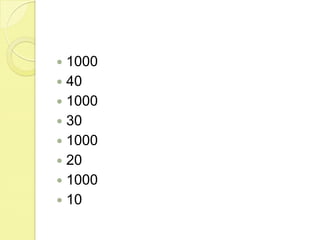
100040100030100020100010
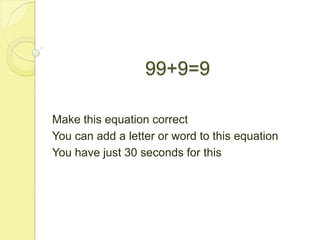
99+9=9Make this equation correctYou can add a letter or word to this equationYou have just 30 seconds for this
What can you dry your hair with , cut the grass with And lift a car with?
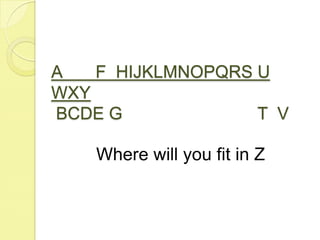
A       F  HIJKLMNOPQRS U WXYBCDE G                            T  VWhere will you fit in Z
A man is wearing black. Black shoes, sockstrousers, coat, gloves and ski mask.He is walking down a back street with all the street lamps off. A black car is coming towards him with its light off but somehow manages to stop in time.How did the driver see the man?
THE WAY THE MIND WORKS
The Paralyzing Power Of Previous Perceptions
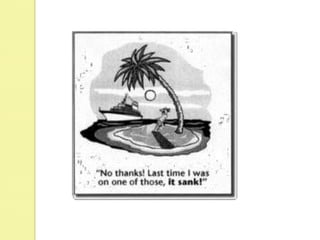
The mind is a cliché making And cliché using system
What do you call a funny story? What are you when you have no money? What's another word for Coca Cola? What's the white of an egg?
What does this have to do with creativity and innovation? This simple example shows you how powerful your previous perceptions influence your thought process and how you arrive at “your right answer.” 
What is Creativity?Creativity brings into being something that did not exist before, either as a product, a process or a thought
Creativity – coming up with ideas
Innovation – bringing ideas to life A child’s creativity decreases 90 percent from age five to seven. By the time they reach 40, their creativity is at rock bottom -- a mere two percent of what they once had.This probably happened to you too. 
What is a Creativity Exercise?For our purposes, anything that changes your way of thinking about a problem(or opportunity)Especially techniques to cultivate new ideasApplicable at any stage of the process.
“Problems cannot be solved by thinking within the framework within which the problems werecreated”Albert Einstein
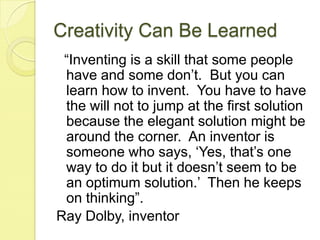
Creativity Can Be Learned  “Inventing is a skill that some people have and some don’t.  But you can learn how to invent.  You have to have the will not to jump at the first solution because the elegant solution might be around the corner.  An inventor is someone who says, ‘Yes, that’s one way to do it but it doesn’t seem to be an optimum solution.’  Then he keeps on thinking”.  Ray Dolby, inventor
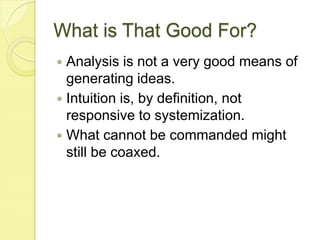
What is That Good For?Analysis is not a very good means of generating ideas.Intuition is, by definition, not responsive to systemization. What cannot be commanded might still be coaxed.
THE MYTHSSO LITTLE  TIME, SO LITTLE IDEASTHE BIGGER THE BUDGET, THE BIGGER THE IDEAYOU CAN’T ROCK THE WORLD IF YOU CAN NOT ROCK THE BOATALL I KNOW IS IT WORKED BEFORETHE ONLY GOOD IDEA IS BIG IDEAGRAPES CAN DIE IN THE VINE ; SO CAN A GREAT IDEACREATIVITY IS FOR CREATIVE PEOPLE
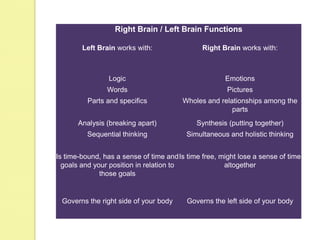
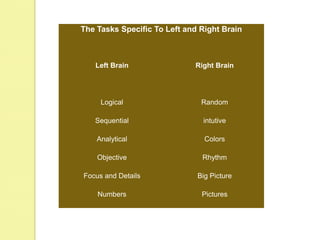
Things You May Already DoMany activities change what parts of your brain are working, and encourage other parts to relax.Identifying these triggers and exploiting them on purpose can be powerful.Not usually a great thing for groups, though.
Things You May Already DoExamples:ExerciseChange of sceneryDrivingShoweringToysSleepMusic
Exercise5 minutesTake four away from four and make it eight
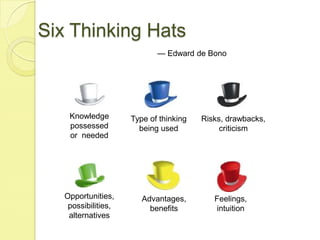
Six Thinking Hats— Edward de BonoKnowledge possessedor  neededType of thinking being usedRisks, drawbacks, criticismOpportunities, possibilities, alternativesAdvantages, benefitsFeelings, intuition
FIVE BIGGEST FEARSFear of FailingFear of SucceedingFear of ChangeFear of Going BrokeFear of Time
The only thing we had to fear was fear itselfF D Rooswelt
Creativity is a nuclear reactor. And like any nuclear reactor, it can’t generate electricity until something gets a chain reaction going
Exercise5 minutesYou have a pile of 24 coins. 23 of them have the same weight. But one of them is heavier than the rest. You are given a scale but no weights. Your task is t identify the heavy coin in no more than three uses of the scale.
Exercise3 minutesA conference room contains three separate wall-mounted spotlights - right, left and front of stage. Each is controlled by its own on-off switch. These three switches are numbered 1, 2 and 3, but they are in a back-room which has no sight of the the spotlights or the conference room (and there are no reflections or shadows or mirrors, and you are alone). How do you identify each switch correctly - right, left, front - if you can only enter the back-room once
Exercise 5 minutesFour men, one of whom was known to have committed murder, made the following statements to the police.Arun: Dave did itDave: Tony did itGeorge: I did not do itTony: Dave lied when he said I did itIf only one of these four statements is true, who was the guilty man?
Exercise5 minutesYou are the treasurer in charge of the Royal mint, which produces a single type coin, the grote. There are ten machines producing grotes, one machine is producing grotes weighing one gram less than they should, each coin should weigh 10 grams. You have a set of broken scales which can be fixed to provide one single weigh of a single amount (no weight changes are allowed). Using the scales once you must identify the single faulty machine. How do you do it?
TECHNIQUES
Action ItemWrite down what image comes to mind when you think of the word “Machine”. Ask a friend or colleague to do the same thing. Compare your lists. Chances are the image you came up with was very different from what they envisioned. Why is that? 
Generation of alternatives
Most basic principle of lateral thinking is that any particular way of looking things is only one from many other possible ways.Lateral thinking is concerned with exploring these other ways
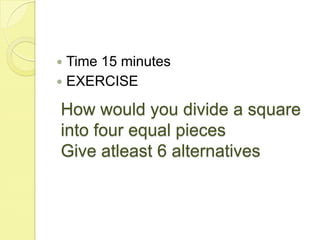
How would you divide a square into four equal piecesGive atleast 6 alternativesTime 15 minutesEXERCISE
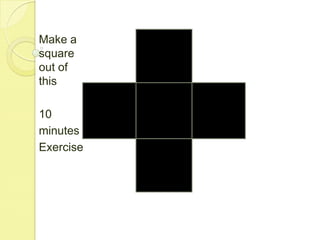
Make a square out of this10minutesExercise
EXERCISEHow  would you divide up a square of cardboard to give an L shape?Give at least three alternatives        Time 10 minutes
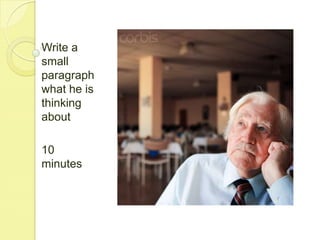
Write a small paragraph what he is thinking about10 minutes
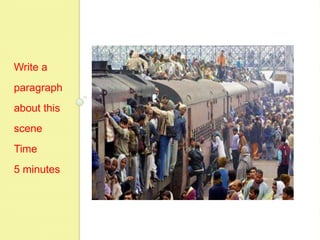
Write a paragraph about this sceneTime5 minutes
CHALLENGING ASSUMPTIONS
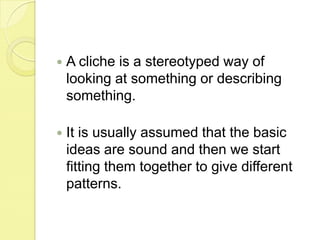
A cliche is a stereotyped way of looking at something or describing something.It is usually assumed that the basic ideas are sound and then we start fitting them together to give different patterns.
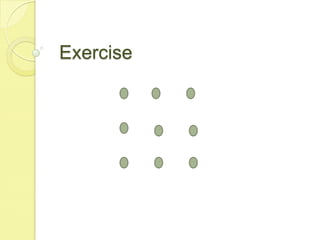
Exercise
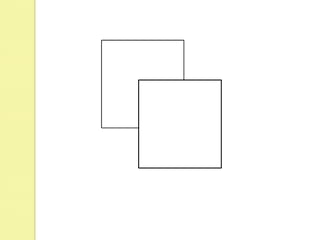
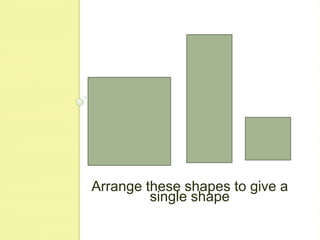
Arrange these shapes to give a single shape
Why TechniqueWhy are black boards black?Why would it matter what they are called?Why can not we call it by different name?
The usual response to why is to explain something unfamiliar in terms that are familiar enough to be an acceptable explanation
Challenge:Simply challenge the way things have always been done or seen, or the way they are. This is done not to show there is anything wrong with the existing situation but simply to direct your perceptions to exploring outside the current area.
PROVOCATION Declare the usual perception out of bounds, or provide some provocative alternative to the usual situation under consideration. DeBono suggests using Prefix the provocation with the term 'Po" to signal that the provocation is not a valid idea put up for judgement but a stimulus for new perception.
ProvocationTo challenge established patternsTo question the validity of established patternsTo disrupt established patterns and lioberate information that can come together to give new patternsTo recue information trapped by the pigeonholes of labels and classifications
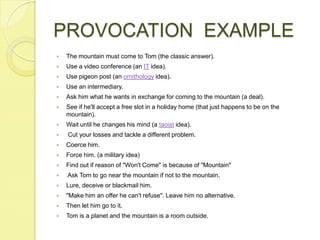
PROVOCATION  EXAMPLEThe mountain must come to Tom (the classic answer). Use a video conference (an IT idea). Use pigeon post (an ornithology idea). Use an intermediary. Ask him what he wants in exchange for coming to the mountain (a deal). See if he'll accept a free slot in a holiday home (that just happens to be on the mountain). Wait until he changes his mind (a taoist idea).  Cut your losses and tackle a different problem. Coerce him. Force him. (a military idea) Find out if reason of "Won't Come" is because of "Mountain"  Ask Tom to go near the mountain if not to the mountain. Lure, deceive or blackmail him. "Make him an offer he can't refuse". Leave him no alternative. Then let him go to it. Tom is a planet and the mountain is a room outside.
Henry Ford took a candidate for lunch.Ordered Soup.The senior candidate picked up salt and added to soup?What was Mr Ford’s observation?Did he hire him?
EXERCISE4 Teams of five  eachTime   15 minutesAnswer at least 5 times whyWhy are wheels  round?Why does a chair has four legs?
The way the Mind worksWhat is Lateral ThinkingGenerating alternativesChallenging Assumtions
FLUENCY, FLEXIBILITY AND ORIGINALITY
Fluency or the ability to ideate copiously is very useful for responding to that class of problems where it is unlikely that a single best solution exists or can be deduced by strictly logical operationsFlexibility is the ability to come out with variety of ideasOriginality is unique ideas, novel and surprising
Exercise10 minutesListed below are five objectsYour task is to write down as many uses as you can for each object.ChairStickThreadFileToothbrush
Exercise5 minutesList objects that have a rectangle in itList five letter words ending in g( No continuous verb)List 5 distinctively different uses of a basketWhat different factors would you bear in mind while taking a new job?
List as many insects,fruits,vegetables,flowers and trees whose names begin with the letters a,e or o
ENTRY POINT AND ATTENTION AREA
Most important feature of the mind as an information processing system is its ability to chooseThis ability to choose arises directly from the mechanical behaviour of the mind as self maximising memory system
Exercise5 minutesDivide a triangle into three parts in such a way that the parts can be put together again to form a rectangle or a square
Exercise5 Minutes to 10 MinutesDraw the outline of a piece of cardboard which is so shaped that with a single straight cut the piece can be divided into four smaller pieces which are exactly alike in size, shape and area.
Random EntryChoose an object at random, or a noun from a dictionary, and associate that with the area you are thinking about.For example imagine you are thinking about how to improve this Hall. Choosing an object at random from a dictionary office you might get a word “fuel”Fuel generates energyEnergy drives vehicles Can we make this hall  more energetic?Fuel is flexible   Can we design flexibility in this room?Fuel …..Do we need to provide some energy giving drinks inside the Hall?
ExerciseGroups of fourHow to make Chennai a clean city?Pick up one object from this roomTry to link this object with the problem “making Chennai cleaner”
Some real lateral thinking questions
No space in the carYou are driving down the road in your car on a wild, stormy night, when you pass by a bus stop and you see three people waiting for the busAn old lady who looks as if she is about to die. An old friend who once saved your life. The perfect partner you have been dreaming about. Knowing that there can only be one passenger in your car, whom would you choose?
The CoinJohn is on a raft, adrift in the ocean with several other survivors of a shipwreck. The others are too weak, so he or Mike will swim to a nearby island to look for help. It is almost certainly suicidal, due to the circling sharks, but they have little else to hope for. Mike takes the lose change from his pocket and puts two pennies in a hat. He tells John that one is a 2005 penny, and the other 1975. If John picks the newer penny he can stay on the rat, and Mike will risk his life. If John picks the older penny, he must go. John has seen that both pennies were actually dated 1975, but he doesn't want to say anything, because Mike is a big guy. How does he win, and get Mike to go, without exposing him as a fraud in front of the others?
BrainstormingBrainstorming is a group creativity technique designed to generate a large number of ideas for the solution to a problem
RECAP
The mind is pattern making systemMind creates patterns out of environment and then recognises and uses such patternsBecause the sequence of arrival of information determines how it is to be arranged into a pattern such patterns are generally less than the best possible arrangement of information
Vertical Thinking is selectiveOne may reach a conclusion by a valid series of stepsLateral Thinking is generativeVertical Thinking develops the ideas generated by Lateral Thinking
Logical thinking works to relate accepted conceptsLateral thinking is to bring about insight restructuringLateral thinking is generativeVertical thinking is selective
Twin aspects of Lateral thinking are first the provocative use of information and second the challenge of accepted conceptsThis helps to restructure patterns
Vertical thinking and Lateral thinking are complementary
Techniques for Lateral ThinkingGenerate IdeasChallenge assumptionsProvocation as a toolLook for entry pointsDevelop fluencyUse BrainstormingAnalogySuspended JudgmentRandom stimulation
The elevator delayThere was a hotel where the visitors complained about the slow moving elevator and how long they had to wait for it to come. It became so severe that the manager was asked to do something about it. If you were the manager what would you suggest ?(Picked up form the book Mediocre but Arrogant MBA)
If you really want to see something, look at something else. If you want to say what something is, inspect something that it isn’t. If you want to see the invisible worldlook at the visible one. If you want to know what East really is, look North. If you have a question concerning the sea, look at the mountains….
If you have gone through the entire presentation  then you may like to download .To download this presentation, please write to   tss@advesh.com
Thank you

Lateral Thinking 1

  • 1.
    LATERAL THINKING ATWORKT.SivasankaranAdvesh Consultancy ServicesChennai Indiatss@advesh.com
  • 2.
    This presentation isdesigned for two days trainingTechnique used is based on Edward de Bono’s Lateral Thinking – Creativity Step by stepPuzzles,exercises and games are from various sources
  • 3.
    Other Reference BooksUsedFourth Eye by PradipN.KhandwallaThe Houdini Solution by Ernie SchenckParadigms by Joel Arthur Barke by RicarMaverick by Ricardo Semler
  • 4.
  • 5.
  • 6.
  • 7.
    99+9=9Make this equationcorrectYou can add a letter or word to this equationYou have just 30 seconds for this
  • 8.
    What can youdry your hair with , cut the grass with And lift a car with?
  • 10.
    A F HIJKLMNOPQRS U WXYBCDE G T VWhere will you fit in Z
  • 11.
    A man iswearing black. Black shoes, sockstrousers, coat, gloves and ski mask.He is walking down a back street with all the street lamps off. A black car is coming towards him with its light off but somehow manages to stop in time.How did the driver see the man?
  • 13.
    THE WAY THEMIND WORKS
  • 14.
    The Paralyzing PowerOf Previous Perceptions
  • 16.
    The mind isa cliché making And cliché using system
  • 17.
    What do youcall a funny story? What are you when you have no money? What's another word for Coca Cola? What's the white of an egg?
  • 18.
    What does thishave to do with creativity and innovation? This simple example shows you how powerful your previous perceptions influence your thought process and how you arrive at “your right answer.” 
  • 19.
    What is Creativity?Creativitybrings into being something that did not exist before, either as a product, a process or a thought
  • 20.
  • 21.
    Innovation – bringingideas to life A child’s creativity decreases 90 percent from age five to seven. By the time they reach 40, their creativity is at rock bottom -- a mere two percent of what they once had.This probably happened to you too. 
  • 22.
    What is aCreativity Exercise?For our purposes, anything that changes your way of thinking about a problem(or opportunity)Especially techniques to cultivate new ideasApplicable at any stage of the process.
  • 23.
    “Problems cannot besolved by thinking within the framework within which the problems werecreated”Albert Einstein
  • 26.
    Creativity Can BeLearned “Inventing is a skill that some people have and some don’t. But you can learn how to invent. You have to have the will not to jump at the first solution because the elegant solution might be around the corner. An inventor is someone who says, ‘Yes, that’s one way to do it but it doesn’t seem to be an optimum solution.’ Then he keeps on thinking”. Ray Dolby, inventor
  • 27.
    What is ThatGood For?Analysis is not a very good means of generating ideas.Intuition is, by definition, not responsive to systemization. What cannot be commanded might still be coaxed.
  • 28.
    THE MYTHSSO LITTLE TIME, SO LITTLE IDEASTHE BIGGER THE BUDGET, THE BIGGER THE IDEAYOU CAN’T ROCK THE WORLD IF YOU CAN NOT ROCK THE BOATALL I KNOW IS IT WORKED BEFORETHE ONLY GOOD IDEA IS BIG IDEAGRAPES CAN DIE IN THE VINE ; SO CAN A GREAT IDEACREATIVITY IS FOR CREATIVE PEOPLE
  • 29.
    Things You MayAlready DoMany activities change what parts of your brain are working, and encourage other parts to relax.Identifying these triggers and exploiting them on purpose can be powerful.Not usually a great thing for groups, though.
  • 30.
    Things You MayAlready DoExamples:ExerciseChange of sceneryDrivingShoweringToysSleepMusic
  • 31.
    Exercise5 minutesTake fouraway from four and make it eight
  • 32.
    Six Thinking Hats—Edward de BonoKnowledge possessedor neededType of thinking being usedRisks, drawbacks, criticismOpportunities, possibilities, alternativesAdvantages, benefitsFeelings, intuition
  • 33.
    FIVE BIGGEST FEARSFearof FailingFear of SucceedingFear of ChangeFear of Going BrokeFear of Time
  • 34.
    The only thingwe had to fear was fear itselfF D Rooswelt
  • 35.
    Creativity is anuclear reactor. And like any nuclear reactor, it can’t generate electricity until something gets a chain reaction going
  • 36.
    Exercise5 minutesYou havea pile of 24 coins. 23 of them have the same weight. But one of them is heavier than the rest. You are given a scale but no weights. Your task is t identify the heavy coin in no more than three uses of the scale.
  • 37.
    Exercise3 minutesA conferenceroom contains three separate wall-mounted spotlights - right, left and front of stage. Each is controlled by its own on-off switch. These three switches are numbered 1, 2 and 3, but they are in a back-room which has no sight of the the spotlights or the conference room (and there are no reflections or shadows or mirrors, and you are alone). How do you identify each switch correctly - right, left, front - if you can only enter the back-room once
  • 38.
    Exercise 5 minutesFourmen, one of whom was known to have committed murder, made the following statements to the police.Arun: Dave did itDave: Tony did itGeorge: I did not do itTony: Dave lied when he said I did itIf only one of these four statements is true, who was the guilty man?
  • 39.
    Exercise5 minutesYou arethe treasurer in charge of the Royal mint, which produces a single type coin, the grote. There are ten machines producing grotes, one machine is producing grotes weighing one gram less than they should, each coin should weigh 10 grams. You have a set of broken scales which can be fixed to provide one single weigh of a single amount (no weight changes are allowed). Using the scales once you must identify the single faulty machine. How do you do it?
  • 40.
  • 41.
    Action ItemWrite downwhat image comes to mind when you think of the word “Machine”. Ask a friend or colleague to do the same thing. Compare your lists. Chances are the image you came up with was very different from what they envisioned. Why is that? 
  • 42.
  • 43.
    Most basic principleof lateral thinking is that any particular way of looking things is only one from many other possible ways.Lateral thinking is concerned with exploring these other ways
  • 46.
    How would youdivide a square into four equal piecesGive atleast 6 alternativesTime 15 minutesEXERCISE
  • 47.
    Make a squareout of this10minutesExercise
  • 48.
    EXERCISEHow wouldyou divide up a square of cardboard to give an L shape?Give at least three alternatives Time 10 minutes
  • 52.
    Write a smallparagraph what he is thinking about10 minutes
  • 53.
    Write a paragraphabout this sceneTime5 minutes
  • 54.
  • 55.
    A cliche isa stereotyped way of looking at something or describing something.It is usually assumed that the basic ideas are sound and then we start fitting them together to give different patterns.
  • 56.
  • 57.
    Arrange these shapesto give a single shape
  • 58.
    Why TechniqueWhy areblack boards black?Why would it matter what they are called?Why can not we call it by different name?
  • 59.
    The usual responseto why is to explain something unfamiliar in terms that are familiar enough to be an acceptable explanation
  • 60.
    Challenge:Simply challenge theway things have always been done or seen, or the way they are. This is done not to show there is anything wrong with the existing situation but simply to direct your perceptions to exploring outside the current area.
  • 61.
    PROVOCATION Declare theusual perception out of bounds, or provide some provocative alternative to the usual situation under consideration. DeBono suggests using Prefix the provocation with the term 'Po" to signal that the provocation is not a valid idea put up for judgement but a stimulus for new perception.
  • 62.
    ProvocationTo challenge establishedpatternsTo question the validity of established patternsTo disrupt established patterns and lioberate information that can come together to give new patternsTo recue information trapped by the pigeonholes of labels and classifications
  • 63.
    PROVOCATION EXAMPLEThemountain must come to Tom (the classic answer). Use a video conference (an IT idea). Use pigeon post (an ornithology idea). Use an intermediary. Ask him what he wants in exchange for coming to the mountain (a deal). See if he'll accept a free slot in a holiday home (that just happens to be on the mountain). Wait until he changes his mind (a taoist idea). Cut your losses and tackle a different problem. Coerce him. Force him. (a military idea) Find out if reason of "Won't Come" is because of "Mountain" Ask Tom to go near the mountain if not to the mountain. Lure, deceive or blackmail him. "Make him an offer he can't refuse". Leave him no alternative. Then let him go to it. Tom is a planet and the mountain is a room outside.
  • 64.
    Henry Ford tooka candidate for lunch.Ordered Soup.The senior candidate picked up salt and added to soup?What was Mr Ford’s observation?Did he hire him?
  • 65.
    EXERCISE4 Teams offive eachTime 15 minutesAnswer at least 5 times whyWhy are wheels round?Why does a chair has four legs?
  • 66.
    The way theMind worksWhat is Lateral ThinkingGenerating alternativesChallenging Assumtions
  • 67.
  • 68.
    Fluency or theability to ideate copiously is very useful for responding to that class of problems where it is unlikely that a single best solution exists or can be deduced by strictly logical operationsFlexibility is the ability to come out with variety of ideasOriginality is unique ideas, novel and surprising
  • 69.
    Exercise10 minutesListed beloware five objectsYour task is to write down as many uses as you can for each object.ChairStickThreadFileToothbrush
  • 70.
    Exercise5 minutesList objectsthat have a rectangle in itList five letter words ending in g( No continuous verb)List 5 distinctively different uses of a basketWhat different factors would you bear in mind while taking a new job?
  • 71.
    List as manyinsects,fruits,vegetables,flowers and trees whose names begin with the letters a,e or o
  • 72.
    ENTRY POINT ANDATTENTION AREA
  • 73.
    Most important featureof the mind as an information processing system is its ability to chooseThis ability to choose arises directly from the mechanical behaviour of the mind as self maximising memory system
  • 74.
    Exercise5 minutesDivide atriangle into three parts in such a way that the parts can be put together again to form a rectangle or a square
  • 75.
    Exercise5 Minutes to10 MinutesDraw the outline of a piece of cardboard which is so shaped that with a single straight cut the piece can be divided into four smaller pieces which are exactly alike in size, shape and area.
  • 76.
    Random EntryChoose anobject at random, or a noun from a dictionary, and associate that with the area you are thinking about.For example imagine you are thinking about how to improve this Hall. Choosing an object at random from a dictionary office you might get a word “fuel”Fuel generates energyEnergy drives vehicles Can we make this hall more energetic?Fuel is flexible Can we design flexibility in this room?Fuel …..Do we need to provide some energy giving drinks inside the Hall?
  • 77.
    ExerciseGroups of fourHowto make Chennai a clean city?Pick up one object from this roomTry to link this object with the problem “making Chennai cleaner”
  • 78.
    Some real lateralthinking questions
  • 79.
    No space inthe carYou are driving down the road in your car on a wild, stormy night, when you pass by a bus stop and you see three people waiting for the busAn old lady who looks as if she is about to die. An old friend who once saved your life. The perfect partner you have been dreaming about. Knowing that there can only be one passenger in your car, whom would you choose?
  • 80.
    The CoinJohn ison a raft, adrift in the ocean with several other survivors of a shipwreck. The others are too weak, so he or Mike will swim to a nearby island to look for help. It is almost certainly suicidal, due to the circling sharks, but they have little else to hope for. Mike takes the lose change from his pocket and puts two pennies in a hat. He tells John that one is a 2005 penny, and the other 1975. If John picks the newer penny he can stay on the rat, and Mike will risk his life. If John picks the older penny, he must go. John has seen that both pennies were actually dated 1975, but he doesn't want to say anything, because Mike is a big guy. How does he win, and get Mike to go, without exposing him as a fraud in front of the others?
  • 81.
    BrainstormingBrainstorming is agroup creativity technique designed to generate a large number of ideas for the solution to a problem
  • 82.
  • 83.
    The mind ispattern making systemMind creates patterns out of environment and then recognises and uses such patternsBecause the sequence of arrival of information determines how it is to be arranged into a pattern such patterns are generally less than the best possible arrangement of information
  • 84.
    Vertical Thinking isselectiveOne may reach a conclusion by a valid series of stepsLateral Thinking is generativeVertical Thinking develops the ideas generated by Lateral Thinking
  • 85.
    Logical thinking worksto relate accepted conceptsLateral thinking is to bring about insight restructuringLateral thinking is generativeVertical thinking is selective
  • 86.
    Twin aspects ofLateral thinking are first the provocative use of information and second the challenge of accepted conceptsThis helps to restructure patterns
  • 87.
    Vertical thinking andLateral thinking are complementary
  • 88.
    Techniques for LateralThinkingGenerate IdeasChallenge assumptionsProvocation as a toolLook for entry pointsDevelop fluencyUse BrainstormingAnalogySuspended JudgmentRandom stimulation
  • 89.
    The elevator delayTherewas a hotel where the visitors complained about the slow moving elevator and how long they had to wait for it to come. It became so severe that the manager was asked to do something about it. If you were the manager what would you suggest ?(Picked up form the book Mediocre but Arrogant MBA)
  • 90.
    If you reallywant to see something, look at something else. If you want to say what something is, inspect something that it isn’t. If you want to see the invisible worldlook at the visible one. If you want to know what East really is, look North. If you have a question concerning the sea, look at the mountains….
  • 91.
    If you havegone through the entire presentation then you may like to download .To download this presentation, please write to tss@advesh.com
  • 92.