Sean Harrington, LCSW-R
Magellan Health, Inc.
USPS/Triboro District
May 2015
1
At the conclusion of this training, Clinicians will be able to…
 Identify and provide examples of Mindfulness
 Illustrate how Mindfulness can benefit the Client
 Demonstrate to the Client, how Mindfulness can be
utilized as a vital tool for behavioral modification
2
 Mindfulness is the ability to maintain an objective or
unbiased awareness of ones own thoughts feelings, and
behaviors. It is always focused on the present moment.
 Originally rooted in the Buddhist tradition as a way of
self-improvement. Several recent studies show significant
benefits are gained in both the physical and mental arena.
Often used as a treatment intervention in schools,
prisons, and hospitals.
http://greatergood.berkeley.edu/topic/mindfulness/definition
3
 Reduces Stress and Anxiety
 Improves Sleep
 Reduces Physical Pain
 Increases Enjoyment of Life
 Increases Self-Awareness and Insight
 Behavioral Modifier – PTSD/Smoking/Drinking/Drug Use/IPV
http://www.helpguide.org/harvard/benefits-of-mindfulness.htm
4
 Body scan – Using concentration to become aware of
whatever sensation is encountered in your physical body. It
is neither controlled or changed – Just experienced
 Raisin exercise – Consciously using as many of your senses,
to experience a raisin. “What does it look like?”, “What does
it taste like?” “What does it feel like?” “What does it smell
like?” It is intended to enable one to focus on the present
moment. It can be tried with different foods.
 Walking meditation – Occurs when the body is in
movement. Contemplate & absorb each step taken for 10
paces & repeat. What thoughts and feelings come to mind?
http://greatergood.berkeley.edu/topic/mindfulness/definition
5
 In a 2011 study from the University of California, brain activity of
volunteers who had completed 8 weeks of mindfulness-based
stress reduction training were compared with those that were not
enrolled. The results showed that functional MRI scans showed
stronger neuro-connections in several regions of enrollees’ brains
compared with those not enrolled.
http://www.health.harvard.edu/blog/mindfulness-meditation-improves-connections-in-the-brain-201104082253
 Research suggests that the practice of some form of meditation
(including mindfulness) may reduce blood pressure, symptoms of
irritable bowel syndrome, anxiety & depression, insomnia, and
the frequency & severity of acute respiratory illnesses.
https://nccih.nih.gov/health/meditation/overview.htm
6
Mindfulness Based Cognitive Therapy was constructed to address
recurring depression. It is the combination of mindfulness
techniques (meditation, breathing exercises and stretching) with cognitive
behavioral therapy
http://bemindful.co.uk/mbct/about-mbct/
 A study, published in the British Journal of Psychiatry, found that
MBCT significantly reduced depressive symptoms by 30-35%.
http://www.mindful.org/news/mindfulness-based-cognitive-therapy-mbct-and-depression
 Recent studies compared MBCT against the long-term use of
antidepressants indicate that the efficacy of MBCT is equal to that
of antidepressants.
http://files.nicabm.com/Mindfulness2012/Segal/NICABM-Segal-2012.pdf
7
 Quitting Smoking
https://www.psychologytoday.com/blog/minding-the-body/201204/can-mindfulness-help-you-quit-smoking
 Avoidance and hyper-arousal associated with PTSD.
http://www.ptsd.va.gov/public/treatment/therapy-med/mindful-ptsd.asp
 Drug/alcohol use
 OCD
 Domestic Violence (IPV)
http://www.researchgate.net/publication/51656380_Mindfulness_and_modification_therapy_for_behavioral_dysregulation_results_from_a_pil
ot_study_targeting_alcohol_use_and_aggression_in_women
8
One Minute Breathing
1. Begin by breathing in/out slowly, holding your breath for a
count of six once you’ve inhaled.
2. Breathe out slowly.
3. Notice the thoughts that come to you, they are what they
are. Don’t alter them.
4. Return to watching your breath.
5. Observe your breath with all of your senses, and then let it
out.
http://www.pocketmindfulness.com/6-mindfulness-exercises-you-can-try-today/
9
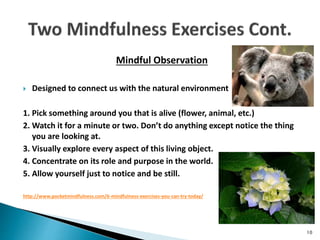
Mindful Observation
 Designed to connect us with the natural environment
1. Pick something around you that is alive (flower, animal, etc.)
2. Watch it for a minute or two. Don’t do anything except notice the thing
you are looking at.
3. Visually explore every aspect of this living object.
4. Concentrate on its role and purpose in the world.
5. Allow yourself just to notice and be still.
http://www.pocketmindfulness.com/6-mindfulness-exercises-you-can-try-today/
10
 Assessing Mindfulness and Acceptance Processes in Clients: Illuminating the
Theory and Practice of Change (The Context Press Mindfulness and Acceptance
Practica Series) 2010 by Ruth Baer PhD (Editor)
 Mindfulness for Beginners: Reclaiming the Present Moment--and Your Life
2011 by Jon Kabat-Zinn
 Mindfulness and Acceptance in Behavioral Medicine: Current Theory and
Practice (The Context Press Mindfulness and Acceptance Practica Series) 2011 by
Lance McCracken (Editor)
 Mindfulness and Acceptance: Expanding the Cognitive-Behavioral Tradition 2011
by Steven C. Hayes (Editor), Victoria M. Follette (Editor), Marsha M. Linehan
(Editor)
 Mindfulness Skills Workbook for Clinicians and Clients: 111 Tools, Techniques,
Activities & Worksheets 2013 by Debra Burdick (Author)
11
12
Thank You!

Mindfulness PPT

  • 1.
    Sean Harrington, LCSW-R MagellanHealth, Inc. USPS/Triboro District May 2015 1
  • 2.
    At the conclusionof this training, Clinicians will be able to…  Identify and provide examples of Mindfulness  Illustrate how Mindfulness can benefit the Client  Demonstrate to the Client, how Mindfulness can be utilized as a vital tool for behavioral modification 2
  • 3.
     Mindfulness isthe ability to maintain an objective or unbiased awareness of ones own thoughts feelings, and behaviors. It is always focused on the present moment.  Originally rooted in the Buddhist tradition as a way of self-improvement. Several recent studies show significant benefits are gained in both the physical and mental arena. Often used as a treatment intervention in schools, prisons, and hospitals. http://greatergood.berkeley.edu/topic/mindfulness/definition 3
  • 4.
     Reduces Stressand Anxiety  Improves Sleep  Reduces Physical Pain  Increases Enjoyment of Life  Increases Self-Awareness and Insight  Behavioral Modifier – PTSD/Smoking/Drinking/Drug Use/IPV http://www.helpguide.org/harvard/benefits-of-mindfulness.htm 4
  • 5.
     Body scan– Using concentration to become aware of whatever sensation is encountered in your physical body. It is neither controlled or changed – Just experienced  Raisin exercise – Consciously using as many of your senses, to experience a raisin. “What does it look like?”, “What does it taste like?” “What does it feel like?” “What does it smell like?” It is intended to enable one to focus on the present moment. It can be tried with different foods.  Walking meditation – Occurs when the body is in movement. Contemplate & absorb each step taken for 10 paces & repeat. What thoughts and feelings come to mind? http://greatergood.berkeley.edu/topic/mindfulness/definition 5
  • 6.
     In a2011 study from the University of California, brain activity of volunteers who had completed 8 weeks of mindfulness-based stress reduction training were compared with those that were not enrolled. The results showed that functional MRI scans showed stronger neuro-connections in several regions of enrollees’ brains compared with those not enrolled. http://www.health.harvard.edu/blog/mindfulness-meditation-improves-connections-in-the-brain-201104082253  Research suggests that the practice of some form of meditation (including mindfulness) may reduce blood pressure, symptoms of irritable bowel syndrome, anxiety & depression, insomnia, and the frequency & severity of acute respiratory illnesses. https://nccih.nih.gov/health/meditation/overview.htm 6
  • 7.
    Mindfulness Based CognitiveTherapy was constructed to address recurring depression. It is the combination of mindfulness techniques (meditation, breathing exercises and stretching) with cognitive behavioral therapy http://bemindful.co.uk/mbct/about-mbct/  A study, published in the British Journal of Psychiatry, found that MBCT significantly reduced depressive symptoms by 30-35%. http://www.mindful.org/news/mindfulness-based-cognitive-therapy-mbct-and-depression  Recent studies compared MBCT against the long-term use of antidepressants indicate that the efficacy of MBCT is equal to that of antidepressants. http://files.nicabm.com/Mindfulness2012/Segal/NICABM-Segal-2012.pdf 7
  • 8.
     Quitting Smoking https://www.psychologytoday.com/blog/minding-the-body/201204/can-mindfulness-help-you-quit-smoking Avoidance and hyper-arousal associated with PTSD. http://www.ptsd.va.gov/public/treatment/therapy-med/mindful-ptsd.asp  Drug/alcohol use  OCD  Domestic Violence (IPV) http://www.researchgate.net/publication/51656380_Mindfulness_and_modification_therapy_for_behavioral_dysregulation_results_from_a_pil ot_study_targeting_alcohol_use_and_aggression_in_women 8
  • 9.
    One Minute Breathing 1.Begin by breathing in/out slowly, holding your breath for a count of six once you’ve inhaled. 2. Breathe out slowly. 3. Notice the thoughts that come to you, they are what they are. Don’t alter them. 4. Return to watching your breath. 5. Observe your breath with all of your senses, and then let it out. http://www.pocketmindfulness.com/6-mindfulness-exercises-you-can-try-today/ 9
  • 10.
    Mindful Observation  Designedto connect us with the natural environment 1. Pick something around you that is alive (flower, animal, etc.) 2. Watch it for a minute or two. Don’t do anything except notice the thing you are looking at. 3. Visually explore every aspect of this living object. 4. Concentrate on its role and purpose in the world. 5. Allow yourself just to notice and be still. http://www.pocketmindfulness.com/6-mindfulness-exercises-you-can-try-today/ 10
  • 11.
     Assessing Mindfulnessand Acceptance Processes in Clients: Illuminating the Theory and Practice of Change (The Context Press Mindfulness and Acceptance Practica Series) 2010 by Ruth Baer PhD (Editor)  Mindfulness for Beginners: Reclaiming the Present Moment--and Your Life 2011 by Jon Kabat-Zinn  Mindfulness and Acceptance in Behavioral Medicine: Current Theory and Practice (The Context Press Mindfulness and Acceptance Practica Series) 2011 by Lance McCracken (Editor)  Mindfulness and Acceptance: Expanding the Cognitive-Behavioral Tradition 2011 by Steven C. Hayes (Editor), Victoria M. Follette (Editor), Marsha M. Linehan (Editor)  Mindfulness Skills Workbook for Clinicians and Clients: 111 Tools, Techniques, Activities & Worksheets 2013 by Debra Burdick (Author) 11
  • 12.