General Pedagogy Module
2
Special Capacity Building Training Program for Secondary
School Teachers on
General Pedagogy
By Tadesse Melesse (Professor)
1 The concept of curriculum & the new curriculum reforms
2
Differentiated Instruction
3
Teaching, learning and quality teachers
4 Students’ learning, assessment and feedback
Presentation Outlines
5 Implementing Constructively Aligned Instructional Plans

The new curriculum
reforms made enforced
to develop he training
module
Based on the reforms,
new teaching-learning
materials have been
developed and teachers
are teaching
Need assessment were
conducted and
teachers’ training gaps
identified.
General education
frameworks and
guidelines developed
based on policy
directions,
Different consultative
meetings and
discussions were made
Finally, agreement
reached to develop
trainings on General
Pedagogy and Subject
Specific subjects.
4
Day One
Module Introduction (Justifications)

General Pedagogy
Goal
 The ultimate goal of this General
Pedagogy is to create a platform for
trainees to discuss and share their
experiences, to trigger and motivate them
to be inquirers of knowledge, skills, and
values; to link their training with the
school-based continuous professional
development (CPD) and ultimately to
further develop the creative, emotional,
and social learning of their students.
Principles that guide the training
program:
 It is anchored in the new curriculum;
 It is rooted in the lived experiences of the
teachers and the learners;
 It applies both the pedagogy of investigation
and the pedagogy of enactment;
 It involves inclusiveness and diversity in
instruction;
 It ensures teacher learning as lifelong learning
(teacher learning continuum); 5

 Introduce the major curriculum concepts ,components and major reforms of the
new general education curriculum.
 Provide reliable information to trainees about the qualities and knowledge areas of
effective or ideal teachers.
 Provide opportunities to explore their students’ differences and the mechanisms of
accommodating the student differences in their classroom teaching through DI.
 Aware the application of gender-responsive and inclusive classroom environments.
 Apply the different active learning strategies that help students acquire the
necessary knowledge, skills, and values.
 Provide the different concepts of classroom management and gadgets to create a
conducive classroom environment for learners and managing large class sizes.
 Aware of the concepts, purposes, and tools of continuous assessment strategies.
 Aware the constructively aligned instructional planning and skills of developing it 6
Purpose of the module
Module Competencies
• After completing the training of this module, trainees are expected to:
Equip trainees with the knowledge, skills, and attitudes of the new curriculum
reforms appropriate for developing competency-based curriculum.
Solidify the trainees’ conceptual and practical understanding of learning and
teaching with Ethiopia’s new competency-based curriculum
Equip with the necessary knowledge and skills to identify diverse student
characteristics, how they learn and know the contents, and accommodating these
diversities through applying differentiated instruction in their classroom teaching.
Develop professional knowledge, professional practice, and professional
engagement of trainees both individually and in groups.
Competencies…
Equip them with practice-based, context-based, and learner-centered training
methods that they will use to deliver in their classroom teaching.
Acquaint trainees with the knowledge, skills, and attitudes of applying the
various active learning strategies in their classroom teaching practices.
The desire to and conviction towards facilitation of learning as espoused in the
reformed curriculum and creating and maintaining supportive and safe learning
environments.
Develop the capacity to assess, run follow-up or monitoring, provide feedback,
and report on students’ progress towards the desired level of competence using
carefully designed tools.
Equip trainees with the capability of developing lesson plans to implement
effective teaching and learning.
Pedagogical Approaches
1
.
C
o
n
s
t
r
u
c
t
i
v
i
s
t
A
p
p
r
o
a
c
h
2
.
C
o
l
l
a
b
o
r
a
t
i
v
e
A
p
p
r
o
a
c
h
3
.
R
e
fl
e
c
t
i
v
e
A
p
p
r
o
a
c
h
4
.
I
n
t
e
g
r
a
t
i
v
e
A
p
p
r
o
a
c
h
5
.
I
n
q
u
i
r
y
B
a
s
e
d
A
p
p
r
o
a
c
h
Assessment Recommendations
Both formative and summative assessment techniques will be employed.
During the training process, continuous-based assessment will be conducted
mainly for learning and feedback purposes.
This ongoing assessment will be carried out to identify achievements and
shortcomings in the delivery of the module and appraise the overall execution
of the pedagogy.
Finally, end-of-course assessment will be administered to gain a summative
appraisal of the module.
After trainees have completed the training and its impact on their actual
school practices, a follow-up evaluation will be conducted using a
questionnaire, interview, portfolio review, or classroom observation.
11
Structure of the Module
• Unit One: The Concepts of Curriculum
and the New Curriculum Reform (5 hrs.)
• Session 1.1: Components of a curriculum
• Session 1.2: Major shifts in the new
curriculum and reasons for change
• Session 1.3: Competence-based
Curriculum and Instruction
• Unit Two: Teaching-Learning and Quality
Teachers (8 hrs.)
• Session 2.1: Knowledge areas of
quality teachers
• Session 2.2: Teaching, learning, and
teacher quality
• Session 2.3: Active learning strategies
• Session 3.4: Experiential learning and
inclusion of indigenous knowledge
• Unit Three: Differentiated Instruction (5 hrs.)
• Session 3.1: Recognizing learners’ diversity in classrooms and
accommodating their diversity in learning
• Session 3.2: Creating a gender-responsive and inclusive and
classroom environment
• Session 3.3: Instructional media usage versus students’
learning styles and multiple intelligences
• Session 3.4. Conducive classroom management & large class size
• Unit Four: Assessment and feedback practices (3 hrs.)
• Session 4.1: Concepts and purposes of continuous assessment
• Session 4.2: Tools of assessment and techniques of providing
constructive feedback
• Unit Five: Creating and Implementing Constructively Aligned
Instructional Plans (3 hrs.)
• Session 5.1: Concepts of instructional planning and
formulation of objectives
• Session 5.2: Developing annual and lesson plans.
Unit 1: The Concept of Curriculum & the New Curriculum Reform
(5 hrs.)
Key Sessions
• Session 1.1: Concepts of
curriculum and
components of
curriculum materials
• Session 1.2: Major
reforms in the new
curriculum and reasons
of reform
• Session 1. 3:
Competence based
curriculum and
instruction
Unit Objectives
• After completing this unit, trainees will be able to:
Comprehend the concepts of curriculum.
Identify the components of curriculum materials teachers are expected to
use.
Use appropriately the different curriculum materials in their classroom
teaching.
Recognize the major reform areas and reasons for the reform.
Apply properly the major curriculum reforms in their classroom.
Appreciate the new curriculum reforms and major shifts.
Integrate horizontally & vertically the lessons they are teaching.
Analyze the concepts of competence-based curriculum & instruction.
Deliver competency-based instruction in their classroom teaching.
Unit 1: The Concept of Curriculum & the New Curriculum
Reform….
Session 1.1:
Concepts of
curriculum &
components of
curriculum
materials
Session Objectives
• After completing this session, trainees will be able to:
• Recognize the different concepts of curriculum.
• Identify the planned and unplanned curriculum and their
purposes.
• Create awareness of the relevance of the informal, hidden,
and null curriculum.
• Understand the different components of the curriculum
(teaching-learning) materials.
• Apply both the planned and unplanned curriculum for
students’ learning.
• Use the different curriculum (teaching-learning) materials
jointly in their classroom teaching.
Session 1.1
Activities
Do activity 1, 2 & 3 step by step.
1. What is curriculum?
2. Are schools addressing only the
formal/planned curriculum?
3. What major curriculum
materials do you have at hand?
4. What are the components of a
flowchart and a syllabus?
5. What is the link between the
textbook & teachers’ guide?
Give Activity 4 as a home task for
trainees.
Key Ideas
• Curriculum, as a dynamic field of study, has
been characterized as elusive, fragmentary, and
confusing.
• Curriculum is the vehicle through which a
country empowers its citizens with the
necessary knowledge, skills, attitudes, and
values that enable them to be socially and
economically engaged and empowered, for
personal and national development.
Curriculum…
B
o
t
h
p
l
a
n
n
e
d
&
u
n
p
l
B
o
t
h
p
l
a
n
n
e
d
&
u
n
p
l
Session1.2: Major reforms in the new curriculum and reasons for
the reform
Session Objectives
• After this session, trainees will be able to:
Understand the major reforms made in the
general education curriculum
Analyze the reasons for changing the old
curriculum.
Apply the major curriculum reforms in their
classroom teaching
Appreciate the new reforms in the education
structure and contents of each subject matter.
Identify the general education learners’
profiles and general education learning areas
learners are expected to take at different grade
levels.
Activities
1. Compare the previous reforms of TESO
and PgDT in our teacher education
programs? What were their strengths and
weaknesses?
2. Currently also a new education reform was
made. Why do you think is a curriculum
reform needed?
3. Mention the critical problems of the
previous general education curriculum of
Ethiopia.
4. Differentiate the new curriculum reforms
from the old.
Key Ideas
The new curriculum
reform is:
• Competence based
• Indigenous
knowledge focused
• Involving the 12st C
skills
• Practice oriented
• Involving moral
education
• Vocationalization of
education
• Digitalising the
curriculum
Education structure
of General
education
• pre-primary,
• Primary (Grades 1-6),
• Middle level (Grades 7-
8), and
• Secondary education
(Grades 9-12).
• 2(3)-6-2-4
Lists of subjects
• Pre-primary
• Primary
• Middle
• Secondary
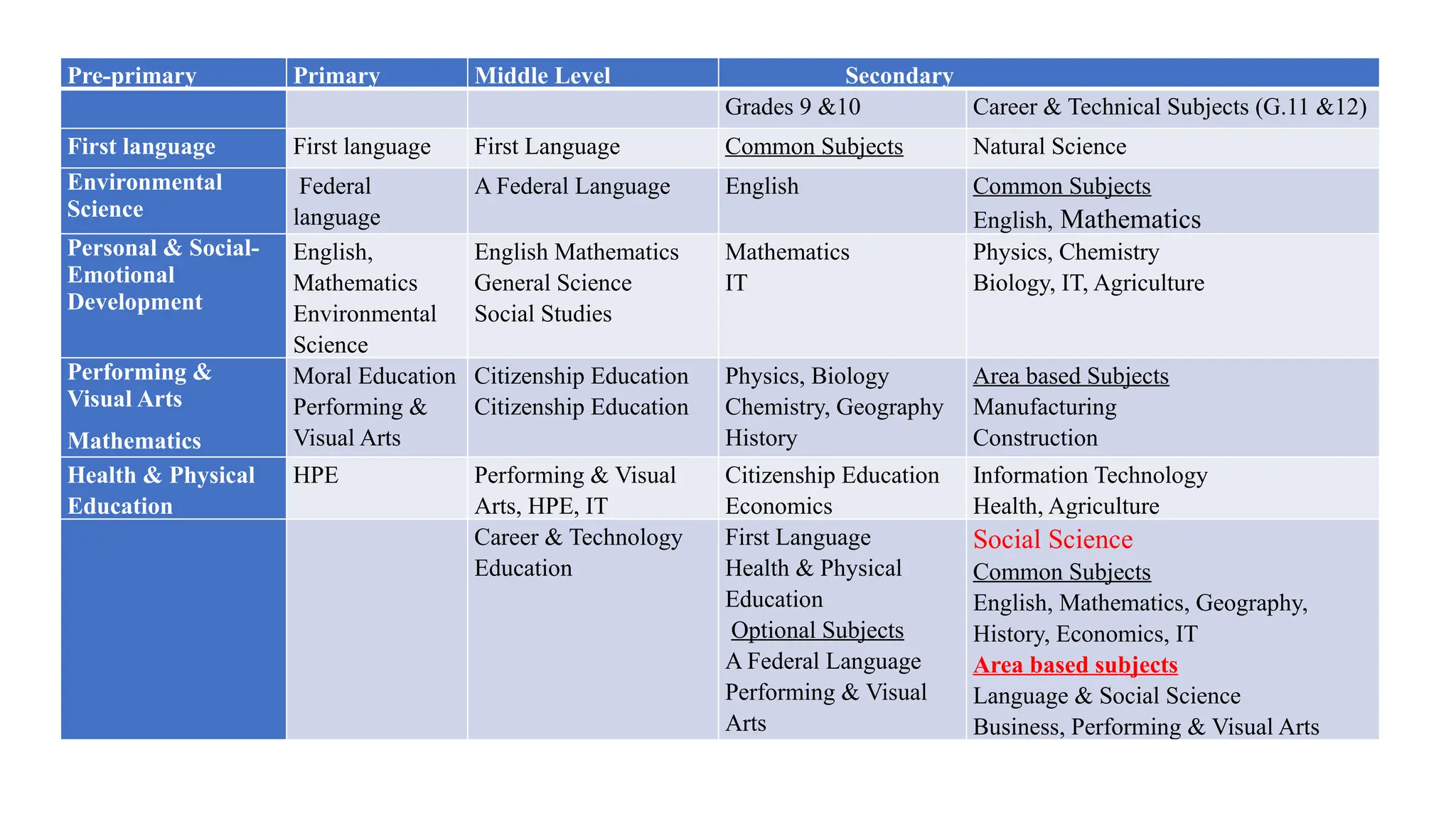
Pre-primary Primary Middle Level Secondary
Grades 9 &10 Career & Technical Subjects (G.11 &12)
First language First language First Language Common Subjects Natural Science
Environmental
Science
Federal
language
A Federal Language English Common Subjects
English, Mathematics
Personal & Social-
Emotional
Development
English,
Mathematics
Environmental
Science
English Mathematics
General Science
Social Studies
Mathematics
IT
Physics, Chemistry
Biology, IT, Agriculture
Performing &
Visual Arts
Mathematics
Moral Education
Performing &
Visual Arts
Citizenship Education
Physics, Biology
Chemistry, Geography
History
Area based Subjects
Manufacturing
Construction
Health & Physical
Education
HPE Performing & Visual
Arts, HPE, IT
Citizenship Education
Economics
Information Technology
Health, Agriculture
Career & Technology
Education
First Language
Health & Physical
Education
Optional Subjects
A Federal Language
Performing & Visual
Arts
Social Science
Common Subjects
English, Mathematics, Geography,
History, Economics, IT
Area based subjects
Language & Social Science
Business, Performing & Visual Arts
Day Two
Unit Two: Teaching, Learning, and Quality Teachers (8 hrs.)
Sessions
• Session 2.1: Quality teachers and
professional attributes
• Session 2.2. Teaching, learning and
qualities of ideal teachers
• Session 2.3: Active learning
strategies
• Session 2.4: The roles of the teacher
and students in active learning
• Session 2.5: Experiential learning
and inclusion of indigenous
knowledge
Module Objectives
• Understand the qualities of ideal or effective teachers
• Analyse the different professional attributes and standards of
general education teachers
• Recognise the TPACK of teachers and other knowledge areas
• Understand the different active learning strategies to address
learning diversity.
• Apply the various active learning strategies in their classroom
teaching.
• Differentiate the roles of students and teachers in active learning
• Integrate experiential learning and inclusion of indigenous
knowledge in the curriculum
• Appreciate the values of indigenous knowledge for students’
learning.
Session 2.1: Quality teachers and their professional attributes
Session Objectives
• After completing this session, trainees
will be able to:
• Understand the characteristics of
quality teachers
• Identify the major professional
attributes or knowledge areas of quality
teachers
• Apply a variety of content and
pedagogical knowledge in their
teaching.
• Apply technological pedagogical content
knowledge in their teaching lessons.
Activity 1
• Let trainees do Activity-1 in the
module referring to characteristics of
an effective teacher.
Characteristics of effective teachers
?
?
?
Qualities of an Effective Teacher
• (a).knowledge of subject
matter
• Knowing the subject well to
teach with confidence
• Preparing daily for effective
teaching
• Selecting appropriate
materials, methods and
learning experiences
• Reading extensively around
the subject matter
• (b). knowledge about
human behavior
• He/she should know how a
human being develop and learn
• He/she should be able to reflect
on a pupil’s performance and
make suggestions for
improvement
• He/she should be able to identify
fast, medium and slow learners
• He/she should find ways of
assisting slow learners.
Qualities of an effective teacher
• (c). display of attitudes that foster
learning and genuine human
relation ship
• He/she must be friendly
• He/she must be sympathetic
• Treating pupils as human beings(with
respect)
• Ability to explain difficulties with patience
• Being firm and impartial
• Show interest in pupils as well as their
parents
• He/she must always strive to motivate
pupils
• (d). Teaching skills
• He/she must be versatile
• Using a variety of skills
• Ready to adapt to changes
• Focusing on the 3Hs (head, hand & heart)
23
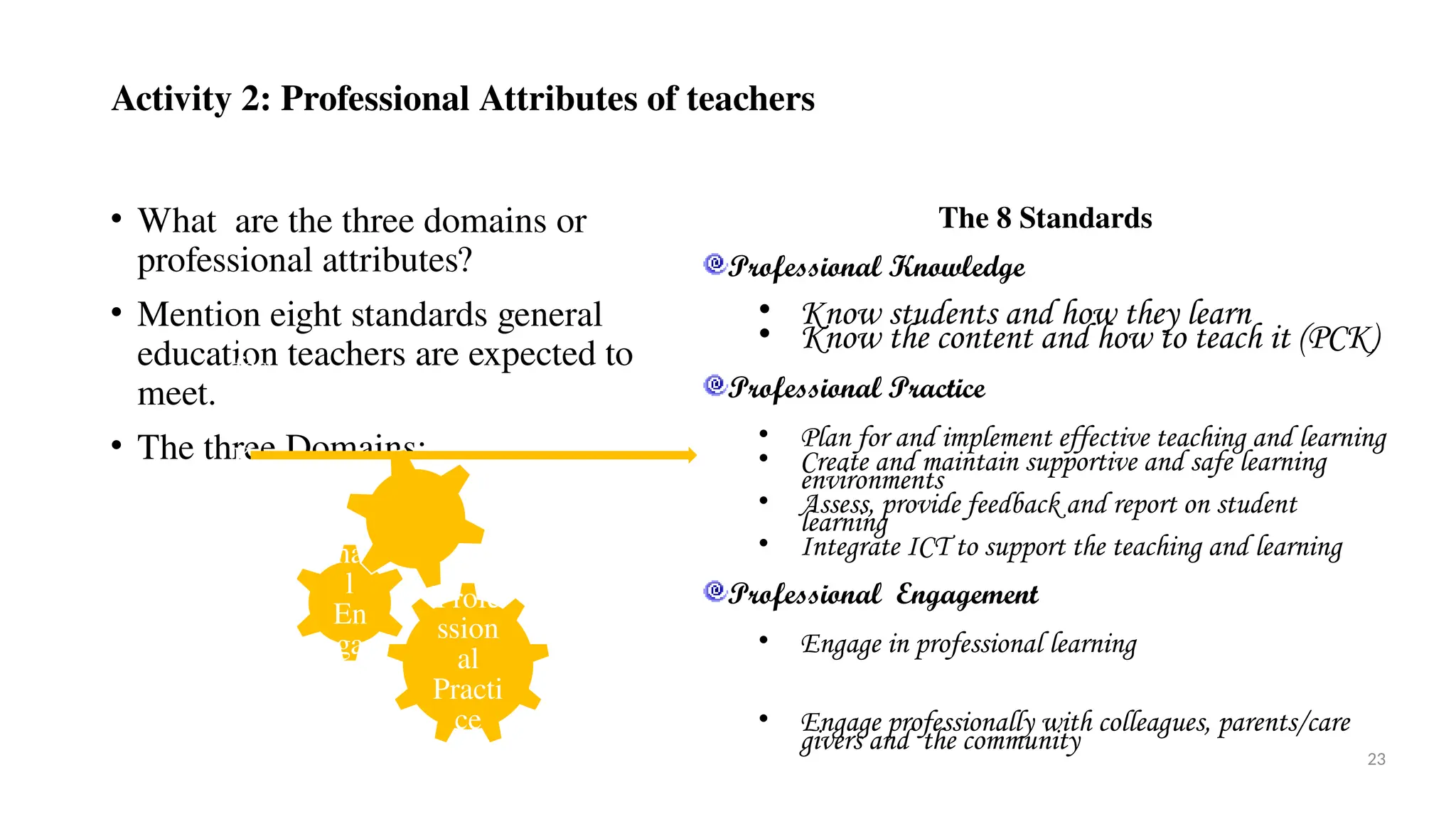
Activity 2: Professional Attributes of teachers
• What are the three domains or
professional attributes?
• Mention eight standards general
education teachers are expected to
meet.
• The three Domains:
The 8 Standards
Professional Knowledge
• Know students and how they learn
• Know the content and how to teach it (PCK)
Professional Practice
• Plan for and implement effective teaching and learning
• Create and maintain supportive and safe learning
environments
• Assess, provide feedback and report on student
learning
• Integrate ICT to support the teaching and learning
Professional Engagement
• Engage in professional learning
• Engage professionally with colleagues, parents/care
givers and the community
Profe
ssion
al
Practi
ce
Pr
of
ess
io
na
l
En
ga
ge
m
en
t
Pro
fes
sio
nal
Kn
ow
led
ge
24
Activity 3: Teachers’ TPACK
• Teachers’ TPACK:
• Knowledge of the subject matter
• Pedagogical knowledge
• Technological knowledge
• Pedagogical content knowledge
• Technological pedagogical
knowledge
• Technological content knowledge
• Technological pedagogical
content knowledge (TPACK)
Session 2.2: Teaching, learning, and teacher quality
Session objectives
• Define what teaching is properly
• Realize the concepts of learning based on
different theories
• Identify the characteristics and principles
of teaching
• Make aware of the qualities of ideal
teachers that are appreciated by their
students and the community.
• Demonstrate the major characteristics of
ideal teachers in their classroom
teaching.
Activities
• Activity 1. From trainees'’ teaching
experience, define teaching based on
the behaviorist, cognitivist, and
constructivist views?
• What about learning?
• Is our current classroom teaching
following the behaviourist or
constructivist approach?
• When do trainees think they are
effectively teaching?
Teaching…
B
eh
av
io
ur
ist
s
Te
ac
hi
ng
is
fo
cu
se
d
on
m
od
if
yi
ng
C
og
ni
ti
vi
st
s
Te
ac
hi
ng
fo
cu
se
s
on
un
de
rst
an
di
ng
ho
w
lea
C
on
st
ru
ct
iv
ist
s
C
on
st
ru
ct
iv
ist
s:
Te
ac
hi
ng
as
a
pr
Learning
• Learning as a relatively permanent change in behaviour.
• This perspective emphasizes the role of external stimuli
rather than internal mental states.
• Conditioning (classical & operant), observational learning
are key principles
Behaviourists
• Cognitive learning theory focuses on the internal mental
processes involved in learning rather than observable
behaviousrs.
• It focuses how people understand, process, and store
information.
Cognitivists
• Learning by constructivists centers around the idea that
learners actively construct their own knowledge and
understanding through experiences and interactions with the
world.
• (Knowledge is not passively received).
• Knowledge construction , student engagement, problem
solving ,learning by doing…
Constructivists
Session 2.3: Active Learning Strategies
Session Objectives
• Compare and contrast the teacher-centered approaches with student-
centered (active learning)
• Define the term active learning
• Identify the different active learning strategies
• Analyze the different case scenarios.
• Understand the misconceptions of active learning
• Use the various active learning strategies
• Create favorable conditions for the active involvement of students
• Appreciate the active engagement of students and teachers in the active
learning process
• Conduct microteaching using different active learning strategies.
• Identify the roles of students and teachers during the active learning
What is active learning?
• Active learning is an
instructional approach
that actively engages
students in the learning
process.
• Key characteristics are:
student engagement,
critical thinking,
collaboration, feedback,
application of knowledge,
reflection, etc.
Ice breaker
1. What do you understand
from the proverbs given?
2. State the information in
your own words. Give
examples of it.
3. Foresee some of its
consequences.
4. State its opposite or
converse.
Activity 2
• 1. What makes teacher-centered
teaching different from the learner-
centered approach?
• 2. What is active learning? What
makes learning “active”? How do
teachers prepare students active from
the start? Why is it necessary to
make learning active?
• 3. How do they help students acquire
knowledge, skills, and attitudes...
actively? And how do they make
learning unforgivable?
• 4.When do you think students
are actively engaged in their
learning? Just try to show
trainees the following figure and
try them to argue in favor or
against the figure based on their
prior experience.
Brainstorming Questions
1. When do you think are students
actively engaged in their learning?
2. How much do they acquire the
knowledge and skills when they
engage in reading only, hearing only,
hearing and looking, saying and
writing, and doing it practically?
3. How can you relate the issues of this
figure with your instructional media
usage? What do you understand in
general from the picture?
Activity 3 Case based scenarios
1. What are some of the differences between the two lessons described in the table below?
Mr. Shaw’s lesson
• ______________________
• ______________________
• ______________________
Mr. Hammond’s lesson
• _____________________
• _____________________
• _____________________
2. Which lesson do you think is more powerful? Why?
3. What are the strong and weak sides of Mr. Shaw and Mr. Hammond?
4. What type of teaching methods were the two teachers employing?
5. What is inquiry-based learning?
6. Why inquiry-based learning needed?
Activity 4: Ask the trainees to
list ALMs they know
Activity 5: Guide then active learning
strategies and how they work
Group 1
Jigsaw
discussion
Brainstorming
Inquiry-based
learning
Classification
Demonstration
Storytelling
Cooperative
learning
Group 2
Hot seating
Balloon gaming
Future wheel
method
Mind mapping
Crossover
grouping
Problem-solving
Group 3
Discovery
learning
Spider diagrams
Diamond
ranking
Debate
Gapped lecture
Field visit
Flipped
classroom
Group 4
Gallery walk
Action research
Matching
exercise
Picture analysis
Project method
Goldfish bowl
Active
Learnin
g
strategi
es
?
?
?
?
?
? ?
?
?
?
?
?
Some active learning strategies
Active Learning
Methods
Brain storming
Ranking order
Demonstration Formal/Informal
Gapped lecture
Hot seating
Golden fish bowel
Balloon Gaming
Bus stop
Mind mapping
Picture analysis
Future wheel
Pyramiding
Gallery Walk
Cross over
Jigsaw
35
.
o Action research
o Active listening
o Balloon gaming
o Brainstorming
o Bus stop
o Buzz group
o CAF (Consider All
Factors)
o Case studies
o Competitions
o Comprehension
activities
o Cooperative learning
o Creative writing
o Crossover groups
o Debate
o Demonstration
(formal/informal)
o Drama
o Drawing pictures,
maps, graphs
o Discovery learning
o Evaluation of
lesson/programme
o Experiment
o Fieldwork
o Flashcards
o Future Wheel (also
called consequence
wheel)
o Games
o Gallery walk
o Gapped lecture
o Goldfish bowl
o Hot seating
o Ice breaker/ starter
activity/ warm-up
o Independent work
o Interviews
o Investigation
o ICT use
o Inquiry method
o Jigsaw groups
o Making models and
resources
o Mastery learning –
‘practice makes
perfect’
o Matching exercises
o Microteaching
o Mind map (sometimes
called concept map)
o Newspaper or radio
reporting
o Pair discussion
o Peer assessment
o Picture analysis
o Portfolio development
o Presentation
o Problem-solving
o Project work
o Pyramiding
o Questioning
o Question and answer
o Quiz
o Ranking tasks
(including
diamond ranking)
o Reflection
o Research
o Roleplay
o Scenario analysis
o Self-assessment
o Small group
discussion
o Spider diagram
(similar to mind
map, can be used
to record results of
brainstorming)
o Stimulus material
o Storytelling
o Target setting
o Thought bubbles
o Visits, etc.
36
Day Three
Session 3.4: Experiential learning & inclusion of indigenous
knowledge
Session Objectives
• Define experiential learning and its cycles.
• Explore the experiential knowledge and
indigenous knowledge practices of trainees.
• Relate the daily lessons with the prior
experiences or experiential learning of students.
• Synthesize the indigenous knowledge with the
knowledge of books
• Apply inclusion of indigenous knowledge in
their classroom teaching
• Link the indigenous knowledge with 21st-
century skills.
Activities
• Activity 1:
1. Are students coming to school without knowledge and
skills gained through life experience?
2. How the indigenous people are controlling soil
erosion, use medicines, construct buildings prepare
food items and alcohol, etc,?
3. How do the local communities cultivate crops, rear,
and adapt different animals?
4. What local medicines are you familiar with in your
areas and for what purpose are they used?
5. What can the local community do to save a person
heated by thunder?
6. What does the state of arbitration look like in our local
communities?
Activity 2
1. Mention various indigenous
knowledge areas which encompass
customs, traditions, traditional
ecological knowledge, spiritual beliefs,
and local language in your areas and
contexts that are related to your subject
matter and share with your colleagues
how it works.
2. How does the integration of indigenous
knowledge in our curriculum look
like?
1. What is your opinion on
integrating and applying
indigenous knowledge
with 21st-century skills?
2. What are the challenges of
applying indigenous
knowledge in classroom
teaching?
39
Inclusion of Indigenous knowledge & experiential learning ….
Activity 3:
Discuss on the following activities by
analysisng the pictures associated
with it.
Are students coming to school
without prior experience of
indigenous knowledge?
Why the mathematics teachers are
teaching students about a Circle and
circle formula (to find circumference,
diameter, radius, arc, etc?
Local material Corresponding Global picture
Measurement
Vo
lu
m
e
an
d
su
rface
a
rea
of
co
n
e
a
nd
cy
lin
d
er
Vo
lu
m
e
an
d
su
rface
a
re
a
s
o
f
con
es
a
n
d
cylin
d
ers
fro
m
a
re
alistic
p
ersp
ective.
• .
V
o
lu
m
e
a
n
d
s
u
r
fa
c
e
a
r
e
a
s
o
f
fr
u
s
tu
m
s
.
V
o
lu
m
e
a
n
d
s
u
r
fa
c
e
a
r
e
a
s
o
f
c
o
n
e
a
n
d
s
p
h
e
r
e
Tadesse Melesse (PhD)
Activity 4
Case study
• Let’s say, those people in Bahir Dar
who are living along the borders of
Lake Tana are repeatedly suffering
from malaria. So, based on the four
steps of Kolb’s Cycle of experiential
learning, how can these people get
relieved from this problem? What
can you do step by step for this
problem?
43
Experiential learning…
• The experiential learning
programme aims to promote
professional skills and knowledge
through hands- on experience,
building confidence and ability to
work in project mode and acquire
enterprise management capabilities.
• There are four major characteristics
of experiential learning theory:
concrete experience, reflective
observation, abstract concepts, and
active experimentation.
Unit 3: Differentiated Instruction (5 hrs.)
• Unit Objectives
• After completing this unit, trainees will be able to:
• Understand the presence of diverse learners in the classrooms,
• Recognize and respect the learners’diversity in the classrooms,
• Address learners’diverse needs, interests, readiness, learning styles, and multiple intelligences
by applying differentiated instruction strategies in their classroom teaching.
• Create gender responsive and inclusive classroom environment while teaching.
• Use various instructional media to address learners’diverse learning styles and multiple
intelligences accordingly.
• Appreciate the presence of diversity in the classrooms for knowledge, skill, and value sharing.
• Identify the different classroom management techniques
• Create a conducive classroom environment for all students’learning.
• Identify the root causes of student misbehaviors.
• Apply the diverse techniques of managing large class-size in their teaching
• Use the preventive and curative techniques of handling student misbehaviors.
Key Topics
• Session 3.1: Recognizing learners’ diversity in classrooms and
accommodating their diverse learning
• Session 3.2: Creating gender responsive and inclusive classroom
environment
• Session 3.3: Instructional media usage versus students’ learning styles
and multiple intelligences
• Session 3.4. Creating conducive classroom management
• Session 3.5: Managing large class-size and techniques of classroom
management
Session 3.1: Learners’ diversity in classrooms and accommodating
their learning
Session Objectives
• After completing this session,
trainees will be able to:
• List exhaustively the major
differences of students in the
classrooms
• Apply various differentiated
instruction strategies in their
classroom teaching to
accommodate students’learning
diversity.
Activities
• Activity 1:
1. Are all students in the
classroom the same? If not
what are their differences?
2. If all students in the classroom
are diverse, what were the
methods of teaching you have
employed to address the diverse
needs and interests of students?
Activity 2
1. Is a one-size-fits-all approach or
differentiating instruction
according to students’ learning
diversity important in the current
classroom teaching? Why?
2. What is differentiated instruction
(DI) for you? What are the
components and strategies of DI?
3. What makes DI different from
universal design for learning
(UDL)?
• 4. Is it possible to differentiate
contents/ lessons, methods of teaching,
assessment strategies, and learning
environment in the same classroom
teaching? Why?
• 5. How is a homogenous assessment
practice possible for heterogeneous
class students in our context?
• 6. What type of strategies can you
apply content, method, assessment,
and learning environment
differentiations?
Activity 3:Is our classroom teaching different from this?
Key Ideas:
No two students are exactly alike!!!
• Readiness levels
• Educational experiences
• Interests
• Learning styles
• Intelligences
• Personal experience
• Learning profiles
Students came with a
variety of
Differences and interconnections of UDL and DI
UDLfocuses on creating inclusive learning environments from the start,
incorporating flexible materials and methods that benefit all students.
UDL through three components: Representation (the what of learning), Action
& Expression (the how of learning), and Engagement (the why of learning).
DI is a systematic approach to planning curriculum and
instruction for academically diverse learners that focuses
on modifying (1) content, (2) process, (3) product, and
(4) learning environments in response to students’ needs.
DI modifies teaching to meet individual student needs,
adjusting content, process, product, and learning
environment.
UDL vs DI
UDL
• UDL is an overarching approach focused
on the inclusive design of the whole
learning environment at the onset.
• It aims to ensure all students have full
access to everything in the classroom,
regardless of their needs and abilities.
• UDL provides multiple means of
engagement, representation, action &
expression to all learners from the start.
• Students are encouraged to self-
differentiate and choose the best path for
themselves.
DI
• Differentiation is a strategy aimed at
addressing/adjusting each student’s individual
levels of readiness, interest, and learning profiles.
• The teacher modifies content and processes to
address the needs of each student and directs
students to specific activities
• Differentiation is done after the data is collated
and trends are noticed.
• The goal is to provide a responsive and optimal
learning environment for individuals/groups of
learners.
• DI is doing what’s fair for students.
UDL
• Proactive- anticipate the existence of
learner variability and plans for it
before a lesson begins.
• UDL proactively evaluates the
classroom instruction and
environment and provides access to
the content on the front end;
• Evaluates environment, classroom,
culture
• Intentional prior planning
• Focuses on variability
DI
• Reactive-
• DI reactively evaluates individual
students and modifies on the back
end.
• Evaluates the student
• Cause/effect based planning &
intervention
• Focuses on individual disability
UDL
“Fix the
lesson”
Plan the lesson
in anticipation
to student
needs
Build the tools
and methods of
differentiation
right into the
lesson
Occurs prior to
instruction
(Proactive)
“ Fix the
student”
Modification in
response to
learner needs
and preferences
as they are
identified
during and
after
instruction
Occurs post-
instruction
(Reactive)
Session 3. 2: Creating a gender-responsive and inclusive classroom
environment
Session Objectives
• Identify where there are specific and
impairment-related differences in
classroom teaching.
• Understand the concept of inclusive and
gender-responsive pedagogy.
• Create a conducive learning environment
for both females and males and students
with special needs.
• Apply gender-responsive and inclusive
classroom teaching for all students in the
classrooms.
Activities
• Activity 1
1. What is gender? What is gender equity?
2. Why is gender agenda for schools and the
community?
3. Based on your prior experience, is there gender
stereotyping in your classroom teaching?
4. In your schools, what major challenges do you
identify in female students’ learning compared to
male students?
5. Is your classroom teaching-learning approach for
male and female students the same? Why?
6. What is gender-responsive pedagogy?
 Do Activity 2 in a similar manner
Activity 2
1. In your schools, are there students with special needs (i.e., visually impaired, deaf,
blind, mentally retarded, emotionally disturbed, and intelligent students)? If No, why
so? If Yes, How are you supporting them?
2. Are there supporting learning materials (e.g., braille for the blind, hearing devices,
sign languages, and also trained teachers with inclusive and special needs education)?
3. How can you address the problems of students with special needs in the classroom
teaching while teaching them with other ‘normal’ students in the same classroom?
What treatment and support mechanisms are provided for them in the classrooms and
outside the classroom?
4. Can you share the major strategies you apply to accommodate these differences?
What are also the major challenges you faced? What solutions did you use for the
challenges you faced?
Session 3.3: Learning styles and multiple intelligences of learners and Instructional media usage
Session Objectives
• Identify the diverse learning styles
and multiple intelligences of
individual students.
• Treat students in classrooms to use
and develop their unique intelligence,
talents, and learning styles.
• Apply the different instructional
media for their lessons by considering
the different learning styles and
multiple intelligences of students in
their classroom teaching.
Activities
Activity 1:
1. What types of students are learning in the
classrooms? Or, are they all the same?
2. How can you characterize the behaviors of
students during your classroom teaching?
3. In your lesson teaching, are you using the same
instructional media for all students or different?
Do all students have the same learning styles?
4. In your experience, what are the diverse learning
styles individual students are applying in their
classroom teaching? What about the students’
multiple intelligences?
Learning styles & Multiple intelligences….
Learning Styles
• What? • What?
• What?
• What?
? ?
?
?
Multiple intelligences
Multipl
e
Intellig
ences
?
?
?
?
?
?
?
?
?
1. How can you treat students in
classrooms to address their unique
intelligence, talents, and learning
styles?
2. What type of instructional media
are you frequently applying in
teaching your subjects? While
using different instructional media,
are you considering the learning
styles and multiple intelligences of
students?
3. What type of instructional media
do you think is appropriate for
visual, auditory, and kinesthetic
/tactile learners?
Learning Styles
• Multiple intelligences
1. Visual Learners: is prosper when information is presented in a visual format. They prefer to see and observe
information through images, diagrams, graphs, and videos. For these learners, incorporating visual aids and
creating visually stimulating learning materials is essential. Teachers can cater to use visual aids like info graphics,
charts, diagrams, and mind maps to present information and enhance comprehension and retention; provide
opportunities to create their own visual representations of concepts; incorporate videos, animations, and slideshows
to reinforce concepts; encourage visual note-taking and the use of colour coding to organize information; and
provide written instructions and handouts to supplement verbal explanations.
2. Auditory Learners: absorb information best through sound and spoken words. They prefer
listening to lectures, discussions, and audio recordings. To cater to auditory learners, teachers should
focus on verbal communication.; ask students to read aloud; engage students in discussions and
debates to encourage active listening; use lectures, podcasts, and audio recordings to deliver
information; encourage students to explain concepts verbally or participate in group discussions; and
provide opportunities for students to present their ideas and findings orally.
3. Kinesthetic/Physical/Tactile Learners: are hands-on learners who thrive through physical activity and
movement. They prefer to engage in practical experiences and learn through touch and manipulation. To cater to
kinesthetic learners, teachers should incorporate experiential learning and real-world applications into their
teaching methods; incorporate hands-on activities, experiments, and simulations; encourage students to participate
in role-plays, skits, or physical demonstrations; use manipulatives, models, or interactive technology to reinforce
concepts; provide opportunities for students to engage in practical applications of knowledge and provide
opportunities for movement during lessons, such as incorporating gestures or allowing students to work in groups
Session 3.4: Conducive classroom management and
managing large class size
Session Objectives
• Identify the conducive classroom environment setting
for students’learning
• Analyze the pros and cons of the different sitting
arrangements
• Realizing the techniques of managing large class size
in their teaching
• Appreciating large class size as an opportunity for
experience sharing than as a challenge.
• Identify various classroom management approaches
and how they work
• Recognize the different classroom student
misbehaviors and causes of the misbehavior
• Devise preventive and curative mechanisms or
techniques for student classroom misbehavior.
ACTIVITIES
• Activity 1
1. What does the classroom setting refers to?
2. What types of sitting arrangements do you
know? Mention them with their advantages and
limitations. Which type of sitting arrangement is
mostly applied in the classrooms?
3. Is a flexible group arrangement or a fixed group
arrangement advantageous? Why?
4. Is there large class size in your schools? How
large is it?
5. Is large class size an opportunity or a challenge?
6. What techniques can you apply to manage large
class size in classroom teaching?
Activity 2.
• 1. Mention what types of classroom management approaches they are
applying in their classroom teaching.
• 2. Compare the strong an weak sides of the following classroom
management approaches
• Bb
• 2.
Authoritarian
approach
 _______
 _______
 _______
 _______
Instructional/
Democratic
approach
 ________
 ________
 _______
Cookbook
approach
 ________
 ________
 _______
 _______
Lessiez-faire/
Permissive
approach
 ________
 ________
 _______
Intimidation
approach
 ________
 ________
 _______
 _______
Activity 3:
1. What are misbehaviors to you?
2. What is the root causes of the student misbehavior? Try to
guide the trainees to discuss the root causes by framing their
discussion as teacher related, student related, school leadership
related, parent/ community related misbehaviors.
3. How can you tackle or minimize students’ classroom
misbehaviors?
4. What are preventive techniques?
5. What are also curative techniques for student classroom
misbehavior?
Day Four
Unit Four: Assessment and feedback practices for students’
learning (3 hrs.)
Unit Objectives
• Understand the concepts of assessment and continuous
assessment
• Analyze the purposes of continuous assessment for
learning and grading.
• Recognize the various tools of assessment to be used
before, during, and after instruction to address learners’
• Apply the different assessment tools to address learners’
diverse needs, interests, readiness, learning styles, and
multiple intelligences.
• Appreciate the use of continuous assessment for
students’ learning progress and feedback.
• Recognize the various techniques of providing
constructive feedback.
Key Sessions
• Session 4.1: Concepts,
purposes and characteristics
of assessment
• Session 4.2: Tools of
assessment and techniques
of providing constructive
feedback
Session 4.1: Concepts, purposes, and characteristics of continuous assessment
Session Objectives
• Understand the concepts of assessment and
continuous assessment,
• Differentiate the concepts of assessment from
measurement and evaluation
• Analyze the different types of continuous
assessment.
• Recognize the characteristics of continuous
assessment.
• Differentiate the purposes of continuous
assessment before, during, and after instruction
• Apply different assessment techniques before,
during and after instruction.
Activity 1
1. Are students learning what they are supposed to be
learning?
2. How can you check whether your students are learning
or not? How frequently are you assessing?
3. What is continuous assessment for you? How can you
differentiate assessment from measurement and
evaluation?
4. When do you think is assessment provided? For what
purpose is assessment used?
5. Is assessment part of the teaching-learning process?
How?
6. What are you going to assess? How can you assess the
knowledge, skills, and attitudes of students? What
assessment tools can you apply to measure knowledge,
skill, and attitudes?
What is the difference????
Evaluatio
n
Exam
Key concepts…
Measurement: The explicit
quantification of the results obtained
through testing.
Assessment: collecting information to
check students’ attainment of the
required learning outcomes
Evaluation: The placing of value or
interpretation of a measurement and
assessment. It is providing decisions
Evaluation = Measurement +
Assessment + value
judgment
Evaluation = Quantitative
(measurement) + qualitative
description (non-measurement)
+ value judgments.
Activity
1.
Assessment
• What is assessment?
• The word ‘assess’ comes
from the Latin verb
‘assidere’ meaning ‘to sit
with’.
• In assessment one is
supposed to sit with the
learner.
• This implies it is something
we do ‘with’ and ‘for’
students.
 What is continuous
assessment?
 ongoing process of gathering and
interpreting information about
student learning.
a means for collecting information to
check students’ attainment of the
required objectives.
 process of gathering pupils’
responses to an educational task.
It enables one self adjust to learning
Activity
1. Why are we going to
assess?
2. How can we assess
students knowledge,
skills and attitudes?
3. Which assessments
are useful and which
are not?
Why we assess students?
Incentive to learn
Feedback to student
To inform instruction
Modification of learning activities
Selection of students
To decide success or failure
Feedback to teacher
Gather evidence of student learning
To motivate students
Increase student achievement
To assign grades/ranks.
Types of Assessment
Diagnostic
assessment
Formative
assessment
Summative
assessment
Session 4.2: Tools of assessment and techniques of
providing constructive feedback
Session Objectives
• List the various assessment
tools to be employed before,
during, and after the instruction
• Understand the purposes of
feedback
• Appreciate the importance of
feedback to improve trainees’
learning and learning progress.
• Apply different feedback
techniques before, during, and
after instruction.
Activities
• Activity 1: Purposes of Assessment
Purposes of assessment
Diagnostic
Assessmen
t
?
?
?
Formative
Assessmen
t
?
?
?
Summative
Assessmen
t
?
?
?
It is not the assessments themselves that are
Diagnostic, formative or summative but how
they are used.
Types of CA
Diagnostic
FCA
SCA
Formative Continuous Assessment
(Assessment for learning)
It is to assist the learning process by providing feedback
It is continuously gathering evidence about learning.
It has the greatest impact on student learning.
It is diagnostic and remedial
It is non-graded
Can be done formally or informally for feedback.
It is process oriented (cultivating the learner)
Carried out during instruction
It is part of the teaching method.
.
Tools of FCA
FCA Tools
Classwork
Homework
Practical activities
Cases
Demonstrations
Q&A
Quiz
Projects
Portfolio
Observations
Tests/Assignments
Summative Continuous Assessment: (Assessment of Learning)
at the end of a unit/term/semester.
the purpose is to gather evidence of student achievement after
instruction.
used primarily to make decisions for grading or certification purpose.
to judge the learner’s overall performance.
for checking mastery
to pass or failure
to determine what has been learned from the lesson,
to summarize student progress.
Tools of SCA (But for grading purpose)
FCA Tools
Written works
Homework
Practical work
Oral Questions
Demonstrations
Q&A
Quiz
Project
Observation results
Tests/Assignments
Final exam
During learning After learning (at the end)
to provide information to improve
achievement
Used to certify student competence
Used to identify and respond to
student needs
Used to rank and sort students
Purpose: improve learning Purpose: measure or audit attainment
Focused on the learning process. Focused on the products of learning.
Collaborative: Teachers & students
work together.
Teacher directed
Fluid- Ongoing process Rigid- fixed time
Unit Five: Creating and Implementing Constructively
Aligned Instructional Plans (3 hrs.)
Unit Objectives
• Understand the concepts and purposes of instructional
planning
• Differentiate the components of instructional planning.
• Formulate objectives based on Bloom’s taxonomy of the
three objective formulation domains in a balanced manner,
• Develop the annual plan for their subject areas,
• Develop sample lesson plans in specific lessons.
• Appreciate the importance of developing a constructively
aligned annual plan and daily/weekly lesson plans.
• Evaluate the previously developed annual plans and lesson
plans and make the necessary improvements.
Key Topics
• Session 5.1: Concepts
of instructional
planning and
formulation of
objectives in planning
• Session 5.2:
Developing annual
plan and lesson plans.
Session 5.1: Concepts of instructional planning and its
components
Session Objectives
• Identify the concepts of
instructional planning,
• Analyse the characteristics and
purposes of instructional planning,
• Address the key instructional
planning questions to be included
during instructional planning.
• Identify the major components of
instructional planning.
Activities
• Activity 1:
• 1. what is instructional planning?
• 2. what is its purpose?
• 3. What are the basic question
addressed in instructional
planning?
Activity
• What is constructive instructional
alignment?
• Effective teaching involves aligning
the three major components of
instruction: learning objectives,
assessments and instructional activities.
1. Discuss how these components are
aligned:
2. What should the student know or
be able to do?
3. How does the student reach the
final level?
4. How are knowledge and abilities
measured?
Activity
1. How are you formulating objectives
for annual plan and daily lesson plan
of your subjects?
2. How is the composition of the three
domains of objectives?
3. What are the major differences in
stating objectives for annual plan and
daily lesson plan?
4. How can you state SMART objectives
for a lesson plan?
5. Formulate SMMART Objectives for a
single lesson using the 3 Hs.
Let’
s do
on
the
3Hs
Head
Hand
Heart
82
Bloom’s Taxonomy of objectives
(try to balance the domains)
Cognitive
• Knowledge
• Understanding
• Application
• Analysis
• Evaluation
• Creating
Psychomotor
• Imitation
• Manipulation
• Precision
• Articulation
• Naturalization
Affective
• Receiving
/Attending
• Responding
• Valuing
• Organization
• Characterization
Further discussion points
Sample Plans
Sample Lesson
plan
See the sample
attached lesson
plan and annual
plan formats in the
module and discus
on it.
If you have
different
experiences, bring
it to the stage and
share your
experience.
Sample Annual
plan
General Pedagogy PPT - Copy4245169278812210036 (1).pptx

General Pedagogy PPT - Copy4245169278812210036 (1).pptx

  • 1.
  • 2.
    2 Special Capacity BuildingTraining Program for Secondary School Teachers on General Pedagogy By Tadesse Melesse (Professor)
  • 3.
    1 The conceptof curriculum & the new curriculum reforms 2 Differentiated Instruction 3 Teaching, learning and quality teachers 4 Students’ learning, assessment and feedback Presentation Outlines 5 Implementing Constructively Aligned Instructional Plans
  • 4.
     The new curriculum reformsmade enforced to develop he training module Based on the reforms, new teaching-learning materials have been developed and teachers are teaching Need assessment were conducted and teachers’ training gaps identified. General education frameworks and guidelines developed based on policy directions, Different consultative meetings and discussions were made Finally, agreement reached to develop trainings on General Pedagogy and Subject Specific subjects. 4 Day One Module Introduction (Justifications)
  • 5.
     General Pedagogy Goal  Theultimate goal of this General Pedagogy is to create a platform for trainees to discuss and share their experiences, to trigger and motivate them to be inquirers of knowledge, skills, and values; to link their training with the school-based continuous professional development (CPD) and ultimately to further develop the creative, emotional, and social learning of their students. Principles that guide the training program:  It is anchored in the new curriculum;  It is rooted in the lived experiences of the teachers and the learners;  It applies both the pedagogy of investigation and the pedagogy of enactment;  It involves inclusiveness and diversity in instruction;  It ensures teacher learning as lifelong learning (teacher learning continuum); 5
  • 6.
      Introduce themajor curriculum concepts ,components and major reforms of the new general education curriculum.  Provide reliable information to trainees about the qualities and knowledge areas of effective or ideal teachers.  Provide opportunities to explore their students’ differences and the mechanisms of accommodating the student differences in their classroom teaching through DI.  Aware the application of gender-responsive and inclusive classroom environments.  Apply the different active learning strategies that help students acquire the necessary knowledge, skills, and values.  Provide the different concepts of classroom management and gadgets to create a conducive classroom environment for learners and managing large class sizes.  Aware of the concepts, purposes, and tools of continuous assessment strategies.  Aware the constructively aligned instructional planning and skills of developing it 6 Purpose of the module
  • 7.
    Module Competencies • Aftercompleting the training of this module, trainees are expected to: Equip trainees with the knowledge, skills, and attitudes of the new curriculum reforms appropriate for developing competency-based curriculum. Solidify the trainees’ conceptual and practical understanding of learning and teaching with Ethiopia’s new competency-based curriculum Equip with the necessary knowledge and skills to identify diverse student characteristics, how they learn and know the contents, and accommodating these diversities through applying differentiated instruction in their classroom teaching. Develop professional knowledge, professional practice, and professional engagement of trainees both individually and in groups.
  • 8.
    Competencies… Equip them withpractice-based, context-based, and learner-centered training methods that they will use to deliver in their classroom teaching. Acquaint trainees with the knowledge, skills, and attitudes of applying the various active learning strategies in their classroom teaching practices. The desire to and conviction towards facilitation of learning as espoused in the reformed curriculum and creating and maintaining supportive and safe learning environments. Develop the capacity to assess, run follow-up or monitoring, provide feedback, and report on students’ progress towards the desired level of competence using carefully designed tools. Equip trainees with the capability of developing lesson plans to implement effective teaching and learning.
  • 9.
  • 10.
    Assessment Recommendations Both formativeand summative assessment techniques will be employed. During the training process, continuous-based assessment will be conducted mainly for learning and feedback purposes. This ongoing assessment will be carried out to identify achievements and shortcomings in the delivery of the module and appraise the overall execution of the pedagogy. Finally, end-of-course assessment will be administered to gain a summative appraisal of the module. After trainees have completed the training and its impact on their actual school practices, a follow-up evaluation will be conducted using a questionnaire, interview, portfolio review, or classroom observation.
  • 11.
    11 Structure of theModule • Unit One: The Concepts of Curriculum and the New Curriculum Reform (5 hrs.) • Session 1.1: Components of a curriculum • Session 1.2: Major shifts in the new curriculum and reasons for change • Session 1.3: Competence-based Curriculum and Instruction • Unit Two: Teaching-Learning and Quality Teachers (8 hrs.) • Session 2.1: Knowledge areas of quality teachers • Session 2.2: Teaching, learning, and teacher quality • Session 2.3: Active learning strategies • Session 3.4: Experiential learning and inclusion of indigenous knowledge • Unit Three: Differentiated Instruction (5 hrs.) • Session 3.1: Recognizing learners’ diversity in classrooms and accommodating their diversity in learning • Session 3.2: Creating a gender-responsive and inclusive and classroom environment • Session 3.3: Instructional media usage versus students’ learning styles and multiple intelligences • Session 3.4. Conducive classroom management & large class size • Unit Four: Assessment and feedback practices (3 hrs.) • Session 4.1: Concepts and purposes of continuous assessment • Session 4.2: Tools of assessment and techniques of providing constructive feedback • Unit Five: Creating and Implementing Constructively Aligned Instructional Plans (3 hrs.) • Session 5.1: Concepts of instructional planning and formulation of objectives • Session 5.2: Developing annual and lesson plans.
  • 12.
    Unit 1: TheConcept of Curriculum & the New Curriculum Reform (5 hrs.) Key Sessions • Session 1.1: Concepts of curriculum and components of curriculum materials • Session 1.2: Major reforms in the new curriculum and reasons of reform • Session 1. 3: Competence based curriculum and instruction Unit Objectives • After completing this unit, trainees will be able to: Comprehend the concepts of curriculum. Identify the components of curriculum materials teachers are expected to use. Use appropriately the different curriculum materials in their classroom teaching. Recognize the major reform areas and reasons for the reform. Apply properly the major curriculum reforms in their classroom. Appreciate the new curriculum reforms and major shifts. Integrate horizontally & vertically the lessons they are teaching. Analyze the concepts of competence-based curriculum & instruction. Deliver competency-based instruction in their classroom teaching.
  • 13.
    Unit 1: TheConcept of Curriculum & the New Curriculum Reform…. Session 1.1: Concepts of curriculum & components of curriculum materials Session Objectives • After completing this session, trainees will be able to: • Recognize the different concepts of curriculum. • Identify the planned and unplanned curriculum and their purposes. • Create awareness of the relevance of the informal, hidden, and null curriculum. • Understand the different components of the curriculum (teaching-learning) materials. • Apply both the planned and unplanned curriculum for students’ learning. • Use the different curriculum (teaching-learning) materials jointly in their classroom teaching.
  • 14.
    Session 1.1 Activities Do activity1, 2 & 3 step by step. 1. What is curriculum? 2. Are schools addressing only the formal/planned curriculum? 3. What major curriculum materials do you have at hand? 4. What are the components of a flowchart and a syllabus? 5. What is the link between the textbook & teachers’ guide? Give Activity 4 as a home task for trainees. Key Ideas • Curriculum, as a dynamic field of study, has been characterized as elusive, fragmentary, and confusing. • Curriculum is the vehicle through which a country empowers its citizens with the necessary knowledge, skills, attitudes, and values that enable them to be socially and economically engaged and empowered, for personal and national development.
  • 15.
  • 16.
    Session1.2: Major reformsin the new curriculum and reasons for the reform Session Objectives • After this session, trainees will be able to: Understand the major reforms made in the general education curriculum Analyze the reasons for changing the old curriculum. Apply the major curriculum reforms in their classroom teaching Appreciate the new reforms in the education structure and contents of each subject matter. Identify the general education learners’ profiles and general education learning areas learners are expected to take at different grade levels. Activities 1. Compare the previous reforms of TESO and PgDT in our teacher education programs? What were their strengths and weaknesses? 2. Currently also a new education reform was made. Why do you think is a curriculum reform needed? 3. Mention the critical problems of the previous general education curriculum of Ethiopia. 4. Differentiate the new curriculum reforms from the old.
  • 17.
    Key Ideas The newcurriculum reform is: • Competence based • Indigenous knowledge focused • Involving the 12st C skills • Practice oriented • Involving moral education • Vocationalization of education • Digitalising the curriculum Education structure of General education • pre-primary, • Primary (Grades 1-6), • Middle level (Grades 7- 8), and • Secondary education (Grades 9-12). • 2(3)-6-2-4 Lists of subjects • Pre-primary • Primary • Middle • Secondary
  • 18.
    Pre-primary Primary MiddleLevel Secondary Grades 9 &10 Career & Technical Subjects (G.11 &12) First language First language First Language Common Subjects Natural Science Environmental Science Federal language A Federal Language English Common Subjects English, Mathematics Personal & Social- Emotional Development English, Mathematics Environmental Science English Mathematics General Science Social Studies Mathematics IT Physics, Chemistry Biology, IT, Agriculture Performing & Visual Arts Mathematics Moral Education Performing & Visual Arts Citizenship Education Citizenship Education Physics, Biology Chemistry, Geography History Area based Subjects Manufacturing Construction Health & Physical Education HPE Performing & Visual Arts, HPE, IT Citizenship Education Economics Information Technology Health, Agriculture Career & Technology Education First Language Health & Physical Education Optional Subjects A Federal Language Performing & Visual Arts Social Science Common Subjects English, Mathematics, Geography, History, Economics, IT Area based subjects Language & Social Science Business, Performing & Visual Arts
  • 19.
    Day Two Unit Two:Teaching, Learning, and Quality Teachers (8 hrs.) Sessions • Session 2.1: Quality teachers and professional attributes • Session 2.2. Teaching, learning and qualities of ideal teachers • Session 2.3: Active learning strategies • Session 2.4: The roles of the teacher and students in active learning • Session 2.5: Experiential learning and inclusion of indigenous knowledge Module Objectives • Understand the qualities of ideal or effective teachers • Analyse the different professional attributes and standards of general education teachers • Recognise the TPACK of teachers and other knowledge areas • Understand the different active learning strategies to address learning diversity. • Apply the various active learning strategies in their classroom teaching. • Differentiate the roles of students and teachers in active learning • Integrate experiential learning and inclusion of indigenous knowledge in the curriculum • Appreciate the values of indigenous knowledge for students’ learning.
  • 20.
    Session 2.1: Qualityteachers and their professional attributes Session Objectives • After completing this session, trainees will be able to: • Understand the characteristics of quality teachers • Identify the major professional attributes or knowledge areas of quality teachers • Apply a variety of content and pedagogical knowledge in their teaching. • Apply technological pedagogical content knowledge in their teaching lessons. Activity 1 • Let trainees do Activity-1 in the module referring to characteristics of an effective teacher. Characteristics of effective teachers ? ? ?
  • 21.
    Qualities of anEffective Teacher • (a).knowledge of subject matter • Knowing the subject well to teach with confidence • Preparing daily for effective teaching • Selecting appropriate materials, methods and learning experiences • Reading extensively around the subject matter • (b). knowledge about human behavior • He/she should know how a human being develop and learn • He/she should be able to reflect on a pupil’s performance and make suggestions for improvement • He/she should be able to identify fast, medium and slow learners • He/she should find ways of assisting slow learners.
  • 22.
    Qualities of aneffective teacher • (c). display of attitudes that foster learning and genuine human relation ship • He/she must be friendly • He/she must be sympathetic • Treating pupils as human beings(with respect) • Ability to explain difficulties with patience • Being firm and impartial • Show interest in pupils as well as their parents • He/she must always strive to motivate pupils • (d). Teaching skills • He/she must be versatile • Using a variety of skills • Ready to adapt to changes • Focusing on the 3Hs (head, hand & heart)
  • 23.
    23 Activity 2: ProfessionalAttributes of teachers • What are the three domains or professional attributes? • Mention eight standards general education teachers are expected to meet. • The three Domains: The 8 Standards Professional Knowledge • Know students and how they learn • Know the content and how to teach it (PCK) Professional Practice • Plan for and implement effective teaching and learning • Create and maintain supportive and safe learning environments • Assess, provide feedback and report on student learning • Integrate ICT to support the teaching and learning Professional Engagement • Engage in professional learning • Engage professionally with colleagues, parents/care givers and the community Profe ssion al Practi ce Pr of ess io na l En ga ge m en t Pro fes sio nal Kn ow led ge
  • 24.
    24 Activity 3: Teachers’TPACK • Teachers’ TPACK: • Knowledge of the subject matter • Pedagogical knowledge • Technological knowledge • Pedagogical content knowledge • Technological pedagogical knowledge • Technological content knowledge • Technological pedagogical content knowledge (TPACK)
  • 25.
    Session 2.2: Teaching,learning, and teacher quality Session objectives • Define what teaching is properly • Realize the concepts of learning based on different theories • Identify the characteristics and principles of teaching • Make aware of the qualities of ideal teachers that are appreciated by their students and the community. • Demonstrate the major characteristics of ideal teachers in their classroom teaching. Activities • Activity 1. From trainees'’ teaching experience, define teaching based on the behaviorist, cognitivist, and constructivist views? • What about learning? • Is our current classroom teaching following the behaviourist or constructivist approach? • When do trainees think they are effectively teaching?
  • 26.
  • 27.
    Learning • Learning asa relatively permanent change in behaviour. • This perspective emphasizes the role of external stimuli rather than internal mental states. • Conditioning (classical & operant), observational learning are key principles Behaviourists • Cognitive learning theory focuses on the internal mental processes involved in learning rather than observable behaviousrs. • It focuses how people understand, process, and store information. Cognitivists • Learning by constructivists centers around the idea that learners actively construct their own knowledge and understanding through experiences and interactions with the world. • (Knowledge is not passively received). • Knowledge construction , student engagement, problem solving ,learning by doing… Constructivists
  • 28.
    Session 2.3: ActiveLearning Strategies Session Objectives • Compare and contrast the teacher-centered approaches with student- centered (active learning) • Define the term active learning • Identify the different active learning strategies • Analyze the different case scenarios. • Understand the misconceptions of active learning • Use the various active learning strategies • Create favorable conditions for the active involvement of students • Appreciate the active engagement of students and teachers in the active learning process • Conduct microteaching using different active learning strategies. • Identify the roles of students and teachers during the active learning What is active learning? • Active learning is an instructional approach that actively engages students in the learning process. • Key characteristics are: student engagement, critical thinking, collaboration, feedback, application of knowledge, reflection, etc.
  • 29.
    Ice breaker 1. Whatdo you understand from the proverbs given? 2. State the information in your own words. Give examples of it. 3. Foresee some of its consequences. 4. State its opposite or converse.
  • 30.
    Activity 2 • 1.What makes teacher-centered teaching different from the learner- centered approach? • 2. What is active learning? What makes learning “active”? How do teachers prepare students active from the start? Why is it necessary to make learning active? • 3. How do they help students acquire knowledge, skills, and attitudes... actively? And how do they make learning unforgivable? • 4.When do you think students are actively engaged in their learning? Just try to show trainees the following figure and try them to argue in favor or against the figure based on their prior experience.
  • 31.
    Brainstorming Questions 1. Whendo you think are students actively engaged in their learning? 2. How much do they acquire the knowledge and skills when they engage in reading only, hearing only, hearing and looking, saying and writing, and doing it practically? 3. How can you relate the issues of this figure with your instructional media usage? What do you understand in general from the picture?
  • 32.
    Activity 3 Casebased scenarios 1. What are some of the differences between the two lessons described in the table below? Mr. Shaw’s lesson • ______________________ • ______________________ • ______________________ Mr. Hammond’s lesson • _____________________ • _____________________ • _____________________ 2. Which lesson do you think is more powerful? Why? 3. What are the strong and weak sides of Mr. Shaw and Mr. Hammond? 4. What type of teaching methods were the two teachers employing? 5. What is inquiry-based learning? 6. Why inquiry-based learning needed?
  • 33.
    Activity 4: Askthe trainees to list ALMs they know Activity 5: Guide then active learning strategies and how they work Group 1 Jigsaw discussion Brainstorming Inquiry-based learning Classification Demonstration Storytelling Cooperative learning Group 2 Hot seating Balloon gaming Future wheel method Mind mapping Crossover grouping Problem-solving Group 3 Discovery learning Spider diagrams Diamond ranking Debate Gapped lecture Field visit Flipped classroom Group 4 Gallery walk Action research Matching exercise Picture analysis Project method Goldfish bowl Active Learnin g strategi es ? ? ? ? ? ? ? ? ? ? ? ?
  • 34.
    Some active learningstrategies Active Learning Methods Brain storming Ranking order Demonstration Formal/Informal Gapped lecture Hot seating Golden fish bowel Balloon Gaming Bus stop Mind mapping Picture analysis Future wheel Pyramiding Gallery Walk Cross over Jigsaw
  • 35.
    35 . o Action research oActive listening o Balloon gaming o Brainstorming o Bus stop o Buzz group o CAF (Consider All Factors) o Case studies o Competitions o Comprehension activities o Cooperative learning o Creative writing o Crossover groups o Debate o Demonstration (formal/informal) o Drama o Drawing pictures, maps, graphs o Discovery learning o Evaluation of lesson/programme o Experiment o Fieldwork o Flashcards o Future Wheel (also called consequence wheel) o Games o Gallery walk o Gapped lecture o Goldfish bowl o Hot seating o Ice breaker/ starter activity/ warm-up o Independent work o Interviews o Investigation o ICT use o Inquiry method o Jigsaw groups o Making models and resources o Mastery learning – ‘practice makes perfect’ o Matching exercises o Microteaching o Mind map (sometimes called concept map) o Newspaper or radio reporting o Pair discussion o Peer assessment o Picture analysis o Portfolio development o Presentation o Problem-solving o Project work o Pyramiding o Questioning o Question and answer o Quiz o Ranking tasks (including diamond ranking) o Reflection o Research o Roleplay o Scenario analysis o Self-assessment o Small group discussion o Spider diagram (similar to mind map, can be used to record results of brainstorming) o Stimulus material o Storytelling o Target setting o Thought bubbles o Visits, etc.
  • 36.
  • 37.
    Day Three Session 3.4:Experiential learning & inclusion of indigenous knowledge Session Objectives • Define experiential learning and its cycles. • Explore the experiential knowledge and indigenous knowledge practices of trainees. • Relate the daily lessons with the prior experiences or experiential learning of students. • Synthesize the indigenous knowledge with the knowledge of books • Apply inclusion of indigenous knowledge in their classroom teaching • Link the indigenous knowledge with 21st- century skills. Activities • Activity 1: 1. Are students coming to school without knowledge and skills gained through life experience? 2. How the indigenous people are controlling soil erosion, use medicines, construct buildings prepare food items and alcohol, etc,? 3. How do the local communities cultivate crops, rear, and adapt different animals? 4. What local medicines are you familiar with in your areas and for what purpose are they used? 5. What can the local community do to save a person heated by thunder? 6. What does the state of arbitration look like in our local communities?
  • 38.
    Activity 2 1. Mentionvarious indigenous knowledge areas which encompass customs, traditions, traditional ecological knowledge, spiritual beliefs, and local language in your areas and contexts that are related to your subject matter and share with your colleagues how it works. 2. How does the integration of indigenous knowledge in our curriculum look like? 1. What is your opinion on integrating and applying indigenous knowledge with 21st-century skills? 2. What are the challenges of applying indigenous knowledge in classroom teaching?
  • 39.
    39 Inclusion of Indigenousknowledge & experiential learning …. Activity 3: Discuss on the following activities by analysisng the pictures associated with it. Are students coming to school without prior experience of indigenous knowledge? Why the mathematics teachers are teaching students about a Circle and circle formula (to find circumference, diameter, radius, arc, etc? Local material Corresponding Global picture Measurement Vo lu m e an d su rface a rea of co n e a nd cy lin d er Vo lu m e an d su rface a re a s o f con es a n d cylin d ers fro m a re alistic p ersp ective.
  • 40.
  • 41.
  • 42.
    Activity 4 Case study •Let’s say, those people in Bahir Dar who are living along the borders of Lake Tana are repeatedly suffering from malaria. So, based on the four steps of Kolb’s Cycle of experiential learning, how can these people get relieved from this problem? What can you do step by step for this problem?
  • 43.
    43 Experiential learning… • Theexperiential learning programme aims to promote professional skills and knowledge through hands- on experience, building confidence and ability to work in project mode and acquire enterprise management capabilities. • There are four major characteristics of experiential learning theory: concrete experience, reflective observation, abstract concepts, and active experimentation.
  • 44.
    Unit 3: DifferentiatedInstruction (5 hrs.) • Unit Objectives • After completing this unit, trainees will be able to: • Understand the presence of diverse learners in the classrooms, • Recognize and respect the learners’diversity in the classrooms, • Address learners’diverse needs, interests, readiness, learning styles, and multiple intelligences by applying differentiated instruction strategies in their classroom teaching. • Create gender responsive and inclusive classroom environment while teaching. • Use various instructional media to address learners’diverse learning styles and multiple intelligences accordingly. • Appreciate the presence of diversity in the classrooms for knowledge, skill, and value sharing. • Identify the different classroom management techniques • Create a conducive classroom environment for all students’learning. • Identify the root causes of student misbehaviors. • Apply the diverse techniques of managing large class-size in their teaching • Use the preventive and curative techniques of handling student misbehaviors.
  • 45.
    Key Topics • Session3.1: Recognizing learners’ diversity in classrooms and accommodating their diverse learning • Session 3.2: Creating gender responsive and inclusive classroom environment • Session 3.3: Instructional media usage versus students’ learning styles and multiple intelligences • Session 3.4. Creating conducive classroom management • Session 3.5: Managing large class-size and techniques of classroom management
  • 46.
    Session 3.1: Learners’diversity in classrooms and accommodating their learning Session Objectives • After completing this session, trainees will be able to: • List exhaustively the major differences of students in the classrooms • Apply various differentiated instruction strategies in their classroom teaching to accommodate students’learning diversity. Activities • Activity 1: 1. Are all students in the classroom the same? If not what are their differences? 2. If all students in the classroom are diverse, what were the methods of teaching you have employed to address the diverse needs and interests of students?
  • 47.
    Activity 2 1. Isa one-size-fits-all approach or differentiating instruction according to students’ learning diversity important in the current classroom teaching? Why? 2. What is differentiated instruction (DI) for you? What are the components and strategies of DI? 3. What makes DI different from universal design for learning (UDL)? • 4. Is it possible to differentiate contents/ lessons, methods of teaching, assessment strategies, and learning environment in the same classroom teaching? Why? • 5. How is a homogenous assessment practice possible for heterogeneous class students in our context? • 6. What type of strategies can you apply content, method, assessment, and learning environment differentiations?
  • 48.
    Activity 3:Is ourclassroom teaching different from this?
  • 49.
    Key Ideas: No twostudents are exactly alike!!! • Readiness levels • Educational experiences • Interests • Learning styles • Intelligences • Personal experience • Learning profiles Students came with a variety of
  • 50.
    Differences and interconnectionsof UDL and DI UDLfocuses on creating inclusive learning environments from the start, incorporating flexible materials and methods that benefit all students. UDL through three components: Representation (the what of learning), Action & Expression (the how of learning), and Engagement (the why of learning). DI is a systematic approach to planning curriculum and instruction for academically diverse learners that focuses on modifying (1) content, (2) process, (3) product, and (4) learning environments in response to students’ needs. DI modifies teaching to meet individual student needs, adjusting content, process, product, and learning environment. UDL vs DI
  • 51.
    UDL • UDL isan overarching approach focused on the inclusive design of the whole learning environment at the onset. • It aims to ensure all students have full access to everything in the classroom, regardless of their needs and abilities. • UDL provides multiple means of engagement, representation, action & expression to all learners from the start. • Students are encouraged to self- differentiate and choose the best path for themselves. DI • Differentiation is a strategy aimed at addressing/adjusting each student’s individual levels of readiness, interest, and learning profiles. • The teacher modifies content and processes to address the needs of each student and directs students to specific activities • Differentiation is done after the data is collated and trends are noticed. • The goal is to provide a responsive and optimal learning environment for individuals/groups of learners. • DI is doing what’s fair for students.
  • 52.
    UDL • Proactive- anticipatethe existence of learner variability and plans for it before a lesson begins. • UDL proactively evaluates the classroom instruction and environment and provides access to the content on the front end; • Evaluates environment, classroom, culture • Intentional prior planning • Focuses on variability DI • Reactive- • DI reactively evaluates individual students and modifies on the back end. • Evaluates the student • Cause/effect based planning & intervention • Focuses on individual disability
  • 53.
    UDL “Fix the lesson” Plan thelesson in anticipation to student needs Build the tools and methods of differentiation right into the lesson Occurs prior to instruction (Proactive) “ Fix the student” Modification in response to learner needs and preferences as they are identified during and after instruction Occurs post- instruction (Reactive)
  • 54.
    Session 3. 2:Creating a gender-responsive and inclusive classroom environment Session Objectives • Identify where there are specific and impairment-related differences in classroom teaching. • Understand the concept of inclusive and gender-responsive pedagogy. • Create a conducive learning environment for both females and males and students with special needs. • Apply gender-responsive and inclusive classroom teaching for all students in the classrooms. Activities • Activity 1 1. What is gender? What is gender equity? 2. Why is gender agenda for schools and the community? 3. Based on your prior experience, is there gender stereotyping in your classroom teaching? 4. In your schools, what major challenges do you identify in female students’ learning compared to male students? 5. Is your classroom teaching-learning approach for male and female students the same? Why? 6. What is gender-responsive pedagogy?  Do Activity 2 in a similar manner
  • 55.
    Activity 2 1. Inyour schools, are there students with special needs (i.e., visually impaired, deaf, blind, mentally retarded, emotionally disturbed, and intelligent students)? If No, why so? If Yes, How are you supporting them? 2. Are there supporting learning materials (e.g., braille for the blind, hearing devices, sign languages, and also trained teachers with inclusive and special needs education)? 3. How can you address the problems of students with special needs in the classroom teaching while teaching them with other ‘normal’ students in the same classroom? What treatment and support mechanisms are provided for them in the classrooms and outside the classroom? 4. Can you share the major strategies you apply to accommodate these differences? What are also the major challenges you faced? What solutions did you use for the challenges you faced?
  • 56.
    Session 3.3: Learningstyles and multiple intelligences of learners and Instructional media usage Session Objectives • Identify the diverse learning styles and multiple intelligences of individual students. • Treat students in classrooms to use and develop their unique intelligence, talents, and learning styles. • Apply the different instructional media for their lessons by considering the different learning styles and multiple intelligences of students in their classroom teaching. Activities Activity 1: 1. What types of students are learning in the classrooms? Or, are they all the same? 2. How can you characterize the behaviors of students during your classroom teaching? 3. In your lesson teaching, are you using the same instructional media for all students or different? Do all students have the same learning styles? 4. In your experience, what are the diverse learning styles individual students are applying in their classroom teaching? What about the students’ multiple intelligences?
  • 57.
    Learning styles &Multiple intelligences…. Learning Styles • What? • What? • What? • What? ? ? ? ? Multiple intelligences Multipl e Intellig ences ? ? ? ? ? ? ? ? ?
  • 58.
    1. How canyou treat students in classrooms to address their unique intelligence, talents, and learning styles? 2. What type of instructional media are you frequently applying in teaching your subjects? While using different instructional media, are you considering the learning styles and multiple intelligences of students? 3. What type of instructional media do you think is appropriate for visual, auditory, and kinesthetic /tactile learners? Learning Styles • Multiple intelligences
  • 59.
    1. Visual Learners:is prosper when information is presented in a visual format. They prefer to see and observe information through images, diagrams, graphs, and videos. For these learners, incorporating visual aids and creating visually stimulating learning materials is essential. Teachers can cater to use visual aids like info graphics, charts, diagrams, and mind maps to present information and enhance comprehension and retention; provide opportunities to create their own visual representations of concepts; incorporate videos, animations, and slideshows to reinforce concepts; encourage visual note-taking and the use of colour coding to organize information; and provide written instructions and handouts to supplement verbal explanations. 2. Auditory Learners: absorb information best through sound and spoken words. They prefer listening to lectures, discussions, and audio recordings. To cater to auditory learners, teachers should focus on verbal communication.; ask students to read aloud; engage students in discussions and debates to encourage active listening; use lectures, podcasts, and audio recordings to deliver information; encourage students to explain concepts verbally or participate in group discussions; and provide opportunities for students to present their ideas and findings orally. 3. Kinesthetic/Physical/Tactile Learners: are hands-on learners who thrive through physical activity and movement. They prefer to engage in practical experiences and learn through touch and manipulation. To cater to kinesthetic learners, teachers should incorporate experiential learning and real-world applications into their teaching methods; incorporate hands-on activities, experiments, and simulations; encourage students to participate in role-plays, skits, or physical demonstrations; use manipulatives, models, or interactive technology to reinforce concepts; provide opportunities for students to engage in practical applications of knowledge and provide opportunities for movement during lessons, such as incorporating gestures or allowing students to work in groups
  • 60.
    Session 3.4: Conduciveclassroom management and managing large class size Session Objectives • Identify the conducive classroom environment setting for students’learning • Analyze the pros and cons of the different sitting arrangements • Realizing the techniques of managing large class size in their teaching • Appreciating large class size as an opportunity for experience sharing than as a challenge. • Identify various classroom management approaches and how they work • Recognize the different classroom student misbehaviors and causes of the misbehavior • Devise preventive and curative mechanisms or techniques for student classroom misbehavior. ACTIVITIES • Activity 1 1. What does the classroom setting refers to? 2. What types of sitting arrangements do you know? Mention them with their advantages and limitations. Which type of sitting arrangement is mostly applied in the classrooms? 3. Is a flexible group arrangement or a fixed group arrangement advantageous? Why? 4. Is there large class size in your schools? How large is it? 5. Is large class size an opportunity or a challenge? 6. What techniques can you apply to manage large class size in classroom teaching?
  • 61.
    Activity 2. • 1.Mention what types of classroom management approaches they are applying in their classroom teaching. • 2. Compare the strong an weak sides of the following classroom management approaches • Bb • 2. Authoritarian approach  _______  _______  _______  _______ Instructional/ Democratic approach  ________  ________  _______ Cookbook approach  ________  ________  _______  _______ Lessiez-faire/ Permissive approach  ________  ________  _______ Intimidation approach  ________  ________  _______  _______
  • 62.
    Activity 3: 1. Whatare misbehaviors to you? 2. What is the root causes of the student misbehavior? Try to guide the trainees to discuss the root causes by framing their discussion as teacher related, student related, school leadership related, parent/ community related misbehaviors. 3. How can you tackle or minimize students’ classroom misbehaviors? 4. What are preventive techniques? 5. What are also curative techniques for student classroom misbehavior?
  • 63.
    Day Four Unit Four:Assessment and feedback practices for students’ learning (3 hrs.) Unit Objectives • Understand the concepts of assessment and continuous assessment • Analyze the purposes of continuous assessment for learning and grading. • Recognize the various tools of assessment to be used before, during, and after instruction to address learners’ • Apply the different assessment tools to address learners’ diverse needs, interests, readiness, learning styles, and multiple intelligences. • Appreciate the use of continuous assessment for students’ learning progress and feedback. • Recognize the various techniques of providing constructive feedback. Key Sessions • Session 4.1: Concepts, purposes and characteristics of assessment • Session 4.2: Tools of assessment and techniques of providing constructive feedback
  • 64.
    Session 4.1: Concepts,purposes, and characteristics of continuous assessment Session Objectives • Understand the concepts of assessment and continuous assessment, • Differentiate the concepts of assessment from measurement and evaluation • Analyze the different types of continuous assessment. • Recognize the characteristics of continuous assessment. • Differentiate the purposes of continuous assessment before, during, and after instruction • Apply different assessment techniques before, during and after instruction. Activity 1 1. Are students learning what they are supposed to be learning? 2. How can you check whether your students are learning or not? How frequently are you assessing? 3. What is continuous assessment for you? How can you differentiate assessment from measurement and evaluation? 4. When do you think is assessment provided? For what purpose is assessment used? 5. Is assessment part of the teaching-learning process? How? 6. What are you going to assess? How can you assess the knowledge, skills, and attitudes of students? What assessment tools can you apply to measure knowledge, skill, and attitudes?
  • 65.
    What is thedifference???? Evaluatio n Exam
  • 66.
    Key concepts… Measurement: Theexplicit quantification of the results obtained through testing. Assessment: collecting information to check students’ attainment of the required learning outcomes Evaluation: The placing of value or interpretation of a measurement and assessment. It is providing decisions Evaluation = Measurement + Assessment + value judgment Evaluation = Quantitative (measurement) + qualitative description (non-measurement) + value judgments.
  • 67.
  • 68.
    Assessment • What isassessment? • The word ‘assess’ comes from the Latin verb ‘assidere’ meaning ‘to sit with’. • In assessment one is supposed to sit with the learner. • This implies it is something we do ‘with’ and ‘for’ students.  What is continuous assessment?  ongoing process of gathering and interpreting information about student learning. a means for collecting information to check students’ attainment of the required objectives.  process of gathering pupils’ responses to an educational task. It enables one self adjust to learning
  • 69.
    Activity 1. Why arewe going to assess? 2. How can we assess students knowledge, skills and attitudes? 3. Which assessments are useful and which are not? Why we assess students? Incentive to learn Feedback to student To inform instruction Modification of learning activities Selection of students To decide success or failure Feedback to teacher Gather evidence of student learning To motivate students Increase student achievement To assign grades/ranks.
  • 70.
  • 71.
    Session 4.2: Toolsof assessment and techniques of providing constructive feedback Session Objectives • List the various assessment tools to be employed before, during, and after the instruction • Understand the purposes of feedback • Appreciate the importance of feedback to improve trainees’ learning and learning progress. • Apply different feedback techniques before, during, and after instruction. Activities • Activity 1: Purposes of Assessment Purposes of assessment Diagnostic Assessmen t ? ? ? Formative Assessmen t ? ? ? Summative Assessmen t ? ? ?
  • 72.
    It is notthe assessments themselves that are Diagnostic, formative or summative but how they are used. Types of CA Diagnostic FCA SCA
  • 73.
    Formative Continuous Assessment (Assessmentfor learning) It is to assist the learning process by providing feedback It is continuously gathering evidence about learning. It has the greatest impact on student learning. It is diagnostic and remedial It is non-graded Can be done formally or informally for feedback. It is process oriented (cultivating the learner) Carried out during instruction It is part of the teaching method. .
  • 74.
    Tools of FCA FCATools Classwork Homework Practical activities Cases Demonstrations Q&A Quiz Projects Portfolio Observations Tests/Assignments
  • 75.
    Summative Continuous Assessment:(Assessment of Learning) at the end of a unit/term/semester. the purpose is to gather evidence of student achievement after instruction. used primarily to make decisions for grading or certification purpose. to judge the learner’s overall performance. for checking mastery to pass or failure to determine what has been learned from the lesson, to summarize student progress.
  • 76.
    Tools of SCA(But for grading purpose) FCA Tools Written works Homework Practical work Oral Questions Demonstrations Q&A Quiz Project Observation results Tests/Assignments Final exam
  • 77.
    During learning Afterlearning (at the end) to provide information to improve achievement Used to certify student competence Used to identify and respond to student needs Used to rank and sort students Purpose: improve learning Purpose: measure or audit attainment Focused on the learning process. Focused on the products of learning. Collaborative: Teachers & students work together. Teacher directed Fluid- Ongoing process Rigid- fixed time
  • 78.
    Unit Five: Creatingand Implementing Constructively Aligned Instructional Plans (3 hrs.) Unit Objectives • Understand the concepts and purposes of instructional planning • Differentiate the components of instructional planning. • Formulate objectives based on Bloom’s taxonomy of the three objective formulation domains in a balanced manner, • Develop the annual plan for their subject areas, • Develop sample lesson plans in specific lessons. • Appreciate the importance of developing a constructively aligned annual plan and daily/weekly lesson plans. • Evaluate the previously developed annual plans and lesson plans and make the necessary improvements. Key Topics • Session 5.1: Concepts of instructional planning and formulation of objectives in planning • Session 5.2: Developing annual plan and lesson plans.
  • 79.
    Session 5.1: Conceptsof instructional planning and its components Session Objectives • Identify the concepts of instructional planning, • Analyse the characteristics and purposes of instructional planning, • Address the key instructional planning questions to be included during instructional planning. • Identify the major components of instructional planning. Activities • Activity 1: • 1. what is instructional planning? • 2. what is its purpose? • 3. What are the basic question addressed in instructional planning?
  • 80.
    Activity • What isconstructive instructional alignment? • Effective teaching involves aligning the three major components of instruction: learning objectives, assessments and instructional activities. 1. Discuss how these components are aligned: 2. What should the student know or be able to do? 3. How does the student reach the final level? 4. How are knowledge and abilities measured?
  • 81.
    Activity 1. How areyou formulating objectives for annual plan and daily lesson plan of your subjects? 2. How is the composition of the three domains of objectives? 3. What are the major differences in stating objectives for annual plan and daily lesson plan? 4. How can you state SMART objectives for a lesson plan? 5. Formulate SMMART Objectives for a single lesson using the 3 Hs. Let’ s do on the 3Hs Head Hand Heart
  • 82.
    82 Bloom’s Taxonomy ofobjectives (try to balance the domains) Cognitive • Knowledge • Understanding • Application • Analysis • Evaluation • Creating Psychomotor • Imitation • Manipulation • Precision • Articulation • Naturalization Affective • Receiving /Attending • Responding • Valuing • Organization • Characterization
  • 83.
    Further discussion points SamplePlans Sample Lesson plan See the sample attached lesson plan and annual plan formats in the module and discus on it. If you have different experiences, bring it to the stage and share your experience. Sample Annual plan

Editor's Notes

  • #9 The constructivist approach is based on the idea that people actively construct or make their own knowledge, and that reality is determined by your experiences as a learner. The collaborative/cooperative approach involves trainees working together on activities or learning tasks in a small group to process and synthesize information, develop higher-level thinking, oral communication, self-management, and leadership skills, promote student-faculty interaction, and increase in student retention, self-esteem, and responsibility. Reflective Practice is a method of assessing trainees’ thoughts and actions for personal learning and development through self and peer evaluations Integrative learning is a teaching pedagogy that helps trainees connect concepts they’re learning to real-world experiences, adapt to the needs of a rapidly changing workplace, and help learners develop the transferable skills needed and develop a deeper understanding and appreciation for their subject area. The inquiry-based approach encourages learners to engage in exploration, investigation, research, and study. It begins with presenting questions, scenarios, or problems that require critical thinking to solve, which is vastly different from other approaches where facts are presented simply (7 E’s -engaging, exploring, explaining, extending/ experimenting & interpreting, evaluating & communicating results).
  • #42 Experiential learning is an engaged learning process whereby students “learn by doing” and by reflecting on the experience. By engaging students in hands-on experiences and reflection, they are better able to connect theories and knowledge learned in the classroom to real-world situations. The experiential learning model allows trainees to participate in engaging, stimulating activities that have a real-world basis, connect what they are learning to prior knowledge, and apply it to new situations or problems.