

Bukidnon State University
College of Teacher Education
A Special Place for
Teaching and
Learning
Reporter: JULIET A. ORIGENES
Instructor: RHONIEL TINOY
Subjects and
Curriculum
Methods and
Strategies
subjects
Facilitating
Learning, Child and
Adolescent
Psychology,
Teaching Profession,
Principles of
Teaching,
Theory and
Concepts
subjects
Field
Study
subjects
Curriculum
Development,
Developmental
Reading,
assessment,
multigrade
classes
Practice
Teaching
EARLY CHILDHOOD
EDUCATION
– an educational program
that teaches children from
birth to eight years old
(pre-school age) with the
main focus of guiding
children learn through play
and improving later school
performance.
SPECIAL EDUCATION
– an educational program that
deals with students who have
special needs (such as the
physically or mentally disabled)
done through an especially
designed set of instructions,
support, and services provided
to students with an identified
disability requiring an
individually designed
instructional program to meet
their unique learning needs.
FACILITATING
LEARNING
– Emphasizes
contemporary theories and
research on the cognitive,
metacognitive,
motivational, socio-cultural,
and individual difference
factors in the acquisition of
knowledge.
SOCIAL DIMENSIONS
OF EDUCATION
– Introduction to Social
Science theory and
research as they relate to
education and the
understanding of the four
pillars of learning.
PRINCIPLES
OF TEACHING
– Introduces prospective
teachers to the nature of
learning and teaching.
ASSESSMENT
OF LEARNING
– Focuses on the development
and utilization of assessment
tools to improve the teaching-
learning process.
CURRICULUM
DEVELOPMENT
– Intended to introduce the
education students to effective
curriculum design and
assessment . The course topics
include curriculum models,
principles and approaches in
designing , delivering and
addressing the curriculum.
TEACHING
MULTIGRADE
CLASSES
– Makes comparison between
multigrade and single grade
teaching in terms of outcome
and teaching processes. It is
designed to prepare
prospective teachers to acquire
deeper understanding of the
philosophy , goals, objectives,
special features of multigrade
teaching.
PRACTICE
TEACHING
– Offered to those who
have completed all field
Study courses. It gives
prospective teachers the
life in the actual learning
environment.
 The ability to
proficiently speak and
write English and
convey information to
students that is easy to
understand.
BEING A GOOD
COMMUNICATOR
 Establishing and
maintaining positive
mutual working
relationships with
students, parents and
co-workers.
INTERPERSONAL
SKILLS
 Understanding student
behavior, avoiding
temper flares and
finding possible
solutions to
unpleasant situations.
PATIENCE
 Having the ability to sort
and arrange information
in a systematic order,
combine ideas and relay
them to the students in a
clear, concise, and
logical manner.
BEING ORGANIZED
 Teaching in primary school
will expose you to younger
age groups, below 12 years
old, and these children
understand things in
different ways than adults or
high school students do.
Able to explain things in
an age appropriate manner
 Being able to speak in
front of a class with 30-
40 students without
losing your concentration
and while keeping calm
and composed.
Being comfortable in Public
Speaking
 –The ability to impose
discipline in the
classroom and obtain
the respect of ones
students
Able to establish Authority
 Children at this age are
very playful and active,
they tend to think of play
more than study, as a
primary school teacher
you need to have a great
amount of understanding
for children.
Able to deal with children
 Teaching is a
profession
 A graduate of
BEED who passes
the Licensure
Examination for
Teachers (LET) is
called a Licensed
Teacher
 Establishing and
enforcing rules for
behavior and
procedures for
maintaining order.
 Developing lesson
plans and instructional
materials
 Providing
individualized and
small group
instruction.
 Keeping appropriate
records
 Communicating with
parents through
conferences and other
means to discuss
students’ progress
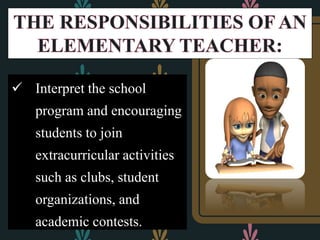
 Interpret the school
program and encouraging
students to join
extracurricular activities
such as clubs, student
organizations, and
academic contests.
Professional Education

Professional Education

  • 1.
    Bukidnon State University Collegeof Teacher Education A Special Place for Teaching and Learning Reporter: JULIET A. ORIGENES Instructor: RHONIEL TINOY
  • 2.
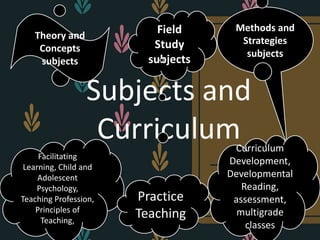
    Subjects and Curriculum Methods and Strategies subjects Facilitating Learning,Child and Adolescent Psychology, Teaching Profession, Principles of Teaching, Theory and Concepts subjects Field Study subjects Curriculum Development, Developmental Reading, assessment, multigrade classes Practice Teaching
  • 4.
    EARLY CHILDHOOD EDUCATION – aneducational program that teaches children from birth to eight years old (pre-school age) with the main focus of guiding children learn through play and improving later school performance.
  • 5.
    SPECIAL EDUCATION – aneducational program that deals with students who have special needs (such as the physically or mentally disabled) done through an especially designed set of instructions, support, and services provided to students with an identified disability requiring an individually designed instructional program to meet their unique learning needs.
  • 6.
    FACILITATING LEARNING – Emphasizes contemporary theoriesand research on the cognitive, metacognitive, motivational, socio-cultural, and individual difference factors in the acquisition of knowledge.
  • 7.
    SOCIAL DIMENSIONS OF EDUCATION –Introduction to Social Science theory and research as they relate to education and the understanding of the four pillars of learning.
  • 8.
    PRINCIPLES OF TEACHING – Introducesprospective teachers to the nature of learning and teaching.
  • 9.
    ASSESSMENT OF LEARNING – Focuseson the development and utilization of assessment tools to improve the teaching- learning process.
  • 10.
    CURRICULUM DEVELOPMENT – Intended tointroduce the education students to effective curriculum design and assessment . The course topics include curriculum models, principles and approaches in designing , delivering and addressing the curriculum.
  • 11.
    TEACHING MULTIGRADE CLASSES – Makes comparisonbetween multigrade and single grade teaching in terms of outcome and teaching processes. It is designed to prepare prospective teachers to acquire deeper understanding of the philosophy , goals, objectives, special features of multigrade teaching.
  • 12.
    PRACTICE TEACHING – Offered tothose who have completed all field Study courses. It gives prospective teachers the life in the actual learning environment.
  • 14.
     The abilityto proficiently speak and write English and convey information to students that is easy to understand. BEING A GOOD COMMUNICATOR
  • 15.
     Establishing and maintainingpositive mutual working relationships with students, parents and co-workers. INTERPERSONAL SKILLS
  • 16.
     Understanding student behavior,avoiding temper flares and finding possible solutions to unpleasant situations. PATIENCE
  • 17.
     Having theability to sort and arrange information in a systematic order, combine ideas and relay them to the students in a clear, concise, and logical manner. BEING ORGANIZED
  • 18.
     Teaching inprimary school will expose you to younger age groups, below 12 years old, and these children understand things in different ways than adults or high school students do. Able to explain things in an age appropriate manner
  • 19.
     Being ableto speak in front of a class with 30- 40 students without losing your concentration and while keeping calm and composed. Being comfortable in Public Speaking
  • 20.
     –The abilityto impose discipline in the classroom and obtain the respect of ones students Able to establish Authority
  • 21.
     Children atthis age are very playful and active, they tend to think of play more than study, as a primary school teacher you need to have a great amount of understanding for children. Able to deal with children
  • 23.
     Teaching isa profession  A graduate of BEED who passes the Licensure Examination for Teachers (LET) is called a Licensed Teacher
  • 24.
     Establishing and enforcingrules for behavior and procedures for maintaining order.
  • 25.
     Developing lesson plansand instructional materials
  • 26.
  • 27.
  • 28.
     Communicating with parentsthrough conferences and other means to discuss students’ progress
  • 29.
     Interpret theschool program and encouraging students to join extracurricular activities such as clubs, student organizations, and academic contests.

Editor's Notes

  • #9 It deals specifically with the principles of effective instruction and the different processes involved; instructional planning and demonstration teaching.
  • #10 It emphasizes the use of teaching for measuring knowledge , comprehension and other thinking skills.
  • #12 This emphasizes professionalization to cover teachers’status and levels of professional rewards and professionalism to involve competencies.