CO-TEACHING “ WHEN ONE TEACHES TWO LEARN.” Viagra viagra  super active  viagra  super active
עבודות אלומיניום   travel  which mobile phone
WHAT IS CO-TEACHING “ when two or more professionals jointly deliver substantive instruction to a diverse, or blended group of students in a single physical space” (Cook and Friend, 1995).  brand  levitra   viagra   levitra
brand  levitra   viagra   levitra
THE CO-TEACHING DYNAMIC TEACHER KNOWLEDGE TIME / SPACE
http://www.specialconnections.ku.edu/cgi-
The Types of Co-teaching Curriculum  Knowledge Planning Time  Allocation Level of Trust Philosophical Agreement Friend, M., Reising, M., & Cook, L. (1993). Co-teaching: An overview of the past, a glimpse at the present, and considerations for the future.  Preventing School Failure, 37 (4), 6-10. Lead and Support Station Teaching   Parallel Teaching Alternative  Teaching   Team  Teaching
STYLES  OF CO-TEACHING  Bauwens and Hourcade (1991) One teach, one support --One person assumes primary instructional responsibility while the other adult assists students with work, monitors behavior, and corrects assignments. (This approach is most successful when it is used on an occasional basis in conjunction with the other approaches.)
2.   Station teaching --Curricular content is divided into two parts. One person teaches the first part to half the students and the other professional presents the second part to the other half. The two student groups then switch.
3 .   Parallel teaching --Students are divided into heterogeneous groups in which each student has more opportunity to participate in discussions. Different types of presentations are structured to accommodate the various student learning styles.
4 .  Alternative teaching -- Students are divided into two groups, and one person instructs one group while the other person pre-teaches the other group for the lesson to follow or re-teaches material using alternative methods.
5.   Team teaching--  Both professionals share leadership and are equally engaged in instructional activities. They might role play, stage debates, or model note-taking strategies. (Friend & Bursuck, 1999, pp. 82-85)
The Components of Co-teaching Gately, S., Gately, F., Understanding Co-teaching Components,  Journal of Teaching Exceptional Children , 2 (3) 41-47 CURRICULUM GOALS TEACHING  PHILOSOPHY BELIEFS ASSESSMENT INSTRUCTION INSTRUCTIONAL  PLANNING FAMILIARITY WITH THE CURRICULUM PHYSICAL  ENVIRONMENT INTERPERSONAL COMMUNICATION CO-TEACHING COMPONENTS
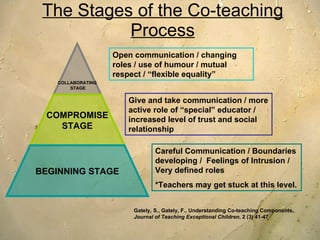
The Stages of the Co-teaching Process Give and take communication / more active role of “special” educator / increased level of trust and social relationship Careful Communication / Boundaries developing /  Feelings of Intrusion / Very defined roles *Teachers may get stuck at this level.   Open communication / changing roles / use of humour / mutual respect / “flexible equality” Gately, S., Gately, F., Understanding Co-teaching Components,  Journal of Teaching Exceptional Children , 2 (3) 41-47 COLLABORATING STAGE COMPROMISE STAGE BEGINNING STAGE
COMPLEMENTING EACH OTHERS STRENGTHS
“ I have a good friend (co-teacher) and we share all the time. She rocks at assessment I rock at presentation. We meld our lessons and constantly trade information and lesson plans. What comes out in the end is great lessons and great assessment.”
The Benefits of Co-teaching better student to teacher ratio and more individual attention (especially helpful to lower level students.).  a wider use of instructional techniques, to better student learning more and better critical, planning and reflective practices by teachers social skills improvement / better classroom management. a more “community” oriented classroom increased score results.
TEACHER BENEFITS Teacher training in-house. The Korean English Teacher betters their own language skills while teaching. Both teachers develop new instructional techniques while teaching and sharing.  New teachers can be given guidance and mentoring.  Effective modeling for students. NESTs > less cultural adaptation.
3 Main Misperceptions 1.   The foreign expert.   Foreign teachers are viewed as “all knowing”. This creates an imbalance in the classroom and eventually resentment. There must be a shared power in the classroom. There is no expert or rather, a Native expert and a Foreign expert. Each have their particular skills and experience and relevance.  Sturman, P., (1992), Team Teaching: A case study from Japan,  Collaborative Language Learning and Teaching , Cambridge University Press, Nunan, D., 149-150
2.  The “walking tape recorder”.  In this case, the Korean teacher feels that the foreign teacher lacks instructional skills  and uses the NEST as a kind of puppet, only good for pronunciation and laughter, cultural communication.
3.  The “token foreigner”.   Here, the NEST is only there to give the school pride as being progressive. They aren’t used as teachers. They are just a symbol of being “international” and progressive.
RECOMMENDATIONS SUGGESTIONS Promote and educate teachers and schools about the value and benefits of co-teaching.  Teachers must know WHY they are co-teaching.  Hold mandatory workshops for co-teachers. Especially prior to the school year. Also social outings to foster their relationship.
Have all co-teachers complete a questionnaire and discuss fully prior to teaching together. Also, give adequate scheduling and planning time for weekly co-teaching meetings. Educate teachers about the co-teaching options they have. There are many different kinds of co-teaching.  Korean co-teachers MUST be in the classrooms with NESTs during lessons.
Allow for no more than 3 co-teachers / NEST.  Preferably schools should provide an English only classroom and teachers shouldn’t have to travel to other classrooms.  Create a process to chose the appropriate people/teachers to be co-teachers.
Set up a dispute resolving mechanism so that when a co-teacher has a complaint, they have somewhere to go.  Schedule so that co-teachers will be with each other for the full contracted year. Make it mandatory that co-teachers hold weekly planning meetings.
Co-teaching survey:  Seoul Metropolitan Office of Education Native Speaking English Teachers
CHECK THE CORRECT ANSWER 1. I can easily read the nonverbal cues  of my co-teaching partner.  RARELY  SOMETIMES  USUALLY  ALWAYS 2. I feel comfortable moving freely about the space in the co-taught classroom.  RARELY  SOMETIMES  USUALLY  ALWAYS
3. I understand the curriculum standards with respect to the content area in the classroom. RARELY  SOMETIMES  USUALLY  ALWAYS 4. Both teachers in the classroom agree on the goals of the classroom  RARELY  SOMETIMES  USUALLY  ALWAYS
5. Planning can be spontaneous, with changes occurring during the instructional lesson  RARELY  SOMETIMES  USUALLY ALWAYS 6.I often present lessons in the co-taught Class  RARELY  SOMETIMES  USUALLY ALWAYS
7.Classroom rules and routines have been jointly developed.  RARELY  SOMETIMES USUALLY ALWAYS 8. Many measures are used for grading students.  RARELY  SOMETIMES  USUALLY  ALWAYS
9.Humor is often used in the classroom. RARELY  SOMETIMES  USUALLY  ALWAYS 10. All materials are shared in the classroom.  RARELY  SOMETIMES  USUALLY  ALWAYS
11. I am familiar with the methods and materials needed to teach the curriculum.  RARELY  SOMETIMES  USUALLY  ALWAYS 12. Modifications of goals for different level students are incorporated into this class.  RARELY  SOMETIMES  USUALLY ALWAYS
13. Planning for classes is the shared responsibility of both teachers.  RARELY  SOMETIMES  USUALLY  ALWAYS 14. The "chalk" passes freely between the two teachers.  RARELY  SOMETIMES  USUALLY  ALWAYS
15. A variety of classroom management techniquesis used to enhance the learning of all students.  RARELY  SOMETIMES  USUALLY  ALWAYS 16.Communication is open and honest.  RARELY  SOMETIMES  USUALLY  ALWAYS
17. There is fluid (changing) positioning of teachers in the classroom  RARELY  SOMETIMES  USUALLY  ALWAYS 18. I feel confident in my knowledge of the curriculum content  RARELY  SOMETIMES  USUALLY  ALWAYS
19. The administration encourages and supports both teachers and co-teaching.  RARELY  SOMETIMES  USUALLY  ALWAYS 20. Both teachers share curriculum resources; audio-video, books, tests, blackline masters  RARELY  SOMETIMES  USUALLY  ALWAYS
21. Students accept both teachers as equal partners in the learning process  RARELY  SOMETIMES  USUALLY  ALWAYS 22. Time is allotted (or found) for common planning.  RARELY  SOMETIMES  USUALLY  ALWAYS
23. Behavior management is the shared responsibility of both teachers.  RARELY  SOMETIMES  USUALLY  ALWAYS   24 I feel happy about my relationship with my co-teacher. RARELY  SOMETIMES  USUALLY  ALWAYS
25. We hold meetings and give honest feedback about lessons  RARELY  SOMETIMES  USUALLY  ALWAYS
GET YOUR SCORE! RARELY = 1  SOMETIMES = 2 USUALLY = 3  ALWAYS= 4 TOTAL = ?
HOW GOOD IS YOUR CO-TEACHING RELATIONSHIP? < 50  = a poor co-teaching relationship 50 – 75  = a satisfactory (but in need of improvement) co-teaching relationship 76 – 100  = a very healthy co-teaching relationship
Discuss afterwards with your co-teaching partner.  What differences did you see? How can you improve those parts of your relationship?
S haring  H opes,  A ttitudes,  R esponsibilities, and  E xpectations     { SHARE } Directions: Take a few minutes to individually complete this worksheet. Be honest in your responses. After completing it individually, share the responses with your co-teaching partner by taking turns reading the responses. Do not use this time to comment on your partner's responses—merely read. After reading through the responses, take a moment or two to jot down any thoughts you have regarding what your partner has said. Then, come back together and begin to share reactions to the responses.   Your goal is to (a) Agree, (b) Compromise, or (c) Agree to Disagree.
1. Right now, the main  hope  I have regarding this co-teaching situation is: _______________. 2. My  attitude /philosophy of teaching students  with disabilities in a general education classroom is:  _______________________.
3. I would like to have the following  responsibilities  in a co-taught classroom:  ________________________. 4. I would like my co-teacher to have the following  responsibilities: ________________________.
5. The biggest  problem  I  expect  to have in co-teaching is:  ___________________. 5a. I think we can overcome this obstacle by:  ______________________.
6. I have the following expectations regarding _______in the classroom : (a)   discipline   __________________________________________________ (b)   class work  __________________________________________________
Materials ____________________. homework  ______________________________________________________. planning   _______________________________________________________.
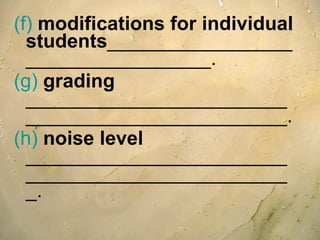
(f)  modifications for individual students __________________________________. (g)   grading   ________________________________________________. (h)  noise level  _________________________________________________.
(i)   cooperative learning   _______________________ (j)  giving/receiving feedback  _____________________________________________. (k)  parental contact   ________________________________________________.
(l)   classroom  appearance/seating  __________________________________________ . (m)   other important  expectations I have  ____________________________________.
Note: Modified  from  Co-Teaching in the Inclusive Classroom: Working Together to Help All Your Students Find Success  (Grades 6-12; p.36-37, by W. W. Murawski, 2003, Medina, WA: Institute for Educational Development.
 
[email_address] www.ddd.batcave.net “ one teaches,  two learn.”

Co teaching

  • 1.
    CO-TEACHING “ WHENONE TEACHES TWO LEARN.” Viagra viagra super active viagra super active
  • 2.
    עבודות אלומיניום  travel which mobile phone
  • 3.
    WHAT IS CO-TEACHING“ when two or more professionals jointly deliver substantive instruction to a diverse, or blended group of students in a single physical space” (Cook and Friend, 1995). brand levitra   viagra   levitra
  • 4.
    brand levitra  viagra   levitra
  • 5.
    THE CO-TEACHING DYNAMICTEACHER KNOWLEDGE TIME / SPACE
  • 6.
  • 7.
    The Types ofCo-teaching Curriculum Knowledge Planning Time Allocation Level of Trust Philosophical Agreement Friend, M., Reising, M., & Cook, L. (1993). Co-teaching: An overview of the past, a glimpse at the present, and considerations for the future. Preventing School Failure, 37 (4), 6-10. Lead and Support Station Teaching Parallel Teaching Alternative Teaching Team Teaching
  • 8.
    STYLES OFCO-TEACHING Bauwens and Hourcade (1991) One teach, one support --One person assumes primary instructional responsibility while the other adult assists students with work, monitors behavior, and corrects assignments. (This approach is most successful when it is used on an occasional basis in conjunction with the other approaches.)
  • 9.
    2. Station teaching --Curricular content is divided into two parts. One person teaches the first part to half the students and the other professional presents the second part to the other half. The two student groups then switch.
  • 10.
    3 . Parallel teaching --Students are divided into heterogeneous groups in which each student has more opportunity to participate in discussions. Different types of presentations are structured to accommodate the various student learning styles.
  • 11.
    4 . Alternative teaching -- Students are divided into two groups, and one person instructs one group while the other person pre-teaches the other group for the lesson to follow or re-teaches material using alternative methods.
  • 12.
    5. Team teaching-- Both professionals share leadership and are equally engaged in instructional activities. They might role play, stage debates, or model note-taking strategies. (Friend & Bursuck, 1999, pp. 82-85)
  • 13.
    The Components ofCo-teaching Gately, S., Gately, F., Understanding Co-teaching Components, Journal of Teaching Exceptional Children , 2 (3) 41-47 CURRICULUM GOALS TEACHING PHILOSOPHY BELIEFS ASSESSMENT INSTRUCTION INSTRUCTIONAL PLANNING FAMILIARITY WITH THE CURRICULUM PHYSICAL ENVIRONMENT INTERPERSONAL COMMUNICATION CO-TEACHING COMPONENTS
  • 14.
    The Stages ofthe Co-teaching Process Give and take communication / more active role of “special” educator / increased level of trust and social relationship Careful Communication / Boundaries developing / Feelings of Intrusion / Very defined roles *Teachers may get stuck at this level. Open communication / changing roles / use of humour / mutual respect / “flexible equality” Gately, S., Gately, F., Understanding Co-teaching Components, Journal of Teaching Exceptional Children , 2 (3) 41-47 COLLABORATING STAGE COMPROMISE STAGE BEGINNING STAGE
  • 15.
  • 16.
    “ I havea good friend (co-teacher) and we share all the time. She rocks at assessment I rock at presentation. We meld our lessons and constantly trade information and lesson plans. What comes out in the end is great lessons and great assessment.”
  • 17.
    The Benefits ofCo-teaching better student to teacher ratio and more individual attention (especially helpful to lower level students.). a wider use of instructional techniques, to better student learning more and better critical, planning and reflective practices by teachers social skills improvement / better classroom management. a more “community” oriented classroom increased score results.
  • 18.
    TEACHER BENEFITS Teachertraining in-house. The Korean English Teacher betters their own language skills while teaching. Both teachers develop new instructional techniques while teaching and sharing. New teachers can be given guidance and mentoring. Effective modeling for students. NESTs > less cultural adaptation.
  • 19.
    3 Main Misperceptions1. The foreign expert. Foreign teachers are viewed as “all knowing”. This creates an imbalance in the classroom and eventually resentment. There must be a shared power in the classroom. There is no expert or rather, a Native expert and a Foreign expert. Each have their particular skills and experience and relevance. Sturman, P., (1992), Team Teaching: A case study from Japan, Collaborative Language Learning and Teaching , Cambridge University Press, Nunan, D., 149-150
  • 20.
    2. The“walking tape recorder”. In this case, the Korean teacher feels that the foreign teacher lacks instructional skills and uses the NEST as a kind of puppet, only good for pronunciation and laughter, cultural communication.
  • 21.
    3. The“token foreigner”. Here, the NEST is only there to give the school pride as being progressive. They aren’t used as teachers. They are just a symbol of being “international” and progressive.
  • 22.
    RECOMMENDATIONS SUGGESTIONS Promoteand educate teachers and schools about the value and benefits of co-teaching. Teachers must know WHY they are co-teaching. Hold mandatory workshops for co-teachers. Especially prior to the school year. Also social outings to foster their relationship.
  • 23.
    Have all co-teacherscomplete a questionnaire and discuss fully prior to teaching together. Also, give adequate scheduling and planning time for weekly co-teaching meetings. Educate teachers about the co-teaching options they have. There are many different kinds of co-teaching. Korean co-teachers MUST be in the classrooms with NESTs during lessons.
  • 24.
    Allow for nomore than 3 co-teachers / NEST. Preferably schools should provide an English only classroom and teachers shouldn’t have to travel to other classrooms. Create a process to chose the appropriate people/teachers to be co-teachers.
  • 25.
    Set up adispute resolving mechanism so that when a co-teacher has a complaint, they have somewhere to go. Schedule so that co-teachers will be with each other for the full contracted year. Make it mandatory that co-teachers hold weekly planning meetings.
  • 26.
    Co-teaching survey: Seoul Metropolitan Office of Education Native Speaking English Teachers
  • 27.
    CHECK THE CORRECTANSWER 1. I can easily read the nonverbal cues of my co-teaching partner. RARELY SOMETIMES USUALLY ALWAYS 2. I feel comfortable moving freely about the space in the co-taught classroom. RARELY SOMETIMES USUALLY ALWAYS
  • 28.
    3. I understandthe curriculum standards with respect to the content area in the classroom. RARELY SOMETIMES USUALLY ALWAYS 4. Both teachers in the classroom agree on the goals of the classroom RARELY SOMETIMES USUALLY ALWAYS
  • 29.
    5. Planning canbe spontaneous, with changes occurring during the instructional lesson RARELY SOMETIMES USUALLY ALWAYS 6.I often present lessons in the co-taught Class RARELY SOMETIMES USUALLY ALWAYS
  • 30.
    7.Classroom rules androutines have been jointly developed. RARELY SOMETIMES USUALLY ALWAYS 8. Many measures are used for grading students. RARELY SOMETIMES USUALLY ALWAYS
  • 31.
    9.Humor is oftenused in the classroom. RARELY SOMETIMES USUALLY ALWAYS 10. All materials are shared in the classroom. RARELY SOMETIMES USUALLY ALWAYS
  • 32.
    11. I amfamiliar with the methods and materials needed to teach the curriculum. RARELY SOMETIMES USUALLY ALWAYS 12. Modifications of goals for different level students are incorporated into this class. RARELY SOMETIMES USUALLY ALWAYS
  • 33.
    13. Planning forclasses is the shared responsibility of both teachers. RARELY SOMETIMES USUALLY ALWAYS 14. The &quot;chalk&quot; passes freely between the two teachers. RARELY SOMETIMES USUALLY ALWAYS
  • 34.
    15. A varietyof classroom management techniquesis used to enhance the learning of all students. RARELY SOMETIMES USUALLY ALWAYS 16.Communication is open and honest. RARELY SOMETIMES USUALLY ALWAYS
  • 35.
    17. There isfluid (changing) positioning of teachers in the classroom RARELY SOMETIMES USUALLY ALWAYS 18. I feel confident in my knowledge of the curriculum content RARELY SOMETIMES USUALLY ALWAYS
  • 36.
    19. The administrationencourages and supports both teachers and co-teaching. RARELY SOMETIMES USUALLY ALWAYS 20. Both teachers share curriculum resources; audio-video, books, tests, blackline masters RARELY SOMETIMES USUALLY ALWAYS
  • 37.
    21. Students acceptboth teachers as equal partners in the learning process RARELY SOMETIMES USUALLY ALWAYS 22. Time is allotted (or found) for common planning. RARELY SOMETIMES USUALLY ALWAYS
  • 38.
    23. Behavior managementis the shared responsibility of both teachers. RARELY SOMETIMES USUALLY ALWAYS 24 I feel happy about my relationship with my co-teacher. RARELY SOMETIMES USUALLY ALWAYS
  • 39.
    25. We holdmeetings and give honest feedback about lessons RARELY SOMETIMES USUALLY ALWAYS
  • 40.
    GET YOUR SCORE!RARELY = 1 SOMETIMES = 2 USUALLY = 3 ALWAYS= 4 TOTAL = ?
  • 41.
    HOW GOOD ISYOUR CO-TEACHING RELATIONSHIP? < 50 = a poor co-teaching relationship 50 – 75 = a satisfactory (but in need of improvement) co-teaching relationship 76 – 100 = a very healthy co-teaching relationship
  • 42.
    Discuss afterwards withyour co-teaching partner. What differences did you see? How can you improve those parts of your relationship?
  • 43.
    S haring H opes, A ttitudes, R esponsibilities, and E xpectations { SHARE } Directions: Take a few minutes to individually complete this worksheet. Be honest in your responses. After completing it individually, share the responses with your co-teaching partner by taking turns reading the responses. Do not use this time to comment on your partner's responses—merely read. After reading through the responses, take a moment or two to jot down any thoughts you have regarding what your partner has said. Then, come back together and begin to share reactions to the responses. Your goal is to (a) Agree, (b) Compromise, or (c) Agree to Disagree.
  • 44.
    1. Right now,the main hope I have regarding this co-teaching situation is: _______________. 2. My attitude /philosophy of teaching students with disabilities in a general education classroom is: _______________________.
  • 45.
    3. I wouldlike to have the following responsibilities in a co-taught classroom: ________________________. 4. I would like my co-teacher to have the following responsibilities: ________________________.
  • 46.
    5. The biggest problem I expect to have in co-teaching is: ___________________. 5a. I think we can overcome this obstacle by: ______________________.
  • 47.
    6. I havethe following expectations regarding _______in the classroom : (a) discipline __________________________________________________ (b) class work __________________________________________________
  • 48.
    Materials ____________________. homework ______________________________________________________. planning _______________________________________________________.
  • 49.
    (f) modificationsfor individual students __________________________________. (g) grading ________________________________________________. (h) noise level _________________________________________________.
  • 50.
    (i) cooperative learning _______________________ (j) giving/receiving feedback _____________________________________________. (k) parental contact ________________________________________________.
  • 51.
    (l) classroom appearance/seating __________________________________________ . (m) other important expectations I have ____________________________________.
  • 52.
    Note: Modified from Co-Teaching in the Inclusive Classroom: Working Together to Help All Your Students Find Success (Grades 6-12; p.36-37, by W. W. Murawski, 2003, Medina, WA: Institute for Educational Development.
  • 53.
  • 54.
    [email_address] www.ddd.batcave.net “one teaches, two learn.”