Disaster Risk Reduction: 
The international perspective 
RUSI Resilience Conference 2014 
London, UK 
14 November 2014 
Paola Albrito 
Head of Regional Office for Europe 
United Nations Office for Disaster Risk Reduction (UNISDR)
2 
www.unisdr.org
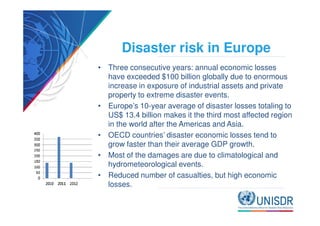
Disaster risk in Europe 
• Three consecutive years: annual economic losses 
have exceeded $100 billion globally due to enormous 
increase in exposure of industrial assets and private 
property to extreme disaster events. 
II 
• Europe’s 10-year average of disaster losses totaling to 
US$ 13.4 billion makes it the third most affected region 
in the world after the Americas and Asia. 
• OECD countries’ disaster economic losses tend to 
grow faster than their average GDP growth. 
• Most of the damages are due to climatological and 
hydrometeorological events. 
• Reduced number of casualties, but high economic 
losses.
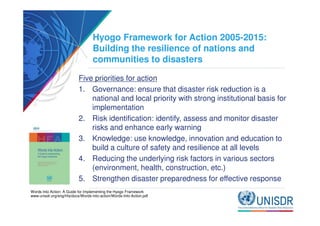
Hyogo Framework for Action 2005-2015: 
Building the resilience of nations and 
communities to disasters 
Five priorities for action 
1. Governance: ensure that disaster risk reduction is a 
national and local priority with strong institutional basis for 
implementation 
2. Risk identification: identify, assess and monitor disaster 
risks and enhance early warning 
3. Knowledge: use knowledge, innovation and education to 
build a culture of safety and resilience at all levels 
4. Reducing the underlying risk factors in various sectors 
(environment, health, construction, etc.) 
5. Strengthen disaster preparedness for effective response 
Words Into Action: A Guide for Implementing the Hyogo Framework 
www.unisdr.org/eng/hfa/docs/Words-into-action/Words-Into-Action.pdf
Addressing the underlying risk 
factors in Europe: HFA Priority 4 
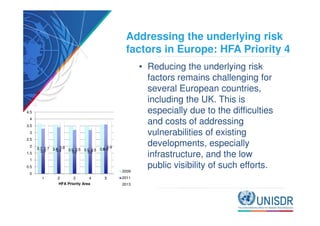
• Reducing the underlying risk 
factors remains challenging for 
several European countries, 
including the UK. This is 
especially due 4.5 
to the difficulties 
and costs of addressing 
vulnerabilities of existing 
developments, especially 
infrastructure, and the low 
public visibility of such efforts. 
3.7 3.8 3.6 
3.7 3.6 3.6 
3.3 3.4 3.5 3.5 3.5 3.2 3.2 
3.5 
3.9 
4 
3.5 
3 
2.5 
2 
1.5 
1 
0.5 
0 
1 2 3 4 5 
HFA Priority Area 
2009 
2011 
2013
Lessons learnt in 10 years of HFA 
implementation in Europe 
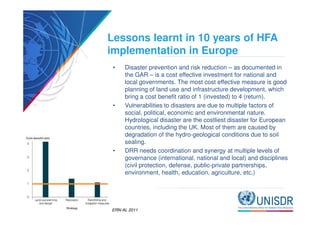
• Disaster prevention and risk reduction – as documented in 
the GAR – is a cost effective investment for national and 
local governments. The most cost effective measure is good 
planning of land use and infrastructure development, which 
bring a cost benefit ratio of 1 (invested) to 4 (return). 
• Vulnerabilities to disasters are due to multiple factors of 
social, political, economic and environmental nature. 
Hydrological disaster are the costliest disaster for European 
countries, including the UK. Most of them are caused by 
degradation of the hydro-geological conditions due to soil 
sealing. 
• DRR needs coordination and synergy at multiple levels of 
governance (international, national and local) and disciplines 
(civil protection, defense, public-private partnerships, 
environment, health, education, agriculture, etc.) 
ERN-AL 2011
Emerging trends globally – 2015 
Global Assessment Report (GAR15) 
Disaster risks  globalising : 
• Need to reduce generation of new risks. 
• Promote economic advantage of investing in DRR/M. 
Urbanising risk: 
I 
• Need to enhance urban risk management and develop resilience. 
• Undertake structural and non structural measures to reduce disaster risk, 
including housing and land use management with DRR considerations. 
Risk governance and translation of policies to practices: 
• Still a challenge to factor DRR into public investment, development and social 
policies. 
• Still lack of coordination and advocacy for public-private partnership and 
translate policies into practices.
Implications for UK 
international aid 
Without concrete and fast action, the rising number of disasters 
will challenge the capacities and resources for international aid 
of the UK as well as the whole international system. 
UK should ensure that ODA is not generating new risk 
UK should ensure that ODA investments are protected from 
disaster risk 
UK should invest in prevention domestically now to avoid 
draining financial aid budgets in the future. 
UK as a thought leader for resilience should actively 
participate in the development of the post-2015 framework for 
DRR.
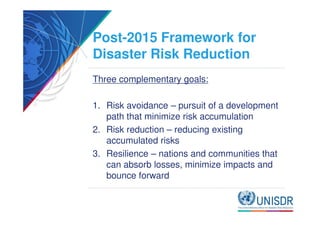
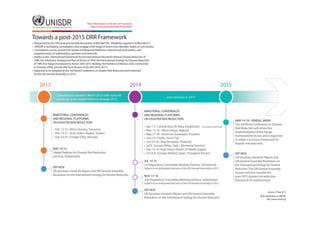
Post-2015 Framework for 
Disaster Risk Reduction 
Three complementary goals: 
1. Risk avoidance – pursuit of a development 
path that minimize risk accumulation 
2. Risk reduction – reducing existing 
accumulated risks 
3. Resilience – nations and communities that 
can absorb losses, minimize impacts and 
bounce forward
Thank you 
United Nations Office for Disaster Risk Reduction 
UNISDR Regional Office for Europe 
UN House, 14 Rue Montoyer 
1000 Brussels, Belgium 
T: +32 (0) 22 902 588 
F: +32 (0) 22 904 950 
isdr-europe@un.org 
www.unisdr.org 
www.unisdr.org/europe

Paola Albrito

  • 1.
    Disaster Risk Reduction: The international perspective RUSI Resilience Conference 2014 London, UK 14 November 2014 Paola Albrito Head of Regional Office for Europe United Nations Office for Disaster Risk Reduction (UNISDR)
  • 2.
  • 3.
    Disaster risk inEurope • Three consecutive years: annual economic losses have exceeded $100 billion globally due to enormous increase in exposure of industrial assets and private property to extreme disaster events. II • Europe’s 10-year average of disaster losses totaling to US$ 13.4 billion makes it the third most affected region in the world after the Americas and Asia. • OECD countries’ disaster economic losses tend to grow faster than their average GDP growth. • Most of the damages are due to climatological and hydrometeorological events. • Reduced number of casualties, but high economic losses.
  • 4.
    Hyogo Framework forAction 2005-2015: Building the resilience of nations and communities to disasters Five priorities for action 1. Governance: ensure that disaster risk reduction is a national and local priority with strong institutional basis for implementation 2. Risk identification: identify, assess and monitor disaster risks and enhance early warning 3. Knowledge: use knowledge, innovation and education to build a culture of safety and resilience at all levels 4. Reducing the underlying risk factors in various sectors (environment, health, construction, etc.) 5. Strengthen disaster preparedness for effective response Words Into Action: A Guide for Implementing the Hyogo Framework www.unisdr.org/eng/hfa/docs/Words-into-action/Words-Into-Action.pdf
  • 5.
    Addressing the underlyingrisk factors in Europe: HFA Priority 4 • Reducing the underlying risk factors remains challenging for several European countries, including the UK. This is especially due 4.5 to the difficulties and costs of addressing vulnerabilities of existing developments, especially infrastructure, and the low public visibility of such efforts. 3.7 3.8 3.6 3.7 3.6 3.6 3.3 3.4 3.5 3.5 3.5 3.2 3.2 3.5 3.9 4 3.5 3 2.5 2 1.5 1 0.5 0 1 2 3 4 5 HFA Priority Area 2009 2011 2013
  • 6.
    Lessons learnt in10 years of HFA implementation in Europe • Disaster prevention and risk reduction – as documented in the GAR – is a cost effective investment for national and local governments. The most cost effective measure is good planning of land use and infrastructure development, which bring a cost benefit ratio of 1 (invested) to 4 (return). • Vulnerabilities to disasters are due to multiple factors of social, political, economic and environmental nature. Hydrological disaster are the costliest disaster for European countries, including the UK. Most of them are caused by degradation of the hydro-geological conditions due to soil sealing. • DRR needs coordination and synergy at multiple levels of governance (international, national and local) and disciplines (civil protection, defense, public-private partnerships, environment, health, education, agriculture, etc.) ERN-AL 2011
  • 7.
    Emerging trends globally– 2015 Global Assessment Report (GAR15) Disaster risks globalising : • Need to reduce generation of new risks. • Promote economic advantage of investing in DRR/M. Urbanising risk: I • Need to enhance urban risk management and develop resilience. • Undertake structural and non structural measures to reduce disaster risk, including housing and land use management with DRR considerations. Risk governance and translation of policies to practices: • Still a challenge to factor DRR into public investment, development and social policies. • Still lack of coordination and advocacy for public-private partnership and translate policies into practices.
  • 8.
    Implications for UK international aid Without concrete and fast action, the rising number of disasters will challenge the capacities and resources for international aid of the UK as well as the whole international system. UK should ensure that ODA is not generating new risk UK should ensure that ODA investments are protected from disaster risk UK should invest in prevention domestically now to avoid draining financial aid budgets in the future. UK as a thought leader for resilience should actively participate in the development of the post-2015 framework for DRR.
  • 9.
    Post-2015 Framework for Disaster Risk Reduction Three complementary goals: 1. Risk avoidance – pursuit of a development path that minimize risk accumulation 2. Risk reduction – reducing existing accumulated risks 3. Resilience – nations and communities that can absorb losses, minimize impacts and bounce forward
  • 11.
    Thank you UnitedNations Office for Disaster Risk Reduction UNISDR Regional Office for Europe UN House, 14 Rue Montoyer 1000 Brussels, Belgium T: +32 (0) 22 902 588 F: +32 (0) 22 904 950 isdr-europe@un.org www.unisdr.org www.unisdr.org/europe