The prospects for Japan-UK collaboration in
defence equipment
UK-Japan Security Dialogue, RUSI London January 2015
Professor Trevor Taylor (RUSI and Cranfield University)
Background and the Japanese policy changes
The traditional Japanese defence industrial model under
pressure
rising equipment costs
limited Japanese economic performance
UK-Japan Security Dialogue, RUSI London January 2015
limited Japanese economic performance
companies leaving the sector
2011- the revision of the Three Principles
from virtually no defence exports
to allowing defence exports under a regulatory regime
particularly to enable collaborative development and
production projects
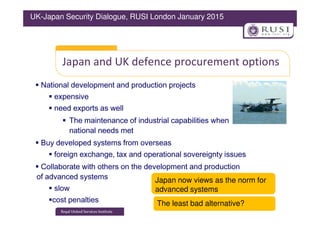
Japan and UK defence procurement options
National development and production projects
expensive
need exports as well
UK-Japan Security Dialogue, RUSI London January 2015
The maintenance of industrial capabilities when
national needs met
Buy developed systems from overseas
foreign exchange, tax and operational sovereignty issues
Collaborate with others on the development and production
of advanced systems
slow
cost penalties The least bad alternative?
Japan now views as the norm for
advanced systems
The prospects for UK-Japan collaboration
A range of considerations
To be addressed in a force field framework
UK-Japan Security Dialogue, RUSI London January 2015
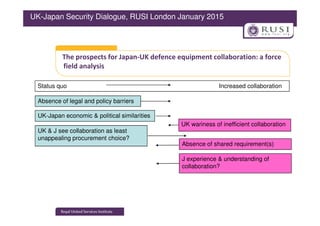
The prospects for Japan-UK defence equipment collaboration: a force
field analysis
Status quo Increased collaboration
Absence of legal and policy barriers
UK-Japan economic & political similarities
UK-Japan Security Dialogue, RUSI London January 2015
UK-Japan economic & political similarities
UK & J see collaboration as least
unappealing procurement choice?
UK wariness of inefficient collaboration
J experience & understanding of
collaboration?
Absence of shared requirement(s)
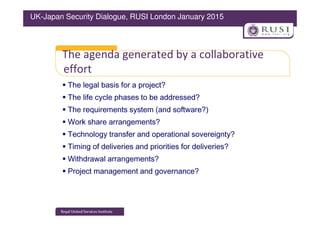
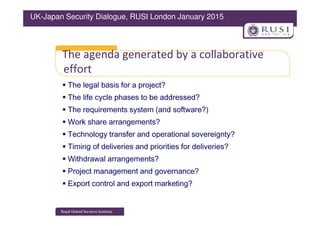
The agenda generated by a collaborative
effort
The legal basis for a project?
The life cycle phases to be addressed?
The requirements system (and software?)
UK-Japan Security Dialogue, RUSI London January 2015
The requirements system (and software?)
Work share arrangements?
Technology transfer and operational sovereignty?
Timing of deliveries and priorities for deliveries?
Withdrawal arrangements?
Project management and governance?
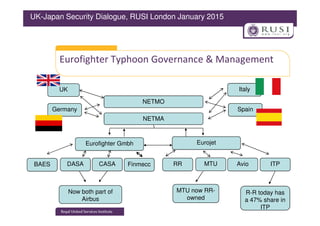
Italy
Eurofighter Typhoon Governance & Management
NETMO
UK
Germany Spain
UK-Japan Security Dialogue, RUSI London January 2015
BAES DASA CASA Finmecc
Now both part of
Airbus
Eurofighter Gmbh Eurojet
RR MTU Avio ITP
NETMA
MTU now RR-
owned
R-R today has
a 47% share in
ITP
The agenda generated by a collaborative
effort
The legal basis for a project?
The life cycle phases to be addressed?
The requirements system (and software?)
UK-Japan Security Dialogue, RUSI London January 2015
The requirements system (and software?)
Work share arrangements?
Technology transfer and operational sovereignty?
Timing of deliveries and priorities for deliveries?
Withdrawal arrangements?
Project management and governance?
Export control and export marketing?
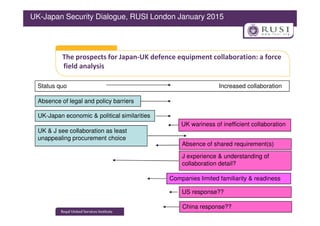
The prospects for Japan-UK defence equipment collaboration: a force
field analysis
Status quo Increased collaboration
Absence of legal and policy barriers
UK-Japan economic & political similarities
UK-Japan Security Dialogue, RUSI London January 2015
UK-Japan economic & political similarities
UK & J see collaboration as least
unappealing procurement choice
UK wariness of inefficient collaboration
J experience & understanding of
collaboration detail?
Absence of shared requirement(s)
US response??
China response??
Companies limited familiarity & readiness
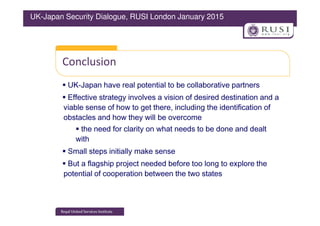
Conclusion
UK-Japan have real potential to be collaborative partners
Effective strategy involves a vision of desired destination and a
viable sense of how to get there, including the identification of
obstacles and how they will be overcome
UK-Japan Security Dialogue, RUSI London January 2015
obstacles and how they will be overcome
the need for clarity on what needs to be done and dealt
with
Small steps initially make sense
But a flagship project needed before too long to explore the
potential of cooperation between the two states

Professor Trevor taylor

  • 1.
    The prospects forJapan-UK collaboration in defence equipment UK-Japan Security Dialogue, RUSI London January 2015 Professor Trevor Taylor (RUSI and Cranfield University)
  • 2.
    Background and theJapanese policy changes The traditional Japanese defence industrial model under pressure rising equipment costs limited Japanese economic performance UK-Japan Security Dialogue, RUSI London January 2015 limited Japanese economic performance companies leaving the sector 2011- the revision of the Three Principles from virtually no defence exports to allowing defence exports under a regulatory regime particularly to enable collaborative development and production projects
  • 3.
    Japan and UKdefence procurement options National development and production projects expensive need exports as well UK-Japan Security Dialogue, RUSI London January 2015 The maintenance of industrial capabilities when national needs met Buy developed systems from overseas foreign exchange, tax and operational sovereignty issues Collaborate with others on the development and production of advanced systems slow cost penalties The least bad alternative? Japan now views as the norm for advanced systems
  • 4.
    The prospects forUK-Japan collaboration A range of considerations To be addressed in a force field framework UK-Japan Security Dialogue, RUSI London January 2015
  • 5.
    The prospects forJapan-UK defence equipment collaboration: a force field analysis Status quo Increased collaboration Absence of legal and policy barriers UK-Japan economic & political similarities UK-Japan Security Dialogue, RUSI London January 2015 UK-Japan economic & political similarities UK & J see collaboration as least unappealing procurement choice? UK wariness of inefficient collaboration J experience & understanding of collaboration? Absence of shared requirement(s)
  • 6.
    The agenda generatedby a collaborative effort The legal basis for a project? The life cycle phases to be addressed? The requirements system (and software?) UK-Japan Security Dialogue, RUSI London January 2015 The requirements system (and software?) Work share arrangements? Technology transfer and operational sovereignty? Timing of deliveries and priorities for deliveries? Withdrawal arrangements? Project management and governance?
  • 7.
    Italy Eurofighter Typhoon Governance& Management NETMO UK Germany Spain UK-Japan Security Dialogue, RUSI London January 2015 BAES DASA CASA Finmecc Now both part of Airbus Eurofighter Gmbh Eurojet RR MTU Avio ITP NETMA MTU now RR- owned R-R today has a 47% share in ITP
  • 8.
    The agenda generatedby a collaborative effort The legal basis for a project? The life cycle phases to be addressed? The requirements system (and software?) UK-Japan Security Dialogue, RUSI London January 2015 The requirements system (and software?) Work share arrangements? Technology transfer and operational sovereignty? Timing of deliveries and priorities for deliveries? Withdrawal arrangements? Project management and governance? Export control and export marketing?
  • 9.
    The prospects forJapan-UK defence equipment collaboration: a force field analysis Status quo Increased collaboration Absence of legal and policy barriers UK-Japan economic & political similarities UK-Japan Security Dialogue, RUSI London January 2015 UK-Japan economic & political similarities UK & J see collaboration as least unappealing procurement choice UK wariness of inefficient collaboration J experience & understanding of collaboration detail? Absence of shared requirement(s) US response?? China response?? Companies limited familiarity & readiness
  • 10.
    Conclusion UK-Japan have realpotential to be collaborative partners Effective strategy involves a vision of desired destination and a viable sense of how to get there, including the identification of obstacles and how they will be overcome UK-Japan Security Dialogue, RUSI London January 2015 obstacles and how they will be overcome the need for clarity on what needs to be done and dealt with Small steps initially make sense But a flagship project needed before too long to explore the potential of cooperation between the two states