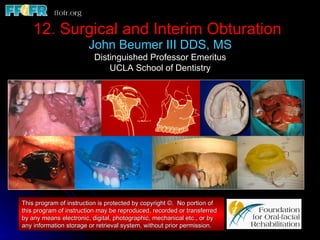
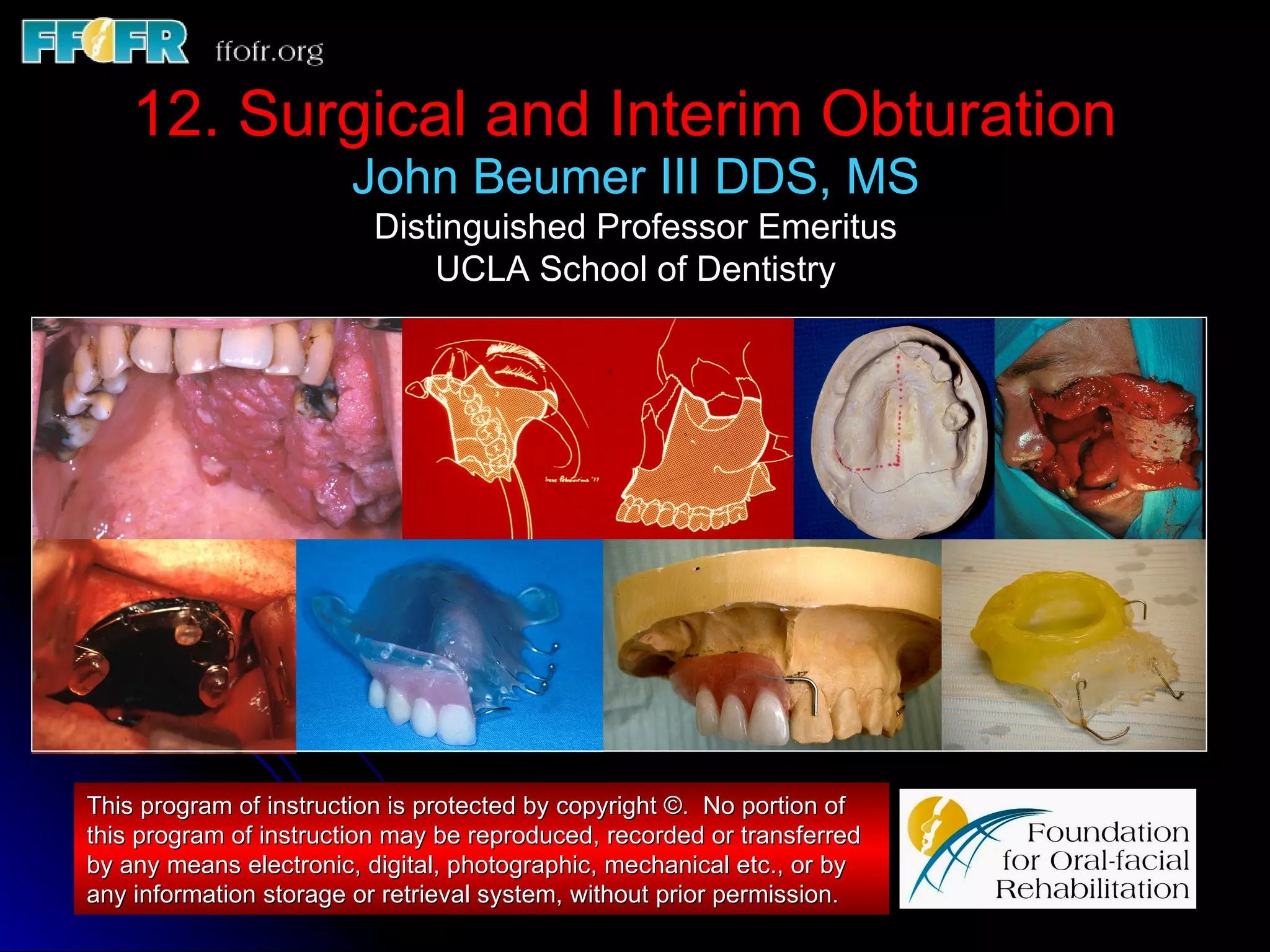
12. Surgical and Interim Obturation
                       John Beumer III DDS, MS
                         Distinguished Professor Emeritus
                             UCLA School of Dentistry


This program of instruction is protected by copyright ©. No portion of
this program of instruction may be reproduced, recorded or transferred
by any means electronic, digital, photographic, mechanical etc., or by
any information storage or retrieval system, without prior permission.
Surgical Obturation -Benefits

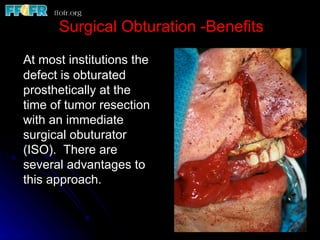
At most institutions the
defect is obturated
prosthetically at the
time of tumor resection
with an immediate
surgical obuturator
(ISO). There are
several advantages to
this approach.
Surgical Obturation -Benefits
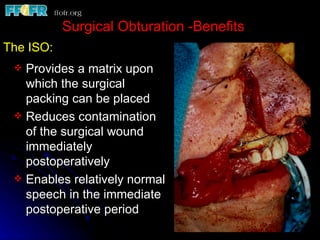
The ISO:
  Provides a matrix upon
   which the surgical
   packing can be placed
  Reduces contamination
   of the surgical wound
   immediately
   postoperatively
  Enables relatively normal
   speech in the immediate
   postoperative period
Surgical Obturation -Benefits
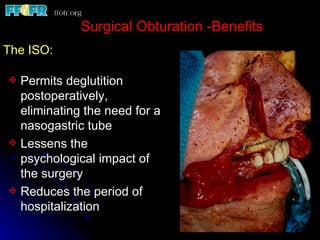
The ISO:

 Permits deglutition
  postoperatively,
  eliminating the need for a
  nasogastric tube
 Lessens the
  psychological impact of
  the surgery
 Reduces the period of
  hospitalization
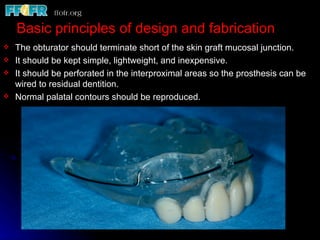
Basic principles of design and fabrication
   The obturator should terminate short of the skin graft mucosal junction.
   It should be kept simple, lightweight, and inexpensive.
   It should be perforated in the interproximal areas so the prosthesis can be
    wired to residual dentition.
   Normal palatal contours should be reproduced.
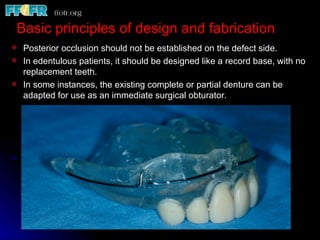
Basic principles of design and fabrication
   Posterior occlusion should not be established on the defect side.
   In edentulous patients, it should be designed like a record base, with no
    replacement teeth.
   In some instances, the existing complete or partial denture can be
    adapted for use as an immediate surgical obturator.
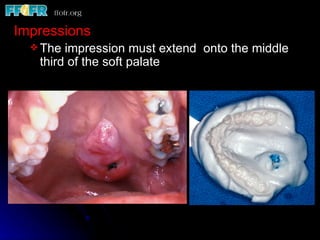
Impressions
   The impression must extend onto the middle
   third of the soft palate
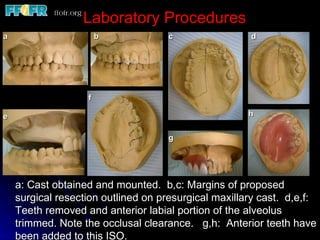
Laboratory Procedures
a                      b             c                d


                   f

e                                                     h


                                     g


    a: Cast obtained and mounted. b,c: Margins of proposed
    surgical resection outlined on presurgical maxillary cast. d,e,f:
    Teeth removed and anterior labial portion of the alveolus
    trimmed. Note the occlusal clearance. g,h: Anterior teeth have
    been added to this ISO.
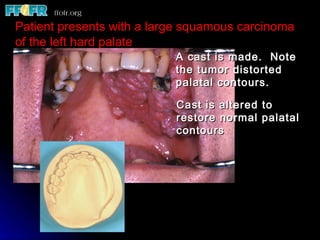
Patient presents with a large squamous carcinoma
of the left hard palate
                           A cast is made. Note
                           the tumor distorted
                           palatal contours.

                           Cast is altered to
                           restore normal palatal
                           contours
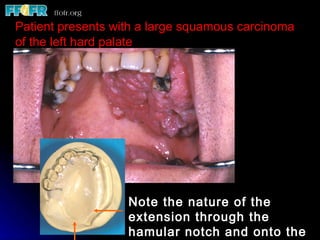
Patient presents with a large squamous carcinoma
of the left hard palate


                   Note the nature of the
                   extension through the
                   hamular notch and onto the
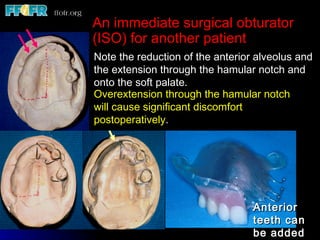
An immediate surgical obturator
(ISO) for another patient
Note the reduction of the anterior alveolus and
the extension through the hamular notch and
onto the soft palate.
Overextension through the hamular notch
will cause significant discomfort
postoperatively.
                The anterior extension of
                the ISO should not extend
                labial to the preexisting
                contours of the alveolus
                and the anterior teeth.
                                   Anterior
                                   teeth can
                                   be added
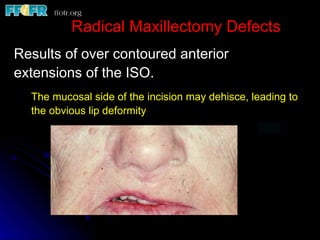
Radical Maxillectomy Defects
Results of over contoured anterior
extensions of the ISO.
  The mucosal side of the incision may dehisce, leading to
  the obvious lip deformity
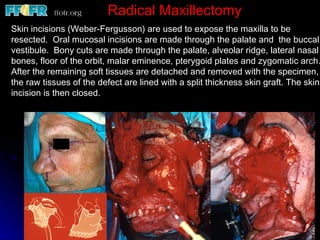
Radical Maxillectomy
Skin incisions (Weber-Fergusson) are used to expose the maxilla to be
resected. Oral mucosal incisions are made through the palate and the buccal
vestibule. Bony cuts are made through the palate, alveolar ridge, lateral nasal
bones, floor of the orbit, malar eminence, pterygoid plates and zygomatic arch.
After the remaining soft tissues are detached and removed with the specimen,
the raw tissues of the defect are lined with a split thickness skin graft. The skin
incision is then closed.
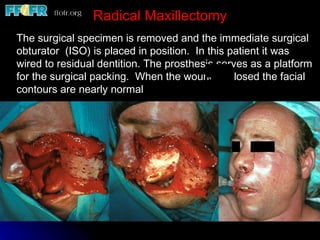
Radical Maxillectomy
The surgical specimen is removed and the immediate surgical
obturator (ISO) is placed in position. In this patient it was
wired to residual dentition. The prosthesis serves as a platform
for the surgical packing. When the wound is closed the facial
contours are nearly normal
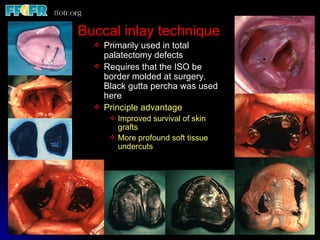
Buccal inlay technique
     Primarily used in total
      palatectomy defects
     Requires that the ISO be
      border molded at surgery.
      Black gutta percha was used
      here
     Principle advantage
          Improved survival of skin
           grafts
          More profound soft tissue
           undercuts
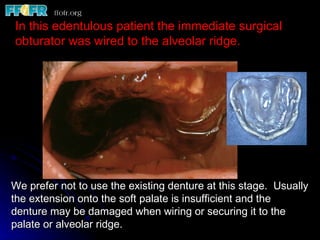
In this edentulous patient the immediate surgical
obturator was wired to the alveolar ridge.


We prefer not to use the existing denture at this stage. Usually
the extension onto the soft palate is insufficient and the
denture may be damaged when wiring or securing it to the
palate or alveolar ridge.
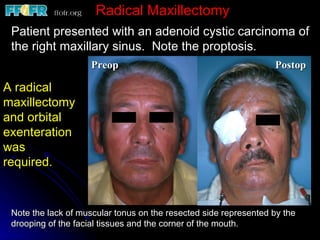
Radical Maxillectomy
 Patient presented with an adenoid cystic carcinoma of
 the right maxillary sinus. Note the proptosis.
                    Preop                                         Postop

A radical
maxillectomy
and orbital
exenteration
was
required.


 Note the lack of muscular tonus on the resected side represented by the
 drooping of the facial tissues and the corner of the mouth.
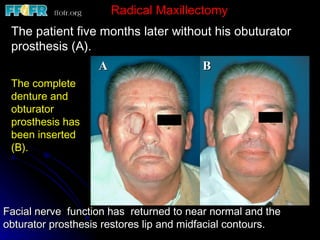
Radical Maxillectomy
 The patient five months later without his obuturator
 prosthesis (A).
                   A                    B
 The complete
 denture and
 obturator
 prosthesis has
 been inserted
 (B).


Facial nerve function has returned to near normal and the
obturator prosthesis restores lip and midfacial contours.
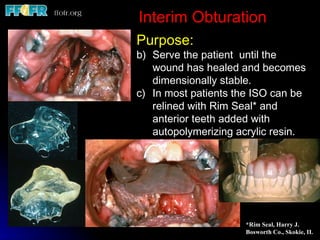
Interim Obturation
Purpose:
b) Serve the patient until the
   wound has healed and becomes
   dimensionally stable.
c) In most patients the ISO can be
   relined with Rim Seal* and
   anterior teeth added with
   autopolymerizing acrylic resin.


                     *Rim Seal, Harry J.
                     Bosworth Co., Skokie, IL
Interim Obturation
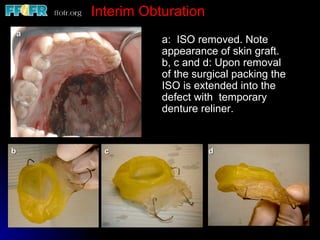
    a
                   a: ISO removed. Note
                   appearance of skin graft.
                   b, c and d: Upon removal
                   of the surgical packing the
                   ISO is extended into the
                   defect with temporary
                   denture reliner.


b         c                  d
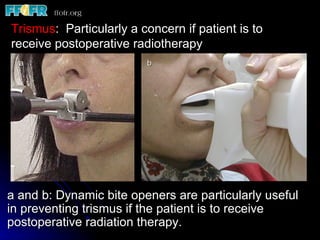
Trismus: Particularly a concern if patient is to
receive postoperative radiotherapy
  a                      b


a and b: Dynamic bite openers are particularly useful
in preventing trismus if the patient is to receive
postoperative radiation therapy.
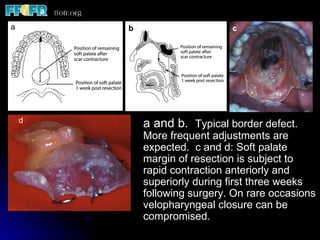
a

aa           b                     c


     d
                 a and b. Typical border defect.
                 More frequent adjustments are
                 expected. c and d: Soft palate
                 margin of resection is subject to
                 rapid contraction anteriorly and
                 superiorly during first three weeks
                 following surgery. On rare occasions
                 velopharyngeal closure can be
                 compromised.
Interim Obturation
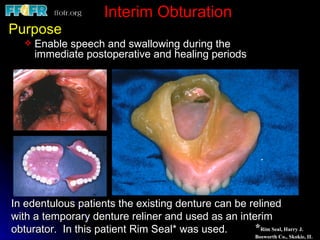
Purpose
      Enable speech and swallowing during the
       immediate postoperative and healing periods


In edentulous patients the existing denture can be relined
with a temporary denture reliner and used as an interim
obturator. In this patient Rim Seal* was used.      *Rim Seal, Harry J.
                                                    Bosworth Co., Skokie, IL
                                                             Bosworth Co., Skokie, IL
Interim Obturation
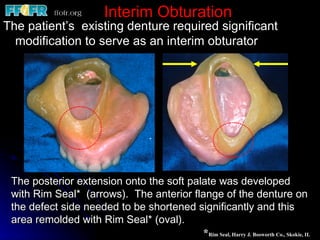
The patient’s existing denture required significant
  modification to serve as an interim obturator


 The posterior extension onto the soft palate was developed
 with Rim Seal* (arrows). The anterior flange of the denture on
 the defect side needed to be shortened significantly and this
 area remolded with Rim Seal* (oval).
                                          *Rim Seal, Harry J. Bosworth Co., Skokie, IL
Interim Obturation
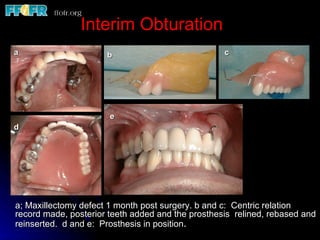
a                     b                            c


                       e
d


a; Maxillectomy defect 1 month post surgery. b and c: Centric relation
record made, posterior teeth added and the prosthesis relined, rebased and
reinserted. d and e: Prosthesis in position.
 Visit ffofr.org for hundreds of additional lectures
  on Complete Dentures, Implant Dentistry,
  Removable Partial Dentures, Esthetic Dentistry
  and Maxillofacial Prosthetics.
 The lectures are free.
 Our objective is to create the best and most
  comprehensive online programs of instruction in
  Prosthodontics

Surgical and Interim Obturation

  • 1.
    12. Surgical andInterim Obturation John Beumer III DDS, MS Distinguished Professor Emeritus UCLA School of Dentistry This program of instruction is protected by copyright ©. No portion of this program of instruction may be reproduced, recorded or transferred by any means electronic, digital, photographic, mechanical etc., or by any information storage or retrieval system, without prior permission.
  • 2.
    Surgical Obturation -Benefits Atmost institutions the defect is obturated prosthetically at the time of tumor resection with an immediate surgical obuturator (ISO). There are several advantages to this approach.
  • 3.
    Surgical Obturation -Benefits TheISO:  Provides a matrix upon which the surgical packing can be placed  Reduces contamination of the surgical wound immediately postoperatively  Enables relatively normal speech in the immediate postoperative period
  • 4.
    Surgical Obturation -Benefits TheISO:  Permits deglutition postoperatively, eliminating the need for a nasogastric tube  Lessens the psychological impact of the surgery  Reduces the period of hospitalization
  • 5.
    Basic principles ofdesign and fabrication  The obturator should terminate short of the skin graft mucosal junction.  It should be kept simple, lightweight, and inexpensive.  It should be perforated in the interproximal areas so the prosthesis can be wired to residual dentition.  Normal palatal contours should be reproduced.
  • 6.
    Basic principles ofdesign and fabrication  Posterior occlusion should not be established on the defect side.  In edentulous patients, it should be designed like a record base, with no replacement teeth.  In some instances, the existing complete or partial denture can be adapted for use as an immediate surgical obturator.
  • 7.
    Impressions The impression must extend onto the middle third of the soft palate
  • 8.
    Laboratory Procedures a b c d f e h g a: Cast obtained and mounted. b,c: Margins of proposed surgical resection outlined on presurgical maxillary cast. d,e,f: Teeth removed and anterior labial portion of the alveolus trimmed. Note the occlusal clearance. g,h: Anterior teeth have been added to this ISO.
  • 9.
    Patient presents witha large squamous carcinoma of the left hard palate A cast is made. Note the tumor distorted palatal contours. Cast is altered to restore normal palatal contours
  • 10.
    Patient presents witha large squamous carcinoma of the left hard palate Note the nature of the extension through the hamular notch and onto the
  • 11.
    An immediate surgicalobturator (ISO) for another patient Note the reduction of the anterior alveolus and the extension through the hamular notch and onto the soft palate. Overextension through the hamular notch will cause significant discomfort postoperatively. The anterior extension of the ISO should not extend labial to the preexisting contours of the alveolus and the anterior teeth. Anterior teeth can be added
  • 12.
    Radical Maxillectomy Defects Resultsof over contoured anterior extensions of the ISO. The mucosal side of the incision may dehisce, leading to the obvious lip deformity
  • 13.
    Radical Maxillectomy Skin incisions(Weber-Fergusson) are used to expose the maxilla to be resected. Oral mucosal incisions are made through the palate and the buccal vestibule. Bony cuts are made through the palate, alveolar ridge, lateral nasal bones, floor of the orbit, malar eminence, pterygoid plates and zygomatic arch. After the remaining soft tissues are detached and removed with the specimen, the raw tissues of the defect are lined with a split thickness skin graft. The skin incision is then closed.
  • 14.
    Radical Maxillectomy The surgicalspecimen is removed and the immediate surgical obturator (ISO) is placed in position. In this patient it was wired to residual dentition. The prosthesis serves as a platform for the surgical packing. When the wound is closed the facial contours are nearly normal
  • 15.
    Buccal inlay technique  Primarily used in total palatectomy defects  Requires that the ISO be border molded at surgery. Black gutta percha was used here  Principle advantage  Improved survival of skin grafts  More profound soft tissue undercuts
  • 16.
    In this edentulouspatient the immediate surgical obturator was wired to the alveolar ridge. We prefer not to use the existing denture at this stage. Usually the extension onto the soft palate is insufficient and the denture may be damaged when wiring or securing it to the palate or alveolar ridge.
  • 17.
    Radical Maxillectomy Patientpresented with an adenoid cystic carcinoma of the right maxillary sinus. Note the proptosis. Preop Postop A radical maxillectomy and orbital exenteration was required. Note the lack of muscular tonus on the resected side represented by the drooping of the facial tissues and the corner of the mouth.
  • 18.
    Radical Maxillectomy Thepatient five months later without his obuturator prosthesis (A). A B The complete denture and obturator prosthesis has been inserted (B). Facial nerve function has returned to near normal and the obturator prosthesis restores lip and midfacial contours.
  • 19.
    Interim Obturation Purpose: b) Servethe patient until the wound has healed and becomes dimensionally stable. c) In most patients the ISO can be relined with Rim Seal* and anterior teeth added with autopolymerizing acrylic resin. *Rim Seal, Harry J. Bosworth Co., Skokie, IL
  • 20.
    Interim Obturation a a: ISO removed. Note appearance of skin graft. b, c and d: Upon removal of the surgical packing the ISO is extended into the defect with temporary denture reliner. b c d
  • 21.
    Trismus: Particularly aconcern if patient is to receive postoperative radiotherapy a b a and b: Dynamic bite openers are particularly useful in preventing trismus if the patient is to receive postoperative radiation therapy.
  • 22.
    a aa b c d a and b. Typical border defect. More frequent adjustments are expected. c and d: Soft palate margin of resection is subject to rapid contraction anteriorly and superiorly during first three weeks following surgery. On rare occasions velopharyngeal closure can be compromised.
  • 23.
    Interim Obturation Purpose  Enable speech and swallowing during the immediate postoperative and healing periods In edentulous patients the existing denture can be relined with a temporary denture reliner and used as an interim obturator. In this patient Rim Seal* was used. *Rim Seal, Harry J. Bosworth Co., Skokie, IL Bosworth Co., Skokie, IL
  • 24.
    Interim Obturation The patient’sexisting denture required significant modification to serve as an interim obturator The posterior extension onto the soft palate was developed with Rim Seal* (arrows). The anterior flange of the denture on the defect side needed to be shortened significantly and this area remolded with Rim Seal* (oval). *Rim Seal, Harry J. Bosworth Co., Skokie, IL
  • 25.
    Interim Obturation a b c e d a; Maxillectomy defect 1 month post surgery. b and c: Centric relation record made, posterior teeth added and the prosthesis relined, rebased and reinserted. d and e: Prosthesis in position.
  • 26.
     Visit ffofr.orgfor hundreds of additional lectures on Complete Dentures, Implant Dentistry, Removable Partial Dentures, Esthetic Dentistry and Maxillofacial Prosthetics.  The lectures are free.  Our objective is to create the best and most comprehensive online programs of instruction in Prosthodontics