Pancreas
Introduction :-
Soft, lobulated
elongated gland with
both exocrine and
endocrine function
Exocrine :- pancreatic juice.
Endocrine :- insulin
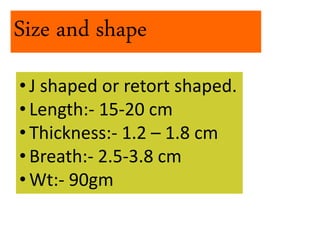
Size and shape
• J shaped or retort shaped.
• Length:- 15-20 cm
• Thickness:- 1.2 – 1.8 cm
• Breath:- 2.5-3.8 cm
• Wt:- 90gm
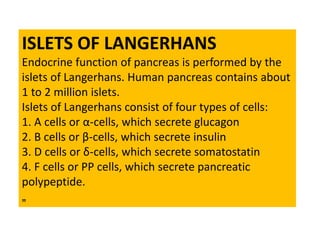
ISLETS OF LANGERHANS
Endocrine function of pancreas is performed by the
islets of Langerhans. Human pancreas contains about
1 to 2 million islets.
Islets of Langerhans consist of four types of cells:
1. A cells or α-cells, which secrete glucagon
2. B cells or β-cells, which secrete insulin
3. D cells or δ-cells, which secrete somatostatin
4. F cells or PP cells, which secrete pancreatic
polypeptide.
„
INSULINSOURCE OF SECRETION
Insulin is secreted by B cells or the β-cells in the islets of
Langerhans of pancreas.
CHEMISTRY AND HALF-LIFE
Insulin is a polypeptide with 51 amino acids and a
molecular weight of 5,808. It has two amino acid chains
called α and β chains, which are linked by disulfide
bridges. The α-chain of insulin contains 21 amino acids
and β-chain contains 30 amino acids. The biological
half-life of insulin is 5 minutes.
SYNTHESIS
Synthesis of insulin occurs in the rough endoplasmic
reticulum of β-cells in islets of Langerhans. It is
synthesized as preproinsulin, that gives rise to proinsulin.
Proinsulin is converted into insulin and C peptide through
a series of peptic cleavages. C peptide is a connecting
peptide that connects α and β chains. At the time of
secretion, C peptide is detached.
Preproinsulin → Proinsulin
Peptic cleavage ↓
Insulin
PLASMA LEVEL
Basal level of insulin in plasma is 10 μU/mL
METABOLISM
Binding of insulin to insulin receptor is essential for its
removal from circulation and degradation. Insulin is
degraded in liver and kidney by a cellular enzyme
called insulin protease or insulin-degrading enzyme
ACTIONS OF INSULIN
Insulin is the important hormone that is concerned
with the regulation of carbohydrate metabolism and
blood glucose level. It is also concerned with the
metabolism of proteins and fats
1. On Carbohydrate Metabolism
Insulin is the only antidiabetic hormone secreted in
the body, i.e. it is the only hormone in the body that
reduces blood glucose level. Insulin reduces the blood
glucose level by its following actions on carbohydrate
metabolism:
i. Increases transport and uptake of glucose by the cells
ii. Promotes peripheral utilization of glucose
iii. Promotes storage of glucose – glycogenesis
iv. Inhibits glycogenolysis
v. Inhibits gluconeogenesis
2. On Protein Metabolism
Insulin facilitates the synthesis and storage of proteins
and inhibits the cellular utilization of proteins by the
following actions:
i. Facilitating the transport of amino acids into the
cell from blood, by increasing the permeability of
cell membrane for amino acids
ii. Accelerating protein synthesis by influencing
the transcription of DNA and by increasing the
translation of mRNA
iii. Preventing protein catabolism by decreasing
the activity of cellular enzymes which act on
proteins
iv. Preventing conversion of proteins into glucose.
Thus, insulin is responsible for the conservation
and storage of proteins in the body.
3. On Fat Metabolism
Insulin stimulates the synthesis of fat. It also increases
the storage of fat in the adipose tissue.
Actions of insulin on fat metabolism are:
i. Synthesis of fatty acids and triglycerides
ii. Transport of fatty acids into adipose tissue
iii. Storage of fat
4. On Growth
Along with growth hormone, insulin promotes
growth ofbody by its anabolic action on
proteins.
The transport of amino acids into the cell and
synthesis of proteins in the cells. It also has the
protein-sparing effect,i.e. it causes
conservation of proteins by increasing the
glucose utilization by the tissues.
REGULATION OF INSULIN SECRETION
Insulin secretion is mainly regulated by blood glucose
level.
In addition, other factors like amino acids, lipid
deriva tives, gastrointestinal and endocrine
hormones
and autonomic nerve fibers also stimulate insulin
secration.
glucagon
SOURCE OF SECRETION
Glucagon is secreted from A cells or α-cells in the islets
of Langerhans of pancreas. It is also secreted from A
cells of stomach and L cells of intestine.
CHEMISTRY AND HALF-LIFE
Glucagon is a polypeptide with a molecular weight of
3,485. It contains 29 amino acids. Half-life of glucagon
is 3 to 6 minutes.
SYNTHESIS
Glucagon is synthesized from the preprohormone
precursor called preproglucagon in the α-cells of
islets.Preproglucagon is converted into proglucagon,
which gives rise to glucagon.
METABOLISM
About 30% of glucagon is degraded in liver and 20% in
kidney. The cleaved glucagon fragments are excreted
through urine. 50% of the circulating glucagon is
degraded in blood itself by enzymes such as serine and
cysteine proteases.
ACTIONS OF GLUCAGON
Actions of glucagon are antagonistic to
those of insulin. It increases the blood
glucose level,peripheral utilization of
lipids and the conversion of
proteins into glucose.
1. On Carbohydrate Metabolism
Glucagon increases the blood glucose level by:
i. Increasing glycogenolysis in liver and releasing
glucose from the liver cells into the blood.
Glucagon does not induce glycogenolysis in
muscle
ii.Increasing gluconeogenesis in liver by:
a. Activating the enzymes, which convert
pyruvate into phosphoenol pyruvate
b. Increasing the transport of amino acids into
the liver cells. The amino acids are utilized
for glucose formation.
2. On Protein Metabolism
Glucagon increases the transport of amino acids
into liver cells. The amino acids are utilized for
gluconeogenesis
3. On Fat Metabolism
Glucagon shows lipolytic and ketogenic actions. It
increases lipolysis by increasing the release of free
fatty
acids from adipose tissue and making them
available for
peripheral utilization. The lipolytic activity of
glucagon, in turn promotes ketogenesis (formation
of ketone bodies) in liver.
REGULATION OF GLUCAGON SECRETION
Secretion of glucagon is controlled mainly by
glucose and amino acid levels in the blood.
somatostain
SOURCE OF SECRETION
Somatostatin is secreted from:
1. Hypothalamus
2. D cells (δ-cells) in islets of Langerhans of pancreas
3. D cells in stomach and upper part of small
intestine.
CHEMISTRY AND HALF-LIFE
Somatostatin is a polypeptide. It is synthesized
in two forms, namely somatostatin-14 (with 14
amino acids) and somatostatin-28 (with 28
amino acids). Both the forms have similar
actions. Half-life of somatostatin is 2 to 4
minutes.
„
SYNTHESIS
1. Somatostatin is synthesized from the
precursor prosomatostatin. Prosomatostatin
is converted mostly into somatostatin-14 in
the D cells of islets in pancreas.
2. However, in the intestine, large amount of
somatostatin-28 is produced from
prosomatostatin.
„
METABOLISM
Somatostatin is degraded in liver and kidney.
ACTIONS OF
SOMATOSTATIN
1. Somatostatin acts within islets of Langerhans and,
inhibits β and α cells, i.e. it inhibits the secretion of
both glucagon and insulin
2. It decreases the motility of stomach, duodenum and
gallbladder
3. It reduces the secretion of gastrointestinal hormones
gastrin, CCK, GIP and VIP
4. Hypothalamic somatostatin inhibits the secretion of GH
and TSH from anterior pituitary. That is why, it is also
called growth hormone-inhibitory hormone (GHIH).
REGULATION OF SECRETION
OF SOMATOSTATIN
Pancreatic Somatostatin
Secretion of pancreatic somatostatin is stimulated
by glucose, amino acids and CCK. The tumor of D
cells of islets of Langerhans causes hypersecretion
of somatostatin. It leads to hyperglycemia and other
symptoms of diabetes mellitus.
Gastrointestinal Tract Somatostatin
Secretion of somatostatin in GI tract is increased by the
presence of chyme-containing glucose and proteins in
stomach and small intestine
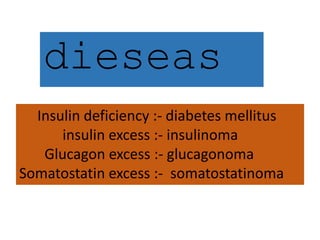
Insulin deficiency :- diabetes mellitus
insulin excess :- insulinoma
Glucagon excess :- glucagonoma
Somatostatin excess :- somatostatinoma
dieseas
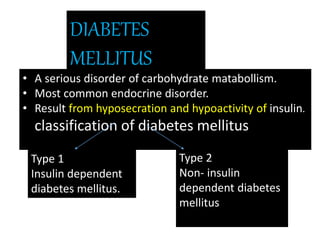
DIABETES
MELLITUS
• A serious disorder of carbohydrate matabollism.
• Most common endocrine disorder.
• Result from hyposecration and hypoactivity of insulin.
classification of diabetes mellitus
Type 1
Insulin dependent
diabetes mellitus.
Type 2
Non- insulin
dependent diabetes
mellitus
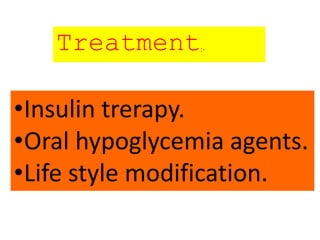
Treatment:-
•Insulin trerapy.
•Oral hypoglycemia agents.
•Life style modification.
Thank you

Pancreas

  • 1.
  • 2.
    Introduction :- Soft, lobulated elongatedgland with both exocrine and endocrine function Exocrine :- pancreatic juice. Endocrine :- insulin
  • 3.
    Size and shape •J shaped or retort shaped. • Length:- 15-20 cm • Thickness:- 1.2 – 1.8 cm • Breath:- 2.5-3.8 cm • Wt:- 90gm
  • 4.
    ISLETS OF LANGERHANS Endocrinefunction of pancreas is performed by the islets of Langerhans. Human pancreas contains about 1 to 2 million islets. Islets of Langerhans consist of four types of cells: 1. A cells or α-cells, which secrete glucagon 2. B cells or β-cells, which secrete insulin 3. D cells or δ-cells, which secrete somatostatin 4. F cells or PP cells, which secrete pancreatic polypeptide. „
  • 5.
    INSULINSOURCE OF SECRETION Insulinis secreted by B cells or the β-cells in the islets of Langerhans of pancreas. CHEMISTRY AND HALF-LIFE Insulin is a polypeptide with 51 amino acids and a molecular weight of 5,808. It has two amino acid chains called α and β chains, which are linked by disulfide bridges. The α-chain of insulin contains 21 amino acids and β-chain contains 30 amino acids. The biological half-life of insulin is 5 minutes.
  • 6.
    SYNTHESIS Synthesis of insulinoccurs in the rough endoplasmic reticulum of β-cells in islets of Langerhans. It is synthesized as preproinsulin, that gives rise to proinsulin. Proinsulin is converted into insulin and C peptide through a series of peptic cleavages. C peptide is a connecting peptide that connects α and β chains. At the time of secretion, C peptide is detached. Preproinsulin → Proinsulin Peptic cleavage ↓ Insulin PLASMA LEVEL Basal level of insulin in plasma is 10 μU/mL
  • 7.
    METABOLISM Binding of insulinto insulin receptor is essential for its removal from circulation and degradation. Insulin is degraded in liver and kidney by a cellular enzyme called insulin protease or insulin-degrading enzyme ACTIONS OF INSULIN Insulin is the important hormone that is concerned with the regulation of carbohydrate metabolism and blood glucose level. It is also concerned with the metabolism of proteins and fats
  • 8.
    1. On CarbohydrateMetabolism Insulin is the only antidiabetic hormone secreted in the body, i.e. it is the only hormone in the body that reduces blood glucose level. Insulin reduces the blood glucose level by its following actions on carbohydrate metabolism: i. Increases transport and uptake of glucose by the cells ii. Promotes peripheral utilization of glucose iii. Promotes storage of glucose – glycogenesis iv. Inhibits glycogenolysis v. Inhibits gluconeogenesis
  • 9.
    2. On ProteinMetabolism Insulin facilitates the synthesis and storage of proteins and inhibits the cellular utilization of proteins by the following actions: i. Facilitating the transport of amino acids into the cell from blood, by increasing the permeability of cell membrane for amino acids ii. Accelerating protein synthesis by influencing the transcription of DNA and by increasing the translation of mRNA
  • 10.
    iii. Preventing proteincatabolism by decreasing the activity of cellular enzymes which act on proteins iv. Preventing conversion of proteins into glucose. Thus, insulin is responsible for the conservation and storage of proteins in the body. 3. On Fat Metabolism Insulin stimulates the synthesis of fat. It also increases the storage of fat in the adipose tissue. Actions of insulin on fat metabolism are: i. Synthesis of fatty acids and triglycerides ii. Transport of fatty acids into adipose tissue iii. Storage of fat
  • 11.
    4. On Growth Alongwith growth hormone, insulin promotes growth ofbody by its anabolic action on proteins. The transport of amino acids into the cell and synthesis of proteins in the cells. It also has the protein-sparing effect,i.e. it causes conservation of proteins by increasing the glucose utilization by the tissues.
  • 12.
    REGULATION OF INSULINSECRETION Insulin secretion is mainly regulated by blood glucose level. In addition, other factors like amino acids, lipid deriva tives, gastrointestinal and endocrine hormones and autonomic nerve fibers also stimulate insulin secration.
  • 13.
  • 14.
    SOURCE OF SECRETION Glucagonis secreted from A cells or α-cells in the islets of Langerhans of pancreas. It is also secreted from A cells of stomach and L cells of intestine. CHEMISTRY AND HALF-LIFE Glucagon is a polypeptide with a molecular weight of 3,485. It contains 29 amino acids. Half-life of glucagon is 3 to 6 minutes.
  • 15.
    SYNTHESIS Glucagon is synthesizedfrom the preprohormone precursor called preproglucagon in the α-cells of islets.Preproglucagon is converted into proglucagon, which gives rise to glucagon. METABOLISM About 30% of glucagon is degraded in liver and 20% in kidney. The cleaved glucagon fragments are excreted through urine. 50% of the circulating glucagon is degraded in blood itself by enzymes such as serine and cysteine proteases.
  • 16.
    ACTIONS OF GLUCAGON Actionsof glucagon are antagonistic to those of insulin. It increases the blood glucose level,peripheral utilization of lipids and the conversion of proteins into glucose.
  • 17.
    1. On CarbohydrateMetabolism Glucagon increases the blood glucose level by: i. Increasing glycogenolysis in liver and releasing glucose from the liver cells into the blood. Glucagon does not induce glycogenolysis in muscle ii.Increasing gluconeogenesis in liver by: a. Activating the enzymes, which convert pyruvate into phosphoenol pyruvate b. Increasing the transport of amino acids into the liver cells. The amino acids are utilized for glucose formation.
  • 18.
    2. On ProteinMetabolism Glucagon increases the transport of amino acids into liver cells. The amino acids are utilized for gluconeogenesis 3. On Fat Metabolism Glucagon shows lipolytic and ketogenic actions. It increases lipolysis by increasing the release of free fatty acids from adipose tissue and making them available for peripheral utilization. The lipolytic activity of glucagon, in turn promotes ketogenesis (formation of ketone bodies) in liver.
  • 19.
    REGULATION OF GLUCAGONSECRETION Secretion of glucagon is controlled mainly by glucose and amino acid levels in the blood.
  • 20.
    somatostain SOURCE OF SECRETION Somatostatinis secreted from: 1. Hypothalamus 2. D cells (δ-cells) in islets of Langerhans of pancreas 3. D cells in stomach and upper part of small intestine.
  • 21.
    CHEMISTRY AND HALF-LIFE Somatostatinis a polypeptide. It is synthesized in two forms, namely somatostatin-14 (with 14 amino acids) and somatostatin-28 (with 28 amino acids). Both the forms have similar actions. Half-life of somatostatin is 2 to 4 minutes. „
  • 22.
    SYNTHESIS 1. Somatostatin issynthesized from the precursor prosomatostatin. Prosomatostatin is converted mostly into somatostatin-14 in the D cells of islets in pancreas. 2. However, in the intestine, large amount of somatostatin-28 is produced from prosomatostatin. „ METABOLISM Somatostatin is degraded in liver and kidney.
  • 23.
    ACTIONS OF SOMATOSTATIN 1. Somatostatinacts within islets of Langerhans and, inhibits β and α cells, i.e. it inhibits the secretion of both glucagon and insulin 2. It decreases the motility of stomach, duodenum and gallbladder 3. It reduces the secretion of gastrointestinal hormones gastrin, CCK, GIP and VIP 4. Hypothalamic somatostatin inhibits the secretion of GH and TSH from anterior pituitary. That is why, it is also called growth hormone-inhibitory hormone (GHIH).
  • 24.
    REGULATION OF SECRETION OFSOMATOSTATIN Pancreatic Somatostatin Secretion of pancreatic somatostatin is stimulated by glucose, amino acids and CCK. The tumor of D cells of islets of Langerhans causes hypersecretion of somatostatin. It leads to hyperglycemia and other symptoms of diabetes mellitus. Gastrointestinal Tract Somatostatin Secretion of somatostatin in GI tract is increased by the presence of chyme-containing glucose and proteins in stomach and small intestine
  • 25.
    Insulin deficiency :-diabetes mellitus insulin excess :- insulinoma Glucagon excess :- glucagonoma Somatostatin excess :- somatostatinoma dieseas
  • 26.
    DIABETES MELLITUS • A seriousdisorder of carbohydrate matabollism. • Most common endocrine disorder. • Result from hyposecration and hypoactivity of insulin. classification of diabetes mellitus Type 1 Insulin dependent diabetes mellitus. Type 2 Non- insulin dependent diabetes mellitus
  • 27.
    Treatment:- •Insulin trerapy. •Oral hypoglycemiaagents. •Life style modification.
  • 28.