endocrine secretion of the
pancreas
By nkalubo isaac
ISLETS OF LANGERHANS
Endocrine function of pancreas is performed by the islets of
Langerhans.
Human pancreas contains about 1 to 2 million islets.
1.A cells or α-cells,which secrete glucagon
2.B cellsor β-cells, which secrete insulin
3.D cells or δ-cells, which secrete somatostatin
4.F cells or PPcells, which secrete pancreatic polypeptide.
INSULIN
• Insulin is a polypeptide with 51
amino acids and a molecular
weight of 5,808.
• It has two amino acid chains called
α and β chains, which are linked by
disulfide bridges.
• The α-chain of insulin contains 21
amino acids and β-chain contains
30 amino acids.
• The biological half-life of insulin is
5minutes
• Insulin is degraded in liver and
kidney by a cellular enzyme
called insulin protease or insulin-
degrading enzyme.
• plasma level of insulin in plasma
is 10 µU/mL
Action of insulin
1. On Carbohydrate Metabolism
Increases transport and uptake of glucose by the cells.
• Insulin facilitates the transport of glucose from blood into the cells by
increasing the permeability of cell membrane to glucose.
• Insulin also increases the number of glucose transporters,especially
GLUT4 in the cell membrane.
• Glucose transporters: Usually, glucose is transported into the cells by
sodium-glucose symport pump.
carbs
• In the liver and muscle cells, insulin promotes the conversion
of glucose into glycogen (glycogenesis) for storage. This process
lowers blood glucose levels after meals.
• Insulin inhibits glycogenolysis, the process where glycogen is
broken down into glucose in the liver. This prevents the release
of glucose into the bloodstream.
• Suppresses Gluconeogenesis: Insulin inhibits gluconeogenesis,
which is the production of glucose from non-carbohydrate
sources (like amino acids) in the liver.
On proteins
• Insulin facilitates the synthesis and storage of proteins and inhibits the
cellular utilization of proteins by the following actions:
i. Facilitating the transport of amino acids into the cell from blood, by increasing
the permeability of cell membrane for amino acids
ii. Accelerating protein synthesis by influencing the transcription of DNA and by
increasing the translation of mRNA
iii. Preventing protein catabolism by decreasing the activity of cellular enzymes
which act on proteins
iv. Preventing conversion of proteins into glucose. Thus, insulin is responsible for
the conservation and storage of proteins in the body
proteins
• iii. Preventing protein catabolism by decreasing the activity of cellular
enzymes which act on proteins
• iv. Preventing conversion of proteins into glucose. Thus, insulin is
responsible for the conservation and storage of proteins in the body
on fats
i. Synthesis of fatty acids and triglycerides
• Insulin promotes the transport of excess glucose into cells, particularly the liver
cells.This glucose is utilized for the synthesis of fatty acids and triglycerides.
• Insulin promotes the synthesis of lipids by activating the enzymes which convert:
a. Glucose into fatty acids
b. Fatty acids into triglycerides.
ii. Transport of fatty acids into adipose tissue Insulin facilitates the transport of fatty
acids into the adipose tissue.
iii. Storage of fat
• Insulin promotes the storage of fat in adipose tissue by inhibiting the enzymes which
degrade the triglycerides.
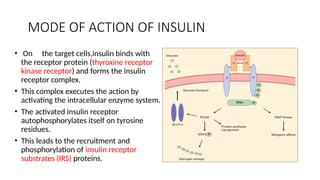
MODE OF ACTION OF INSULIN
• On the target cells,insulin binds with
the receptor protein (thyroxine receptor
kinase receptor) and forms the insulin
receptor complex.
• This complex executes the action by
activating the intracellular enzyme system.
• The activated insulin receptor
autophosphorylates itself on tyrosine
residues.
• This leads to the recruitment and
phosphorylation of insulin receptor
substrates (IRS) proteins.
• IRS proteins then activate two major signaling pathways:
• PI3K-Akt pathway (Phosphatidylinositol 3-kinase/Akt pathway): This
pathway is crucial for the metabolic actions of insulin, including
glucose uptake.
• MAPK pathway (Mitogen-Activated Protein Kinase pathway): This
pathway is involved in gene expression and cell growth.
REGULATION OF INSULIN SECRETION
1. Insulin secretion is mainly regulated by blood glucose level
• . Blood Glucose Levels (Primary Regulator)
• High blood glucose (after a meal): Elevated blood sugar levels stimulate insulin release
from beta cells in the pancreas.
• Low blood glucose (fasting): Low glucose levels suppress insulin secretion, allowing
glucose production by the liver.
2. Hormonal Control
• Glucagon: Secreted by alpha cells of the pancreas in response to low blood sugar,
glucagon has the opposite effect of insulin, promoting glucose production by the liver.
However, it indirectly promotes insulin secretion to prevent hyperglycemia.
• Catecholamines (adrenaline, noradrenaline): Released during stress, they inhibit
insulin secretion to increase glucose availability for energy.
cont...
3. Neural Control
• The autonomic nervous system regulates insulin secretion through:
• Parasympathetic stimulation (vagal nerve activity) after eating, which promotes
insulin release.
• Sympathetic stimulation during stress or exercise, which inhibits insulin release.
4. Nutrient Sensing
• Certain amino acids (e.g., leucine, arginine, lysin) can stimulate insulin secretion,
especially when combined with glucose.
• Elevated free fatty acids in the blood can also enhance insulin secretion.
5. Negative Feedback Mechanisms
• Once insulin has facilitated glucose uptake and reduced blood glucose levels, the
lowered glucose concentration signals the pancreas to reduce insulin production,
maintaining balance and preventing hypoglycemia.
GLUCAGON
• Glucagon is secreted from A cells or α-cells in the islets of Langerhans of
pancreas.
• It is also secreted from A cells of stomach and L cells of intestine.
• Glucagon is a polypeptide with a molecular weight of 3,485.
• It contains 29 aminoacids.
• Half-life of glucagon is 3 to 6 minutes.
• Glucagon is synthesized from the preprohormone precursor called
preproglucagon in the α-cells of islets.
• Preproglucagon is converted into proglucagon, which gives rise to
glucagon.
• About 30% of glucagon is degraded in liver and 20% in kidney.
• The cleaved glucagon fragments are excreted through urine.
• 50% of the circulating glucagon is degraded in blood itself by
enzymes such as serine and cysteine proteases.
ACTIONS OF GLUCAGON
1. Stimulates Glycogenolysis:
Glucagon promotes the breakdown of glycogen (the stored form of
glucose) in the liver into glucose, which is then released into the
bloodstream.
2. Stimulates Gluconeogenesis:
 Glucagon encourages the liver to produce glucose from non-
carbohydrate sources like amino acids and fatty acids through a
process called gluconeogenesis. This helps maintain blood glucose
levels when dietary glucose is not available.
CONT...
3. Increases Lipolysis:
In adipose (fat) tissue, glucagon stimulates the breakdown of fat into
free fatty acids and glycerol, which can be used for energy. This
provides fuel for cells when glucose is scarce.
4. Inhibition of Glycogenesis:
Glucagon inhibits glycogenesis (the process of glycogen formation),
ensuring that glucose is not stored in the liver when the body needs it
in the bloodstream.
Regulation of Glucagon:
Low Blood Glucose: When blood sugar levels drop (hypoglycemia),
glucagon is secreted to increase glucose availability.
High Blood Glucose: When blood sugar levels are high
(hyperglycemia), glucagon secretion is suppressed.
Amino Acids: Certain amino acids can stimulate glucagon release,
particularly after a high-protein meal.
Exercise: Physical activity can stimulate glucagon secretion to provide
additional energy.
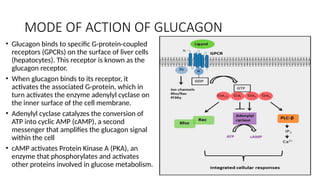
MODE OF ACTION OF GLUCAGON
• Glucagon binds to specific G-protein-coupled
receptors (GPCRs) on the surface of liver cells
(hepatocytes). This receptor is known as the
glucagon receptor.
• When glucagon binds to its receptor, it
activates the associated G-protein, which in
turn activates the enzyme adenylyl cyclase on
the inner surface of the cell membrane.
• Adenylyl cyclase catalyzes the conversion of
ATP into cyclic AMP (cAMP), a second
messenger that amplifies the glucagon signal
within the cell
• cAMP activates Protein Kinase A (PKA), an
enzyme that phosphorylates and activates
other proteins involved in glucose metabolism.
applied physiology
insulin and glucagon physiology presentation

insulin and glucagon physiology presentation

  • 1.
    endocrine secretion ofthe pancreas By nkalubo isaac
  • 2.
    ISLETS OF LANGERHANS Endocrinefunction of pancreas is performed by the islets of Langerhans. Human pancreas contains about 1 to 2 million islets. 1.A cells or α-cells,which secrete glucagon 2.B cellsor β-cells, which secrete insulin 3.D cells or δ-cells, which secrete somatostatin 4.F cells or PPcells, which secrete pancreatic polypeptide.
  • 3.
    INSULIN • Insulin isa polypeptide with 51 amino acids and a molecular weight of 5,808. • It has two amino acid chains called α and β chains, which are linked by disulfide bridges. • The α-chain of insulin contains 21 amino acids and β-chain contains 30 amino acids. • The biological half-life of insulin is 5minutes • Insulin is degraded in liver and kidney by a cellular enzyme called insulin protease or insulin- degrading enzyme. • plasma level of insulin in plasma is 10 µU/mL
  • 4.
    Action of insulin 1.On Carbohydrate Metabolism Increases transport and uptake of glucose by the cells. • Insulin facilitates the transport of glucose from blood into the cells by increasing the permeability of cell membrane to glucose. • Insulin also increases the number of glucose transporters,especially GLUT4 in the cell membrane. • Glucose transporters: Usually, glucose is transported into the cells by sodium-glucose symport pump.
  • 5.
    carbs • In theliver and muscle cells, insulin promotes the conversion of glucose into glycogen (glycogenesis) for storage. This process lowers blood glucose levels after meals. • Insulin inhibits glycogenolysis, the process where glycogen is broken down into glucose in the liver. This prevents the release of glucose into the bloodstream. • Suppresses Gluconeogenesis: Insulin inhibits gluconeogenesis, which is the production of glucose from non-carbohydrate sources (like amino acids) in the liver.
  • 6.
    On proteins • Insulinfacilitates the synthesis and storage of proteins and inhibits the cellular utilization of proteins by the following actions: i. Facilitating the transport of amino acids into the cell from blood, by increasing the permeability of cell membrane for amino acids ii. Accelerating protein synthesis by influencing the transcription of DNA and by increasing the translation of mRNA iii. Preventing protein catabolism by decreasing the activity of cellular enzymes which act on proteins iv. Preventing conversion of proteins into glucose. Thus, insulin is responsible for the conservation and storage of proteins in the body
  • 7.
    proteins • iii. Preventingprotein catabolism by decreasing the activity of cellular enzymes which act on proteins • iv. Preventing conversion of proteins into glucose. Thus, insulin is responsible for the conservation and storage of proteins in the body
  • 8.
    on fats i. Synthesisof fatty acids and triglycerides • Insulin promotes the transport of excess glucose into cells, particularly the liver cells.This glucose is utilized for the synthesis of fatty acids and triglycerides. • Insulin promotes the synthesis of lipids by activating the enzymes which convert: a. Glucose into fatty acids b. Fatty acids into triglycerides. ii. Transport of fatty acids into adipose tissue Insulin facilitates the transport of fatty acids into the adipose tissue. iii. Storage of fat • Insulin promotes the storage of fat in adipose tissue by inhibiting the enzymes which degrade the triglycerides.
  • 9.
    MODE OF ACTIONOF INSULIN • On the target cells,insulin binds with the receptor protein (thyroxine receptor kinase receptor) and forms the insulin receptor complex. • This complex executes the action by activating the intracellular enzyme system. • The activated insulin receptor autophosphorylates itself on tyrosine residues. • This leads to the recruitment and phosphorylation of insulin receptor substrates (IRS) proteins.
  • 10.
    • IRS proteinsthen activate two major signaling pathways: • PI3K-Akt pathway (Phosphatidylinositol 3-kinase/Akt pathway): This pathway is crucial for the metabolic actions of insulin, including glucose uptake. • MAPK pathway (Mitogen-Activated Protein Kinase pathway): This pathway is involved in gene expression and cell growth.
  • 11.
    REGULATION OF INSULINSECRETION 1. Insulin secretion is mainly regulated by blood glucose level • . Blood Glucose Levels (Primary Regulator) • High blood glucose (after a meal): Elevated blood sugar levels stimulate insulin release from beta cells in the pancreas. • Low blood glucose (fasting): Low glucose levels suppress insulin secretion, allowing glucose production by the liver. 2. Hormonal Control • Glucagon: Secreted by alpha cells of the pancreas in response to low blood sugar, glucagon has the opposite effect of insulin, promoting glucose production by the liver. However, it indirectly promotes insulin secretion to prevent hyperglycemia. • Catecholamines (adrenaline, noradrenaline): Released during stress, they inhibit insulin secretion to increase glucose availability for energy.
  • 12.
    cont... 3. Neural Control •The autonomic nervous system regulates insulin secretion through: • Parasympathetic stimulation (vagal nerve activity) after eating, which promotes insulin release. • Sympathetic stimulation during stress or exercise, which inhibits insulin release. 4. Nutrient Sensing • Certain amino acids (e.g., leucine, arginine, lysin) can stimulate insulin secretion, especially when combined with glucose. • Elevated free fatty acids in the blood can also enhance insulin secretion. 5. Negative Feedback Mechanisms • Once insulin has facilitated glucose uptake and reduced blood glucose levels, the lowered glucose concentration signals the pancreas to reduce insulin production, maintaining balance and preventing hypoglycemia.
  • 13.
    GLUCAGON • Glucagon issecreted from A cells or α-cells in the islets of Langerhans of pancreas. • It is also secreted from A cells of stomach and L cells of intestine. • Glucagon is a polypeptide with a molecular weight of 3,485. • It contains 29 aminoacids. • Half-life of glucagon is 3 to 6 minutes. • Glucagon is synthesized from the preprohormone precursor called preproglucagon in the α-cells of islets. • Preproglucagon is converted into proglucagon, which gives rise to glucagon.
  • 14.
    • About 30%of glucagon is degraded in liver and 20% in kidney. • The cleaved glucagon fragments are excreted through urine. • 50% of the circulating glucagon is degraded in blood itself by enzymes such as serine and cysteine proteases.
  • 15.
    ACTIONS OF GLUCAGON 1.Stimulates Glycogenolysis: Glucagon promotes the breakdown of glycogen (the stored form of glucose) in the liver into glucose, which is then released into the bloodstream. 2. Stimulates Gluconeogenesis:  Glucagon encourages the liver to produce glucose from non- carbohydrate sources like amino acids and fatty acids through a process called gluconeogenesis. This helps maintain blood glucose levels when dietary glucose is not available.
  • 16.
    CONT... 3. Increases Lipolysis: Inadipose (fat) tissue, glucagon stimulates the breakdown of fat into free fatty acids and glycerol, which can be used for energy. This provides fuel for cells when glucose is scarce. 4. Inhibition of Glycogenesis: Glucagon inhibits glycogenesis (the process of glycogen formation), ensuring that glucose is not stored in the liver when the body needs it in the bloodstream.
  • 17.
    Regulation of Glucagon: LowBlood Glucose: When blood sugar levels drop (hypoglycemia), glucagon is secreted to increase glucose availability. High Blood Glucose: When blood sugar levels are high (hyperglycemia), glucagon secretion is suppressed. Amino Acids: Certain amino acids can stimulate glucagon release, particularly after a high-protein meal. Exercise: Physical activity can stimulate glucagon secretion to provide additional energy.
  • 18.
    MODE OF ACTIONOF GLUCAGON • Glucagon binds to specific G-protein-coupled receptors (GPCRs) on the surface of liver cells (hepatocytes). This receptor is known as the glucagon receptor. • When glucagon binds to its receptor, it activates the associated G-protein, which in turn activates the enzyme adenylyl cyclase on the inner surface of the cell membrane. • Adenylyl cyclase catalyzes the conversion of ATP into cyclic AMP (cAMP), a second messenger that amplifies the glucagon signal within the cell • cAMP activates Protein Kinase A (PKA), an enzyme that phosphorylates and activates other proteins involved in glucose metabolism.
  • 19.