Interventional
Procedures in Chronic
Pain
Dr Brendan Moore
Specialist Pain Medicine Physician
Adjunct Associate Professor
University of Queensland
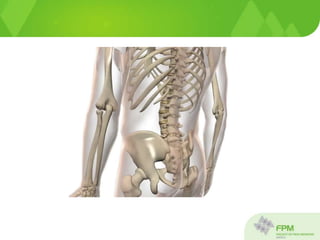
Degenerative Lumbar Back Pain
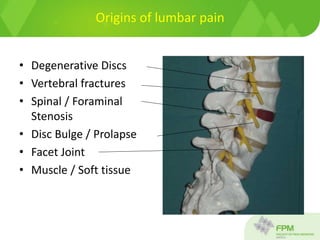
Origins of lumbar pain
• Degenerative Discs
• Vertebral fractures
• Spinal / Foraminal
Stenosis
• Disc Bulge / Prolapse
• Facet Joint
• Muscle / Soft tissue
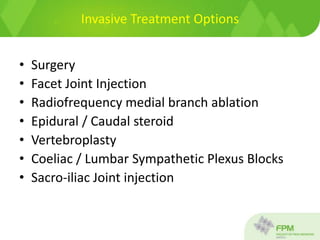
Invasive Treatment Options
• Surgery
• Facet Joint Injection
• Radiofrequency medial branch ablation
• Epidural / Caudal steroid
• Vertebroplasty
• Coeliac / Lumbar Sympathetic Plexus Blocks
• Sacro-iliac Joint injection
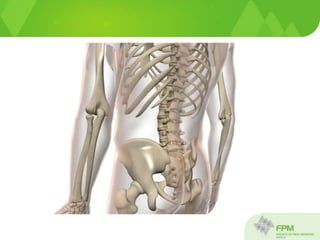
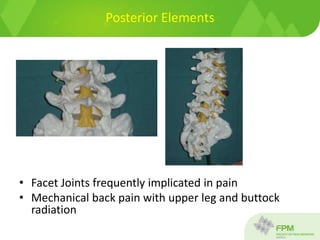
Posterior Elements
• Facet Joints frequently implicated in pain
• Mechanical back pain with upper leg and buttock
radiation
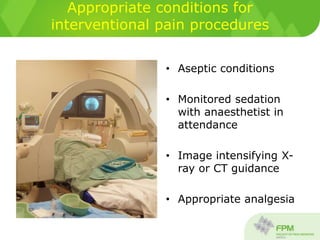
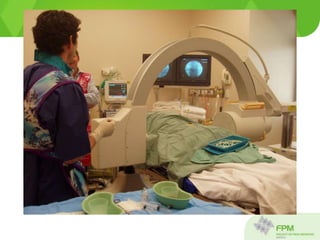
Appropriate conditions for
interventional pain procedures
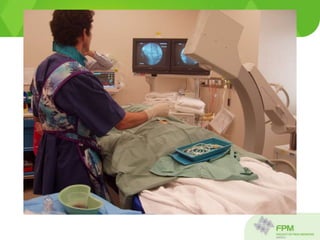
• Aseptic conditions
• Monitored sedation
with anaesthetist in
attendance
• Image intensifying X-
ray or CT guidance
• Appropriate analgesia
Procedures
• Epidural injections
– Cervical, Thoracic, Lumbar, Caudal
• Facet joint injections
• Sacroiliac joint injections
• Medial branch blocks
• Radiofrequency nerve ablation
Epidural injections
• Most effective in the presence of nerve root
compression and spinal stenosis
• Increased efficacy if given in the first weeks of
the onset of pain
• Effects of the injection tend to be temporary (1
week to 1 year)
• Can be beneficial in providing relief for patients
during an episode of severe back pain
• Allows patients to progress in their rehabilitation
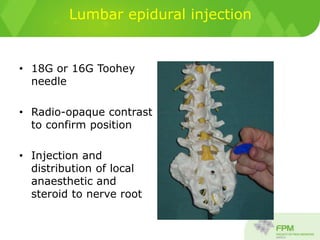
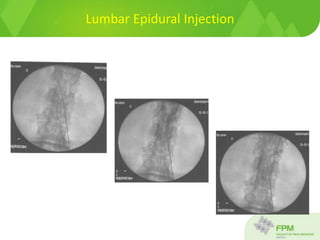
Lumbar epidural injection
• 18G or 16G Toohey
needle
• Radio-opaque contrast
to confirm position
• Injection and
distribution of local
anaesthetic and
steroid to nerve root
Lumbar Epidural Injection
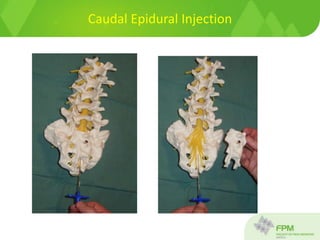
Caudal Epidural Injection
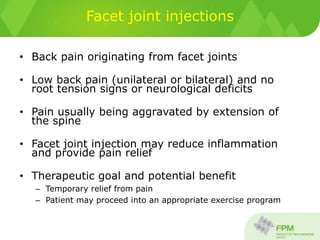
Facet joint injections
• Back pain originating from facet joints
• Low back pain (unilateral or bilateral) and no
root tension signs or neurological deficits
• Pain usually being aggravated by extension of
the spine
• Facet joint injection may reduce inflammation
and provide pain relief
• Therapeutic goal and potential benefit
– Temporary relief from pain
– Patient may proceed into an appropriate exercise program
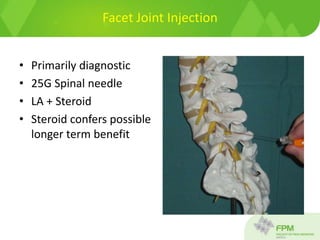
Facet Joint Injection
• Primarily diagnostic
• 25G Spinal needle
• LA + Steroid
• Steroid confers possible
longer term benefit
Sacroiliac joint injection
• Indicated with referred pain
• Pain referral pattern – area around and just
caudal to the posterior superior iliac spine
• Referred pain in the low back, buttocks,
abdomen, groin or legs
• In some patients, S-1 joint injections can
provide significant pain relief
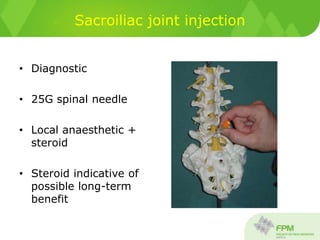
Sacroiliac joint injection
• Diagnostic
• 25G spinal needle
• Local anaesthetic +
steroid
• Steroid indicative of
possible long-term
benefit
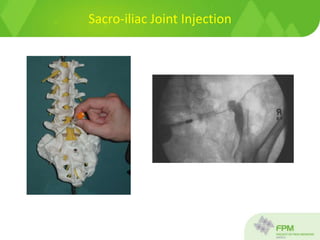
Sacro-iliac Joint Injection
Medial branch blocks
• Medial branch nerves are the very small nerve
branches that controls sensation of the facet joint
• Indicated in low back pain (unilateral or bilateral)
• Pain usually aggravated by extension of the spine
• Medial branch blocks are a diagnostic procedure
• Can provide temporary pain relief
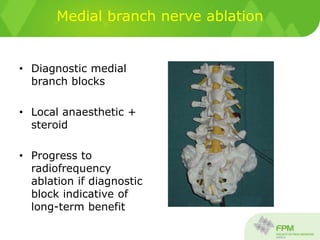
Medial branch nerve ablation
• Diagnostic medial
branch blocks
• Local anaesthetic +
steroid
• Progress to
radiofrequency
ablation if diagnostic
block indicative of
long-term benefit
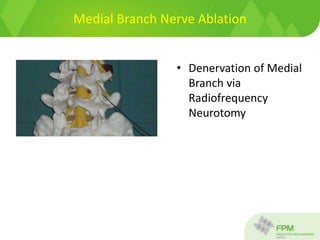
Medial Branch Nerve Ablation
• Denervation of Medial
Branch via
Radiofrequency
Neurotomy
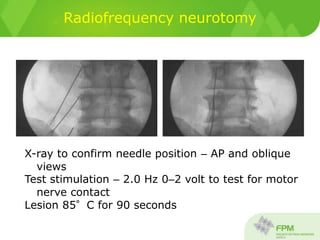
Radiofrequency neurotomy
X-ray to confirm needle position – AP and oblique
views
Test stimulation – 2.0 Hz 0–2 volt to test for motor
nerve contact
Lesion 85°C for 90 seconds
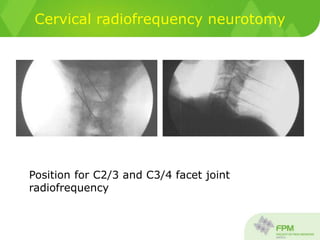
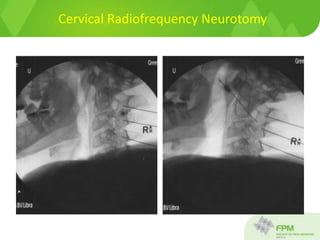
Cervical radiofrequency neurotomy
Position for C2/3 and C3/4 facet joint
radiofrequency
Cervical Radiofrequency Neurotomy
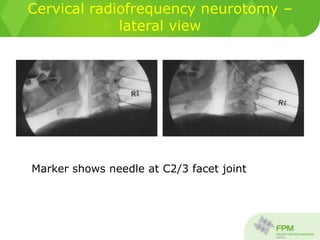
Cervical radiofrequency neurotomy –
lateral view
Marker shows needle at C2/3 facet joint
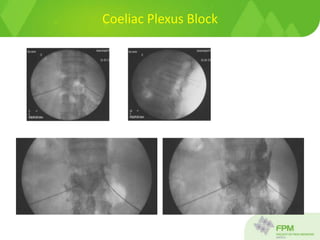
Coeliac Plexus Block
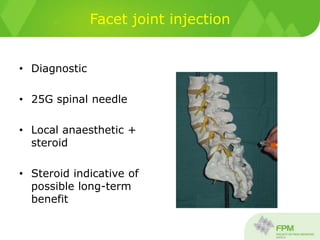
Facet joint injection
• Diagnostic
• 25G spinal needle
• Local anaesthetic +
steroid
• Steroid indicative of
possible long-term
benefit
Elena Yusim – Pain Psychologist
The Psychology of Pain
Management
Strategy
Psychosocial Assessment
 medical history – any flags/concerns/drug seeking
 Thinking patterns – helpful or unhelpful
 Social interactions - family, friends, spouse
 Behaviours - activity levels, avoidance, anything harmful
 Sleep patterns – any changes
Testing
 Beck Depression Inventory – BDI
 Depression, Anxiety and Stress Scale – DASS
 Personality Assessment Inventory - PAI
Reality Check
 Why is the patient here?
 Motivation to RTW?
 Any secondary gain from sick role?
 Are they prepared to do the hard work?
 Do they expect to be fixed?
 What do they agree to, if they don’t comply?
Invisible Tool Kit
 Goal setting
 Pacing
 Journaling
 Thought Management – CBT, ACT
 Relaxation and self regulation strategies
 Relapse prevention planning
Opioids in Chronic Pain
Dr Brendan Moore
Pain Medicine Specialist Physician
Adjunct Associate Professor
University of Queensland
Opioid prescribing:
dose limits and
considerations
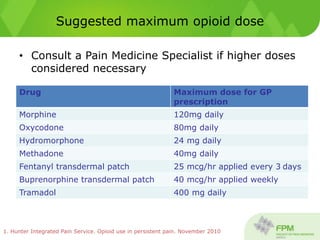
Suggested maximum opioid dose
• Consult a Pain Medicine Specialist if higher doses
considered necessary
1. Hunter Integrated Pain Service. Opioid use in persistent pain. November 2010
Drug Maximum dose for GP
prescription
Morphine 120mg daily
Oxycodone 80mg daily
Hydromorphone 24 mg daily
Methadone 40mg daily
Fentanyl transdermal patch 25 mcg/hr applied every 3 days
Buprenorphine transdermal patch 40 mcg/hr applied weekly
Tramadol 400 mg daily
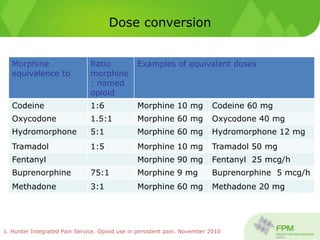
Dose conversion
Morphine
equivalence to
Ratio
morphine
: named
opioid
Examples of equivalent doses
Codeine 1:6 Morphine 10 mg Codeine 60 mg
Oxycodone 1.5:1 Morphine 60 mg Oxycodone 40 mg
Hydromorphone 5:1 Morphine 60 mg Hydromorphone 12 mg
Tramadol 1:5 Morphine 10 mg Tramadol 50 mg
Fentanyl Morphine 90 mg Fentanyl 25 mcg/h
Buprenorphine 75:1 Morphine 9 mg Buprenorphine 5 mcg/h
Methadone 3:1 Morphine 60 mg Methadone 20 mg
1. Hunter Integrated Pain Service. Opioid use in persistent pain. November 2010
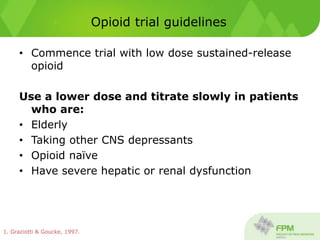
Opioid trial guidelines
• Commence trial with low dose sustained-release
opioid
Use a lower dose and titrate slowly in patients
who are:
• Elderly
• Taking other CNS depressants
• Opioid naïve
• Have severe hepatic or renal dysfunction
1. Graziotti & Goucke, 1997.
Review of opioid trial
• Discuss progress and outcomes
• Functional goals achieved?
• Medication used responsibly?
• Discuss risks / benefits of continued therapy
• Assess 4 ‘A’s1
– Analgesia
– Activity
– Adverse effects
– Aberrant drug behaviours
1. Gourlay & Heit, 2005.
Federal requirements
PBS prescription
Restricted benefit
• Chronic severe disabling pain not responding to non-
narcotic analgesics (treatment <12 months)
• If treatment required beyond 12 months, patient must be
reviewed by a second medical practitioner
• Authority required when prescribing increased quantities
of opioid and/or repeats
– By phone – 1 month’s supply with no repeats
– In writing – 1 month’s supply with 2 repeats
• Short term supply can be prescribed without an authority
Department of Health and Ageing, 2008.
State requirements - QLD
• If intend to prescribe S8 drugs for longer than 8 weeks,
forward a “Report to the Chief Executive” through the Drugs
of Dependence Unit (DDU)
• A treatment approval from the Chief Executive is required
prior to treating, for any controlled drug for a patient
considered to be drug dependent
• For approvals and “Reports to the Chief Executive” contact
the Drugs of Dependence Unit
– Phone 3328 9890
– Fax 3328 9821
Preventing doctor-shopping
Medicare Australia
Prescription Shopping Information Service
• If patient suspected of getting medicine in excess
of medical need, contact the Prescription
Shopping Information Service:
– Complete and sign the registration form available at
www.medicareaustralia.gov.au
• Registration confirmed within 2 business days (fax) or by
mail
– Information Service available 24/7 for registered GPs to:
• Find out if patient has been identified under the
Prescription Shopping Program
• Receive information on the amount and type of PBS
medicine recently supplied to that patient
 1800 631 181
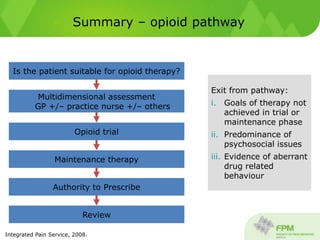
Summary – opioid pathway
Multidimensional assessment
GP +/– practice nurse +/– others
Opioid trial
Maintenance therapy
Authority to Prescribe
Review
Exit from pathway:
i. Goals of therapy not
achieved in trial or
maintenance phase
ii. Predominance of
psychosocial issues
iii. Evidence of aberrant
drug related
behaviour
Integrated Pain Service, 2008.
Is the patient suitable for opioid therapy?
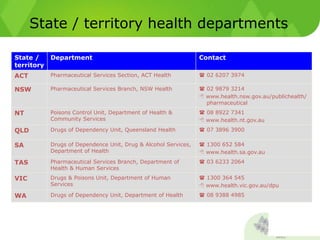
State / territory health departments
State /
territory
Department Contact
ACT Pharmaceutical Services Section, ACT Health  02 6207 3974
NSW Pharmaceutical Services Branch, NSW Health  02 9879 3214
 www.health.nsw.gov.au/publichealth/
pharmaceutical
NT Poisons Control Unit, Department of Health &
Community Services
 08 8922 7341
 www.health.nt.gov.au
QLD Drugs of Dependency Unit, Queensland Health  07 3896 3900
SA Drugs of Dependence Unit, Drug & Alcohol Services,
Department of Health
 1300 652 584
 www.health.sa.gov.au
TAS Pharmaceutical Services Branch, Department of
Health & Human Services
 03 6233 2064
VIC Drugs & Poisons Unit, Department of Human
Services
 1300 364 545
 www.health.vic.gov.au/dpu
WA Drugs of Dependency Unit, Department of Health  08 9388 4985

Pain management

  • 1.
    Interventional Procedures in Chronic Pain DrBrendan Moore Specialist Pain Medicine Physician Adjunct Associate Professor University of Queensland
  • 2.
  • 4.
    Origins of lumbarpain • Degenerative Discs • Vertebral fractures • Spinal / Foraminal Stenosis • Disc Bulge / Prolapse • Facet Joint • Muscle / Soft tissue
  • 5.
    Invasive Treatment Options •Surgery • Facet Joint Injection • Radiofrequency medial branch ablation • Epidural / Caudal steroid • Vertebroplasty • Coeliac / Lumbar Sympathetic Plexus Blocks • Sacro-iliac Joint injection
  • 6.
    Posterior Elements • FacetJoints frequently implicated in pain • Mechanical back pain with upper leg and buttock radiation
  • 7.
    Appropriate conditions for interventionalpain procedures • Aseptic conditions • Monitored sedation with anaesthetist in attendance • Image intensifying X- ray or CT guidance • Appropriate analgesia
  • 10.
    Procedures • Epidural injections –Cervical, Thoracic, Lumbar, Caudal • Facet joint injections • Sacroiliac joint injections • Medial branch blocks • Radiofrequency nerve ablation
  • 11.
    Epidural injections • Mosteffective in the presence of nerve root compression and spinal stenosis • Increased efficacy if given in the first weeks of the onset of pain • Effects of the injection tend to be temporary (1 week to 1 year) • Can be beneficial in providing relief for patients during an episode of severe back pain • Allows patients to progress in their rehabilitation
  • 12.
    Lumbar epidural injection •18G or 16G Toohey needle • Radio-opaque contrast to confirm position • Injection and distribution of local anaesthetic and steroid to nerve root
  • 13.
  • 14.
  • 15.
    Facet joint injections •Back pain originating from facet joints • Low back pain (unilateral or bilateral) and no root tension signs or neurological deficits • Pain usually being aggravated by extension of the spine • Facet joint injection may reduce inflammation and provide pain relief • Therapeutic goal and potential benefit – Temporary relief from pain – Patient may proceed into an appropriate exercise program
  • 16.
    Facet Joint Injection •Primarily diagnostic • 25G Spinal needle • LA + Steroid • Steroid confers possible longer term benefit
  • 17.
    Sacroiliac joint injection •Indicated with referred pain • Pain referral pattern – area around and just caudal to the posterior superior iliac spine • Referred pain in the low back, buttocks, abdomen, groin or legs • In some patients, S-1 joint injections can provide significant pain relief
  • 18.
    Sacroiliac joint injection •Diagnostic • 25G spinal needle • Local anaesthetic + steroid • Steroid indicative of possible long-term benefit
  • 19.
  • 20.
    Medial branch blocks •Medial branch nerves are the very small nerve branches that controls sensation of the facet joint • Indicated in low back pain (unilateral or bilateral) • Pain usually aggravated by extension of the spine • Medial branch blocks are a diagnostic procedure • Can provide temporary pain relief
  • 21.
    Medial branch nerveablation • Diagnostic medial branch blocks • Local anaesthetic + steroid • Progress to radiofrequency ablation if diagnostic block indicative of long-term benefit
  • 22.
    Medial Branch NerveAblation • Denervation of Medial Branch via Radiofrequency Neurotomy
  • 23.
    Radiofrequency neurotomy X-ray toconfirm needle position – AP and oblique views Test stimulation – 2.0 Hz 0–2 volt to test for motor nerve contact Lesion 85°C for 90 seconds
  • 24.
    Cervical radiofrequency neurotomy Positionfor C2/3 and C3/4 facet joint radiofrequency
  • 25.
  • 26.
    Cervical radiofrequency neurotomy– lateral view Marker shows needle at C2/3 facet joint
  • 27.
  • 28.
    Facet joint injection •Diagnostic • 25G spinal needle • Local anaesthetic + steroid • Steroid indicative of possible long-term benefit
  • 31.
    Elena Yusim –Pain Psychologist The Psychology of Pain Management
  • 32.
    Strategy Psychosocial Assessment  medicalhistory – any flags/concerns/drug seeking  Thinking patterns – helpful or unhelpful  Social interactions - family, friends, spouse  Behaviours - activity levels, avoidance, anything harmful  Sleep patterns – any changes
  • 33.
    Testing  Beck DepressionInventory – BDI  Depression, Anxiety and Stress Scale – DASS  Personality Assessment Inventory - PAI
  • 34.
    Reality Check  Whyis the patient here?  Motivation to RTW?  Any secondary gain from sick role?  Are they prepared to do the hard work?  Do they expect to be fixed?  What do they agree to, if they don’t comply?
  • 35.
    Invisible Tool Kit Goal setting  Pacing  Journaling  Thought Management – CBT, ACT  Relaxation and self regulation strategies  Relapse prevention planning
  • 36.
    Opioids in ChronicPain Dr Brendan Moore Pain Medicine Specialist Physician Adjunct Associate Professor University of Queensland
  • 37.
  • 38.
    Suggested maximum opioiddose • Consult a Pain Medicine Specialist if higher doses considered necessary 1. Hunter Integrated Pain Service. Opioid use in persistent pain. November 2010 Drug Maximum dose for GP prescription Morphine 120mg daily Oxycodone 80mg daily Hydromorphone 24 mg daily Methadone 40mg daily Fentanyl transdermal patch 25 mcg/hr applied every 3 days Buprenorphine transdermal patch 40 mcg/hr applied weekly Tramadol 400 mg daily
  • 39.
    Dose conversion Morphine equivalence to Ratio morphine :named opioid Examples of equivalent doses Codeine 1:6 Morphine 10 mg Codeine 60 mg Oxycodone 1.5:1 Morphine 60 mg Oxycodone 40 mg Hydromorphone 5:1 Morphine 60 mg Hydromorphone 12 mg Tramadol 1:5 Morphine 10 mg Tramadol 50 mg Fentanyl Morphine 90 mg Fentanyl 25 mcg/h Buprenorphine 75:1 Morphine 9 mg Buprenorphine 5 mcg/h Methadone 3:1 Morphine 60 mg Methadone 20 mg 1. Hunter Integrated Pain Service. Opioid use in persistent pain. November 2010
  • 40.
    Opioid trial guidelines •Commence trial with low dose sustained-release opioid Use a lower dose and titrate slowly in patients who are: • Elderly • Taking other CNS depressants • Opioid naïve • Have severe hepatic or renal dysfunction 1. Graziotti & Goucke, 1997.
  • 41.
    Review of opioidtrial • Discuss progress and outcomes • Functional goals achieved? • Medication used responsibly? • Discuss risks / benefits of continued therapy • Assess 4 ‘A’s1 – Analgesia – Activity – Adverse effects – Aberrant drug behaviours 1. Gourlay & Heit, 2005.
  • 42.
    Federal requirements PBS prescription Restrictedbenefit • Chronic severe disabling pain not responding to non- narcotic analgesics (treatment <12 months) • If treatment required beyond 12 months, patient must be reviewed by a second medical practitioner • Authority required when prescribing increased quantities of opioid and/or repeats – By phone – 1 month’s supply with no repeats – In writing – 1 month’s supply with 2 repeats • Short term supply can be prescribed without an authority Department of Health and Ageing, 2008.
  • 43.
    State requirements -QLD • If intend to prescribe S8 drugs for longer than 8 weeks, forward a “Report to the Chief Executive” through the Drugs of Dependence Unit (DDU) • A treatment approval from the Chief Executive is required prior to treating, for any controlled drug for a patient considered to be drug dependent • For approvals and “Reports to the Chief Executive” contact the Drugs of Dependence Unit – Phone 3328 9890 – Fax 3328 9821
  • 44.
    Preventing doctor-shopping Medicare Australia PrescriptionShopping Information Service • If patient suspected of getting medicine in excess of medical need, contact the Prescription Shopping Information Service: – Complete and sign the registration form available at www.medicareaustralia.gov.au • Registration confirmed within 2 business days (fax) or by mail – Information Service available 24/7 for registered GPs to: • Find out if patient has been identified under the Prescription Shopping Program • Receive information on the amount and type of PBS medicine recently supplied to that patient  1800 631 181
  • 45.
    Summary – opioidpathway Multidimensional assessment GP +/– practice nurse +/– others Opioid trial Maintenance therapy Authority to Prescribe Review Exit from pathway: i. Goals of therapy not achieved in trial or maintenance phase ii. Predominance of psychosocial issues iii. Evidence of aberrant drug related behaviour Integrated Pain Service, 2008. Is the patient suitable for opioid therapy?
  • 46.
    State / territoryhealth departments State / territory Department Contact ACT Pharmaceutical Services Section, ACT Health  02 6207 3974 NSW Pharmaceutical Services Branch, NSW Health  02 9879 3214  www.health.nsw.gov.au/publichealth/ pharmaceutical NT Poisons Control Unit, Department of Health & Community Services  08 8922 7341  www.health.nt.gov.au QLD Drugs of Dependency Unit, Queensland Health  07 3896 3900 SA Drugs of Dependence Unit, Drug & Alcohol Services, Department of Health  1300 652 584  www.health.sa.gov.au TAS Pharmaceutical Services Branch, Department of Health & Human Services  03 6233 2064 VIC Drugs & Poisons Unit, Department of Human Services  1300 364 545  www.health.vic.gov.au/dpu WA Drugs of Dependency Unit, Department of Health  08 9388 4985