Postoperative Pain
Management
Dr. Hriday Ranjan Roy
Assistant Professor,
Surgery,
Rangpur Medical
College, Rangpur,
Bangladesh
What’s the definition of pain?
Pain is a Sensory and Emotional experience
associated with tissue damage or described
in terms of such damage
(I.A.S.P)
(The International Association for the
Study of Pain)
Pain is
Always
Subjective
and Can
Never be
Proved or

TOTAL RECALL
The Pain Pathways and
Mechanisms
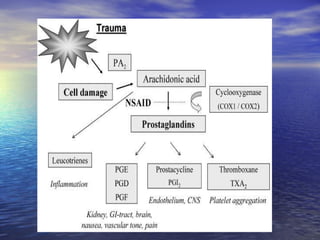
How Pain Occurs
Tissue damage

prostaglandins,

releases bradykinin and
which activate or sensitize

nociceptors.
Activation of nociceptors
leads to the release of
substance P and calcitonin gene related peptide
(CGRP).
Substance P
acts on mast cells in the vicinity of
sensory endings and release of histamine, which
directly excites nociceptors.
Substance P and CGRP produces dilation of
peripheral blood vessels. The resultant edema causes
additional liberation of bradykinin.
Thus Nociceptors activate and cause pain.
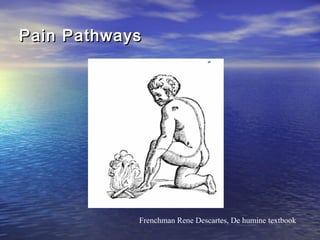
Pain Pathways

Frenchman Rene Descartes, De humine textbook
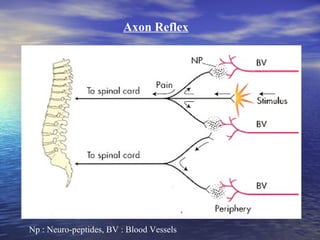
Axon Reflex

Np : Neuro-peptides, BV : Blood Vessels
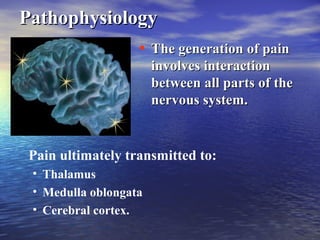
Pathophysiology
• The generation of pain
involves interaction
between all parts of the
nervous system.

Pain ultimately transmitted to:
• Thalamus
• Medulla oblongata
• Cerebral cortex.
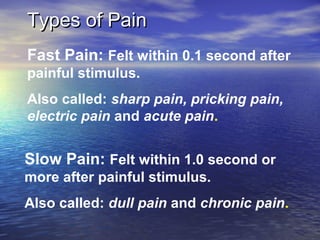
Types of Pain
Fast Pain: Felt within 0.1 second after
painful stimulus.
Also called: sharp pain, pricking pain,
electric pain and acute pain.

Slow Pain: Felt within 1.0 second or
more after painful stimulus.
Also called: dull pain and chronic pain.
Types of Pain
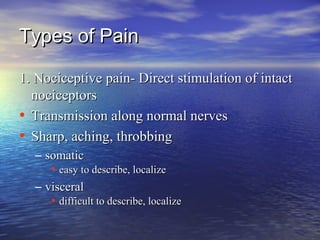
1. Nociceptive pain- Direct stimulation of intact
nociceptors
• Transmission along normal nerves
• Sharp, aching, throbbing
– somatic
• easy to describe, localize
– visceral
• difficult to describe, localize
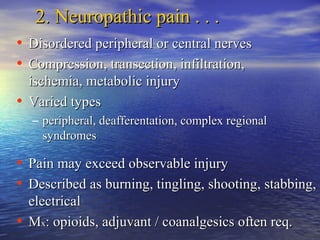
2. Neuropathic pain . . .
• Disordered peripheral or central nerves
• Compression, transection, infiltration,
ischemia, metabolic injury
• Varied types
– peripheral, deafferentation, complex regional
syndromes
• Pain may exceed observable injury
• Described as burning, tingling, shooting, stabbing,
electrical
• Mx: opioids, adjuvant / coanalgesics often req.
Assessment of Pain

How do
You
Quantify
pain?
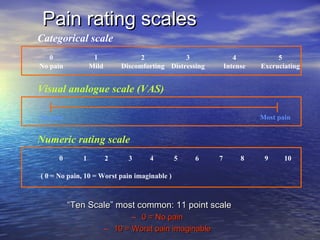
Pain rating scales
Categorical scale
1
Mild

0
No pain

2
3
Discomforting Distressing

4
Intense

5
Excruciating

Visual analogue scale (VAS)
No pain

Most pain

Numeric rating scale
0

1

2

3

4

5

6

7

( 0 = No pain, 10 = Worst pain imaginable )

“Ten Scale” most common: 11 point scale
– 0 = No pain
– 10 = Worst pain imaginable

8

9

10
•PAIN

MANAGEMENT
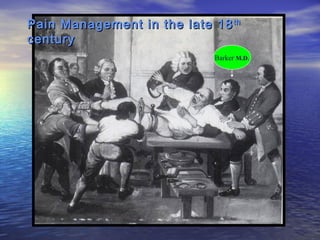
Pain Management in the late 18 th
century
Barker M.D.
Pain Management
Different Pain management
Modalities

Pre-emptive Analgesia

•
•
•
•
•

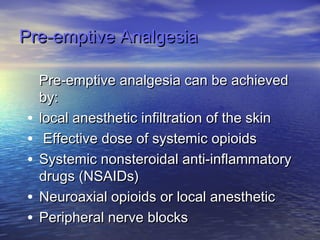
Pre-emptive analgesia can be achieved
by:
local anesthetic infiltration of the skin
Effective dose of systemic opioids
Systemic nonsteroidal anti-inflammatory
drugs (NSAIDs)
Neuroaxial opioids or local anesthetic
Peripheral nerve blocks
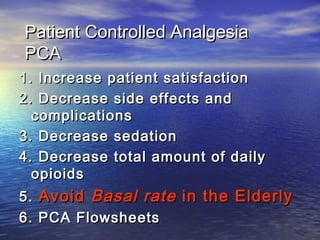
Patient Controlled Analgesia
PCA
1. Increase patient satisfaction
2. Decrease side effects and
complications
3. Decrease sedation
4. Decrease total amount of daily
opioids
5. Avoid Basal rate in the Elderly
6. PCA Flowsheets
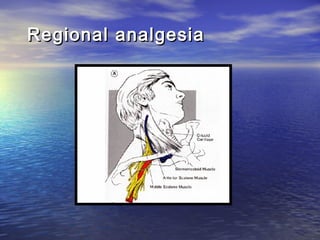
Regional analgesia
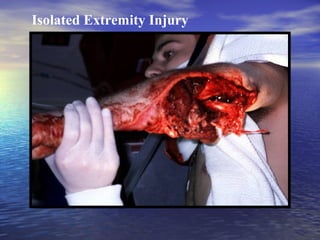
Isolated Extremity Injury
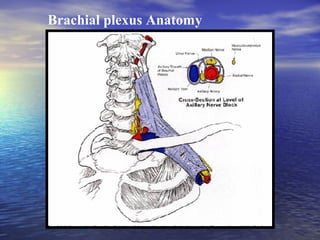
Brachial plexus Anatomy
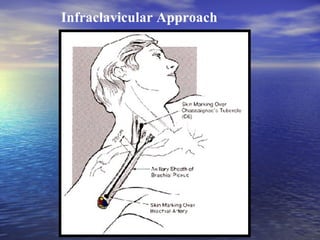
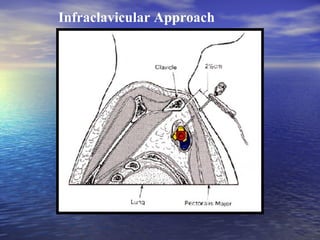
Infraclavicular Approach
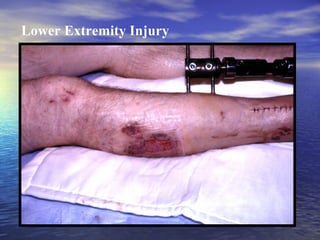
Lower Extremity Injury
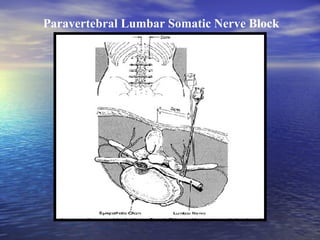
Paravertebral Lumbar Somatic Nerve Block
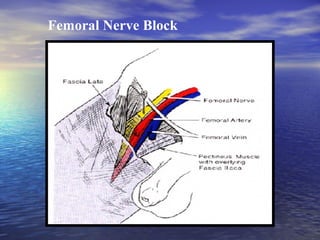
Femoral Nerve Block
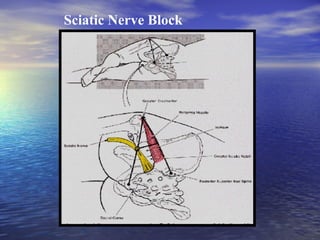
Sciatic Nerve Block
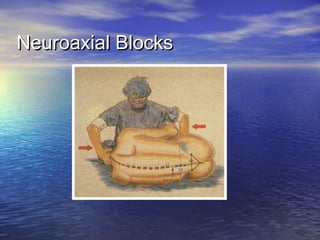
Neuroaxial Blocks
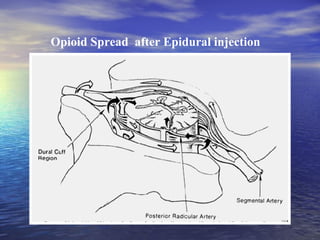
Opioid Spread after Epidural injection
Adjuvant Therapy
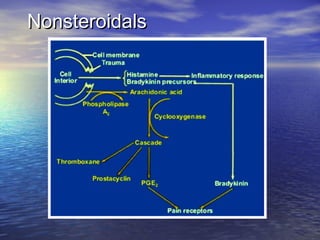
Nonsteroidals
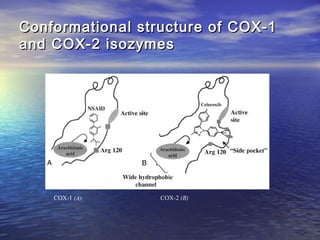
Conformational structure of COX-1
and COX-2 isozymes

COX-1 (A)

COX-2 (B)
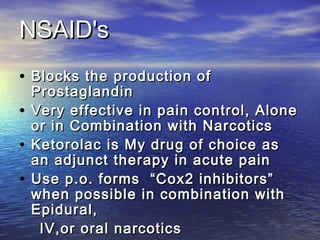
NSAID's
• Blocks the production of

Prostaglandin
• Very effective in pain control, Alone
or in Combination with Narcotics
• Ketorolac is My drug of choice as
an adjunct therapy in acute pain
• Use p.o. forms “Cox2 inhibitors”
when possible in combination with
Epidural,
IV,or oral narcotics
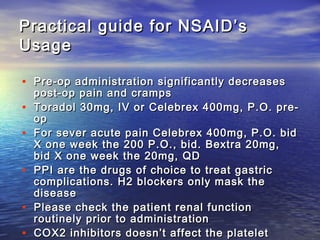
Practical guide for NSAID’s
Usage
• Pre-op administration significantly decreases
•
•
•
•
•

post-op pain and cramps
Toradol 30mg, IV or Celebrex 400mg, P.O. preop
For sever acute pain Celebrex 400mg, P.O. bid
X one week the 200 P.O., bid. Bextra 20mg,
bid X one week the 20mg, QD
PPI are the drugs of choice to treat gastric
complications. H2 blockers only mask the
disease
Please check the patient renal function
routinely prior to administration
COX2 inhibitors doesn’t affect the platelet
Practical guide for NSAID’s
Usage
(Continuum)
All specific or non-specific NSAID’s may
cause:
• water retention and edema
• Hypertension
• Renal dysfunction
• May delay bony fusion in chronic usage ?
Clonidine
• Alpha2 agonist with outstanding
•
•
•
•
•

properties when administered
intrathecally:
Pain control properties by itself
Decrease the requirement of narcotics
Decrease tolerance
Great for neuropathic pain control
Adding 1mcg/kg for children caudal
block will extend pain relief up to 24h
Clonidine
Oral or transdermal Clonidine:
 Enhance the effect of narcotics
 Decreases the daily narcotic requirement
 Excellent Adjuvant therapy for narcotic
dependent patients
 Effective for neuropathic pain
Coanalgesic Agents
•
•
•
•

Anxiolytic drugs
Anticonvulsants
Antidepressants
Ketamine
Ketamine

• NMDA receptors antagonist →

Neuropathic pain
• Potent analgesic effect
• Small doses in combination of opioids
substantially improve pain control
• Bolus dose of 100 mcg/kg followed by a
continuous drip of 1-3 mcg/kg/min is ideal
for chronic opioid users postoperatively
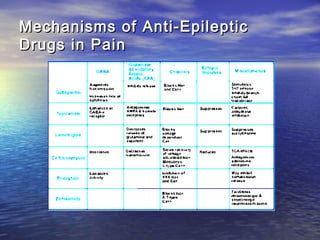
Mechanisms of Anti-Epileptic
Drugs in Pain
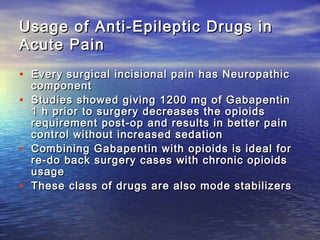
Usage of Anti-Epileptic Drugs in
Acute Pain
• Every surgical incisional pain has Neuropathic
•
•
•

component
Studies showed giving 1200 mg of Gabapentin
1 h prior to surgery decreases the opioids
requirement post-op and results in better pain
control without increased sedation
Combining Gabapentin with opioids is ideal for
re-do back surgery cases with chronic opioids
usage
These class of drugs are also mode stabilizers
Non Chemical Techniques
• Psychological treatments:

Relaxation, hypnosis Cognitive
therapy etc..
• TENS Units
• Physiotherapy
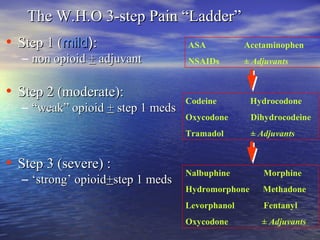
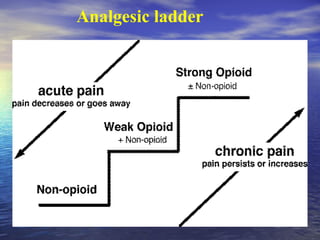
The W.H.O 3-step Pain “Ladder”

• Step 1 (mild):

– non opioid + adjuvant

• Step 2 (moderate):

ASA

Acetaminophen

NSAIDs

± Adjuvants

• Step 3 (severe) :

– ‘strong’ opioid+step 1 meds

Hydrocodone

Oxycodone

Dihydrocodeine

Tramadol

– “weak” opioid + step 1 meds

Codeine

± Adjuvants

Nalbuphine

Morphine

Hydromorphone

Methadone

Levorphanol

Fentanyl

Oxycodone

± Adjuvants
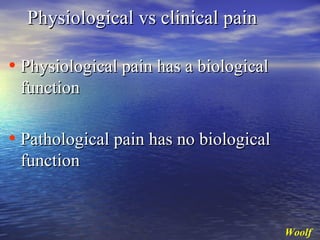
Physiological vs clinical pain

• Physiological pain has a biological
function

• Pathological pain has no biological
function

Woolf
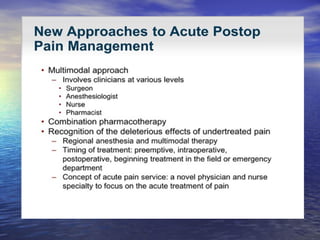
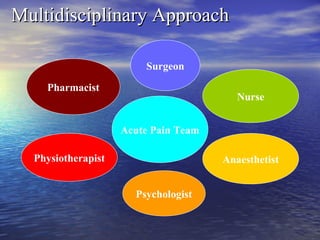
Multidisciplinary Approach
Surgeon
Pharmacist

Nurse
Acute Pain Team

Physiotherapist

Anaesthetist
Psychologist
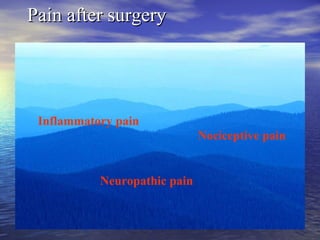
Pain after surgery

Inflammatory pain

•
•
•

Inflammatory pain
Nociceptive painpain
Nociceptive
Neuropathic pain

Neuropathic pain
Chronic post surgical pain
•
•
•

Pain developed after a surgical procedure
At least 2 month duration
Other causes excluded (malignancy, chronic
infection)
• Possibility of continuous pain of pre-existing
problem

Macrae 2001
Principles of analgesic Plan
•
•
•
•
•

Balanced analgesia
Opioids: First line morphine
Regional analgesia
Actual dose of analgesics will not be discussed
Regular and breakthrough prescription including
night-time
Analgesic ladder
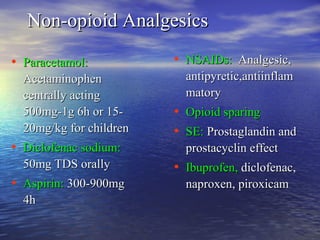
Non-opioid Analgesics
• Paracetamol:
Acetaminophen
centrally acting
500mg-1g 6h or 1520mg/kg for children

• Diclofenac sodium:
50mg TDS orally

• Aspirin: 300-900mg
4h

• NSAIDs: Analgesic,
antipyretic,antiinflam
matory

• Opioid sparing
• SE: Prostaglandin and
prostacyclin effect

• Ibuprofen, diclofenac,
naproxen, piroxicam
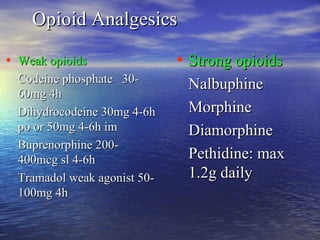
Opioid Analgesics
• Weak opioids
Codeine phosphate 3060mg 4h
Dihydrocodeine 30mg 4-6h
po or 50mg 4-6h im
Buprenorphine 200400mcg sl 4-6h
Tramadol weak agonist 50100mg 4h

• Strong opioids
Nalbuphine
Morphine
Diamorphine
Pethidine: max
1.2g daily
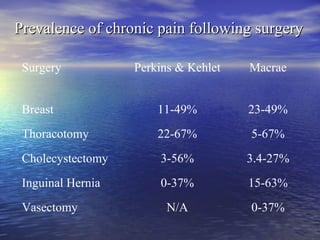
Prevalence of chronic pain following surgery
Surgery

Perkins & Kehlet

Macrae

Breast

11-49%

23-49%

Thoracotomy

22-67%

5-67%

Cholecystectomy

3-56%

3.4-27%

Inguinal Hernia

0-37%

15-63%

N/A

0-37%

Vasectomy
Neuropathic pain can become
established extremely quickly after
trauma and surgery and remain
unchanged after 6 months
Post operative pain management

Post operative pain management

  • 1.
    Postoperative Pain Management Dr. HridayRanjan Roy Assistant Professor, Surgery, Rangpur Medical College, Rangpur, Bangladesh
  • 2.
  • 3.
    Pain is aSensory and Emotional experience associated with tissue damage or described in terms of such damage (I.A.S.P) (The International Association for the Study of Pain)
  • 6.
    Pain is Always Subjective and Can Neverbe Proved or TOTAL RECALL
  • 7.
    The Pain Pathwaysand Mechanisms
  • 8.
    How Pain Occurs Tissuedamage prostaglandins, releases bradykinin and which activate or sensitize nociceptors. Activation of nociceptors leads to the release of substance P and calcitonin gene related peptide (CGRP). Substance P acts on mast cells in the vicinity of sensory endings and release of histamine, which directly excites nociceptors. Substance P and CGRP produces dilation of peripheral blood vessels. The resultant edema causes additional liberation of bradykinin. Thus Nociceptors activate and cause pain.
  • 9.
    Pain Pathways Frenchman ReneDescartes, De humine textbook
  • 11.
    Axon Reflex Np :Neuro-peptides, BV : Blood Vessels
  • 12.
    Pathophysiology • The generationof pain involves interaction between all parts of the nervous system. Pain ultimately transmitted to: • Thalamus • Medulla oblongata • Cerebral cortex.
  • 13.
    Types of Pain FastPain: Felt within 0.1 second after painful stimulus. Also called: sharp pain, pricking pain, electric pain and acute pain. Slow Pain: Felt within 1.0 second or more after painful stimulus. Also called: dull pain and chronic pain.
  • 14.
    Types of Pain 1.Nociceptive pain- Direct stimulation of intact nociceptors • Transmission along normal nerves • Sharp, aching, throbbing – somatic • easy to describe, localize – visceral • difficult to describe, localize
  • 15.
    2. Neuropathic pain. . . • Disordered peripheral or central nerves • Compression, transection, infiltration, ischemia, metabolic injury • Varied types – peripheral, deafferentation, complex regional syndromes • Pain may exceed observable injury • Described as burning, tingling, shooting, stabbing, electrical • Mx: opioids, adjuvant / coanalgesics often req.
  • 16.
    Assessment of Pain Howdo You Quantify pain?
  • 17.
    Pain rating scales Categoricalscale 1 Mild 0 No pain 2 3 Discomforting Distressing 4 Intense 5 Excruciating Visual analogue scale (VAS) No pain Most pain Numeric rating scale 0 1 2 3 4 5 6 7 ( 0 = No pain, 10 = Worst pain imaginable ) “Ten Scale” most common: 11 point scale – 0 = No pain – 10 = Worst pain imaginable 8 9 10
  • 18.
  • 19.
    Pain Management inthe late 18 th century Barker M.D.
  • 20.
  • 24.
  • 25.
    Pre-emptive Analgesia • • • • • Pre-emptive analgesiacan be achieved by: local anesthetic infiltration of the skin Effective dose of systemic opioids Systemic nonsteroidal anti-inflammatory drugs (NSAIDs) Neuroaxial opioids or local anesthetic Peripheral nerve blocks
  • 26.
    Patient Controlled Analgesia PCA 1.Increase patient satisfaction 2. Decrease side effects and complications 3. Decrease sedation 4. Decrease total amount of daily opioids 5. Avoid Basal rate in the Elderly 6. PCA Flowsheets
  • 27.
  • 28.
  • 29.
  • 30.
  • 31.
  • 32.
  • 33.
  • 34.
  • 35.
  • 36.
  • 37.
    Opioid Spread afterEpidural injection
  • 38.
  • 39.
  • 40.
    Conformational structure ofCOX-1 and COX-2 isozymes COX-1 (A) COX-2 (B)
  • 41.
    NSAID's • Blocks theproduction of Prostaglandin • Very effective in pain control, Alone or in Combination with Narcotics • Ketorolac is My drug of choice as an adjunct therapy in acute pain • Use p.o. forms “Cox2 inhibitors” when possible in combination with Epidural, IV,or oral narcotics
  • 42.
    Practical guide forNSAID’s Usage • Pre-op administration significantly decreases • • • • • post-op pain and cramps Toradol 30mg, IV or Celebrex 400mg, P.O. preop For sever acute pain Celebrex 400mg, P.O. bid X one week the 200 P.O., bid. Bextra 20mg, bid X one week the 20mg, QD PPI are the drugs of choice to treat gastric complications. H2 blockers only mask the disease Please check the patient renal function routinely prior to administration COX2 inhibitors doesn’t affect the platelet
  • 43.
    Practical guide forNSAID’s Usage (Continuum) All specific or non-specific NSAID’s may cause: • water retention and edema • Hypertension • Renal dysfunction • May delay bony fusion in chronic usage ?
  • 44.
    Clonidine • Alpha2 agonistwith outstanding • • • • • properties when administered intrathecally: Pain control properties by itself Decrease the requirement of narcotics Decrease tolerance Great for neuropathic pain control Adding 1mcg/kg for children caudal block will extend pain relief up to 24h
  • 45.
    Clonidine Oral or transdermalClonidine:  Enhance the effect of narcotics  Decreases the daily narcotic requirement  Excellent Adjuvant therapy for narcotic dependent patients  Effective for neuropathic pain
  • 46.
  • 47.
    Ketamine • NMDA receptorsantagonist → Neuropathic pain • Potent analgesic effect • Small doses in combination of opioids substantially improve pain control • Bolus dose of 100 mcg/kg followed by a continuous drip of 1-3 mcg/kg/min is ideal for chronic opioid users postoperatively
  • 48.
  • 49.
    Usage of Anti-EpilepticDrugs in Acute Pain • Every surgical incisional pain has Neuropathic • • • component Studies showed giving 1200 mg of Gabapentin 1 h prior to surgery decreases the opioids requirement post-op and results in better pain control without increased sedation Combining Gabapentin with opioids is ideal for re-do back surgery cases with chronic opioids usage These class of drugs are also mode stabilizers
  • 50.
    Non Chemical Techniques •Psychological treatments: Relaxation, hypnosis Cognitive therapy etc.. • TENS Units • Physiotherapy
  • 51.
    The W.H.O 3-stepPain “Ladder” • Step 1 (mild): – non opioid + adjuvant • Step 2 (moderate): ASA Acetaminophen NSAIDs ± Adjuvants • Step 3 (severe) : – ‘strong’ opioid+step 1 meds Hydrocodone Oxycodone Dihydrocodeine Tramadol – “weak” opioid + step 1 meds Codeine ± Adjuvants Nalbuphine Morphine Hydromorphone Methadone Levorphanol Fentanyl Oxycodone ± Adjuvants
  • 52.
    Physiological vs clinicalpain • Physiological pain has a biological function • Pathological pain has no biological function Woolf
  • 53.
    Multidisciplinary Approach Surgeon Pharmacist Nurse Acute PainTeam Physiotherapist Anaesthetist Psychologist
  • 54.
    Pain after surgery Inflammatorypain • • • Inflammatory pain Nociceptive painpain Nociceptive Neuropathic pain Neuropathic pain
  • 55.
    Chronic post surgicalpain • • • Pain developed after a surgical procedure At least 2 month duration Other causes excluded (malignancy, chronic infection) • Possibility of continuous pain of pre-existing problem Macrae 2001
  • 56.
    Principles of analgesicPlan • • • • • Balanced analgesia Opioids: First line morphine Regional analgesia Actual dose of analgesics will not be discussed Regular and breakthrough prescription including night-time
  • 57.
  • 58.
    Non-opioid Analgesics • Paracetamol: Acetaminophen centrallyacting 500mg-1g 6h or 1520mg/kg for children • Diclofenac sodium: 50mg TDS orally • Aspirin: 300-900mg 4h • NSAIDs: Analgesic, antipyretic,antiinflam matory • Opioid sparing • SE: Prostaglandin and prostacyclin effect • Ibuprofen, diclofenac, naproxen, piroxicam
  • 59.
    Opioid Analgesics • Weakopioids Codeine phosphate 3060mg 4h Dihydrocodeine 30mg 4-6h po or 50mg 4-6h im Buprenorphine 200400mcg sl 4-6h Tramadol weak agonist 50100mg 4h • Strong opioids Nalbuphine Morphine Diamorphine Pethidine: max 1.2g daily
  • 60.
    Prevalence of chronicpain following surgery Surgery Perkins & Kehlet Macrae Breast 11-49% 23-49% Thoracotomy 22-67% 5-67% Cholecystectomy 3-56% 3.4-27% Inguinal Hernia 0-37% 15-63% N/A 0-37% Vasectomy
  • 61.
    Neuropathic pain canbecome established extremely quickly after trauma and surgery and remain unchanged after 6 months