“My Crook Back”
Dr Adrian Nowitzke
Acknowledgement: Dr Paul Licina as creator of original slides
Graphic from www.hibiscusflowershop.blogspot.com
Today is not about:
the statistics of back pain
the “blah blah blah” of back pain
management of “garden variety” conditions
being “talked at”
The purpose of today:
To dissect the pot-pourri of back pain by
exploring the evidence, techniques and strategies
of
examination
investigation
non-operative treatment
operative treatment
To provide practical tips and tricks to managing this
group of patients
CHRONIC
SPECIFIC
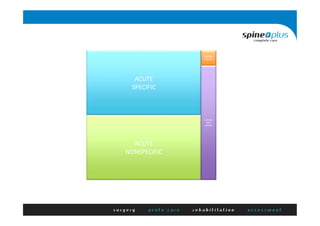
ACUTE
SPECIFIC
CHRONIC
NON
SPECIFIC
ACUTE
NONSPECIFIC
CHRONIC
SPECIFIC
ACUTE
SPECIFIC
CHRONIC
NON
SPECIFIC
ACUTE
NONSPECIFIC
Resolves < 3 months
Surgery rarely indicated w/o neurological change
CHRONIC
SPECIFIC
ACUTE
SPECIFIC
CHRONIC
NON
SPECIFICACUTE
NONSPECIFIC
Surgery
has a
role
Chronic
Non-specific
Low Back
Pain
CHRONIC
SPECIFIC
ACUTE
SPECIFIC
CHRONIC
NON
SPECIFIC
ACUTE
NONSPECIFIC
95%
Most patients do not need surgery
Most patients do not need radiology
Most patients need multidisciplinary care
It is key that we diagnose “chronicity” and actively manage it
http://www.biomedcentral.com/1471-2474/9/11
Chronic non-specific low back pain
sub-groups or a single mechanism?
Benedict M Wand and Neil E O'Connell
CNSLBP patients have back pain
yet no conservative or surgical
pain relieving measures directed
at the back appear effective.
• exercise programme
• manipulation
• massage
• acupuncture
• cognitive therapy
• functional restoration
• steroid injection
• radiofrequency neurotomy
• spinal fusion
similar effects
variable and modest improvement
not sustained over time
They display a number of biomechanical
abnormalities, however treatment directed at
normalising lumbar biomechanics has little
effect and there is no relationship between
changes in outcome and changes in spinal
mechanics.
• exercise is beneficial
• no evidence that one type better than
another
• general physical activity may be better than
specific exercises
They demonstrate some psychological
problems but psychologically based treatments
offer only partial solution to the problem.
• high levels of distress
• presence of depression
• fear-avoidance behaviour
A possible explanation for these findings is that
they are epiphenomena, features that are
incidental to a problem of neurological
reorganisation and degeneration.
• is it in the brain vs the back?
• much evidence to suggest changes in brain
structure and function
• reorganisation of the brain may lead to
sensitisation of nociceptive pathways,
central pain memories, sensory-motor
conflict
• may lead to changes in back biomechanics
• may alter cortical representation of back
and lead to fear-avoidance behaviour
• thus biomechanical and psychological
changes may be the compensatory rather
than causative
Tools you may find helpful
FACTOR GOOD BAD
pain intensity low high
symptom duration short long
disability mild-moderate severe-crippling
distress low high
depression/anxiety absent present
fear-avoidance absent present
well being high low
opiates no yes
compensation absent present
litigation absent present
abn.illness.behavior absent present
degenerate levels single multiple
Oswestry Disability Index
0% to 20%: minimal disability: The patient can cope
with most living activities.
21%-40%: moderate disability: The patient
experiences more pain and difficulty with sitting
lifting and standing. Travel and social life are more
difficult and they may be disabled from work.
Personal care sexual activity and sleeping are not
grossly affected.
41%-60%: severe disability: Pain remains the main
problem in this group but activities of daily living are
affected.
61%-80%: crippled: Back pain impinges on all
aspects of the patient's life.
81%-100%: These patients are either bed-bound or
exaggerating their symptoms.
Waddell’s nonorganic signs
Tenderness: Superficial (lumbar skin tender
to light touch) and nonanatomical (deep
tenderness over a wide area that crosses
musculoskeletal boundaries)
Simulation: Axial loading (light downward
pressure on the head causes pain) and
simulated rotation (back pain on
pseudorotation ie. rotation of pelvis and
spine together)
Distraction: Supine vs seated SLR (significant
difference betweeen straight leg raising
when lying down compared with when
sitting up)
Regional changes: Weakness (cog-wheel
type weakness with giving way of several
muscle groups) and sensory change
(widespread nonanatomical alteration of
light touch sensation)
Three take home strategies
Understand and explain the cause
80% of people get back pain.
90% improve within 3 months.
For those who do not improve (CNSLBP)
Most people have nothing serious wrong.
Multiple investigations and treatments are unhelpful.
There is likely to be a central cause that is not well understood.
Provide evidence-based treatment advice
Drug treatment does not cure back pain.
Opioids only partially relieve the pain and must be used
carefully.
Massage and manipulation can help relieve pain.
Exercises can be beneficial.
Multidisciplinary therapy can help improve function, but will
not completely cure pain.
Surgery can help some patients to various degrees, but most
people are not suitable candidates.
Avoid making things worse
Recognise those at risk of chronicity.
Minimise the use of opiates.
Discourage prolonged passive treatments.
Ensure imaging done with contextual interpretation.
Refer judiciously to exclude treatable cause.
Facilitate return to activity and work.
Try to help in the compensation process.
Do not encourage litigation.

My crook back

  • 1.
    “My Crook Back” DrAdrian Nowitzke Acknowledgement: Dr Paul Licina as creator of original slides
  • 2.
  • 3.
    Today is notabout: the statistics of back pain the “blah blah blah” of back pain management of “garden variety” conditions being “talked at”
  • 4.
    The purpose oftoday: To dissect the pot-pourri of back pain by exploring the evidence, techniques and strategies of examination investigation non-operative treatment operative treatment To provide practical tips and tricks to managing this group of patients
  • 5.
  • 6.
    CHRONIC SPECIFIC ACUTE SPECIFIC CHRONIC NON SPECIFIC ACUTE NONSPECIFIC Resolves < 3months Surgery rarely indicated w/o neurological change
  • 7.
  • 8.
    CHRONIC SPECIFIC ACUTE SPECIFIC CHRONIC NON SPECIFIC ACUTE NONSPECIFIC 95% Most patients donot need surgery Most patients do not need radiology Most patients need multidisciplinary care It is key that we diagnose “chronicity” and actively manage it
  • 9.
    http://www.biomedcentral.com/1471-2474/9/11 Chronic non-specific lowback pain sub-groups or a single mechanism? Benedict M Wand and Neil E O'Connell
  • 10.
    CNSLBP patients haveback pain yet no conservative or surgical pain relieving measures directed at the back appear effective. • exercise programme • manipulation • massage • acupuncture • cognitive therapy • functional restoration • steroid injection • radiofrequency neurotomy • spinal fusion similar effects variable and modest improvement not sustained over time
  • 11.
    They display anumber of biomechanical abnormalities, however treatment directed at normalising lumbar biomechanics has little effect and there is no relationship between changes in outcome and changes in spinal mechanics. • exercise is beneficial • no evidence that one type better than another • general physical activity may be better than specific exercises
  • 12.
    They demonstrate somepsychological problems but psychologically based treatments offer only partial solution to the problem. • high levels of distress • presence of depression • fear-avoidance behaviour
  • 13.
    A possible explanationfor these findings is that they are epiphenomena, features that are incidental to a problem of neurological reorganisation and degeneration. • is it in the brain vs the back? • much evidence to suggest changes in brain structure and function • reorganisation of the brain may lead to sensitisation of nociceptive pathways, central pain memories, sensory-motor conflict • may lead to changes in back biomechanics • may alter cortical representation of back and lead to fear-avoidance behaviour • thus biomechanical and psychological changes may be the compensatory rather than causative
  • 14.
    Tools you mayfind helpful
  • 15.
    FACTOR GOOD BAD painintensity low high symptom duration short long disability mild-moderate severe-crippling distress low high depression/anxiety absent present fear-avoidance absent present well being high low opiates no yes compensation absent present litigation absent present abn.illness.behavior absent present degenerate levels single multiple
  • 16.
    Oswestry Disability Index 0%to 20%: minimal disability: The patient can cope with most living activities. 21%-40%: moderate disability: The patient experiences more pain and difficulty with sitting lifting and standing. Travel and social life are more difficult and they may be disabled from work. Personal care sexual activity and sleeping are not grossly affected. 41%-60%: severe disability: Pain remains the main problem in this group but activities of daily living are affected. 61%-80%: crippled: Back pain impinges on all aspects of the patient's life. 81%-100%: These patients are either bed-bound or exaggerating their symptoms.
  • 18.
    Waddell’s nonorganic signs Tenderness:Superficial (lumbar skin tender to light touch) and nonanatomical (deep tenderness over a wide area that crosses musculoskeletal boundaries) Simulation: Axial loading (light downward pressure on the head causes pain) and simulated rotation (back pain on pseudorotation ie. rotation of pelvis and spine together) Distraction: Supine vs seated SLR (significant difference betweeen straight leg raising when lying down compared with when sitting up) Regional changes: Weakness (cog-wheel type weakness with giving way of several muscle groups) and sensory change (widespread nonanatomical alteration of light touch sensation)
  • 19.
    Three take homestrategies
  • 20.
    Understand and explainthe cause 80% of people get back pain. 90% improve within 3 months. For those who do not improve (CNSLBP) Most people have nothing serious wrong. Multiple investigations and treatments are unhelpful. There is likely to be a central cause that is not well understood.
  • 21.
    Provide evidence-based treatmentadvice Drug treatment does not cure back pain. Opioids only partially relieve the pain and must be used carefully. Massage and manipulation can help relieve pain. Exercises can be beneficial. Multidisciplinary therapy can help improve function, but will not completely cure pain. Surgery can help some patients to various degrees, but most people are not suitable candidates.
  • 22.
    Avoid making thingsworse Recognise those at risk of chronicity. Minimise the use of opiates. Discourage prolonged passive treatments. Ensure imaging done with contextual interpretation. Refer judiciously to exclude treatable cause. Facilitate return to activity and work. Try to help in the compensation process. Do not encourage litigation.