Interventional
Procedures in Chronic
Pain
Dr Brendan Moore
Specialist Pain Medicine Physician
Adjunct Associate Professor
University of Queensland
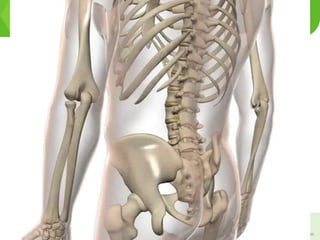
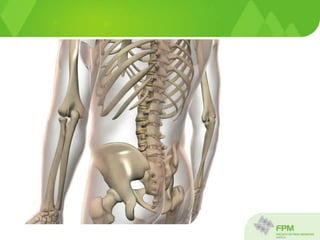
Degenerative Lumbar Back Pain
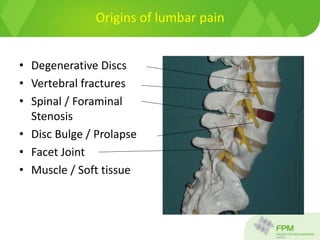
Origins of lumbar pain
• Degenerative Discs
• Vertebral fractures
• Spinal / Foraminal
Stenosis
• Disc Bulge / Prolapse
• Facet Joint
• Muscle / Soft tissue
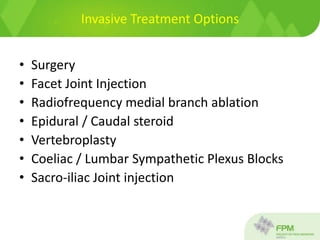
Invasive Treatment Options
• Surgery
• Facet Joint Injection
• Radiofrequency medial branch ablation
• Epidural / Caudal steroid
• Vertebroplasty
• Coeliac / Lumbar Sympathetic Plexus Blocks
• Sacro-iliac Joint injection
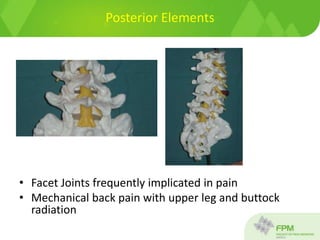
Posterior Elements
• Facet Joints frequently implicated in pain
• Mechanical back pain with upper leg and buttock
radiation
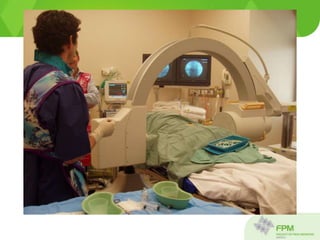
Procedures
• Epidural injections
– Cervical, Thoracic, Lumbar, Caudal
• Facet joint injections
• Sacroiliac joint injections
• Medial branch blocks
• Radiofrequency nerve ablation
Epidural injections
• Most effective in the presence of nerve root
compression and spinal stenosis
• Increased efficacy if given in the first weeks of
the onset of pain
• Effects of the injection tend to be temporary (1
week to 1 year)
• Can be beneficial in providing relief for patients
during an episode of severe back pain
• Allows patients to progress in their rehabilitation
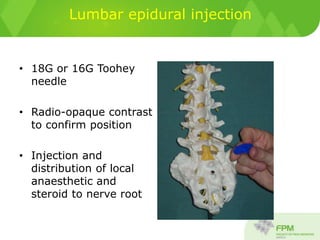
Lumbar epidural injection
• 18G or 16G Toohey
needle
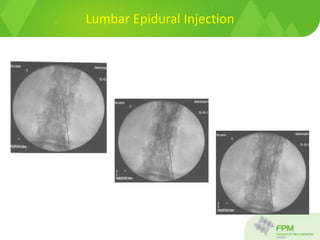
• Radio-opaque contrast
to confirm position
• Injection and
distribution of local
anaesthetic and
steroid to nerve root
Lumbar Epidural Injection
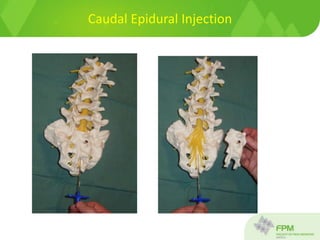
Caudal Epidural Injection
Facet joint injections
• Back pain originating from facet joints
• Low back pain (unilateral or bilateral) and no
root tension signs or neurological deficits
• Pain usually being aggravated by extension of
the spine
• Facet joint injection may reduce inflammation
and provide pain relief
• Therapeutic goal and potential benefit
– Temporary relief from pain
– Patient may proceed into an appropriate exercise program
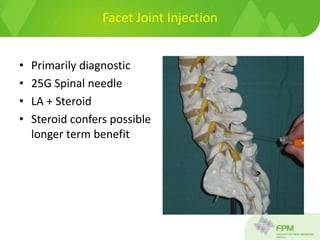
Facet Joint Injection
• Primarily diagnostic
• 25G Spinal needle
• LA + Steroid
• Steroid confers possible
longer term benefit
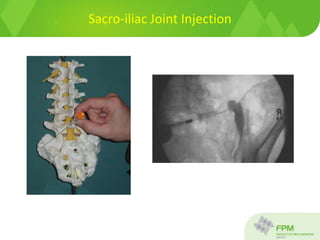
Sacro-iliac Joint Injection
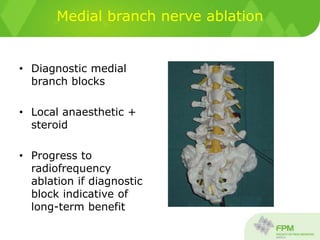
Medial branch nerve ablation
• Diagnostic medial
branch blocks
• Local anaesthetic +
steroid
• Progress to
radiofrequency
ablation if diagnostic
block indicative of
long-term benefit
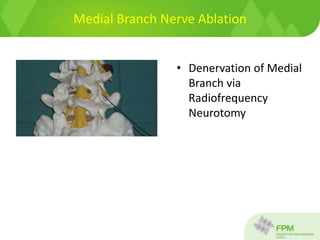
Medial Branch Nerve Ablation
• Denervation of Medial
Branch via
Radiofrequency
Neurotomy
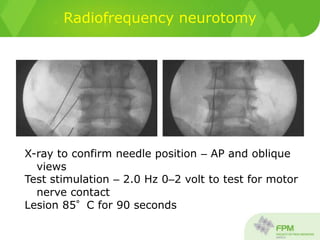
Radiofrequency neurotomy
X-ray to confirm needle position – AP and oblique
views
Test stimulation – 2.0 Hz 0–2 volt to test for motor
nerve contact
Lesion 85°C for 90 seconds
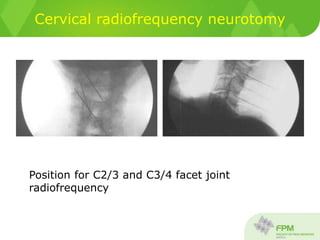
Cervical radiofrequency neurotomy
Position for C2/3 and C3/4 facet joint
radiofrequency
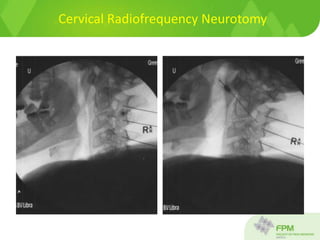
Cervical Radiofrequency Neurotomy
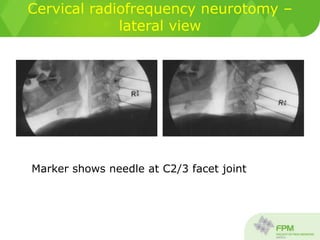
Cervical radiofrequency neurotomy –
lateral view
Marker shows needle at C2/3 facet joint
Opioid prescribing:
dose limits and
considerations
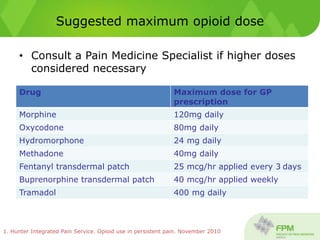
Suggested maximum opioid dose
• Consult a Pain Medicine Specialist if higher doses
considered necessary
1. Hunter Integrated Pain Service. Opioid use in persistent pain. November 2010
Drug Maximum dose for GP
prescription
Morphine 120mg daily
Oxycodone 80mg daily
Hydromorphone 24 mg daily
Methadone 40mg daily
Fentanyl transdermal patch 25 mcg/hr applied every 3 days
Buprenorphine transdermal patch 40 mcg/hr applied weekly
Tramadol 400 mg daily
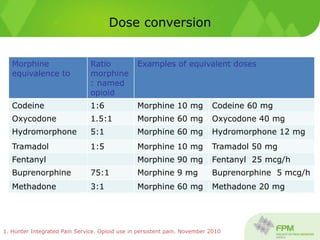
Dose conversion
Morphine
equivalence to
Ratio
morphine
: named
opioid
Examples of equivalent doses
Codeine 1:6 Morphine 10 mg Codeine 60 mg
Oxycodone 1.5:1 Morphine 60 mg Oxycodone 40 mg
Hydromorphone 5:1 Morphine 60 mg Hydromorphone 12 mg
Tramadol 1:5 Morphine 10 mg Tramadol 50 mg
Fentanyl Morphine 90 mg Fentanyl 25 mcg/h
Buprenorphine 75:1 Morphine 9 mg Buprenorphine 5 mcg/h
Methadone 3:1 Morphine 60 mg Methadone 20 mg
1. Hunter Integrated Pain Service. Opioid use in persistent pain. November 2010
FPM Opioid Calculator App
Free download

Pain management

  • 1.
    Interventional Procedures in Chronic Pain DrBrendan Moore Specialist Pain Medicine Physician Adjunct Associate Professor University of Queensland
  • 2.
  • 4.
    Origins of lumbarpain • Degenerative Discs • Vertebral fractures • Spinal / Foraminal Stenosis • Disc Bulge / Prolapse • Facet Joint • Muscle / Soft tissue
  • 5.
    Invasive Treatment Options •Surgery • Facet Joint Injection • Radiofrequency medial branch ablation • Epidural / Caudal steroid • Vertebroplasty • Coeliac / Lumbar Sympathetic Plexus Blocks • Sacro-iliac Joint injection
  • 6.
    Posterior Elements • FacetJoints frequently implicated in pain • Mechanical back pain with upper leg and buttock radiation
  • 8.
    Procedures • Epidural injections –Cervical, Thoracic, Lumbar, Caudal • Facet joint injections • Sacroiliac joint injections • Medial branch blocks • Radiofrequency nerve ablation
  • 9.
    Epidural injections • Mosteffective in the presence of nerve root compression and spinal stenosis • Increased efficacy if given in the first weeks of the onset of pain • Effects of the injection tend to be temporary (1 week to 1 year) • Can be beneficial in providing relief for patients during an episode of severe back pain • Allows patients to progress in their rehabilitation
  • 10.
    Lumbar epidural injection •18G or 16G Toohey needle • Radio-opaque contrast to confirm position • Injection and distribution of local anaesthetic and steroid to nerve root
  • 11.
  • 12.
  • 13.
    Facet joint injections •Back pain originating from facet joints • Low back pain (unilateral or bilateral) and no root tension signs or neurological deficits • Pain usually being aggravated by extension of the spine • Facet joint injection may reduce inflammation and provide pain relief • Therapeutic goal and potential benefit – Temporary relief from pain – Patient may proceed into an appropriate exercise program
  • 14.
    Facet Joint Injection •Primarily diagnostic • 25G Spinal needle • LA + Steroid • Steroid confers possible longer term benefit
  • 15.
  • 16.
    Medial branch nerveablation • Diagnostic medial branch blocks • Local anaesthetic + steroid • Progress to radiofrequency ablation if diagnostic block indicative of long-term benefit
  • 17.
    Medial Branch NerveAblation • Denervation of Medial Branch via Radiofrequency Neurotomy
  • 18.
    Radiofrequency neurotomy X-ray toconfirm needle position – AP and oblique views Test stimulation – 2.0 Hz 0–2 volt to test for motor nerve contact Lesion 85°C for 90 seconds
  • 19.
    Cervical radiofrequency neurotomy Positionfor C2/3 and C3/4 facet joint radiofrequency
  • 20.
  • 21.
    Cervical radiofrequency neurotomy– lateral view Marker shows needle at C2/3 facet joint
  • 24.
  • 25.
    Suggested maximum opioiddose • Consult a Pain Medicine Specialist if higher doses considered necessary 1. Hunter Integrated Pain Service. Opioid use in persistent pain. November 2010 Drug Maximum dose for GP prescription Morphine 120mg daily Oxycodone 80mg daily Hydromorphone 24 mg daily Methadone 40mg daily Fentanyl transdermal patch 25 mcg/hr applied every 3 days Buprenorphine transdermal patch 40 mcg/hr applied weekly Tramadol 400 mg daily
  • 26.
    Dose conversion Morphine equivalence to Ratio morphine :named opioid Examples of equivalent doses Codeine 1:6 Morphine 10 mg Codeine 60 mg Oxycodone 1.5:1 Morphine 60 mg Oxycodone 40 mg Hydromorphone 5:1 Morphine 60 mg Hydromorphone 12 mg Tramadol 1:5 Morphine 10 mg Tramadol 50 mg Fentanyl Morphine 90 mg Fentanyl 25 mcg/h Buprenorphine 75:1 Morphine 9 mg Buprenorphine 5 mcg/h Methadone 3:1 Morphine 60 mg Methadone 20 mg 1. Hunter Integrated Pain Service. Opioid use in persistent pain. November 2010
  • 27.
    FPM Opioid CalculatorApp Free download