Theft Happens:


Data Security for
Intellectual Property Managers


Presented by Fred Holborn on behalf of Psiframe, Inc. to the Intellectual Property Society, July 16, 2003.
For more information, visit http://www.ipsociety.net and http://www.psiframe.com.

Copyright  2003 Psiframe, Inc. All Rights Reserved.
Today’s Situation

!   92% of large organizations detected computer
    security attacks in 2003.

!   75% acknowledged financial losses due to
    computer breaches.

!   Theft of proprietary information caused the
    greatest financial loss - $2.7 Million average.

    Source: CSI / FBI Computer Crime and Security Survey, April 2003 http://www.gocsi.com
$2.7 Million . . .
!   Profit vs. Loss for                 , Inc?

!   $        Annual Interest Expense?

!   $        Million in Additional Revenue to Recoup?
Founding Premise


  “Improve the security of a site
   by breaking into it.”

      Dan Farmer, 1993
      Creator of SATAN
      (Security Analysis Tool for Auditing Networks)

      Source: http://www.fish.com/security/admin-guide-to-cracking.html
Psiframe’s Purpose

!   Psiframe enables organizations to Lock Down
    Data Systems and Network Security by:

    "   Performing “Real World” Risk Assessments.

    "   Identifying Exploitable Vulnerabilities
        from an Attacker’s Perspective.

    "   Recommending “Best Practice” Solutions.
Goals and Objectives

!   Protect Information Assets through a program of
    regularly conducted assessments that quantify
    and enable mitigation of unacceptable risks.

!   Develop understanding and consensus among
    executive and technology leaders to achieve and
    validate strong security.
Assessing IP Assets on IP Networks

!   What are the IP Assets and their values
                                     values?
!   What are the actual threats to IP Assets facilitated
    by vulnerabilities on Networks?
!   What consequences are possible if threats arise?
!   What are the probabilities that thefts will happen?
!   What safeguards can be deployed?
!   What investments are required for safeguards?
What’s Vulnerable?

Examples:
   !   Hardware Devices

   !   Operating Systems & Applications Software

   !   Systems Architecture & Configurations

   !   Data Transmission & Encryption Protocols

   !   Access Control Methods

   !   People
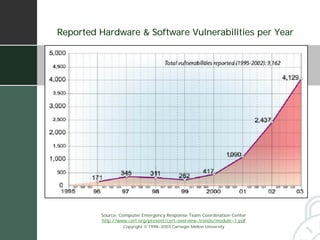
Reported Hardware & Software Vulnerabilities per Year


         Source: Computer Emergency Response Team Coordination Center
         http://www.cert.org/present/cert-overview-trends/module-1.pdf
                  Copyright  1998-2003 Carnegie Mellon University
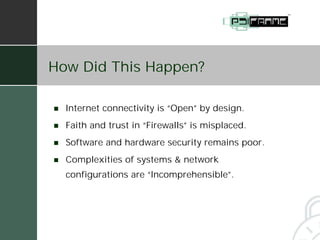
How Did This Happen?

!   Internet connectivity is “Open” by design.
!   Faith and trust in “Firewalls” is misplaced.
!   Software and hardware security remains poor.
!   Complexities of systems & network
    configurations are “Incomprehensible”.
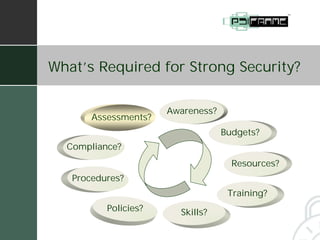
What’s Required for Strong Security?

                      Awareness?
       Assessments?
                                   Budgets?
  Compliance?
                                     Resources?
   Procedures?
                                    Training?
          Policies?     Skills?
What’s At Risk?

1.   Information Assets

2.   Business Relationships

3.   Network Infrastructure
1. Information Assets At Risk


!   Trade Secrets

!   Designs & Processes

!   Business Plans

!   Personnel Records

!   Financial Transactions

!   Privileged Communications
2. Business Relationships At Risk


!   Customer & Partner Data Confidentiality

!   Production & Service Quality

!   Industry Reputation

!   Competitive Advantage

!   Regulatory Compliance

!   Investor & Stakeholder Confidence
3. Network Infrastructure At Risk


!   Authentication & Privacy

!   Availability of Systems & Resources

!   Customer & Supplier Connectivity

!   Functionality of Software Applications

!   Integrity of Records & Databases

!   Business Continuity
Network Security Roadmap

1.  Establishing Executive Mandates for Assessments
2. Comparing Audit Methodologies & Deliverables
3. Identifying Exploitable Vulnerabilities
4. Exposing Firewall Circumventions
5. Detecting & Monitoring Wireless Access
6. Revealing Information Leakage & Sources
7. Recognizing Critical Infrastructure & IP Threats
8. Implementing Lock Down & Best Security Practices
9. Maintaining Federal & State Regulatory Compliance
10. Managing Ongoing Processes & Oversight
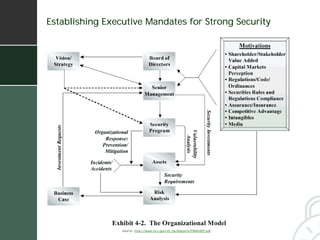
!Establishing   Executive Mandates for Strong Security


                    Source: http://www.ncs.gov/n5_hp/Reports/FINALREP.pdf
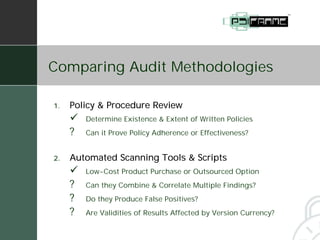
Comparing Audit Methodologies

1.   Policy & Procedure Review
     "   Determine Existence & Extent of Written Policies
     ?   Can it Prove Policy Adherence or Effectiveness?


2.   Automated Scanning Tools & Scripts
     "   Low-Cost Product Purchase or Outsourced Option
     ?   Can they Combine & Correlate Multiple Findings?
     ?   Do they Produce False Positives?
     ?   Are Validities of Results Affected by Version Currency?
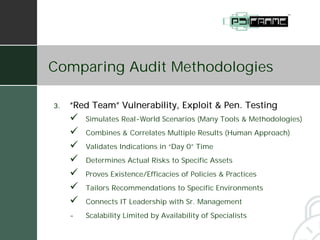
Comparing Audit Methodologies

3.   “Red Team” Vulnerability, Exploit & Pen. Testing
     "   Simulates Real-World Scenarios (Many Tools & Methodologies)
     "   Combines & Correlates Multiple Results (Human Approach)
     "   Validates Indications in “Day 0” Time
     "   Determines Actual Risks to Specific Assets
     "   Proves Existence/Efficacies of Policies & Practices
     "   Tailors Recommendations to Specific Environments
     "   Connects IT Leadership with Sr. Management
     -   Scalability Limited by Availability of Specialists
Comparing Deliverables

!   Paper Based or Interactive Reports?
!   Level of Comprehensiveness?
!   Includes Both Vulnerability & Risk Assessments?
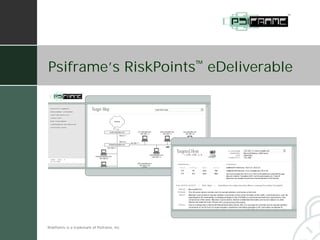
Psiframe’s RiskPoints™ eDeliverable


RiskPoints is a trademark of Psiframe, Inc.
Identifying Exploitable Vulnerabilities

Examples:

   !   Routers
   !   Operating Systems
   !   Service Applications (Mail, FTP, DNS, etc.)
   !   Web Applications
   !   Configuration Errors
   !   Authentication Weaknesses
   !   People
Exploit Example: Router

Cisco IOS Vulnerability & Exploit
   # This vulnerability enables eavesdroppers to sniff email and monitor
       other traffic while transparently forwarding it to its intended
       destination within milliseconds.
   !   Once privileged (administrative) access to the Client’s router was
       gained, Psiframe installed an encapsulated tunnel (Virtual Private
       Network) between the router and a Psiframe server on the Internet.
   !   Using this technique, Psiframe was able to surreptitiously capture
       any or all outgoing traffic from the Client's network.
Exploit Example: Web Server

Microsoft IIS Vulnerability & Exploit
   # This vulnerability enables intruders to deface Web sites, install worms
       that attack other sites, or leverage them as stepping-stones to penetrate
       back-end systems such as database servers with credit card data.
   !   Once root access was gained to the Client’s Web server, Psiframe had
       full administrative control over all files and configuration settings.
   !   From the Web server, Psiframe was able to penetrate further and access
       other systems on the Client's internal network that “trusted” the Web
       server through the firewall.
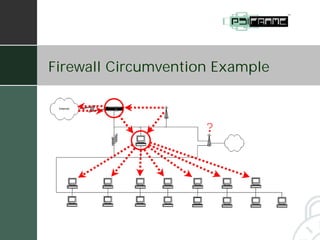
Exposing Firewall Circumventions

!   Vulnerable Systems, Services and Software
!   Misconfigured Firewalls & Network Topologies
!   Dual-Homed Devices
!   Modems
!   Rogue & Insecure Wireless Access Points
Firewall Circumvention Example


                     ?
“WiFi” Wireless LANs

!   2003 Worldwide Users: 5 Million +
!   Advertised Useable Distance: ~ 300 Feet
!   Encryption: None (default) / 40 bit & 128 bit (WEP)
!   Authentication: None (default) / Various Types
!   User IP Address Assignment: Auto (default) / None
“WiFi” Wireless LANs

!   “By year-end 2002, 30 percent of enterprises will suffer serious security
    exposures from deploying wireless local area networks (WLANs) without
    implementing the proper security… At least 20 percent of enterprises
    already have ‘rogue’ WLANs attached to their corporate networks,
    installed by users looking for the convenience of wireless and unwilling
    to wait for the IS organization to take the lead… Fixing the exposure
    after a hacking attack cannot recapture lost intellectual property and
    sensitive customer information.” — Gartner


    Source: http://www.gartner.com/5_about/press_releases/2001/pr20010809b.html
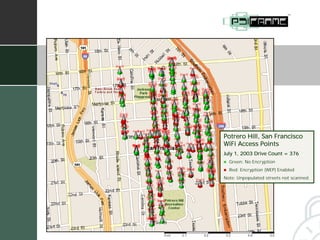
Wireless “WiFi” LANs


                       Potrero Hill, San Francisco
                       WiFi Access Points
                       July 1, 2003 Drive Count = 376
                       !   Green: No Encryption
                       !   Red: Encryption (WEP) Enabled
                       Note: Unpopulated streets not scanned.
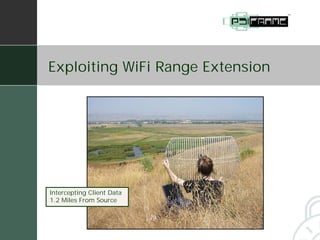
Exploiting WiFi Range Extension


Intercepting Client Data
1.2 Miles From Source
Information Leakage Examples

#   Whois: Search Domain Account Holder Records
    http://www.xwhois.com


#   Dig-It: Query DNS for Host Names & IP Addresses
    http://us.mirror.menandmice.com/cgi-bin/DoDig


#   Netcraft: What’s That Site Running?
    http://www.netcraft.com


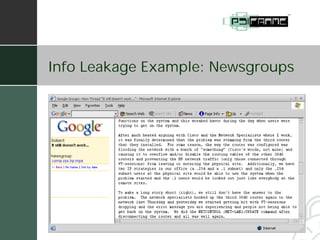
#   Google: Technical Newsgroup Archives
    http://groups.google.com
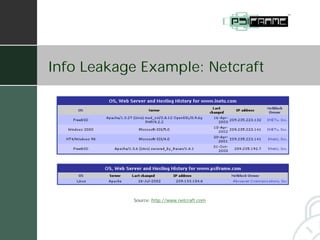
Info Leakage Example: Netcraft


           !Source:   http://www.netcraft.com
Info Leakage Example: Newsgroups
Recognizing Critical Infrastructure

!   IP Asset Storage Locations & Shared Files
!   Authorized Users & Privileges
!   Networked Devices & Services
!   Access Points
!   Interconnections
!   Single Points of Failure
!   Failover, Backup & Recovery Systems
Locking Down With Best Practices

“Best Practices” is a Consensus of Approaches
   #   SANS Institute
       http://www.sans.org/resources

   #   NSA Security Recommendation Guides
       http://nsa.gov/snac

   #   IETF Site Security Handbook
       http://www.ietf.org/rfc/rfc2196.txt

   #   NIST Computer Security Resource Center
       http://csrc.nist.gov

   #   AICPA Trust Services Principles and Criteria
       http://www.aicpa.org/assurance/systrust/princip.htm
Maintaining Regulatory Compliance

Examples of New California & Federal Legislation
   !   Security Breach Information Act
   !   Notification of Risk to Personal Data Act


   #   Consult Your Attorney
New California Law


      This bill, operative July 1, 2003, would require a state
      agency, or a person or business that conducts business in
      California, that owns or licenses computerized data that
      includes personal information, as defined, to disclose in
      specified ways, any breach of the security of the data, as
      defined, to any resident of California whose unencrypted
      personal information was, or is reasonably believed to have
      been, acquired by an unauthorized person...

Source: http://info.sen.ca.gov/pub/01-02/bill/sen/sb_1351-1400/sb_1386_bill_20020926_chaptered.html
Proposed Federal Law


      A bill to require Federal agencies, and persons engaged in
      interstate commerce, in possession of electronic data
      containing personal information, to disclose any
      unauthorized acquisition of such information. This Act may
      be cited as the Notification of “Risk to Personal Data Act”...


Source: http://frwebgate.access.gpo.gov/cgi-bin/getdoc.cgi?dbname=108_cong_bills&docid=f:s1350is.txt.pdf
Manage Process & Oversight

Strong Security Is Not An Option

   !   Cultivate C-Level Awareness
   !   Regularly Assess Risks, Threats & Vulnerabilities
   !   Provide Administrator Training
   !   Review Incident Detection, Reporting
       & Response Programs
Why Leverage Psiframe?

"   Real World Scenarios
"   Comprehensive Audit Framework
"   Impartial & Objective Findings
"   Interactive RiskPoints eDeliverable
"   Best Practice Recommendations

"   Expert Knowledge & Skills Transfer
Recommended Actions

1.   Involve Board-Level Management
2.   Review a Sample Composite Deliverable
3.   Request an Engagement Agreement
4.   Conduct a “Baseline” Assessment
5.   Attend the Findings Presentation
6.   Measure Improvement Quarterly
Contact

!   Fred Holborn


    Desk     925.803.4131
    Cell     925.876.6903
    Email    fholborn@psiframe.com
    Web      http://www.psiframe.com

Information Security Risk Management

  • 1.
    Theft Happens: Data Securityfor Intellectual Property Managers Presented by Fred Holborn on behalf of Psiframe, Inc. to the Intellectual Property Society, July 16, 2003. For more information, visit http://www.ipsociety.net and http://www.psiframe.com. Copyright  2003 Psiframe, Inc. All Rights Reserved.
  • 2.
    Today’s Situation ! 92% of large organizations detected computer security attacks in 2003. ! 75% acknowledged financial losses due to computer breaches. ! Theft of proprietary information caused the greatest financial loss - $2.7 Million average. Source: CSI / FBI Computer Crime and Security Survey, April 2003 http://www.gocsi.com
  • 3.
    $2.7 Million .. . ! Profit vs. Loss for , Inc? ! $ Annual Interest Expense? ! $ Million in Additional Revenue to Recoup?
  • 4.
    Founding Premise “Improve the security of a site by breaking into it.” Dan Farmer, 1993 Creator of SATAN (Security Analysis Tool for Auditing Networks) Source: http://www.fish.com/security/admin-guide-to-cracking.html
  • 5.
    Psiframe’s Purpose ! Psiframe enables organizations to Lock Down Data Systems and Network Security by: " Performing “Real World” Risk Assessments. " Identifying Exploitable Vulnerabilities from an Attacker’s Perspective. " Recommending “Best Practice” Solutions.
  • 6.
    Goals and Objectives ! Protect Information Assets through a program of regularly conducted assessments that quantify and enable mitigation of unacceptable risks. ! Develop understanding and consensus among executive and technology leaders to achieve and validate strong security.
  • 7.
    Assessing IP Assetson IP Networks ! What are the IP Assets and their values values? ! What are the actual threats to IP Assets facilitated by vulnerabilities on Networks? ! What consequences are possible if threats arise? ! What are the probabilities that thefts will happen? ! What safeguards can be deployed? ! What investments are required for safeguards?
  • 8.
    What’s Vulnerable? Examples: ! Hardware Devices ! Operating Systems & Applications Software ! Systems Architecture & Configurations ! Data Transmission & Encryption Protocols ! Access Control Methods ! People
  • 9.
    Reported Hardware &Software Vulnerabilities per Year Source: Computer Emergency Response Team Coordination Center http://www.cert.org/present/cert-overview-trends/module-1.pdf Copyright  1998-2003 Carnegie Mellon University
  • 10.
    How Did ThisHappen? ! Internet connectivity is “Open” by design. ! Faith and trust in “Firewalls” is misplaced. ! Software and hardware security remains poor. ! Complexities of systems & network configurations are “Incomprehensible”.
  • 11.
    What’s Required forStrong Security? Awareness? Assessments? Budgets? Compliance? Resources? Procedures? Training? Policies? Skills?
  • 12.
    What’s At Risk? 1. Information Assets 2. Business Relationships 3. Network Infrastructure
  • 13.
    1. Information AssetsAt Risk ! Trade Secrets ! Designs & Processes ! Business Plans ! Personnel Records ! Financial Transactions ! Privileged Communications
  • 14.
    2. Business RelationshipsAt Risk ! Customer & Partner Data Confidentiality ! Production & Service Quality ! Industry Reputation ! Competitive Advantage ! Regulatory Compliance ! Investor & Stakeholder Confidence
  • 15.
    3. Network InfrastructureAt Risk ! Authentication & Privacy ! Availability of Systems & Resources ! Customer & Supplier Connectivity ! Functionality of Software Applications ! Integrity of Records & Databases ! Business Continuity
  • 16.
    Network Security Roadmap 1. Establishing Executive Mandates for Assessments 2. Comparing Audit Methodologies & Deliverables 3. Identifying Exploitable Vulnerabilities 4. Exposing Firewall Circumventions 5. Detecting & Monitoring Wireless Access 6. Revealing Information Leakage & Sources 7. Recognizing Critical Infrastructure & IP Threats 8. Implementing Lock Down & Best Security Practices 9. Maintaining Federal & State Regulatory Compliance 10. Managing Ongoing Processes & Oversight
  • 17.
    !Establishing Executive Mandates for Strong Security Source: http://www.ncs.gov/n5_hp/Reports/FINALREP.pdf
  • 18.
    Comparing Audit Methodologies 1. Policy & Procedure Review " Determine Existence & Extent of Written Policies ? Can it Prove Policy Adherence or Effectiveness? 2. Automated Scanning Tools & Scripts " Low-Cost Product Purchase or Outsourced Option ? Can they Combine & Correlate Multiple Findings? ? Do they Produce False Positives? ? Are Validities of Results Affected by Version Currency?
  • 19.
    Comparing Audit Methodologies 3. “Red Team” Vulnerability, Exploit & Pen. Testing " Simulates Real-World Scenarios (Many Tools & Methodologies) " Combines & Correlates Multiple Results (Human Approach) " Validates Indications in “Day 0” Time " Determines Actual Risks to Specific Assets " Proves Existence/Efficacies of Policies & Practices " Tailors Recommendations to Specific Environments " Connects IT Leadership with Sr. Management - Scalability Limited by Availability of Specialists
  • 20.
    Comparing Deliverables ! Paper Based or Interactive Reports? ! Level of Comprehensiveness? ! Includes Both Vulnerability & Risk Assessments?
  • 21.
  • 22.
    Identifying Exploitable Vulnerabilities Examples: ! Routers ! Operating Systems ! Service Applications (Mail, FTP, DNS, etc.) ! Web Applications ! Configuration Errors ! Authentication Weaknesses ! People
  • 23.
    Exploit Example: Router CiscoIOS Vulnerability & Exploit # This vulnerability enables eavesdroppers to sniff email and monitor other traffic while transparently forwarding it to its intended destination within milliseconds. ! Once privileged (administrative) access to the Client’s router was gained, Psiframe installed an encapsulated tunnel (Virtual Private Network) between the router and a Psiframe server on the Internet. ! Using this technique, Psiframe was able to surreptitiously capture any or all outgoing traffic from the Client's network.
  • 24.
    Exploit Example: WebServer Microsoft IIS Vulnerability & Exploit # This vulnerability enables intruders to deface Web sites, install worms that attack other sites, or leverage them as stepping-stones to penetrate back-end systems such as database servers with credit card data. ! Once root access was gained to the Client’s Web server, Psiframe had full administrative control over all files and configuration settings. ! From the Web server, Psiframe was able to penetrate further and access other systems on the Client's internal network that “trusted” the Web server through the firewall.
  • 25.
    Exposing Firewall Circumventions ! Vulnerable Systems, Services and Software ! Misconfigured Firewalls & Network Topologies ! Dual-Homed Devices ! Modems ! Rogue & Insecure Wireless Access Points
  • 26.
  • 27.
    “WiFi” Wireless LANs ! 2003 Worldwide Users: 5 Million + ! Advertised Useable Distance: ~ 300 Feet ! Encryption: None (default) / 40 bit & 128 bit (WEP) ! Authentication: None (default) / Various Types ! User IP Address Assignment: Auto (default) / None
  • 28.
    “WiFi” Wireless LANs ! “By year-end 2002, 30 percent of enterprises will suffer serious security exposures from deploying wireless local area networks (WLANs) without implementing the proper security… At least 20 percent of enterprises already have ‘rogue’ WLANs attached to their corporate networks, installed by users looking for the convenience of wireless and unwilling to wait for the IS organization to take the lead… Fixing the exposure after a hacking attack cannot recapture lost intellectual property and sensitive customer information.” — Gartner Source: http://www.gartner.com/5_about/press_releases/2001/pr20010809b.html
  • 29.
    Wireless “WiFi” LANs Potrero Hill, San Francisco WiFi Access Points July 1, 2003 Drive Count = 376 ! Green: No Encryption ! Red: Encryption (WEP) Enabled Note: Unpopulated streets not scanned.
  • 30.
    Exploiting WiFi RangeExtension Intercepting Client Data 1.2 Miles From Source
  • 31.
    Information Leakage Examples # Whois: Search Domain Account Holder Records http://www.xwhois.com # Dig-It: Query DNS for Host Names & IP Addresses http://us.mirror.menandmice.com/cgi-bin/DoDig # Netcraft: What’s That Site Running? http://www.netcraft.com # Google: Technical Newsgroup Archives http://groups.google.com
  • 32.
    Info Leakage Example:Netcraft !Source: http://www.netcraft.com
  • 33.
  • 34.
    Recognizing Critical Infrastructure ! IP Asset Storage Locations & Shared Files ! Authorized Users & Privileges ! Networked Devices & Services ! Access Points ! Interconnections ! Single Points of Failure ! Failover, Backup & Recovery Systems
  • 35.
    Locking Down WithBest Practices “Best Practices” is a Consensus of Approaches # SANS Institute http://www.sans.org/resources # NSA Security Recommendation Guides http://nsa.gov/snac # IETF Site Security Handbook http://www.ietf.org/rfc/rfc2196.txt # NIST Computer Security Resource Center http://csrc.nist.gov # AICPA Trust Services Principles and Criteria http://www.aicpa.org/assurance/systrust/princip.htm
  • 36.
    Maintaining Regulatory Compliance Examplesof New California & Federal Legislation ! Security Breach Information Act ! Notification of Risk to Personal Data Act # Consult Your Attorney
  • 37.
    New California Law This bill, operative July 1, 2003, would require a state agency, or a person or business that conducts business in California, that owns or licenses computerized data that includes personal information, as defined, to disclose in specified ways, any breach of the security of the data, as defined, to any resident of California whose unencrypted personal information was, or is reasonably believed to have been, acquired by an unauthorized person... Source: http://info.sen.ca.gov/pub/01-02/bill/sen/sb_1351-1400/sb_1386_bill_20020926_chaptered.html
  • 38.
    Proposed Federal Law A bill to require Federal agencies, and persons engaged in interstate commerce, in possession of electronic data containing personal information, to disclose any unauthorized acquisition of such information. This Act may be cited as the Notification of “Risk to Personal Data Act”... Source: http://frwebgate.access.gpo.gov/cgi-bin/getdoc.cgi?dbname=108_cong_bills&docid=f:s1350is.txt.pdf
  • 39.
    Manage Process &Oversight Strong Security Is Not An Option ! Cultivate C-Level Awareness ! Regularly Assess Risks, Threats & Vulnerabilities ! Provide Administrator Training ! Review Incident Detection, Reporting & Response Programs
  • 40.
    Why Leverage Psiframe? " Real World Scenarios " Comprehensive Audit Framework " Impartial & Objective Findings " Interactive RiskPoints eDeliverable " Best Practice Recommendations " Expert Knowledge & Skills Transfer
  • 41.
    Recommended Actions 1. Involve Board-Level Management 2. Review a Sample Composite Deliverable 3. Request an Engagement Agreement 4. Conduct a “Baseline” Assessment 5. Attend the Findings Presentation 6. Measure Improvement Quarterly
  • 42.
    Contact ! Fred Holborn Desk 925.803.4131 Cell 925.876.6903 Email fholborn@psiframe.com Web http://www.psiframe.com