Packaging
Rohit Kochhar BBA452213
Rusin Mishra BBA450213
The Product’s Public Face
What is packaging?
Containers and wrapping materials used to
protect, contain, identify, promote and facilitate the
use of the product.
It is an integral part of product planning and promotion
 10% of the retail price is spent on developing, designing, and
producing just the package
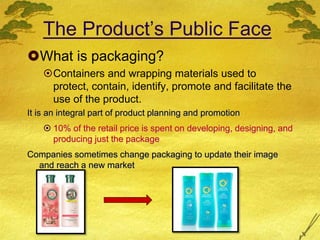
Companies sometimes change packaging to update their image
and reach a new market
Label
 What is a label?
Informative tag, wrapper, or seal attached to the
product or the product’s package. It presents
information.
 What information does it present?
Brand name (Bold detergent)
Ingredients, Instructions (machine washable), how
to open or dispose, guarantees, danger warnings
Need for a label?
Protects businesses from legal liability if someone if
injured while using the product
Three Kinds of Labels
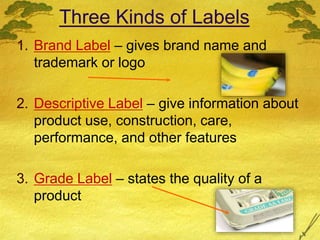
1. Brand Label – gives brand name and
trademark or logo
2. Descriptive Label – give information about
product use, construction, care,
performance, and other features
3. Grade Label – states the quality of a
product
Functions of Packaging
1. Promoting and Selling the Product
2. Defining Product Identity
3. Providing Information
4. Expressing Customer Needs
5. Ensure Safe Use
6. Protecting the Product
The Keys to Product Packaging
1. Promoting and Selling the Product
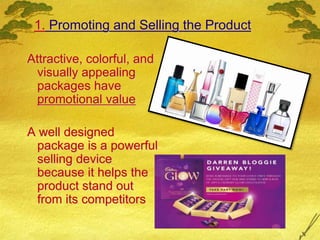
Attractive, colorful, and
visually appealing
packages have
promotional value
A well designed
package is a powerful
selling device
because it helps the
product stand out
from its competitors
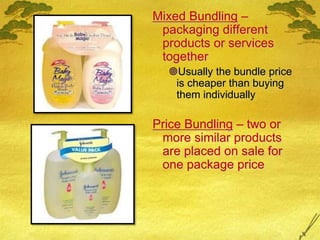
Mixed Bundling –
packaging different
products or services
together
Usually the bundle price
is cheaper than buying
them individually
Price Bundling – two or
more similar products
are placed on sale for
one package price
2. Defining Product Identity
Packaging is sometimes
used to promote an
image such as prestige,
convenience, or status
It can be a crucial part of
the marketing strategy,
particularly in
advertising
3. Providing Information
Gives customer
useful information on:
directions for using
the product
its contents
product guarantees
nutritional value
potential hazards
4. Expressing Customer Needs
When designing packages, companies
analyze customer lifestyles and create
packaging that meets their needs for
size and convenience
Packages often come in various sizes
Family size
Single serving
5. Ensure Safe Use
Proper packaging helps to eliminate
potential injuries or misuse of a
product
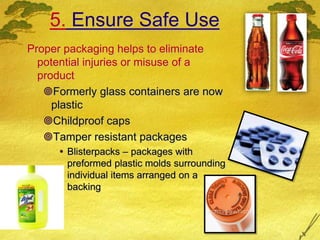
Formerly glass containers are now
plastic
Childproof caps
Tamper resistant packages
 Blisterpacks – packages with
preformed plastic molds surrounding
individual items arranged on a
backing
6. Protecting the Product
Must protect during shipping, storage, and
display
Prevent or discourage from tampering
Prevent shoplifting
Protect against breakage and spoilage
All materials used to package food have
economic and practical reasons for their
use.
The main packaging types include:
1. Glass
2. Plastic
3. Metal
4. Paper and paper based products
Packaging types
Is one of the oldest packaging materials
but there has been a decline in its use
and a trend towards toughened plastic
Glass
Versatile - plastics can be flexible or
rigid, and can be moulded into shapes
Resistant to acids and other chemicals
Easily transport
Lightweight and do not allow moisture,
bacteria or gas to pass through
Relatively Cheap to produce
Plastic
Thin plastics can be used to as a
protective covering
This plastic covering can also provide
the opportunity for labelling
Plastic Wrapping
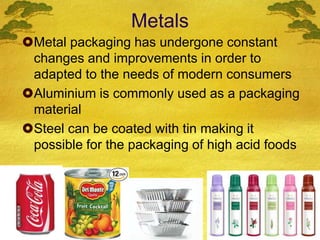
Metal packaging has undergone constant
changes and improvements in order to
adapted to the needs of modern consumers
Aluminium is commonly used as a packaging
material
Steel can be coated with tin making it
possible for the packaging of high acid foods
Metals
Relatively cheap to produce
Very easy to print on
Derived from renewable sources and
are completely biodegradable
Lightweight
Paper and Paper based products
Packaging

Packaging

  • 1.
  • 2.
    The Product’s PublicFace What is packaging? Containers and wrapping materials used to protect, contain, identify, promote and facilitate the use of the product. It is an integral part of product planning and promotion  10% of the retail price is spent on developing, designing, and producing just the package Companies sometimes change packaging to update their image and reach a new market
  • 3.
    Label  What isa label? Informative tag, wrapper, or seal attached to the product or the product’s package. It presents information.  What information does it present? Brand name (Bold detergent) Ingredients, Instructions (machine washable), how to open or dispose, guarantees, danger warnings Need for a label? Protects businesses from legal liability if someone if injured while using the product
  • 4.
    Three Kinds ofLabels 1. Brand Label – gives brand name and trademark or logo 2. Descriptive Label – give information about product use, construction, care, performance, and other features 3. Grade Label – states the quality of a product
  • 5.
    Functions of Packaging 1.Promoting and Selling the Product 2. Defining Product Identity 3. Providing Information 4. Expressing Customer Needs 5. Ensure Safe Use 6. Protecting the Product The Keys to Product Packaging
  • 6.
    1. Promoting andSelling the Product Attractive, colorful, and visually appealing packages have promotional value A well designed package is a powerful selling device because it helps the product stand out from its competitors
  • 7.
    Mixed Bundling – packagingdifferent products or services together Usually the bundle price is cheaper than buying them individually Price Bundling – two or more similar products are placed on sale for one package price
  • 8.
    2. Defining ProductIdentity Packaging is sometimes used to promote an image such as prestige, convenience, or status It can be a crucial part of the marketing strategy, particularly in advertising
  • 9.
    3. Providing Information Givescustomer useful information on: directions for using the product its contents product guarantees nutritional value potential hazards
  • 10.
    4. Expressing CustomerNeeds When designing packages, companies analyze customer lifestyles and create packaging that meets their needs for size and convenience Packages often come in various sizes Family size Single serving
  • 11.
    5. Ensure SafeUse Proper packaging helps to eliminate potential injuries or misuse of a product Formerly glass containers are now plastic Childproof caps Tamper resistant packages  Blisterpacks – packages with preformed plastic molds surrounding individual items arranged on a backing
  • 12.
    6. Protecting theProduct Must protect during shipping, storage, and display Prevent or discourage from tampering Prevent shoplifting Protect against breakage and spoilage
  • 13.
    All materials usedto package food have economic and practical reasons for their use. The main packaging types include: 1. Glass 2. Plastic 3. Metal 4. Paper and paper based products Packaging types
  • 14.
    Is one ofthe oldest packaging materials but there has been a decline in its use and a trend towards toughened plastic Glass
  • 15.
    Versatile - plasticscan be flexible or rigid, and can be moulded into shapes Resistant to acids and other chemicals Easily transport Lightweight and do not allow moisture, bacteria or gas to pass through Relatively Cheap to produce Plastic
  • 16.
    Thin plastics canbe used to as a protective covering This plastic covering can also provide the opportunity for labelling Plastic Wrapping
  • 17.
    Metal packaging hasundergone constant changes and improvements in order to adapted to the needs of modern consumers Aluminium is commonly used as a packaging material Steel can be coated with tin making it possible for the packaging of high acid foods Metals
  • 18.
    Relatively cheap toproduce Very easy to print on Derived from renewable sources and are completely biodegradable Lightweight Paper and Paper based products