ES 1111
Lecture 2 - The Ozone Layer
& Ozone Hole
(Page 222 of first text, but mostly from
book “Earth Under Siege”)
The Beginning of Ozone
 It is the ozone layer that allowed life to
evolve onto land
 Prior to the ozone layer, organisms lived in
the murky waters or in the deep ocean
 The ozone layer wasn’t always there
because oxygen itself was rare at the start
 Photosynthesis by aquatic plants enriched
the atmosphere with oxygen
The Ozone Layer
 The ozone layer is at its maximum between 20
and 30 kilometers above the surface, and is
located in the stratosphere
 The ozone layer is vital for life because it shields
the surface from high-energy ultraviolet radiation
 Currently, concerns about the thinning of the
ozone layer are being raised by the world’s
nations
 Ozone is three atoms of oxygen bonded together
as a molecule (O3)
Creation of Stratospheric Ozone
 Stratospheric ozone is created differently than the ozone
found near the surface
 Photodissociation – when a photon of sunlight strikes a
molecule with enough energy to break the molecular bonds
apart
 Diatomic oxygen is photodissociated by ultraviolet sunlight
(wavelengths 0.25 micrometers or less)
 The reactions that create ozone are:
O2 + UV light —> O + O
2 ( O + O2 + M —> O3 + M )
Net Reaction: 3O2 —> 2O3
Where M is a mediator molecule to allow the reaction
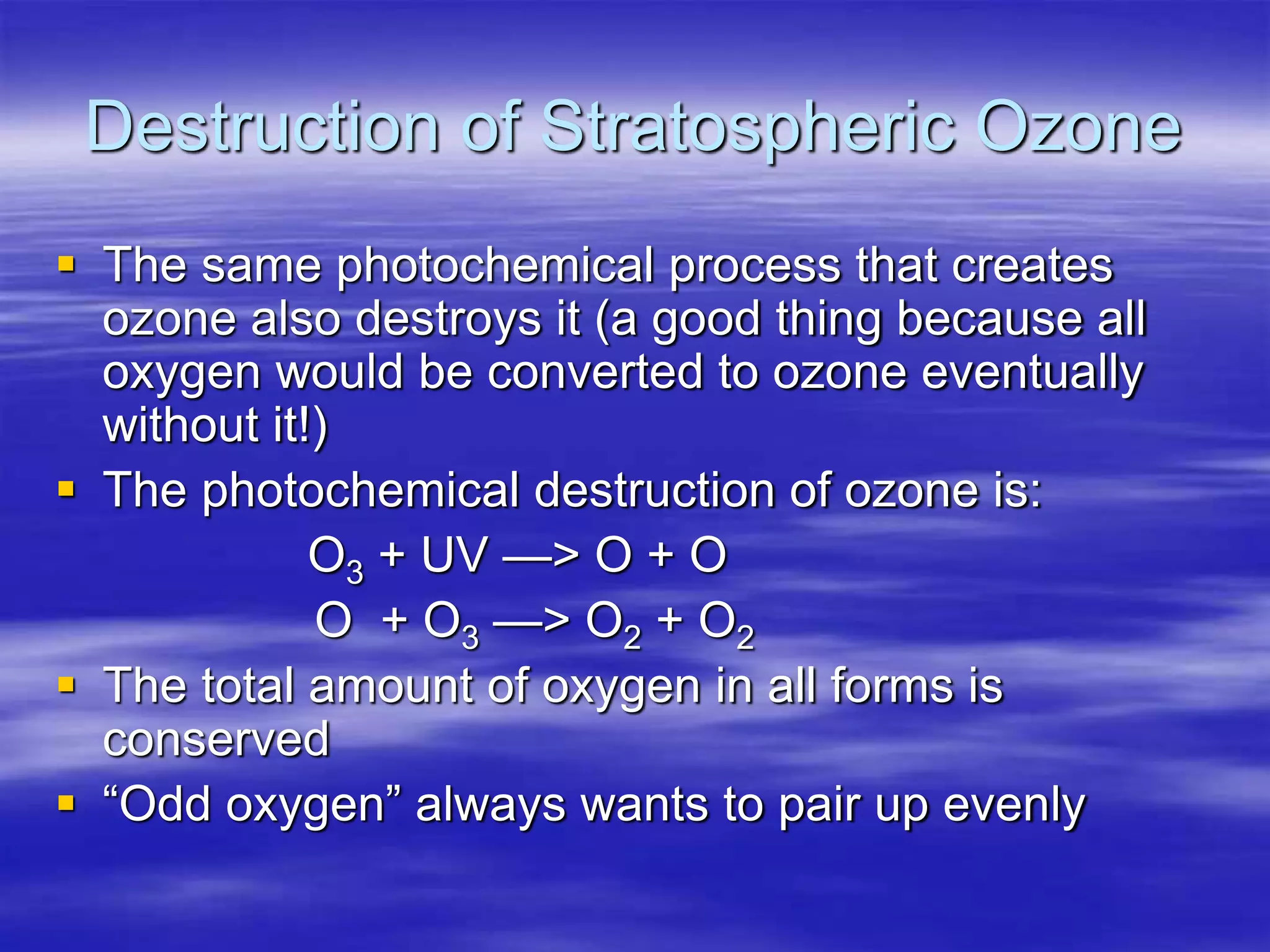
Destruction of Stratospheric Ozone
 The same photochemical process that creates
ozone also destroys it (a good thing because all
oxygen would be converted to ozone eventually
without it!)
 The photochemical destruction of ozone is:
O3 + UV —> O + O
O + O3 —> O2 + O2
 The total amount of oxygen in all forms is
conserved
 “Odd oxygen” always wants to pair up evenly
Budget of Stratospheric Ozone
 At any given moment, the stratosphere
holds about 3 Gigatons of ozone
 The creation of ozone by the photolysis of
diatomic oxygen by UV light is 1 Gigaton per
year
 The destruction of ozone by UV light also
equals 1 Gigaton per year
 If all the ozone were to disappear suddenly,
it would take 3 years to replenish it
Vertical Ozone Layer Distribution
Figure showing the vertical distribution of
ozone in the atmosphere. Peak values are
found between 20 and 30 kilometers, with
rapidly decreasing amounts above and
below that level
Measurement of Ozone
 Ozone column – the number of ozone molecules
contained in a column of air 1 square centimeter in
area that extends vertically from the surface up
through the atmosphere
 1 Dobson Unit = 2.7 x 10¹⁶ molecules in the ozone
column
 The average amount in the atmosphere is 300
Dobson Units
 If you took all the ozone and brought it down to the
surface, the ozone layer would be about 3 mm
thick
Variations in Ozone Distribution
 Every point on the globe has at least 250
DU of ozone overhead
 Ozone distribution is zonally symmetric
(parallel contours of DU with latitude circles)
 Ozone increases as you go from the tropics
to the poles (destruction stronger at tropics)
 Seasonal variations are higher over high
latitudes and small over tropics, with the
most ozone found in late-winter/early-spring
Latitudinal Ozone Distribution
Figure showing the global distribution of total
ozone in the Earth’s atmosphere
The Ozone Hole
 A loss of half the typical amount of ozone
has been observed over Antarctica
 The culprit of the ozone hole is believed to
be CFC’s: chlorofluorocarbons (contains
chlorine, fluorine, and carbon)
 A series of meteorological circumstances
results in the ozone hole over Antarctica
Chlorofluorocarbons
 Man-made compounds created to act as propellants and
refrigerants
 In the old days, refrigerators used hazardous materials like
Ammonia, and leaky refrigerators could result in death!
 Chlorofluorocarbons are stable compounds, do not break
down easily, and are nontoxic
 Because of their stability, they remain in the atmosphere
for a long time (allowing their long travel to stratosphere)
 Eventually, they leak into the stratosphere (by overshooting
tops in thunderstorms) where they do break down in the
presence of ice and ultraviolet light
 Chlorine in particular is the problem that creates the hole
Chlorine’s Attack on Ozone
 First, CFC’s are broken down by light
CFCl3 + UV —> CFCl2 + Cl
 The free chlorine then reacts with ozone:
O3 + Cl —> O2 + ClO
ClO + O —> Cl + O2
 Note that ozone is destroyed into diatomic oxygen
 Also note that the chlorine that started it all ends up being
released at the end
 Catalytic Reaction – a repetitive reaction sequence where
chlorine is produced at the end, able to react yet again
 As a result, one chlorine atom can destroy hundreds of
thousands of ozone molecules
Chlorine’s Lifetime
 Chlorine is locked into the CFC molecule, which is
very stable
 It takes about 50 years for a CFC molecule to
make its way up to the stratosphere
 Once in the stratosphere, high energy UV
radiation breaks it apart
 Chlorine can remain in the stratosphere for 100
years (all the while destroying ozone molecules)
 To remove the stray chlorine atom, it must react
with hydrogen to produce hydrochloric acid (HCl)
or combine to form ClONO2
Meteorology of the Ozone Hole
 The reason why the ozone hole has been observed over
Antarctica and nowhere else is due to meteorological
circumstances:
– Fast winds (polar vortex) develops in the Stratosphere around
Antarctica in the winter, isolating the stratospheric air
– Extremely cold temperatures allowing the formation of clouds in the
stratosphere (ice allows the CFCs to become unstable)
– With the first rays of Sun in the spring, UV light breaks up the CFCs
and releases the chlorine
– Ozone hole develops as catalytic reaction takes over in the
Antarctic spring
– Once the polar vortex weakens, mixing of stratospheric air from
lower latitudes heals the ozone hole
Ozone Layer Anomalies
Figure showing stratospheric ozone
concentrations globally, with the ozone hole
evident over Antarctica. An ozone “dent”
appears over the North Pole. Reductions of
15% are found over the North Pole, but the
same meteorological conditions that are
found over Antarctica are not found there.
Thinning Ozone = More UV
 The ozone hole is alarming because higher ultraviolet radiation
amounts are a serious threat to almost all living organisms
 Ultraviolet light comes in four forms:
– Far UV: Wavelengths < 250 nm, entirely absorbed by oxygen in the
upper atmosphere
– Ultraviolet C: Wavelengths of 250-290 nm, extremely hazardous and
currently is completely absorbed by the ozone layer (organisms have
no natural protection)
– Ultraviolet B: Wavelengths of 290-320 nm, biologically hazardous,
organisms produce melanin (skin pigments) that can absorb UV-B and
prevent damage to deeper tissues. Can cause skin cancer and
cataracts over time. A small amount of UV-B reaches the surface
– Ultraviolet A: Wavelengths >320 nm, tanning beds use this type,
suspected of having health consequences. 100% reaches the ground
 For every 1% decrease in total ozone, the UV-B radiation dose
increases 2-4%
Penetration of UV in the Atmosphere
Figure showing the depth of penetration for far
UV, UV-C, B, and A in our atmosphere.
Skin Cancers and Latitude
Figure showing that skin cancers decrease as
you go to higher latitudes (because sunlight
is weaker). In addition, recall that the ozone
layer is weaker in the tropics, so tropical
latitudes get a double-whammy (high
insolation and a weak ozone layer)
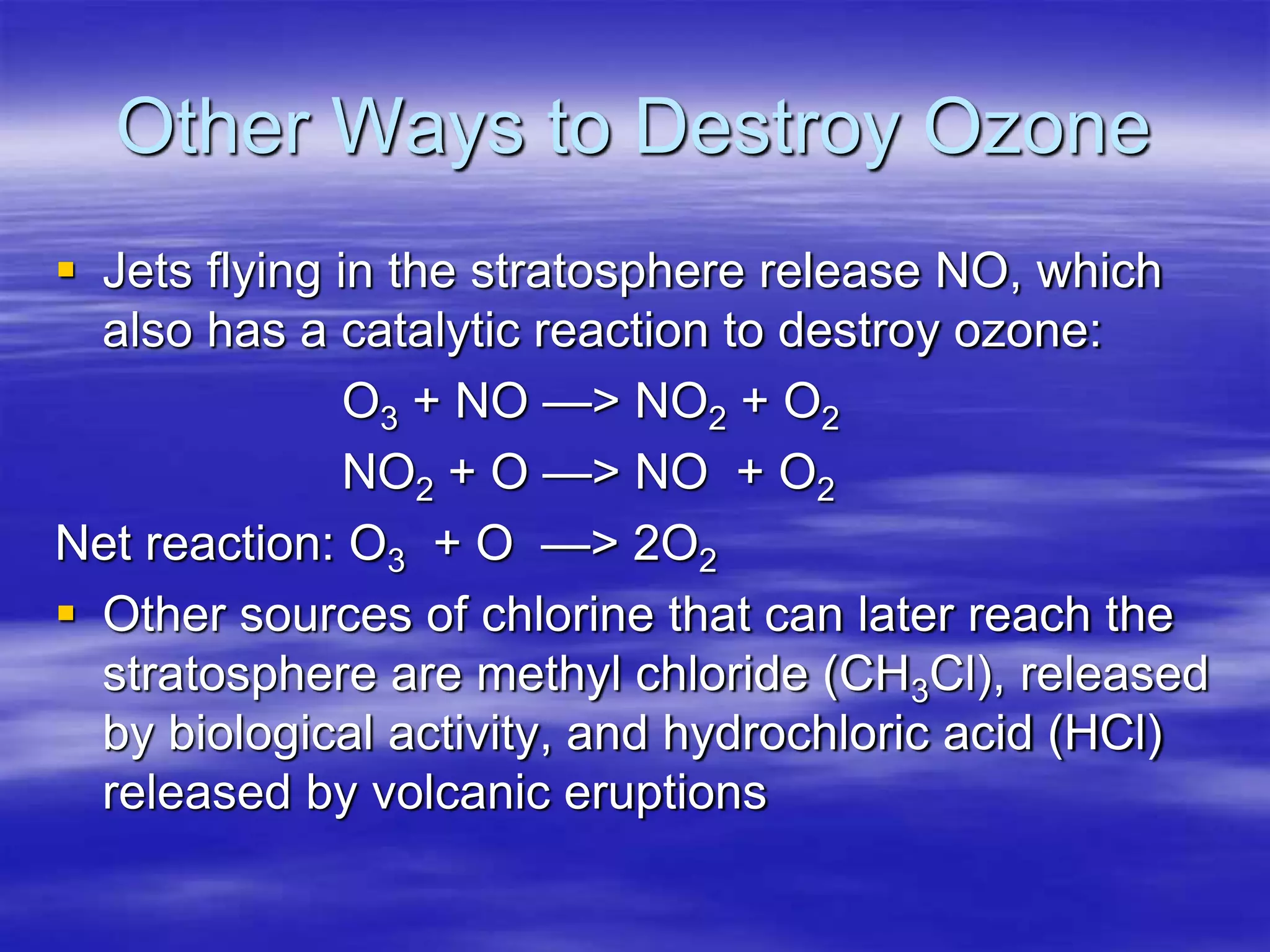
Other Ways to Destroy Ozone
 Jets flying in the stratosphere release NO, which
also has a catalytic reaction to destroy ozone:
O3 + NO —> NO2 + O2
NO2 + O —> NO + O2
Net reaction: O3 + O —> 2O2
 Other sources of chlorine that can later reach the
stratosphere are methyl chloride (CH3Cl), released
by biological activity, and hydrochloric acid (HCl)
released by volcanic eruptions
Can We Repair the Hole?
 Planes flying in the troposphere can create ozone by
emitting NO and going through the photochemical
reactions of smog. However, ozone doesn’t last long for
this to fix the hole
 Lasers may allow us to break down the CFCs before they
reach the stratosphere, but such lasers would fry birds that
flew in the beam and pose risks to aircraft
 Another idea involved charging chlorine by having it obtain
extra electrons and have these charged atoms accelerated
out of the atmosphere by Earth’s normal electrical field.
Many problems exist with this idea, including the fact that
an airplane would need to fly up there to emit electrons
 In general, the problem is so large that any attempt to
engineer a solution would be feeble
The Montreal Protocol
 The only real solution today is to limit the
production and emission of CFCs
 The Montreal Protocol (1987) and later
amendments phased out CFC use
 Nearly 150 countries have signed the treaty
 New compounds to perform the tasks of
CFCs are being designed that are safe
 Third-world countries require assistance in
technology to phase out their CFCs
Future Outlook
 Because of the long residence times, the ozone
hole will continue getting worse before it gets
better
 Levels of chlorine in the atmosphere have leveled
off in response to the protocols
 Projections in chlorine amount have us returning
to pre-1960s levels of 2 ppbv by 2060-2080
 Reduction of ozone would have doubled between
1990 and 2030 without the Montreal Protocol
Chlorine Levels in the Future
Figure showing the forecasted chlorine
concentration in our atmosphere given the
Montreal Protocol and the subsequent
London and Copenhagen amendments.
The Montreal Protocol would not have
reduced chlorine levels, which is why we
had the subsequent amendments.
Other Increases in Radiation
Dosage
 Earth’s magnetic field keeps us protected from many
charged particles that would be hazardous to our health
and our atmosphere
 The magnetic field is created by hot, liquid iron flowing in
our outer core
 Our magnetic field has weakened and reversed polarity in
the past, and is forecast to do so again (we are overdue)
 Weakening of the field during reversal would increase our
radiation dosage
 Without our magnetic field, the atmosphere would be
stripped from our planet (like Mars, which currently doesn’t
have a magnetic field)

3. Ozonosfer.ppt

  • 1.
    ES 1111 Lecture 2- The Ozone Layer & Ozone Hole (Page 222 of first text, but mostly from book “Earth Under Siege”)
  • 2.
    The Beginning ofOzone  It is the ozone layer that allowed life to evolve onto land  Prior to the ozone layer, organisms lived in the murky waters or in the deep ocean  The ozone layer wasn’t always there because oxygen itself was rare at the start  Photosynthesis by aquatic plants enriched the atmosphere with oxygen
  • 3.
    The Ozone Layer The ozone layer is at its maximum between 20 and 30 kilometers above the surface, and is located in the stratosphere  The ozone layer is vital for life because it shields the surface from high-energy ultraviolet radiation  Currently, concerns about the thinning of the ozone layer are being raised by the world’s nations  Ozone is three atoms of oxygen bonded together as a molecule (O3)
  • 4.
    Creation of StratosphericOzone  Stratospheric ozone is created differently than the ozone found near the surface  Photodissociation – when a photon of sunlight strikes a molecule with enough energy to break the molecular bonds apart  Diatomic oxygen is photodissociated by ultraviolet sunlight (wavelengths 0.25 micrometers or less)  The reactions that create ozone are: O2 + UV light —> O + O 2 ( O + O2 + M —> O3 + M ) Net Reaction: 3O2 —> 2O3 Where M is a mediator molecule to allow the reaction
  • 5.
    Destruction of StratosphericOzone  The same photochemical process that creates ozone also destroys it (a good thing because all oxygen would be converted to ozone eventually without it!)  The photochemical destruction of ozone is: O3 + UV —> O + O O + O3 —> O2 + O2  The total amount of oxygen in all forms is conserved  “Odd oxygen” always wants to pair up evenly
  • 6.
    Budget of StratosphericOzone  At any given moment, the stratosphere holds about 3 Gigatons of ozone  The creation of ozone by the photolysis of diatomic oxygen by UV light is 1 Gigaton per year  The destruction of ozone by UV light also equals 1 Gigaton per year  If all the ozone were to disappear suddenly, it would take 3 years to replenish it
  • 7.
    Vertical Ozone LayerDistribution Figure showing the vertical distribution of ozone in the atmosphere. Peak values are found between 20 and 30 kilometers, with rapidly decreasing amounts above and below that level
  • 8.
    Measurement of Ozone Ozone column – the number of ozone molecules contained in a column of air 1 square centimeter in area that extends vertically from the surface up through the atmosphere  1 Dobson Unit = 2.7 x 10¹⁶ molecules in the ozone column  The average amount in the atmosphere is 300 Dobson Units  If you took all the ozone and brought it down to the surface, the ozone layer would be about 3 mm thick
  • 9.
    Variations in OzoneDistribution  Every point on the globe has at least 250 DU of ozone overhead  Ozone distribution is zonally symmetric (parallel contours of DU with latitude circles)  Ozone increases as you go from the tropics to the poles (destruction stronger at tropics)  Seasonal variations are higher over high latitudes and small over tropics, with the most ozone found in late-winter/early-spring
  • 10.
    Latitudinal Ozone Distribution Figureshowing the global distribution of total ozone in the Earth’s atmosphere
  • 11.
    The Ozone Hole A loss of half the typical amount of ozone has been observed over Antarctica  The culprit of the ozone hole is believed to be CFC’s: chlorofluorocarbons (contains chlorine, fluorine, and carbon)  A series of meteorological circumstances results in the ozone hole over Antarctica
  • 12.
    Chlorofluorocarbons  Man-made compoundscreated to act as propellants and refrigerants  In the old days, refrigerators used hazardous materials like Ammonia, and leaky refrigerators could result in death!  Chlorofluorocarbons are stable compounds, do not break down easily, and are nontoxic  Because of their stability, they remain in the atmosphere for a long time (allowing their long travel to stratosphere)  Eventually, they leak into the stratosphere (by overshooting tops in thunderstorms) where they do break down in the presence of ice and ultraviolet light  Chlorine in particular is the problem that creates the hole
  • 13.
    Chlorine’s Attack onOzone  First, CFC’s are broken down by light CFCl3 + UV —> CFCl2 + Cl  The free chlorine then reacts with ozone: O3 + Cl —> O2 + ClO ClO + O —> Cl + O2  Note that ozone is destroyed into diatomic oxygen  Also note that the chlorine that started it all ends up being released at the end  Catalytic Reaction – a repetitive reaction sequence where chlorine is produced at the end, able to react yet again  As a result, one chlorine atom can destroy hundreds of thousands of ozone molecules
  • 14.
    Chlorine’s Lifetime  Chlorineis locked into the CFC molecule, which is very stable  It takes about 50 years for a CFC molecule to make its way up to the stratosphere  Once in the stratosphere, high energy UV radiation breaks it apart  Chlorine can remain in the stratosphere for 100 years (all the while destroying ozone molecules)  To remove the stray chlorine atom, it must react with hydrogen to produce hydrochloric acid (HCl) or combine to form ClONO2
  • 15.
    Meteorology of theOzone Hole  The reason why the ozone hole has been observed over Antarctica and nowhere else is due to meteorological circumstances: – Fast winds (polar vortex) develops in the Stratosphere around Antarctica in the winter, isolating the stratospheric air – Extremely cold temperatures allowing the formation of clouds in the stratosphere (ice allows the CFCs to become unstable) – With the first rays of Sun in the spring, UV light breaks up the CFCs and releases the chlorine – Ozone hole develops as catalytic reaction takes over in the Antarctic spring – Once the polar vortex weakens, mixing of stratospheric air from lower latitudes heals the ozone hole
  • 16.
    Ozone Layer Anomalies Figureshowing stratospheric ozone concentrations globally, with the ozone hole evident over Antarctica. An ozone “dent” appears over the North Pole. Reductions of 15% are found over the North Pole, but the same meteorological conditions that are found over Antarctica are not found there.
  • 17.
    Thinning Ozone =More UV  The ozone hole is alarming because higher ultraviolet radiation amounts are a serious threat to almost all living organisms  Ultraviolet light comes in four forms: – Far UV: Wavelengths < 250 nm, entirely absorbed by oxygen in the upper atmosphere – Ultraviolet C: Wavelengths of 250-290 nm, extremely hazardous and currently is completely absorbed by the ozone layer (organisms have no natural protection) – Ultraviolet B: Wavelengths of 290-320 nm, biologically hazardous, organisms produce melanin (skin pigments) that can absorb UV-B and prevent damage to deeper tissues. Can cause skin cancer and cataracts over time. A small amount of UV-B reaches the surface – Ultraviolet A: Wavelengths >320 nm, tanning beds use this type, suspected of having health consequences. 100% reaches the ground  For every 1% decrease in total ozone, the UV-B radiation dose increases 2-4%
  • 18.
    Penetration of UVin the Atmosphere Figure showing the depth of penetration for far UV, UV-C, B, and A in our atmosphere.
  • 19.
    Skin Cancers andLatitude Figure showing that skin cancers decrease as you go to higher latitudes (because sunlight is weaker). In addition, recall that the ozone layer is weaker in the tropics, so tropical latitudes get a double-whammy (high insolation and a weak ozone layer)
  • 20.
    Other Ways toDestroy Ozone  Jets flying in the stratosphere release NO, which also has a catalytic reaction to destroy ozone: O3 + NO —> NO2 + O2 NO2 + O —> NO + O2 Net reaction: O3 + O —> 2O2  Other sources of chlorine that can later reach the stratosphere are methyl chloride (CH3Cl), released by biological activity, and hydrochloric acid (HCl) released by volcanic eruptions
  • 21.
    Can We Repairthe Hole?  Planes flying in the troposphere can create ozone by emitting NO and going through the photochemical reactions of smog. However, ozone doesn’t last long for this to fix the hole  Lasers may allow us to break down the CFCs before they reach the stratosphere, but such lasers would fry birds that flew in the beam and pose risks to aircraft  Another idea involved charging chlorine by having it obtain extra electrons and have these charged atoms accelerated out of the atmosphere by Earth’s normal electrical field. Many problems exist with this idea, including the fact that an airplane would need to fly up there to emit electrons  In general, the problem is so large that any attempt to engineer a solution would be feeble
  • 22.
    The Montreal Protocol The only real solution today is to limit the production and emission of CFCs  The Montreal Protocol (1987) and later amendments phased out CFC use  Nearly 150 countries have signed the treaty  New compounds to perform the tasks of CFCs are being designed that are safe  Third-world countries require assistance in technology to phase out their CFCs
  • 23.
    Future Outlook  Becauseof the long residence times, the ozone hole will continue getting worse before it gets better  Levels of chlorine in the atmosphere have leveled off in response to the protocols  Projections in chlorine amount have us returning to pre-1960s levels of 2 ppbv by 2060-2080  Reduction of ozone would have doubled between 1990 and 2030 without the Montreal Protocol
  • 24.
    Chlorine Levels inthe Future Figure showing the forecasted chlorine concentration in our atmosphere given the Montreal Protocol and the subsequent London and Copenhagen amendments. The Montreal Protocol would not have reduced chlorine levels, which is why we had the subsequent amendments.
  • 25.
    Other Increases inRadiation Dosage  Earth’s magnetic field keeps us protected from many charged particles that would be hazardous to our health and our atmosphere  The magnetic field is created by hot, liquid iron flowing in our outer core  Our magnetic field has weakened and reversed polarity in the past, and is forecast to do so again (we are overdue)  Weakening of the field during reversal would increase our radiation dosage  Without our magnetic field, the atmosphere would be stripped from our planet (like Mars, which currently doesn’t have a magnetic field)