

A SEMINAR ON OZONE
DEPLETION
SUBMITTED BY RAVI SINGH JADAUN
DATE- 23-03-2017
JIWAJI UNVERSITY GWALIOR
SYNOPSIS
 INTRODUCTION
 DEFINITION
 HISTORY OF OZONE LAYER
 STRUCTURE OF OZONE
 OZONE LAYER DEPLETION
 MAIN OZONE DEPLETING SUBSTANCES ODS
 EFFECTS OF OZONE DEPLETION
 SOLUTIONS TO OZONE DEPLETION
INTRODUCTION
 ozone layer is a deep layer in earth’s atmosphere that
contain ozone which is a naturally occurring molecule
containing three oxygen atoms. These ozone molecules form
a gaseous layer in the Earth’s upper atmosphere called
stratosphere. This lower region of stratosphere containing
relatively higher concentration of ozone is called
Ozonosphere. The Ozonosphere is found 15-35 km (9 to 22
miles) above the surface of the earth
DEFINITION
a layer in the earth's stratosphere which containing a
high concentration of ozone, which absorbs most of
the ultraviolet radiation reaching the earth from the
sun.
HISTORY OF OZONE
 600,000,000 B.C. Ozone layer forms
 1865 JeanLouis Soret proves that ozone is O3
 1924 G.M.B. Dobson develops ozone spectrophotometer and begins regular
measurements of ozone abundance (Arosa, Switzerland)
 1978 Total Ozone Mapping Spectrometer (TOMS) is launched aboard NIMBUS7
spacecraft giving global coverage of ozone layer thickness
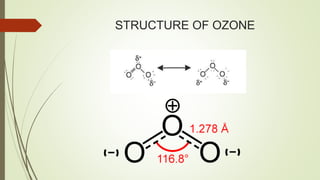
STRUCTURE OF OZONE
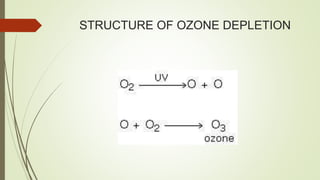
STRUCTURE OF OZONE DEPLETION
CONCENTRATION OF OZONE
 The concentration of ozone in the ozone layer is usually
under 10 parts per million while the average concentration of
ozone in the atmosphere is about 0.3 parts per million. The
thickness of the ozone layer differs as per season and
geography. The highest concentrations of ozone occur at
altitudes from 26 to 28 km (16 to 17 miles) in the tropics and
from 12 to 20 km (7 to 12 miles) towards the poles.
OZONE LAYER DEPLETION
 Natural causes of depletion of ozone layer: Ozone layer
has been found to be affected by certain natural phenomena
such as Sun-spots and stratospheric winds. But this has been
found to cause not more than 1-2% depletion of the ozone
layer and the effects are also thought to be only temporary. It
is also believed that the major volcanic eruptions (mainly El
Chichon in 1983 and and Mt. Pinatubo in 1991) has also
contributed towards ozone depletion.
CONT…OZONE LAYER DEPLETION
 Man-made causes of depletion of ozone layer: The main
cause for the depletion of ozone is determined as excessive
release of chlorine and bromine from man-made compounds
such as chlorofluorocarbons (CFCs). CFCs
(chlorofluorocarbons), halons, CH3CCl3 (Methyl chloroform),
CCl4 (Carbon tetrachloride), HCFCs (hydro-
chlorofluorocarbons), hydrobromofluorocarbons and methyl
bromide are found to have direct impact on the depletion of
the ozone layer. These are categorized as ozone-depleting
substances (ODS).
MAIN OZONE DEPLETING
SUBSTANCES
ODS Chlorofluorocarbons (CFCs)
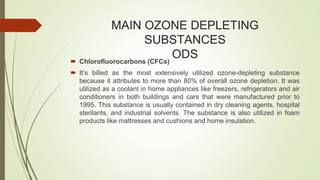
 It’s billed as the most extensively utilized ozone-depleting substance
because it attributes to more than 80% of overall ozone depletion. It was
utilized as a coolant in home appliances like freezers, refrigerators and air
conditioners in both buildings and cars that were manufactured prior to
1995. This substance is usually contained in dry cleaning agents, hospital
sterilants, and industrial solvents. The substance is also utilized in foam
products like mattresses and cushions and home insulation.
EFFECTS OF OZONE DEPLETION
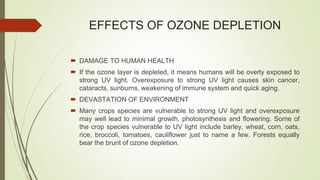
 DAMAGE TO HUMAN HEALTH
 If the ozone layer is depleted, it means humans will be overly exposed to
strong UV light. Overexposure to strong UV light causes skin cancer,
cataracts, sunburns, weakening of immune system and quick aging.
 DEVASTATION OF ENVIRONMENT
 Many crops species are vulnerable to strong UV light and overexposure
may well lead to minimal growth, photosynthesis and flowering. Some of
the crop species vulnerable to UV light include barley, wheat, corn, oats,
rice, broccoli, tomatoes, cauliflower just to name a few. Forests equally
bear the brunt of ozone depletion.
CONT.. EFFECTS OF OZONE
DEPLETION
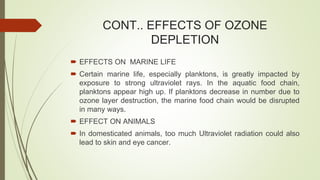
 EFFECTS ON MARINE LIFE
 Certain marine life, especially planktons, is greatly impacted by
exposure to strong ultraviolet rays. In the aquatic food chain,
planktons appear high up. If planktons decrease in number due to
ozone layer destruction, the marine food chain would be disrupted
in many ways.
 EFFECT ON ANIMALS
 In domesticated animals, too much Ultraviolet radiation could also
lead to skin and eye cancer.
CONT.. EFFECTS OF OZONE
DEPLETION
 IMPACTS CERTAIN MATERIALS
 Materials like plastics, wood, fabrics, rubber are massively degraded by
too much ultraviolet radiation
 PROHIBIT THE USE OF HARMFULL NITROUS OXIDE
 The Montreal Protocol formed in 1989 helped a lot in the limitation of
Chlorofluorocarbons (CFCs). However, the protocol never covered nitrous
oxide, which is a known harmful chemical that can destroy the ozone
layer. Nitrous oxide is still in use today. Governments must take action
now and outlaw nitrous oxide use to reduce the rate of ozone depletion.
SOLUTIONS TO OZONE DEPLETION
 STOP USING PESTICIDES
 Pesticides are great chemicals to rid your farm of pests and weeds, but they
contribute enormously to ozone layer depletion. The surefire solution to get rid of
pests and weeds is to apply natural methods. Just weed your farm manually and
use alternative eco-friendly chemicals to alleviate pests.
 USE PUBLIC MODE OF TRANSPORATION
 The easiest technique to minimize ozone depletion is to limit the number of
vehicles on the road. These vehicles emit a lot of greenhouse gases that
eventually form smog,. a catalyst in the depletion of ozone layer
REFERENCE
Environmental Protection Agency.
THANK YOU

Ozone depletion

  • 1.
    A SEMINAR ONOZONE DEPLETION SUBMITTED BY RAVI SINGH JADAUN DATE- 23-03-2017 JIWAJI UNVERSITY GWALIOR
  • 2.
    SYNOPSIS  INTRODUCTION  DEFINITION HISTORY OF OZONE LAYER  STRUCTURE OF OZONE  OZONE LAYER DEPLETION  MAIN OZONE DEPLETING SUBSTANCES ODS  EFFECTS OF OZONE DEPLETION  SOLUTIONS TO OZONE DEPLETION
  • 3.
    INTRODUCTION  ozone layeris a deep layer in earth’s atmosphere that contain ozone which is a naturally occurring molecule containing three oxygen atoms. These ozone molecules form a gaseous layer in the Earth’s upper atmosphere called stratosphere. This lower region of stratosphere containing relatively higher concentration of ozone is called Ozonosphere. The Ozonosphere is found 15-35 km (9 to 22 miles) above the surface of the earth
  • 4.
    DEFINITION a layer inthe earth's stratosphere which containing a high concentration of ozone, which absorbs most of the ultraviolet radiation reaching the earth from the sun.
  • 5.
    HISTORY OF OZONE 600,000,000 B.C. Ozone layer forms  1865 JeanLouis Soret proves that ozone is O3  1924 G.M.B. Dobson develops ozone spectrophotometer and begins regular measurements of ozone abundance (Arosa, Switzerland)  1978 Total Ozone Mapping Spectrometer (TOMS) is launched aboard NIMBUS7 spacecraft giving global coverage of ozone layer thickness
  • 6.
  • 7.
  • 8.
    CONCENTRATION OF OZONE The concentration of ozone in the ozone layer is usually under 10 parts per million while the average concentration of ozone in the atmosphere is about 0.3 parts per million. The thickness of the ozone layer differs as per season and geography. The highest concentrations of ozone occur at altitudes from 26 to 28 km (16 to 17 miles) in the tropics and from 12 to 20 km (7 to 12 miles) towards the poles.
  • 9.
    OZONE LAYER DEPLETION Natural causes of depletion of ozone layer: Ozone layer has been found to be affected by certain natural phenomena such as Sun-spots and stratospheric winds. But this has been found to cause not more than 1-2% depletion of the ozone layer and the effects are also thought to be only temporary. It is also believed that the major volcanic eruptions (mainly El Chichon in 1983 and and Mt. Pinatubo in 1991) has also contributed towards ozone depletion.
  • 10.
    CONT…OZONE LAYER DEPLETION Man-made causes of depletion of ozone layer: The main cause for the depletion of ozone is determined as excessive release of chlorine and bromine from man-made compounds such as chlorofluorocarbons (CFCs). CFCs (chlorofluorocarbons), halons, CH3CCl3 (Methyl chloroform), CCl4 (Carbon tetrachloride), HCFCs (hydro- chlorofluorocarbons), hydrobromofluorocarbons and methyl bromide are found to have direct impact on the depletion of the ozone layer. These are categorized as ozone-depleting substances (ODS).
  • 11.
    MAIN OZONE DEPLETING SUBSTANCES ODSChlorofluorocarbons (CFCs)  It’s billed as the most extensively utilized ozone-depleting substance because it attributes to more than 80% of overall ozone depletion. It was utilized as a coolant in home appliances like freezers, refrigerators and air conditioners in both buildings and cars that were manufactured prior to 1995. This substance is usually contained in dry cleaning agents, hospital sterilants, and industrial solvents. The substance is also utilized in foam products like mattresses and cushions and home insulation.
  • 12.
    EFFECTS OF OZONEDEPLETION  DAMAGE TO HUMAN HEALTH  If the ozone layer is depleted, it means humans will be overly exposed to strong UV light. Overexposure to strong UV light causes skin cancer, cataracts, sunburns, weakening of immune system and quick aging.  DEVASTATION OF ENVIRONMENT  Many crops species are vulnerable to strong UV light and overexposure may well lead to minimal growth, photosynthesis and flowering. Some of the crop species vulnerable to UV light include barley, wheat, corn, oats, rice, broccoli, tomatoes, cauliflower just to name a few. Forests equally bear the brunt of ozone depletion.
  • 13.
    CONT.. EFFECTS OFOZONE DEPLETION  EFFECTS ON MARINE LIFE  Certain marine life, especially planktons, is greatly impacted by exposure to strong ultraviolet rays. In the aquatic food chain, planktons appear high up. If planktons decrease in number due to ozone layer destruction, the marine food chain would be disrupted in many ways.  EFFECT ON ANIMALS  In domesticated animals, too much Ultraviolet radiation could also lead to skin and eye cancer.
  • 14.
    CONT.. EFFECTS OFOZONE DEPLETION  IMPACTS CERTAIN MATERIALS  Materials like plastics, wood, fabrics, rubber are massively degraded by too much ultraviolet radiation  PROHIBIT THE USE OF HARMFULL NITROUS OXIDE  The Montreal Protocol formed in 1989 helped a lot in the limitation of Chlorofluorocarbons (CFCs). However, the protocol never covered nitrous oxide, which is a known harmful chemical that can destroy the ozone layer. Nitrous oxide is still in use today. Governments must take action now and outlaw nitrous oxide use to reduce the rate of ozone depletion.
  • 15.
    SOLUTIONS TO OZONEDEPLETION  STOP USING PESTICIDES  Pesticides are great chemicals to rid your farm of pests and weeds, but they contribute enormously to ozone layer depletion. The surefire solution to get rid of pests and weeds is to apply natural methods. Just weed your farm manually and use alternative eco-friendly chemicals to alleviate pests.  USE PUBLIC MODE OF TRANSPORATION  The easiest technique to minimize ozone depletion is to limit the number of vehicles on the road. These vehicles emit a lot of greenhouse gases that eventually form smog,. a catalyst in the depletion of ozone layer
  • 16.
  • 17.