OXYGEN THERAPY
- Insp. Vijay Kumar
NDRF ACADEMY
Nagpur
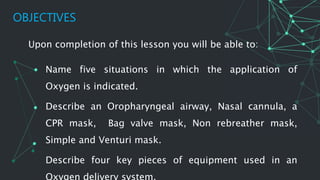
OBJECTIVES
Upon completion of this lesson you will be able to:
Name five situations in which the application of
Oxygen is indicated.
Describe an Oropharyngeal airway, Nasal cannula, a
CPR mask, Bag valve mask, Non rebreather mask,
Simple and Venturi mask.
Describe four key pieces of equipment used in an
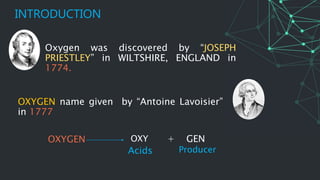
INTRODUCTION
OXYGEN
Oxygen was discovered by “JOSEPH
PRIESTLEY” in WILTSHIRE, ENGLAND in
1774.
OXYGEN name given by “Antoine Lavoisier”
in 1777
OXY + GEN
Acids Producer
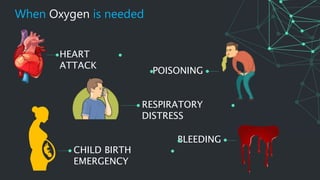
When Oxygen is needed
HEART
ATTACK
CHILD BIRTH
EMERGENCY
POISONING
RESPIRATORY
DISTRESS
BLEEDING
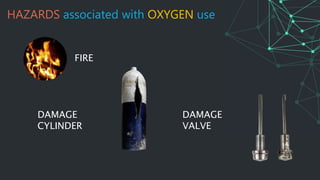
HAZARDS associated with OXYGEN use
FIRE
DAMAGE
CYLINDER
DAMAGE
VALVE
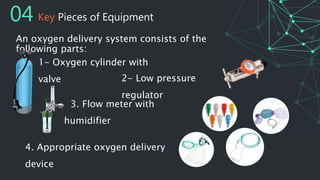
Key Pieces of Equipment04
An oxygen delivery system consists of the
following parts:
1- Oxygen cylinder with
valve 2- Low pressure
regulator
3. Flow meter with
humidifier
4. Appropriate oxygen delivery
device
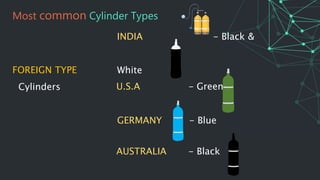
Most common Cylinder Types
FOREIGN TYPE
Cylinders
INDIA - Black &
White
AUSTRALIA - Black
U.S.A - Green
GERMANY - Blue
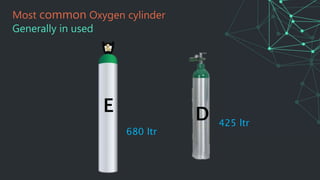
Most common Oxygen cylinder
Generally in used
D 425 ltr
680 ltr
E
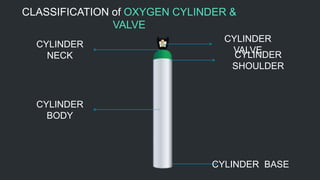
CYLINDER BASE
CLASSIFICATION of OXYGEN CYLINDER &
VALVE
CYLINDER
VALVE
CYLINDER
NECK CYLINDER
SHOULDER
CYLINDER
BODY
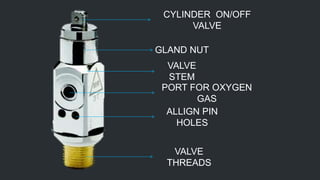
CYLINDER ON/OFF
VALVE
GLAND NUT
PORT FOR OXYGEN
GAS
ALLIGN PIN
HOLES
VALVE
THREADS
VALVE
STEM
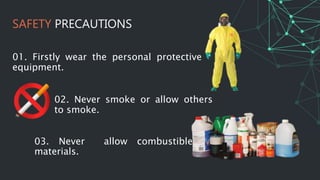
SAFETY PRECAUTIONS
01. Firstly wear the personal protective
equipment.
02. Never smoke or allow others
to smoke.
03. Never allow combustible
materials.
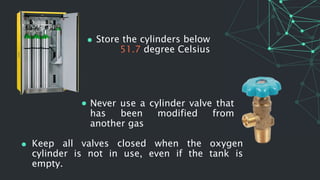
Store the cylinders below
51.7 degree Celsius
Never use a cylinder valve that
has been modified from
another gas
Keep all valves closed when the oxygen
cylinder is not in use, even if the tank is
empty.
OXYGEN ADMINISTRATION
PROCEDURE
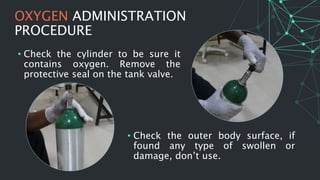
• Check the cylinder to be sure it
contains oxygen. Remove the
protective seal on the tank valve.
• Check the outer body surface, if
found any type of swollen or
damage, don’t use.
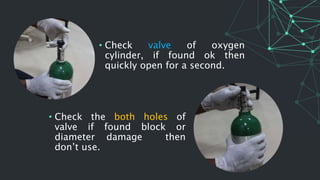
• Check the both holes of
valve if found block or
diameter damage then
don’t use.
• Check valve of oxygen
cylinder, if found ok then
quickly open for a second.
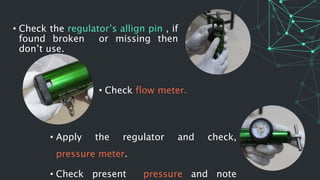
• Apply the regulator and check,
pressure meter.
• Check present pressure and note
• Check the regulator’s allign pin , if
found broken or missing then
don’t use.
• Check flow meter.
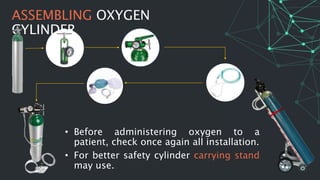
ASSEMBLING OXYGEN
CYLINDER
• Before administering oxygen to a
patient, check once again all installation.
• For better safety cylinder carrying stand
may use.
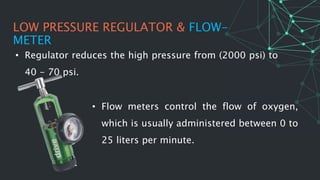
LOW PRESSURE REGULATOR & FLOW-
METER
• Regulator reduces the high pressure from (2000 psi) to
40 - 70 psi.
• Flow meters control the flow of oxygen,
which is usually administered between 0 to
25 liters per minute.
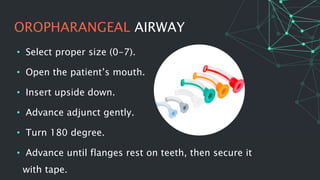
OROPHARANGEAL AIRWAY
• Select proper size (0-7).
• Open the patient’s mouth.
• Insert upside down.
• Advance adjunct gently.
• Turn 180 degree.
• Advance until flanges rest on teeth, then secure it
with tape.
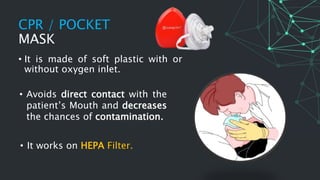
CPR / POCKET
MASK
• It is made of soft plastic with or
without oxygen inlet.
• Avoids direct contact with the
patient’s Mouth and decreases
the chances of contamination.
• It works on HEPA Filter.
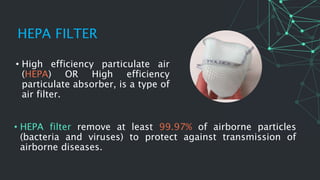
HEPA FILTER
• High efficiency particulate air
(HEPA) OR High efficiency
particulate absorber, is a type of
air filter.
• HEPA filter remove at least 99.97% of airborne particles
(bacteria and viruses) to protect against transmission of
airborne diseases.
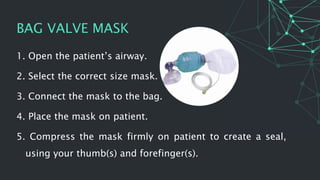
BAG VALVE MASK
1. Open the patient’s airway.
2. Select the correct size mask.
3. Connect the mask to the bag.
4. Place the mask on patient.
5. Compress the mask firmly on patient to create a seal,
using your thumb(s) and forefinger(s).
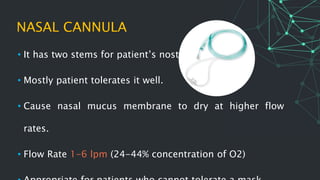
NASAL CANNULA
• It has two stems for patient’s nostrils.
• Mostly patient tolerates it well.
• Cause nasal mucus membrane to dry at higher flow
rates.
• Flow Rate 1-6 lpm (24-44% concentration of O2)
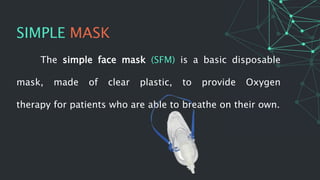
SIMPLE MASK
The simple face mask (SFM) is a basic disposable
mask, made of clear plastic, to provide Oxygen
therapy for patients who are able to breathe on their own.
• The Simple face mask can deliver higher flow rates than
Nasal Cannula, (6-10 liters per minute) of 40-60%
oxygen.
• Nasal Cannula and simple face masks are described as
low flow delivery systems.
• The simple face mask lacks a reservoir bag.
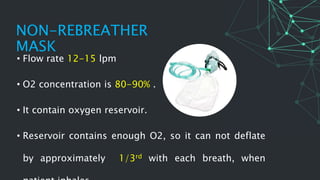
• Flow rate 12-15 lpm
• O2 concentration is 80-90% .
• It contain oxygen reservoir.
• Reservoir contains enough O2, so it can not deflate
by approximately 1/3rd with each breath, when
NON-REBREATHER
MASK
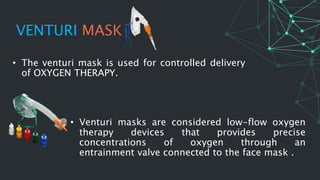
VENTURI MASK
• The venturi mask is used for controlled delivery
of OXYGEN THERAPY.
• Venturi masks are considered low-flow oxygen
therapy devices that provides precise
concentrations of oxygen through an
entrainment valve connected to the face mask .
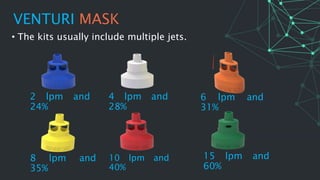
VENTURI MASK
• The kits usually include multiple jets.
6 lpm and
31%
4 lpm and
28%
10 lpm and
40%
15 lpm and
60%
8 lpm and
35%
2 lpm and
24%
HUMIDIFIER
• Non breakable jar of water attached to
the flow meter.
Provide moisture to the dry oxygen.
• Must be kept clean. It can become a
breeding ground for algae, harmful
bacteria and fungal organisms.
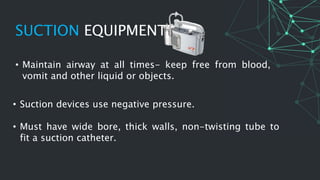
SUCTION EQUIPMENT
• Suction devices use negative pressure.
• Must have wide bore, thick walls, non-twisting tube to
fit a suction catheter.
• Maintain airway at all times- keep free from blood,
vomit and other liquid or objects.
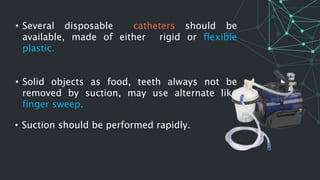
• Several disposable catheters should be
available, made of either rigid or flexible
plastic.
• Solid objects as food, teeth always not be
removed by suction, may use alternate like
finger sweep.
• Suction should be performed rapidly.
REVIEW
THANK YOU
9284868901 vijayanand.vimnandu@gmail.com

Oxygen therapy

  • 1.
    OXYGEN THERAPY - Insp.Vijay Kumar NDRF ACADEMY Nagpur
  • 2.
    OBJECTIVES Upon completion ofthis lesson you will be able to: Name five situations in which the application of Oxygen is indicated. Describe an Oropharyngeal airway, Nasal cannula, a CPR mask, Bag valve mask, Non rebreather mask, Simple and Venturi mask. Describe four key pieces of equipment used in an
  • 3.
    INTRODUCTION OXYGEN Oxygen was discoveredby “JOSEPH PRIESTLEY” in WILTSHIRE, ENGLAND in 1774. OXYGEN name given by “Antoine Lavoisier” in 1777 OXY + GEN Acids Producer
  • 4.
    When Oxygen isneeded HEART ATTACK CHILD BIRTH EMERGENCY POISONING RESPIRATORY DISTRESS BLEEDING
  • 5.
    HAZARDS associated withOXYGEN use FIRE DAMAGE CYLINDER DAMAGE VALVE
  • 6.
    Key Pieces ofEquipment04 An oxygen delivery system consists of the following parts: 1- Oxygen cylinder with valve 2- Low pressure regulator 3. Flow meter with humidifier 4. Appropriate oxygen delivery device
  • 7.
    Most common CylinderTypes FOREIGN TYPE Cylinders INDIA - Black & White AUSTRALIA - Black U.S.A - Green GERMANY - Blue
  • 8.
    Most common Oxygencylinder Generally in used D 425 ltr 680 ltr E
  • 9.
    CYLINDER BASE CLASSIFICATION ofOXYGEN CYLINDER & VALVE CYLINDER VALVE CYLINDER NECK CYLINDER SHOULDER CYLINDER BODY
  • 10.
    CYLINDER ON/OFF VALVE GLAND NUT PORTFOR OXYGEN GAS ALLIGN PIN HOLES VALVE THREADS VALVE STEM
  • 11.
    SAFETY PRECAUTIONS 01. Firstlywear the personal protective equipment. 02. Never smoke or allow others to smoke. 03. Never allow combustible materials.
  • 12.
    Store the cylindersbelow 51.7 degree Celsius Never use a cylinder valve that has been modified from another gas Keep all valves closed when the oxygen cylinder is not in use, even if the tank is empty.
  • 13.
    OXYGEN ADMINISTRATION PROCEDURE • Checkthe cylinder to be sure it contains oxygen. Remove the protective seal on the tank valve. • Check the outer body surface, if found any type of swollen or damage, don’t use.
  • 14.
    • Check theboth holes of valve if found block or diameter damage then don’t use. • Check valve of oxygen cylinder, if found ok then quickly open for a second.
  • 15.
    • Apply theregulator and check, pressure meter. • Check present pressure and note • Check the regulator’s allign pin , if found broken or missing then don’t use. • Check flow meter.
  • 16.
    ASSEMBLING OXYGEN CYLINDER • Beforeadministering oxygen to a patient, check once again all installation. • For better safety cylinder carrying stand may use.
  • 17.
    LOW PRESSURE REGULATOR& FLOW- METER • Regulator reduces the high pressure from (2000 psi) to 40 - 70 psi. • Flow meters control the flow of oxygen, which is usually administered between 0 to 25 liters per minute.
  • 18.
    OROPHARANGEAL AIRWAY • Selectproper size (0-7). • Open the patient’s mouth. • Insert upside down. • Advance adjunct gently. • Turn 180 degree. • Advance until flanges rest on teeth, then secure it with tape.
  • 19.
    CPR / POCKET MASK •It is made of soft plastic with or without oxygen inlet. • Avoids direct contact with the patient’s Mouth and decreases the chances of contamination. • It works on HEPA Filter.
  • 20.
    HEPA FILTER • Highefficiency particulate air (HEPA) OR High efficiency particulate absorber, is a type of air filter. • HEPA filter remove at least 99.97% of airborne particles (bacteria and viruses) to protect against transmission of airborne diseases.
  • 21.
    BAG VALVE MASK 1.Open the patient’s airway. 2. Select the correct size mask. 3. Connect the mask to the bag. 4. Place the mask on patient. 5. Compress the mask firmly on patient to create a seal, using your thumb(s) and forefinger(s).
  • 22.
    NASAL CANNULA • Ithas two stems for patient’s nostrils. • Mostly patient tolerates it well. • Cause nasal mucus membrane to dry at higher flow rates. • Flow Rate 1-6 lpm (24-44% concentration of O2)
  • 23.
    SIMPLE MASK The simpleface mask (SFM) is a basic disposable mask, made of clear plastic, to provide Oxygen therapy for patients who are able to breathe on their own.
  • 24.
    • The Simpleface mask can deliver higher flow rates than Nasal Cannula, (6-10 liters per minute) of 40-60% oxygen. • Nasal Cannula and simple face masks are described as low flow delivery systems. • The simple face mask lacks a reservoir bag.
  • 25.
    • Flow rate12-15 lpm • O2 concentration is 80-90% . • It contain oxygen reservoir. • Reservoir contains enough O2, so it can not deflate by approximately 1/3rd with each breath, when NON-REBREATHER MASK
  • 26.
    VENTURI MASK • Theventuri mask is used for controlled delivery of OXYGEN THERAPY. • Venturi masks are considered low-flow oxygen therapy devices that provides precise concentrations of oxygen through an entrainment valve connected to the face mask .
  • 27.
    VENTURI MASK • Thekits usually include multiple jets. 6 lpm and 31% 4 lpm and 28% 10 lpm and 40% 15 lpm and 60% 8 lpm and 35% 2 lpm and 24%
  • 28.
    HUMIDIFIER • Non breakablejar of water attached to the flow meter. Provide moisture to the dry oxygen. • Must be kept clean. It can become a breeding ground for algae, harmful bacteria and fungal organisms.
  • 29.
    SUCTION EQUIPMENT • Suctiondevices use negative pressure. • Must have wide bore, thick walls, non-twisting tube to fit a suction catheter. • Maintain airway at all times- keep free from blood, vomit and other liquid or objects.
  • 30.
    • Several disposablecatheters should be available, made of either rigid or flexible plastic. • Solid objects as food, teeth always not be removed by suction, may use alternate like finger sweep. • Suction should be performed rapidly.
  • 31.
  • 32.