RESCUE
STRATEGIES
AND
TECHNIQUES
Insp Vijay Kumar
NDRF Academy
Nagpur
1
04 List the steps for removing rubble.
03
List the five factors to analyze when
evaluating access condition.
02
List the four techniques for accessing and
rescuing a victim.
01
Describe the two ways of approaching a
located trapped victim.
OBJECTIVE
S Upon completion of this lesson you will be able to …
05
Describe the procedures for penetrating
different materials.
VERTICAL APPROACH
APPROACH STRATEGIES
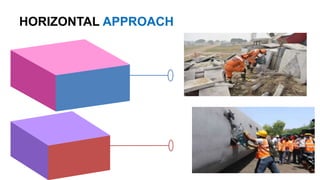
HORIZONTAL APPROACH
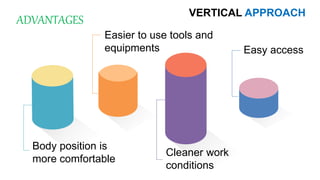
VERTICAL APPROACH
Easy access
Cleaner work
conditions
Body position is
more comfortable
Easier to use tools and
equipments
ADVANTAGES
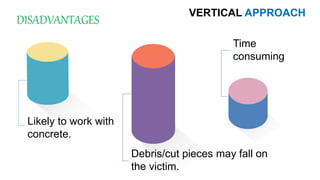
VERTICAL APPROACH
Time
consuming
Debris/cut pieces may fall on
the victim.
Likely to work with
concrete.
DISADVANTAGES
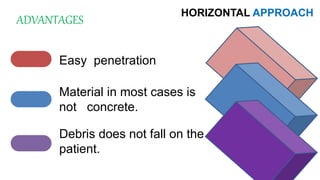
Easy penetration
Material in most cases is
not concrete.
Debris does not fall on the
patient.
HORIZONTAL APPROACH
ADVANTAGES
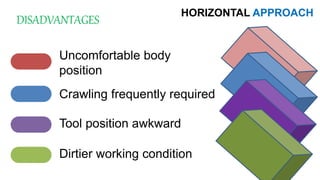
Uncomfortable body
position
Crawling frequently required
Tool position awkward
Dirtier working condition
HORIZONTAL APPROACH
DISADVANTAGES
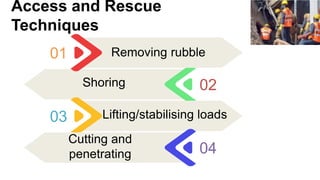
Access and Rescue
Techniques
02
03
04
01 Removing rubble
Shoring
Lifting/stabilising loads
Cutting and
penetrating
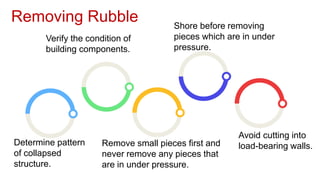
Avoid cutting into
load-bearing walls.
Shore before removing
pieces which are in under
pressure.
Removing Rubble
Remove small pieces first and
never remove any pieces that
are in under pressure.
Verify the condition of
building components.
Determine pattern
of collapsed
structure.
Insp Vijay kumar 11
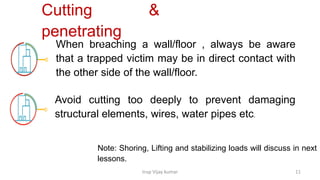
When breaching a wall/floor , always be aware
that a trapped victim may be in direct contact with
the other side of the wall/floor.
Avoid cutting too deeply to prevent damaging
structural elements, wires, water pipes etc.
Cutting &
penetrating
Note: Shoring, Lifting and stabilizing loads will discuss in next
lessons.
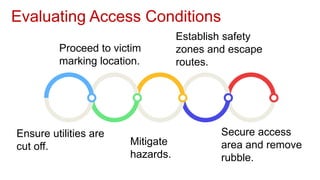
Secure access
area and remove
rubble.
Establish safety
zones and escape
routes.
Evaluating Access Conditions
Mitigate
hazards.
Proceed to victim
marking location.
Ensure utilities are
cut off.
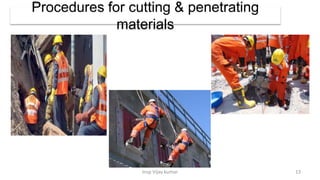
Procedures for cutting & penetrating
materials
Insp Vijay kumar 13
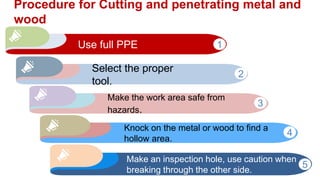
Procedure for Cutting and penetrating metal and
wood
Use full PPE
Select the proper
tool.
Make the work area safe from
hazards.
Knock on the metal or wood to find a
hollow area.
Make an inspection hole, use caution when
breaking through the other side.
5
4
3
2
1
Insp Vijay kumar 15
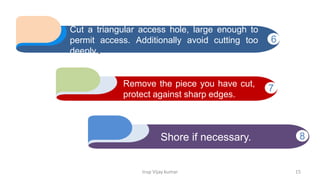
Cut a triangular access hole, large enough to
permit access. Additionally avoid cutting too
deeply..
Remove the piece you have cut,
protect against sharp edges.
Shore if necessary. 8
7
6
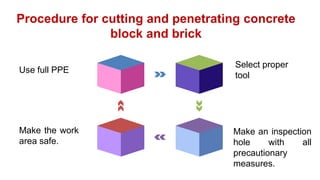
Procedure for cutting and penetrating concrete
block and brick
Select proper
tool
Make the work
area safe.
Make an inspection
hole with all
precautionary
measures.
Use full PPE
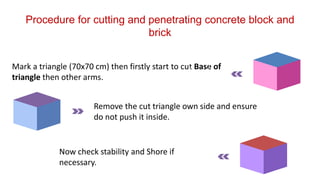
Procedure for cutting and penetrating concrete block and
brick
Now check stability and Shore if
necessary.
Remove the cut triangle own side and ensure
do not push it inside.
Mark a triangle (70x70 cm) then firstly start to cut Base of
triangle then other arms.
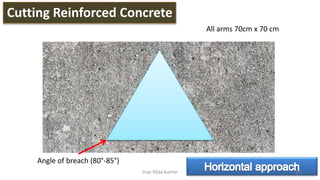
Angle of breach (80°-85°)
Cutting Reinforced Concrete
Insp Vijay kumar 18
All arms 70cm x 70 cm
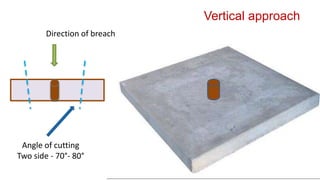
Direction of breach
Angle of cutting
Two side - 70°- 80°
Insp Vijay kumar 19
Vertical approach
Insp Vijay kumar 20
Cutting Reinforced Concrete
Cable reinforcements needs to be
identified early.
Cutting pretension cables can result in
the immediate failure of the slab or
structural componnts.
Tensioned cable should be cut only
under the direction of a structural
engineer.
1
2
3
Insp Vijay kumar 21
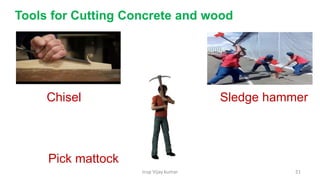
Tools for Cutting Concrete and wood
Sledge hammerChisel
Pick mattock
Insp Vijay kumar 22
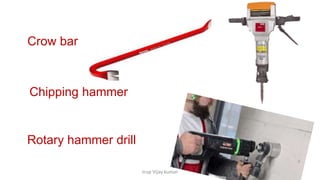
Crow bar
Chipping hammer
Rotary hammer drill
Insp Vijay kumar 23
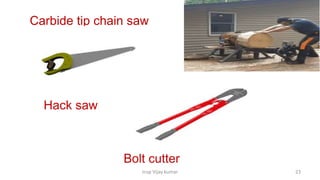
Hack saw
Bolt cutter
Carbide tip chain saw
Insp Vijay kumar 24
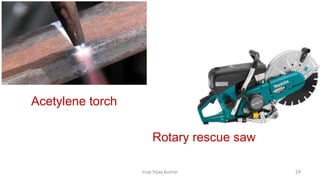
Acetylene torch
Rotary rescue saw
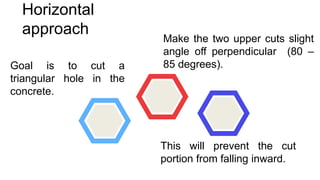
Horizontal
approach
Goal is to cut a
triangular hole in the
concrete.
Make the two upper cuts slight
angle off perpendicular (80 –
85 degrees).
This will prevent the cut
portion from falling inward.
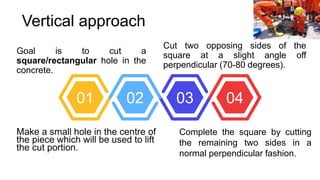
Vertical approach
01 03 0402
Goal is to cut a
square/rectangular hole in the
concrete.
Make a small hole in the centre of
the piece which will be used to lift
the cut portion.
Cut two opposing sides of the
square at a slight angle off
perpendicular (70-80 degrees).
Complete the square by cutting
the remaining two sides in a
normal perpendicular fashion.
Lift out the piece using the centre
hole.
Insp Vijay kumar 27
06
05
For reinforced concrete with steel bars or
stranded cable, loosen the concrete around
the bar and cut the individual bar.
Insp Vijay kumar 28
REVIEW
Insp Vijay kumar 29
ANY QUESTIONS ?
1. Tell any two disadvantages of horizontal approach ?
Insp Vijay kumar 30
EVALUATIO
N
2. Tell any two advantages of vertical approach ?
Insp Vijay kumar 31
THANK YOU

Rescue strategy and technique PPT

  • 1.
  • 2.
    04 List thesteps for removing rubble. 03 List the five factors to analyze when evaluating access condition. 02 List the four techniques for accessing and rescuing a victim. 01 Describe the two ways of approaching a located trapped victim. OBJECTIVE S Upon completion of this lesson you will be able to … 05 Describe the procedures for penetrating different materials.
  • 3.
  • 4.
  • 5.
    VERTICAL APPROACH Easy access Cleanerwork conditions Body position is more comfortable Easier to use tools and equipments ADVANTAGES
  • 6.
    VERTICAL APPROACH Time consuming Debris/cut piecesmay fall on the victim. Likely to work with concrete. DISADVANTAGES
  • 7.
    Easy penetration Material inmost cases is not concrete. Debris does not fall on the patient. HORIZONTAL APPROACH ADVANTAGES
  • 8.
    Uncomfortable body position Crawling frequentlyrequired Tool position awkward Dirtier working condition HORIZONTAL APPROACH DISADVANTAGES
  • 9.
    Access and Rescue Techniques 02 03 04 01Removing rubble Shoring Lifting/stabilising loads Cutting and penetrating
  • 10.
    Avoid cutting into load-bearingwalls. Shore before removing pieces which are in under pressure. Removing Rubble Remove small pieces first and never remove any pieces that are in under pressure. Verify the condition of building components. Determine pattern of collapsed structure.
  • 11.
    Insp Vijay kumar11 When breaching a wall/floor , always be aware that a trapped victim may be in direct contact with the other side of the wall/floor. Avoid cutting too deeply to prevent damaging structural elements, wires, water pipes etc. Cutting & penetrating Note: Shoring, Lifting and stabilizing loads will discuss in next lessons.
  • 12.
    Secure access area andremove rubble. Establish safety zones and escape routes. Evaluating Access Conditions Mitigate hazards. Proceed to victim marking location. Ensure utilities are cut off.
  • 13.
    Procedures for cutting& penetrating materials Insp Vijay kumar 13
  • 14.
    Procedure for Cuttingand penetrating metal and wood Use full PPE Select the proper tool. Make the work area safe from hazards. Knock on the metal or wood to find a hollow area. Make an inspection hole, use caution when breaking through the other side. 5 4 3 2 1
  • 15.
    Insp Vijay kumar15 Cut a triangular access hole, large enough to permit access. Additionally avoid cutting too deeply.. Remove the piece you have cut, protect against sharp edges. Shore if necessary. 8 7 6
  • 16.
    Procedure for cuttingand penetrating concrete block and brick Select proper tool Make the work area safe. Make an inspection hole with all precautionary measures. Use full PPE
  • 17.
    Procedure for cuttingand penetrating concrete block and brick Now check stability and Shore if necessary. Remove the cut triangle own side and ensure do not push it inside. Mark a triangle (70x70 cm) then firstly start to cut Base of triangle then other arms.
  • 18.
    Angle of breach(80°-85°) Cutting Reinforced Concrete Insp Vijay kumar 18 All arms 70cm x 70 cm
  • 19.
    Direction of breach Angleof cutting Two side - 70°- 80° Insp Vijay kumar 19 Vertical approach
  • 20.
    Insp Vijay kumar20 Cutting Reinforced Concrete Cable reinforcements needs to be identified early. Cutting pretension cables can result in the immediate failure of the slab or structural componnts. Tensioned cable should be cut only under the direction of a structural engineer. 1 2 3
  • 21.
    Insp Vijay kumar21 Tools for Cutting Concrete and wood Sledge hammerChisel Pick mattock
  • 22.
    Insp Vijay kumar22 Crow bar Chipping hammer Rotary hammer drill
  • 23.
    Insp Vijay kumar23 Hack saw Bolt cutter Carbide tip chain saw
  • 24.
    Insp Vijay kumar24 Acetylene torch Rotary rescue saw
  • 25.
    Horizontal approach Goal is tocut a triangular hole in the concrete. Make the two upper cuts slight angle off perpendicular (80 – 85 degrees). This will prevent the cut portion from falling inward.
  • 26.
    Vertical approach 01 030402 Goal is to cut a square/rectangular hole in the concrete. Make a small hole in the centre of the piece which will be used to lift the cut portion. Cut two opposing sides of the square at a slight angle off perpendicular (70-80 degrees). Complete the square by cutting the remaining two sides in a normal perpendicular fashion.
  • 27.
    Lift out thepiece using the centre hole. Insp Vijay kumar 27 06 05 For reinforced concrete with steel bars or stranded cable, loosen the concrete around the bar and cut the individual bar.
  • 28.
  • 29.
    Insp Vijay kumar29 ANY QUESTIONS ?
  • 30.
    1. Tell anytwo disadvantages of horizontal approach ? Insp Vijay kumar 30 EVALUATIO N 2. Tell any two advantages of vertical approach ?
  • 31.
    Insp Vijay kumar31 THANK YOU